



Abstract
After the 2007 financial crisis, most macroeconomists advocated policies to restore economic growth, disregarding the constraints imposed by nature. Because standard macroeconomic models ignore environmental constraints, we propose reviving Harrod’s dynamic model as a useful abstraction of the dialectic of an evolving macroeconomy. Harrod’s model describes how environmental constraints can push the economy into recession, and it explains why traditional macroeconomic policies are unable to put a resource-constrained economy back on a full employment growth path. By clarifying the dialectic conflicts between desired economic growth and natural growth, Harrod’s model also reveals what types of policies can achieve full employment in a resource-constrained economy.
1. Introduction
During the 2007–9 global economic recession, economists and policymakers debated how to restore pre-crisis growth rates. Many economists argued for active policies to expand aggregate demand and directly increase employment, while others favored austerity, deregulation, and the reduction of government debt. Such arguments disregard the scientific evidence on global warming, climate change, and other pressures on our ecosystem, which prevent any policy from fully “restoring” the energy-intensive economic growth we have experienced since World War II.
Economists’ failure to consider environmental constraints on growth was, in part, due to the use of macroeconomic models that ignored ecological barriers to growth. To correct for this deficiency, we extend Harrod’s (1939, 1948) dynamic macroeconomic model, whose logical framework can incorporate such barriers and permits us to examine macroeconomic policy prescriptions for an environmentally constrained economy.
2. The Ecological Consequences of Material Economic Growth
Earth’s ecosystem is under severe pressure from the growth of the human population and its economic and social activity. Humanity is causing rapid climate change, ocean acidification, mass species extinction, disappearing landcover, degradation of freshwater resources, disruption of the nitrogen and phosphorous cycles, and many other transformations of our ecosystem. Wackernagel et al. (2002) estimated that humanity’s exploitation of Earth’s resources corresponded to 70 percent of capacity in 1961 and 120 percent in 1999; by 2008, the World Wildlife Fund (2008: 2) estimated that “humanity’s demand on the planet’s living resources… now exceeds the planet’s regenerative capacity by about 30 percent.”
Efforts to compensate for the depletion of non-renewable resources and the stress on nature’s vital services often make things worse. The exploitation of new sources of petroleum, such as the development of the tar sands in Alberta, Canada, are environmentally damaging, and new drilling methods such as “fracking” use dangerous chemicals while, according to Howarth, Santoro, and Ingraffea (2011), releasing large amounts of methane into the atmosphere. The dirtiest of source of carbon energy, coal, continues to be exploited because, as detailed by Shindell (2015) and Diaz and Moore (2015), the market price of coal reflects only a small fraction of the total, true social cost of burning coal for fuel. Biodiversity has been substantially lost to monoculture motivated by the substitution of large equipment for labor, the heavy application of chemical fertilizers and insecticides in place of more labor-intensive diversified uses of the land, and industrial food processing that requires uniform products (see, for example, Friedman 2015, and Magdoff 2015). Capitalist agriculture is today the largest contributor to global warming and biodiversity loss (see, for example, Holt-Jimenez 2017, and the periodic reports by the Union of Concerned Scientists).
The growth of economic activity has also caused social conflict and war. Obvious examples are the wars over oil supplies in Kuwait, Iraq, and Libya, the continual foreign threats of war against oil producers like Iran, Venezuela, and Ecuador, and the foreign-financed civil wars in more than a dozen African countries for control of assorted natural resources. Large countries such as China, the United States, Russia, and others are engaged in an arms race to extend their control over the world’s scarce resources. Countries such as Iran, Pakistan, and North Korea have developed, or seek to develop, nuclear weapons to protect themselves and their resources.
In sum, humanity and its monopoly capitalist economies have accelerated technological change, as predicted by economists from Marx (1867) to Schumpeter (1934) to Solow (1956), but the resulting economic growth has created an “ecological bubble” in the sense that our growth of material output now requires unsustainable levels of exploitation of Earth’s resources.
3. Economists’ Failure to Deal with the Environment
Just as most economists did not anticipate the 2000 “dotcom” bubble or the global 2007–9 “great recession,” economists continue to ignore clear evidence of an ecological bubble. Only a few economists have looked at the interactions between the economy and the ecosystem. For example, in Volume III of Capital, Marx (1981) described the “irreparable rift in the interdependent process of social metabolism,” caused by the long-distance trade in raw materials that severs the natural regeneration of the ecosystem. More recently, Boulding (1966), Georgescu-Roegen (1971), Daly (1973, 1980, 2014), Schumacher (1973), Foster (1999), Victor (2008), and most recently, Foster, Clark, and York (2010) and Foster and Clark (2018), have continued to address environmental issues. But these were exceptions; even most post-Keynesian economists, who predicted the financial bubbles, supported measures to deal with the 2007 financial crisis that included corporate tax cuts to spur traditional investment and income tax cuts to increase material consumption.
Here we argue that Harrod’s (1939, 1948) well-known dynamic macroeconomic model, which he developed to clarify the dynamic conditions for maintaining a stable macroeconomic circular flow over time, can conveniently incorporate ecological constraints on economic growth. 1
4. Harrod’s Growth Model
Harrod noted that investment is not only the volatile component of aggregate demand that Keynes focused on, but it also adds to the economy’s productive capacity. Hence, to maintain economic stability, investment and the other sources of aggregate demand must grow just fast enough to exactly absorb the increased output that the investment makes possible.
Harrod (1939) specified a simple model of the economy’s productive capacity, in which he assumed a constant capital/output ratio, or K/YS = γ, where K is the stock of capital and YS is aggregate supply, no depreciation, so that I = ΔK, a constant savings rate, σ, and equality between savings and investment: 2

Since YS = (1/γ)K, the change in output must be ΔYS = (1/γ)ΔK = (σ/γ)YS, and the growth of the supply of output can be stated as:

Thus, a rise in the rate of saving/investment increases the rate of growth of potential output, as would a decline in the capital/output ratio. But actual aggregate supply also depends on aggregate demand.
Keynes (1936) viewed investment as a complex function driven by expectations of the inherently uncertain future, and actual investment depended in part on whether investors’ earlier expectations were validated. Harrod, therefore, assumes that investment demand is a function of growth in demand for output:

and aggregate demand, YD = C + I, is:

Suppose that initially YD = YS, so the economy is on what Harrod (1939: 23) terms its warranted growth path, GW, which “is determined jointly by the propensity to save and the quantity of capital required by technological and other considerations per unit increment of total output.” For the economy to remain on GW, desired investment and actual savings must remain equal, or bΔYD = σYS, which implies that the growth of demand must be equal to:

Combining equations (2) and (5), for demand growth to always equal supply growth, b must always equal γ.
The problem for short-run macroeconomic stability is not only that parameter b is dependent on the volatile state of investor confidence and γ varies with the composition of the capital stock, but the warranted growth path is an unstable dynamic equilibrium, a “knife’s edge.” For example, if γ > 1 and producers increase output more than warranted, then aggregate demand increases by more than output, which then calls for even higher investment, and an accelerating economic boom takes actual growth farther away from GW. A slight decrease in output causes the economy to spiral into a depression. Figure 1 illustrates such divergences of actual growth, GA, from GW. By adding a dynamic source of instability, Harrod thus enhances Keynes’ (1936) conclusion that active macroeconomic policy is necessary to deal with the inevitable short-run ups and downs of an economy.
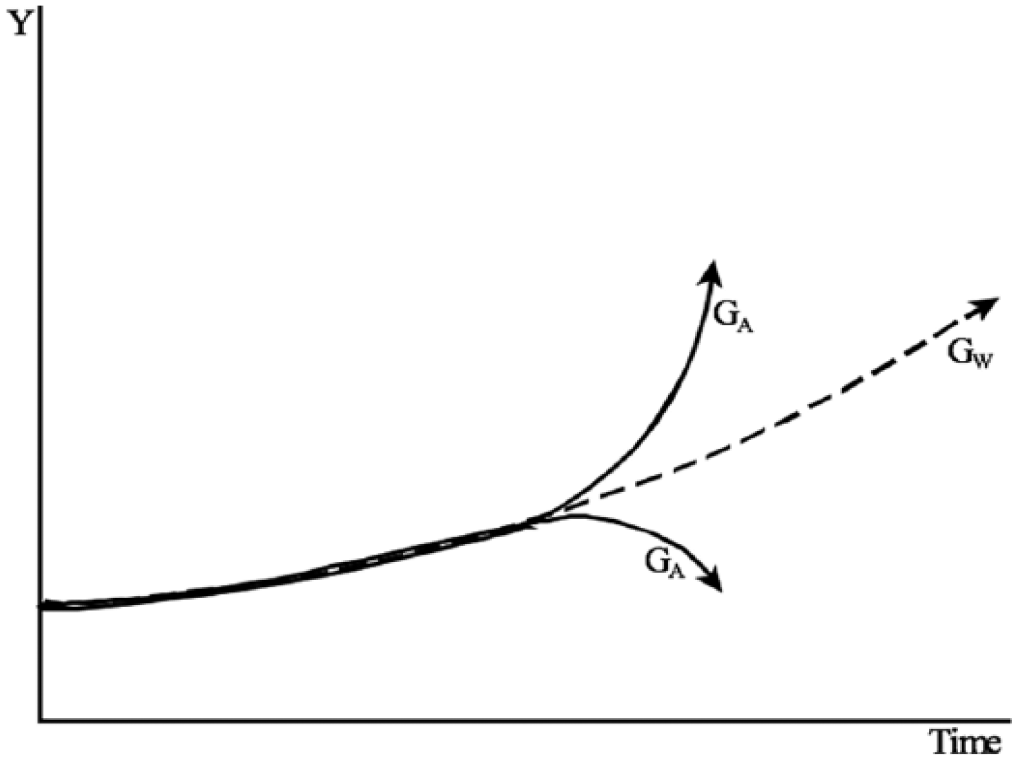
Warranted growth and the knife’s edge.
5. The Harrod Model’s Fundamental Dynamics
Harrod (1939, 1948) goes beyond the “knife’s edge” dynamic interaction between warranted growth and actual growth, and he introduces a longer-run constraint on growth into his analysis in the form of a natural growth path. Harrod (1939: 273) describes the latter as the “maximum rate of growth allowed by the increase in population, accumulation of capital, technological improvement, and the work/leisure preference schedule, supposing that there is full employment in some sense.” Today, given the scientific evidence described earlier, the natural growth path must reflect environmental limits to economic growth in addition to the factors mentioned by Harrod. Thus, we can use Harrod’s framework to analyze the dynamics of a macroeconomy in terms of dialectical conflicts, reactions, and interactions among three different dynamic growth paths: actual growth of output, GA, warranted growth, GW, and natural growth, GN, where the latter reflects environmental constraints on long-run economic growth.
Figure 2 depicts an economy in which GA and GW coincide but lie below the natural growth path. Warranted growth can be sustained, but low savings keep the economy in a “moving” Keynesian unemployment equilibrium. An unexpected excess supply in the economy would push the economy into a downward spiral in output that raises unemployment even farther away from full employment. Alternatively, an unexpected increase in aggregate demand will push GA upward from GW on a path that will sooner or later bump into GN. Full employment is likely to come at the cost of accelerating inflation as aggregate demand continually exceeds the economy’s productive capacity. In this case, macroeconomic policies to slow economic growth also serve to keep the economy within its limits to growth.
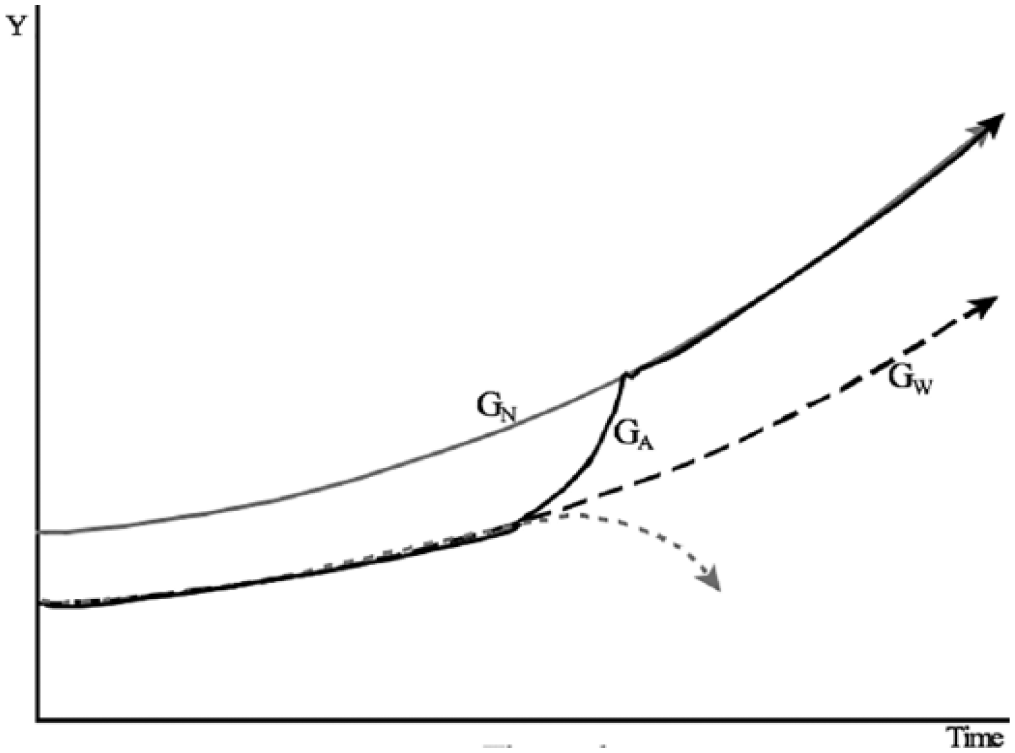
A boom results in an inflationary spiral.
Figure 3 illustrates the case where the warranted growth path crosses the natural growth path, causing a shift in the policy environment. Policymakers were at first able to use traditional stimulative macroeconomic policies to push the economy closer to full employment along GW, but after the paths cross actual growth is restricted to the recessionary side of the “knife’s edge.” In Harrod’s (1948: 88) words, “if GW exceeds GN, then GA must lie below GW for most of the time, since the average value of GA over a period cannot exceed GN, Therefore we must expect the economy to be prevailingly depressed.” Policymakers will now have to deal with “chronic unemployment.” In sum, Harrod’s model suggests a type of dialectic process that determines long-run growth possibilities as well as short-run cyclical tendencies.
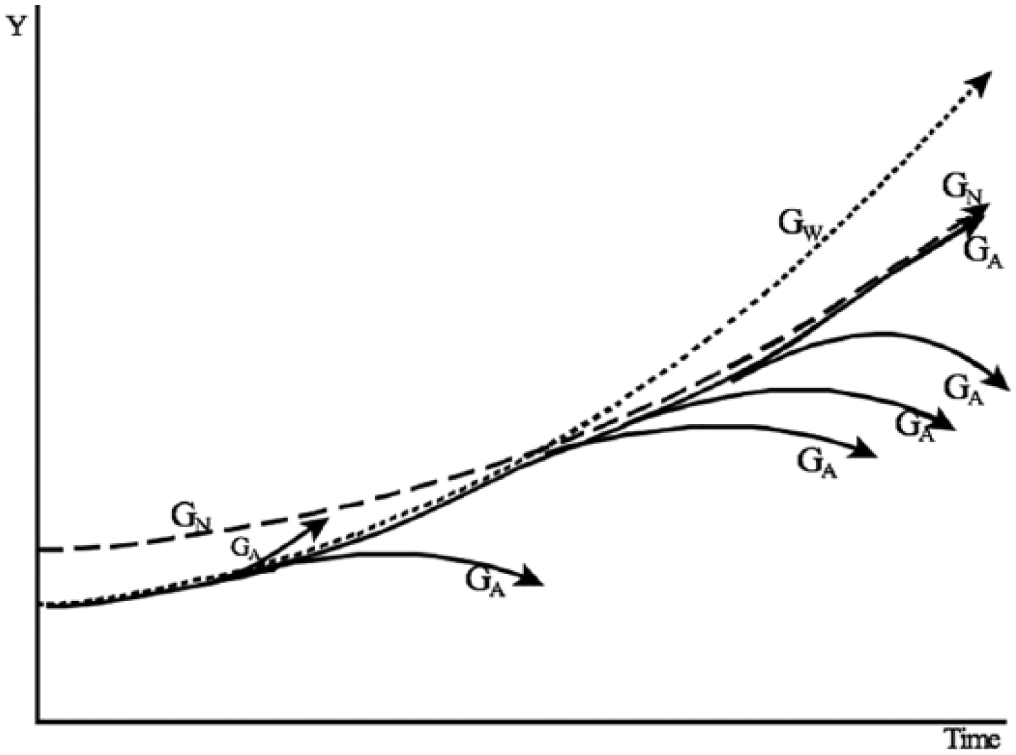
A shift in the policy environment: from policy space to policy confusion.
6. Dealing with the Macroeconomic Effects of Environmental Constraints
Harrod’s dynamic model is Keynesian in that active macroeconomic policy is called for in all the cases illustrated. In Figure 1, active monetary and fiscal policies are needed to counter cyclical deviations from the warranted growth path. In Figure 2, a downward spiral must be reversed, and a booming economy’s growth cannot be allowed to reach GN and spiral into accelerating inflation. The third case is useful for explaining our current resource-constrained economy. One possible policy response to the potential conflict with the natural growth path would be to force adjustments in the parameters that define warranted growth so that GW again dips below GN, and constant growth and nearly full employment could be more easily maintained.
Many ecologists and environmental activists, for example, Klein (2014), Lohmann (2006), and Rising Tide North America (2009), have argued that we cannot avoid ecological disaster without slowing the growth of material output. Another school of thought advocates abandoning the quest for growth altogether, seeking instead what they call decroissance (degrowth). For example, Harribey, Quiron, and Rotillon (2012) and Bayon, Flipo, and Schneider (2010) propose ending all use of fossil fuels and nuclear energy, using productivity increases to reduce work hours rather than increasing output, equalizing the distribution of income, and redirecting economic activity from the market economy to the public commons. Of course, those who are vested in our current social/economic system will use their wealth to prevent such policies, which is why proponents of decroissance also advocate a more participatory political system that wealthy vested interests cannot dominate.
In order to maintain full employment under slow or zero growth, some production could grow provided the most resource-using sectors are diminished sufficiently to reduce overall resource and energy throughput. GRAIN (2014) suggests reorganizing agriculture: given the massive job destruction by modern energy-, chemical-, and capital-intensive agriculture, reversing this ecologically damaging development could restore a large amount of recently lost employment while maintaining output. In healthcare, more labor-intensive, low-throughput activities could improve health outcomes and, therefore, the real value of production. Education is inherently a labor-intensive process because, as Polanyi (1958) argues, much learning is tacit in nature. And, there is a continual need for education; economists from Smith (1776) to Marx (1867) and educators like Dewey (1897) and Freire (1970) have convincingly argued that ongoing educational activities for people of all ages are, in fact, necessary for maintaining just social and economic environments. Other low-throughput activities include entertainment, art, maintenance and repair services, sports activities, and the care sector. Finally, since many goods and services are non-rival and can, or must, be consumed by many people simultaneously, we get more value out of pubic goods than individual goods.
Employment and economic participation could be increased under decroissance by reducing work hours. Schor (2013), Coote, Franklin, and Simms (2010), and Coote and Franklin (2013) argue that quality of life is inversely related to working hours because leisure is highly valued. It takes time to consume the material goods and services we produce, and community and cultural activities often are especially time-consuming. Hence, the latter are relatively underconsumed in countries like the United States and Britain, where long work hours effectively force people to resort to individualized material consumption over more desirable time-intensive social activities.
Evidence also suggests that human well-being is not as closely tied to material consumption as advertising leads us to believe. Surveys of people’s life satisfaction by Veenhoven (1988), Easterlin (1995), Frey and Stutzer (2000), and others suggest that in the long run average human happiness does not change significantly as average per capita consumption grows. Even in low-income countries, overall happiness rises with average per capita income only until it reaches about $10,000. Blanchflower and Oswald (2000) and Dolan, Peasgood, and White (2008) present evidence that people most highly value marriage, status, respect of others, and participating economically in their societies, provided basic needs are met. People are social animals who often value social status well above absolute levels of material consumption. In short, a slowdown in economic growth may not be detrimental to well-being at all.
7. Conclusions
The Harrod model suggests that, in an ecologically constrained economy, unemployment cannot be addressed by simply stimulating material economic growth using traditional macroeconomic policies to increase aggregate demand and material production. Ecological constraints will neutralize such stimuli by keeping the economy “prevailingly depressed.” Rather, Harrod’s model is a useful abstraction of a dialectic process in which simultaneous policy goals require complex mixtures of policies to shift all three growth paths. Furthermore, the required policies differ in the context of ever-evolving economic, social, and natural conditions. For example, where standard Keynesian demand policies worked well in the 1930s, today such policies are more likely to generate stagflation, chronic unemployment, and perhaps even destructive welfare-reducing ecological disasters. Therefore, we now need new policies that bring about a social reorganization to reduce the likelihood of conflicts between actual, warranted, and natural growth.
Including a social restructuring toward more collective consumption, less material wealth, and greater social interactions among the available and useful set of macroeconomic policies may appear too “radical,” but note that such a restructuring is no more radical than the social restructuring brought about by the growth of global monopoly capitalism, which within little more than a century completely transformed how humans live and work. Most macroeconomic policies are now designed to sustain this capitalist transformation. It is obvious that a new economic and social restructuring clashes with the interests of the capitalist class and its anxiety about sustaining profits. However, this political reality does not justify macroeconomists’ silence on environmental constraints on growth. Conventional macroeconomic policy is expanding the already dangerous ecological bubble. It is in this light that we suggest Harrod’s dynamic framework as a realistic abstraction of the dialectic macroeconomic process and the growing contradictions between material economic growth and our natural environment. Specifically, this modern application of Harrod’s model shows that macroeconomists must take a more environmentally conscious policy approach if they are to meet traditional macroeconomic goals in an environmentally constrained economy.
Footnotes
Declaration of Conflicting Interests
The author(s) declared no potential conflicts of interest with respect to the research, authorship, and/or publication of this article.
Funding
The author(s) received no financial support for the research, authorship, and/or publication of this article.
1
2
Harrod (1939) admits that an expansion of activity might increase the proportion of income saved, but he shows that for feasible savings rates and realistic capital–output ratios, the shift in saving necessary to alter the growth rate of the economy even a little would be essentially impossible in the medium term.  uses a neoclassical production function in place of Harrod’s fixed γ to allow for factor substitution, and he concludes that realistic short- and medium-term adjustments to factor proportions cannot substantially alter the economy’s capital–output ratio.