




Abstract
Since the beginning of the 21st century, the expression ‘Nepalese diaspora’ has increasingly been used by the Nepalese government, expatriates, reporters and intellectuals. The Nepalese diaspora, or those who speak on behalf of it, occupies a growing amount of Nepalese public space, especially on the Internet. Taking into account the performativity of the term ‘diaspora’, the author tries to understand how Nepalese diasporic websites are the sign and conditions of an ‘incipient diaspora’. Analysis of authoritative websites and links between different websites helps understand the structure of the Nepalese diaspora and the issues at stake. The Internet is hardly egalitarian and reflects the tensions in Nepalese society. However, links between websites are real. Non-Resident Nepalis’ Association websites are central to the associative Web, and cultural association websites are in the majority. The ‘etic’ study of ‘emic’ discourses of self-presentation by the diaspora shows that, through their public and performative dimensions, Nepalese diasporic websites are at the very heart of the process of constructing the Nepalese diaspora.
Since the beginning of the new millennium, the term ‘Nepalese diaspora’ has been used more and more by the Nepalese government, reporters and intellectuals. Created in 2003 along the lines of the Non-Resident Indian Association, the Non-Resident Nepali Association (NRNA) has been trying to federate Nepalese people residing abroad and to play an economic and political role in the country’s destiny. 1 Diasporic claims go hand in hand with the surge in international labor migration that emerged from the end of the 1990s onwards. 2 Prior to then, the Nepalese diaspora did not exist because no-one talked about it as such, with the exception of Hutt (1997) and Pradhan (1991). 3 Today, determining the extent of the Nepalese diaspora or the number of Nepalese expatriates is still a difficult undertaking (Sharma & Sharma, 2011). Outside of Nepal, between three and six million people could claim to be of Nepalese descent to one degree or another, whilst the actual Nepalese population amounts to 28 million.
In a scientific context where the term ‘diaspora’ is used in diverse ways (Brubaker, 2005) and where the term has been taken up by scattered groups as part of a strategy aimed at self-designation and at claiming their rights (Ma Mung, 2006), it is not surprising that the Nepalese have also appropriated it. The NRNA aspires to become a showcase for Nepalese expatriates, to ensure them an existence and power. As their spokesman, it uses the term ‘diaspora’ in an uncompromising way. However, the etic discourse might qualify it as an ‘incipient diaspora’ or a diaspora ‘in the making’ (Sheffer, 2003).
Diasporic websites have developed at the same time as public awareness of this dispersion emerged. Run by expatriate community members, these sites help ‘the diasporic process, that is [they support] the members’ consciousness or the awareness about a common identity, declare it to the world, found it and organize the community self-assigned roles’ (Scopsi, 2009: 92). The word ‘diaspora’ is commonly used, but few questions seem to be asked about it. From Ma Mung’s perspective (2000), according to whom a diaspora is characterized by multipolarity, interpolarity and the consciousness of dispersion, the reason for this approach by observing the diaspora through its websites is to study the links that connect all the websites. The e-Diasporas project, thanks to its tools of analysis, helps us to understand the role of an e-diaspora in the creation of a social group one of whose problems is building a community despite, or rather by making use of, its dispersal (Ma Mung, 2006). 4 As the links between websites mirror the links between people—‘there is no binary opposition between real life and virtual life’ (Gajjala, 2006)—websites are both a way of creating a diaspora, and an expression and a means of self-assertion and of teaming up. The question of the performativity of the term ‘diaspora’ must be addressed with regard to relations and power within the group itself. The validity of the assertion made by Winkin (2006: 141), according to whom ‘to control new information technologies is to ensure a new right to be seen and heard, which disrupts traditional power relations’, will also be questioned since access to the Web and to airing one’s opinion on the Web is still uneven.
What follows is a preliminary study of the Nepalese diasporic Web in an attempt to understand how it is organized, the stakes involved and any tensions present. I have set out to answer the following questions: How do websites help to ‘form a society’ in a dispersion situation? What does the structure of the Nepalese diasporic Web reveal? What are its main strengths and its points of convergence? In short, how are diasporic websites both an expression and a condition of the Nepalese diaspora?
Having analyzed the structure of the Nepalese diasporic websites and website categories, I show how the links between sites allow us to talk of an e-diaspora. In a more exploratory section, I tackle the question of how the diaspora is formed and how it unites expatriates via its websites.
1 The structure of the web of Nepalese people from outside
The mobility of people outside Nepal is nothing new. Outmigration of Gurkha mercenaries and of workers to British India was encouraged during colonial times. Patterns of migration to India, whether temporary or permanent, have been superseded since the end of the 1990s by massive migration to the Gulf countries, Malaysia and, to a lesser extent, to Western countries. The Nepalese diasporic Web, which is dense and dominated by voluntary organizations, partly reflects this geographic dispersion.
1.1 A dense yet barely clustered graph
The Nepalese diasporic website graph (see
As far as the making of a diaspora is concerned, the fact that nodes, that is sites, are close to each other and form a dense mass, is already a first finding. It expresses the strength of the links between local and global communities.
1.2 Voluntary organization websites lead the way
To analyze the diasporic Web, relevant categories of analysis have to be created which are both heuristically productive and which correspond to existing forms. Five categories emerged when compiling the corpus (see Table 1).
Nepali diaspora website categories (http://maps.e-diasporas.fr/resources/templates/actions/viewsvg.php)
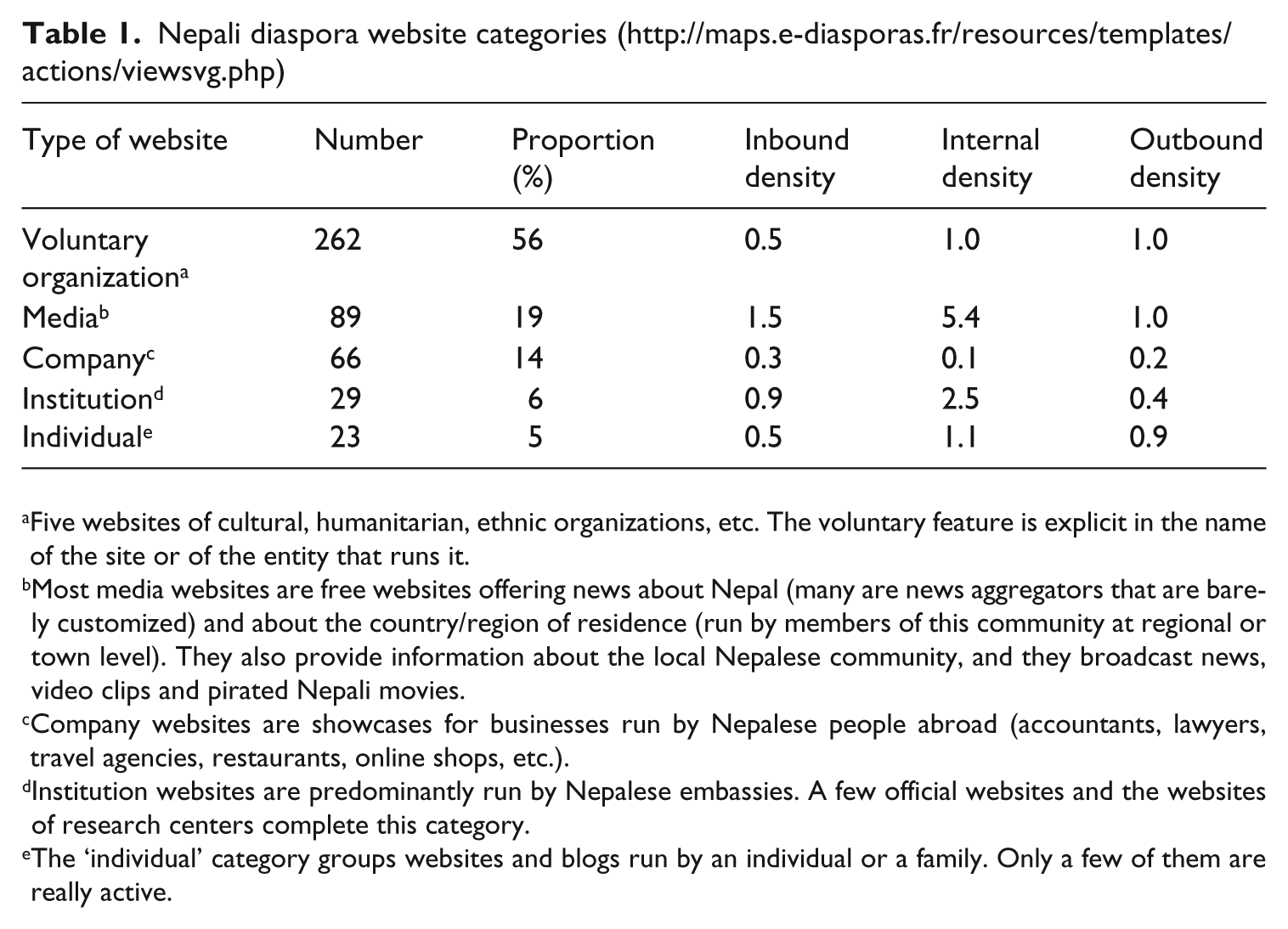
Five websites of cultural, humanitarian, ethnic organizations, etc. The voluntary feature is explicit in the name of the site or of the entity that runs it.
Most media websites are free websites offering news about Nepal (many are news aggregators that are barely customized) and about the country/region of residence (run by members of this community at regional or town level). They also provide information about the local Nepalese community, and they broadcast news, video clips and pirated Nepali movies.
Company websites are showcases for businesses run by Nepalese people abroad (accountants, lawyers, travel agencies, restaurants, online shops, etc.).
Institution websites are predominantly run by Nepalese embassies. A few official websites and the websites of research centers complete this category.
The ‘individual’ category groups websites and blogs run by an individual or a family. Only a few of them are really active.
The ‘voluntary organization’ category largely dominates the corpus, comprising 56% of all diasporic websites. The ‘type of website’ subgraph (see
The distribution of the ‘media’ category is less uniform than the ‘voluntary organization’ category and has a high internal density, which is a sign of a high number of links between sites. Eighty percent of the latter are portals that provide news about Nepal and Nepalese people in the world (‘Keeping the diaspora connected always’ is, for example, the motto of Nepalhorizons.com ) and, to a lesser extent, about the place from where they post information. Besides these news sites, those geared to entertainment (radio, movies, songs) provide the Internet user with a direct link to the Nepalese folk culture. In some of Qatar’s migrant worker labor camps (the term used in the Gulf to refer to dwelling-places for migrants) which have an Internet connection, canadanepal.net is one of the most popular websites because it enables migrants to view the latest Nepalese movies on streaming websites (Bruslé, 2012). The ‘media’ category is definitely oriented towards the homeland. Since the ‘organization’ category is the biggest, and news about Nepal remains a focus for Nepalese expatriates, these two categories have the most links.
The ‘company’ category is clearly situated on the graph’s periphery. Although 50% are located in the United States, their authority remains marginal. The 66 company websites have a stronger link to media websites than to the rest of the corpus through advertising, but their ‘ethnic business’ activity remains marginal.
The ‘institution’ category is made up mainly of Nepalese Embassy websites, which do not occupy a central position in the organization of the diaspora, apart from the Nepalese Embassy website in Great Britain. The Ministry of Foreign Affairs website is an important authoritative site because it is often cited, in particular by the diplomatic network.
The last category, ‘individual’, represents 5% of all websites and is made up of a majority of blogs, a great many of which are not active. Strangely enough, rajan.com , a family-run website, dominates this category even though it has not been active since 2009. Is it because it was one of the first personal websites to be run by a Nepalese expatriate living in the United States? The fact remains that individual websites occupy very little space on the Web and are barely acknowledged: they are seldom cited, as if only collective commitment were legitimate. However, individual expressions take place in forums ( Sajha.com ) and on the media websites (like nepalitimes.com ).
This rapid survey of Nepalese diasporic websites shows domination by private collective actors. Non-government associations are a key element in organizing the diaspora, since the Nepalese state is absent, contrary to that of India, the Philippines or Croatia, which have official authorities to monitor the diaspora. Non-Resident Nepalese (NRN) status was defined by the Nepalese government in 2007 and led to the creation of NRN and PNO (Person of Nepalese Origin) cards, which facilitate the coming and going of people and investments by people of Nepalese origin who have taken up foreign citizenship and have therefore forsaken their Nepalese citizenship. Although the government supports NRNA’s economic initiatives, it has so far rejected any demands for dual citizenship. The Nepalese national identity remains exclusive.
2 Chosen interconnections
Just as ‘transnational diasporic life requires nodes in its networks, nodes marked by a relative sedentariness’ (Tölölyan, 2007: 654), the diasporic Web also needs a certain degree of fixity to guarantee its future. As Tölölyan reminds us, for a transnational network to exist, communities belonging to it need geographical stability: this is also a condition for the existence of websites and a sign of their becoming an integral part of the public sphere.
2.1 The Nepalese diasporic web in the global geographical space
The graph of the geography of diasporic websites (
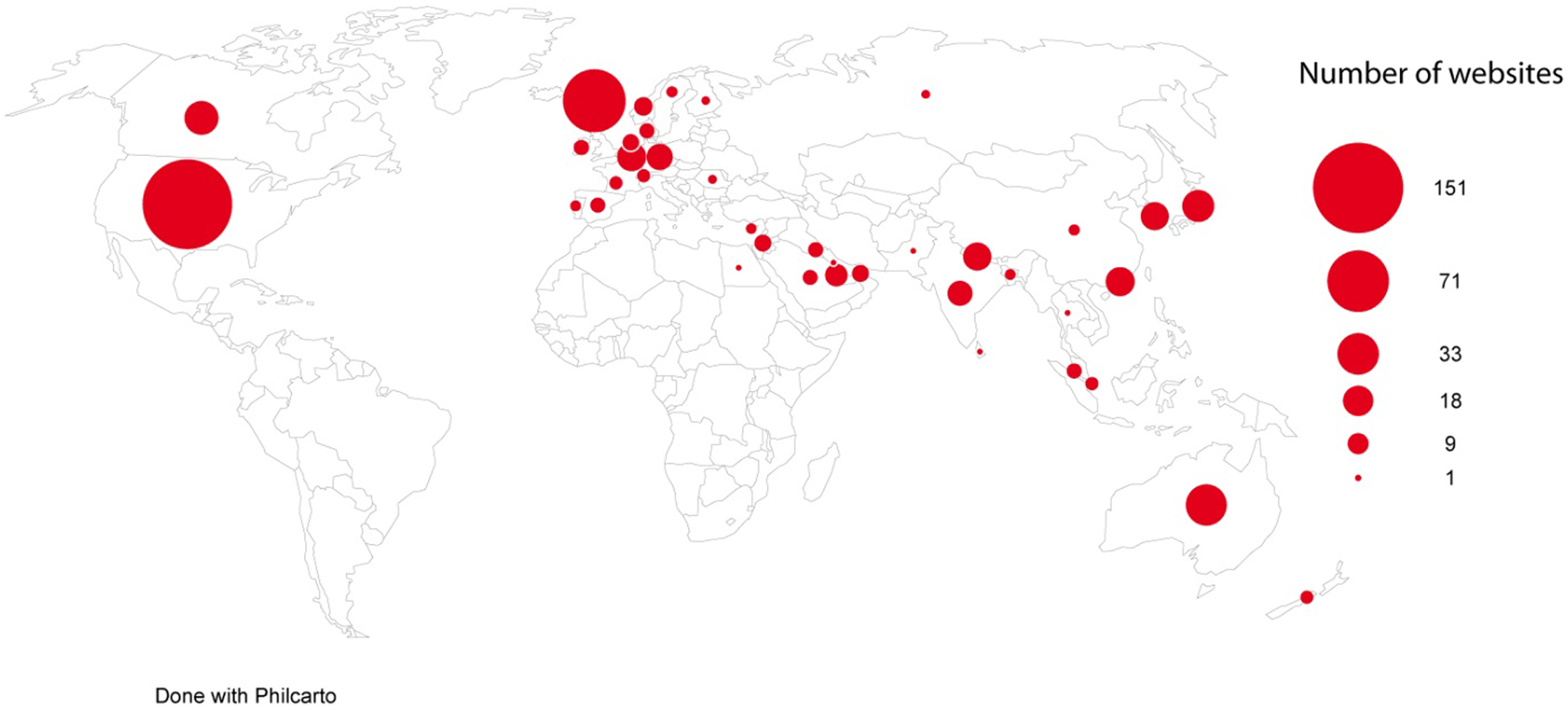
Country-related distribution of Nepalese diasporic websites.
Distribution of Nepali diaspora websites according to country of residence and densities for countries with more than nine websites
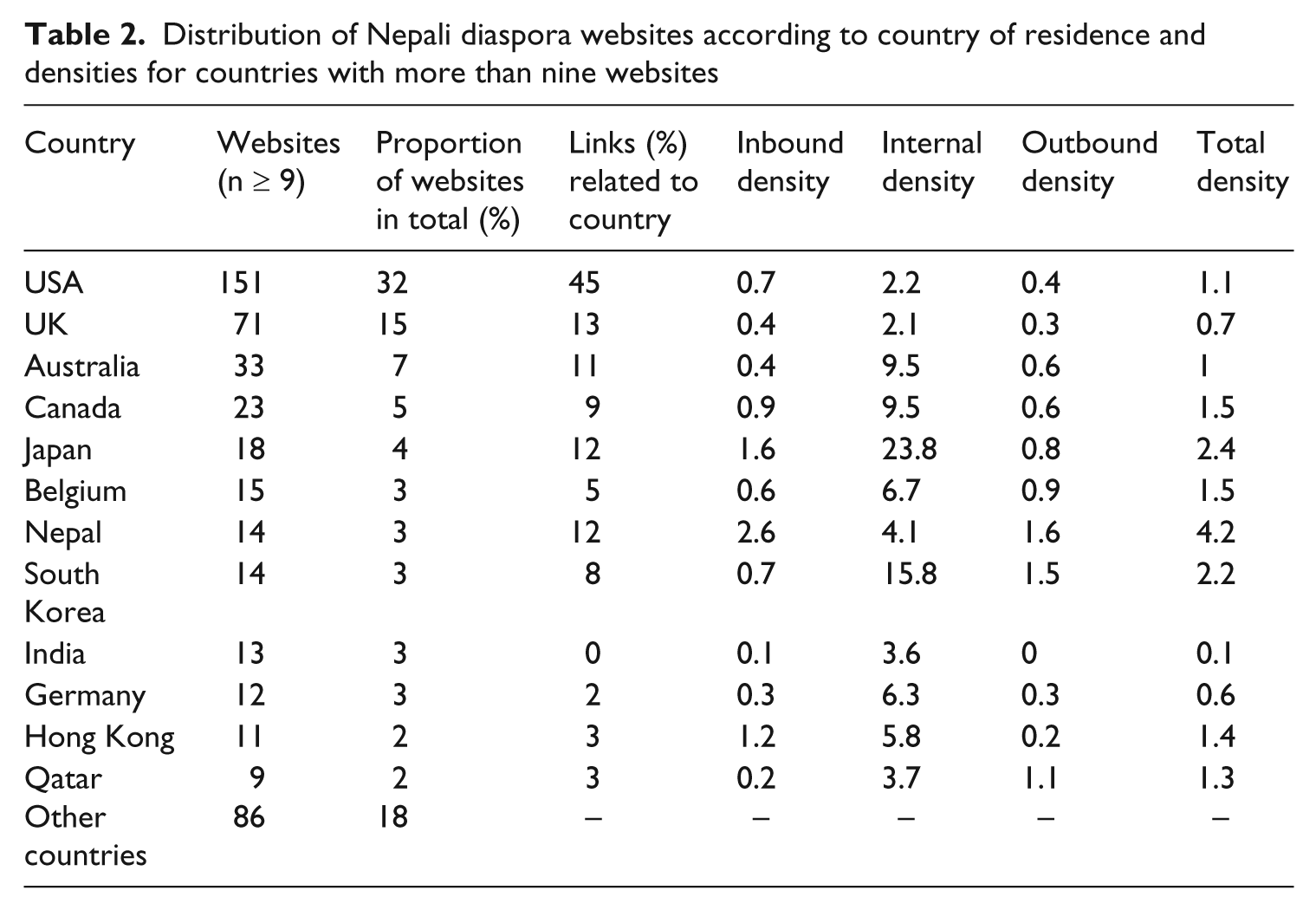
The dominance of websites based in the United States is striking. They make up a third of all sites, whereas the United Kingdom represents only one-sixth. Four countries (USA, UK, Australia and Canada) host 59% of all websites. The websites are concentrated over a few countries, and inconsistencies in their representation seem to reflect a standard situation, which needs to be investigated and explained. Whereas the majority of Nepalese expatriates live in India (4 to 6 million), in Gulf countries (about 2 million) and in Malaysia (0.3 million), websites located in the Western world and in developed Asian countries dominate the corpus in a disproportionate manner.
As far as USA-based websites are concerned, it is worthwhile noting that their centrality on the main graph is not corroborated by inbound densities 9 that are higher than other sites. How are we to explain this? It is due to two statistical factors. First, the ‘American website’ corpus is much more ‘extraverted’ than other corpora, with a low internal density, as in the case of the UK. Second, as it is a sizeable corpus, the number of authoritative websites is also high, which means that they receive a large number of links (see below).
American and British corpora have the lowest internal densities. As each of these countries has a high number of websites, it is no surprise to note that not all these sites are connected to each other. In the USA, groupings are based more on the type of website than on any other criteria: voluntary organization websites are better interconnected than media websites.
In other countries, internal densities are high, revealing that the notion of local community, bounded by its geographical position, is still of considerable importance. Japanese, Australian or Canadian corpora are made up of websites that are all interconnected, save for one or two exceptions, and they are fully connected to the rest of the global corpus. Due to the relatively small size of their communities, the strength of their bonds of friendship is expressed over the Web.
The problem of the lack of representation of the largest communities needs to be addressed. Why are there so few websites run by Nepalese of Indian origin? Why are they not connected to the rest of the corpus? First of all, because Indians of Nepalese origin, who have been living in India for more than one-and-a-half centuries, strive to acquire an Indian identity (Sinha & Subba, 2003). Therefore, they have no sense of belonging to the Nepalese diaspora, or else this is seldom expressed. This explains the absence of any links with the rest of the corpus. And lastly, the many activities of their numerous, often pan-Indian, organizations are not mirrored on the Internet due to insufficient financial capital to ensure their presence.
This situation is comparable to that of Nepalese expatriates working in the Gulf and in Malaysia. 10 Although they amount to at least 2 million, that is, more than 80% of Nepalese migrants working outside Nepal, they represent only 4% of all websites. In Qatar, for example, the Nepalese population is made up mostly of unskilled workers, and despite the existence of more than a hundred voluntary organizations, their participation in the diasporic Web is very poor (of nine websites, only two belong to voluntary organizations). The fact that all these associations are illegal may be a reason for their lack of visibility on the Internet. And finally, migrants in the Gulf can never obtain the citizenship of host countries: they are transnational migrants who see migration as a temporary experience.
When examining the corpus more closely, one realizes that, thanks to the NRNA website and to a lesser extent to that of the Ministry of Foreign Affairs, Nepal plays a central role as far as its diaspora is concerned, which is shown by the high internal and external densities.
The geographical aspects are not canceled out by the Web but instead enable us to explain the multipolar structure of the corpus, in which interpolarity is obvious. The diasporic Web portrays a postcolonial geography where migrants’ movements are disconnected from any historical allegiance. Though the American corpus, because of its weight, is situated at the center of the corpus and surrounded by other communities, the periphery is represented by Indian Nepalese and those residing in the Gulf and in Malaysia. The geographical location of Nepalese expatriates is decisive for understanding power relations in the diasporic Web, which reflect only a differential takeover of speech and power. Some assert themselves in the public space, others remain in the background.
2.2 Authoritative websites and hubs: ‘representational’ models
A study of authoritative websites and of hubs reveals that most Nepalese diasporic websites are ‘representational’ (Parham, 2005), in that they are similar to magazines where a country and/or its culture is put on display for its own community or for those outside (see Tables 1–5). It is a top–down model for disseminating information, and is by no means participatory or open. Information circulates in a unilateral way. Internet users are seldom encouraged to participate, except on a few websites where the forum is the main activity. 11
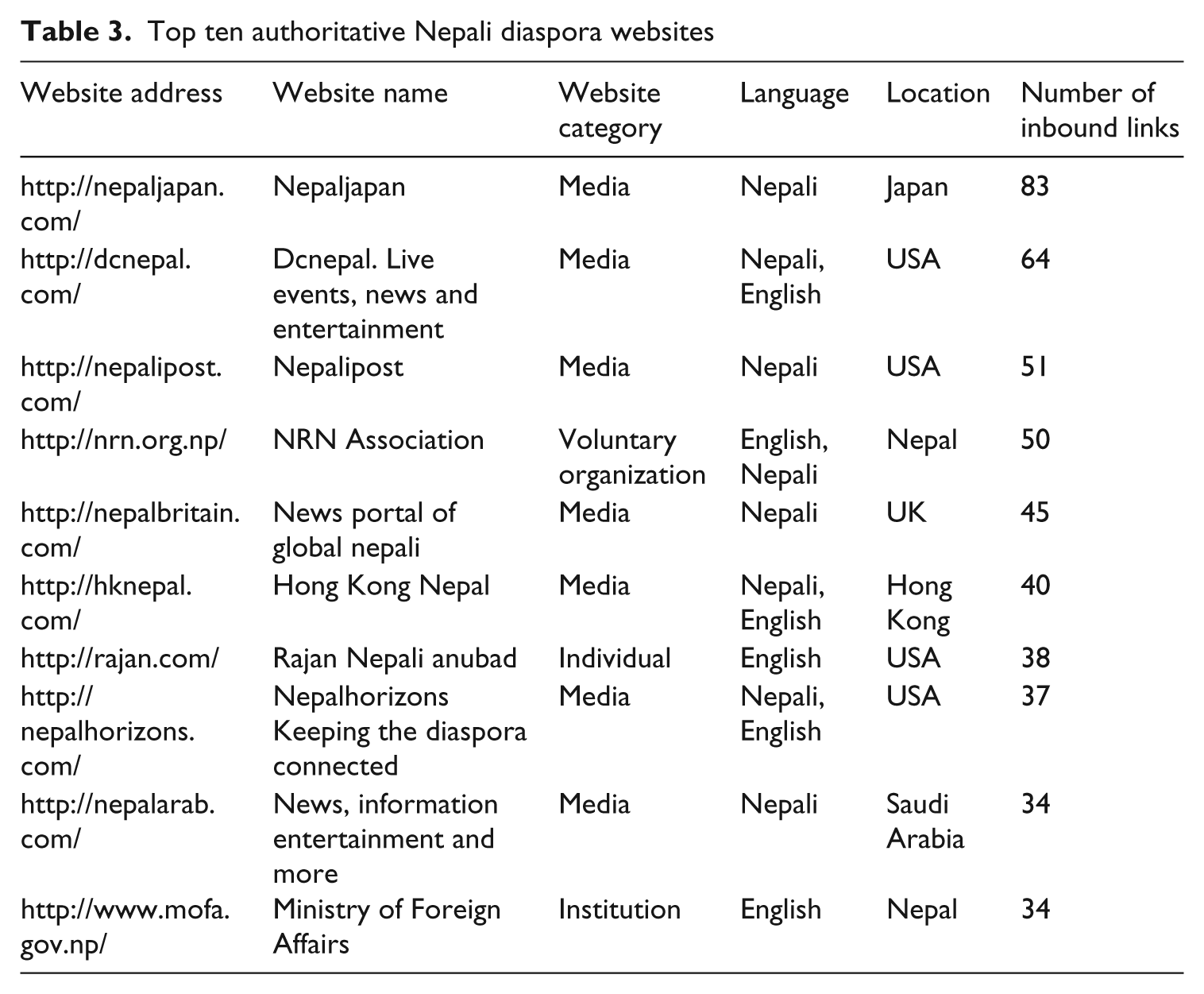
Top ten authoritative Nepali diaspora websites
Types of Nepali diaspora voluntary organization
Languages used on Nepali diaspora websites
The ‘English/Nepali’ category means that English is used more than Nepali.
Authoritative websites are those most cited in the whole corpus (see Table 3). There is a particularly high number of inbound links, which demonstrate how well-known a website is on the Web. Using mostly Nepali as the language of communication, five of the ten most-cited websites belong to the ‘media’ category. They provide information in the main and, to a lesser extent, offer entertainment. The NRNA occupies a major position, even the very first, if we take into account all corpus links (inbound and outbound). Its motto, ‘For Nepali by Nepali’, is perfectly illustrated by the way it encourages expatriates to close ranks, and by its centrality. However, its use of English as the main language raises the question of excluding a large part of the population with no access to this language. This discriminatory policy in promoting the organization’s existence shows the limits to inclusion according to the thinkers behind the Nepalese diaspora (see Section 3.3).
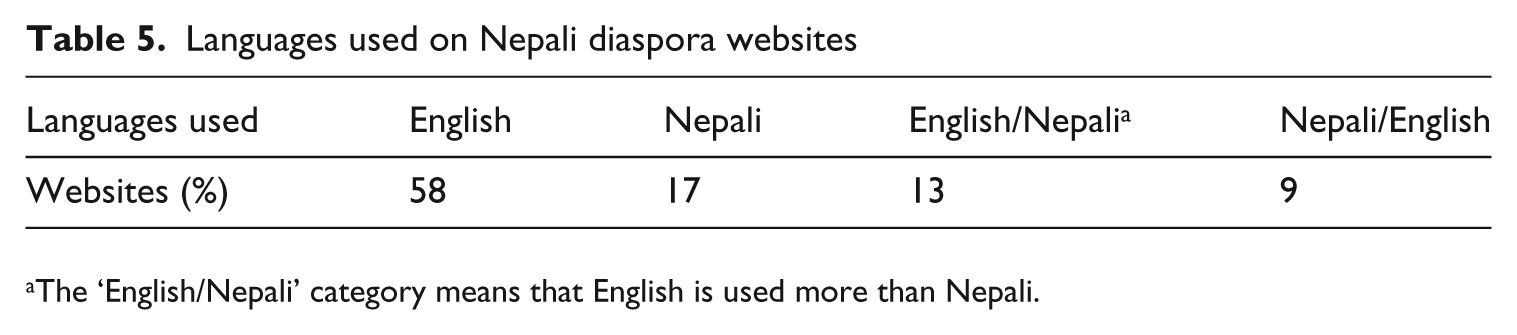
Do these authoritative websites serve the Nepalese diaspora? In a certain way, they do show the permanency of links to the country of origin, through media or institutions. Yet, though they eclipse all the others, they are not representative of the Nepalese diasporic Web, where 76% of all sites use only English (see Table 5).
I have not gone into detail about the first 10 hubs of the corpus but instead I draw attention to how the media dominate and how well positioned the NRNA website is. The Nepalese Embassy in the UK is an intermediary, a bridge website, between the general corpus and the British, and especially Gurkha, one. At the local level, a public institution (an embassy) organizes the diaspora.
Ranked twelfth among the most influential websites, Sajha.com would deserve more than just a few lines here; it would need a complete study on its own. Contrary to other websites where information is controlled and posted by a webmaster, Sajha, as a forum, is what Parham (2005) calls network publics. Just as it offers classified ads (for lodgings, jobs), mutual aid, a platform for heated political discussions and entertainment, it is a more democratic space, less administered than others. It is certainly a place for building the diaspora because it is the fourth website in terms of the use of the term ‘diaspora’.
Authoritative websites and most diasporic Nepalese websites correspond to a way of disseminating authoritative discourses made by the elite for the masses. Contrary to the notion of subaltern publics used by Parham (2005), for whom marginalized groups can take over the Internet and create safe spaces, members of the Nepalese diaspora who post on the Web are already integrated in any of their host societies whose standard of education is high, as in the USA (Bohra-Mishra, 2011). The more marginalized Nepalese expatriates who become unskilled workers in the Gulf and the Indian population of Nepalese descent seldom express themselves on the Web. 12
Multipolarity is a feature of the Nepalese diasporic Web, although the scattering of nodes (i.e. websites) does not correspond to the geographical dispersion of people of Nepalese origin.
3 Is a Nepalese diaspora in the making on the Web?
After examining the organization of links between websites and understanding the importance of websites based in the West, we look next in a more qualitative way at what makes the websites of Nepalese expatriates peculiar. How do they contribute to the making of the diaspora? Do they condition the existence of the diaspora? I will try and demonstrate the qualities of the diaspora, as seen on the Web. The question of the self-representation of communities and of the possible unity of the diaspora is also addressed. As members of the diaspora are bound by ‘mental links’ (Ma Mung, 2006: 411), do hypertext links contribute to creating the diaspora’s social form?
3.1 Relations with Nepal
Relations with the homeland 13 have to be taken into account when defining a diaspora (Safran, 1991), since the question of the ‘orientation to a real or imagined “homeland” as an authoritative source of value, identity and loyalty’ (Brubaker, 2005: 5) is central to diasporic discourses. Whether real (travel, sending remittances, humanitarian or development actions), imaginary or fantasized, links with Nepal should prompt members of the diaspora to openly support their country of origin. The NRNA states, for example, that it is ‘committed to creating a global network of Nepalis and streamline their energy and resources so as to make the Diaspora a catalyst of economic and social transformation of our motherland’. 14 The characteristics of voluntary organizations and virtual links with Nepal should logically reflect the diasporans’ tendency to display a ‘homeland orientation’ (Brubaker, 2005).
Strangely enough, in my corpus, there are few Nepal-oriented voluntary organizations with humanitarian aims. If we count the number of cultural organizations that announce a willingness to ‘help Nepal’, only 30 of them fall within this category, that is 6% of the total corpus. This contradicts the assertion made by Bohra-Mishra (2011), according to which more than a hundred Nepalese associations in the USA devote themselves to development in Nepal. Comparing fieldwork data and data from the Internet should make it possible to clarify the situation.
One of the paradoxes that the diaspora faces is that, while living in one place, diasporans have to show solidarity and connections with another place (Clifford, 1994). As far as links between websites are concerned, Nepal enjoys the highest inbound density (among all countries), thus showing a certain polarization of websites towards those situated in the country of origin. Showing allegiance to the NRNA and preserving the national culture are important, but committing oneself to one’s country seems less important. In the end, this matches the distribution of remittances sent home by migrants, most of which come from the Gulf, Malaysia and India.
3.2 Association websites or the strength of localized communities
As we have seen, the general form of
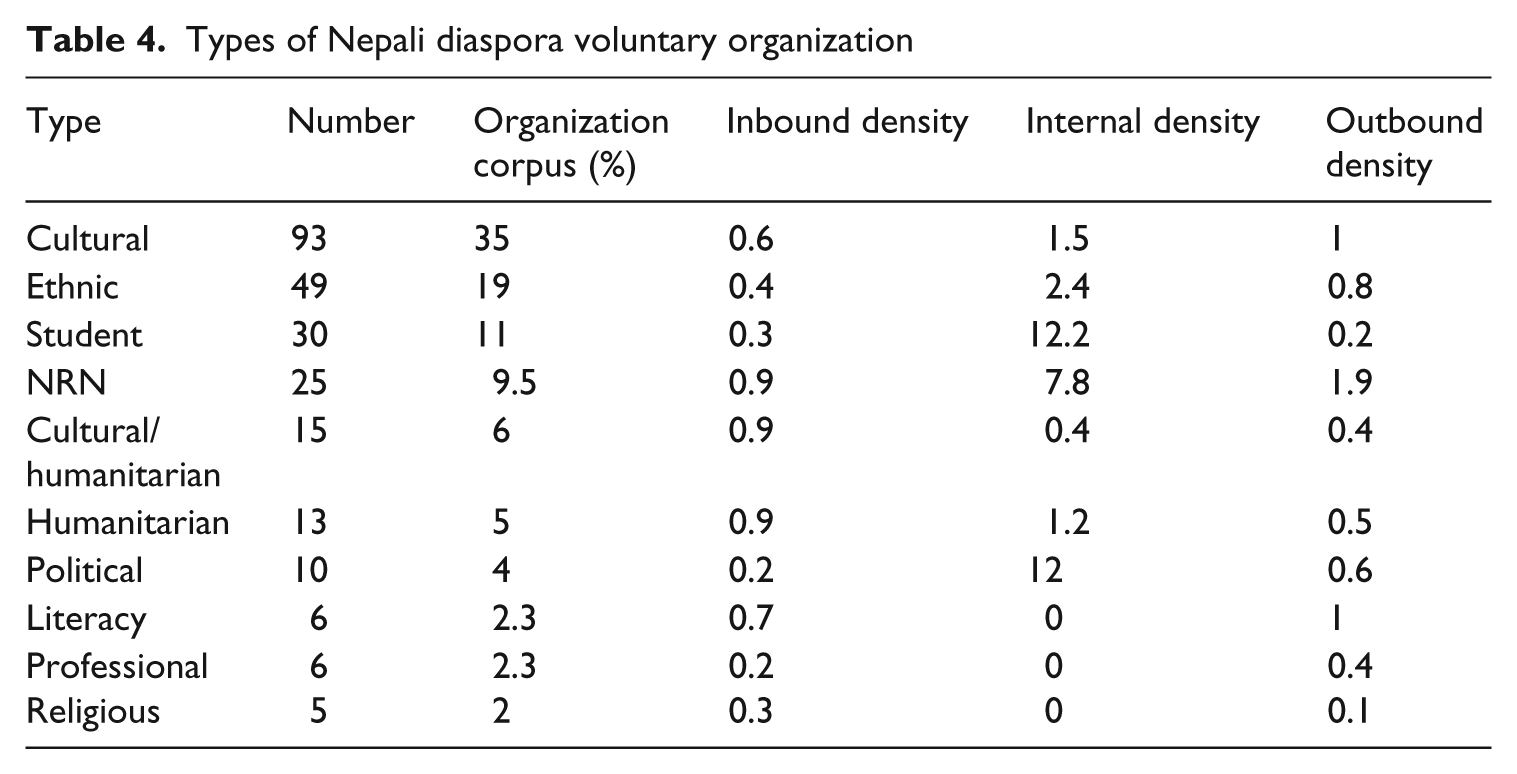
Cultural organization websites dominate the corpus, amounting to 35% of voluntary organizations and of the total corpus (Table 4). Once more, websites housed in the USA and in the UK take first place, with 58% of all cultural organization websites. The ‘identity–territory–memory tryptich’ (Chivallon, 2006: 13) prevails in the Nepalese diasporic affirmation. 15 The organizations’ focus on identity issues echoes another NRNA motto: ‘Once a Nepali, always a Nepali.’ In view of the risks of watering down one’s identity and of losing one’s bearings in a foreign country, the essentialization of the Nepalese identity is visible in the objectives fixed by organizations’ statutes. Merouk.com (‘my UK’), for example, wants to ‘unite the UK Nepalese to preserve, promote and develop Nepalese culture, tradition and literature for an identity of Nepalese establishing a global network’. The question of the Nepalese diasporic culture disrupting the national cultural model has yet to be studied since cultural production has not entered the age of hybridity, which characterizes diaspora according to Hall (1999), but it still belongs to the realm of non-reinterpreted heritage. 16 Apart from these identity-oriented objectives, voluntary organizations support both mutual-help initiatives and the development of local communities based on national belonging. They have the strongest links with the NRN category.
Forty-nine websites of ethnic organizations, half of which are in the USA and the UK, reflect the Nepalese identity policies that have developed over the last two decades. The main Nepalese ethnic groups are well represented on the Web, with the exception of the untouchables (dalit), who have only one website. The digital marginalization of dalits reflects their social marginalization in migration processes and their poor access to the world of digital information. Should we then speak of an ‘indigenous diaspora’ (Clifford, 2006) for these groups of ethnic organizations? The question still stands as long as there are strong indigenous demands in Nepal: claiming dispersion to impose autochthony is a stance that requires further investigation.
On all the graphs, the wnso.org student portal forms a distinct group at the bottom of the graphs. It is the only one not to be based on a geographical position. But it also shows the students’ marginalization in the diaspora, no doubt because the NRNA does not grant them NRN status.
The number of NRNA websites and those of its local branches amount to 25 and are scattered homogeneously throughout the corpus. 17 They are closely linked and benefit from being well-known. This dual feature shows the importance of the NRNA as an institution and its role in organizing the diaspora.
Finally, the 10 websites representing political parties belong (70%) to the Nepali Congress (center-right), while the others belong to the Nepalese Communist Party (center-left) and to the Maoist Communist Party. The political dimension of the diaspora, which is not only expressed on the parties’ websites, is nonetheless an important aspect of expatriates’ mobilization, as Bernal (2006) has shown in the Eritrean case. It was expressed in particular in 2005 on diasporic websites when King Gyanendra seized power with a coup d’état and put an end to all political freedom in Nepal. The Web was a means of organizing a virtual mobilization but also prompted demonstrations outside Nepalese embassies. The diaspora’s national sentiment was valorized.
All voluntary organization websites claim, often in the title of their website, an anchorage point where the community has settled. The locality is of some importance, save for a few websites which try to create virtual communities that have no local bearing, and which dominate the ‘type of association’ graph (
3.3 Diaspora, a domination principle?
The diaspora can never be a homogeneous group, but its promoters like to portray it as such in order to assert its importance. However, the unity of the diaspora must not be taken for granted. Why would dispersion, exile and co-presence be enough to instill a sense of belonging in an often distant and misunderstood social form (i.e. the diaspora), in individuals who have not necessarily followed the same social and professional trajectories? As we can see in this section, far from uniting the community, the way in which the Nepalese diaspora uses and makes postings on the Web gives the impression that the term ‘diaspora’ has been confiscated for the benefit of an active minority.
The use of English as the main language on the Nepalese diasporic web (61% of all websites use English as their main language) de facto discourages a large proportion of non-English-speaking Nepalese expatriates from using these sites (Table 5). English cannot be considered, as in India, to be a unifying language because it is spoken so little, and Nepali remains the national language. Eighty-five percent of Australian websites and 70% of American and British websites are in English. The proportion rises to 85% and to 90% of English as the main language in these latter two countries when Table 4 is consulted. This reflects the dominance of the English language in 80% of voluntary-sector websites. Even 68% of NRN websites use English as their main language. Media websites are the only ones to use Nepali to a high proportion (63%), thus showing the extent to which the national language is important with regard to contact with the homeland. Could English be the language of scattered communities wishing to become integrated in English-speaking countries? Nonetheless, language is a discriminatory tool that does not encourage identification with the diaspora.
Similarly, whereas the term ‘diaspora’ seems relatively neutral and gathers together a group of people, processes for building this social form show that the stakes involving domination are decisive. The domination of American-based websites, like ‘the American Hmong hegemony on the Web’ (Moua, 2009), is the sign of a process whereby a minority appropriates a community that is in the making. The working class, the Untouchables and Indians of Nepali origin are rendered invisible on the Web by classes with a higher social and cultural capital, and this reproduces both old and new hierarchies, as observed among the Indian diaspora (Gajjala, 2006). 19 It reflects the perpetuation of caste-based hierarchies in the UK’s Nepalese community, where discriminatory practices towards dalits are still common (Pariyar, 2011). It might also reflect Sheffer’s (2003: 141–142) temporal and linear visions of the types of diaspora. Indians of Nepalese origin would therefore belong to the dormant diaspora, the one assimilated to the host society, barely interested in the homeland but inclined to be ‘awakened’. The rest of the diasporic population would belong to an incipient diaspora, with differences depending on the social groups and the host countries. The making of an active militant diasporic elite which ultimately becomes a lobbying group is not in itself all that uncommon (Tölölyan, 1996). In the case of Nepalese expatriates, however, the study of the Web as a chamber for recording domination practices makes it seem original. Diasporas are never unitary agents (Ragazzi, 2009), although they often claim to be.
During fieldwork carried out in Qatar among poorly qualified Nepalese workers, I never heard them use the word ‘diaspora’. On the other hand, local members of the NRNA use the term, not to emphasize their ‘multicultural [and hybrid] identities’ (Ragazzi, 2009) but in reference to their Nepalese culture, their links with Nepal and their efforts to help their fellow citizens. Although only two of the 470 websites have ‘diaspora’ in their title, the term appears on the NRNA (NRN equals diaspora) website more than on any other, e.g. hknepal.com (Hong Kong Nepal) or the forum Sajha.com. This prestigious term (Tölölyan, 2007: 648), which has been appropriated by the expatriate elite (more entrepreneurial than intellectual), is used to refer to oneself and has a performative effect, as Moua (2009) observed among the Hmongs, or Simonin, Watin et al. (2009) among people from the Ile de la Réunion. Using it ‘institutes [the Nepalese diaspora] as a diaspora and transforms it as such’ (Ma Mung, 2000: 19). The mise-en-scène of the term on the Internet helps to federate communities, to think about the group beyond its divisions but also to impose the use of the term ‘diaspora’ and to wield power over scattered communities. As in autosuggestion, by repeating to ourselves that we form a diaspora, we hope to become one.
Conclusion: the Web as a prestigious tool for diaspora activists
The Nepalese diaspora is a project, a position launched by the elite above who deliver an official discourse that the people below are supposed to follow. Diasporic websites are a tool for implementing this policy of forming the group. They represent a ‘category of practice’ (Brubaker, 2005: 12) and a means to express allegiance to the country of origin or to the created social form. They contribute to the creation of a nascent diaspora through the links they have forged with each other and through performativity, that is by the mere fact that they exist and call themselves a diaspora. They correspond to a policy of making scattered groups visible and of gathering them under terms (diaspora, NRN), aimed at the group’s self-awareness. Internet is a catalyst, proof of the existence of a social group whose objectives to preserve the Nepali culture, to ensure mutual help or to contribute to Nepal’s development are said to be shared by all.
The study of the Nepalese diasporic Web shows the high degree of connections between sites, a variety of agents, thus a high level of organization, despite the recent diasporic claims by a majority of transnational migrants. The Nepalese diaspora is emerging because it is at the stage where transnational migrants settle permanently in their host countries, where voluntary-sector organizations are being structured and where links are being created between poles of dispersion. The diaspora comes into existence through action, by formulating a public project.
However, the Nepalese e-diaspora is exclusive and incomplete. Despite the formal membership in NRNA of 2 million workers in the Gulf countries and in Malaysia, they barely have any room to move in the public sphere that the Web represents. Similarly, Indians of Nepalese origin (excluded from NRNs according to its statutes) are practically absent from the diasporic Web in spite of their large number. 20 Nevertheless, the over-representation of some agents goes against the NRNA’s desire for homogeneity. The hierarchies are reproduced according to social classes and to the host countries. Exposure on the Web contributes to the marginalization of some and helps others to seize power over a social group in order to strengthen their networks and power.
Footnotes
Funding
The e-Diasporas Atlas received funding from the Agence National de la Recherche (STIC Contents), the Ecole d’ingénieurs Telecom ParisTech and the Fondation Maison des Sciences de l’Homme Paris.