



Abstract
While the Triple Helix relationship between university, industry and government, called ‘innovation in innovation’ by Etzkowitz, has frequently been a key concept guiding national and regional innovation policies around the world, there is an emerging awareness that no one-size-fits-all approach can be used in developing innovation systems. Criticism has been expressed that the conceptualization of the Triple Helix model in the most recent literature pays little attention to contextual effects. The present article seeks to enhance the context sensitivity of the Triple Helix model by integrating it with the insights of institutional logics. More specifically, seven ‘ideal’ institutional logics aligned with ‘ideal’ Triple Helix activities in Western society are identified. These have a potential to be used as a conceptual/benchmarking framework for understanding how institutional settings, particularly institutional logics, influence the development of Triple Helix innovation systems in different national contexts. To verify such a proposition, some alternative Triple Helix models as well as associated institutional logics are compared to the ideal-type, demonstrating that different institutional logics may divert the Triple Helix interactions in other directions. Meanwhile, it is claimed that institutional logics do not necessarily lead to a Triple Helix model but serve only as enabling conditions. To what extent the Triple Helix will be developed depends on innovation policies and on the key actors involved in the innovation process. The framework constructed in this study aims to provide a solid basis from which policymakers, especially those from developing and transition countries, may improve the design of these innovation policies by employing appropriate Triple Helix approaches.
Introduction
Innovation systems consist of complex functions and interactions among various organizational actors, including government, enterprises, universities and research institutes, as well as institutions, for example policies and social norms (Edquist, 1997; Kumaresan & Miyazaki, 1999; Lundvall, 1992; Nelson, 1993; OECD, 1999). In a similar vein, Etzkowitz and Leydesdorff (1995, 1997) developed the Triple Helix model for understanding dynamic interactions between university, industry and government which foster entrepreneurship, innovation and economic growth. Etzkowitz (2003) calls the Triple Helix model ‘innovation in innovation’ because it changes the traditional ways of achieving innovation. Nowadays the Triple Helix, alongside its variations such as the Quadruple Helix (Carayannis & Campbell, 2009), Triple Helix twins (Etzkowitz & Zhou, 2006), as well as the new concept ‘Triple Helix System’ recently introduced by Ranga and Etzkowitz (2013), has been much used as a normative framework by researchers and policymakers to account for interactions between key actors in innovation systems and developing innovation policies.
In spite of its popularity, the Triple Helix model has not been without problems. Criticisms have been adduced that, among others, the Triple Helix model is highly abstract (Cooke, 2005: 1130), lacks clear theoretical foundations at the micro level (Shinn, 2002: 609; Viale & Pozzali, 2010: 576), rarely addresses tensions and contradictions in the process of Triple Helix interactions (Fogelberg & Thorpenberg, 2012; Tuunainen, 2002) and ignores the role of workers (Lundvall, 2013: 50–51). One attack, as highlighted in this article, is that the Triple Helix model has paid scant attention to national/regional contexts and other social settings (Balzat & Hanusch, 2004; Cooke, 2005; Pugh, 2014; Shinn, 2002: 610). Therefore the Triple Helix model can hardly provide appropriate rationales on the basis of which systematically structured criteria and indicators may be developed for researching, measuring and comparing different empirical cases (Mowery & Sampat, 2004), especially when the cases are in disparate national and cultural contexts (Eun et al., 2006).
This implies that the Triple Helix model has not been fully developed to take account of the context effect, which is defined as ‘the set of factors surrounding a phenomenon that exert some direct or indirect influence on it’ (Whetten, 2009: 31). Drawing on McKelvey (2002), Whetten (2009) suggests that whether a theory is valid or not is basically a matter of contextual sensitivity. A theory should not merely deal with e.g. the relationship between X and Y, but must also include explanatory factors associated with higher levels of contextual analysis than those expressly under investigation; ‘investigators should not “test” hypotheses to determine if they are true or false, but rather they should determine the conditions under which a particular hypothesis holds’ (Whetten, 2009: 38).
It should be noted that the formation of the Triple Helix model is a result of inductive theorizing based on the successful innovation stories in the contexts of Western countries. The founders of the Triple Helix model, Etzkowitz and Leydesdorff, as well as other Triple Helix followers do indeed acknowledge the differences between Western and non-Western countries, and even take note of the variations among Western societies. They have empirically examined Triple Helix models in different national contexts in the special issues of some journals (e.g. Leydesdorff & Meyer, 2003; Saad & Zawdie, 2008) and edited books (e.g. Saad & Zawdie, 2011b). However, these studies have not attempted to develop appropriate frameworks for studying the development of Triple Helix relations between university, industry and government in different national/regional contexts, particularly in the developing and transition countries.
As to whether the Western-context-based Triple Helix treatment can be applied in other countries, two kinds of responses can be found in the literature. In one group, the scholars directly employ the Triple Helix model in their studies on developing or emerging economies regardless of the contextual differences (e.g. da Silva et al., 2012; Saad et al., 2008; Saad & Zawdie, 2011a; Zhou & Peng, 2008). The researchers in the other group are highly sceptical of the applicability of the Triple Helix in less economically developed countries, and therefore tend to build up different, often context-specific, frameworks for understanding the interplay between innovation actors (e.g. Bernasconi, 2005; Eun et al., 2006; Williams & Woodson, 2012; Zawislak & Dalmarco, 2011). However, because the analytical frameworks developed in these studies are ad hoc, the findings and analyses are less readily comparable to practices elsewhere.
Can a balance be achieved whereby the insights from the Triple Helix could be fully utilized and account taken of specific contexts in the analysis of innovation activities in different national and cultural contexts? This is a matter of theory improvement for the Triple Helix model. As noted by Whetten (2009: 38), ‘all theories are context-bound … they should not unknowingly be applied in circumstances that exceed their operational boundaries’. Therefore, when using the Triple Helix model for cross-context analysis, the boundaries or contexts of the Triple Helix should first be established/ascertained. Though not specifically referring to the Triple Helix, Edquist (2001) expressed criticism that, in general, innovation system approaches overemphasize the interplay between organizational actors while paying little attention to the institutional environments in which the organizational actors are situated and in which their actions take place. Sotarauta and Kosonen (2013) promote this point by arguing that innovation policies are context sensitive and therefore must be customized according to local conditions.
While scholars are aware of the importance of context effect, few have attempted to make explicit what the context is. Before attempting any theoretical improvement in terms of enhancing the sensitivity of the Triple Helix model, the first step must be to identify the contextual factors that promote the development of Triple Helix originating in an ‘ideal’ Western society, and hopefully these will form a basis or benchmarking framework for understanding and comparing different patterns of Triple Helix development elsewhere. Therefore the purpose of this article is to identify major institutional logics that foster the formation and development of an ‘ideal’ Triple Helix model in Western countries. For this we make use of institutional theory, particularly the institutional-logics perspective (Friedland & Alford, 1991; Thornton et al., 2012). The term ‘institutional logics’ generally refers to broad belief systems that shape the cognition and behaviour of actors (Friedland & Alford, 1991). Though he does not refer to the concept of institutional logics, Etzkowitz (2011) suggests that what is fundamental to the Triple Helix are the changes of norms and beliefs in both academia and industry.
This study can also be seen as an innovative application of the ‘ideal-type’ approach developed by Max Weber, who used the notion of the ideal-type to avoid a dilemma faced by social scientists (Coser, 1971: 223–224; Weber et al., 1946: 59): on the one hand, when a concept is too general we tend to leave out what is most distinctive in it; on the other hand, when one phenomenon is particularized under discussion there is little room for comparison with related phenomena. Using the ideal-type approach, Weber analysed the main characteristics of capitalism and bureaucracies in a perfect state. An ideal-type is an analytical construct that serves as a measuring rod to identify similarities as well as deviations in concrete cases (Coser, 1971). When Etzkowitz (2008) provides the characteristics of the ideal Triple Helix model – a balanced overlapping and interaction between university, industry and government, it is quite similar to Weber’s notion of the ‘ideal-type’. In this study, as an innovative way of applying the ideal-type approach, institutional logics is further brought into the construct of the ideal Triple Helix.
This article starts with a presentation of the theoretical framework. It first presents the relevance of using institutional theory to understand contextual effects on innovative styles as well as different models of Triple Helix. Then two key concepts of institutionalism, namely institutionalization and institutional logics, are introduced. Accordingly, the development of the Triple Helix model is interpreted as a process of institutionalization. In the following section, the article identifies seven ‘ideal’ institutional logics aligned with the ‘ideal’ Triple Helix activities of each stage in the Western contexts. To verify the correspondence between ideal institutional logics and the ideal model of Triple Helix, the next two sections briefly consider how different institutional logics underline alternative Triple Helix models, such as the statist model and laissez-faire model of Triple Helix (Etzkowitz & Leydesdorff, 2000) as well as the general situation and a special Triple Helix development in China. The results of some Chinese case studies are utilized here, but in a purely supportive role. The article concludes with both scholarly and practical implications of integrating the insights of the Triple Helix model and the institutional-logics perspective, and calls for future research in the framework of integrating institutional logics with the Triple Helix model.
Theoretical framework: Combining the insights of the institutional-logics perspective and the Triple Helix
Institutional analysis of the context effects on structures for innovation – A response to Hollingsworth’s call
Hollingsworth (2000: 596) called for the use of institutional theory to understand the context effects of innovation and tried to address and connect two important but separate issues: ‘(l) why do societies vary in their style of innovativeness?; and (2) how should we go about doing institutional analysis?’ In his study, he tries to improve institutional analysis by categorizing institutions into five levels, namely social institutions, institutional arrangements, institutional sectors, organizational structures and outputs/performance. At the end of his study, he sets out implications for future innovation studies.
However, Hollingsworth’s (2000) emphasis is mainly on technology innovation or scientific discoveries rather than on structures or policies for technology innovation. The same focus has been retained in his later study (Hollingsworth, 2006), where he continues to address how institutional environment and organizational characteristics affect major scientific discoveries. Although Hollingsworth’s (2000) thesis has potential for understanding the relations between institutional frameworks and structures for innovation, neither Hollingsworth himself nor other scholars have followed up his study in this direction. There are two reasons for this. First, the five-level structure of institutional analysis suggested by Hollingsworth (2000) is still too complex to be applied in empirical studies. And second, as implied earlier, Hollingsworth has not provided a framework for understanding different structures for innovation.
This article responds to and continues on from Hollingsworth’s study by integrating the insights provided by both the Triple Helix (Etzkowitz, 2008) and institutional logics (Friedland & Alford, 1991; Thornton et al., 2012): the former helps distinguish different patterns of structures for innovation under the name of Triple Helix; the latter has recently been developed by Thornton et al. (2012) into a more nuanced approach to institutional analysis. To facilitate the theoretical integration, the concept of institutionalization is also adopted in our analysis.
Before further introduction of the institutional-logics perspective, two theses of the theory are especially important for our study. First, Thornton et al. (2012) claim that the (multiple) institutional logics prevailing within one context will affect decisively how the actors communicate their interests, determine which problems are salient and which solutions are appropriate. Second, Friedland and Alford (1991) state that it is the multiple and contending logics that provide the dynamic for potential change (innovation) in organizations and societies. Accordingly, the following assumptions are evinced: (1) when the Triple Helix model was initially developed in Western societies, there must have been certain (ideal) institutional logics that facilitated the process; (2) thus, when the Triple Helix model is adopted in a non-Western context, the incompatibility between the local and ideal institutional logics may explain the challenges of implementing the Triple Helix model there; (3) when the Triple Helix model is applied to a non-Western society, logics associated with the original model are likely to be imported as well; and (4) the differences between the institutional logics aligned with the Western Triple Helix model and local institutional logics may become a source of dynamics for change or innovation, which may lead to different styles of Triple Helix development.
Despite certain disparities/dissimilarities, most Western societies have some characteristics in common, and an attempt is made here to extract a list of ‘ideal’ Western logics supporting an ‘ideal’ Triple Helix model. The endeavour to combine the Triple Helix and the institutional theory is twofold. First, the Triple Helix development is interpreted from an institutional-theory perspective, where four stages of the institutionalizing of an ideal model of Triple Helix observed in the West are distinguished. Second, ‘ideal’ institutional logics aligned with the Triple Helix activities of each stage in the Western contexts are identified.
Institutional logics
Institutional theory has become a popular and powerful explanatory tool for actions of both individual and collective actors (Dacin et al., 2002: 45). It mainly stresses the dependency of actors’ actions on institutions, such as wider environmental contexts, rules and norms (Meyer et al., 2007: 188). One central concept in institutional theory is institution. Institutions can generally be understood as social orders (Berger & Luckmann, 1967), social rules (Burns & Flam, 1987) or a logic of appropriateness (March & Olsen, 2006), composed of appropriate rules and exemplary behaviour. Social orders, rules and exemplary behaviour become institutions when they are perceived by actors to be natural, appropriate, expected and legitimate. In other words, they are institutionalized. However, a lack of consensus on boundaries and content of institutions has become an obstacle in empirical studies (Hollingsworth, 2000). Compared to Hollingsworth’s efforts to concretize institutional analysis, Thornton et al. (2012) develop a more nuanced approach, which they call institutional logics, ‘that incorporates macro structure, culture, and agency, through cross-level processes (society, institutional field, organization, interactions, and individuals) that explain how institutions both enable and constrain action’ (Thornton et al., 2012: vi).
The concept of institutional logics was first introduced by Alford and Friedland (1985) for describing how contradictory practices and beliefs inherent in modern Western societies shape individuals’ actions in the political arena. Friedland and Alford (1991) developed the institutional-logics approach further as an explanation for institutional change: modern Western societies have central institutions with potentially incompatible institutional logics; it is the incompatibility of logics that provides the dynamic for potential change. Since then the approach has developed into a growing research area in organization studies. Nevertheless, the institutional-logics perspective had not been elaborated in a deliberative and systematic manner, until the publication of Thornton et al.’s (2012) book, The Institutional Logics Perspective: A new approach to culture, structure, and process.
The institutional-logics perspective is developed from the new institutional theory, sharing views with Meyer and Rowan (1977), Zucker (1977) and DiMaggio and Powell (1983) about how institutions shape organizational structures and constrain individual behaviours. It also distinguishes from and transforms the new institutional theory in that the focus is no longer on isomorphism but on the effects of differentiated institutional logics on the practices of individuals and organizations that provide sources for change, and the influences of individual and organizational actors on changing institutional logics (Thornton & Ocasio, 2008; Thornton et al., 2012).
According to Friedland and Alford (1991: 248), each society consists of a set of institutional orders, and each of the institutional orders has a central institutional logic that constitutes its organizing principles and is available for elaboration by organizations and individuals. Institutional logics have both material and symbolic characteristics. Following such understanding, Thornton and Ocasio (1999: 804) define institutional logics as ‘the socially constructed, historical pattern of material practices, assumptions, values, beliefs, and rules by which individuals produce and reproduce their material subsistence, organize time and space, and provide meaning to their social reality’. In spite of the original focus of institutional logics at the macro-societal level, institutional logics can also be examined at the level of organizational field (Greenwood et al., 2011) and even within a single organization (McPherson & Sauder, 2013). When applying the institutional-logics perspective in understanding the development of the Triple Helix model, the logics under investigation in this article lie at both the societal and organizational field levels.
Institutionalization
Another central concept of institutional theory is institutionalization. Meyer and Rowan (1977: 341) define institutionalization as a process ‘by which social processes, obligations, or actualities, come to take on a rule-like status in social thought and action’. The institutionalized social orders and rules are beyond question and cannot be compared to alternatives. Similarly, DiMaggio and Powell (1991: 14) argue that ‘institutionalization tends to reduce variety, operating across organizations to override diversity in local environments’.
Institutionalization processes take place within organizational fields. An organizational field is defined as ‘those organizations that, in the aggregate, constitute a recognized area of institutional life: key suppliers, resource and product consumers, regulatory agencies, and other organizations in the field’ (DiMaggio & Powell, 1983: 148). The organizational field involves a process of structuration, which occurs through interaction and information exchange, generating structures of prestige dominated by certain organizations as well as shared norms and practices. Once an organizational field has become mature, whatever change occurs will lead toward greater conformity.
Social movements/reforms often become institutionalized or isomorphic across national contexts (Cai, 2010). For instance, the Triple Helix as a strategy for developing innovation systems tends to be commonly adopted in most countries in the world, regardless of their economic development levels and traditional cultures. Therefore, Benner and Sandström (2000) understand the development of the Triple Helix model as a process of institutionalization.
Several stages can be distinguished along with the institutionalization process. Greenwood et al. (2002) outline six stages of institutional change, including (1) precipitating jolts, (2) de-institutionalization, (3) pre-institutionalization, (4) theorization, (5) diffusion and (6) re-institutionalization. In the process some institutions disappear, while emerging structures proliferate and gain legitimacy throughout an organizational field to become institutionalized. Some other studies have developed similar frameworks for understanding institutionalization processes, such as Rogers’ (2003) five-stage model: (1) agenda setting, (2) matching, (3) redefinition, (4) clarifying and (5) routinizing; and Levine’s (1980) four-stage model: (1) recognition of needs, (2) planning and formulating a solution, (3) initiation and implementation of a plan and (4) institutionalization or termination.
All these authors share the notion that any institutional change basically includes three stages: first, organizational actors realize there is a need for change; then they initiate organizational changes; and finally the changes either become institutionalized or are terminated. As the Triple Helix framework involves organizations from different sectors, the organizational changes can be understood from two dimensions: intra-organizational and inter-organizational.
Four stages in Triple Helix development
The rise of the Triple Helix model has coincided with the rise of the knowledge-based economy and innovation system, in which economic growth is based on continuous innovation and advances in science and technology. The Triple Helix model referred in this article follows the definition provided by the Helix Conference official website:
The Triple Helix concept comprises three basic elements: (1) a more prominent role for the university in innovation, on a par with industry and government in a knowledge-based society; (2) a movement toward collaborative relationships among the three major institutional spheres, in which innovation policy is increasingly an outcome of interaction rather than a prescription from government; (3) in addition to fulfilling their traditional functions, each institutional sphere also ‘takes the role of the other’ performing new roles as well as their traditional function. Institutions taking non-traditional roles are viewed as a major potential source of innovation in innovation. (Triple Helix Conference website, 2011)
The Triple Helix relationship of university–industry–government is, to a large extent, about competition and cooperation for resources, redistribution of power and network building. From the institutional-logics perspective, the meanings of power, resources and networks vary by institutional logics (Thornton et al., 2012). Hence the evolution of the Triple Helix model may have different trajectories in different institutional contexts. Etzkowitz and Leydesdorff (2000) distinguish three types of Triple Helix models, namely the ‘statist model’ (Figure 1), the ‘laissez-faire model’ (Figure 2), and the ‘balanced model’ (Figure 3) (Ranga & Etzkowitz, 2013).
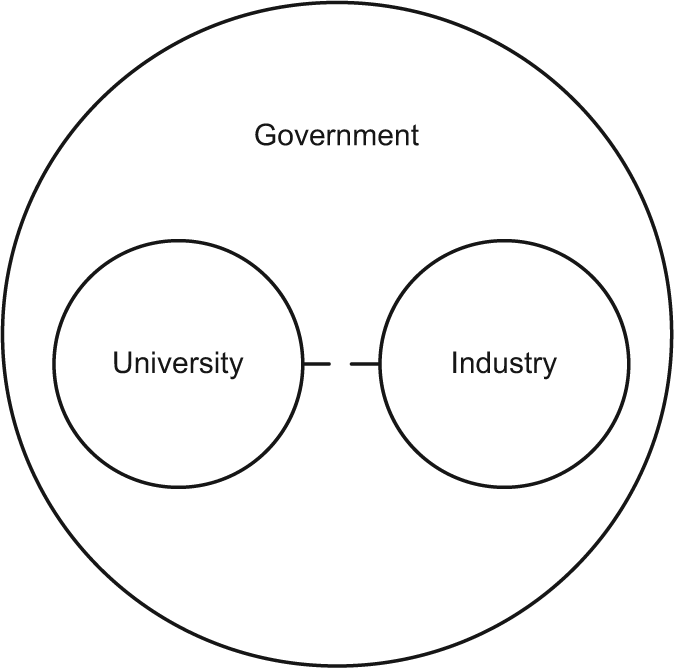
Statist model.
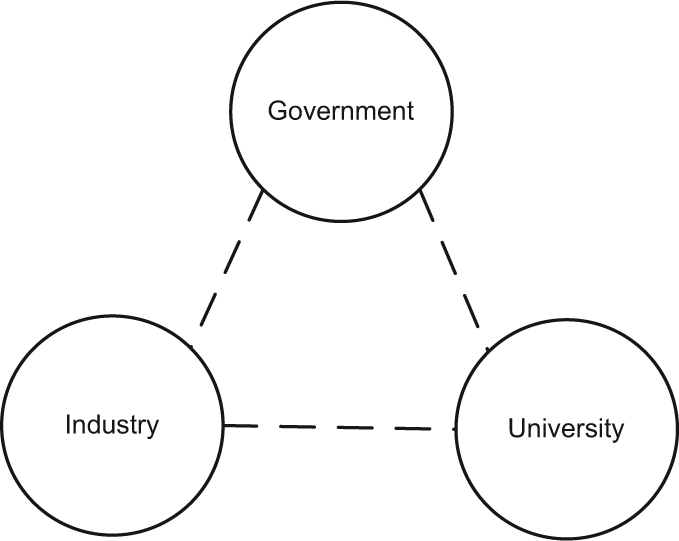
Laissez-faire model.

Balanced helix model.
The ideal or balanced model of Triple Helix ‘begins from two opposing standpoints: a statist model of government controlling academia and industry, and a laissez-faire model with industry, academia and government separate and apart from each other, interacting only modestly across strong boundaries’ (Etzkowitz, 2008: 12). In the statist model (Figure 1), government controls both academia and industry, and is expected to take the lead in developing projects and providing the resources for new initiatives. Examples can be seen in the former Soviet Union, France and many Latin American countries. In the laissez-faire model (Figure 2), industry, academia and government are separate and independent of each other. These actors interact only modestly across strong boundaries. This model is typically exemplified by the USA.
The global tendency is a move towards a balanced model (Figure 3), in which the three institutional spheres overlap and collaborate. The model represents a change ‘from one of strong boundaries between separate institutional spheres and organizations to a more flexible overlapping system, with each taking the role of the other’ (Etzkowitz, 2002: 2). The balanced model is considered to be preferable or ideal: ‘The balanced configuration offers the most important insights for innovation, because the most favourable environments for innovation are created at the intersections of the spheres’ (Ranga & Etzkowitz, 2013: 239). However, a pure model of this type, especially with balanced interactions between the three spirals, can hardly exist in reality. Nevertheless, such a balanced Triple Helix model has been used as an ideal-type or a normative framework by Triple Helix scholars to explain the functions of the Triple Helix model as well as the underlying rationale.
The Triple Helix literature (Etzkowitz, 2002, 2003, 2008; Etzkowitz & Leydesdorff, 1997, 2000; Leydesdorff, 2012; Leydesdorff & Etzkowitz, 1998) implies that the development of the (ideal) Triple Helix model entails several steps. For instance, Etzkowitz (2008) has more explicitly distinguished three steps of the development of the Triple Helix, namely ‘Triple Helix impetus’, ‘taking the role of the other’ and ‘from bilateral to trilateral interactions’. Here the Triple Helix development is reinterpreted from the perspective of institutionalization, in which four stages are suggested:
Stage I: realization of needs
Stage II: intra-organizational transformation
Stage III: inter-organizational interactions
Stage IV: institutionalization of the Triple Helix concept
The four-stage development model differs from Etzkowitz’s three-step model in two respects. First, while the three-step model tends to describe the path to the ideal Triple Helix from two opposing standpoints (a statist model and a laissez-faire model), the four-stage model focuses on the development of the ideal Triple Helix model. Second, Etzkowitz looks mainly at the development process from a time-sequential perspective, but the focus of the four-stage model is how the concept of Triple Helix has been institutionalized. Nevertheless, there are many overlaps between the two approaches. Etzkowitz’s work indeed provides solid foundations for the interpretation of the institutionalization process of the Triple Helix. Although the four stages are presented sequentially, this is done mainly to facilitate the analysis. In practice there are overlaps between these stages, the second and third stages in particular being likely to occur almost simultaneously.
Institutional logics aligned with Triple Helix activities
The development of the ‘ideal’ model of Triple Helix can arguably be best explained in Western contexts. This section examines what are the typical institutional logics aligned with the ‘ideal’ Triple Helix activities of each stage in the West.
Stage I. Realization of needs
In the first stage, as suggested by Etzkowitz (2008: 8), ‘a Triple Helix regime typically begins as university, industry, and government enter into a reciprocal relationship with each other in which each attempts to enhance the performance of the other’. The rapid development and increasing complexity of technology can radically alter the environment of many types of organizations. It has been acknowledged that single organizational sectors alone can no longer respond to changes and uncertainties unless they cooperate with each other. In this stage, the collaboration between university, industry and government for enhancing the local economy is mainly through their traditional roles. For example, universities produce and transfer more knowledge to industry and society, while gaining additional funding sources from industry and government to strengthen the performance of research.
In many Western countries, there is a broad social consensus that economic competition depends on the creation of new and better technologies/products as the supporting logics for Triple Helix development. As such, the enhancement of knowledge generation and technology innovation becomes essential. Due to such a belief, although many Western universities have suffered governmental budget cuts since the 1980s, the actual public funding spent on higher education has not declined but is instead being directed through more diversified channels. For instance, some public funding has been used to provide incentives and to promote university and industry cooperation for knowledge generation and knowledge transfer. Nowadays one common governmental strategy is to concentrate funding on supporting research and development (R&D) in fast-growing or high-potential areas in the expectation that the investment will eventually pay off through economic growth led by the companies that benefit from cutting-edge knowledge. For their survival or sustainable development, firms strongly believe, too, that innovation is key (Cefis & Marsili, 2006) and in so doing they seek cooperation with universities to strengthen their R&D.
Therefore the institutional logic aligned with the first-stage activities is the social belief, shared by government and industry, that knowledge production and technology advancement are the keys to economic growth and success in economic competition. While government and industry are motivated by this belief, the university’s involvement in technology transfer in the initial stage is driven mainly by public policies and financial incentives. Under such circumstances, the first stage of the Triple Helix commences, in which university, industry and government realize the need for developing a reciprocal relationship.
Stage II. Intra-organizational transformation
The emerging demands for cooperation with others address challenges that gradually lead to the second stage of Triple Helix development, where internal transformation is characterized by ‘taking the role of the other’ (Etzkowitz, 2008: 9). This means that, in addition to performing its traditional tasks (as primary activities), each takes the role of the other (as secondary activities), but meanwhile university, industry or government retain their respective primary roles and distinct identities. Universities retain their traditional roles of teaching and research, but also devote attention to the capitalization of knowledge; patents, start-up companies, etc. Firms continue to produce goods and services, but also engage in research and provide training at high levels (e.g. through a corporate university). Government is responsible for resolving market failures by adjusting public policies and setting up market rules, but also makes available venture capital to start new companies, particularly for high-risk businesses. The supporting institutional logics for these activities are the cultures of (1) market orientation and (2) process management.
Taking the role of the other is driven mainly by the institutional order of market, in which the fundamental norms are concerned with self-interest and profit-seeking. To increase their revenues, universities directly engage in business activities, such as selling education and research services, and setting up university-owned companies. Meanwhile, companies establish corporate universities to develop the skills of their professionals and managers for the needs of company development. Government also offers venture capital to help start new enterprises to promote regional economic growth. To adapt to the new functions, each sector has to be more innovative in developing organizational structures and strategies.
Thus taking the role of the other can also be perceived as organizations learning from each other and also as a way of organizational innovation. One of the main drivers of organizational learning and innovation is market orientation (Hurley & Hult, 1998), which is defined as ‘the organization culture that most effectively and efficiently creates the necessary behaviours for the creation of superior value for buyers and, thus, continuous superior performance for the business’ (Narver & Slater, 1990: 21). Adopting a market-orientation approach in an organization is about how the organization is oriented to the market, paying more attention to consumers’ needs, competitors’ advantages and inter-functional coordination (Narver & Slater, 1990). Market-oriented culture has been considered to be a key to enhancing competitive advantages for organizations to best pursue interest and profit (Liao et al., 2011).
One competitive advantage pursued by organizations is knowledge or technology innovation. ‘The innovation process is highly dependent on the knowledge accumulation and learning processes in the organization’ (Lopperi & Soininen, 2005: 4). To ensure knowledge accumulation and learning from existing knowledge, it is important to apply ‘process management’ which ‘involves adherence to routines through the adoption of standardized best practices throughout an organization’ and ‘ensures that organizational processes are repeated, allowing for continued efficiency improvements’ (Benner & Tushman, 2002: 678). In this light, innovation is more incremental and exploitative in nature than explorative.
Lang (2009: 25–34), a Hong Kong-based economist, observed that the success of technology innovation in the West is to be largely attributed to the culture of process management. The ethos of process management can also be reflected in research activities in the West. In a Western conception, research is basically about knowledge accumulation and transmission through the ‘trial-and-error’ method and by following a rigid academic protocol (Lang, 2009: 5–6). It follows that new knowledge is always generated from existing knowledge and the process of knowledge generation is well documented. Following the logic of process management, organizations’ competitive advantages when ‘taking the role of the other’ are based on their existing know-how. Thus the Triple Helix model enables knowledge and technology organizations to contribute to innovation through incorporating existing knowledge/technology (Marques et al., 2006).
Stage III. Inter-organizational interactions
During the process of ‘taking the role of the other’, organizational actors in the three sectors have realized that engaging in others’ fields is a necessary but not sufficient condition for achieving the desired goals. In addition, intra-organizational transformation also gives rise to new challenges and demands within and between sectors. As a solution, they need even closer cooperation and interaction with each other (Etzkowitz, 2008). Thus the third step in the development of the Triple Helix is the evolution of trilateral interactions between the three sectors, characterized by increasing interdependency between the three spirals: One spiral has a significant influence on the other’s actions, and through the interactions, organizations in each spiral are able to adopt new ideas from the others to solve problems and meet new needs. For instance, a university’s knowledge production cannot be carried out by itself, but needs industry not only as a source of research problems but also as a strong partner in knowledge production. Meanwhile, university technology transfer is largely dependent on the conditions or environments created by the government. ‘The firm is thus transformed from a competitive unit related to other firms solely through the market to a Triple Helix entity increasingly based on relationships with other firms as well as academia and government’ (Etzkowitz, 2008: 58). The interactions also result in the creation of hybrid organizations, such as incubators, joint research centres, science parks, etc. With respect to the third stage, the key institutional logics in Western society are (1) legal protection of intellectual property (IP) and (2) civil society.
The most crucial development in Triple Helix inter-organizational relations is the cooperation and interaction between university and industry, founded on trust between the two parties. The trust is largely guaranteed by a mature institutional context for IP protection. For instance, the technology transfer between university and industry in the USA has only developed at a fast pace since the 1980 Bayh–Dole Act, according to which universities are able to retain ownership of inventions made with federally funded research. Thus a firm that engages in productizing an invention patented by a university can hold an exclusive licence once this is granted by the university.
According to Etzkowitz (2008: 62), effective interaction between the three spirals is also contingent upon broad social participation, including both top-down and bottom-up initiatives. As such, the Triple Helix model can best be developed in a civil society which allows free mobilization and organization, debate and initiatives, and hence encourages diverse sources of innovation. He further implies that successful Triple Helix operation is not coordinated entirely by the state, but also depends on the commitment at the local level as well as the inputs of a variety of innovation actors. Etzkowitz (2003) argued that it was the re-establishment of civil society that made the Triple Helix possible in Brazil. It has also been argued elsewhere that, as policies related to innovation systems are often confronted with issues that are both complex and controversial, one way to deal with such a complex problem is thus via citizen involvement (Griessler, 2012). Etzkowitz’s position is consistent with the ideas of Quadruple Helix (Carayannis & Campbell, 2009), in which society or the general public is added as the fourth helix, but Leydesdorff and Etzkowitz (2003) do not admit the necessity of transforming the Triple Helix into a Quadruple Helix, arguing that civil society or the general public is the institutional foundation on which the Triple Helix evolved. Although civil society is characterized by its alleged independence from the state (Perry & Fuller, 1991), it cannot live without the state. Neither can it exist without reference to a market dominated by private actors. Instead, it serves as a buffer zone between the control of authorities and private initiatives (Seppälä, 1992: 2) thereby making it easier for both top-down governance and grassroots initiatives to interact and engage with each other in innovation processes (Carayannis & Campbell, 2012: 3). Therefore, in this study, civil society is considered as one type of institutional logic supporting the ideal Triple Helix model rather than as an additional helix.
Stage IV. Institutionalization of the Triple Helix concept
The final stage is the institutionalization of the Triple Helix. This means that the Triple Helix concept and its associated activities have become a set of routines or practices that are reproduced over time and tend to serve as a cognitive framework structuring the actions of key actors, such as academia, industry and government. As stated by Benner and Sandström (2000: 292), the Triple Helix model becomes a new kind of institutional order based on the interactions of political, industrial and academic interests, and is institutionalized in an organizational field consisting of the state, industry and the academic system. However, such an understanding tends to take a simplistic view of the institutional environment, as if the Triple Helix culture becomes the only institutional order surrounding all the three groups of organizations. According to the institutional-logics perspective, organizations are embedded in different, often conflicting, institutional orders, or an inter-institutional system (Thornton et al., 2012).
It should be mentioned that the classic Triple Helix literature does not suggest that university, industry and government merge into one organizational field, but that there are overlaps between the three fields/spheres. Etzkowitz (2008) has specifically elaborated the institutionalization of the Triple Helix concept in each sector, although without explicitly using the term institutionalization. He implies that in an ideal situation, actors in the three sectors of government, university and industry all share similar views regarding their collaboration.
In their study on regional innovation systems in western Sweden, Fogelberg and Thorpenberg (2012) find a gap ‘between the expectation of an ideal-type of Triple Helix process and actors’ view of the actual development process’ (Fogelberg & Thorpenberg, 2012: 355). They argue that the bigger the gap, the greater the tension counterproductive to the goal of stimulating innovation through Triple Helix collaboration, implying that when the Triple Helix model is institutionalized, the gap is supposed to be minimized.
Thus the institutionalization process is about the structuration of an ideal model of Triple Helix, meaning that the actors in different sectors in a nation or region have shared certain concepts regarding Triple Helix relations between university, industry and government. Politicians and governmental officials in particular tend to use these common understandings to unite their audiences for the successful implementation of Triple Helix-driven innovation systems. As Fogelberg and Thorpenberg (2012: 354) put it: ‘Policy managers at the national and regional level aimed to align their agenda to a common theory-laden language that a broad set of actors could understand and sign up to [the Triple Helix].’ Such a definition of the institutionalization of the Triple Helix does not posit any ideal linear path for transitions in different national contexts and regional settings.
As institutions are composed of three pillars, namely: regulative, normative and cognitive, the processes of institutionalization also occur in all three categories. Regulative, normative and cognitive institutionalization processes are grounded in different logics but are also intertwined with each other (Scott, 1995). To achieve institutionalization, two institutional logics in particular are important, namely: (1) the market competition environment, and (2) democracy in policymaking. Both are important in the process of collective sense-making and belief-shaping.
The Triple Helix model has often been used by national and regional governments as a strategy to promote the development of innovation systems which challenge traditional ways of organizing research (i.e. collegial control) and technology development (Benner & Sandström, 2000: 292). In this respect, the institutionalization of the Triple Helix starts in the pillar of regulative institutions. The governmental approach is to leverage funding for cooperation between academia and industry. Although universities and academics may not consider the Triple Helix strategy the right option, most of them take part in Triple Helix activities because they want to secure funding for their survival and development. In Colbeck’s (2002: 398) words, ‘[regulative] institutionalization occurs as individuals find it expedient to comply with the rules’. For instance, Benner and Sandström’s (2000) study on ‘Institutionalizing the Triple Helix’ deals with the regulative process mainly by emphasising the funding agencies’ roles in the structuration of the institutional order of the Triple Helix.
‘Normative institutionalization processes are grounded in a collective sense of what is appropriate’, Colbeck writes (2002: 398). In its attempt to adjust academic research to the knowledge interests of industry, the Triple Helix model goes against the traditional academic norm that it is professors who decide what is to be studied. The participants will not believe that the innovation of the Triple Helix model is right unless it has brought them benefits. Therefore, for the Triple Helix model to be appreciated by the participants, the funding and evaluation systems must be shrewdly designed.
The institutionalization of the Triple Helix may take many rounds of revisions and adjustments, based on feedback from those involved. The importance of feedback loops in the evolution of the Triple Helix has been pointed out by Viale and Pozzali (2010: 583–584): When a government tries to promote university and industry cooperation by introducing financial incentives for relevant participants, the effect is determined by either positive or negative feedback generated by the impact of these incentives on the behaviour of the actors concerned. While negative feedback tends to produce resistance to change and leads to inertia, positive feedback shakes the stability of the status quo and catalyses change. Thus the Triple Helix is likely to develop in competitive market systems where feedback mechanisms are well developed. While there has always been competition in industry, the key to developing the Triple Helix lies in the competition logics in the field of the university. This explains why the phenomena associated with the Triple Helix model, such as the second academic revolution, the dual academic career and the entrepreneurial university, are more often observed in the competitive university systems of the USA and the UK than in relatively more centralized universities of continental Europe.
To effectively adopt the feedback from participants in the policymaking process also requires a political system in which social groups and individuals involved in and affected by a policy programme have a chance to influence the policymaking. As Carayannis and Campbell (2012: 3) noted: ‘democracy shapes and drives government, academic, and industrial policies and practices and where a proper calibration of the issues addressed and the frequency modulation of the feedback received via [a democratic action] allows for higher order learning to impart intelligence and enact wisdom in choices and initiatives’.
The realization of regulative and normative institutionalization can already show the success of implementing the Triple Helix model, but it is the cognitive pressures that eventually lead to the final institutionalization of the Triple Helix. ‘Cognitive institutionalization processes occur as more and more individuals assume that an activity is naturally the way things are done, and act accordingly’ (Colbeck, 2002: 405). It suggests that individuals find it hard to conceive of alternatives to the model advocated by the Triple Helix. To this end, both a democratic policymaking process and a competitive market environment are crucial, as both are important mechanisms in public learning (or collective sense-making) which play a key role in influencing the belief systems of the actors in a given field (Cai, 2013).
A summary of institutional logics aligned with Triple Helix activities
The congruency between ideal institutional logics and ideal Triple Helix activities at each stage is summarized in Table 1 in light of the discussion above. In an environment consisting of the ideal institutional logics often found in Western societies, the Triple Helix model is likely to be developed and even institutionalized. These ideal institutional logics are at the levels of both society and organizational field.
Institutional logics in the evolution of the ‘ideal’ Triple Helix model.

Alternative institutional logics and deviation to other Triple Helix models
The aforementioned institutional logics represent those typical in Western countries that promote the ‘ideal’ Triple Helix. While these logics can be largely observed in many Western societies, their intensity may vary between countries. More different and even contradictory institutional logics are to be found between Western/developed and non-Western/developing contexts. Knowing that the ‘ideal’ Triple Helix model is associated with certain ‘ideal’ institutional logics helps to understand why the ‘ideal’ model could hardly be implemented in some (non-Western) contexts and how some alternative models can be developed there. This section is concerned with how possible alternative institutional logics may affect the Triple Helix development in different ways. The discussion is organized around the seven sets of ideal-typical institutional logics.
A shared belief, particularly in industry, that technology advancement/innovation is the key to economic growth is the precondition for the development of any form of Triple Helix. What characterizes the ‘ideal’ Triple Helix model is that the belief is simultaneously developed and shared by government, industry and university, though the university’s awareness may come somewhat later. Thus they all ‘enter into a reciprocal relationship with each other in which each attempts to enhance the performance of the other’ (Etzkowitz, 2008: 8). However, if the three parties have not developed such beliefs in the same period, the first to acknowledge the importance of knowledge and technology innovation in economic development may trigger the Triple Helix without the active participation of the others. Thus the Triple Helix models are unlikely to be ‘ideal’. In the case of China, the central government strongly endorsed a strategy emphasizing technology and education as fundamental to economic development as early as the 1980s, but only in recent years did a shared belief develop among local governments and firms that technology advancement and innovation are the key to economic growth. Partially for this reason, China’s industry innovation was initiated and organized by the central government, exemplifying the statist model of Triple Helix (Etzkowitz et al., 2007).
The logics of market orientation and process management do not necessarily determine the routes towards the Triple Helix. However, such logics will facilitate internal organizational transformation in the process of ‘taking the role of the other’. Both logics are foundations of organizational learning and knowledge accumulation, and eventually contribute to the efficiency of innovation. In regions where one or both of these logics are missing, it is hardly feasible for university and industry to effectively interact with each other in the ways posited by the ‘ideal’ model. Especially when industrial and academic organizations are lacking market orientation logics, they may be less motivated to directly interact and cooperate with each other. One consequence is that universities will transfer their knowledge to industry through publications and graduates, exemplifying the characteristics of the laissez-faire model. Another scenario can be seen in the statist model, where university is relatively distant from industry.
The logics of IP protection affect the interaction between university and industry, particularly technology transfer from university to industry. In a context where the IP protection system is incompletely developed, the Triple Helix tends to be the statist model. This is because, in such an institutional environment, technology transfer from university to industry cannot be easily achieved in the marketplace, and thus the government needs to intervene and organize the process. In the laissez-faire model, where the role of government is limited, effective IP protection is essential as the buying and selling between industry and university take place in the market.
As stated by Etzkowitz (2008: 11), ‘a triple helix embedded in a flourishing civil society encourages the emergence of diverse sources of innovation’. The logics of civil society are especially fundamental to either the laissez-faire or ideal model. In countries lacking a civil society, there often exists the statist model of Triple Helix, in which the state takes overall coordination responsibility and thus provides only a limited source of ideas and initiatives (Etzkowitz, 2008: 62).
The logics of competitive market and democratic policymaking allow a region or country to test and choose the best ways to engage in tripartite interactions, and eventually institutionalize the optimum model in the context. This is the case for the ‘ideal’ model in the Western context. It is called ‘ideal’ because it has been proven by a number of empirical cases that the overlapping and interdependency between the three sectors are optimum conditions for innovation. Being facilitated by these logics, the ‘ideal’ model has been institutionalized in many countries and regions in the West. We may assume that in those regions where either a statist or laissez-faire model is adopted, as long as the logics of competitive market and democratic policymaking are embedded, they are likely to gradually choose the best model through trial and error.
In light of the above discussion, the institutional logics embedded in the three models, namely: the ‘ideal’ model, the statist model and the laissez-faire model, can be summarized as in Table 2. Such efforts at linking institutional logics to different Triple Helix models are mainly a simplification of more complex realities, and serve mainly as a guiding framework for more detailed examination in concrete cases. To further illustrate how the institutional-logics perspective may help to understand the development of Triple Helix models, a Chinese case is described in the following section.
Institutional logics in different Triple Helix models.
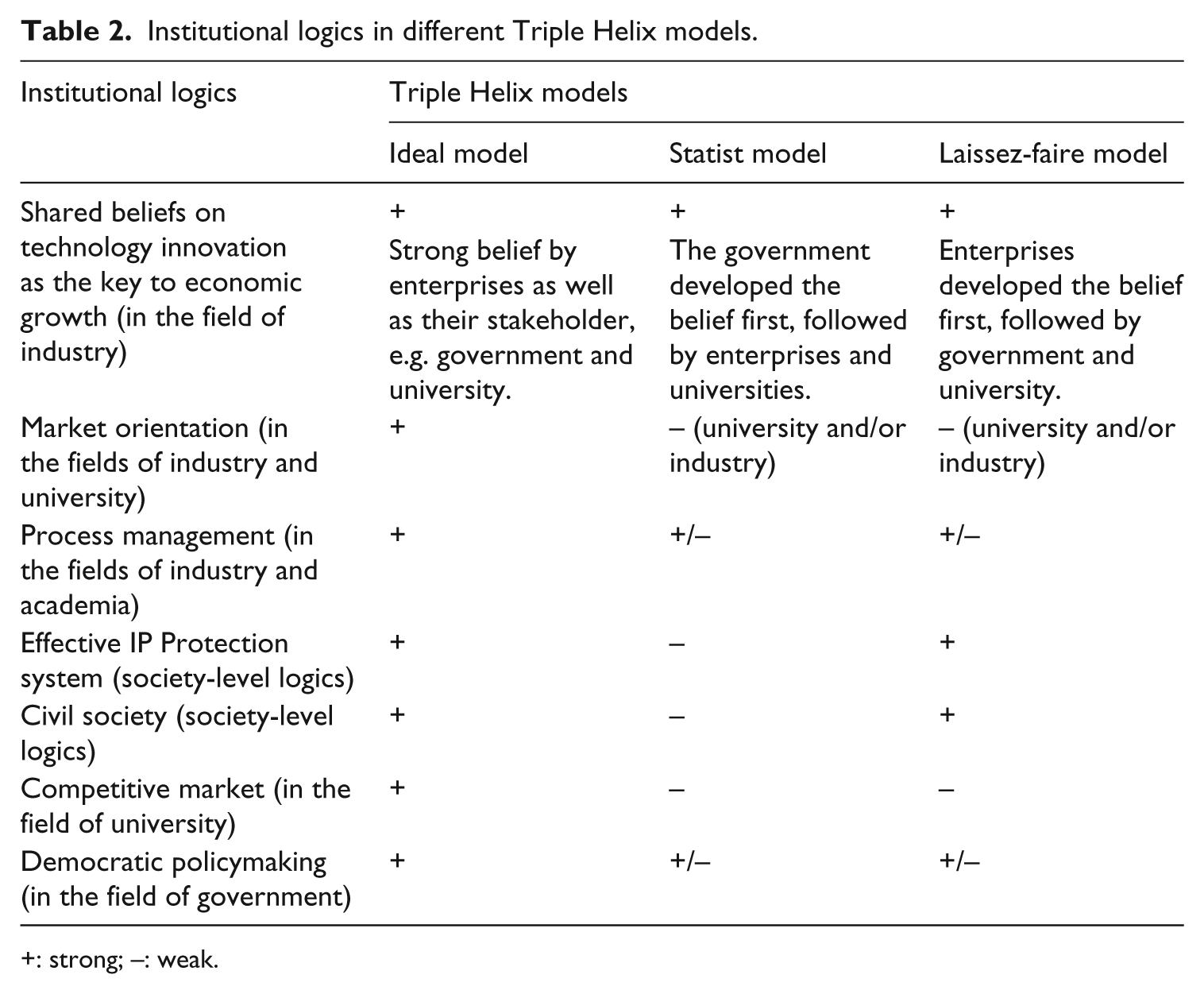
+: strong; –: weak.
An example of Triple Helix development in China and a creative cluster in Shanghai
This section illustrates how the trajectories of Triple Helix development may be different in a specific institutional environment, for instance in China. Etzkowitz et al. (2007) state that the Triple Helix relation of university, industry and government in China exemplifies a statist model:
On the one hand, neither the university nor industry sector is strong enough to become the organizer of regional innovation. On the other hand, the ownership relations among university, industry and government mandate that only government can become the organizer. Thus, government pulls the other two spheres to achieve regional innovation. (Etzkowitz et al., 2007: 16)
So far, Chinese economic reforms, like the development of national innovation systems, come from top-down initiatives. To encourage university–industry cooperation, the central government has invested heavily in national science parks. Such a statist model is determined by the overall institutional logics in China. In a situation where there is less trust between academia and industry, e.g. due to the weak protection of intellectual rights in China, such an approach is practically useful, especially for national priority projects. Yet, ‘it can also waste resources to generate prestige-driven flops’ (Someren & Someren-Wang, 2013: 31) and ‘may fail to ensure adequate resources for emerging technologies’ (WIPO, 2007: 15).
Following the framework of Table 1, Cai (2014) identified institutional logics in the Chinese context. The study shows that, although Chinese economic reforms have changed the policy environment in a direction that may facilitate the implementation of the Triple Helix model in China, some institutional logics may complicate the implementation of an ‘ideal’ Triple Helix model derived from the Western experience. The institutional logics that are gradually coming closer to those of the West include: (1) belief in technology innovation as a key to economic growth, (2) market orientation, (3) IPR protection and (4) market competition. The other three institutional logics, namely: (1) process management, (2) civil society and (3) democracy in policymaking, aligned with the Triple Helix activities in the West are largely absent in China. The counterparts of these logics in China are deeply rooted in the Chinese traditions and political system, and are likely to persist in the foreseeable future.
While this study presents an overall picture of China, the institutional logics at the regional level may differ to varying extents. For instance, Cai and Liu’s (2015) study is based on the case of the development of Tongji Creative Centre, and they use the label of ‘delayed government-led Triple Helix model’ (Figure 4) to describe the university, industry and government relations in the development process in this case. The delayed government-led model is not static, but represents a dynamic process of changing relations between the university, industry and government.
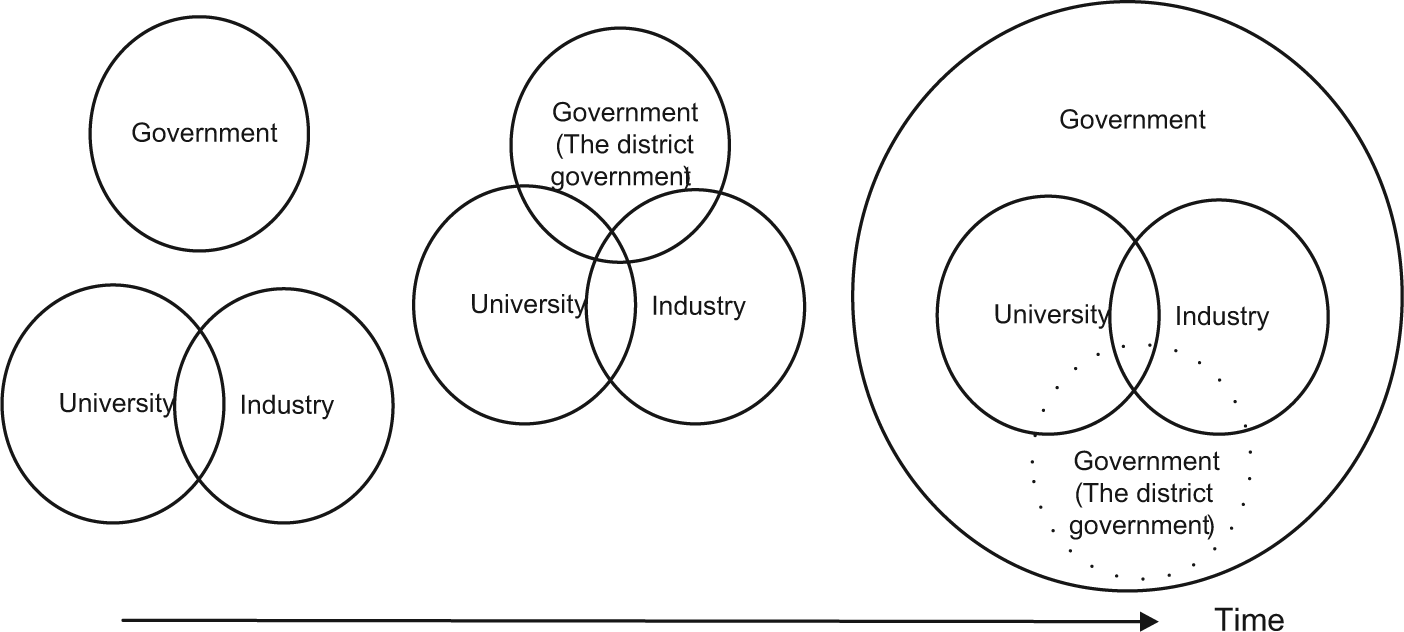
Delayed government-led model.
In the initial stage, the interactions between Tongji University and the surrounding industry (mainly the university’s spin-off companies) in the cluster were spontaneous, and there was no intervention from any level of government. While the cluster of these companies grew very fast, it gradually attracted special attention from the Yangpu district government, where Tongji University is located. Then the cluster entered into the second development stage, in which the relations between university, industry and (district) government in this stage closely resemble the ‘ideal’ Triple Helix model. Here the district government came into the picture as a partner, performing its role through ‘reflective control’ (Etzkowitz & Leydesdorff, 2000). The local government invested financial resources to promote the cluster’s development and also introduced matching policies. In the last stage, the Shanghai municipal government and the central government became involved and took control of the overall development of the cluster. The central government especially played an important role in integrating the university into the national innovation system, e.g. in building cross-regional linkages among the university, industry and local government, and in maximizing the intangible capital of the cluster through a number of influential programmes. Although the district government is still involved, its role, on the one hand, is outweighed by those of the municipal and central governments and, on the other hand, has been transformed to be more encompassing.
The development of such a different Triple Helix model is due to a variety of local political, social and economic conditions, in other words different institutional settings. From the institutional-logics perspective, this case can be compared to the general situation of China as shown in Table 3.
Institutional logics in the Chinese national context and the regional context of the case models.

Conclusions
Applying an institutional-logics perspective in Triple Helix analysis is an attempt to improve context sensitivity. Here the Triple Helix model is further elaborated in two ways. First, the Triple Helix model can be seen from the perspective of dynamic evolution, in which four development stages are distinguished. Second, the key activities in each stage can be aligned with a variety of ideal institutional logics. This study demonstrates in particular that the seven sets of institutional logics aligned with the ‘ideal’ Triple Helix model can be further developed into a benchmark for understanding the implementation of Triple Helix in a specific context.
The analysis in this article suggests that developing innovation systems such as the Triple Helix model is not merely about how to leverage relations between academia, industry and government for dynamic economic growth, but is also a matter of adjusting the institutional environment or institutional innovation. This corroborates and substantiates the latest research on Triple Helix, which emphasizes the interactions between the three institutional spheres of university, industry and government (Ranga & Etzkowitz, 2013). Although the notion of institutional sphere has long been used in the elaboration of the Triple Helix model (e.g. Etzkowitz, 2008; Etzkowitz & Leydesdorff, 2000), it has not been clearly defined. One recent attempt at further understanding the concept of institutional sphere is that by Zhou (2014), who distinguishes it from the concept of functional sphere. Although her conceptualization lacks theoretical foundation, her interpretation of institutional sphere is fairly close to the concept of ‘organizational field’ (DiMaggio & Powell, 1983), which consists of a set of institutional logics (Greenwood et al., 2011; Thornton et al., 2012). The intersection between institutional logics and the Triple Helix concept has the potential to provide new insight into the nature of the organizational field (or institutional sphere) of each helix. It particularly leads to a more nuanced analysis of the institutional context in which the Triple Helix is developed.
The ‘ideal’ Triple Helix model is likely to occur in those contexts where all seven sets of ‘ideal’ institutional logics co-exist and intersect with each other. When one or more of these institutional logics are missing, the Triple Helix can be developed in different models, such as statist, laissez-faire or others. While these logics can best be observed in most Western societies, their intensity between Western countries may vary. More different and even contradictory institutional logics are to be found between Western/developed and non-Western/developing contexts.
It must be noted that institutional logics do not necessarily lead to a Triple Helix model but only create enabling conditions. To what extent the Triple Helix will be developed depends on innovation policies and the key actors participating in the innovation process. Nevertheless, institutional-logic analysis provides a solid basis for policymakers to better design innovation policies by employing appropriate Triple Helix approaches. This will be especially useful for developing and transition countries still seeking optimal operational models to streamline the relationships between university, industry and government.
One common approach among these countries is learning and borrowing the ‘ideal’ model from the West, as this has proven most successful in promoting innovation and economic growth. This can be explained by ‘mimetic isomorphism’ (DiMaggio & Powell, 1983), which is characterized by copying structural elements of organizational patterns believed to be successful and legitimate. Normally an organisation facing uncertainty tends to imitate well-established organizations, which is the case when many developing countries design new strategies for developing innovation systems. However, these countries must be aware of the unique local institutional frameworks. Instead of asking ‘which are the “best practices” that should be adopted’, they should ask ‘whose practices are considered “best practices”’ (Steiner-Khamsi, 2014: 154).
When a non-Western country borrows ‘advanced’ experience from the West, it is not a matter of learning a technical means; the Western ideologies and cultures inherent in the Western model are imported, too (Cai, 2012). Thus, when the ‘ideal’ model is introduced into non-Western contexts, on the one hand some contradictory institutional logics in the local contexts may cause barriers to implementing the Triple Helix model, and on the other hand some Western logics aligned with the model may have an impact on the local institutional settings. Therefore the implementation process in non-Western contexts may prove difficult due to the dissimilarities in institutional logics. This being so, these countries should not feel frustrated. Rather, they may also evolve more compatible and innovative approaches to developing their own innovation systems by leveraging institutional differences.
Finally it must be acknowledged that the identification of institutional logics aligned with Triple Helix models in this study is preliminarily based on a review of the relevant literature. Given the limited space, more case studies on Triple Helix systems available in existing literature have not been included, but these deserve special attention in future study. Moreover, new empirical studies guided by the institutional-logics framework are anticipated.
Footnotes
Acknowledgements
I am deeply indebted to Henry Etzkowitz, Loet Leydesdorff and Chunyan Zhou for their thoughtful advice and warm encouragement throughout my two-year-long process of writing and refining this article. I am grateful to Andy Traveller and Anne Swanson for their review and suggestions on an early version, and for the helpful comments of two anonymous reviewers.
Funding
This research received no specific grant from any funding agency in the public, commercial, or not-for-profit sectors.