



Abstract
The article takes theoretical inspiration from Peirce’s views on emotion categorization and proposes to apply these ideas to the analysis of an historical episode. The latter is the resignation of former Egyptian President Hosni Mubarak, and more specifically the emotions that Egyptians expressed in Tahrir Square following Mubarak’s resignation. The article compares the dynamics of these emotional expressions as narrated by the media, on the one hand, and as they can be reconstructed from the direct witnessing of raw video materials, on the other.
Media expressions of emotions are frequently criticized but rarely considered in the social sciences as an object of study in their own right. Implicitly, the criticisms developed by Gustave Lebon (1895) regarding emotions as merely instinctive and irrational pulsations spreading through a crowd by contagion, underlie most of the comments. Although Adam Smith, in the 18th century, tried to explain why the reader of a newspaper is affected by the news of an earthquake happening miles away, and invented the figure of an inner spectator, and despite Luc Boltanski’s more recent book, La souffrance à distance (1993), which insists on the efficiency of emotions as expressions of public concern, the idea that emotions are irrational is still prevalent. In what follows I seek, on the contrary, to develop a pragmatist approach to these questions based on the theory of the Interpretant developed by Charles Sanders Peirce. 1 As we will see, Peirce’s originality consists in the introduction of a conceptual mediation to the process of manifestation of emotions that is opposed to the usual definition of emotions as spontaneous, impulsive or irrational.
This proposition is illustrated by an analysis of several videos covering the resignation of Egypt’s President Hosni Mubarak on 11 February 2011 – videos that show the collective demonstrations of joy in the streets of Cairo. The corpus is composed of videos recorded by the international TV channels, CBS, ABC, Al Jazeera, France2, BBC and CNN, and a video that has circulated on YouTube since 11 February. The YouTube video casts a different light on the manifestations of jubilation in Tahrir Square from that of the TV narratives, and it is these differences I want to explore in this article.
A semiotic approach to emotions 2
What are the new elements brought by a pragmatist approach to the emotions, and what is the specificity of Charles Peirce’s theory? Originally, his theory was an answer to William James’s definition of an emotion as the sensation of a bodily change. Peirce does not think that bodily manifestations determine emotions and insists on the role of interpretation, which makes us distinguish tears of joy from tears of sadness, for instance. He also remarks that, if the body reacts to a perception, it seems to react to the initial ‘feeling-quality’ of an object or of a situation (firstness). But, in reality, the quality of a situation is never a first impression or, if it is, it occurs before any attempt to determine such a quality. On the other hand, the determination of an emotion requires the mediation of a concept. Considered as a firstness, an emotion is a feeling, but, as part of an inference, it becomes a judgement (thirdness) (Chevalier, 2007). When we say that we are anxious or sad, we need a concept of anxiety or sadness that can be applied to various situations. For this reason, we may consider emotions as signs.
A sign is composed of a representamen, an object and an interpretant. Bodily movements could be considered as representamens (tears as signs of sadness), or interpretants (the situation from which the tears originate is sad). The objects of emotions are the situations in which they develop. Following Peirce:
If a man is angry, he is saying to himself that ‘this or that is vile or outrageous’. If he is in joy, he is saying ‘this is delicious’. If he is wondering, he is saying ‘this is strange’. In short, whenever a man feels, he is thinking of something. Even those passions which have no definite objects as melancholy only come to consciousness through tinging the object of thought. (Peirce, 1931/35: 292)
These situations are the objects of emotions, and when we need to determine an emotion we require the mediation of a concept. When we want to determine an emotion, i.e. to name what we are feeling, we will use a concept of joy, sadness or anxiety, which can be applied to a great variety of situations and also a manifold of bodily reactions. The process of determination of an emotion is the same, for Peirce, as the determination of a perception. When we say that an oven is black, ‘is black’ requires a concept of blackness, which can be applied to a large number of different objects.
However, it is a different operation to determine our own emotions and to determine another’s emotions. The physical movements can be considered as indices that somebody is feeling a specific emotion. Indices link a First to a Second object in various activities such as fight, love, work, etc. The term ‘index’ or ‘indice’ refers to an object in the outer world, such as an index finger pointing toward something. These signs are affected by their object in the way a weather-vane is affected by the wind or a footprint in the sand is affected by a foot. So far, we consider other people’s bodily changes as symptoms, and we diagnose their emotions on that basis. This means that individuals can be affected by the situation that they have to face. To this extent, we may consider emotions as a transaction between an organism and its environment (Aranguren & Tonnelat, 2014; Dewey, 2011).
In return, these bodily changes can give rise to specific reactions. John Dewey observes that, when a baby cries, its mother may interpret the crying as an indication that the baby is hungry or that something is causing him discomfort, and will act in order to change the conditions that have given rise to the baby’s cries. As the baby grows up, he becomes aware of the relationship between his cries and his mother’s response, and may cry intentionally to make his mother come to him. In this case, the intentional cry becomes a linguistic sign, a symbol. It may be used to inform or communicate, and above all, to give rise to a specific response. In communication, we treat bodily movements as indices giving evidence of what somebody is feeling, and also as symbols designed to elicit specific responses from someone else. Again, the transaction between an organism and its environment is never direct but conveys the conceptual mediation of an interpretant, which can be dynamic, energetic, or logical. David Savan argues that:
First, the emotional dynamic interpretant is the qualitative semiotic effect of that sign, second, the dynamic interpretant may be an act in which some energy is expended, and such an act Peirce called an energetic interpretant. The energetic interpretant may be a muscular encounter with the external world, or it may be the manipulation and exploration of the images of the inner world … The logical dynamic interpretant is the thought, concept, or general understanding actually produced by a sign. To think is to make inferences, to draw on consequences of certain premisses, to move in accordance with some general rule. (Savan, 1987/88: 48, quoted by Beeson, 2008)
The dynamic interpretant plays an important part in the dynamic of the situations themselves. The different categories of interpretants are never separated, but they can give rise to each other as the situation develops and they can give rise to new developments in the situation as well. If we tremble when facing a danger, we feel the qualitative effect of a situation; if we run to escape this danger, this is an energetic interpretant, and if we look for a place to hide, or if we try to find help, these are logical interpretants. Within the dynamic of the interpretants, we may possibly tremble, then run, then try to find help. As interpretants, bodily movements should not be considered as automatic responses to stimuli, but as being obviously endowed with a capacity of interpretation and cognition. More often, this process does not develop within a single individual but in a situation where several individuals are engaged. The signs of an emotion felt by A can give rise to an energetic or logical interpretant by B, which in return will be the source of a new interpretant from A or from other individuals, ad infinitum, allowing different individuals to adjust to each other.
These observations lead also to the conclusion that emotions are never fixed once and for all. They arise, progress, merge with other emotions, and sometimes just fade away. They result from ‘bouquets’ of sensations and physical reactions gathered into one single predicate such as sadness, joy, anxiety, melancholy, etc.
The emotions, as a little observation will show, arise when our attention is strongly drawn to complex and inconceivable circumstances. Fear arises when we cannot predict our fate; joy in the case of certain indescribable and peculiarly complex sensations. If there are some indications that something greatly for my interest, and which I have anticipated would happen, may not happen; and if, after weighing probabilities, and inventing safeguards, and straining for further information, I find myself unable to come to any fixed conclusion in reference to the future, in the place of that intellectual hypothetical inference which I seek, the feeling of anxiety arises. When something happens for which I cannot account, I wonder. When I endeavor to realize to myself what I never can do, a pleasure in the future, I hope. ‘I do not understand you’, is the phrase of an angry man. The indescribable, the ineffable, the incomprehensible, commonly excite emotion; but nothing is so chilling as a scientific explanation. Thus an emotion is always a simple predicate substituted by an operation of the mind for a highly complicated predicate. Now if we consider that a very complex predicate demands explanation by means of an hypothesis, that that hypothesis must be a simpler predicate substituted for that complex one; and that when we have an emotion, an hypothesis, strictly speaking, is hardly possible, the analogy of the parts played by emotion and hypothesis is very striking. (Peirce, 5.292: 147)
Two kinds of emotions seem to be at stake for Peirce. Some emotions like fear, anxiety or hope arise when the future seems uncertain or unpredictable, other emotions like joy and wonder arise when we experience something we cannot describe or account for, and these hypotheses concern the present situation rather than its future developments, and are a part of the process of determination of the situation as well. Emotions are predicates composed of sensations, which are themselves hypotheses. Mental processes organize the heterogeneity of various phenomena by inference. Therefore, emotions and sensations are part of a permanent and general inquiry that Peirce compares with a piece of music:
Thus the various sounds made by the instruments of an orchestra strike upon the ear, and the result is a peculiar musical emotion, quite distinct from the sounds themselves. This emotion is essentially the same thing [rather] than a hypothetic[al] inference. (Peirce, 2.643)
In order to communicate and to adjust to one another, individuals need to share the same interpretants. It is possible for someone else to consider that I am happy only if we share a common interpretant of joy or happiness. If several people manifest their joy to each other, each of them ratifies the interpretant of the others, and they will share the same interpretant. For Peirce, the interpretant is always social because it is held in common. Shared interpretants create continuity between the inner life and the social life, which otherwise would be so separated that we would be unable to communicate with one another. As we will see below, with the example of the jubilation of the Egyptians when learning that President Mubarak had resigned, the collective joy is not the result of some kind of contagion, nor is it a sudden collective outburst provoked by official good news, but rather it occurs because the participants share a common interpretant of what they are feeling with regard to the situation in which they are involved. This common interpretant is a value proposition on the situation which, as John Dewey said, ‘points in the direction of the conditions in which their common emotions originate’ (Dewey, 1939).
Emotions and the narrative structure of the situation: ‘The Friday of Victory’
The jubilation of the Egyptians upon hearing the news that Mubarak had resigned has been recorded and commented on by most of the international TV channels around the world. It is interesting to analyze the story told by the TV reports and to define what was actually considered by the media to be ‘the joy of the Egyptians’.
Narratives of the events of 11 February make sense against the background of the preceding weeks. By having refused to resign on several occasions, most notably on 10 February, Mubarak had given rise to disappointment and anger among the activists gathered in Tahrir Square and those involved at a distance in the social networks. On 11 February, they were still occupying Tahrir Square and some of them had organized the ritual Friday prayers to take place there. It is important to add that the category of people designated as ‘activists’ fighting against Mubarak’s regime included Christians and other non-Muslims as well as Muslims. The date, 11 February 2011, is characterized by a wide variety of emotions, ranging from uncertainty to indignation, from disappointment to a fierce determination to pursue the action initiated on 25 January. To a certain extent, the qualifications applied by Charles Sanders Peirce to those situations that, because they are ‘indescribable’, ‘ineffable’, and ‘incomprehensible’, ‘commonly excite emotion’ (Peirce, 5.292: 147), could be applied to the present situation. How did the media, especially the international TV channels, cover this situation?
Despite the diversity of the videos broadcast by Al Jazeera and the other channels such as CBS, ABC, CNN, BBC and France 2 during the night of the 11th and the day following Mubarak’s resignation, the various reports are based on, or contain the same assemblage of footage and develop the following schema:
The joy of the Egyptians.
Flashback to the preceding weeks when Mubarak’s resignation was inconceivable.
The announcement of Mubarak’s resignation being made by Omar Suleiman, Mubarak’s spokesman.
Outbursts of popular joy in Tahrir Square at the news.
Al Jazeera also broadcasts footage of various expressions of religious fervor during the midday prayer and images of Imam Jibril, famous for his support for the activists.
When the videos are live (on ABC for instance), they usually focus on the jubilation of the Egyptians. The reporters cover the demonstrations of joy in the streets of Cairo, alternating their comments with brief interviews. What follows is a transcript of the beginning of the story as told by Al Jazeera a few days later, looking back at the events of 11 February:
Good evening,
The Supreme Council of the Egyptian army, which owns the power since the resignation of the overthrown President Mohammad Hosni Mubarak, has declared that it did not share the legitimacy regained by the people.
And Omar Suleiman, the Vice-President, announced earlier that the toppled President Mubarak resigned considering the situation actually undergone by the country. Once the statement had been broadcast, hundreds of thousands of Egyptians went out into the streets of Cairo and other towns to demonstrate their joy at the end of Mubarak’s era.
(Voiceover): The Egyptians have done it and have toppled Mohammad Hosni Mubarak and his regime. Some weeks ago, nobody could have imagined that the Egyptian police regime, which has oppressed the Egyptians for thirty years, could collapse in eighteen days. (Press release of Omar Suleiman): President Hosni Mubarak decided to resign as President of the Republic and charged the Supreme Council of the Army to look after the country. God bless Egypt. (Voiceover): Omar Suleiman has just made this much expected pronouncement and in all the places in Egypt, everywhere in Egypt, there has been an outburst of joy, thanking god (Allahou Akbar). They have changed their famous slogan: ‘The people have toppled the regime’.
3
Different aspects of this video (a prototype of most of the videos broadcast by Al Jazeera as well as by the US and French channels) should be emphasized. First of all, we observe the direct relationship between Omar Suleiman’s statement and the joy of the people, which appears as a response within a dialogue. The spokesman’s statement is presented as the cause as well as the object of the joy expressed by the Egyptians. However, the narration does not say how, or when, the people happened to get the news in Tahrir Square. The statement seems to have been followed immediately by the outburst of joy according to the Question–Answer pattern of a conversation. The direct relationship of cause and effect leaves no room for any other sort of emotion, nor does it show any progression or evolution of the joy. The videos focusing on the emotion insist on its suddenness (‘outburst’, ‘explosion’), and the fact that everybody seems to share the same feeling: the views of Tahrir Square from above show a massive jubilant crowd. From that moment on, uncertainty, incredulity and anger are relegated to the past. Anger is mentioned as the dominant feeling just before the victory (the preceding Friday had been called ‘the Friday of Anger’).
Yet, the religious aspect of the situation is perceptible in footage on Al Jazeera showing the ritual Friday prayers. It qualifies the situation in a specific way (the prayer is said at midday by Sheikh Mohammad Jibril, famous for his support for the activists and his open-mindedness toward non-Muslims. He reads the prayer of the Qunuts, which is specific to times of catastrophe) and expresses another range of emotions: fervor and faith in God’s mercy towards the activists and more generally to the Egyptian people. Since the beginning, the public prayers of the Muslims, or the Christians, were part of the fight against Mubarak’s regime and played a decisive role in the narration of their action (Saber & El-Houri, 2014). However, this aspect is minor and takes up little room in the economy of the whole video, which, again, focuses on the fictitious dialogue between Omar Suleiman and the Egyptians. The fact that hundreds of people seem to have the same feeling at the same time turns the diversity of the activists (religious, political) and their supporters (the army, some famous religious figures) into one single collective agent: the Egyptians. In point of fact, the narration describes a dialogue between three agents: Hosni Mubarak and his spokesman Omar Suleiman on the one hand, and the Egyptians on the other. It says nothing of what is happening between the people actually gathered in Tahrir Square.
We observe the same narrative structure on the different international channels, with few variations. On ABC, reporter Terry Moran decides to join the people marching toward the Presidential palace, and his report seems embedded in the political action of the people of Cairo. Then, the religious feature has disappeared from the US and French videos, which do not show pictures of the prayers and do not seem to take into account the fact that the resignation takes place on a Friday, as well as the symbolic meaning attached to this fact.
On 12 February a video could be found on YouTube, filmed by an amateur, who obviously was in Tahrir Square among the activists praying at 5 o’clock in the afternoon. This video films the prayer and after a long while (approximately 4 minutes) shows how the news of Mubarak’s resignation found its way among the protesters, and the evolution of their reactions, including those of the man holding the camera. (A translation of the prayer and of the various audible individual comments can be found in the Appendix.)
The religious context of this video is important. The activists came to know that Mubarak had resigned during the ritual prayer of the evening, around 5 o’clock. The Surah chosen for this prayer asks God to punish the unfaithful (i.e. Mubarak’s supporters) and sounds like a threat: ‘Our camp will triumph’. For the activists, the prayer is a political action, a means to resist the dictatorship, and to transform a public place like Tahrir Square ‘into a place where communion is part of the public and popular political demonstration’ (Saber & El-Hourri, 2014: transl. by this author). The fact that the official statement is made during the prayer will make it appear to be an answer from God, a divine support and a legitimization.
At first, nobody seems to understand or to know for sure what is happening (someone says ‘There is a press release!’; someone else: ‘It could be a rumor’, ‘ask him to watch the TV’). If, instead of considering the joy of the activists as an effect of Suleiman’s statement, we consider it as an operation transforming a situation, we could say that this burst of joy turns the situation into the celebration of a political and religious victory. It comes gradually, through confusion, uncertainty, skepticism. Also, some people still want to finish the prayer, while others have started to shout, raise hands and flags, etc. … It performs the victory and, coming just after the prayer, turns the situation into a success which could be achieved thanks to Allah, and attaches a religious aspect to the political frame of this situation.
We can also observe this in the various documents they develop, which follow a different temporality. On the Internet, the narration is prospective. The action that is developing is filmed live and is oriented toward a goal and the expectation of an achievement, that is to say it is oriented toward the future. Day after day, this goal had moved away, and its withdrawal intertwined a horizon of expectations and a field of experience. This shaped the political experience of the activists: experience of the difficulty of the task, of what a pacifist fight actually means, the experience of solidarity, of the fear of the violence that could be committed by the army at any moment. The expression of collective joy was a sort of climax, a culmination of these different phases of uncertainty and faith. It gave meaning in retrospect to what had happened previously and organized the variety of the previous reactions into one emotion. Joy, considered as the end-point of an evolutionary situation, completes the narration, which becomes, again retrospectively, the narration of a revolution achieving its goal with a happy ending. The ‘Friday of the Victory’ follows hopefully on the ‘Friday of Anger’.
On the TV channels, the narration from the very beginning has been oriented toward the past, recounting what has happened under the description of an ending. It starts with the joy of the Egyptians and then goes back to the preceding hours. The joy appears to be the consequence of the spokesman’s statement, and from this point of view, the situation is already organized as a whole when the narration begins. Thus, the aspect of uncertainty, hesitation, incomprehension, that was embedded in the situation as it developed, now disappears. Joy, as a dynamic emotion that is the result of a variety of interactions and of several other emotions embedded in a situation, gives way to a label: ‘the joy of the Egyptians’, meaning that the situation is already achieved. The narration, then, has to explore the causes of the popular joy, while the YouTube video shows a process oriented towards an ending.
In the second type of TV report based on live videos, the story begins with the expressions of jubilation, the people already know that Hosni Mubarak has resigned and they rush into the street to share the victory. Here too the situation is already determined when the report starts.
Spiral of the interpretants: The meaning of bodily movements
Comparisons between the news on the international TV channels and the amateur YouTube video show how the emotions are intertwined in a different way in the narrative structure of the situation. Furthermore, we notice that the role of the interpretants is also different in both cases.
If we apply Peirce’s trichotomy of signs to the TV reports, we may characterize the bodily movements of the activists as representamen (raising arms, moving flags, jumping up and down, screaming, smiling, etc.). The interpretant given by the journalist’s comments is ‘the joy of the Egyptians’, and the object of this joy is the victory. This organization can be schematized as shown in Figure 1.
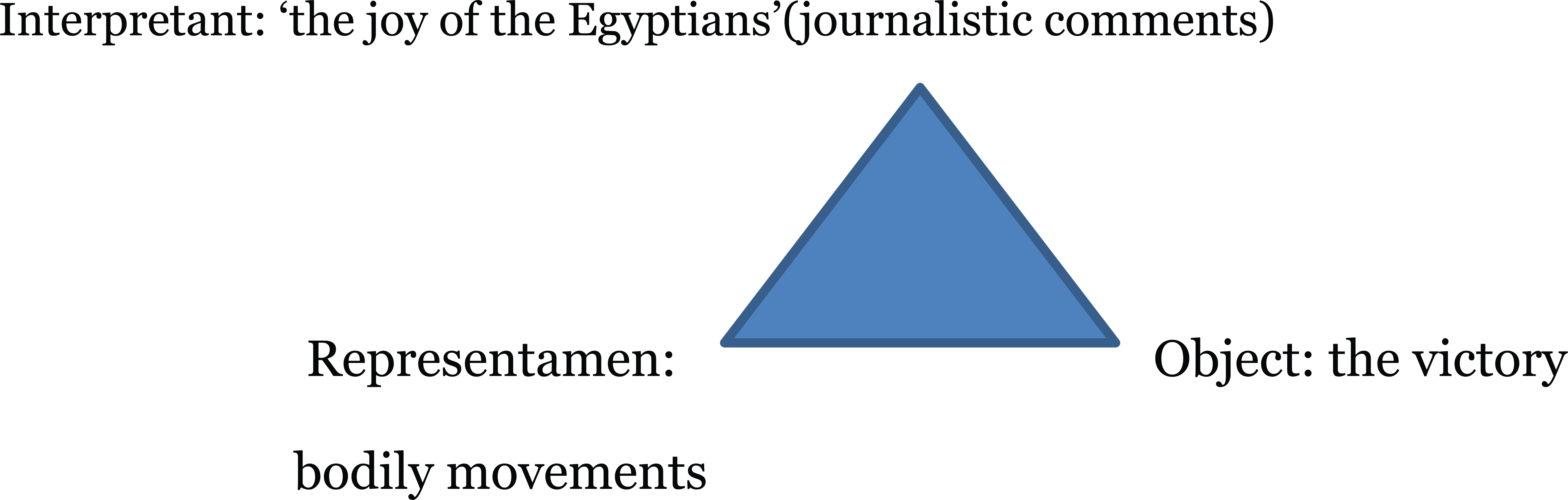
Schematization of the journalistic interpretant of ‘the joy of the Egyptians’.
The media translate the bodily movements produced by the activists into a linguistic interpretant, and the variety of these movements is gathered into one single hypothesis: joy. This interpretant is logical, ‘giving a name to a manifold physical reactions’, this name is a concept that could be applied to many different situations, but which seems convenient in the present case. On the other hand, the physical reactions of the activists on the amateur video can also be considered as an energetic interpretant of the situation, or, let us say, a valuation. In fact, from the video on YouTube to the TV reports, the spiral of the interpretants could be developed as shown in Figure 2.

Spiral of the interpretants of ‘the joy of the Egyptians’.
On passing from the filming of the situation as it is lived by the activists to the media narration, a shift happens in the production of meaning. In the amateur video, the bodily reactions of the activists are a valuation of the new situation, which they manifest to one another. These manifestations aim at arousing a specific response (raising hands, jumping, dancing, smiling, etc.). At the beginning, some participants show their disagreement, wanting to give priority to the prayer, which adds to the confusion, and then they gradually, mutually, ratify the same interpretant. From this perspective, Mubarak’s resignation is also a sign whose object is God’s will. And this sign gives a new legitimacy to the people.
No TV cameras have reached this area of Tahrir Square yet, and the interactions among the activists are based on a bodily appropriation of the new situation, which means that they are ‘touched’ by what is happening, a valuation of the situation as positive, fulfilling expectations and hopes, and a mutual ratification of what is felt by everyone. What the video shows is in fact a transaction (Aranguren & Tonnelat, 2014). On the other hand, the different operations of meaning produced by the journalists on the whole applies a concept of joy to the variety of bodily reactions. These reactions appear as an answer to a statement, and the concept of joy puts a label on a situation which is, henceforth, stabilized. The religious feature and the link between the prayer and the jubilation disappear. In addition, the people filmed in the reports, whether they are activists or just supporters of the victory against Mubarak, are obviously no longer addressing each other. Facing the camera, these bodily movements then become a sign of victory addressed to the whole world.
Joy and fervor in Tahrir Square and from a distance: The constitution of a collective entity
There is another significant difference between the TV coverage and the amateur video: the amateur video refers to ‘the activists’, while the TV reports refer to ‘the Egyptians’. Following Gabriel Tarde, a crowd is homogeneous and reacts as ‘one man’ and can behave in a freakish way when emotions get into it. On the contrary, a Public is heterogeneous and characterized by a capacity for dialogue. The different documents analyzed in this article cast a new light on the role of emotions in the constitution of collective entities. On 11 February, this collective entity becomes visible as a result of an emotional activity, which on the one hand is performed in Tahrir Square as well as in the social networks as we will see, and, on the other hand, is also performed by the media narrations. There is no doubt that the people gathered in Tahrir Square are very diverse from a social, religious as well as a political point of view. At the last moment, the army also joins the protesters. The support of the army and some famous religious figures for the civilians is a rare example of unity.
The amateur video shows clearly a variety of reactions when the news begins to find its way among the people: uncertainty and confusion prevail for a long while. There is also some disagreement between those who want to pray and wait until the end of the prayer and those who want to celebrate immediately. We can hear some people shouting: ‘The prayer! The prayer!’ The man with the camera talks to somebody who is with him and asks him several times to check the news. There are few televisions and they have been placed at the far ends of the square; in the middle of the square nobody can hear Omar Suleiman’s statement. They will gradually learn what is happening, but this will take time, nothing in common with the dialogue shown in the TV reports. This complete confusion is also very different from the homogeneity of the ‘joy of the Egyptians’. In Tahrir Square, a collective entity arises through a progressive sharing of common interpretants and a myriad of transactions.
Meanwhile, the video, once posted on the Internet, appeals to the comments of the internauts. The video received 60 comments, which can be divided into several categories. 7
– Congratulations and expressions of support: ‘Bravo!’, ‘Congratulations’, and wishes expressed using the formula ‘May…’. – Comments ratifying the victory: ‘Long life to the people of Egypt!’ – Comments projecting a specific field of revolutionary experience or liberation on the present event (from Russia, China, Cuba, Germany, for instance). – Comments opening new horizons of expectations: ‘To which point can this movement spread all over the Arab world and further, in Africa for instance?’ – Comments questioning the shape of the new collective entity arising from the action qualified unanimously as a revolution: ‘I feel when reading all these comments that what’s happening is the start of the Arab unity.’ ‘The Arab Egypt, Nasser’s Egypt, Egypt the mother of all Arab countries, Egypt the strong, Egypt the mighty will be back again and bring to all its sons and to all Arabs pride and dignity. Congratulations to Egypt, the Arabs and all free people of the world.’
Obviously, for internauts, the subject of the political revolution is Egypt as a national, geographical and historical entity. Indeed, some comments insist on the diversity of the activists:
People in the square came from a multitude of ideologies and walks of life. There were liberals, conservatives, moderates of both Islamic and Christian affiliations. The majority didn’t have any religious motive behind the protest. They went there to call for democracy, freedom and a better life. Trials to place a frame around all of them, labeling them under a single belief system, is a grave mistake. (
But, the reference to Nasser widens the shape of this historical subject to the Arab world. The international expressions of support and solidarity show that this subject goes far beyond the group of agents filmed by the video. In fact, through the sharing of joy, the internauts produce a kind of reflexivity to the activists that is not based on the use of the videos as a mirror but, again, on the sharing of the same interpretants. When talking of ‘the joy of the Egyptians’, the media collaborate in their way in this process of reflexivity and bring it to a head. The activists are then assimilated to the Egyptians as a whole, which makes the revolution the fight of a people against one single dictator. The specter of a civil war is temporarily dismissed. However, some comments express their surprise when comparing the video and the TV reports:
Wow this is the amazing stuff you don’t see on the news necessarily. thanks for uploading. I had no idea people were still committed to prayers even though the announcement came and cheers were happening all around them. (
Thank you so much. This is the video I hoped existed. Because the Al Jazeera footage didn’t have the moment of liberation in this way. Historic. I will put it on the website of the Dutch magazine I work for. I applaud the courage and discipline of the Egyptian people. Peace. (
Conclusion
Far from opposing the television reports to an amateur video, the purpose of this article is to observe a form of continuity or process through different documents and to analyze the meaning of some discontinuities in this process. These documents show how one collective emotion, joy, operates in a situation. The joy of the Egyptian activists performs a victory against their dictator. Meanwhile, the emotion performs also a collective entity, the people of Egypt. Of course, this collective entity does already exist a priori. When the internauts refer to Nasser, they refer to this sort of entity. When the media talk of ‘the joy of the Egyptians’, they are talking about a people with a long History. This collective agent precedes every action and can be considered as an a priori. But this a priori collective entity also suddenly arises through the diversity of people celebrating their victory. Their joy unifies their diversity into a new collective entity, which can be qualified as an a posteriori (Kaufman, 2010). The sharing of the same emotion creates a We as a whole, which allows a collection of individuals to become a collective agent (Livet, 2002; Livet & Nef, 2009). The sharing of interpretants and valuations is part of this process. The joy as the achievement of an emotional and narrative process performs a victory as well as the collective agent of this victory. Such a performance does not secure the duration of the collective agent. It may fade away or split into different factions, and these divisions have since been experienced by the Egyptians. But it may also be a resource that could inspire future actions. Contrary to the Egyptians, ‘the people who toppled the regime’ had no long-lasting existence, but the event briefly created a living-in-common that was a genuine political experience.
Footnotes
Appendix
This is a translation of the Friday prayer and of the various individual comments that are audible on the soundtrack of amateur video footage recorded in Tahrir Square on 11 February 2011, which has subsequently circulated as a video on YouTube.
1. In the name of God, Most Gracious, Most Merciful.
2. Praise be to God, the Cherisher and Sustainer of the Worlds;
3. Most Gracious, Most Merciful;
4. Master of the Day of Judgment.
5. Thee do we worship, and Thine aid we seek.
6. Show us the straight way,
7. The way of those on whom thou hast bestowed Thy Grace, those whose portion is not wrath, and who go not astray.
Amen.
171. Already has Our Word been passed before this to Our Servants sent by Us,
172. That they would certainly be assisted,
173. And that Our forces, They surely must conquer.
174. So turn Thou away from them for a little while,
175. And watch them how they fare, and they soon shall see how Thou fares!
(His friend) No, let’s stay a little.
176. Do they wish indeed to hurry on our Punishment?
177. But when it descends into the open space before them, evil will be the morning for those who were warned and heeded not!
178. So turn Thou away from them for a little,
179. And watch how they fare and they soon shall see how thou farest!
180. Glory to thy Lord, the Lord of Honour and Power! He is free from what they ascribe to Him!
181. And Peace on the apostles!
182. And Praise to God, the Lord and Cherisher of the Worlds.
Funding
This research received no specific grant from any funding agency in the public, commercial, or not-for-profit sectors.