




Abstract
The present study investigates the interface between sociological and physiological analyses of violence. The aim is to explore the cognitive processes leading to violence in daily interactions. We suggest that violent interactions derive from uncertainty about the course of the interactions: something in the way an individual moves blurs the interactional rules and prevents other individuals predicting his or her intentions. From this perspective, gestures categorized as violent break execution regularities that are normally expected during the interaction and present regularities of their own. We test this hypothesis by an experimental recording of gestures and a quantitative analysis of their trajectories.
Introduction
Sociological and biological explanations of violence have long been disconnected. However recent works, both in sociology and neuroscience, present interesting results between which we can draw connections and on which we can rely to formulate new hypotheses on the genesis of violent behaviors.
In his book Violence: A micro-sociological theory (2008) Randall Collins makes a significant stride in the sociological understanding of violent actions. Analyzing written sources (testimonies, press articles and observation notes), photos and videos, Collins notes the diversity of violent events and their relative rarity compared to the great number of daily interactions. He therefore proposes to focus on violent situations – rather than considering violence from the sole individual perspective – and offers a model for understanding the particular shapes of the situations in which violent behaviors occur. 1 In his perspective, all violent interactions are characterized by a confrontational tension: situations derive into violence when this tension is not held back. It appears that, most of the time, confrontational tensions remain under control. Indeed violent speech or gestures are not easy to perform, as they go against the continuation of the interaction: ‘Confrontational tension and fear is not merely an individual’s selfish fear of bodily harm; it is a tension that directly contravenes the tendency for entertainment in each other’s emotions when there is a common focus of attention. We have evolved on the physiological level in such a way that fighting encounters a deep interactional obstacle’ (Collins, 2008: 27). Collins’s study analyses interactions in cases where this tension is not restrained because of the shapes of the situation – and eventually because of the social frame it relies on. 2
The micro-sociological analysis of violent actions zooms in on the physical dynamic of interactions (physical proximity, density or noise, for instance) and sheds light on the physiological substrate of interactions. The claim above that ‘we have evolved on the physiological level in such a way that fighting encounters a deep interactional obstacle’ (Collins, 2008: 27) contains a physiological argument that exceeds Elias’s evolutionary theory of civilization process since it anchors the dynamic of the interaction in the body (Elias, 2002[1939]). Following Elias, Collins states that physiological inhibitions go along with social coercion during the course of interactions. Collins adds that what is at stake in violent actions is the bypassing of the physiological brakes during face-to-face interactions.
This assumption suggests interesting connections with recent research in affective and cognitive neuroscience. These works notably point out that violent actions derive from cognitive impairments to process-situational information. For example, in a recent study, the neuroscientists Mariska Kret and Beatrice de Gelder (2013) tested the hypothesis according to which violent offenders readily detect a threat from the emotional body language of a person. After presenting photos and videos of actors with blurred faces in fearful, aggressive and neutral postures to 29 men convicted of aggression and to a control group composed of 31 men with similar socioeconomic characteristics, the authors concluded that violent offenders tend to interpret ambiguous body signals as aggressive, therefore forming aggressive anticipations about individual intentions (Kret & de Gelder, 2013: 407).
A recent and complementary study supports the idea that cognitive impairment in set-switching and feedback processing explains violent actions: using the Wisconsin Card Sorting Test, Vilà-Ballo and colleagues (2015) investigated the hypothesis according to which aggressive behaviors in violent and non-psychopathic juvenile offenders are the consequences of a cognitive rigidity, i.e. an inability to process feedback information and therefore to adapt to situational changes.
Though focusing on a particular kind of individuals – violent offenders labeled as such by social institutions – these two neuroscientific studies make important contributions to an understanding of violent interactions in general. The first suggests that emotions enable behavioral adaptations to other individuals during interactions and that violent actions are related to the propensity to privilege aggressive signals. The second defines violence as a rigid way of facing situational changes.
The studies in affective and cognitive neuroscience and Collins’s micro-sociological analysis can be brought together and read in a new light if we introduce the following hypothesis: violent actions are related to uncertainty during and about the course of an interaction. Though the role of uncertainty is not explicitly formulated by the authors, one can read their work in the light of this hypothesis. First, in Collins’ situational observations, uncertainty about each other’s intentions often works as a starting point in the rise of confrontational tensions. Second, emotional body-language studies suggest that aggressive interpretations occur when behavioral data leaves room for uncertainty. Finally, one can add that cognitive rigidity reflects an inability to deal with uncertainty: new information is not processed and remains ambiguous as the individual maintains the rules he/she knows.
In focusing on uncertainty, our study explores the interface between the above-cited physiological and sociological analyses of violent interactions. Our claim is that violent interactions derive from uncertainty about the course of interactions: something in the way an individual moves blurs the interactional rules and prevents other individuals predicting his or her intentions. Uncertainty arises when a physical or verbal act does not fit individual expectations. The act exceeds the social frame shaping the situation, that is, in Erving Goffman’s perspective, the cognitive scheme driving the interpretation of a situation and guiding actions (Goffman, 1967, 1974). The physiological dimension of interactions plays a crucial role in the formation of individual anticipations, or rather, to put it in Marcel Mauss’s words, in the building of individual attentes (1924). This core concept points out the fact that, during an interaction, individuals share common expectations about behaviors in order to understand the situation and to adjust their actions. Furthermore, Mauss underlines that attentes are cognitively, physiologically and socially shaped: indeed, attentes are not only pure cognitive calculation but designate the physiological state of anticipations expressed through gestures. 3 In this perspective, one can define a gesture as a dynamic body configuration of social and physiological structures.
The aim of the present study is to look at gestures in order to understand how an ambiguous situation occurs. We assume that gestures perceived as violent break execution regularities that are normally expected during an interaction and present regularities of their own.
In the following sections, we present our method and the results of our experimental inquiry, and discuss a definition of violence based on the notion of uncertainty. The article concludes by suggesting a new model for the study of violent interactions from both a cognitive neuroscientific and a sociological perspective.
Method and materials
An experimental approach: The festive violence paradigm 4
In order to test the hypothesis above, we designed an experimental situation based on three criteria. First, it had to offer observations of a situation that could be either non-violent or violent. Second, it had to engage bodies. Third, it had to be relevant for both neuroscientific and sociological scholarship. These criteria are well met in festive violent situations, i.e. violent situations deriving from festive activities. 5
Situations of festive violence have frequently been explored to test hypotheses about violence. Collins notes that entertainment can potentially drift into violence because of particular contextual data (physical proximity, noise, suspension of moral rules, for instance) (Collins, 2008: 242–281). The demarcation between festive and violent is also studied by Gregory Bateson, using frame analysis (Bateson, 1955). Studying monkeys, who play at fighting, Bateson concludes that meta-communicative signals exist that enable participants to agree on ‘this is play’. 6 The interpretation of these signals relies on primary and secondary mental processes, 7 so that participants can regulate their actions within a situation of double framing: the primary processes read gestures into the frame of fighting, whereas the secondary processes interpret fighting actions in the light of a play frame.
In order to design an experimental protocol, we adapted the ball-tossing paradigm, which has been used in neuroscientific studies to evaluate social ostracism (Van Beest & Williams, 2006; David et al., 2006). The studies show that ball tossing is an accurate experimental setting for the study of social interaction since it creates a social situation mobilizing widely shared skills. Moreover, one and the same action – tossing a ball – is bodily modulated depending on the social nature of the situation: ball tossing can be festive or violent, as the ball can be tossed to entertain or to harm.
Interestingly, though they do not explicitly refer to sociological works, the actual neuroscientific studies on emotional body language explore this social function of emotional body signals (De Gelder, 2006). Indeed, sociologists have largely documented and theorized the social shaping of the body. For instance, body modulation can be read in the light of Mauss’s techniques du corps (Mauss, 1935), of Gregory Bateson and Margaret Mead’s analysis of body socialization and uses (Bateson & Mead, 1942) and of Pierre Bourdieu’s theory of habitus (Bourdieu, 2000[1972]). These studies demonstrate that a gesture not only engages the physiology of the body but mobilizes social structures, which are embodied through socialization processes and act as guides for actions.
To address the issue of body expression during violent interactions, we designed a new paradigm that enabled us to empirically explore the difference of performance between festive ball tossing and violent ball tossing. In line with our starting hypothesis, we supposed that, if violent ball tossing introduces uncertainty about the course of the interaction, it will be executed with a higher variability than festive ball tossing. In other words, the more gestures move away from contained repertoires, the less they fit attentes and the more they generate uncertainty about the course of the interaction and the definition of the situation.
Recording and selecting the videos
We asked nine professional actors (five men and four women, mean age = 26.3 SD = 2.7) to perform five tasks, in which they had to build a gamme 8 of festive and violent gestures during simulated ball tossing. The video recordings of their performances took place during a seminar at the Jacques Lecoq Theater School in Paris. The ball was a 450-gram toning ball. The five tasks were labeled as follows:
Task 1: Imagine a person in front of you with whom you are playing ball tossing. Your exchanges must increase in intensity, that is, get more and more festive. Your gamme must be composed of four stages. You must keep the ball in your hand.
Task 2: The person you imagine becomes threatening. You answer violently with the ball. Your exchanges must increase in intensity, that is, get more and more violent. Your gamme must be composed of four stages. You must keep the ball in your hand.
Task 3: In pairs, you simulate with the person in front of you, who has a festive posture, a festive ball tossing. Your exchanges must increase in intensity, that is, get more and more festive. Your gamme must be composed of four stages. You must keep the ball in your hand.
Task 4: In pairs, you simulate with the person in front of you, who has a threatening posture, a violent ball tossing. Your exchanges must increase in intensity, that is, get more and more violent. Your gamme must be composed of four stages. You must keep the ball in your hand
Task 5: In pairs, you simulate with the person in front of you, who has a neutral posture, a festive ball tossing that gets violent. Your exchanges must increase in intensity. Your gamme must be composed of four stages of gestures: the first two get more and more festive, the latter two get more and more violent. You must keep the ball in your hand.
We recorded three gammes for each task and actor. We filmed the performances with three cameras, one positioned in front of the actors, the two others on their left and their right (Figure 1). We ended up with 135 videos (nine actors × three cameras × five tasks) consisting of 135 gammes (nine actors × five tasks × three gammes) or 540 gestures (135 gammes × four gestures).
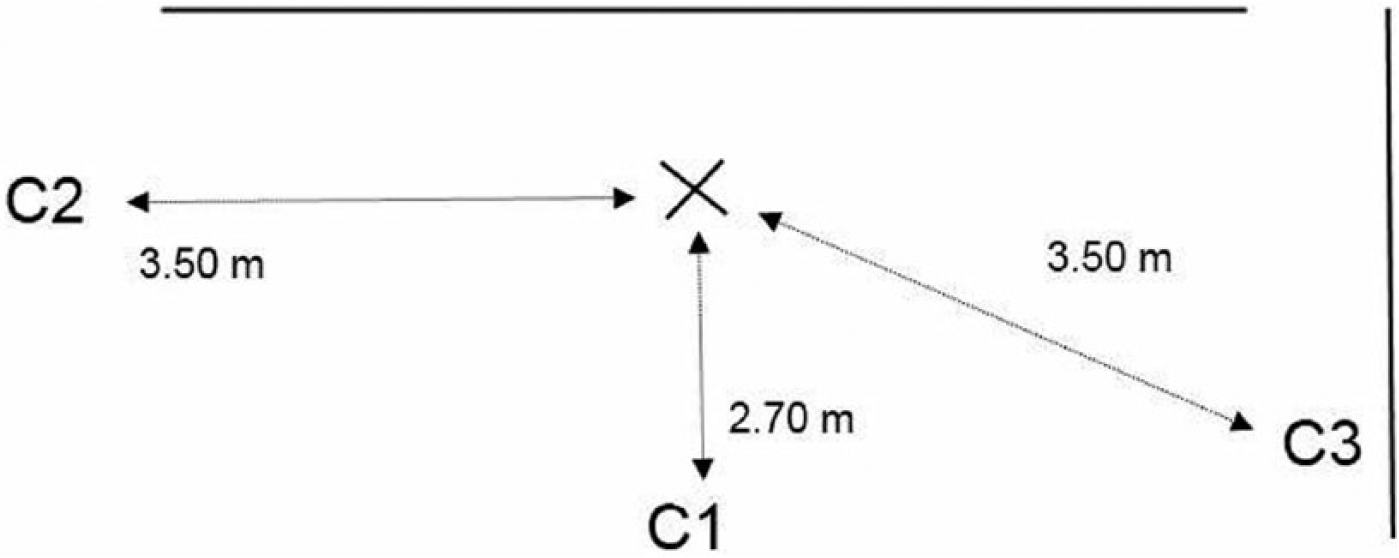
Map of recordings at Jacques Lecoq Theater School.
We then selected the performances of three right-handed actors – two women and one man – which were the most exploitable and suitable for a quantitative analysis: 9 gestures had to remain in the camera angle and to present a regularity among and within the gammes, i.e. not to be based on too much improvisation such as feints or jumping. Moreover, the ball should not fall to the floor. The following analysis therefore relied on 180 gestures (three actors × five tasks × three gammes × four gestures).
We purposely chose to analyze actors’ gestures as they professionally mobilize repertoires of gestures expressing different emotional intensity fitting a social situation. In other words, we were aware that the following analyses focus on gestures performed by actors that are not in a context of radical uncertainty. However, our aim was not to test how actors react emotionally or cognitively to uncertainty but to rely on their professional skills in order to record a great number of different executions of ball tossing – a restraint action, relying on widely shared skills and limiting improvisations. The capacity to perform a large gamme of ball tossing thus made the actors from the Jacques Lecoq Theater School suitable subjects for this study. 10
In the same perspective, we mobilized categories such as ‘festive’ and ‘violent’ without defining them in terms of emotions (Do festive gestures express joy and are violent gestures based on aggressiveness?), nor in terms of intentions (Do joyful individuals aim to please and do violent individuals want to hurt?) (Figures 2 and 3). Our purpose was to assess the interactional definition of violent situations through gesture variations. We therefore built our analysis on two categories of gestures (festive and violent) relying on actors’ performances precisely in order to identify what differed in the executions. 11

Photo of high-intensity festive throwing, recorded with C1 during the first task.

Photo of high-intensity violent throwing, recorded with C1 during the second task.
Quantitative analysis of the videos
In order to observe regularities and variations of festive and violent gestures, we analyze the videos recorded by C1. 12 Using Kinovea – a free software used in sports studies – we traced the trajectories of 11 body components: head, shoulders, elbows, hands, knees and feet. We focused only on members, articulations and body surfaces whose movements are visible and significant in face-to-face interaction (for example, during face-to-face ball tossing, toe movements are neither very visible nor central). From these recordings, we extracted coordinates representing the horizontal and vertical changes over time in the positions of the components on a plane. The center of this graph represents the middle of the line that we drew on the ground to indicate to the actors where they were to stand at the beginning of each gesture. We then calculated the duration and body surface for each gesture and the speed of each coded body component between each image (33 ms). We edited a table representing the dispersion (mean and SD) of these variables for each gesture.
Results
Our data analysis shows that (1) there are significant differences in the executions of festive and violent gestures; (2) these differences can be analyzed in terms of variability between festive and violent gestures and in terms of variability within each gesture category.
Execution differences between festive and violent gestures
In order to analyze the execution of festive and violent gestures, we first focus on three variables: duration, surface and right-hand speed (i.e. the speed of the hand that is tossing the ball) (Figure 4).

Duration, surface and right-hand speed comparisons of festive and violent gestures.
Festive and violent gestures present similar duration and surface features, but different right-hand speed features. Viewing the videos reveals that the duration comprises sequences of movement and immobility that differ with respect to festive or violent gestures. Moreover it shows that similar surfaces can result from different body trajectories and different ball-tossing strategies: festive gestures include moving to the left, to the right and backward, whereas violent gestures tend to move forward. The festive tossing is aimed at throwing the ball higher and further while violent tossing directs the ball from top to bottom towards what seems to be a close target. Taken together, quantitative data and qualitative analysis suggest that the main difference between festive and violent gestures relies on the right-hand speed and that it reveals different configurations of time and space.
Furthermore these variables differ regarding gesture intensities (Figures 5 and 6). Low-intensity festive gestures are faster than low-intensity violent gestures. High-intensity festive gestures are slower than high-intensity violent gestures. These data highlight that violent gestures are not necessarily rapid or executed with force, but that they rely on different intensity strategies for the occupation of time and space.

Duration, surface and right-hand speed comparisons of low- and high-intensity festive gestures.
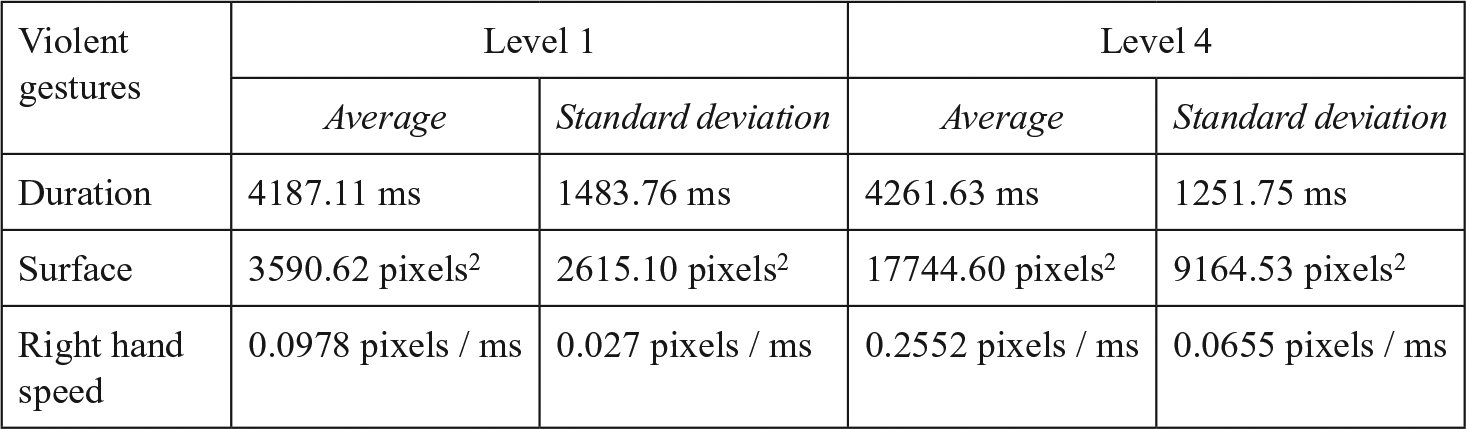
Duration, surface and right-hand speed comparisons of low- and high-intensity violent gestures.
In conclusion, these results confirm that the same action – throwing a ball – can be executed in different ways according to the festive or violent dimensions that individuals aim to give to their gestures – i.e. to the intensity of the gesture and to the context of the gestures – and that these variations produce different perceptive effects.
Variability of festive and violent gestures
The above-aggregated data lead us to compare festive and violent gestures regarding their variability, which we assess by means of standard deviations: how far from the mean do festive and violent gestures executions tend to drift?
We define two variabilities: internal and external. The latter corresponds to the level of variation that exists between gestures and is measured by the duration and the surface for each gesture as well as by speed standard deviations for the 11 body components we described above. Internal variability corresponds to the level of variation during the execution of a particular category of gestures (festive or violent) and is measured by the duration, the surface for each gesture plus speed standard deviations for the same 11 body components.
External variability
We edited a principal component analysis (PCA) in order to compare the surface, duration and speed standard deviations of each body component for each gesture. Our data set consists of 180 gestures (180 rows numbered from 1 to 180) described by 13 quantitative variables (surface, duration and 11 speed standard deviations). In addition, a qualitative variable describes whether gestures are festive or violent: the gestures from Task 1, Task 3 and the two first gestures of each gamme of Task 5 are festive; gestures from Task 2, Task 4 and the last two gestures of Task 5 are violent. Another qualitative variable describes the intensity of the gestures within the gamme, written M and numbered from 1 to 4.
We retained two dimensions, explaining together 79.40 % of variance (Figure 7). As Figure 8 illustrates, Dimension 1 explains 69,97% of variance and is highly correlated with the speed standard deviations variables, especially with those of the right elbow (0,9523) and of the left hand (0.9512). Dimension 2 explains 9,43% of variance and is correlated with the duration (0.8623) and the surface (0.5936). Furthermore, the variable graph highlights a co-variation of standard deviation variables (Figure 9).
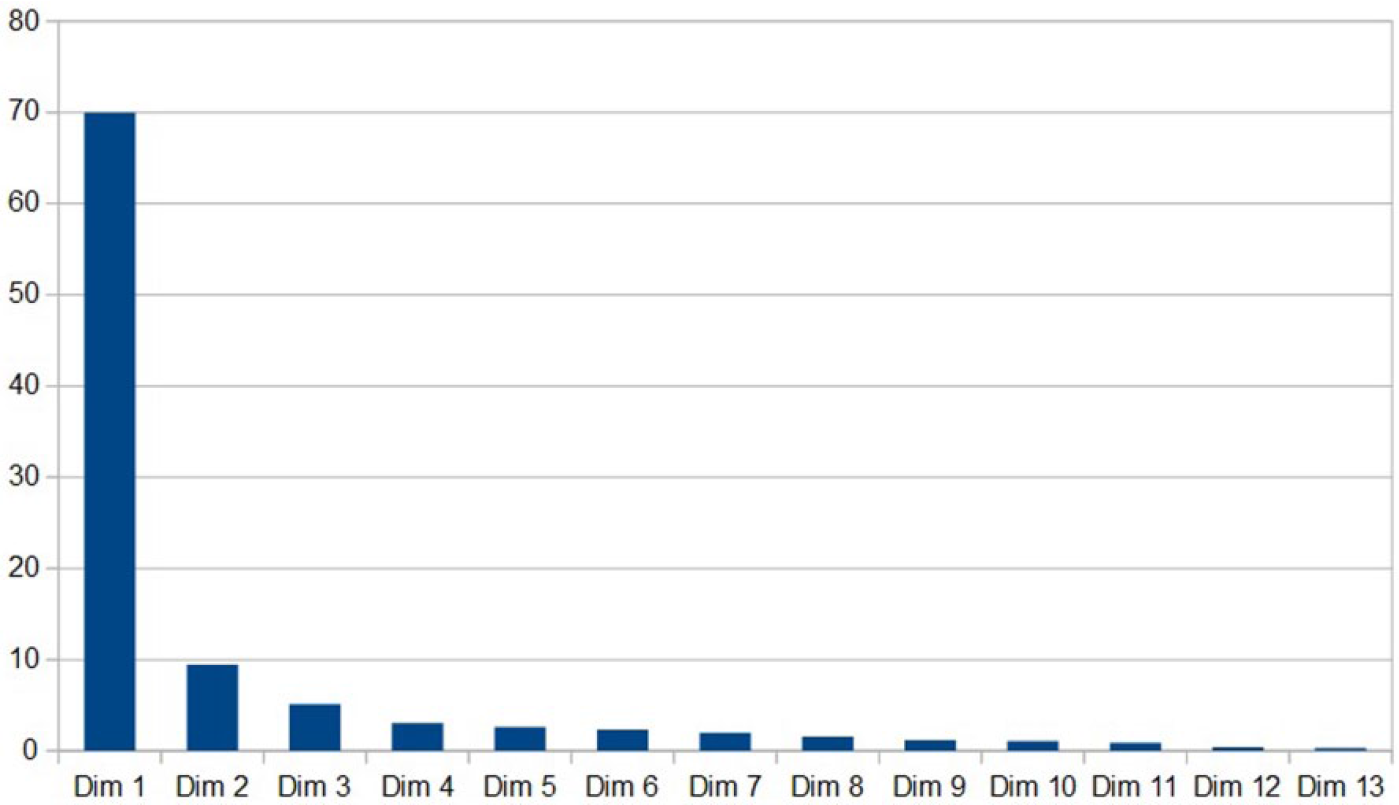
Barplot of the percentage of variance for each dimension.

Correlations of each variable with Dimensions 1 and 2.

Variable graph.
The distribution of gestures along the horizontal axis (Figure 10) shows a distinction between festive gesture and violent gestures: violent gestures tend to have a higher standard deviation than festive gestures. The distribution of gestures along Axis 2 appears less influenced by festive or violent category. The gesture duration is due instead to the experimental setting, given the fact that we asked actors to perform temporally standardized gestures ranked within a gamme. Moreover, the surface variable depends more on gesture intensities than on the festive or violent category, as Figure 11 shows. In other words, our experimental design explains why gestures are uniformly distributed along the vertical axis independently of their festive or violent patterns.
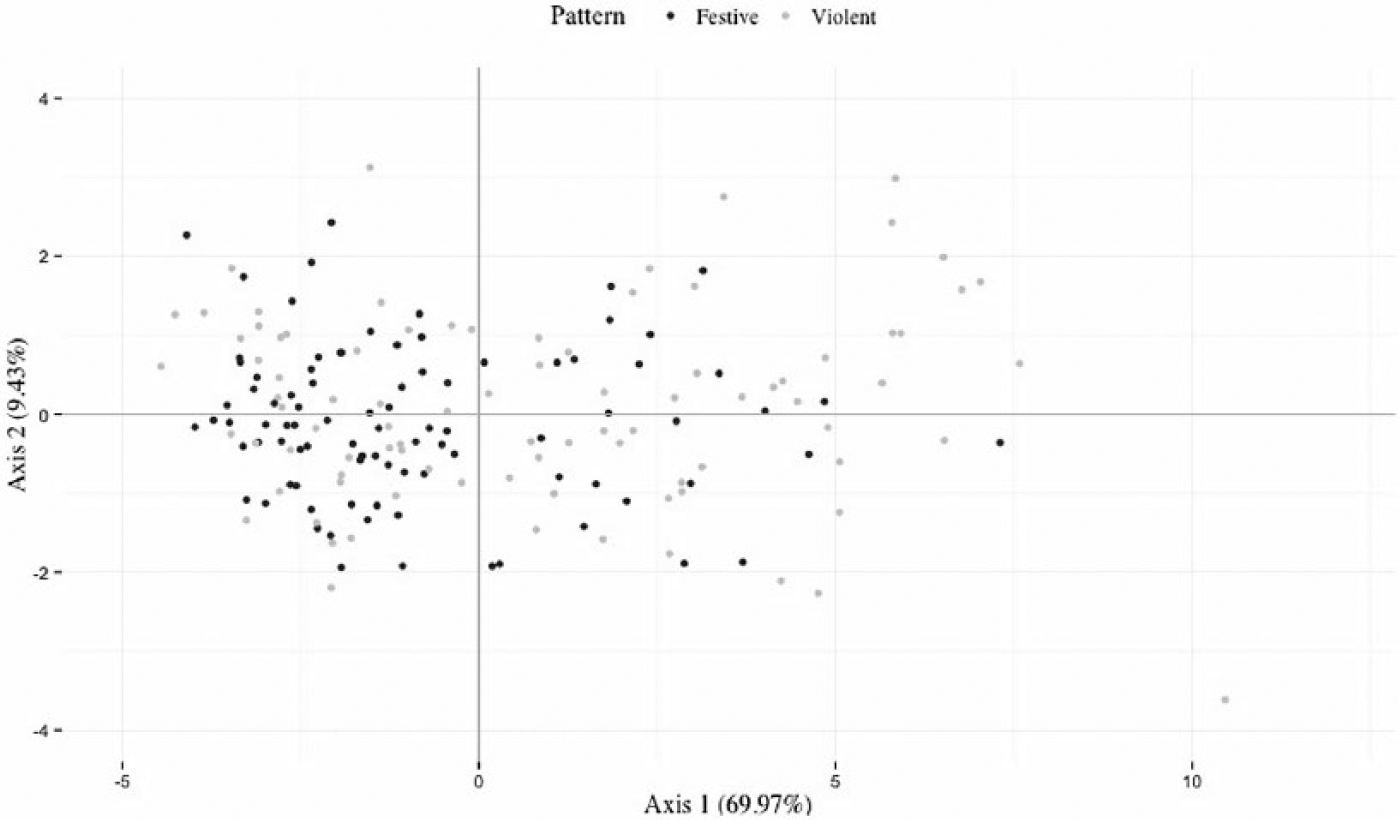
Gesture graph differentiated by patterns (festive or violent).
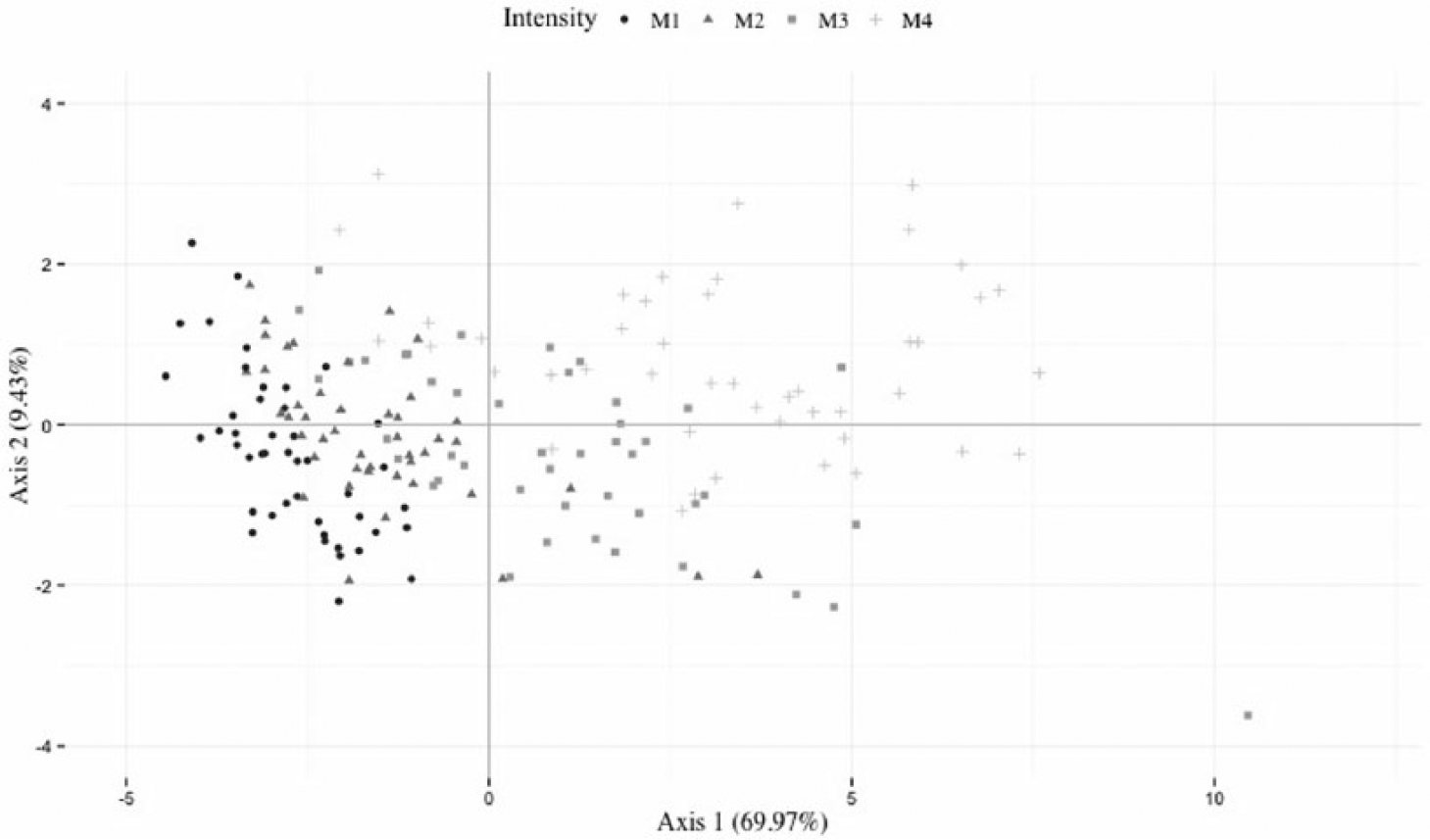
Gesture graph differentiated by intensity.
We deduce from the distribution of gestures along the horizontal axis that violent gestures have a higher variability than festive gestures: the tendency to have a higher speed standard deviation for each body component does not mean that violent gestures are necessarily faster, but that they tend to have a higher speed variability, i.e. they can suddenly be very rapid or very slow.
Internal variability
We edited a PCA focusing on the variability within each gesture pattern. We divided our data set in two, according to festive and violent categories. Our two data sets consist of 180 gestures (180 rows numbered from 1 to 180) described by 13 quantitative variables (surface, duration and 11 standard deviations of the speed of each body component). One supplementary qualitative variable describes the intensity of the gestures within the gamme, from 1 to 4.
PCA of festive gestures: We retained two dimensions, explaining together 76.12% of variance. Dimension 1 explains 65.60% of variance (Figure 12) and is highly correlated with the variables of speed standard deviations, especially with those of the right elbow (0.9443) and the left hand (0.9408) (Figure 13). Dimension 2 explains 10.52% of variance (Figure 12) and is correlated with the duration (0.8703) and the surface (0.5879) (Figure 13). The variable graph illustrates the co-variation of the speed standard deviation variables (Figure 14).
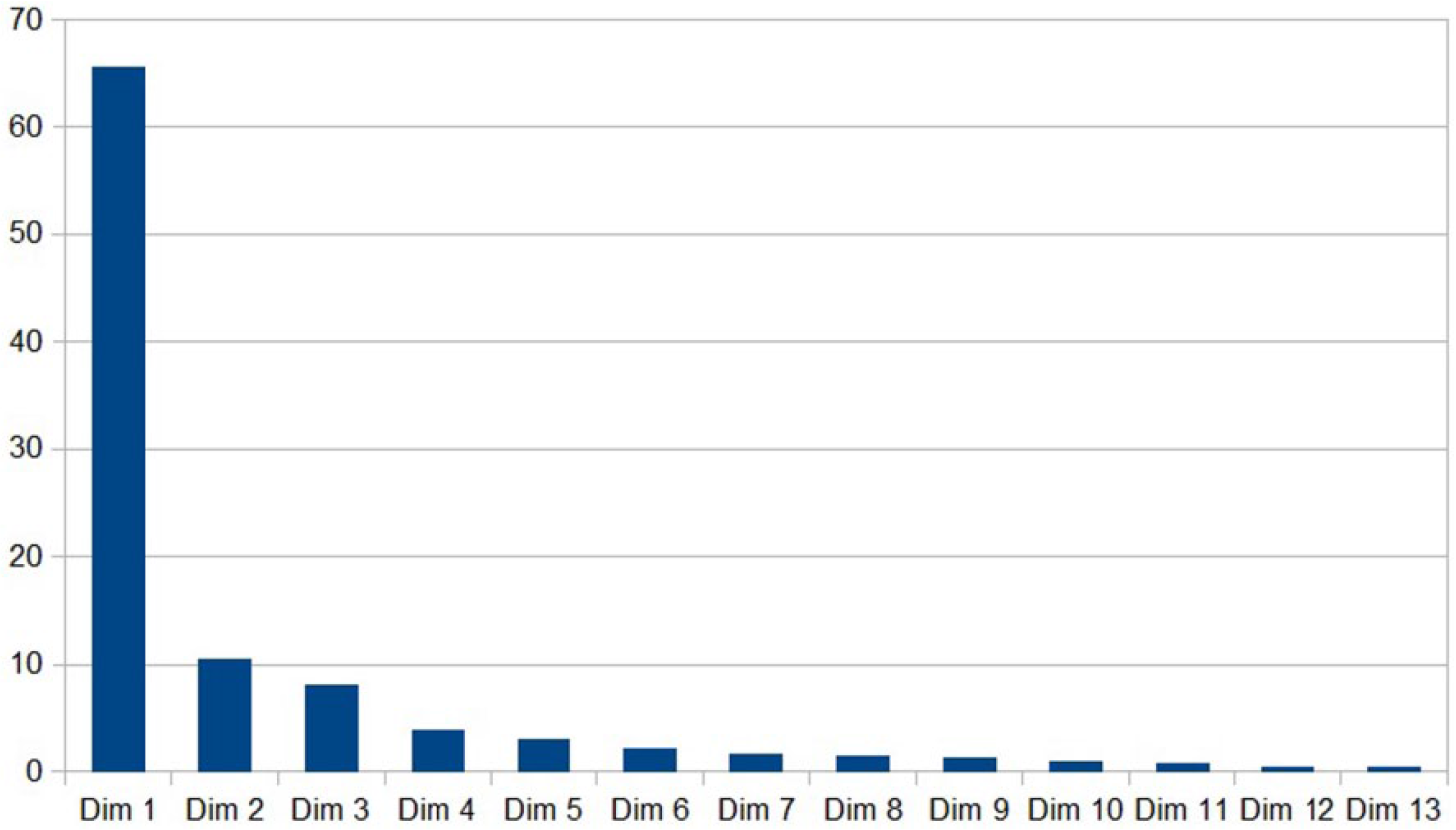
Barplot of the percentage of variance for each dimension.
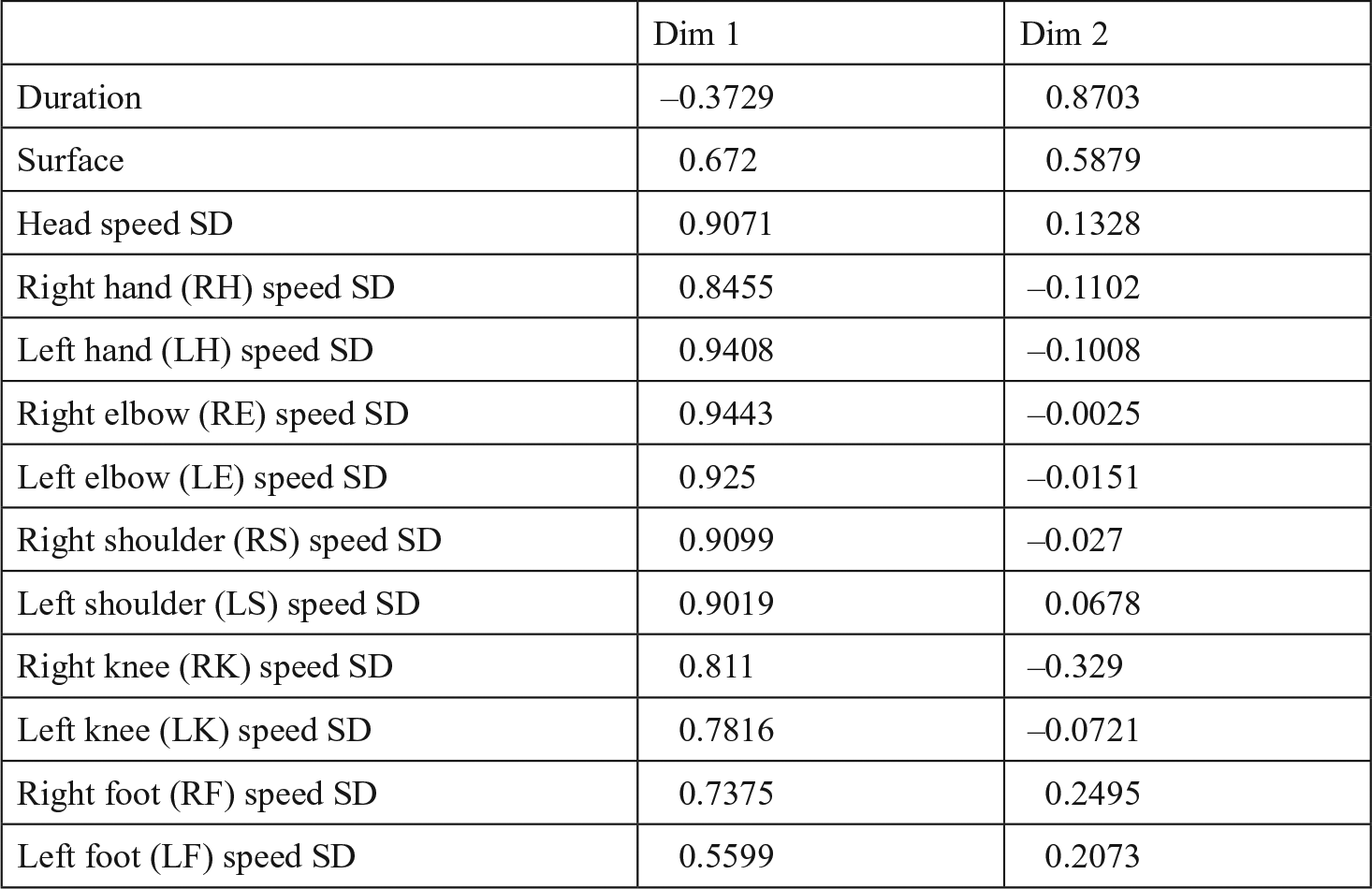
Correlations of each variable with Dimensions 1 and 2.
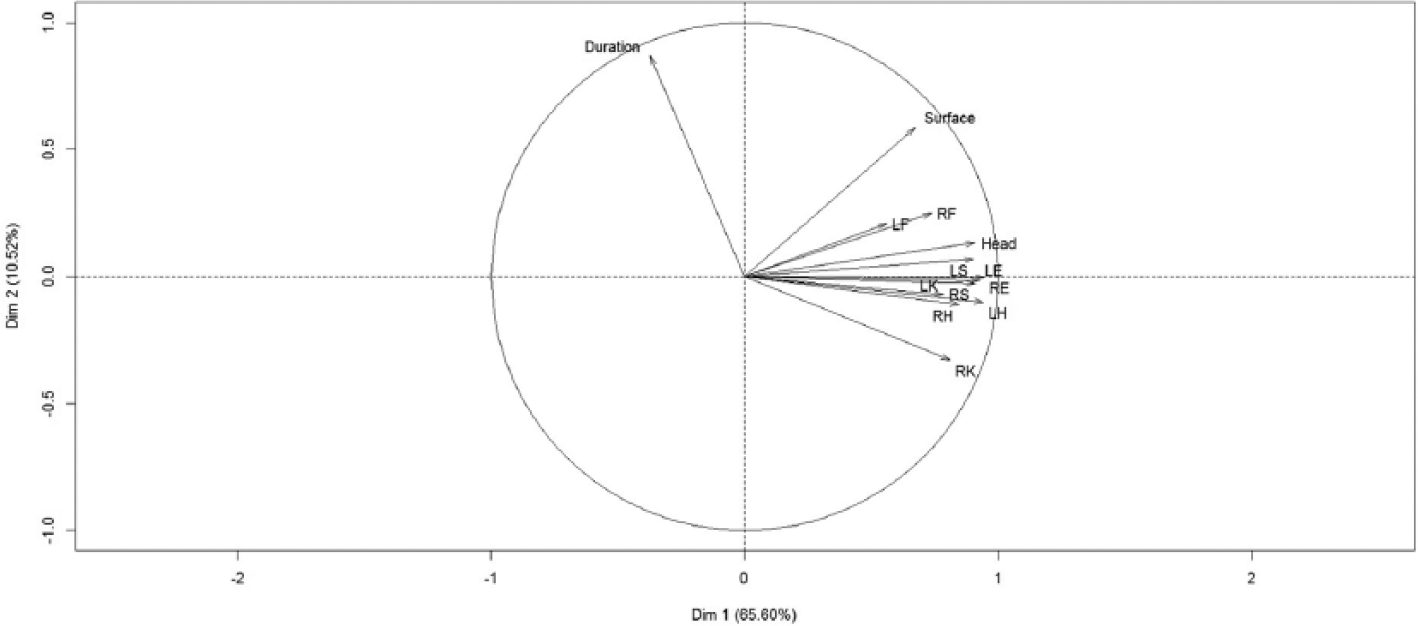
Variable graph.
PCA of violent gestures: We retained two dimensions, explaining together 80.85% of variance. Dimension 1 explains 71.51% of variance (Figure 15) and is highly correlated with the variables of standard deviations, especially with those of the right elbow (0.9522) and the left hand (0.9515) (Figure 16). Dimension 2 explains 9.34% of variance (Figure 15) and is correlated with the duration (0.821) and the surface (0.6348) (Figure 16). The variable graph illustrates the co-variation of the speed standard deviation variables (Figure 17).

Barplot of the percentage of variance for each dimension.
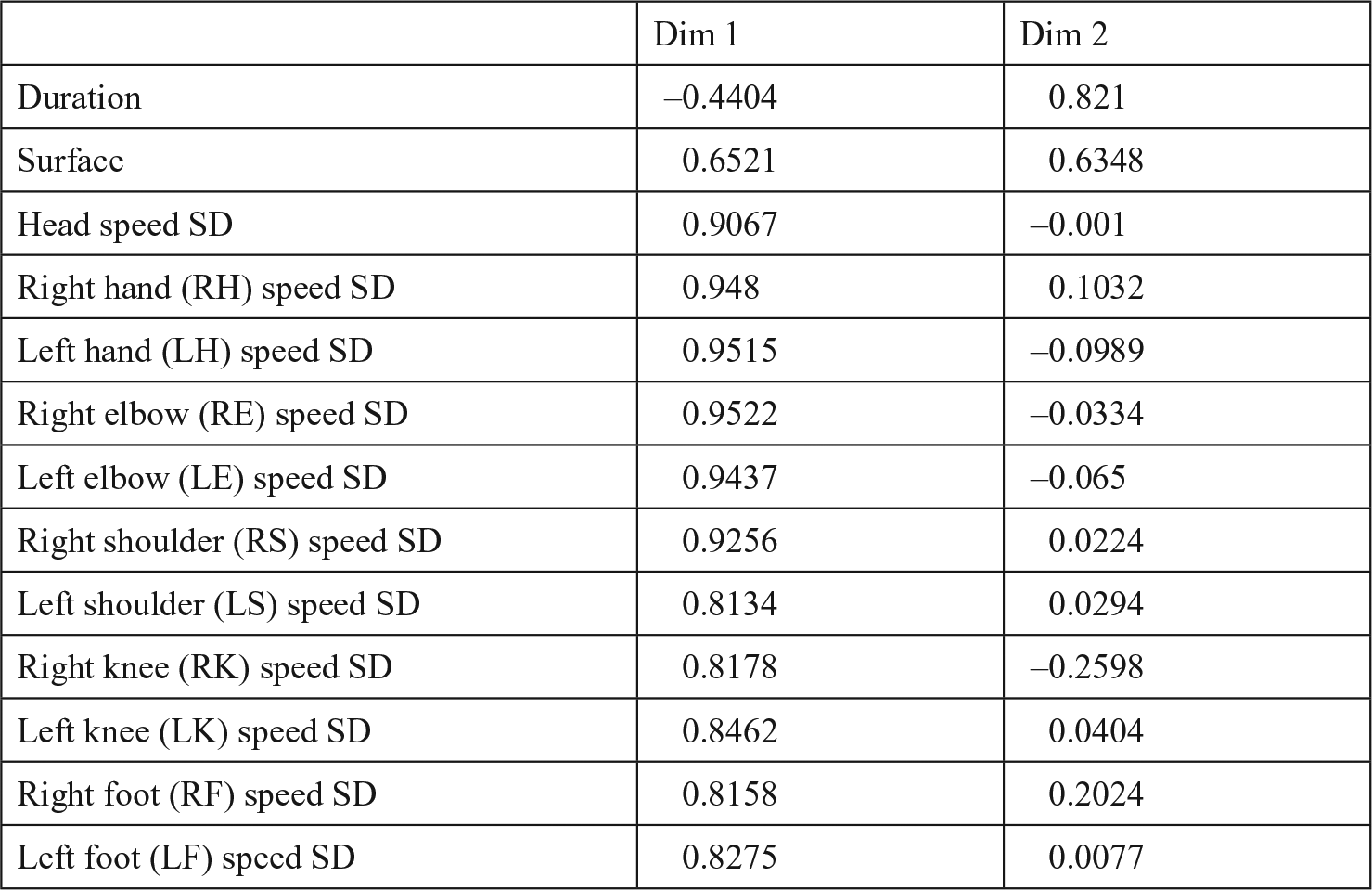
Correlations of each variable with Dimensions 1 and 2.

Variable graph.
PCA comparison: as Figures 18 and 19 illustrate, positions of festive gestures and violent gestures obey the same distribution rules as in the first PCA. They distribute along the vertical axis according to their values for speed standard deviation variables and along the vertical axis according to duration and surface variables. However comparison of the two PCAs highlights different displays: festive gestures spread largely along the horizontal axis, contrary to violent gestures. Whereas festive gestures have higher speed standard deviations, violent gestures have a more restrained value scale for those variables. In other words, the speed variability of violent gestures, though it tends to be higher, appears more contained than the variability of festive gestures.
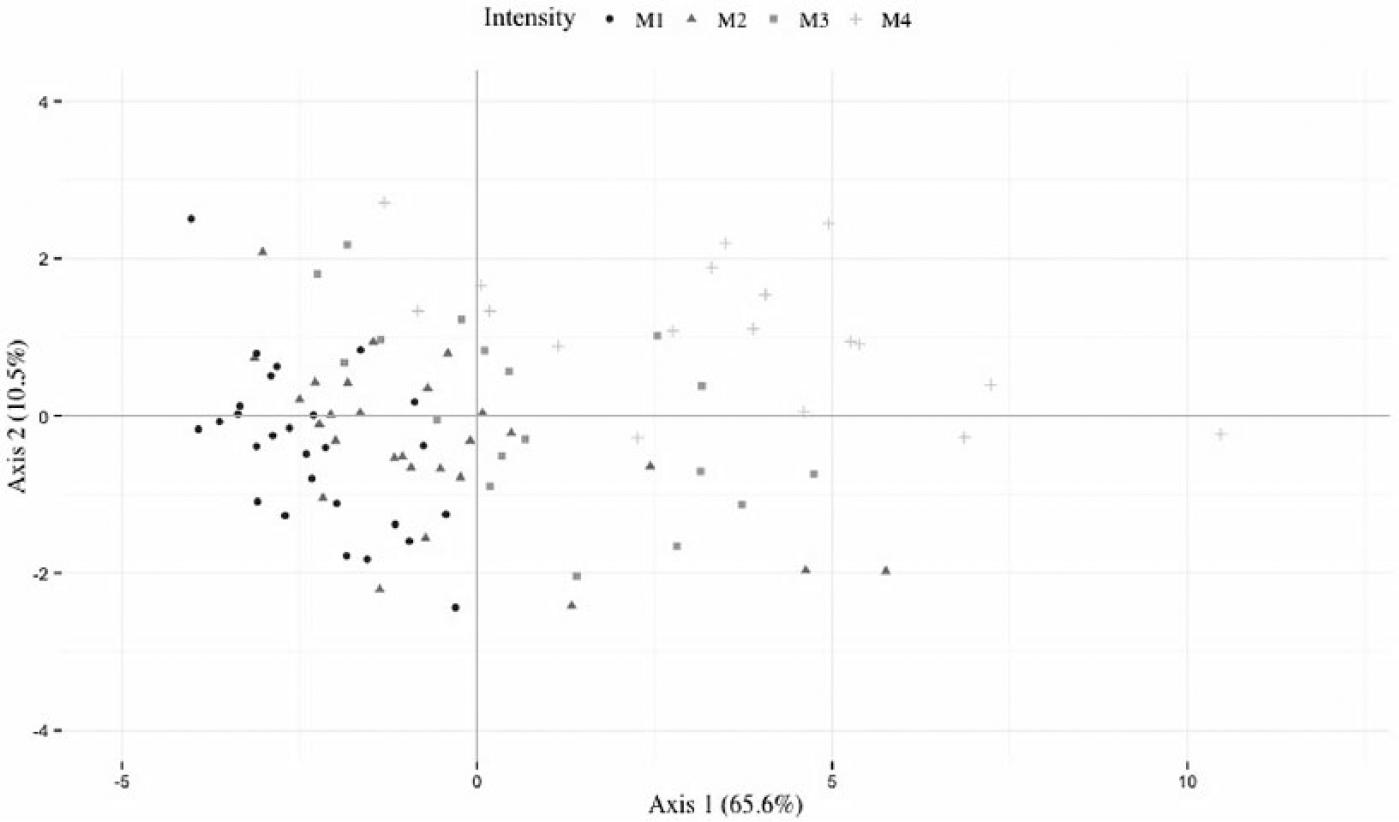
Festive gestures graph differentiated by intensity.
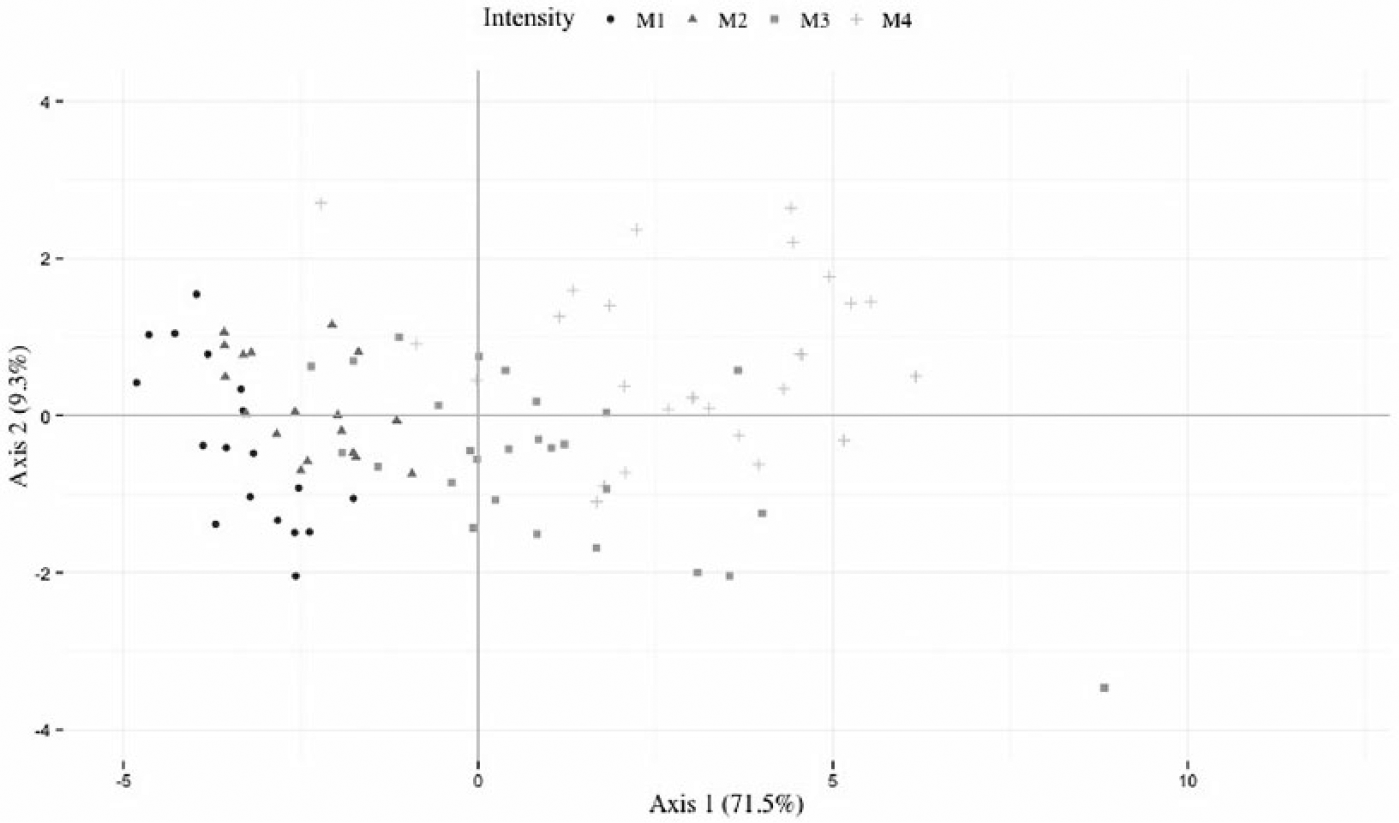
Violent gestures graph differentiated by intensity.
To sum up, festive and violent gestures tend to mobilize different patterns of execution during the same action (throwing a ball). This difference can doubly be expressed in terms of variability. First, among all the gestures, violent gestures tend to show a higher variation from the mean, compared to festive gestures, which tend to remain in a contained zone. Second, within the same gesture category, we observe a smaller variability for violent gestures.
Discussion
Compared to festive gestures, the external and internal variabilities of violent gestures suggest that violent actions are related to the eruption of uncertainty. The following discussion suggests that violence stems from uncertainty about the situation and that it emerges in a two-step cognitive process: the breaking and the rigidification of a social frame.
Violence and frame breaking
How can a gesture break a social frame? As interactionist sociologists have demonstrated, the rules of interaction that maintain a frame are reaffirmed through each execution of a gesture: gestures express meta-communicative messages that enable players to agree, for instance, that ‘this is play’ (Bateson, 1955). Those meta-communicative messages are descriptions of the situation and enable the cognitive discrimination between the gesture (tossing a ball for example) and the situation (tossing a ball during a baseball play for instance) in order to maintain social frames. Bateson lists three types of messages: mood-signs, stimulation of mood-signs, discrimination between mood-signs and those other signs which resemble them, i.e. meta-communicative messages. This latter kind of message plays a role in the distinctive structuring of festive and violent gestures.
Festive gestures occur within the frame of a ball-tossing game. The main objective of a game is entertainment, and, in order to have fun, participants can play – to a certain extent – with the rules of interaction. ‘To a certain extent’ means here that their gestures must remain in a contained zone so that shared attentes support mutual entrainment within the same festive frame. For instance, a baseball player has to throw the ball with force toward his/her partner’s bat, but he/she cannot do the same at his/her partner’s face without breaking off the game (‘hit by pitch’ is punished). This is also demonstrated in the analysis of internal variability of festive gestures: though they tend to have lower speed variability than violent gestures, festive gestures have a larger range in the expression of this variability.
Thus the game relies on the fact that participants are authorized to feint and to improvise as long as their gestures remain within a contained repertoire and do not jeopardize the course of the interaction by failing to perform the validated meta-communicative description.
In comparison, as violent gestures exceed the expected gesture executions, they infringe on the ability of other participants to predict the situation. They break their attentes, generating uncertainty: this is precisely the moment when gestures and individuals can be perceived as violent. For instance, a baseball player who throws the ball with force at the face of his/her partner breaks off the game, as his/her gesture does not fit the attentes conditioned by and conditioning the game situation. This argument is validated by the above results: violent gestures present higher speed standard deviations than festive gestures, thus exceeding the expected and contained variability of festive gestures.
Therefore a gesture is not violent in itself – nor is it festive in itself – but its qualification arises from the situation and the interpretation that individuals form about the situation. Indeed we should instead write that an interactive situation becomes violent when individuals can no longer form anticipations: the fact that gestures divert from a contained zone regarding meta-communicative executions breaks their attentes about the course of the interaction, thus generating uncertainty. This breaking results from violent gestures containing, or neglecting to express, meta-communicative data preventing other participants predicting the course of the interaction.
Violence and frame rigidification
What happens once the frame is broken? Violent gestures not only break the social frame, they also rigidify the situation by re-setting a frame based on uni-dimensional assumptions and restrictive rules of interaction.
The uncertainty derives from the fact that people do not know what the course of the action will be. Each deriving gesture therefore is aimed at re-setting the situation and, in the case of violent gestures, the purpose is the reduction of uncertainty in a particular way: frame rigidification, i.e. a reduction of the possibilities of action. Indeed, as our analysis shows, violent gestures are characterized by a restriction of internal variability: though they tend to have a higher speed variability than festive gestures, violent gestures tend to be more contained in the expression of this variability. This result shows that violent gestures obey completely different meta-communicative patterns because they refer to another frame. More precisely, this new setting consists in a restrictive and constraining frame in order to reduce uncertainty.
In this perspective, violent gestures are not anarchistic gestures but obey a cognitive process – reducing uncertainty, re-setting a frame – structured by and expressing social coercion. This Durkheimian expression sheds light on the coercive nature of social facts, exterior to individuals and imposing upon them by structuring their interiorities (Durkheim, 201[1894]). Social rules constrain individuals’ actions and, in return, individuals act as agents of this social coercion. The present data suggest that frame rigidification consists in the setting of a frame that aims at assigning a restrictive, uni-dimensional and unequivocal position to individuals in order to reduce uncertainty. Thus violent situations appear as situations that rely on a dynamic of assignment of excessively constrained positions.
Conclusion: New indications for the study of violence
This article proposes a new understanding of violence, based on social frame analysis. Neuroscientific research mainly studies violence in individuals whose behaviors have already been socially labeled as violent, i.e. in persons who were either sanctioned by a court or diagnosed by the medical profession (Putsilnik, 2009; Rose & Abi-Rached, 2013). Besides the fact that the definition of the object of study is thus left to social institutions, the studies of criminals, juvenile delinquents or patients with mental disorders often leads scientists to consider violence in terms of internal dysfunction, inability or impairment. Sociological analyses are liable to advance symmetrical criticism when they focus on social groups without tracing their genealogies (Ray, 2016).
In this study, we suggest that violent actions have an interactional source: they are related to normal anticipations formed by individuals in a context of uncertainty. 13 Violence is an empirical concept used to express a cognitive and affective processing that consists of frame breaking in an interactive situation followed by frame rigidification, i.e. the re-setting of a social frame based on the permanent re-affirmation of more and more restrictive interactive rules in a context of uncertainty. In other words, anthropological regularities of violence rely on the ability of social groups to deal with uncertainty, i.e. their abilities to create and face uncertainty.
The above study is a preliminary test and discussion of the hypothesis that violence is the breaking and rigidification of a social frame. For a better understanding of violence, further inquiry is needed, in particular with regard to other situations of violence, not only to sudden violent acting out, but to daily routinely violent situations.
Footnotes
Acknowledgements
The authors would like to warmly thank Jos Houben, Professor at the Jacques Lecoq Theater School, the actors for their performances, Victor Alexandre for his technical support during the video recordings and data editions, Felix Rietmann for his sharp re-reading, and our referee for his/her attentive reading and stimulating reviewing.
Funding
This article is part of Gaëlle Chartier’s doctoral dissertation project, supervised by Alain Berthoz, Eric Brian and Marie Jaisson (advisor), and funded by the University Paris XIII and the Collège de France.
Ethics statement
All actors participated voluntarily in the recordings and interviews for the study. Written consent was obtained for data collection and use in scientific publications.