




Abstract
Catholic economics is the interdisciplinary pursuit of joining Church teaching with economic science. The Church and its leaders, the Pope and Bishops, are primarily concerned with the salvation of souls and their general welfare, or the common good, and as such govern and guide the faithful to that end. Catholic scholars seeking to apply those teachings are free to and do debate the merits of particular policies or institutions. Catholic economists also question particular economic theories that contrast with Church teaching, especially with regard to human nature. This article examines these core elements of the Catholic Economics school of thought.
Introduction
Catholic economics is based on the teachings of the leaders of the Catholic Church—the Popes and Bishops—and the writings of philosophers, theologians, and economists making arguments on behalf of the Church that attempt to explain human behavior or advocate for policies and institutions that constitute an ideal, just economy. The vast majority of the writings attempt to mold human behavior and construct institutions that are moral and just and might therefore appear to belong to politics or ethics and not economics. Indeed, given a traditional understanding of the nature of economics as a social science, it may be misleading to speak of a Catholic Economics school of thought, as if such a school existed alongside the Neoclassical, Austrian, Institutional, Post-Keynesian, or Marxist schools of thought that primarily offer competing explanations for economic phenomena, and also provide visions for an ideal economy and policies or institutions that best achieve those visions. The Catholic Church has much to say on the latter, but less to say on the former. Yet, the Catholic Economics Association (CEA), which now exists as the Association for Social Economics (ASE), was a “founding member” of the Allied Social Science Association (ASSA), 1 and many economists and Catholic intellectuals continue to take on the task of marrying various economic theories with a Catholic theology or worldview.
Popes, Bishops, priests, theologians, and other lay Catholics have long taken an interest in economic matters. Jesus himself offered many economic moral instructions, particularly in the Sermon on the Mount, and the Bible is fraught with specific rules and general guidance on how the economic life of humanity should serve their overall well-being.
Most economists, however, employ the positive/normative distinction developed and made popular by influential economists like John Neville Keynes (1891), Lionel Robbins (1932), and Milton Friedman (1953), which rejects out of hand the possibility that Catholic teaching could have a school of thought in economics because the Catholic Church’s teaching is inherently value-laden. Should such a school of thought be said to exist then, it would seem to belong primarily to the sub-discipline of welfare economics, which does take up questions of general welfare and standards by which to measure it. 2 Examined further below, the Church offers a vision for a just economy and standards by which to judge policies and economic systems.
However, Catholic teaching does offer positive or explanatory statements concerning the nature, behavior, and motivations of persons, which are also taken up by standard economic theory whose subject is the person. As will be articulated below, the Church’s version of the person differs significantly from the standard economic version of the person. Catholics disagree on the extent of that difference and whether or not the explanations are compatible. The goal of this article is to introduce the reader to the elements of Catholic economics and how they compare and contrast to standard or mainstream economic theory.
Catholic Social Teaching
To understand Catholic economics, it is first necessary and useful to understand how the Church views itself and its role in economic matters. The Catholic Church is, of course, a religious institution founded by Jesus Christ, a first-century Jewish Rabbi, who claimed to be the Son of God and the Messiah foreseen by the prophets of the Old Testament. Jesus appointed 12 Apostles as leaders of his newly created Church with one of them—Peter—in charge. After Jesus’s crucifixion, the Apostles, at Jesus’s direction, spread their message far and wide (primarily throughout the Roman empire) seeking new adherents, or Christians, to their faith. The Apostles then appointed successors called Bishops, who were to shepherd the faithful by teaching and governing their Diocese and the Church as a whole with the Pope, or Bishop of Rome, at the head of the College of Bishops. 3
Today, adherents to the Catholic Church number over 1 billion and are scattered throughout the world (Pew Research Center, 2013). The primary mission of the Church and its leaders is the salvation of souls, which is believed to be obtained by the grace given by God through the sacraments dispensed by the Church. The Pope and Bishops govern the faithful and teach them on matters of faith and morals in order that they may be saved, and also that they may live rightly for their general welfare and the good of all (John XXIII, 1961, §1). In other words, the teaching is for this life and for the afterlife. These teachings are thought by Catholics to be divinely inspired and protected from error, even despite the many failings of the men proclaiming those teachings (Catholic Church, 1997, §105–108, 890–892). Many of those teachings on morals involve or concern economic life and these teachings are collectively referred to as Catholic Social Teaching.
The Catholic Church is, of course, not the only religion to take an interest in economic matters. Each of the world’s largest religions—Christianity, Islam, Judaism, Hinduism, Buddhism, Taoism, and all their subdivisions—offer a normative framework with which to evaluate economic behavior and institutions. 4 In concerning themselves with the telos, religions offer humanity a guidebook for happiness that often includes a conception of the ultimate and supernatural end, such as heaven, jannah, moksha, nirvana, or something similar. These guidebooks are full of rules and wisdom about how to behave in economic transactions (and more generally) and primarily amount to curbing selfishness which most religions consider to be endemic to human nature. 5 For example, Jews apply the Imitatio Dei principle to evaluate behavior. The Abrahamic religions, in particular, are full of rules and principles to guide decision-making, including bans on usury and the requirement of charitable giving. Islam is perhaps most famous for its laws known as Sharia and Fiqh. The promise and aim of these rules are personal happiness and social welfare.
Religions are not reducible to their ethics and rulebooks, however. They often stress that there is more to life than the economic and even encourage detachment from material goods. 6 Sacrifice is a virtue. The material must be subordinated to the spiritual. Prayer, worship, and meditation are common and expected practices for personal and social well-being. Faith in God is the ultimate quality in the Abrahamic religions. Harmony or oneness with the universe and all of creation is prized in the eastern religions.
Despite these broad similarities, religions retain their uniqueness on multiple fronts, including their bases for authority, church governance, and the specifics of their teachings. Much of the authority in religions comes from ancient texts and somewhat less so from spiritual leaders like imams, monks, or gurus who interpret and update those texts. The Catholic Church is probably the most centralized with regard to its authority and governance. Protestant Christianity is by its nature much more decentralized and fractured making discussion of a Protestant economics difficult to speak of as a whole. 7 Eastern religions are nearly void of authoritative hierarchy.
The Church probably also has the most extensive and contemporary library of official teachings on economic matters. Adherents to other religions tend to defer to the ancient authoritative texts or will look to guidance from spiritual leaders who may or may not have official authority and are therefore subject to voluntary compliance in a way that Catholics are not.
Catholic Social Teaching can be found throughout the Church’s written and oral traditions, but has more recently taken the form of a body of Papal encyclicals or letters interpreting new issues in light of the Church’s age-old teachings. Pope Benedict XIV wrote the first encyclical in 1740, but Pope Leo XIII’s (1891) Rerum Novarum initiated a series of encyclicals dedicated specifically to socioeconomic issues (Holland, 2003; Storck, 2017). Pope Francis’s (2015) Laudato Si, primarily about care for the environment, is the latest addition to that corpus. These social encyclicals have largely abstained from making purely positive or cause–effect statements about the economy, and have instead provided normative guidelines and ethical considerations for the agents—households, businesses, intermediary organizations, and the governments—acting in the economy or society more generally. Table 1 provides a short summary of the core elements of Catholic Social Teaching found in the encyclicals.
Core Elements of Catholic Social Teaching.
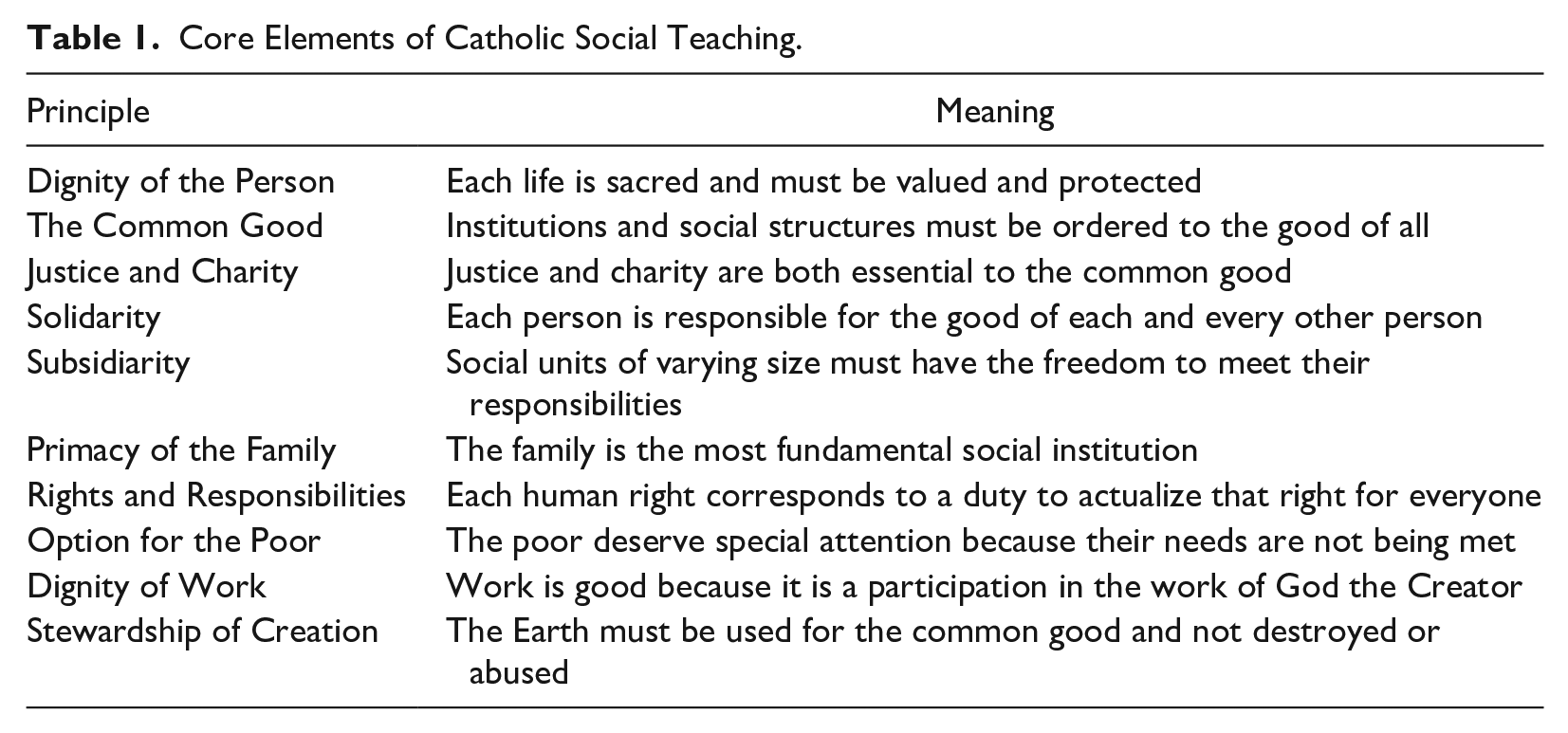
For example, the Church teaches that people have the right to private property, but they have the responsibility to use it for the good of all (Leo XIII, 1891, §6–14, 22). The Church also teaches that people have the right to a living wage, but also the duty to work, if able, to secure the means for survival and well-being for themselves, their families, and their communities (Pius XI, 1931, §70–75). The general theme of corresponding rights and responsibilities is found throughout its teaching (Catholic Church, 1997, §156). Together, these instructions are meant to guide the faithful and provide standards by which to judge general welfare or specific policies and therefore contend with the normative standards employed by other schools of thought in economics.
Norms for General Welfare
Prior to the disciplinary divisions of the social sciences in the late 19th and early 20th centuries, economic thinkers were typically moral philosophers transcending disciplines. With the advent of positive Neoclassical economics, normative principles were largely relegated to the sub-discipline of welfare economics or to heterodox schools of thought (Lutz, 1999). 8 Welfare economics takes up questions of general welfare and the means or standards by which to assess the value of policies or institutions. The strong influence of Classical Liberalism, a competing philosophy to Catholic theology, led economists to seek standards void of strong teleological and normative content.
For example, the standard of allocative efficiency, taught in all introductory microeconomics courses, is defined as producing only those goods and services demanded by consumers. The consumers can choose for themselves what they want to buy and an ideal economy—one that provides for the general social welfare—would then produce to meet those demands and therefore does not waste resources producing items consumers do not want. Similarly, productive efficiency is defined as producing the maximum amount of goods and services desired by consumers in the least cost manner possible. These efficiencies are taught to be achieved in perfectly competitive markets void of imperfections and government interventions leading many economists to advocate for a free market economic system or for government intervention to either increase competition or reduce imperfections. The chosen standards—allocative and productive efficiency—in other words, guide the construction of the economy and economists’ opinions on policy.
It is quite useful to be able to measure the effectiveness or efficiency of different policy proposals—to be able to say, for example, that a policy efficiently allocates resources or that a policy makes many better off without making anyone worse off. Such an approach is wrought with problems, not the least of which is the very reason for economists desiring to stay away from value judgments altogether in the first place—there is much disagreement about which standards to use and what, exactly, those standards entail. Catholic teaching offers several of its own values by which to measure or assess overall economic well-being, and which constitute the bulk of what we might call Catholic economics.
The general welfare principle of Catholic Social Teaching, labeled the “common good,” or the sum of conditions that allow each and every person access to their own fulfillment (Paul VI, 1965, §26), is the overarching standard by which all social institutions and behaviors are judged (Catholic Church, 2004, §164). 9 The virtue governing relations between persons, justice, and all of its sub-components—distributive justice, commutative justice, legal justice, social justice, and so on—are, of course, constituent of the common good. The Catholic Church also stresses the importance of charity, or love of God and neighbor, for “love—caritas—will always prove necessary, even in the most just society” (Benedict XVI, 2005, §28). Both are essential for the realization of the common good.
Beyond that, the Church elaborates on several subsidiary elements of the common good; first, and chief among them, is the dignity of the human person. The Church teaches that each person is made in the image and likeness of God and is therefore endowed with an inviolable dignity that must be protected by human action and institutions at all times (John XXIII, 1963, §3–10). Murder and destitution are obvious violations of this principle, but exploitative labor relations or unjust working conditions would also be violations. 10 A related principle, the preferential option for the poor, where the poor and vulnerable deserve special attention and care, follows, not because they have more dignity but because their dignity is not being adequately protected (John Paul II, 1987, §42). Rather non-controversially, reducing or eliminating material poverty is a chief concern for an ideal economy. 11
Also following from the dignity of the human person is the Church teaching that each person is responsible for each and every other person—known as the solidarity of the human family. Catholic means “universal” and Jesus explicitly instructed his Apostles to make disciples of all nations thereby making the spiritual and material welfare of each person the concern of each and every other person. Catholics are thus required by Church teaching to evangelize—to convince others of the value of their faith—and also to treat each person with equal dignity regardless of their faith or personal character. 12
To best pursue the common good and safeguard the dignity of the human person, the Church believes society should be organized according to the principle of subsidiarity. The family is seen as the backbone and most fundamental unit of society, but all social organizations, including governments, are vital to achieving the common good (Catholic Church, 1997, §209–214). Simply, the Church believes that the family should be given the freedom and power to act for its own good and the good of the community in cooperation with and without interference from a higher social organization. Likewise, a higher level organization like a local government, corporation, or school board should be given the freedom and power to act for the good of the families under its care and the good of neighboring and distant communities in cooperation with and without interference from a still higher institution like a national government. This then extends in like manner all the way to the level of a global authority. In other words, there is a role to play for each organized level of society and each should work in mutual cooperation for the common good (Pius XI, 1931, §80).
The Church also teaches that work has dignity—that it is a good thing for humanity and not a mere disutility (John Paul II, 1981, §9). Work here means any activity done by a person for the sake of the common good, whether it be procuring goods and services or fostering community through wage labor, entrepreneurship, volunteer work, or any at-home non-market activities. Work can be toilsome but is also fulfilling and good for developing the virtues of industriousness and discipline among others. Catholic Social Teaching therefore highly values just working conditions and labor relations, as well as the opportunity to work. The Church also stresses that humans are the subject of work and should not be subjugated to capital for the purpose of profits or, further, to be treated merely as capital (objects) themselves (John Paul II, 1981, §5–7). 13 In this vein, the Church supports the freedom of economic initiative, which not only includes the freedom of enterprise but also disallows the subjugation of employees by employers or the state to the level of a slave or a mere cog in the industrial machine.
Finally, the Church teaches that the Earth and all its resources were created by God for the good of humanity. Because it was created by God, the Earth and its abundance are endowed with dignity that must be protected and cared for by those entrusted with it. People are called to be good stewards of the environment using it for their own benefit without violating its dignity through destruction or exploitation. Furthermore, the abundance of creation is meant to be for the good of all, a principle known as the universal destination of goods (Francis, 2015, §93–95). As mentioned above, the Church does recognize and support the right to privately own property, but the associated responsibility to share it with all. 14
Altogether, a good and just economic system—one that serves the common good—will protect the dignity of the person with special care for the poor and vulnerable, affording them enough resources to live and foster a life of virtue and holiness, as well as providing them an opportunity to work for their own good and the good of all without compromising the dignity of the environment, and all while granting each social unit its proper freedom to act with regard to its particular responsibilities. Such standards are very broad and do not lend themselves to easy measurement, but there is much here to compare and contrast with standard welfare economics.
For example, noteworthy absentees among these principles are the standards by which traditional welfare economics measures general welfare. Instead of justice and charity, for example, freedom appears to be the chief virtue of standard economics. 15 Efficiency and growth are not necessarily at odds with Catholic teaching, but they would be considered secondary concerns (Barrera, 2001). The Church, unlike most orthodox economists, is keen to name the ends people should pursue and offer guidance on the manner in which they are pursued. In this way, Catholic teaching is very anti-liberal. Indeed, allocative efficiency is potentially quite at odds with Catholic teaching if what consumers want is bad for them or for society. Furthermore, the Church has frequently advocated for an equitable distribution of goods that protects the dignity of the human person, and standard economic theory prefers to remain neutral with regard to any particular distribution of income and wealth.
The principle of subsidiarity also highlights the dependence and interdependence of persons and the need for cooperation and participation among all the levels of society. The methodological individualism in standard economic theory (evident, for example, in the individualistic, subjective preference satisfaction models of the person) runs counter to the principle of solidarity and the social obligations inherent therein (see below for further discussion on this point). The “dignity of work” contrasts with the standard economic rendering of work as a disutility with its only, or primary, reward being monetary. Finally, the Church’s concern for the environment goes beyond standard economic discourse again due to economists’ unwillingness to venture into normative territory. 16
Beyond these basic, but more general, principles, the Popes in their encyclicals have offered more particular statements or commentary guiding the faithful in application of the general principles. For example, the Popes condemned socialism—state ownership and control of property—but affirmed the right to form labor unions and argued for state intervention to protect the interests of the working class (John XXIII, 1963, §23; Leo XIII, 1891, §34). Although the rejection of socialism is outright, they have also strongly critiqued unbridled capitalism for its concentration of power and wealth in the hands of a few and their apparent all-consuming desire for profit and thirst for power (John Paul II, 1987, §37). 17 The Popes have, in essence, rejected the extremes of liberalism and collectivism and have thereby carved out space for the state to act for the common good without dominating the rights of individuals and families—what would become known as subsidiarity. 18 Thus, the Church also does not advocate for any one particular form of government (John XXIII, 1963, §67).
Papal teaching has also affirmed the right to migrate, especially out of economic necessity, but has lamented its necessity (John Paul II, 1981, §23), and have supported social insurance and price support programs, especially for agriculture (John XXIII, 1961, §136–137). Several Popes condemned the arms race during the Cold War and argued for more international aid to underdeveloped parts of the globe and a global authority to foster cooperation between states (John XXIII, 1963, §112, 137). They have advocated for employee-owned cooperatives and the sharing of management by both workers and owners (John Paul II, 1981, §14). They have called for the protection of the environment and a moderate use of resources (Francis, 2015), and have rebuked consumerism and have repeatedly called for solidarity and a turning to God for happiness rather than in having or consuming (John Paul II, 1991, §36). 19
Prudential Judgment and Competing Viewpoints
Despite these general and more specific guiding principles, the teachings leave significant room for Catholics to disagree over specific policies or institutions. That is, the problem left for those who wish to follow the Church’s teachings is putting them into practice in a specific context that may not be well outlined by the general teaching. Just as there is debate among economists about policies that best achieve their stated goals of efficiency or other, Catholics disagree over the policies that best achieve the common good and all it encompasses. Often, that disagreement stems from the understanding of root causes and the theories that explain them. For this problem, the Church allows for what it calls prudential judgment. 20
For example, a Catholic may not be opposed to the moral principle of the right to a just wage, but may be opposed to a minimum wage law attempting to provide that living wage on the grounds that such a law would not actually achieve or best achieve its stated intent. Alternatively, a Catholic may not be opposed to the moral principle of the right to own private property, but may favor redistribution programs that curb that right so long as those programs are believed to achieve or enhance the common good, say through a more just and equitable distribution of property. Catholics cannot choose their own moral teachings, but they can and do argue over the best applications of those moral teachings to their particular context. Much of the secondary literature on Catholic Social Teaching or Catholic Economics constitutes a debate between scholars with competing viewpoints and a variety of economic perspectives.
Given that competing viewpoints over particular applications of moral teachings are allowed by the Church, it is perhaps no surprise that Catholics run the gamut of current political leanings. It is too much to cover every argument and thinker, but a quick overview is beneficial to understand Catholic economics and should therefore suffice. 21
Many Catholic scholars and lay members favor broad government interventions—particularly redistribution programs and demand management policies—in capitalist economies. They follow in the legacy of John Ryan, an American Catholic priest who, inspired by Rerum Novarum, wrote his dissertation on minimum wage legislation, defending it as proper application of the right to a living wage (Ryan, 1906). Ryan also took up broader questions of distribution in his book Distributive Justice (Ryan, 1916) and would later be nicknamed Right Reverend New Dealer by an opponent and critic because of his support for Roosevelt’s New Deal programs (Schmiesing, 2004). These Catholics tend to be heavily influenced by Keynesian economics or other schools of thought critical of laissez faire capitalist economies like institutional economics. 22 Although they reject outright socialism, or complete ownership and control of the means of production, as has the Church, they are strongly critical of the apparent injustices of free market capitalism.
Influential European scholars G. K. Chesterton and Hilaire Belloc, writing contemporaneously alongside Ryan, spawned a group called the Distributists who similarly rebuked free market capitalism for its unequal distribution of wealth and productive resources, but believed the widespread distribution of productive property and an end to exploitative wage labor were necessary to ameliorate the evils of capitalism (Belloc, 1912; Chesterton, 1926/2001). They and their followers also tend to favor small-scale production over the distant, mass production by seemingly faceless multinational corporations whom they argue make it easier to exploit and marginalize the lower, property-less classes. E. F. Schumacher (1973/2010), a pupil of Keynes and late convert to Catholicism, argued for such in Small Is Beautiful. The popular Catholic Worker movement started by Dorothy Day and Peter Maurin may be seen as operating in a similar vein as the Distributists. Today, Distributists continue to maintain a following via the publications of authors such as John Medaille (2010), Thomas Storck (2017), and others and tend to favor employee-owned cooperatives, strong anti-trust laws, and widespread ownership of productive property (Medaille, 2010).
Still more strongly opposed to free market capitalism, some Catholics, inspired by Marxist thought, advocate for a much more socialist economy. The most prominent proponents of this viewpoint might be the Liberation Theology movement, a primarily Latin American group heavily influenced by the remnants of the exploitative colonial institutions dominating South and Central America, led by Catholic priest Gustavo Gutierrez. Outright support of socialism runs counter to Papal teaching, but some have found gray area in the meaning of the term and emphasize more strongly the general support found in the encyclicals for government interventions, to push for the nationalization of key industries and stronger redistribution programs. 23
Finally, on the other end of the spectrum are the more free-market-favoring, American conservatives like Michael Novak, Thomas Woods, and Catholic priest Robert Sirico. Writing toward the end of the 20th century and the beginning of the new millennium, these American Catholic scholars defend free market capitalism and argue against government interventions, especially from those who would use Catholic Social Teaching as a justification for an increased role of the state. They tend to be influenced by Austrian economic thought and therefore believe that most government interventions, even those of good intent, would be counterproductive to social welfare (Novak, 1993; Sirico, 2012; Woods, 2005).
Such disagreement was also evident in the CEA that was founded in 1942 by American Catholic economists, most notably Catholic priests Thomas Divine, Bernard Dempsey, and John Ryan. The CEA sought to discuss “scientifically problems of economic policy the solution of which requires a knowledge of both economic science and of Christian social principles” (Divine, 1991, p. 545). Divine, a pupil of Lionel Robbins, advocated for a more conventional economics, whereas Dempsey, a pupil of Joseph Schumpeter, supported the more heterodox solidarist economics of German priest Heinrich Pesch (O’Boyle, 2014). Both wrote their dissertations on the rate of interest where Divine spoke more positively about its role in the economy and Dempsey more negatively about its usurious effects. 24
Given the wide variety in perspectives, and again, the allowance for prudential judgment on specific applications in pursuit of the common good, it is not surprising or uncommon to find Catholic defenses or rejections of a wide range of policies. Frustratingly, no single set of economic institutions or policies can be thought of as Catholic as there as many possible compatible arrangements with the common good depending on the context.
Human Nature and the Rational Choice Model
Although the bulk of Catholic Economic thought concerns standards and applications for general welfare, some Catholic scholars have offered alternative explanations or models for human behavior in lieu of the models adopted by most economists and taught in all introductory economics courses. A key part of the Church’s theology is its understanding of human nature, a theology that can be found throughout much of scripture and that has since been expounded on by theologians. Anthropology, perhaps more than any other science, draws the Church’s interest because the subject of the Church’s teaching is the human person and their relationship with God.
The Church believes that the person is not mere matter, but rather an embodied soul and the soul is not a material, physical reality, but a metaphysical and immaterial one, which means it lies beyond the realm of scientific inquiry (Catholic Church, 1997, §35–384). The fact that people are material means that material goods are good and necessary for their physical survival but are also necessary for the development of virtue and the salvation of their souls. 25 This anti-reductive, anti-materialist position often draws the ire of empiricists or those who claim that knowledge can be discovered and built only through the scientific method. The Church does not maintain that science is incompatible with theology, but rather argues that the two are complimentary and that one cannot contradict the other (John Paul II, 1998). Because the human is physical and metaphysical, both scientific inquiry and theology are needed to understand the nature of the person and also therefore their behavior and motivations which constitute a core part of economic theory. Much of the systematic Catholic understanding of the person can be found in the work of Thomas Aquinas who brought together Classical Greek Philosophy and Catholic theology.
The core of this Thomist and Catholic anthropology is the belief that humans are made in the image and likeness of God and are made for union with God who is perfect love. Part of human motivation according to this view can be explained, then, by the desire for perfection, which can only be fulfilled by God. However, people often struggle to act in a way that is well ordered to their ultimate end of perfection often by making intermediate goods, such as the acquisition of money, their ultimate end. So, though humans desire perfection, they also fail to act toward that end by giving in to concupiscence or by denying their ultimate end and choosing it for themselves. 26 The dual and often competing motivations can explain human behavior, and as some Catholics argue, more robustly than the standard economic model (Hirschfeld, 2018; Yuengert, 2012).
Debate over the rational choice model is not new and remains unsettled among economists, though the model maintains its place as the foundation of economic theory. Critics argue the standard economic model of the rational individual choosing between ends to maximize utility is problematic and at best incomplete. For one, it is not very scientific. The model is dressed up with strong assumptions that are nice to model mathematically, but that do not match reality. Behavioral economics has shown in a number of ways how people do not behave as the model would predict; that is, they behave irrationally. Students of economics need to be taught how to think like an economist. Many, for example, are not aware of the concept of opportunity cost.
Perhaps most significantly, the model itself is not value-neutral or void of philosophical content for it strongly implies that maximization of utility with subjectively defined preferences should be the stated aim of all individual and collective action. As such, it sets itself up as a rival to Catholic anthropology which argues that people do not get to choose their own ultimate end and any attempt to do so will only result in folly and their unhappiness. The standard economic model also has a strong bias toward calculation and quantitative acquisitiveness, for accruing more and more utility requires acquiring more and more goods. The rational choice model may be predictive of some behavior, especially with regard to monetary incentives, but loses its predictability when it attempts to encompass altruistic behavior that would appear to be self-defeating.
Proponents of the model counter that the model can accommodate any set of individual beliefs, but by doing so critics state that it becomes a mere tautology. If people only act to maximize utility, even when acting self-sacrificially for the good of another, then nothing they do or consume can be said to not maximize utility. 27
Because of these objections, some Catholic economists have argued for an augmentation of the model to accommodate a Catholic understanding of the person. Edward O’Boyle (2005, 2007), for example, promotes a modification of homo economicus that he calls homo socioeconomicus. According to O’Boyle, homo economicus, as conceived by standard economic theory, is too individualistic, self-centered, and self-made. It is an embodied creature. Homo socioeconomicus, on the contrary, is “unique and alike, solitary and communal, autonomous and dependent, self-centered and other-centered, self-made and culture-bound” and “behaves in ways that are described at once as utility-maximizing and utility-satisfying, privacy-protecting and company-seeking, commodity-acquiring and gift-giving” (O’Boyle, 2007, p. 330). It is an embodied spirit. O’Boyle and others attempt to appeal to economists of all persuasions by embedding this understanding of the person within a school of thought they call personalist economics, though it is rooted in a Catholic understanding of human nature (O’Boyle & Welch, 2016).
Andrew Yuengert (2012) and Mary Hirschfeld (2018) offer an augmentation to the rational choice model that is more directly grounded in Thomist theology. They argue that the rational choice model is too animalistic or robotic and does better explaining impulsive, appetite-driven, self-serving behavior more akin to animals than it does the distinctly human, free-will-evident, altruistic behavior. Although there is plenty of room for subjective preferences with regard to the goods or services preferred for the fulfillment of intermediate ends, “happiness cannot be achieved by pursuing an indefinite string of goods nor a finite cluster of distinct goods” (Hirschfeld, 2018, p. 82) as the rational choice model implies it does. Rather, “Human choice is not about efficiently getting what we want so much as it is about learning how to want what is genuinely good” (Hirschfeld, 2018, p. 84).
Even if the rational choice model is broadened to accommodate a Catholic set of preferences, Yuengert and Hirschfeld maintain that it cannot adequately model the higher order reasoning that “discerns what is worthy of pursuit” (Hirschfeld, 2018, p. 105). Because humans can “judge their own judgment” or “consider the finite good that their appetites present to them under the aspect of more universal considerations” (Hirschfeld, 2018, p. 74), a model for this higher order of reasoning—prudence—is necessary to account for this type of behavior. Prudence, in scholastic philosophy, is the virtue that “allows us to discern what goods are worthy of pursuit and to order them into a coherent pattern of life” (Hirschfeld, 2018, p. 106). Of course, not all people have a well-developed virtue of prudence, but this addition to the model can explain why people respond to base, monetary, and self-serving incentives, and also choose to deny intermediate goods in the pursuit of a higher good. Such a model does not lend itself to calculation (because it is not a calculation) or to mathematical modeling, but does, according to Yuengert and Hirschfeld, explain human behavior that the rational choice model cannot. Catholics are not required to reject the rational choice model, but there are some significant hurdles to clear for Catholics who wish to wed it to a Catholic understanding of the human person. 28
Conclusion
Catholic economics is inherently an interdisciplinary pursuit of joining Church teaching with economic science, primarily by providing the norms by which to evaluate socioeconomic institutions and policies, advocating for particular solutions that best achieve those norms, and assessing economic theories in light of Church teaching. As such, it is an important addition to the discipline, particularly for the over 1 billion Catholics worldwide, and also for other interested parties who find common ground with the teaching or the approach.
Today, Catholic economists find a home in a number of associations. The Catholic Research Economists Discussion Organization (CREDO) was created in 2013 for mostly conventional economists who are Catholic and interested in the relationship between their work and their faith. The Society for Catholic Social Scientists meets and publishes the Catholic Social Science Review annually. It contains a number of economists who wish to write specifically about Catholic Social Teaching and economic issues. Catholic economists also publish in Faith & Economics, a journal published by the Association of Christian Economists; in the Journal of Markets & Morality published by the Acton Institute; and in the two journals published by the ASE, the remnant of the CEA. There are also a large number of Catholic periodicals where readers can find the arguments of Catholic economists and scholars on current economic issues.
Footnotes
Acknowledgements
The author would like to thank Michael Volker, Paul Grimes, and Marybeth Grimes for comments and editorial assistance that greatly improved the article.
Author’s Note
Remaining errors are the sole responsibility of the author.
Declaration of Conflicting Interests
The author declared no potential conflicts of interest with respect to the research, authorship, and/or publication of this article.
Funding
The author received no financial support for the research, authorship, and/or publication of this article.
