



Abstract
Economic development (EcD) introduces new goods and services into a region's portfolio of traded products or expands the productive capabilities of existing members of a region's economic base. And EcD organizations are intermediaries that reduce risk and transaction costs by honestly representing their community and region to potential business investors. There are five closely related yet separate development practices. Four (community, workforce, housing, and commercial and industrial real estate development) create long-term regional EcD assets. While those assets are required for EcD to occur, they are insufficient to generate EcD outputs. Investments resulting in the production of goods and services are also necessary. EcD is a regional activity because the markets for three of the development practices are regional: labor, housing, and commercial and industrial real estate. Finally, EcD is both an art and a science. The art of EcD is connecting the dots that others cannot see. The science is getting deals done. Together they create investment momentum that builds optimism, generates trust, and mitigates risk.
Keywords
In 2002, Duluth, Minnesota's Mayor Gary Doty asked if I could explain economic development (EcD) at his city's summit. 1 That was when I started writing this commentary. I am a slow writer.
As an economist, I understand that the invisible hand of self-organizing markets is the foundation of The Wealth of Nations (Smith, 2000). However, I have worked closely with EcD practitioners and observed that good economic development practice enables Adam Smith's invisible hand by reducing transaction costs and uncertainty. EcD professionals are problem solvers who reduce investment risk by providing information and connecting the supply and demand sides of regional markets for economic assets. Good EcD professionals operate in teams that connect supplies of regional economic development assets (labor and specific know-how, land, and the market access and infrastructure embodied in sites, and capital represented in equipment and finance) to demand from businesses and establishments. 2 Economic developers also encourage the creation of new products and services that refresh a region's product portfolio and boost productivity. And EcD professionals encourage new flows of regional economic development assets, enabling the sale or rent of current stocks of those assets to businesses. In other words, EcD professionals are market makers.
There are five sections in the commentary. The first provides a practice- and product-centered discussion of the outputs of economic development. 3 In the second, I present three qualitative product-focused models of how regional economies develop. The first is Joseph Schumpeter's five hypothesized sources of economic development. These hypotheses are the foundation of his term “creative destruction.” Next is Vernon's product-cycle model, followed by a model that depicts the economic base of regions as portfolios of products distributed by product cycle age. The third section cross-references the business recruitment, retention, expansion, and entrepreneurship (BRREE) practices of economic development organizations with the product cycle. The result represents the jobs of economic developers as one of five animals in a small zoo: rabbits, gazelles, buffalo, foxes, and puffins. The fourth section explores the relationships among the five developments (economic, community, workforce, housing, and commercial and industrial real estate). Finally, the fifth section contains summary comments about the job of an EcD professional.
The Outputs of Economic Development Are the Introduction of New Goods and Services and Expanding the Capabilities of Existing Businesses
I frequently ask audiences to name the outputs of economic development activities. Their answers are predictable; they identify outcomes instead of outputs. Jobs are most often mentioned. In private, taxes are at the top of mayors’ minds; in public, the answer is usually jobs. Some people offer population growth. Increasing per capita income is the standard answer from economists and public policy analysts. More recently, concerns over income distribution and social mobility have been added to their complicated answer. Activists respond with well-paying jobs with benefits, with little consideration for skill. University presidents reflexively lobby for more research funding because they believe economic development comes from research.
Unfortunately, EcD does not respond to personal needs, an activist's agenda, or a university president's marketing because neither EcD professionals nor EcD investments directly produce any of the benefits or outcomes mentioned. Instead, these outcomes are all byproducts of the direct output of EcD, which is a business or organization producing and selling new or additional goods or services. Without sales and profit, the desired outcomes will be missing: no jobs, no earnings, no taxes, no immigration, and no positive income mobility. Also, without products, research remains science.
How should we consider the outputs or services provided by nonprofit organizations such as cultural and religious institutions or educational and health care organizations? The answer is straightforward. Forget how the tax code classifies an organization, whether it has stockholders, or if the organization tells the Internal Revenue Service that it has recorded a profit or a surplus. Instead, follow the money. Answer four questions: (1) What is the product or service? (2) Who gets paid to produce it? (3) Who pays for the production? and (4) what are the sources of the investment? Three examples of religion as a traded service come to mind.
Colorado Springs, Colorado, successfully diversified its economy by actively recruiting national and international headquarters of evangelical religious ministries and organizations in the mid-1980s through the 1990s (Atkins, 2019; Kenworthy, 1997; Roberts, 2021; Schultz, 2017). 4 In 1847, Salt Lake City, Utah, was founded as the headquarters for what became a global religious denomination and became the Vatican City of the Rockies. And Cleveland, Ohio, attracted the headquarters of the United Church of Christ from the denomination's founding city, New York, due to differences in operating costs. Each is a not-for-profit organization that exports services. The Church of Jesus Christ of Latter-day Saints, commonly called the Mormon Church, generates an inbound religious visitor destination industry to Salt Lake City and an outbound flow of young missionaries. The missionaries often return fluent in a new language and culture. The acquired human capital and cultural competencies of the young missionaries are distinctive regional economic development assets (Fry & McCarlie, 2002; Olsen & Esplin, 2020). 5
Other examples of locally produced exported services abound. Providing goods and services to visitors and attracting retirees who bring money and benefits are examples of EcD in retirement regions. The same holds for providing medical and educational services to people from outside an area. These are all EcD activities because the goods and services sold are a form of external regional aggregate demand. But what about selling goods and services to residents who are not retirees or educating and healing locals? Does satisfying internal demand count as part of economic development? No, these activities are part of community development and quality of life because they respond to internal demand. Both internal and external demand are important to a regional economy. Likewise, exporting scientific knowledge and getting paid is EcD. And research is often paired with an advanced education sector that imports students and their tuition payments and, later, exports graduates with credentials. Occasionally, research results in a new good or service being spun out from a laboratory when an entrepreneur or a licensee roots it in the regional economy. However, research that does not result in a product or service is called science.
Creative Destruction, Product Cycles, and Product Portfolios
Creative Destruction
Joseph Schumpeter coined the phrase creative destruction in his 1942 book, Capitalism, Socialism, and Democracy, to describe the process of economic development (Schumpeter 1942, 2008). Creative destruction is an evocative phrase hinting at how market forces redeploy an economy's stock of economic development assets to introduce new goods and services, disrupt current production methods, or infuse novel characteristics into existing products. However, as well-known as that phrase is, it is better to understand the five hypotheses about economic progress underlying the phrase. Schumpeter presented these hypotheses in the second chapter of the English language version of his 1939 book, The Theory of Economic Development.
6
Production innovation is the introduction of new methods of production. Schumpeter's use of production innovations hinted at both new production technologies (the machinery used to make things) and what we now call process innovations, the way machines and people are arrayed in a system to produce goods and services. The result is enhanced physical and economic productivity.
7
Product innovation creates new goods or services or introduces unique qualities to existing goods and services. Mobile phones are a good example. Motorola released the first mobile phone in 1973. Analog cellular service appeared in Japan and the Nordic nations from 1979 to 1981, with digital networks dominating the 1990s. After that date, mobile phones evolved to maturity until Samsung put cameras and related software applications into mobile devices in 2000. Camera phones accelerated demand for replacement mobile phones, reducing their economic age, and stimulating a new suite of software and services. Then, in 2007, Apple released its first iPhone. Apple combined a mobile phone, camera, portable music device, and continuous Internet access with onboard processing. Apple accessed the package of hardware innovations with a graphical user interface. The iPhone reset the product cycle age of mobile phones, bringing it back to the takeoff stage. Fifteen years later, cellular phones are mature products. New markets in 1911 meant establishing new geographical markets. It is unclear to me whether Schumpeter was writing from a nation-state perspective or a business perspective. His writing appears to reflect both the colonial ambitions of Western European nations before the First World War and the creation of transnational industrial businesses. Process innovation in Schumpeter's observations was restricted to developing new sources of raw materials or work-in-process supplies. Today, these are called supply chain innovations. Organizational innovation reflected Schumpeter's view that “it is not essential … that the new combinations should be carried out by the same companies or people” (p. 66). The statement is a foundational observation about the disruptive role of entrepreneurs in economic development when they bring new combinations of EcD assets to markets. The hypothesis also reflects the rise of industrial bureaucracies as a managerial innovation.
8
Schumpeter's hypotheses bridge the previous discussion of the direct outcomes from industrial restructuring to Raymond Vernon's (1966) model of a product's life cycle, which is discussed in the next section. Moreover, Schumpeter's observations have a particular bearing on two product cycle stages: (1) product introduction and (2) abandonment or rejuvenation.
Schumpeter's lesson is that economic regions must constantly create and deepen their stocks of EcD assets because the economic base of a thriving regional economy is a constantly changing portfolio of products. All products travel along the product life cycle as they age; however, in the end, most die. The critical question to answer is if the death of a traded product also results in the economic decline or demise of the region. That is why economies must restock their portfolios with new goods and services.
Product Life Cycle
No matter the end state of individual products, a region's product portfolio needs constant replenishment. Vernon's original conceptualization of the product cycle had four phases (Vernon, 1966, 1979). 9 However, the concept has evolved through its use in business strategy into a six-part typology with slightly different labels given to each stage by various authors and business consultancies. These stages are (1) product development (product development and refinement); (2) product introduction; (3) takeoff (rapid sales growth); (4) product maturity; (5) product decline and industry consolidation; and (6) abandonment. 10 See Figure 1.
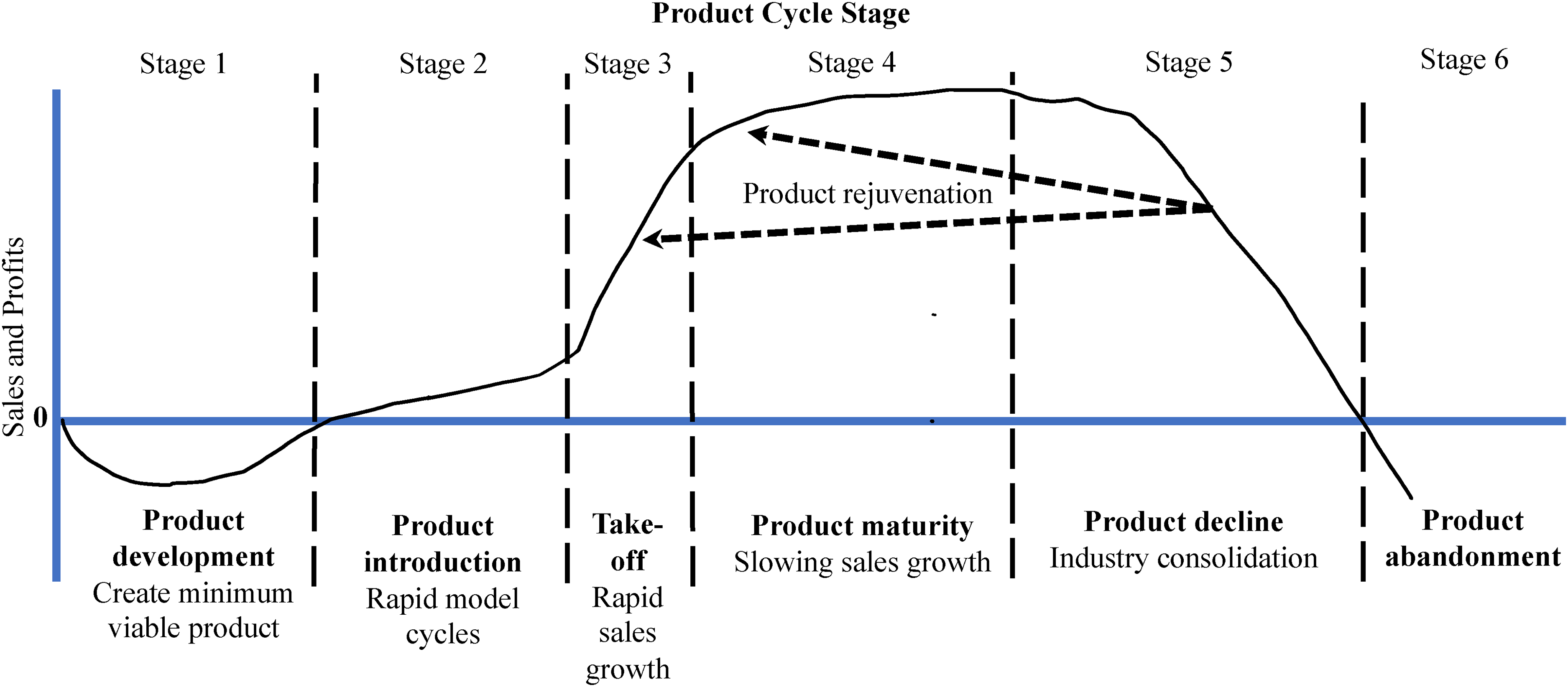
The product life cycle.
Product Development
Minimum viable products (MVPs) are created and tested during the first stage as their uses emerge and evolve from a concept or technology into a product. In this stage, profits do not exist because the business is developing and does not have meaningful sales.
Product Introduction and the Threat of Moving
A business enters the second state once an MVP is available for sale. The product introduction stage is when the market tests the viability of both the product and the company. Profits are slow to arrive as customers discover the product, which either finds its reason for being or it fails. Most business failures occur in the first two stages of the product cycle, accounting for the endemically high turnover rates among start-up businesses (Hurst et al., 2011).
The probability of a company moving out of a region increases as it proceeds from one stage of the product cycle to the next because the change can trigger demand for more staff, space to accommodate capital equipment, or a search for a workforce with a different occupational mix. The hydrogen fuel cell and energy start-up company Hyperion is a good example.
Hyperion was founded in Columbus, Ohio, by a group of aerospace and automotive engineers in 2011, and hydrogen fuel cells were its product. 11 In 2015, Hyperion moved to Orange County, California, to take advantage of California's Hydrogen Highway to support its research and vehicle prototype testing. 12 Then in February 2020, the company announced the XP-1, a hydrogen fuel-cell-propelled sports car with a declared range of 1,000 miles, as an attention-getting umbrella product and its expansion with a large investment back in Columbus. The announcement signaled Hyperion's move from Phase 1 to 2 along the product cycle.
Hyperion will maintain its research and design center in Orange County, along with prototyping, testing, marketing, and sales. At the same time, the company is investing in a $297 million, 65-acre campus in Columbus that will house its headquarters, production engineering, and the manufacturing, assembly, and distribution of its fuel cell stacks. It expects to employ more than 100 engineers, 230 manufacturing workers, 40 warehouse employees, and 35 facilities jobs, among other positions on the campus. Additionally, Hyperion will make components for the XP-1 in Columbus, with final assembly done by a contract assembler.
Reporting by the Columbus Dispatch and the company's website indicates that the decision to expand in Columbus revolved around three critical location factors: the price of the campus, the availability and cost of labor, and the locations of its potential industrial customers (Welker, 2022).
Takeoff
Once a product stabilizes and its model cycles slow, companies enter the takeoff phase of rapid growth. Leadership focuses on managing and accommodating rapid increases in product demand and building the company's supply chains while being vigilant for the emergence of competitors. Takeoff is where the product or industry can propel regional employment gains. The section below on gazelle companies is an extension of this short description of establishments in the product cycle's takeoff stage.
Product Maturity
When growth rates slow and the upward trajectory of the product cycle curve moderates, the product enters maturity. Product maturity happens when management begins to switch its focus and culture from accommodating growth to cost control and building market share. Products are susceptible to being moved to lower-cost locations with different occupational mixes during the transition from takeoff to maturity. However, operations rarely pack up and leave at this transition point. For example, when a company builds a branch establishment, the branch plant will often have newer technology, lower operating costs, or be near a growing geographic market. Then when demand diminishes, the company will put the original location and younger branch locations into a pro forma spreadsheet cost competition, with the older site having either a cost or revenue disadvantage. NCR, formerly the National Cash Register Company, is an example of the ties between the product cycle, corporate strategy and structure, and location.
John Patterson invented the cash register and founded NCR in Dayton, Ohio, in 1884. The company evolved into computer manufacturing after the Second World War, emphasizing the banking industry and becoming a dominant automatic teller machine (ATM) manufacturer. NCR also commercialized barcode scanners and point-of-sale information technology. 13 As time progressed, the company developed software and information systems for the banking industry and retail. However, the computer business melted from mainframe to minicomputer to personal computers to abandonment, resulting in NCR focusing its hardware business on ATMs. The corporate history of NCR became tangled in 1990 with changes in ownership, acquisitions and divestitures, and reorganizations that continue today. However, for this commentary, NCR's purchase of Compris Technologies in 1997 is significant because Compris was a Kennesaw, Georgia, producer of software sold to restaurant chains.
In 2009, NCR shocked Dayton when it announced that it was moving its headquarters and research and development to Duluth, Georgia, in Gwinnett County and was establishing an ATM manufacturing center in Columbus, Georgia. CNN Money's Ben Rooney (2009) reported that the company chose Georgia for its headquarters and research and development operations after an “extensive analysis of potential locations based on the nature of the local workforce, infrastructure, financial incentives and government tax structures.” In addition, NCR pointed to the shift in its center of gravity in employment away from Dayton between 1997 to 2009. NCR also stated that its new Georgia facilities would create synergies as its headquarters, research, call center, and manufacturing were within 150 miles of each other (Berry, 2010; Fisher, 2015; Wolf, 2009).
The American Banker's headline emphasized that the move generated savings in time and money after insourcing its manufacturing from a contract manufacturer and locating research and development near its Georgia plant (Wolf, 2009). In addition, the company cited better domestic and international air connections, especially to South America, and lower operating costs (Berry, 2010). Interestingly, in 2007 the company established an executive office in New York City to accommodate its new CEO and maintained it through his tenure.
In 2015, NCR announced that its headquarters and research functions would move again as it began construction in Atlanta's Midtown district. The company wanted to locate closer to Georgia Tech's talent and technology agglomeration as its product mix shifted from hardware to software and services (Karkaria, 2018). But NCR's struggles in managing its mature ATM division and an economically younger software enterprise continued.
In September 2022, NCR announced that it would cleave itself into two independently traded companies by the end of 2023. One company will use its ATM systems to deliver services to retailers and banks. NCR's press release positions this company as mature and cash-generating. NCR described the second as a digital commerce growth company serving the retail, hospitality, and banking industries that will “reinvest in the business to accelerate growth and recurring revenue” (NCR, 2022). NCR's CEO will lead the company with a financial upside. This is the economically younger growth company.
Product Decline and Rejuvenation
Once returns or growth begin to turn negative, the product enters phase five, decline. And the decline phase often ends with abandonment when the product exits its home region's product portfolio for one of four reasons. The first is to move to a lower-cost location to improve margins. Second, sell to a business with a competing product interested in building market share; however, selling to a competitor is also likely to result in the product leaving the region. Third, the founding company either goes bankrupt or abandons the business. On rare occasions, the decline stimulates product revitalization that changes the product's cycle position, as represented by the dashed arrows in Figure 1.
Currently, traditional automotive assemblers are managing their transition from decline to rejuvenated products stimulated by the threat from start-up electric vehicle (EV) producers. Personal transportation and trucking are in the early stages of a 15- to 20-year transition from internal combustion engines (ICE) into lower carbon electric or fuel cell powertrains. Hybrid ICE-EV powertrains are likely to offer a multiyear waystation. The question for regional economies with ICE assembly, powertrain, or parts plants is where is the new investment going? Will new investment flow in their direction and revitalize their economic base? Or will the investment go into regions that do not have legacy ICE powertrain investments? Part of the answer to this question depends on which assemblers survive—the entrepreneurial start-ups or the legacy original equipment manufacturers (OEMs).
Comparative Versus Competitive Advantage
The terms comparative advantage and competitive advantage cause confusion among practitioners. They are not synonymous. Comparative advantage in spatial economies comes from their stocks of economic development assets. Comparative advantage is the mix and costs of factors of production in one regional economy compared to another, as well as how geographic location and natural and built amenities stack up against those in other regions. Competitive advantage rests within companies and comes from proprietary corporate assets that give a firm an absolute advantage over its competitors. These sources can be its brand, distribution, intellectual property, or its locations and the factors of production embodied in those locations, especially in its workforce. A region's economic development assets can be a comparative advantage in attracting and retaining products and their related businesses at a specific point in the product or industry life cycle. And a region's comparative advantage can also be the source of a business's competitive advantage. However, as products move through their life cycle, factors of production that were once sources of competitive advantage often turn into comparative disadvantages. After that transition occurs, the chance that the company will move, or the operation will lose an intracompany internal rate of return competition to another facility, or an external competitor, increases.
Often the relationship between a region's comparative advantage and a company's competitive advantage is based on how the region's mix of labor skills and costs matches a company's occupational demand at the product's position along the product cycle. The connection is best illustrated with a hypothetical example. Let's begin with a start-up company, such as Hyperion, that locates its prototyping and initial production close to its research and design function to speed the product's model development cycle. The co-location recognizes that infant products experience rapid model changes as minimum viable products mature into standardized products. In Hyperion's case, the economic development asset that bonded the company to Southern California was the research and development team's dependence on California's Hydrogen Highway. In other cases, the co-location will be rooted in the mix of engineers, scientists, and industrial designers who provide the region with a comparative advantage in research and product development. However, as soon as product models stabilize and model development becomes incremental, dependence on research and development weakens. And, as growth rates slacken, the company becomes more sensitive to operating costs and may search for a new location. Here again, Hyperion serves as an example when it moved production to Columbus, Ohio, from Southern California based on cost factors and the location of many of its potential customers.
The geographic separation between research and development and production occurred in the computer and mobile phone hardware industries in what MForesight's Sridar Kota and Tom Mahoney referred to as an “invent here, manufacture there” production strategy (Kota & Mahoney, 2022). Apple's locational decisions and geographic relationship to its supply chain illustrate this strategy. An earlier example of technology rejuvenating a mature product and triggering production relocation is the rapid decline of tire manufacturing in Akron, Ohio. Corporate investment decisions related to the shift from bias-ply to radial-belted tires coincided with a strike of the United Rubber Workers Union in 1976 that resulted in Akron's tire manufacturing plants closing. 14 The companies invested in new plants in right-to-work states with lower energy costs.
The lesson that EcD practitioners should hold dear is that a company's current location is at risk every time a product moves from one stage of the product cycle to the next. What was a comparative advantage—a desirable and competitive mix of EcD assets—in one part of the product cycle might become a comparative disadvantage in the following stages. Therefore, economic developers must guide their regions to replace lost products through entrepreneurship and change the region's EcD assets to attract new products.
Practitioners and academicians should remember that markets determine how long a good or service spends at each stage of the product cycle. Clocks and calendars do not determine economic time, and EcD is neither physics nor trigonometry, where phases are well defined. For example, Southeast Michigan's run with automobiles began in 1896 when Henry Ford built his quadricycle in his kitchen. And the region's vehicle assemblers moved from product initiation to decline over a century and are now attempting to revitalize their products by moving to hybrid and electric drivetrains. Washington, D.C. was founded to export the federal government's services in 1800. It survived invasion in 1812, succession and civil war in 1861, and insurrection in 2021. The long runs of Detroit's and Washington's dominant products contrast with the short heydays of the lumber capitals of Bangor, Maine, and Muskegon, Michigan, or the fleeting reliance on flour milling in Buffalo and Minneapolis. Pittsburgh had a longer run with steel, as did Hartford, Connecticut, with gun manufacturing and insurance, but those eras ended.
Economic developers are constantly asked what is next whenever one part of a region's economic base dies. If there is no ready answer, the region will enter a period of secular decline that may result in a new, lower equilibrium and radically lower returns, or payments, for its factors of production. The previous sentence is a jargon-filled way of writing that real earnings will decline, housing values will decline, the value of commercial and industrial real estate will decline, and population will decline. Eventually, the region will reach a lower level of stable real, or inflation adjusted, EcD asset prices and move along a lower growth path.
Regional Product or Industry Portfolios
The concept of regional product portfolios introduces product life-cycle diversity as a complement to sectoral variety, which is behind portfolio theory in finance. Regional product portfolios are constructed from the life-cycle positions of each product in a region's economic base. The weighted average of the distribution is the region's growth rate, and the distribution of products across the different stages of development indicates the diversification of the region's product cycle.
A reality of the life of products and their industries is that over time growth slows, and, eventually, decline occurs. When taken to the level of an economic region, the implication is that regional growth rates will slow as products age and companies will either move production or disappear. Likewise, growth will decline if a region is not constantly introducing new or infant products into its portfolio. However, the implicit social contract between employers and workers limits a regional economy's ability to reload its product portfolio. This unwritten contract is a set of expectations about earnings, benefits, and working conditions held by the legacy workforce.
For example, wages and benefits in long-established industries set labor market expectations that prospective businesses may not be able to sustain. Earnings expectations will be especially sticky if the companies that owned the declining products had market power, earned monopoly or oligopoly profits, and supported the social contract by paying above-market wages to buy labor peace. If wage and benefit expectations are too high based on the productivity or skill mix of the existing workforce, the decline will become secular. If this occurs, negative path dependency results until the terms of the social contract erode or skills improve. The lesson is that, over time, regional growth rates change as the distribution, or mix, of products across the segments of their product portfolios changes.
While the idea of regional product cycle portfolios is intriguing, modeling the portfolio presents a considerable challenge for three reasons. First, publicly available data on products are nonexistent. Public data are collected by industry and are made publicly available at high levels of product aggregation. However, these publicly available industry data are the analytical starting point. Second, product age is not determined regionally. The geography of demand for a product defines its product-cycle age, and demand for all but local services is typically national or global. Third, new products and industries are often green shoots that emerge from the ashes of older or defunct parts of a region's economic base, especially if research and product development took place in that region.
Treado (2010) demonstrated that a specialized metallurgy and materials research and service industry developed in Pittsburgh from the legacy of that region's metals industry and became part of metropolitan Pittsburgh's economic base. Pittsburgh's heritage of research and development in metals provided the rootstock. Treado wrote that although Pittsburgh lost “steel-making capacity during the end of the twentieth century, it did not lose its steel-making expertise” (p.105).
I missed this nascent knowledge cluster in a regionally based, statewide economic cluster study that used two- and three-digit NAICS data (Deloitte, 2004). 15 The data were too highly aggregated to find this cluster. To complicate matters, the cluster's members crossed several NAICS industrial categories. Treado taught me that while quantitative research provides an excellent baseline for EcD analysis and planning, finding green shoots often requires a qualitative examination of the regional economy that focuses on products and services rather than industries.
Product portfolios can be constructed by placing industries in a matrix where each sector is positioned qualitatively within one of the cells by translating product age descriptors into positions along the product life-cycle curve. Those positions can then weight value added or regional GDP in each segment or product cycle bucket. A colleague and I wrestled with using industry GDP growth rates (first differences) and the rate of change in the growth rate (second differences) nationally and regionally over an extended period to capture product cycle positions. Unfortunately, the work was tedious and hampered by data aggregation. Nevertheless, I concluded that locating the place of each industry qualitatively in a product-cycle category, or bucket, is adequate for economic development planning and analysis for a single region or a small number of regions.
An understanding of EcD, creative destruction, product cycle age, and product portfolios sets the stage for a discussion of the work of economic developers by defining five activities that dominate their day-to-day jobs.
The Zoo of Economic Development Practice
The core activities or service lines of economic development organizations (EDO) are business recruitment (attraction), retention, expansion, and entrepreneurship (BRREE). EcD practitioners commonly refer to business retention and expansion as BRE. BRREE adds recruitment and entrepreneurship to retention and expansion. Most EDOs leave entrepreneurship to specialized organizations because the operational culture, skills, and tools used to support entrepreneurs and product development differ from recruitment, retention, and expansion activities. Establishing an entrepreneurial business culture and experiencing success is specialized and complex with uncertain results. I am keeping entrepreneurship in the mix because it is the start of the product life cycle. Entrepreneurship is a way to restock a region's product portfolio and is a specialized part of economic development practice.
I think of EcD practice as a matrix of activities with BRREE on the horizontal axis of Figure 2 and product cycle stages along the vertical axis. (Product development is not inlcuded in Figure 2 because it is the precursor to product introduction.) Walking through the matrix is tedious, so I use a small zoo of five “animals” (rabbits, gazelles, foxes, buffalos, and puffins) to teach the connections between the product cycle and BRREE to EcD practitioners. The zoo connects a region's product portfolio with the jobs of EcD practitioners.
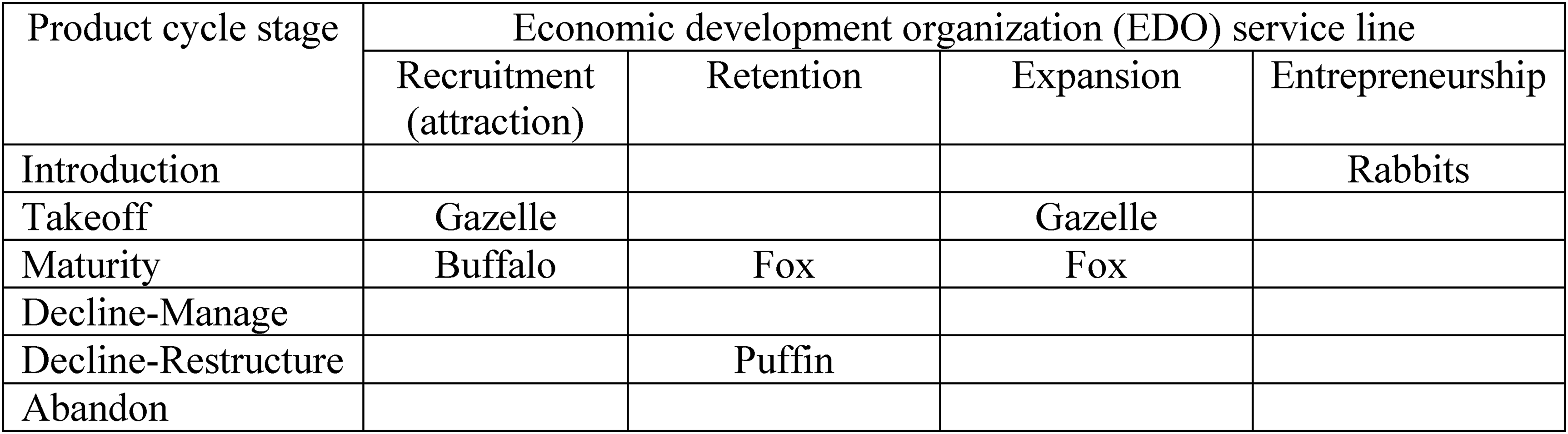
Welcome to the EcD Zoo: The intersections of the product cycle and BRREE activities.
Rabbits
All who risk their incomes and assets to start or take over a business are entrepreneurs. Therefore, entrepreneurs are not just business owners who intend to lead high-growth firms or run companies with technology-based products. And their businesses will range from sole proprietorships to potential global companies. Entrepreneurs' motivations include being their own boss, earning an income, providing a solution to a pressing social problem, responding to a market opportunity, and translating a personal passion into a job. And the earnings goals of entrepreneurs range from replacing incomes lost after being fired to extreme wealth.
Entrepreneurs differ along four dimensions: (1) the amount of financing their business requires; (2) the complexity of their capital structure; (3) their desire to work in their business (producing the actual good or service) compared to their desire and ability to manage the growth of their business (and their ability to delegate responsibilities and production); and (4) the scope and complexity of their operations. These distinctions determine the level of technical assistance that EDOs provide. For example, the EDO in Ohio's Appalachia area rarely works with a company with more than ten employees, so cash management and marketing assistance are in high demand. At the same time, Ohio's major metropolitan areas created entrepreneurial ecosystems facilitated by specialized EDOs to identify and nurture rabbits that aspire to become gazelles.
While it would be nice if all regions could grow enough start-up businesses and products to completely replace those that aged, moved on, or died, however, the truth is that entrepreneurship is a piece of the job-growth puzzle because of five realities.
First, most net employment growth comes from a small number of high-growth firms (Piazza & Hill, 2021). Second, most start-ups fail at the product development and introduction phases of the product cycle (Hurst et al., 2011). Third, not all entrepreneurs are interested in taking on the 20-year task of building a national or global brand with substantial employment in a tradeable sector. Fourth, start-up businesses that produce tradeable goods and services and survive are associated with a region experiencing reduced poverty and increased incomes. In juxtaposition, while local serving (or nontradeable) start-ups generate external economic benefits, they are not large enough to reduce poverty (Lee & Rodriguez-Pose, 2021). Finally, higher new firm formation rates are associated with lower income inequality. In contrast, higher self-employment rates have a positive statistical relationship with increased income inequality, mainly through growth in the number of jobs at the bottom of the income distribution (Liu & Qian, 2022). Therefore, a herd of fecund rabbits appropriately represents entrepreneurial development because regions need to breed many start-ups to help restock and grow their product portfolios.
Three questions about an entrepreneur help predict if a rabbit will convert into a gazelle or a fox. Is an entrepreneur interested in managing a thinly capitalized, high-growth firm for 20 or more years to achieve scale? 2) Is an entrepreneur looking to replace lost income from another job? 3) Does an entrepreneur maintain tight top-down control over the enterprise? If a successful start-up owner answers no to the first question or yes to the last two, the company will likely become a valued part of the region's economic fabric. However, it will not become a desired gazelle. At best, it will become a respected and midsized lifestyle company (a fox), with its growth capped by the owner's aspirations or need to control the enterprise.
Gazelles
Gazelles represent high-growth firms in the takeoff phase of the product cycle. They have demonstrated a viable product and earned a market presence. Due to their growth rates, their corporate cultures focus on sustaining the top line of their income statements and meeting demand. And as a result, gazelles are highly desired targets for out-of-region EcD recruitment. If a region has companies with gazelle products, then EDOs should work closely with them to retain and sustain their operations. However, gazelles are difficult to identify unless the EDO is close to the industry. Gazelles are also hard to work with because the founders and managers are so busy running and growing their businesses that they stay under the EcD radar. When I show a gazelle in my lectures, the image is of a cheetah getting ready to take the gazelle down. I use this image for three reasons. First, several companies can enter a product niche market, and few will come out on the other side. Second, some owners of gazelle companies are not interested in establishing a long-lived company. Instead, they see themselves as a product development company. Being bought out by a large firm is their exit strategy. Third, when a gazelle gains visibility, other regions will try to attract the company or a significant part of its planned expansion. EDOs must remember that retention and expansion are competitive activities, and retaining a gazelle is not a region's birthright.
Site Selection
When mature companies grow, they often increase their geographic locations while actively managing costs and expenses. Expansions are motivated by a desire to access talent, increase sales, or lower operating costs. Exceptions can occur in closely held companies where locational decisions can be affected by the owners’ or senior managers’ lifestyles or political preferences. No matter the motivation, these locational decisions are often cold-blooded, data-driven optimization exercises.
Site selection is a funnel with searches taking part in three phases. 16 The first is internal with the search team, possibly aided by a consultant. At this stage, the team sifts data and other information to identify the regions on which the search will focus. The company's goal is to narrow the number of potential regional economies as quickly as possible. During the first phase, the search team defines its desired operational outcomes and derives positive critical location factors (must haves) and knockout factors (must avoids).
An example of a knockout factor is a state's lack of right-to-work legislation (legislation that makes it more difficult for unions to organize a workplace). I ask EDOs and site selection consultants what fraction of expansion projects reject states because of right-to-work legislation. I do so for two reasons. First, right-to-work legislation is associated with higher metropolitan area GDP growth rates in econometric studies (Wolman et al., 2017). Second, the topic often emerges during barroom conversations at EcD meetings. The answer is that no one knows because the early stage, the knockout stage, is done by the firm or a consultant with data before the site selection team contacts an EDO. However, the suspicion among those with experience in nonright-to-work states is that the share is high. Guesses range between one-third and one-half of formal searches aided by site location consultants. (The range does not control for the round of drinks or who was paying.) But, again, these are guesses made in casual conversation, not documented facts.
I make six observations from conversations about right-to-work knockouts and the correlations in regression models. First, the effect is real but has moderated over time. Second, union avoidance most often affects jobs requiring low to moderate skills and manufacturing firms that are sensitive to labor costs more than any other critical location factor. Third, it is unknown whether the motivation is union avoidance or if companies see right-to-work laws as signals of a business-friendly political and regulatory climate. (I’d bet on union avoidance.) Fourth, some EDOs in states that do not have right-to-work legislation have produced data demonstrating how infrequent organizing is, that it is essentially a public sector phenomenon, and that private sector organizing varies by region within states. Fifth, tight labor market conditions have placed more emphasis on the availability of talent and occupational skills than union avoidance. Six, no EDO or public official is comfortable publicly talking about right-to-work as a knockout factor.
The second phase of site selection is both analytical and outward-focused. It begins when the corporate team accesses commercial real estate and EDO data to identify potential sites within the candidate regions. Toward the end of this phase, they begin to contact EDOs in those regions for additional information. The third phase is site analysis, where the team conducts comparative site-specific cost analyses and investigates the feasibility of specific sites. The third stage involves municipal EcD staff, planners, and the public service and building departments. Typically, this is when the bargaining over incentives takes place. The most visible recent site location competitions were Amazon's HQ 2 site location auction in 2018, the scramble to attract integrated circuit fabrication plants in 2022 (Schultz, 2022), and the EV vehicle assembly and supply chain land rush in 2022 (McDonnell, 2022; Tavernise, 2019).
The goal of attraction is to locate branches of facilities of gazelles or mature firms that generate jobs paying family-supporting wages based on the mix of the region's EcD assets and operating costs. I associate two animals in the zoo with product maturity: buffalo for recruiting and foxes for retention and expansion.
Buffalo
When I think of the attraction activities of EDOs, the image of a buffalo hunt appears. In this cartoon of reality, EcD professionals set out on a quest for buffalo to sustain the region. They drag their kill back, and the people eat. And when all the meat is gone, the hunters head back out. Buffalo hunts are neverending for EcD professionals, and it is the dominant EcD practice. While there is plenty of buffalo meat, there is little motivation to hunt. If life is good, why do anything differently? The answer is that, like a good meal, branch plants can pass quickly.
Foxes
Foxes are associated with product maturity because mature firms are concerned with managing their expenses. My association between foxes and mature products comes from idioms about foxes being wily and sharp-eyed, which is true of successful midsized companies engaged in retention or expansion projects with a financing component. Retention and expansion projects can also use other EDOs, such as the Manufacturing Extension Partnership, to improve the productivity and operations of existing establishments and change a potential relocation into a retention project (Bartik, 2016; Summit Consulting & W.E. Upjohn Institute for Employment Research, 2021).
In Figure 2, I split the decline phase of the product cycle into two paths, restructured and managed. Restructuring operations, improving products, and introducing new features to existing products are ways of moving a declining operation back in product cycle time. However, managing waning product demand is an activity that aligns with the Boston Consulting Group's (BCG) growth-share product portfolio matrix. The BCG matrix plots a product's market share against its growth rate and divides the figure into four quadrants (Henderson, 1970). 17
BCG recommended that managers of slow-growing products with low market shares “should liquidate, divest, or reposition these “pets” and reinvest in products with high growth and dominant market share or fast growth and growing market share (BCG, n.d.). The decision to abandon a product or a production location is a private-sector decision. However, when an organization announces its closing, EDOs are often under political pressure to react, even if that reaction is mainly symbolic. Abandonment is where puffins, an endangered species, take center stage.
Puffins
Cute and lovable puffins are an endangered species and represent retention efforts involving operations in decline and where management, or labor and management, are unwilling to restructure operations to return to profitability or wherecompetitive footing cannot be reestablished. Cleveland's saga over its steel mills is a good example (Encyclopedia of Cleveland History, n.d.; Shingler, 2020). The conglomerate LTV purchased Jones and Laughlin's (J&L) Cleveland Works in 1968 and Republic's Cleveland plant 4 years later. The plants are opposite each other on the banks of the Cuyahoga River. Unfortunately, operating economies from the merger never materialized in the face of declining demand. As a result, the behemoth entered bankruptcy in 1986 despite wage and benefit concessions by the United Steel Workers Union. As a result, steel production in Cleveland became an endangered species, and political pressure focused both political and economic development activities on saving the mills. LTV restructured its operations, but steel demand continued to erode, and operational efficiencies did not appear. As a result, the company reentered bankruptcy in 2000, and the mills closed in 2001. A year later, International Steel Group (ISG), a Chicago-based hedge fund run by Wilbur Ross, purchased LTV's assets, and combined them with other bankrupt mills. However, the purchase only occurred after the union and ISG agreed to restructure operations, and ISG promised to recapitalize the plant after the deal closed. In 2005, ISG sold the plant to Mittal Steel, and, for a time, it became the most efficient integrated steel mill in the nation. Cleveland Cliffs purchased Mittal's Cleveland Works and Indiana Harbor Works in 2020. Saving a region's endangered species depends on the willingness of the company, investors, workforce, and state and local government to support the restructuring and reinvestment required to create a rejuvenated set of products. The endangered species will become extinct if labor or the political community is determined to reestablish the old way of doing business and to reassert implicit social contracts.
What Are the Five Development Professions?
The five developments are different professional practices that modify the word development in Figure 3: economic, community, workforce, housing, and commercial and industrial real estate. Each has a distinct purpose. They are not synonyms; they do not produce the same outputs and outcomes and are not the same jobs.
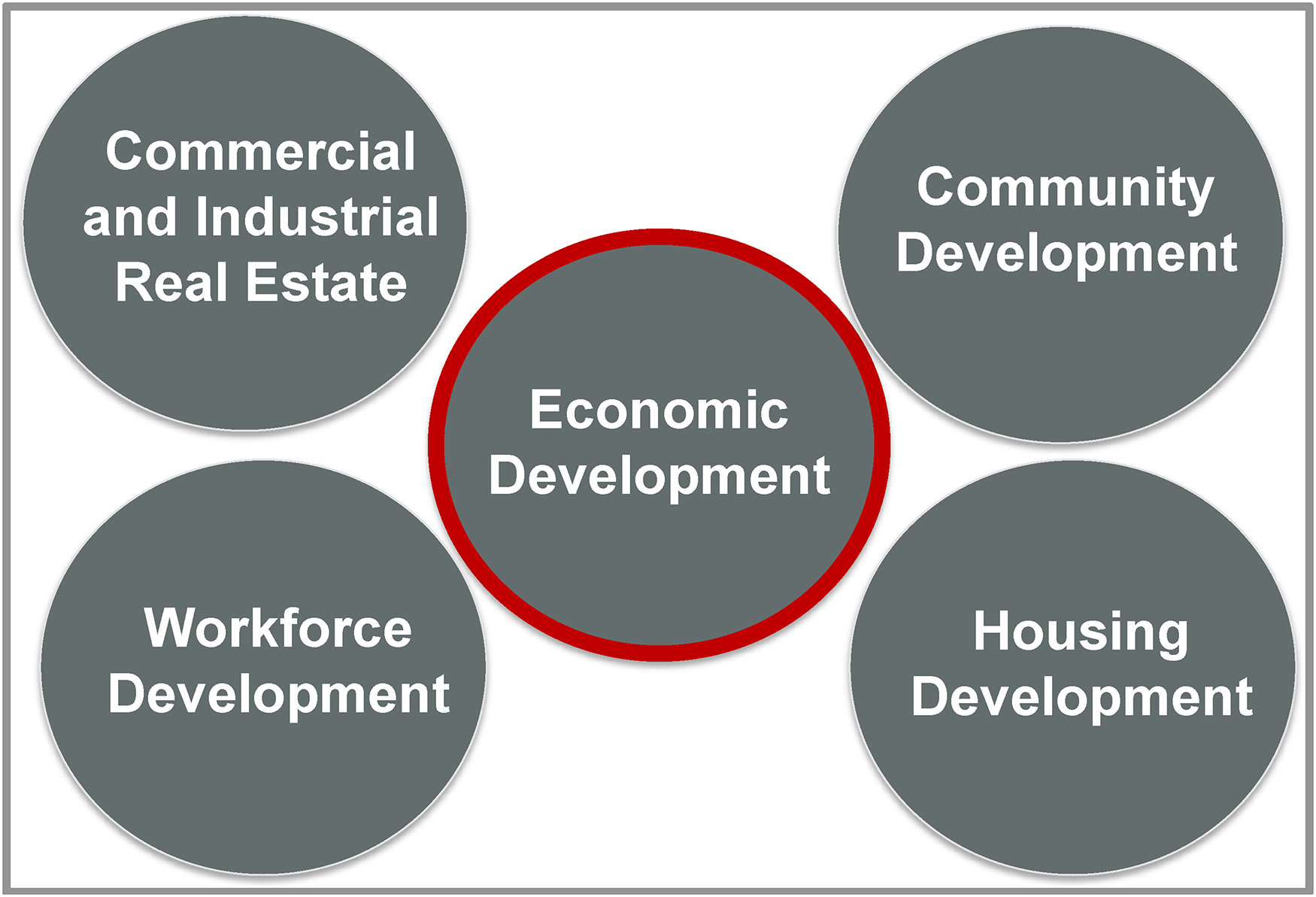
The five developments.
Workforce developers and industrial and commercial real estate developers supply the flow and maintain the stock of these essential regional EcD assets. While labor is an economic development asset, workers require accommodations, making housing the third regional market. In contrast to the developments that operate on a regional scale, community developers provide investment funds, organization, and regulation to support neighborhoods and municipalities.
The outcomes from community development investments are safe places to live, educated people, recreational and social amenities, and locations for production and commerce. Community development anchors the building blocks of a vibrant economy and positions communities within the region's maze of housing and commercial and industrial real estate submarkets (Galster & Rothenberg, 1991; Rothenberg et al., 1991). When done well, community development can change the relative position of geographic nodes or submarkets within their overarching economic region (Van Leuven & Hill, 2021).
While migration can cure some workforce shortages, regions create and maintain most of their stock of talent. Human capital development on a scale that can lift a regional economy is inclusive, based on high expectations, and diverse in learning modalities. There is no one-size-fits-all educational program that fits the capabilities and talents of all people or the teaching requirements of all skills. Education must accommodate those who learn by connecting their heads to their hands and those who learn deductively. And educational outcomes must include developing technicians and workers in the skilled trades, as well as those who are college-bound. Educational outcomes should be of regional concern because the labor market is regional. If municipal school systems fail, then the economic prospects of their regions suffer.
Education that is local serving is not EcD because its product (skilled labor) is a factor of production; it is not the product. Yet, education and workforce development are a region's most critical assets for creating better economic futures. And while education is an essential EcD input, it is, for the most part, a population-serving outcome of community development. So, people who call local-serving education economic development are wrong; however, people who ignore education are also wrong because an educated workforce is an essential economic development asset.
The relationships between the four developments and EcD need to be clearly understood by EcD professionals. First and foremost, community and workforce development are necessary but insufficient for EcD to occur. Also, well-functioning housing and commercial and industrial real estate markets are required to support EcD activities and workers. Nevertheless, these four development practices do not create EcD. Instead, they accommodate EcD. In other words, workforce, housing, commercial and industrial, and community development are necessary for EcD to occur, but they are not sufficient. The catalytic event is private sector investment that results in new or enhanced goods and services.
Ultimately, improving competitive assets—workforce skills, quality of place and environment, and infrastructure––is done by regions through collaboration because governments that service economic regions do not exist. It requires state government funding with support from the federal government because no single government entity encompasses an economic region (Barnes & Ledebur, 1998).
What Is the Job of an Economic Developer?
Economic developers are market makers and deal closers who connect the demand for regional development assets of workers and sites with the current supply. The best economic developers are honest brokers who act as the voice of their customers in their regions. They also serve as the voice of their communities to their customers. The EDOs that employ economic development professionals operate on the geographic scale of supply and demand for their region's economic development assets, which is the economic region. Importantly, EDOs and their professionals need to operate at the decision-making speed of their customers.
Economic developers must be servant leaders because they are intermediaries. Economic developers do not make business investment decisions. And they rarely control funds that can improve their region's factors of production. As a result, they create neither private-sector jobs nor EcD assets. Instead, economic developers encourage investment and risk taking by the private sector by lowering transaction costs, reducing investment risk, and perfecting the flow of regional information.
The practice of EcD is both an art and a science. The art of EcD is connecting the dots between the supply of and demand for EcD assets that no one else can see. The science of economic development is getting the deal done. The connection between the art and science of economic development mitigates risk, builds trust, and reinforces optimism. Most importantly, the art and science of economic development create investment momentum that can change the long-term development path of the region.
However, the art and science of economic development practice alone cannot create a miracle that instantly turns an economy around. Instead, residents and political leaders need to do the hard, decades-long work of fixing the basics of local service provision and investing in competitive stocks of economic development assets. The four Ps that create long-term economic value are people, products, productivity, and place making.
Twenty-one years after Mayor Doty asked me to explain the purpose of economic development at a community forum in Duluth, I answered his question. I am a very slow writer.
Footnotes
Acknowledgments
Bruce Katz recommended me to Mayor Doty in 2001, which started this commentary. Kelly Kinahan kept after me to consider the connection between community and economic development. Fran Stewart and Andrew Van Leuven knew what I was trying to write and made helpful comments on a draft of this essay. I owe four economic development practitioners thanks for connecting me to practice. Joe Roman co-taught my classes in Cleveland, and Mark Barbash participated in the class in Columbus. Mark also made me an annual lecturer on the fundamentals of economic development in the Ohio Economic Development Association's Basic Economic Development course. This commentary grew from those lectures. Tracey Nichols taught me the importance of transactions. Finally, Carol Coletta encouraged me to focus on practice when she was vice president for community and national initiatives for the Knight Foundation and leader of CEOs for Cities.
Declaration of Conflicting Interests
The author declared no potential conflicts of interest with respect to the research, authorship, and/or publication of this article.
Funding
The author received no financial support for the research, authorship, and/or publication of this article.