



Abstract
For Georg Simmel, humans confront their basic contradiction in the city, and such contradiction warrants critical assessment to help in the long tradition of articulating the problematic development of cities or metropolises, and hopefully advocate for the kind of life we want. This contradiction is a corollary to the modern visual aesthetics of young, contemporary artists such as Iza Caparas, Farley del Rosario and Daniel Aligaen. Their works not only depict the city or urban living; also their styles or sense of aesthetics are informed on a larger scale by the geopolitics of the ’70s up to the present, the influence of the early modernist artists, and their own estimation as well of what is happening in the country. This paper uses visual impairment or blindness as a trope for modernist aesthetics. The contradiction of city life produces this particular problematic vision that is then appropriated by these young painters. In this paper I am guided by three important questions: How do I understand the city and its contradictions? How is the city depicted in the paintings of young contemporary artists? How do I talk about modernist paintings and aesthetics in terms of the dynamics of city or urban life?
We do not find two opposing world, but rather a global society and a variety of social universes whose fundamental characteristics are their fragmentation, the sharp definition of their boundaries, and the low level of communication with other such universes. (Manuel Castells)
Two worlds apart
My experience of modernity in the city is a contradiction. Studying in Ateneo de Manila University 1 in the late ’80s made me realize the deep, penetrating problem of urbanity as I commuted every day from my home in Taguig, 2 passing through Pasig City, Marikina, and Quezon City. Later I reckoned that my observation was not just personal but also historical and systemic. Journalist Gloria M. Gloria observes in Makati 3 that, despite the menacing high-rise apartment blocks, banks and malls, one cannot help but notice the miserable barangays in the outskirts where most workers reside. Makati is actually two worlds torn apart by the gap between its posh villages and its squalid barangays. Sociologist Erhard Berner (1997: 11) says that in Makati, as well as in some urban centers like Cubao and Pasig, towering skyscrapers and impressive building façades are repudiated to some extent by the sprawling slum areas in the peripheries.
Such contradiction warrants critical assessment not only because we want to come up with an urban renewal program but, more importantly, to help in the long tradition of articulating the problematic development of cities or metropolises and eventually advocate for the kind of life we want. For Georg Simmel (1950: 409), man confronts his basic contradiction in the city, and cities are sometimes seen as both catalysts and cancers, both aiding and hindering the development process or urbanization (Caoili 1999: 12). The experience of contradiction cannot just be solved by simply eliminating the poor or by getting rid of them through forced evacuation. What is needed is an understanding of this contradiction that allows us to see Manila in light of the development of other cities around the world. My experience of Manila necessitates an approach that sees the modern city in terms of its social relations and symbols, hence the city as a site of everyday practice. Setha M. Low advocates for a broader discourse of urban studies and urban policy, and she believes that it is through these experiences of everyday life in the city that we gain knowledge of the bigger texture and fabric of human experience (Low 1999: 2–3). James Donald (1999: 1–3) has mapped out a sort of cartography of various studies in and about cities, citing Christopher Prendergast, Victor Burgin, Mike Davis and Sharon Zukin, among others. My aim in this paper is only to situate my experience of Manila in this long tradition of urban studies, one that sees Manila as a site for globalization or development on one hand, which means funded partly by transnational corporations and its informal sector (Berner 1997: 3–5), and, on the other hand, animated and constituted by the slums or ghettoes. This means that slums are not just the outcome of failed city or urban planning but rather the inherent logic of city formation, the result of simultaneous and articulated processes of growth and decline (Castells in Berner 1997: 6–7), and the coping mechanism of the residents within the limited or allotted space claimed as their territory.
I would like to look in particular at how Manila is imagined or depicted in contemporary visual arts since the experience of the city manifests themselves as ambiguities in various modes of everyday experiences and forms of cultural production. An interesting study by Jonathan Beller looks at the cinema and other forms of media as the institutions that brought about the industrial revolution to the ‘eye’. Not only does the television (or radio) audience produce itself as a commodity, but watching image-commodities is value-creating labor on those commodities in which the looked-at commodity becomes the very surplus extracted by the capitalist. Thus, Beller (2006: 1–5) argues for an understanding of exploitation in seeing or acquiring vision. Similarly, I would like to look at the contradiction in metropolis as corollary to the modern visual aesthetics of young, contemporary artists such as Iza Caparas, Farley del Rosario and Daniel Aligaen. Their works not only depict the city or urban living but their styles or sense of aesthetics are informed on a larger scale by the political economy of the ’70s up to the present, the influence of the early modernist artists like Arturo Luz, and their own estimation as well of what is happening in the country. However, unlike Beller who sees capitalist exploitation within the trope of city visibility, I would like on the other hand to use visual impairment or blindness as a trope for modernist aesthetics. Somehow the contradiction germane in city life produces this particular problematic vision that is then appropriated by these young painters whether consciously or not. In this paper I am guided by three important questions: How do I understand the city (Manila) and its contradictions? How is the city depicted in the paintings of young contemporary artists (Iza Caparas, Farley del Rosario and Daniel Aligaen)? How do I talk about modernist paintings and aesthetics in terms of the dynamics of city or urban life?
Dual contradiction in Manila
There are two levels of contradiction in Manila that we need to understand. The first of these is the construction of Manila as a colonial city during the Spanish Period. Intramuros or the Walled City was built to institutionalize the divide between the colonizers and their subjects. It was the seat of both the higher Spanish bureaucracy and the ecclesiastical hierarchy. Until the latter part of the 18th century, Intramuros functioned mainly as the central conduit for the shipment of goods from China to Mexico, but direct participation in this galleon trade was limited to the Spaniards. The native population was excluded. As the Spanish merchants kept their capital invested in Manila, the economic prosperity brought by the galleons was largely confined to the city and its suburbs, while the outlying towns and provinces produced their food and other needs, hardly anything of interest to exporters except sugar, timber and gold, of which there was very little surplus for export (Caoili 1999: 3). A parasitic relationship of the city to the neighboring towns and communities is characteristic of the colonial city, and it was a relationship that would last for 300 years. Contradictions such as this are also physical and architectural and exist in other colonial cities or colonial hill stations, such as Baguio in the northern portion of the Philippines, built and used by the Americans during their occupation, or the Bokor Hill Station in Cambodia, and Bandung, West Java, Indonesia. Although these hill stations or colonial cities are quite diverse historically and culturally, their function of segregating the colonizers from their colonized subjects is quite familiar. However, Sarah Low (1999: 7–8) attributes such formation not only to a colonial city but also to a divided city that evokes not only physical barriers but hidden barriers in terms of race, class, and gender divide. In such a division one faction is more powerful than the other – the colonizers against the colonized, uptown against the ghetto, men against women, or whites against blacks or other ethnic groups. This unevenness of power relations creates a politics of visibility whereby the colonized subjects are rendered visible, to be categorized, segregated, manipulated or controlled while the colonizers remain hidden from view. As in the case of Intramuros, Indios were not granted access to it and the walls fortified with canons are strategically aimed at various communities like Binondo or Parian around Intramuros. In some cases where naval or army bases are built, as in Subic and Pampangga, fortification is part juridical and administrative on the part of our government and the US. These cities or centers are rendered invisible – they cannot be seen yet they exercise surveillance among its target subjects. Such invisibility or the concomitant blindness of the people governed or subjected in this relation is a case of the power-effect that will be utilized by every modern city. Segregation and mutual exclusion prevail in colonial Manila.
The second level of contradiction is not so much physical or architectural but rather more fluid, brought about by the country’s involvement in the Second World War. More than being a site of the juxtaposition between the rich and poor, Manila’s destruction would augur the creation of economic and political centers like Makati and Quezon City, which would eventually rise as competing centers replicating colonial Manila’s division and segregation. The formation of Makati and Quezon City is part of the United States’ neocolonial policies against the country, making the economy highly dependent on their markets. During the American occupation of the country, the United States was experiencing sustained economic growth and widespread material advancement. Henry Ford was instrumental in heralding US transformation from an agricultural to an industrial, mass production, mass consumption economy. Mass production spread across the oceans to new auto industries and new kinds of production from house building to junk food (Hobsbawm 1994: 263), and Ford would engender a variety of public policies, institutions, and governance mechanisms. Makati and Quezon City would then be a haven for US Fordist economic policies and we would see a tremendous outpouring of US financial aid for modernization, in particular the construction of public roads, buildings, and centers. Universities like Ateneo de Manila would move to Quezon City. After 1948, Zobel de Ayala developed its farms, put up infrastructure and leased the land to investors. The former Nielson Airport would be converted to business centers and its runways the main avenues. By 1992, most of the banks had their headquarters in Makati (Berner 1997: 16). Caoili (1999: 62) cites the development of Makati and Quezon City as testaments to the deep cleavages in Philippine society, showing the contradictions that arose from political independence under conditions of economic dependence, in which intra-elite competition for control of the government and the economy paved the way for the declaration of martial law in 1972.
The Marcos regime would actually hasten the uneven urban development in the ’70s. Marcos would commission architects to create buildings such as the Cultural Center of the Philippines, the Film Center and the PICC as icons of progress. However, despite the construction boom, the government failed to meet and solve the growing urban problems. People would be attracted to the city or centers and Manila’s population would increase and overflow to its suburbs and other towns, reaching as far as Bulacan, Cavite and Laguna provinces (Caoili 1999: 69). Neferti Xina Tadiar (2004) uses the concept of ‘state bulimia’ to describe Manila in the ’70s in relation to its neighboring towns and communities. Manila is bulimic as it attracts a lot of laborers, and once these buildings or construction projects are finished, the city would figuratively disgorge the now redundant workers in the peripheries as they settle temporarily in makeshift houses. Literature and film about the plight of these workers and laborers flourished during this period. Roland Tolentino (2001) discusses at length the films of Lino Brocka, which are critical of the condition of people during the Marcos regime. Instead of experiencing the exhilaration of modernity and progress promised by the regime, this period of change brought about a heightened awareness of the contradiction of modern living. The concept of proletarian art would draw a number of adherents from the first-generation modernist painters (Guillermo 2001: 49). Although Arturo Luz may not necessarily be considered as part of this protest movement, his work nonetheless is very much informed by the ambivalent nature of this period. He is known for ‘playful linear works’, minimalism and geometric abstracts. One of Luz’s important works is the City Series in which the city or buildings are depicted in continuous and connecting lines, conic towers, and sometimes plain arched domes. What enthralls us in this work is its allegorical value that places us in a distant and alienating stance in relation to the subject. It is as if, looking at a panorama of skyscrapers, we begin to feel the desolation of dwelling in the city, this unhomely place that glorifies only the exchange value of commodity and where we, in the end, recede into the background, surrendering to the manipulations and distractions of city lights and billboard advertisements. Walter Benjamin (1999: 5) writes of the same predicament of the flaneur in his Arcades Project, the flaneur being lost in the crowd and yet still not part of the crowd, for he is still able to discern the material condition of his subjugation vis-à-vis the phantasmagoria of the city and the arcades. Thus, Luz’s intended viewer and Benjamin’s flaneur are one and the same, and if Luz’s City is an abstraction of the real city, it is only because the world of the flaneur is already abstract. Luz is not just presenting a city; he is painting a way of seeing our world, the city being transparent, a city of lines and geometric figures where man is rendered invisible. Arturo Luz and the rest of the modernist painters, like Ang Kiukok, Vicente Manansala or Jose Joya, would augur this way of seeing. Through their abstract works, they are concerned with a heightened awareness of the contradiction of living in the city on one hand and the apparent blindness acquired on the other hand.

Visual impairment as modernist aesthetics
The philosopher Paul Virilio (2008: 25) believes that our life in the city is defined and determined by speed, which is for him a form of militarism combined with capitalism that structures our world in a constant state of crisis and an unending cold war of environmental and economic exploitation. Our alienation can be perfectly explained by our orientation to this speed that oftentimes leads to a proliferation of phantoms that obscure our perception of the world or the saturation of images that almost render us blind. It is not surprising, therefore, that artists often depict the city in abstract forms, transparent, blurry, or glassy. This is the reason that painters and artists always endeavor positively to reinvent our vision of the world, and Iza Caparas’ s ‘Urban Life’ is no different in articulating our blindness and the violence of everyday life.
In ‘hustle and bustle’ Iza depicts the city and the people in blurs and impressions. Somehow this blurry effect can already be construed as a form of blindness or myopia (nearsightedness) where the image of distant objects is not focused on the retina but rather in front of it. One can see the buildings that are near but not at a distance. This blurry effect of a myopic depiction of the city is already pointing towards the real blindness inherent in modern living. One case in point is the fact that we love a computer game called Plants vs. Zombies, but do we really see how we, in the process of being glued to a computer or hooked on this game, have become either like a plant or a zombie? Life in the city is making a plant or a zombie out of us all. The call center industry today keeps the Philippine economy afloat, and yet this industry is also making a plant or zombie out of their workers. With the time difference between the Philippines and the US, the call center agents in the Philippines are the real zombies or walking dead, literally dead in the morning and alive only at night. The city as we experience it and how Iza sees it alludes to this kind of duplicity, caught in between life and death, between being a plant or a zombie. ‘Night café’ depicts people as apparitions merging with the buildings and shadows, and the same can also be said of ‘night market2’ and ‘raindrops’. We see people here as phantasms and these works echo Jean Baudrillard (1996: 1–13), who believes that our hallucinations and fantasies reduce our world to two-dimensionality, to an image, stripping away its relief and its historicity and in a way ushering us into a state of contradiction and immobility. Here the individual has become a mere cog in a machine and his progress, spirituality, and value are objectified (Simmel 1950: 429). If Iza Caparas translates the world into a myopic or hyperopic view, Farley del Rosario is much more concerned with depicting reality viewed by someone afflicted with strabismus, or a muscle imbalance resulting in the inability of both eyes to look directly at an object at the same time. Someone with strabismus sees distorted images.
In Farley’s works, this distortion becomes the very basis of his critique. In ‘I’m Hot’, we see a distortion of a favorite Japanese anime, Voltes Five, relieving heat with a native fan or pamaypay made of anahaw leaves. The backdrop of fumes issuing from cylindrical outcroppings might be a play not only on the anime and the factory pollution but also about the period itself when the country was beginning to feel the effects of globalization since Japan then was fast becoming an industrialized country and competing vigorously against the world market. This period would also augur a series of migrations of Filipinos and waves of contractual workers abroad. ‘I’m Hot’ therefore may not necessarily be just an expression of discomfort but an articulation of commodification, how we in the process of globalization become ‘hot’ raw materials to be circulated and distributed in the world trade. Many Filipinos would actually feel like Voltes Five as well, not just in being a machine but rather in its atomized or fragmented condition since Voltes Five is made from discreet robot parts. Whatever it is that we do not see in our time, Farley tries to bring it back, albeit through his works, especially in this series Farley called his ‘Play land’. The play land becomes an apt trope by which Farley communicates this esotropic vision, in which the distortion of figures leads to some sort of inward looking, one that somehow allows us to see our contradictory situation.


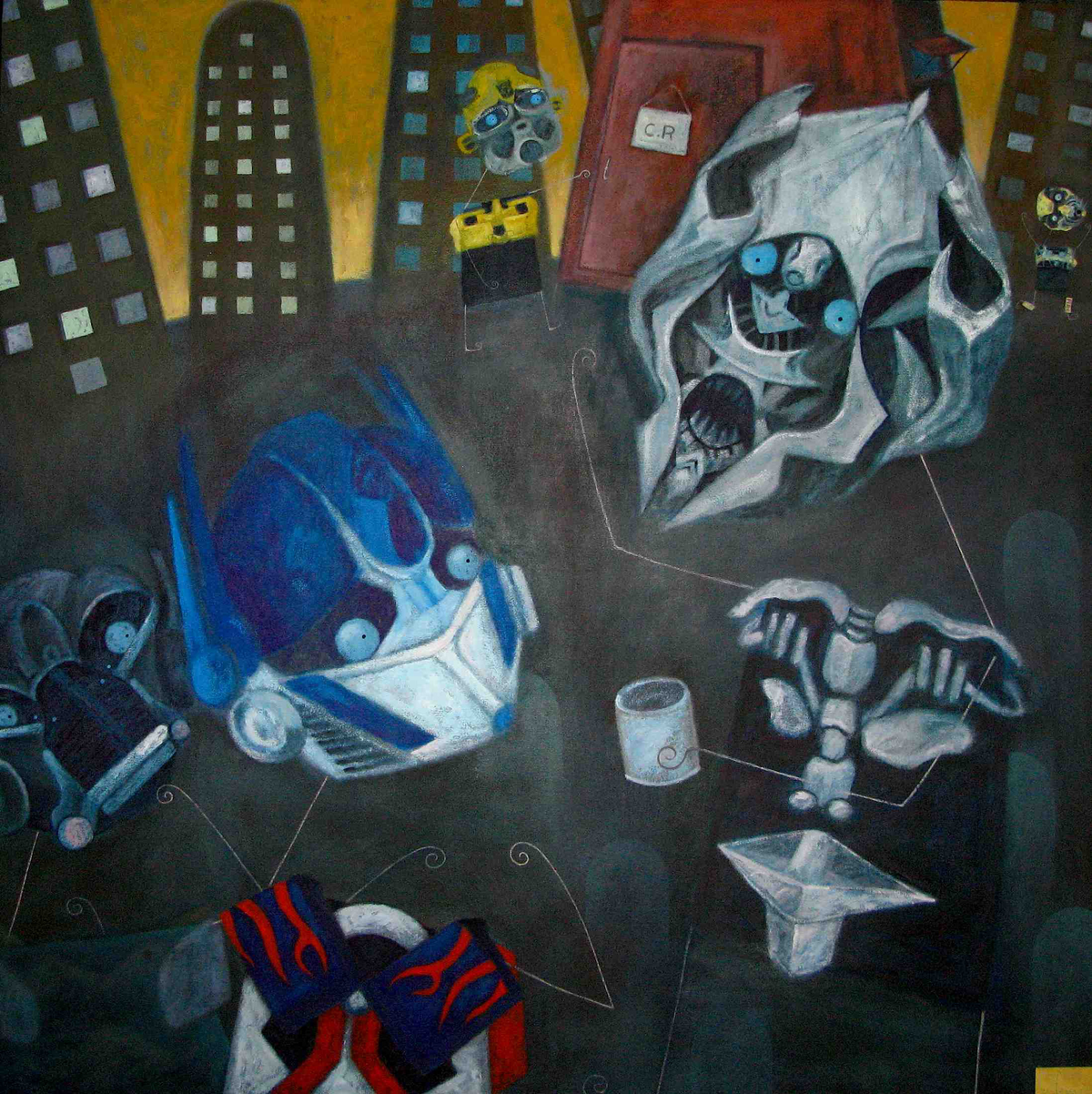
Farley also believes that our fragmentation is a continuing saga, as seen in ‘Transfarley: Sarao’, where the jeepney turns into a Transformer Decepticon with the curlicues and a smoke-belching muffler as its deadly weapon. If Voltes Five was the icon of the late ’70s, Transformers was one for the ’90s. Here our continuing degradation becomes more complex as our feeling of isolation becomes a necessary condition so that we can adapt to the foreign. Like the Transformer, we must be convertible from one machine to another. And this conversion is not just seen in our work but also in our social relations, how we relate to other Filipinos, and how we even see ourselves in relation to foreigners. Sometimes we cannot help but see ourselves not just as working machines but machines that can be converted into other functional devices. One can also see this horrifying conversion or transformation in ‘Collection’, where Megatron, another Transformer, is portrayed as a lavatory fee collector taking payment from a host of other characters from the popular film. In ‘Have a Blast’, the battle between Bumblebee and Barricade set in Glorietta Mall intimates how even our forms of entertainment or leisure activities are not spared this machination. Farley’s critique of modern living as shown in his works can be deceptively fun and cute, and yet the entertainment is just one of his tricks for foregrounding the theatricality of the world we live in.
If Farley uses distorted popular icons, Daniel Aligaen is more impressionistic and uses our insensitivity and blindness to our present condition. In a collaborative work with seasoned artist Fred Liongoren, dubbed Mga Kuwentong EDSA (EDSA Stories), 4 Daniel addresses the generational gap between those of us who were there and those of us who are often told ‘if only you had been there’, and between the promise of 1986 and the reality that confronts us today. EDSA for Daniel may still represent hope – but the hope is challenged, strained, if not shattered. Hoy Gumising Ka (Hey, wake up) and Teka, ano nga ba ang pinaglalaban natin? (Wait, what are we fighting for?) allude to this dreamy and illusory condition of the in-betweenness, transience, and interim period. In these works we see faces looking up as though clinging to a dream, and their faces bear the marks of grid streets that they have travelled. Daniel intimates the devaluation of the world and concomitant dehumanization he sees in the streets. In as much as we reclaimed our freedom from the street in 1986, Daniel sees otherwise – the repression, devaluation, and worthlessness. He invokes us to wake up by portraying ordinary people in the streets who perhaps defy the powers that be in the middle of the street. His conception shows not only moral courage but imaginative power, and his works were meant to dramatize the demands and adventures of modernity in the city. Daniel echoes Simmel (1950: 430) in that he sees cities as a contested urban space where the self-preservation of certain personalities is bought at the price of devaluating the whole objective world, a devaluation which in the end unavoidably drags one down into a feeling of worthlessness.
Continuing fragmentation
Young and emerging artists Iza Caparas, Farley del Rosario and Daniel Aligaen use art not only to depict objects but, more importantly, to depict our way of seeing and concomitant blindness. A study of their works reveals a facet of urbanization that is happening in Manila and elsewhere. Their works and styles may be interpellated by the dual contradictions of Manila, the juxtaposition of rich and poor and the vigorous competition among economic and political centers in Manila, and that through art they intend to contribute to the long tradition of political aesthetics and advocacy. From Arturo Luz’s time until today, artists are still addressing our fundamental crisis, our continuing fragmentation and dehumanization. For what it’s worth, this study veers away from the entangled discourses of periodizing art works, whether we are ushering in a new form of modern art or not. The more important concern is that art works have constituted and continue to constitute our ambivalent and contradictory modern experiences. With the mushrooming of supermalls and regional malls in Manila and nearby towns and provinces, one cannot help but see how such contradiction and blindness persist, as cities and centers, including all our activities, are being replicated or simulated. It will be interesting to account for our blindness within this new ‘mall phenomenon’ – how the class or gender division persists, how these malls compete with one another, how our very lives are conditioned by the spatiality of these malls. In the usual economic activity of a small group production serves the customer, but in the modern metropolis and in malls, economic activity is about producing for the market, for entirely unknown customers who never enter the actual field of vision of the producers (Simmel 1950: 430). This level of contradiction will have a bearing not only on cultural production but on the very fabric of our existence, and we have no choice but to confront it, understand it, and work against it. Confronting our contradiction is indeed a struggle whether in arts or in day-to-day activities. But as Jose Rizal, who dealt with his own contradictions and our society’s contradictions then, committing his life to the rectification of our vision (and unwittingly one of the first ophthalmologists in the country), once said: victory is the child of struggle, joy blossoms from suffering, and redemption is a product of sacrifice.