



Abstract
When the Royal Botanic Gardens at Kew in South London were opened to the general public in the 1840s, they were presented as a ‘world text’: a collection of flora from all over the world, with the spectacular tropical (read: colonial) specimens taking centre stage as indexes of Britain’s imperial supremacy. However, the one exotic plant species that preoccupied the British cultural imagination more than any other remained conspicuously absent from the collection: the banyan tree, whose non-transferability left a significant gap in the ‘text’ of the garden, thereby effectively puncturing the illusion of comprehensive global command that underpins the biopolitical designs of what Richard Grove has aptly dubbed ‘green imperialism’. This article demonstrates how, in the 19th and early 20th centuries, the banyan tree became an object of fascination and admiration for British scientists, painters, writers and photographers precisely because of its obstinate non-availability to colonial control and visual or even conceptual representability.
As Stephen Heath argued long ago, world literature may best be understood as the effect of reconceiving texts, ‘not merely comparatively and generically […] but migrationally and impurely, writings intermingled with one another, against the grain of ready – legitimate – identities’ (Heath, 2004: 174). Instead of fixed and circumscribed entities, then, texts would instead be grasped as porously open nodes in webs of multi-layered interweavings that allow for the construction of often surprising and unexpected affiliations across languages, temporalities and cultural territories. It is this intertwined and entangled condition of literary texts that allows contemporary scholars of world literature to make (out) lines of connection that link, say, Gilgamesh, Derrida and Henry James (cf. Dimock, 2006: 73–106), or Rabîd ben Rab’ia and Mallarmé (Badiou in Apter, 2006: 85–89). Epistemologically, the vectors of teleological evolutionism thus give way to the spatialization of literature as worldwide web. While the linearity of the Darwinian ‘tree of life’ will certainly not fit as a concept metaphor for this decentred and open-ended network, the banyan tree may very well function as a suitable image – a speculation supported by the way in which Susan Bassnett and Harish Trivedi, in the ‘Introduction’ to their edited volume,
Post-Colonial Translation (1999), invoke the banyan as an emblem of cross-cultural textual migration and diffusion: a natural process of organic, ramifying, vegetative growth and renewal, comparable perhaps with the process by which an ancient banyan tree sends down branches which then in turn take root all around it and comprise an intertwined family of trees: quot rami tot arbores. (Bassnett and Trivedi, 1999: 10) banyan tree, which must have an original root but sends down so many subsequent roots from its branches (other variants) that one can no longer tell which was the original. The pattern of banyan roots is rather like a Venn diagram of family resemblances, or the web of any invisible spider. (Doniger, 2011: 156–7)
It may well be true that one can neither access nor address nature in the raw and ‘as such’ but always only through the perspectival fractures that the cultural moment one inhabits allows for; this, however, does not mean that nature should (or even can) be fully dissolved into culture or language. Rather, the ‘materiality of the actual world we inhabit’ (Ganguly, 2017: 69) appears inextricably intertwined with the historical, the social and the cultural worlds that humans create for better or worse. Recovering a phrase suggested by Marx in The German Ideology, Jason Moore has dubbed this juxtaposition of nature and culture ‘historical nature’. Moore proceeds from the assertion that ‘there is clearly a web of life whose durée is reckoned in the billions of years’ but that this ‘web of life’, ever since the emergence of humanity, has been entangled with human rhythms and temporalities. Therefore, as Moore states, ‘time is always multi-layered and […] the interpenetration of these layers of historical time and nature’s deep time is fundamental’ (Moore, 2015: 116) for any understanding of historical nature.
On this premise, the banyan is not merely a trope or allegory, even though it certainly is one; it is also and just as much embedded in and invested with historical nature – not least, as will not come as a surprise, with the complex histories of imperialism and coloniality, especially in the manifold Indo-British contact zones. This paper aims to revisit one particular stratum of the banyan’s historical nature by looking at a couple of significant encounters that Europeans (mostly Britons) had with that species of tree between the early 19th and the early 20th century, i.e. that period that ‘gave us Darwin and the Kew Gardens’ (Moore, 2015: 117). It goes without saying that the banyan has a far longer history in the European – especially the British – imagination, where it appears as a literary trope in Milton, in Wordsworth and Coleridge, in Thackeray and T.S. Eliot; as an anthropological concept metaphor; or as a stock subject in picturesque painting and colonial photography. In all of these distinct areas of engagement, the banyan plays the role of a disruptive factor, both threatening and alluring, grotesque and sublime, forbidding and inviting. This leitmotif of the banyan’s obstinacy as a disruptive factor in the historical nature of high imperialism and industrial capitalism emerges most poignantly in the specialized fields of colonial botany and in picturesque painting, which will accordingly form the main focal areas of this paper.
However, I will briefly turn to a somewhat unlikely literary text to gain access to the banyan’s historical nature, c. 1919, when Virginia Woolf published her early experimental prose sketch ‘Kew Gardens’, in which no banyan appears – at least at face value. Instead the text interweaves the manifold sensory impressions of a hot summer afternoon in London’s Royal Botanic Gardens, where conversation fragments flutter like butterflies through the shimmering air; snails and beetles serve as narrative focalizers; spoken words transmute into colours, until finally bodies and objects merge into one all-embracing organic fluidum: ‘enveloped in layer after layer of green-blue vapour, […] at first bodies had substance and a dash of colour, but later both colour and substance dissolved in the green atmosphere’ (Woolf, 1989: 95). In this layered, vegetative atmosphere the bounded selves of both visitors and inhabitants of the Botanic Gardens coalesce into some organic transindividuality. This seems to confirm Allen McLaurin’s claim that Woolf’s poetics was driven by the utopian idea of an anima mundi, a shared ‘world soul’ and ‘unity of consciousness’ (McLaurin, 1981–2: 117) through which all individuals are essentially deeply connected so that ‘the characters’ minds are often so inextricably entwined at deep levels that they have difficulty retaining any illusion of individuality or separateness’ (Hague, 2003: 269).
‘Kew Gardens’, however, closes with a surprisingly mechanistic turn. The setting – the Royal Botanic Gardens – are themselves embedded, or rather encased, in a much larger multi-layered construction, namely the city, London, which appears ‘like a vast nest of Chinese boxes all of wrought steel turning ceaselessly one within another’ (Woolf, 1989: 95). There are various hints that the story’s complex, multi-layered space is potentially infinite as the box of the city is nested in the larger container of the surrounding world that the ‘Chinese boxes’ suggest (cf. Nadel, 2016: esp. 76–8). Fictional space thus exceeds the horizon of the city and opens out toward an indeterminate transnationality which, following Fredric Jameson, marks the limit of what can be represented and indeed experienced in metropolitan High Modernism: the experience of the individual subject […] becomes limited to a tiny corner of the world, a fixed-camera view of a certain section of London or the countryside or whatever. But the truth of that experience no longer coincides with the place in which it takes place. The truth of that limited daily experience of London lies, rather, in India or Jamaica or Hong Kong; it is bound up with the whole colonial system of the British empire. (Jameson, 1990: 49)
However important this popular educational dimension may have been, Kew Gardens not only disseminated botanical knowledge; perhaps even more importantly, they also produced it. They were a central actor in the bringing-forth and consolidation of that collective fiction that Thomas Richards has called the ‘imperial archive’: not only a network of powerful institutions but a whole epistemological complex whose aim it was to make the totality of empire representable as an object of systematic empirical knowledge: ‘in the nineteenth century the imperial archive succeeded not in attaining comprehensive knowledge but in collectively imagining a not-too-distant future when all species would be identified, all languages translated, all books catalogued’ (Richards, 1993: 39).
No doubt, as a lavishly furnished and funded research centre, Kew Gardens were important for upholding that vision; but beyond ‘mere’ taxonomy and classification of imperial flora, the experts at Kew were also crucially involved in engineering and utilizing this flora, whose ‘effective commercial utilisation depended upon precise identification, and Kew with its extensive collections of the colonial flora led the way in their global botanical survey’ (Desmond, 2007: 202). The discipline of the experts at Kew was not just botany but economic botany, as it was called in the heyday of colonialism, when Kew was an epicentre for the development of highly expansive transplantation scenarios. Indeed, Kew can be best described as one vast think tank churning out geo/biopolitical planning utopias on a global scale – ‘global designs’ to be realized overseas. The experts at Kew played a crucial role in the designing and implementation of highly profitable plant-based industries in Britain’s tropical colonies; as Lucille Brockway emphasizes, these industries organized the introduction and large-scale cultivation of ecdemic agricultural plants in suitable colonial territories. In this way, ‘Kew Gardens played a major part in the development of several highly profitable and strategically important plant-based industries in the tropical colonies’ (Brockway, 2002: 6); yet, more generally, ‘such institutions played a critical role in generating and disseminating useful scientific knowledge which facilitated transfers of energy, manpower and capital on a worldwide basis and on an unprecedented scale’ (Brockway, 2002: 6).
The most dramatic consequence of 19th-century agri-industrial globalization is surely the devastation of endemic biodiversity with the aim to establish vast colonial tracts of monoculture. Hence, for example, the Peruvian chinchona tree, from which quinine is extracted, was introduced to the South Indian Nilgiri Hills in 1863 and there cultivated in large plantations; by ‘1891, there were an estimated 1,800,000 chinchona trees on the government plantations of the district’ (Brockway, 2002: 121). Likewise, the Mexican agave sisalana got cultivated in large sections of East Africa, especially today’s Tanzania, for the production of sisal. Richard Grove calls this large-scale transfer of plant energy, labour power and capital ‘green imperialism’ that led to ‘a rapid ecological transformation and impoverishment in many parts of the world’ (Grove, 1996: 6). However, green imperialism not only imposed monocultures on the southern colonies; it also created the metropolitan showcase herbarium at Kew that offered a maximum diversity: a floral multicultural potpourri of representative transplants from all over the world.
But not everything can be transferred. Like the imperial archive at large, the collections at Kew remain gappy, as the strangely incomplete presence of the banyan tree in the collection most strikingly demonstrates. In the 1858 edition of the official Kew Gardens guide authored by William Jackson Hooker, the life-long director of that institution, the banyan, sometimes also called the Bengal Fig Tree, figures as both present and absent (see Figure 1): Among the numerous kinds of figs there will be found here […] a young plant of the Banyan (Ficus Indica, fig. 25), one of the most celebrated trees in tropical India, for the immense stretch of its limbs and the singular mode provided by nature for their support […]. These roots or props occupy such a space of ground in their native soil that one, growing on the banks of the Nerbuddah, covers an almost incredible area, of which the circumference now […] is nearly 2000 feet. […] 320 main trunks may be counted while the smaller ones exceed 3000, and each of these is continually sending forth branches and pendent roots to form other trunks and become the parents of future progeny. The whole has been known to shelter 7000 men in its wide-spread shade. Our young plant […] can of course give little idea of this famous tree; indeed it is evident that a well-grown one would alone fill the entire Palm-Stove of the Garden. (Hooker, 1858: 71–2)
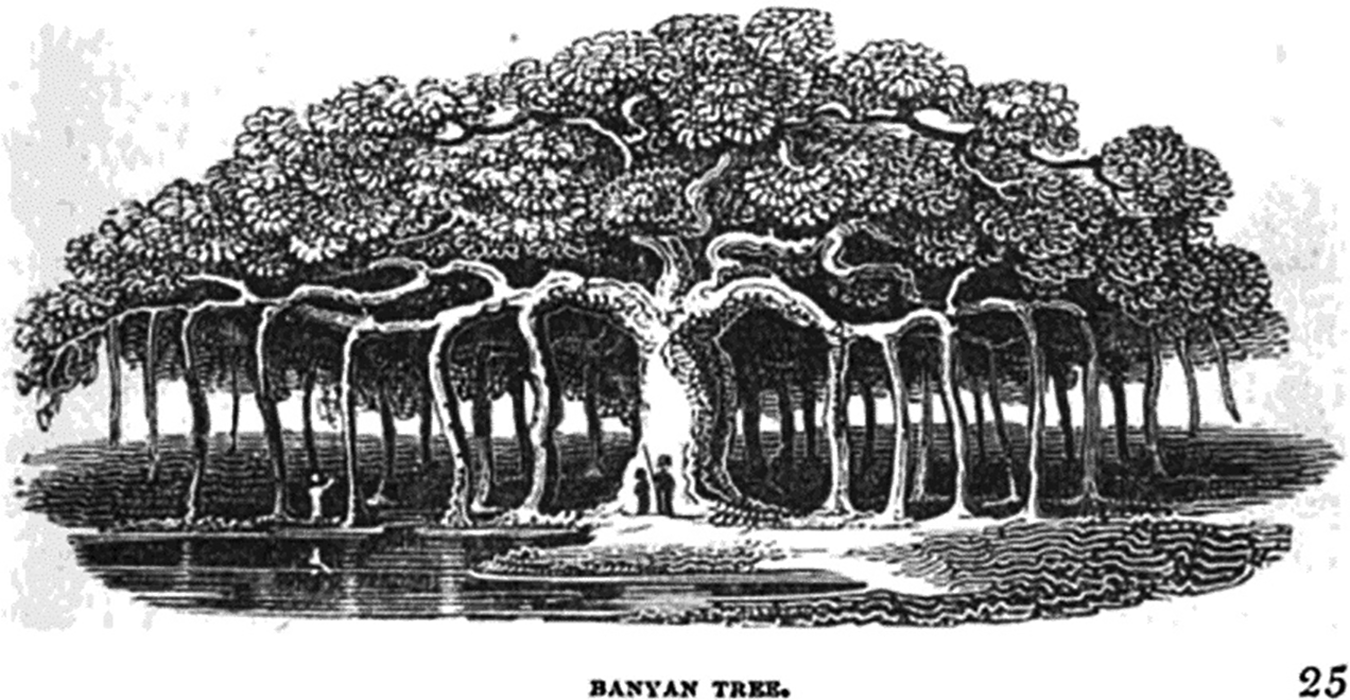
‘Banyan Tree’. In W.J. Hooker (1858: 72).
Hooker, speaking with the authoritative voice of the exhibitionary institution, has to concede the limits of imperial transplantation. A ‘well-grown’ banyan would demand a full-scale redesigning of the whole park since one single specimen alone would fill the entire palm-stove, by far the largest of the numerous glasshouses of which Kew Gardens prided themselves. The banyan, then, would implement on Kew Gardens what colonial plant transfer imposed on the colonies: monoculture instead of diversity. What is in fact on display, then, is a miniature banyan that is so small that it can give only ‘little idea’ of what it stands for. Unlike the life-size palms, ferns, rhododendrons and cactus trees, it does not yield actual presence and therefore refers to its own status as stand-in, as representative sign of something absent: the actual, non-transferrable banyan which accordingly requires to be not only described at length in Hooker’s Guide but also pictorially represented so as to grant visitors at least some surrogate for that which the imperial archive-on-display cannot actually put on display.
Not only as a biological specimen, but even as a textual object the banyan cannot be successfully transferred. This at least is the bottom line of a lecture that the philologist George Henry Noehden gave to the Royal Asiatic Society in 1824. Like Umberto Eco’s The Name of the Rose, Noehden’s lecture, titled ‘Account of the Banyan-Tree, or Ficus Indica, as Found in the Ancient Greek and Roman Authors’, is centred on a lost treatise by Aristotle: in this case not the legendary second volume of the Poetics but the book ‘On Plants’ in which, as Noehden has it, ‘[t]he mention of such a production as the Banyan-tree could not have been omitted’ (Noehden, 1824: 120). Noehden assumes that Aristotle must have written about the banyan since he, as the teacher of Alexander the Great, must have had immediate access to the data pools that Alexander’s military exploits made accessible to Greek scholars: ‘It is to be presumed that, by the orders of Alexander, not only specimens of natural productions were looked for, but that observations were also made, on the spot, by competent persons, on such objects as could not be removed’ (p. 119). Among these ‘objects as could not be removed’, Noehden imagines first of all the banyan whose observation ‘by competent persons’ must have served the great philosopher as raw material for his own lost description of the banyan. This hypothetical Aristotelian original then becomes the starting point of a complex intertextual avalanche, a series of Chinese whispers, or banyan-style ramifications: in this series of proliferation, first, Theophrastus ‘correctly’ cites the lost Aristotelian original and thus produces a ‘full and detailed, clear and accurate’ description of the banyan (p. 123). Not surprisingly, Noehden explains this accuracy by the fact that Theophrastus, ‘the favourite and most distinguished pupil of Aristotle […] undoubtedly had access […] to the stores of his master’ (pp. 120–1). Truthful description thereby easily slides from accurate rendition of the object to fidelity to the master’s script; and no wonder, given the circumstance that none of these writers, including Aristotle himself, did have any immediate access to the banyan as an actual organic entity. It is on this condition that the passing on of the written account always runs the risk of leading to distortions, as Noehden makes out in Pliny the Elder’s account of the banyan, for which Theophrastus’ ‘good’ copy of the Aristotelian original ‘forms the foundation’ (p. 124). But Pliny ‘omits, or alters, some essential points’ (p. 127), thereby introducing a truncated and distorted rendition of the banyan. Relying on this inaccurate variant – the outcome of misquotation, or ‘false’ reproduction – Strabo, drawing on Pliny, can only compose a deficient and ‘erroneous’ rendition of the banyan. Like the petty specimen in Kew Gardens, for whose sparsity Hooker apologizes in his guide to the park, the written banyan also comes out of the process of transfer diminished and deformed.
Noehden and Hooker both operate within the framework of a historical nature in which deep time is configured with the optimistic notion of progress that underwrites not only Darwinism but the imperial archive at large. Nature is here conceived as the object of scientific enquiry, an object waiting to be ‘improved’, whether as industrial monoculture, as scientific-didactic biodiversity, or as closure of the remaining gaps in the textual archive: Noehden surely dreams of recovering the lost Aristotelian ‘original’, from which all the other accounts are derived like the progeny of the banyan’s ‘mother tree’. However, within this progressivist framework, the banyan becomes a disruptive factor that leaves Hooker’s imperial exhibition incomplete and inverts progress into corruption in Noehden’s lecture. This move sets in already with the romantics, for whom the banyan serves as a topos of anachronism that stands in for some mythical lost origin. Thus the narrator in Sydney Owenson’s novel The Missionary praises the banyan as ‘the most stupendous and the most beautiful of the vegetable world. […] This tree which alone belongs to those mighty regions where God created man, and man beheld his Creator’ (Owenson, 2002: 135). Robert Southey calls the banyan a ‘natural temple’ where ‘a pious heart’s first impulse would be prayer’ (Southey, 1909: 179), and in a similar vein Wordsworth compares a country kirk in the Lake District to ‘the Indian tree whose branches, downward bent / Take root again, a boundless canopy’ (Wordsworth, 1849: 219).
No doubt colonial botany in the 19th century provided a rich sample of metaphors to conceptualize the immensity and inscrutability of the ‘East’ as ‘jungle’. In particular the ‘banyan tree became a trope for racial difference and complexity, and a metaphor for the dark inscrutability of the tropical forest as a whole’ (Sampson, 2002: 96). Since it grows simultaneously upwards and downwards, outwards and inwards, it put into question the linearity of the arboreal meta-metaphors of the imperial archive. It is true that some unchecked epistemological frustration speaks through the concession that ‘the “East” was indeed a place where simple dendritic symbols could not apply’ (Pinney, 1992: 172); yet all insight into the inaptness of European conceptual armatures notwithstanding, colonial science seems to have been incapable of taking the banyan for an epistemological model: ‘the British never seemed to think of using the most typical South Asian tree, the banyan’ (Cohn, 1996: 55) as a vehicle for their concept metaphors. It is against this backdrop that the numerous European banyan paintings and photographs from the colonial period lend themselves for a reading as (unwittingly) sceptical reflections on the limits and limitations of the imperial gaze, as so many indicators that ‘the East’ was intuited as a region that defied simple linearity and, hence, representability as such.
The turn in Romantic literature towards sacralizing the banyan as kirk, temple, or the last surviving species from Paradise itself, implies of course an attempt to contain this defiant status of ‘the East’: it is a kind of symbolic transfer that attempts to represent the other in terms of the self. This process finds its visual equivalent in the picturesque – a term that literally means ‘like a picture’ and whose application to landscape painting in Britain and elsewhere underscored the desire to improve nature, to recreate it as one imagined nature to be or expected it to look like, and to translate its ultimate otherness into a reassuring familiarity. European landscape painters working in late 18th and early 19th century India were literally obsessed with the banyan as a picturesque motif in which, as Romita Ray suggests, India’s inscrutability was bound to get symbolically suspended: ‘By singling out the banyan, the artist registers the desire to rarefy the complexity of the Indian geography into manageable, consumable glimpses’ (Ray, 2013: 118). In order to achieve this aim, British artists in India ‘invented’ a new genre that would soon strike roots all over Europe in Romantic landscape painting: the ‘arboreal portrait’ in which for the first time an individual tree took centre stage, the more bizarre and ‘ramified’ the better. Yet while European painters like Edward Kennion or Caspar David Friedrich successfully ‘portrayed’ grandiose oak trees, their predecessors working on the banyan got invariably frustrated by their motif, which refused to yield to the most basic requirement that any portrait subject has to fulfil: to be painted as an individual. This at least is the task that Charles D’Oyly sets himself in a letter to Warren Hastings: ‘to exert my talents in painting the tree as it ought to be: alone’ (in Ray, 2013: 118; see Figure 2). The banyan, however, is never ‘alone’ as it is never one but many.
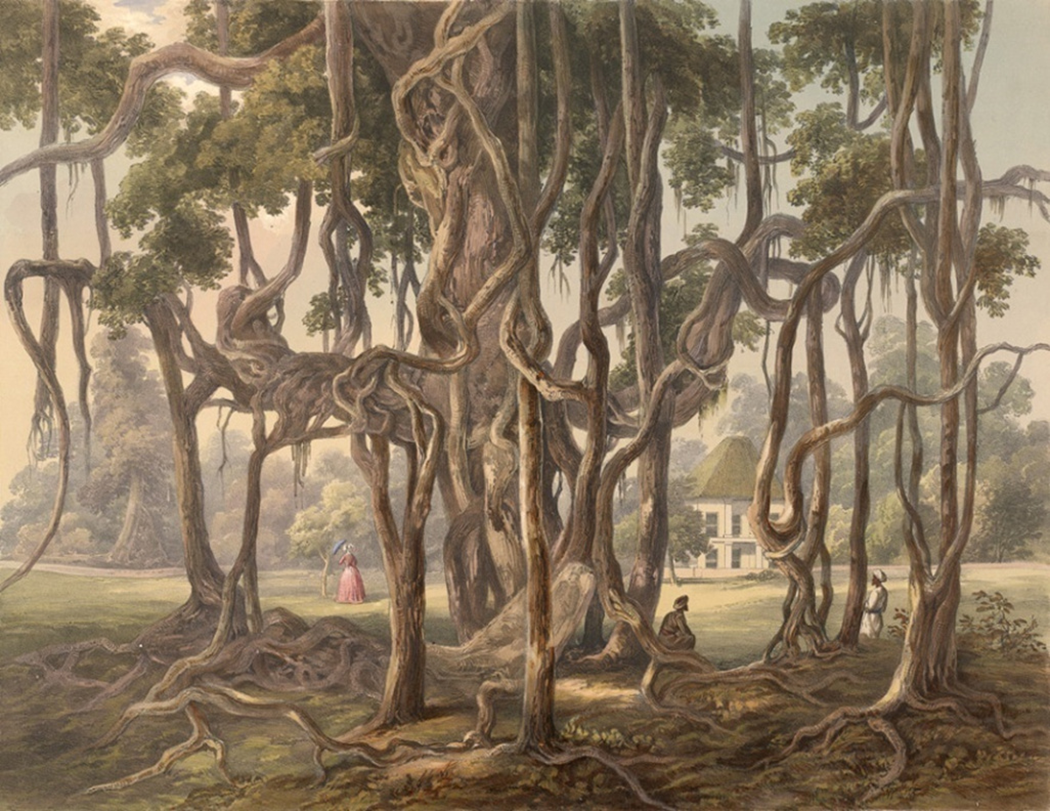
Charles D’Oyly, ‘Banyan Tree’ (1848). In Romita Ray (2013: 126).
The frustrated attempts at arboreal portraiture thus only reconfirmed the banyan’s unruliness and consolidated its suitability as a condensed image for the vastness and inscrutability of the ‘Orient’. As it grows not simply upwards but also downwards and horizontally, the banyan did not comply with the ubiquitous tree metaphors of the period and put their unilateral and teleological simplicity heavily into question – along with the claim to scopic control that is a crucial cultural characteristic of modern colonialism. In this vein, anthropologist Christopher Pinney (2013) interprets the numerous banyan photographs taken by Europeans in the late 19th and early 20th centuries as so many sceptical reflexions on the limits of the imperial gaze: as indicators that ‘the East’ was increasingly perceived as a region where simple linearity failed, a region that – like empire in Fredric Jameson’s model – refused to be representable as a totality. This refusal is of course precisely crystallized in the obstinate banyan and the impossibility of its portrayal. Whether in painting or photography, it takes an extreme long-shot perspective to capture a ‘total’ ‘well-grown’ banyan (see Figure 3), to return once again to Hooker’s apology for the absence of a proper banyan in Kew Gardens. What these pictures convey is the banyan as a bounded whole.
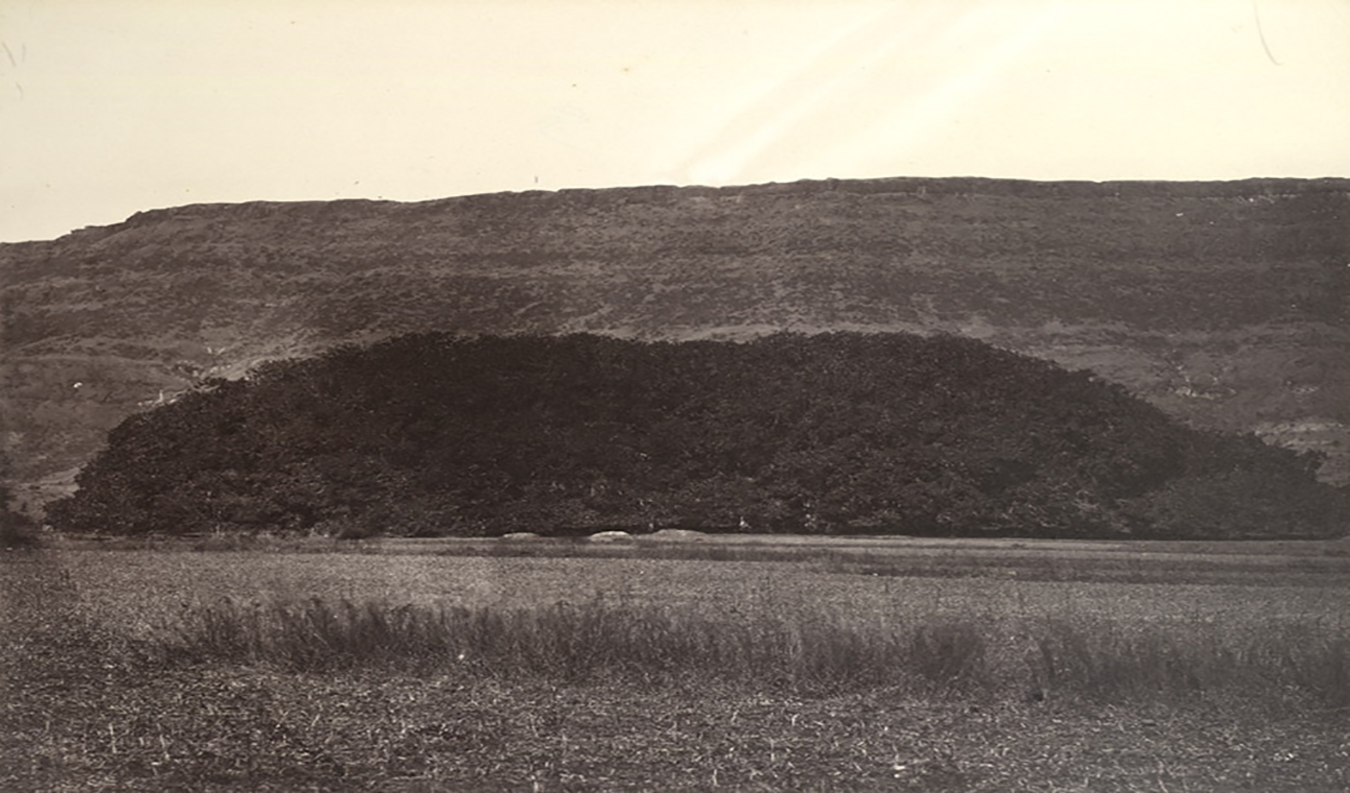
‘Great Tree, Waee near Mahableshwar. Covers 5 Acres of Ground’. Anonymous (1860s) from a private album titled ‘Photographs of India and Overland Route’. British Library Online Gallery. http://www.bl.uk/onlinegallery/onlineex/apac/photocoll/g/largeimage57480.html.
But any image that shows the banyan as a whole will have to omit the really striking formal feature of that tree, namely its multi-layered network structure that comes into view only in the partial visual representation of the close-up that denies full scopic control. Of course the banyan is simultaneously a whole and a network. As Caroline Levine argues, networks are theoretically infinitely expanding and thus appear incompatible with self-enclosed totalities. Yet she concedes that wholes and networks do overlap, ‘sometimes sustaining and reinforcing one another, at other times creating threats and obstacles’ (Levine, 2017: 119). The banyan, in this light, is a particular embodiment of this tense coexistence of the bounded whole and the sprawling network.
At the end of the 19th century, the Canadian company Underwood and Underwood launched a stereogram titled ‘Among the aerial roots of a single banyan tree’, with the comment that ‘Instead of showing the entire tree at a distance we have chosen to bring you among its wonderfully multiplied trunks’ (see Figure 4). Rather than a long-shot offering a total view of the tree, the stereogram offers a partial representation that allows for an optical immersion into the thicket. In order to achieve this effect a stereoscopic gaze is required that takes in two images simultaneously. The photographs have to be held very close to the eyes so that a ‘tunnel gaze of extreme close-up perception’ is produced in which the two overlapping images merge into one seemingly three-dimensional picture – an optical illusion ensuing from the intake of two images at the same time.
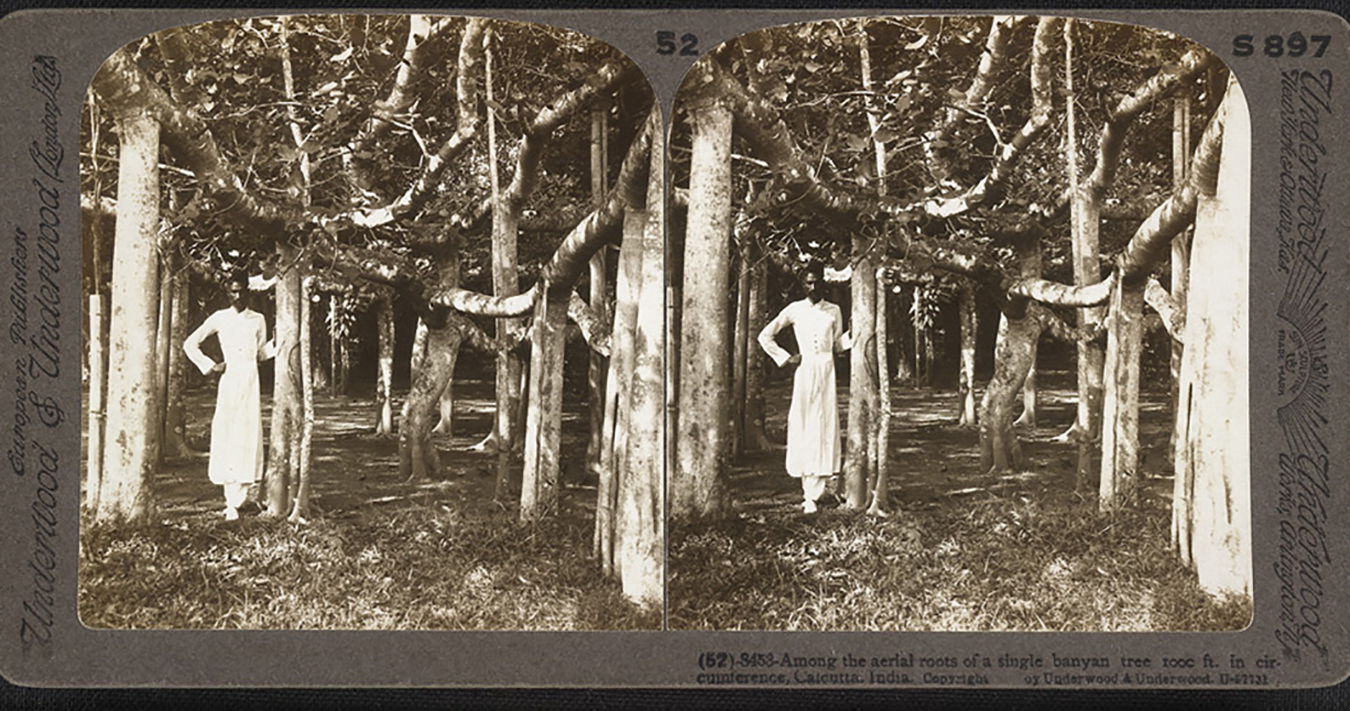
‘Among the aerial roots of a single banyan tree 1000 ft. in circumference, Calcutta, India’. James Ricalton for Underwood & Underwood Studios, c. 1903. In Christopher Pinney (1992: 169).
Could such a double vision perhaps hold together the two contradictory aspects of the banyan – it being a ‘whole’ and at the same time a network? It demands a double vision that the stereogram does not afford because it shows the same picture twice. What is required, instead, is that kind of double vision that Stephen Greenblatt calls metaphor. For Greenblatt, the metaphorical enables us ‘to sustain the simultaneous perception of two things at once; of likeness and difference, the very special perception we give to metaphor’ (Greenblatt, 1991: 31). Metaphoric double vision of likeness and difference offers an alternative to acquisitive transfer, to saming and othering alike. It is a layered perception in which the other is neither entirely different and hence incommensurate, nor a mere extension of the self. It is instead acknowledged in its opacity and obstinacy.
Perhaps – but this is pure speculation – Virginia Woolf has treated the banyan in such a non-possessive way and credited it with the opacity that the metaphorical approach allows for. As is well documented, Woolf was an ardent reader of the classics, not least those writers whom Noehden cites in his philological genealogy of the banyan as intertextual topos. As Jeanne Dubino (2017: 155) observes, Strabo was one of Woolf’s favourite sources, especially his monumental Geography. Strabo, perhaps not by coincidence, is the last in the line of Chinese whisperers in Noehden’s treatise. His ‘inaccurate’ rendition of the true Aristotelian banyan can be found in Volume 15 of the Geography, and it seems to anticipate exactly that multi-layered structure that Woolf ascribes to the atmosphere in Kew Gardens. Strabo writes that ‘when the trunks of the banyan have reached the ground, they strike roots, like layers and form other layers, and other layers, and again others’ (Strabo, 1930: 33). As we have seen, the visitors of the Botanic Gardens stroll or rest in a similarly layered ‘envelope’ in which they dissolve, into which they retreat and disappear in a way that reminds us of the ways in which the users of the stereoscopic photograph immerse themselves in the groves of the banyan – in moments that anticipate a historical nature that is not reduced to the ‘cheap nature’ of capitalist extraction but is recuperated as the very web of life in which we are all entangled.
Footnotes
Funding
The author(s) received no financial support for the research, authorship, and/or publication of this article.