



Abstract
Using data from the Panel Study of Income Dynamics we explore the relationship between current and early maternal occupational complexity and preadolescent children’s academic achievement in mathematics and reading. We measure white-collar occupational complexity with an index that incorporates task complexity, authority, and autonomy. Blue-collar occupational complexity is observed with a measure of task complexity with things. Controlling for differential selection into employment, we find that current maternal occupational complexity has positive associations with reading and mathematics scores for children, with stronger associations for sons. We find mixed associations between early maternal employment and children’s academic achievement, suggesting that the influence of early maternal employment on child development declines as children age.
Keywords
The employment of women with children in the home has risen dramatically over the past four decades. This shift has sparked considerable academic debate regarding the consequences of mothers’ employment for families and especially for children (Jacobs & Gerson, 2004). The findings from the resultant literature are mixed. Some suggest that maternal employment is detrimental for child cognitive outcomes (Coleman, 1988), particularly verbal and mathematical ability of young children (Ruhm, 2004). However, a larger set of studies finds that maternal employment neither affects the quality of the mother-child relationship nor the academic achievement of children (McGroder, Zaslow, Papillo, Ahluwalia & Brooks, 2005; Parcel, Nickoll, & Dufur, 2000). Indeed, some research suggests that maternal employment has positive effects on child outcomes (Kovacs, 1999; Parcel & Menaghan, 1994b; Vandell & Ramanan, 1992).
What might account for the variation in these findings regarding the impact of maternal employment on child cognitive abilities? We suggest that it may be due to the neglect of an important dimension of employment: occupational complexity. Most research has focused on the quantity of maternal employment, examining how maternal employment shapes children’s academic achievement through mothers’ work schedules, hours, stress, and occasionally mothers’ pay. However, the quality of maternal employment, in terms of its task complexity, autonomy, authority may also impact children’s cognitive outcomes. Research suggests that jobs that are cognitively stimulating may have spillover effects on the mother–child relationship in ways that benefit children (Kohn & Schooler, 1982; Perry-Jenkins, Repetti, & Crouter, 2000). Indeed, Parcel and Menaghan’s (1994a, 1994b) studies found significant positive associations between occupational complexity and early child outcomes. This article builds most directly on Parcel and Menaghan (1994a) replicating and extending their core finding with a new dataset, the Panel Study of Income Dynamics (PSID), and for a slightly older cohort of children. Parcel and Menaghan’s studies used 3- to 6-year-old children from the Children of the 1979 National Longitudinal Survey of Youth (NLSY), as does the vast majority of studies examining the effects of maternal employment on child outcomes (see appendix Table A1), making it unsurprising that these previous studies repeatedly show the same results. In addition to introducing a new dataset to this body of literature, this article provides a series of improvements on Parcel and Menaghan’s pioneering work by introducing occupational complexity as a measure of maternal employment. Following Parcel and Menaghan, but improving on the other studies in this literature we make a clear distinction between hours of work and occupational complexity. Compared to Parcel and Menaghan we improve the measurement of occupational complexity through separate indices for white- and blue-collar jobs. By using a slightly older group of children (6- to 13-year-olds) we are able to consider whether the impacts of early maternal employment on child outcomes for younger children shown in past research persist as children age. In addition, we extend Parcel and Menaghan’s strategy of controlling for relevant background characteristics of the mother that could a priori influence child outcomes by explicitly modeling differential selection into employment with Heckman two-stage corrections.
Literature Review
The literature on the associations between maternal employment and child outcomes offers different reasons and mechanisms why and how maternal employment might be linked to early child outcomes. We offer a summary of these studies, specifying the data used, the age range of children studied, the child outcome measures, the maternal employment measures and their major findings in appendix Table A1. One set of studies finds negative associations between maternal employment and child outcomes. This research argues that maternal employment, particularly during the first year of life, is associated with cognitive and behavioral problems in later life (Blau & Grossberg, 1992; Brooks-Gunn, Han, & Waldfogel, 2002, 2010; Ruhm, 2004). Waldfogel, Han, and Brooks-Gunn (2002) claim that maternal employment adversely affects the home environment in White, middle-class households, and that nonmaternal care used during the first year of life is linked to lower cognitive outcomes among children. They suggest that mothers who return to work in the early years of a child’s life might inadvertently be less patient, less sensitive, and less nurturing with their children, and thus create a negative home environment hindering their child’s cognitive development measured in terms of reading recognition, receptive vocabulary, and mathematics achievement. As indicators of this, Waldfogel et al. (2002) point to more sporadic breast-feeding schedules and greater use of nonmaternal childcare among employed mothers.
The timing and intensity of maternal employment may be important in explaining potential negative associations between maternal employment and child cognitive outcomes. Brooks-Gunn, Han, and Waldfogel (2002) find that the children of mothers who worked long hours until the time the child was 3 years old had lower cognitive development measured in terms of verbal and perceptual development, and school readiness scores (see also Parcel & Menaghan, 1994b). In addition, Ruhm (2004) observes that the children of women who were employed during the child’s first 3 years of life had significantly lower reading and mathematics achievement than those children whose mothers stayed at home in the same period. Similarly, Desai, Chase-Lansdale, and Michael (1989) find adverse effects of maternal employment on the vocabulary knowledge of middle-class boys when their mothers started paid work in the 1st year of life. The same authors, however, find that the negative effect of maternal employment on vocabulary knowledge is absent when mothers become employed once the child is older. In contrast, Parcel and Menaghan (1994b) find no lasting negative impact of mother’s early employment on vocabulary recognition at ages 3 to 6, and behavior problems at ages 4 to 6. Thus, it seems that this set of studies argue that early timing and intensity of maternal employment may be important factors to consider in investigating the relationship between maternal employment and child outcomes such as reading and mathematics scores. Parcel and Menaghan’s (1994b) result suggests, however, that any negative relationship between maternal work and academic achievement, and behavior problems may be transitory.
There is also good reason to expect that the children of employed mothers will actually exhibit better developmental trajectories. There is a basic pattern of positive selection into the labor market, such that women with the lowest levels of education and emotional resources are less likely to look for and find employment (Cohany & Sok, 2007). Since parenting is a skill requiring both emotional and practical resources, it stands to reason that there may be unobserved differences between employed and nonemployed women and that the attributes that positively select women into employment also serve as resources in child rearing. We examine this expectation in Hypothesis 1 and incorporate this insight into our models examining occupational complexity as a potential unmeasured variable that might influence both child outcomes and access to complex jobs.
In addition to the timing of maternal employment in the child’s life course, the timing of her work hours during the child’s day may matter. The literature on the effects of working nonstandard hours or variable shifts agrees on the detrimental effects of this form of employment on work and family lives of workers (Henly & Lambert, 2005; Hsueh & Yoshikawa, 2007; Presser, Gornick, & Parashar, 2008). Nonstandard employment may influence the structure of family life, and affect the stability and quality of parent–child and marital relationships (Hsueh & Yoshikawa, 2007; Presser et al., 2008). In addition, Hsueh and Yoshikawa (2007) find that working nonstandard hours and variable shifts may put stress and temporal pressure on parents. Although working variable shifts may allow parents to better juggle demands of work and family in low-income families, variable shifts may also increase work–family conflict because the timing of these nonstandard and variable shifts are dictated by the employers (Hsueh & Yoshikawa, 2007).
Working many hours does not necessarily imply that a mother allocates insufficient time to her child when it comes to enhancing cognitive development. She may make up the loss in quantity of time through quality of time spent with her child (Bianchi, Robinson, & Milkie, 2006). In addition, the assumption that each additional hour a mother works is 1 hr less than that she spends with her child is not empirically supported. As Bianchi et al. (2006) demonstrate with time-diary data, employed mothers are creative in finding ways to maintain interaction time with children, often by reducing time allocated to housework, leisure, personal time, and sleep. The evidence that the number of hours a mother works produces negative child outcomes is not consistent. As Gregg and Waldfogel (2005) found, maternal part-time employment, even during the first 18 months of a child’s life, does not have a negative influence on children’s health and behavioral development. Even more strikingly, Chase-Lansdale et al. (2003) find no positive effects of shift from full-time to part-time work on children’s school achievement.
Finally, maternal employment has been found to have differential associations with child outcomes depending on the child’s gender. Literature argues that the long-term effects of maternal employment is more beneficial for daughters than sons. Daughters of employed women have higher reading scores than daughters of stay-at-home mothers (Parcel & Menaghan, 1994a), although the opposite effect has been observed for boys (Kovacs, 1999). This gender difference has been attributed to differential influences of maternal aspirations and role modeling on girls and boys. What is less studied is how maternal occupational complexity may have differential gender outcomes for reading and math scores of daughters and sons of employed mothers.
Maternal Occupational Complexity
We suspect that there is more to maternal employment than time away from home, and argue that day-to-day tasks and responsibilities of a mother influences her intellectual flexibility and creativity, which in turn may influence the quality of her parenting. The values and behaviors that are effective in the parents’ workplace are often the values parents teach their children at home (Kohn, 1977; Parcel & Menaghan, 1994a). That is, the positive influence of mother’s occupational complexity on child achievement can be understood in terms of both social class and cultural capital (Bourdieu & Passeron, 1990) and skills that parents bring from work into the home. Kohn (1977) and Parcel and Menaghan (1994a) claim that working conditions of middle-class- and working-class parents influence how they parent (Parcel & Menaghan, 1994a). Kohn (1977) and Lareau (2003) argue parents’ values and occupational resources define their parenting styles, and the transmission of these values facilitates class reproduction. Middle-class parents with higher-ranking occupations are more likely to raise their children with an emphasis on self-direction, autonomy, and reasoning than those (of the working class) with lower-ranking occupations (Lareau, 2003). These class differences in childrearing have consequences for children’s cognitive skill development. Mothers who have more complex jobs might develop better problem solving skills and transfer these skills to their own children (Enchautegui-de-Jesus, Yoshikawa, & McLoyd, 2006; Perry-Jenkins et al., 2000).
In other words, we argue that parents’ level of occupational complexity as workers influence how they interact with their children in their homes (Kohn & Schooler, 1982; Lareau, 2003; Enchautegui-de-Jesus et al., 2006). Occupational complexity is related to self-direction and autonomy in the workplace. Kohn and Schooler (1982) argue that self-direction and closeness of supervision are two important dimensions of job complexity. They assert that self-direction, which is described as “the use of initiative, thought, and independent judgment in work” is inversely related to closeness of supervision, which limits the workers’ ability to exercise self-direction and discretionary effort in the workplace. These dimensions of occupational complexity directly influence job-related stress and job satisfaction. As we discuss below, both job-related stress and job satisfaction have spillover effects onto family life and parent–child interactions.
Self-direction and autonomy at work decrease job-related stress while increasing job satisfaction. Lower levels of self-direction and autonomy (i.e., reduced worker scope for decision-making, little control over work schedules, and externally driven work pressures) are linked to higher levels of job-related stress (Glavin & Schieman, 2012). In contrast, greater worker discretionary effort, self-direction and autonomy, despite managerial surveillance, are related to greater job satisfaction (Brown & Korczynski, 2010). Thus, the self-direction and autonomy dimensions of occupational complexity influence both levels of job-related stress levels and job satisfaction among workers.
In turn, reduced job-related stress and increased job satisfaction raise the quality of the parent–child relationship at home. Blair-Loy (2009) and Glavin and Schieman (2012) focus on workplace flexibility and control, and how they influence work-to-family stress and quality of relationships within the family. They find that increased job satisfaction such as worker flexibility and control over timing of work increase organizational commitment (Blair-Loy, 2009), and influence the extent of role blurring (Glavin & Schieman, 2012) so that work-to-family stress is reduced. Enchautegui-de-Jesus et al. (2006) also argue that jobs that have higher complexity with people and data may reduce parenting stress, and increase the quality of the relationship between parent and child at home (Brown & Korczynski, 2010; Kmec & Gorman, 2010; Sherman, 2010; Williams & Connell, 2010). This literature suggests that, through its effects on maternal job stress and job satisfaction, occupational complexity impacts family life and the relationships between mothers and their children. To the extent child academic outcomes depend on the quality of mother–child interactions, we should find positive effects of maternal occupational complexity on child test scores. In other words, mothers’ level of autonomy and self-direction on the job may positively influence children’s achievement through the type of interaction skills they nurture in the mother—through lessening work-to-family stress—who transfers similar skills to the child.
Although we know of no research that has suggested this, we suspect that the positive influence of mother’s occupational complexity on children’s cognitive development will be most pronounced for children in disadvantaged households. It is in these households where the additional cognitive skills mothers export from the shop floor to the kitchen floor are most likely to make significant enhancement to their parenting skills. Since children’s reading and math test scores tend to lag in minority, single mother, and low-education households, we explore the possibility that occupational complexity effects will be strongest in these homes.
We expect that the children of women whose jobs have higher levels of complexity will have better reading and math achievement scores than children of women whose jobs evidence less complexity, autonomy, and authority. Parcel and Menaghan (1994a) offer empirical support for this claim, reporting that children’s reading scores are higher among mothers whose jobs are more complex. Enchautegui-de-Jesus et al. (2006) find for children between 3 and 6 years of age that maternal occupational complexity has significant benefits on early verbal ability, but the effect declines as children age. Parcel and Menaghan (1994a) also explored the influence of fathers’ occupational complexity, but find it has no significant correlations with children’s reading achievement (Parcel & Menaghan, 1994a).
Hypotheses
We construct three core hypotheses about the relationship between maternal employment and occupational complexity and children’s reading and math achievement:
Hypothesis 1 (H1): Net of family background and human capital, children of employed mothers score higher in reading and mathematics tests than children of nonemployed mothers.
Hypothesis 2 (H2): Net of differential selection into employment, family background and human capital, mothers’ current occupational complexity will be positively correlated with children’s reading and mathematics scores.
Hypothesis 3 (H3): Net of differential selection into employment, family background and human capital, mothers’ occupational complexity in the first 3 years of the child’s life will be positively correlated with children’s reading and mathematics scores.
Model Development
It is possible that there are other unobserved traits, such as emotional stability and intellectual complexity that may select mothers into employment, particularly into complex jobs, and also be resources for their children. For this reason we first present a model showing that this positive selection exists and then in our models testing the core hypothesis that occupational complexity influences child outcomes, control for selection into employment using a two-stage Heckman selection model.
An additional dimension of occupational complexity is the ease with which a person can reconcile work and family life. Flexibility may be an influential temporal dimension of employment with consequences for parenting success (Presser et al., 2008). Experiencing work stress and time pressure can exhaust mothers, and might make them less patient while handling their children. This increased stress may increase the likelihood of insensitivity to children’s needs, and hinder the creation of a cognitively stimulating home environment (Enchautegui-de-Jesus et al., 2006; Hsueh & Yoshikawa, 2007). Unfortunately our data does not have measures of nonstandard hours. We do have measures of hours worked and can model the degree to which children do better or worse when mothers work very long hours.
Mother’s education is the strongest alternative explanation to any observed association between occupational complexity or hours worked and child outcomes. Mother’s level of education is likely to be strongly correlated with the quality of maternal employment. Jobs that allow workers to exercise autonomy, and require minimal or no supervision are more likely to be jobs that require higher levels of education (Leibowitz, 1977; Parcel & Menaghan, 1994a). Moreover, maternal education may independently shape child outcomes, possibly rendering the relationship between child outcomes and occupational complexity as spurious. Although Desai et al. (1989) report that mother’s employment decreases mother’s time spent with the child, Datcher-Loury (1988) and Leibowitz (1977) find that time spent by mothers with their children is affected by their level of education, where more educated mothers attempt intensive mothering (Hays, 1996) that increases the quality of mother–child interactions (Parcel & Menaghan, 1994a). To control for education we include a set of categorical variables indicating highest degree obtained. 1
There are some well-known additional factors that may affect child’s cognitive development. We include family income, marital status of the parents, race, number of children in the household, and child’s age as controls in all models (Cherlin, Chase-Lansdale, & McRae, 1998; Datcher-Loury, 1988; Farel, 1980; Kalmijn, 1994; Muller, 1995, 1998). Some authors have also argued that mother’s income in particular is more likely to be devoted to children’s needs (Dooley, Lipman, & Stewart 2005). Conversely, mothers’ earnings may merely proxy jobs with higher complexity and authority. We control for mother’s earnings as well.
Data and Method
We use the 1984 to 1996 panels of the Panel Study of Income Dynamics (PSID) and the 1997 panel of the Child Development Supplement (CDS). Our sample includes 1,343 children between ages 6 and 13, which is an older sample than that of Parcel and Menaghan (1994a), who studied 3- to 6-year olds. There are 293 mothers with two children in the sample. 2 The PSID is a nationally representative longitudinal panel study of individuals and of their families, and has been collected annually since 1968, and biannually since 1997. In 1997, PSID started collecting the CDS, a supplemental data package regarding information of 0- to 13-year-old children of the original sample in 1968. The longitudinal panel nature of the PSID and the CDS is convenient to our investigation since PSID includes data on parents’ backgrounds and the CDS on their children. In addition to a new conceptual and methodological approach to the research question, the use of the PSID as the sample is a new addition to the literature since all the previous studies use the NLSY or, to a lesser extent, geographically limited samples.
Variables
Dependent variables of interest are children’s reading and mathematics test scores measured by the Revised Woodcock–Johnson Test of Achievement (WJ-R), a well-accepted measure of cognitive development. We use the standardized passage comprehension test for reading, and the standardized calculation skill test for mathematics achievement. Both of these tests are administered to children ages 6 to 13. Our dependent variable and the age range of the sample are different from those Parcel and Menaghan (1994) used; their dependent variable was reading recognition for children ages 3 to 6. The distribution for reading achievement scores is normally distributed with a mean of 104.23 and a standard deviation of 15.88 for children with employed mothers (n = 1,219), and with a mean of 96.16 and a standard deviation of 16.53 for children with nonemployed mothers (n = 122). Mathematics achievement score is the sum of applied mathematics and calculations test scores. The distribution of broad mathematics achievement is normally distributed with a mean of 101.47 and a standard deviation of 17.93 for children with employed mothers, and with a mean of 93.8 and a standard deviation of 17.4 for children with nonemployed mothers. The mean of both achievement scores of children with employed mothers is significantly higher than that of nonemployed mothers. Descriptive statistics for this and all other variables in the analysis are presented in Table 1.
Descriptive Statistics for Employed and Not Employed Mothers
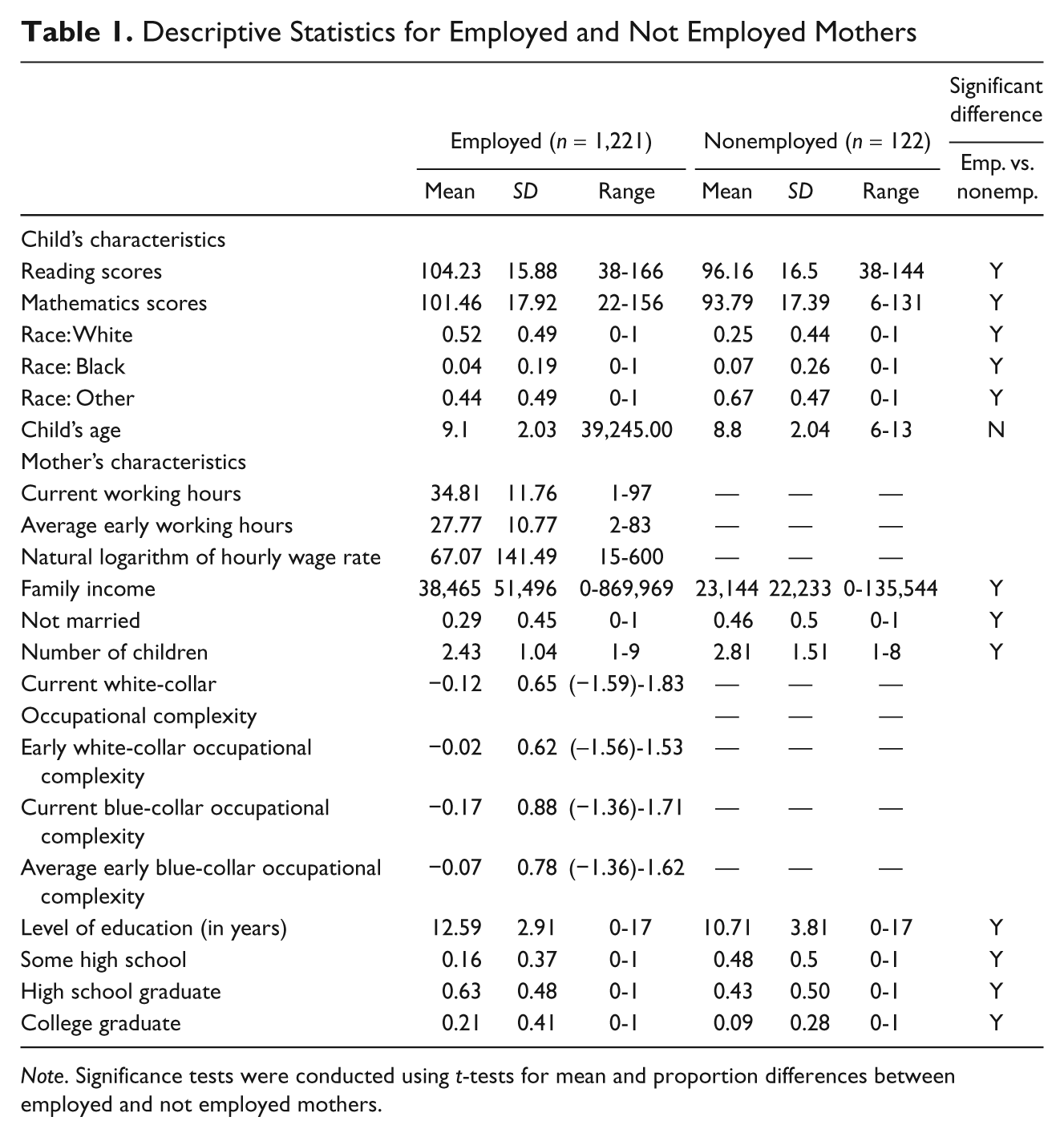
Note. Significance tests were conducted using t-tests for mean and proportion differences between employed and not employed mothers.
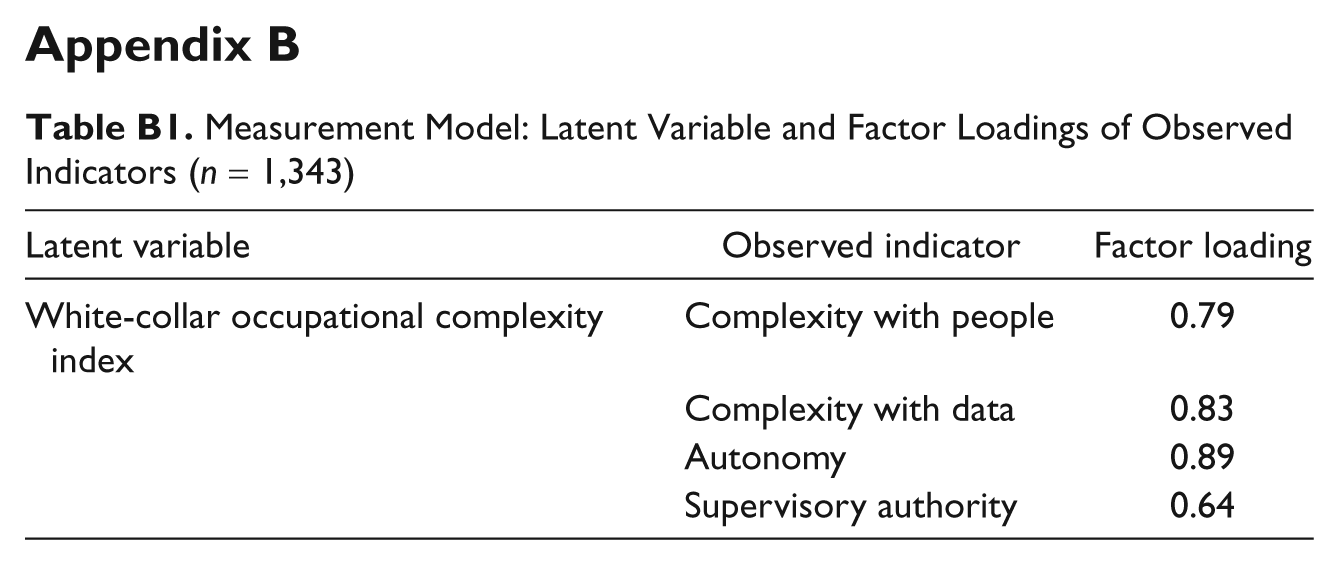
The independent variables of interest reflect a multidimensional concept that includes several indicators of occupational quality: task complexity, autonomy, and authority/power. Measures come from the Dictionary of Occupational Titles (DOT; England & Kilbourne, 1991) and were merged onto the PSID main data using the current and earlier job’s 3-digit detailed Census occupational codes to provide measures of task complexity. Three variables measure the “level of complexity at which worker functions in relation to data, people, and things” (England & Kilbourne, 1991), respectively. Autonomy of the occupation is measured with a DOT variable that reports the occupational mean percentage of workers’ “adaptability to accepting responsibility for the direction, control or planning of an activity” (England & Kilbourne, 1991). Authority/power of the occupation is measured through a dummy variable from the DOT that reports “whether occupation involves supervisory or managerial power over other workers” (England & Kilbourne, 1991). We created two separate indices of occupational complexity, one oriented toward tasks typically associated with white-collar work and another oriented toward blue-collar task complexity. For the white-collar occupational complexity index, we combined the variables for complexity with data and people, autonomy, and authority (Cronbach’s α = 0.80, factor loadings are presented in appendix Table A1). Complexity with things was negatively correlated with this index of white-collar occupational complexity. Complexity with things is a better measure of jobs that require mechanical and manipulative skills, which usually corresponds to more complex blue-collar jobs (e.g., skilled trades such as electrician or baker). In other words, complexity with data, complexity with people, autonomy, and authority tend to be present in complex white-collar occupations whereas complexity with things is found more often in skilled blue-collar occupations, such as technical and crafts occupations. Thus, we use complexity with things as a separate single item indicator of occupational complexity typically associated with skilled blue-collar jobs (see appendix Table A1). Previous research has not examined the impact of blue-collar occupational complexity on children’s developmental outcomes. Despite the labels of white and blue collar these are standardized continuous indicators not strictly tied to class or occupational categorical distinctions.
We believe that our measure of white-collar occupational complexity is an improvement upon the measure used by Parcel and Menaghan (1994a). Although they are conceptually similar, our measure is simpler (4 vs. 19 items), more conceptually tied to occupational complexity, and performs substantially better in our models predicting children’s reading and mathematics scores. We replicated Parcel and Menaghan’s 19-item scale as they describe it in their original work (1994a), finding for our sample a slightly lower scale reliability coefficient of 0.91 (compared to their reported scale reliability coefficient of 0.94). We checked the correlation between children’s reading scores and Parcel and Menaghan’s occupational complexity scale, and the correlation between children’s reading scores and our occupational complexity scale. Although the correlation between children’s reading scores and Parcel and Menaghan’s occupational complexity scale and children’s reading scores (r = 0.33) is higher than the correlation between children’s reading scores and our occupational complexity scale (r = 0.23), we find that the net effect of our occupational complexity scale on children’s reading scores is considerably stronger than the effect of Parcel and Menaghan’s occupational complexity scale on children’s reading scores (tables available upon request). This is due to the fact that their occupational complexity scale has a higher shared covariance with mothers’ education (r = 0.54) than our occupational complexity scale (r = 0.43). It may also reflect some distortion of scale values by the inclusion of items in their scale that do not have clear implications for mother’s cognitive skills and expectations (e.g., finger dexterity).
Other measures of maternal employment are hourly wages and weekly work hours. 3 For mothers currently employed (in 1996), measures of maternal employment from 1996 are used. For mothers who were employed during the first 3 years of the child’s life, we include measures of average occupational complexity and hours of work for that period. The use of early maternal occupational complexity measures allows us to contrast the influence early and current maternal cognitively stimulating work on early (first 3 years of child’s life) child development.
We examine our hypotheses with four samples of children: all children with valid reading and math scores, those whose mothers were employed in 1996, those whose mothers were employed for at least 1 year in the first 3 years of child’s life, and those whose mothers were employed in 1996 and for at least 1 year in the first 3 years of child’s life.
For the first hypothesis we use a simple ordinary least squares regression model to contrast the academic skills of children of employed and nonemployed mothers. Subsequent models examine the impact of maternal occupational complexity on child outcomes. However, employed mothers are not a random sample of all mothers, but have characteristics that may select them into the labor market in the first place. If we fail to model this selectivity, we may generate misleading estimations of the regression parameters (Heckman, 1979). To correct for the sample selection bias, we use a two-stage Heckman model with a sample selection equation. In the first stage, we use measures for other sources of family income, race, and presence of a child under 3 years of age to predict women’s labor market participation. Labor force participation is coded as a dichotomous measure = 1 if respondent is employed and = 0 if respondent is out of the labor force. Presence of a preschool child in the home is our exogenous variable, which has an effect on the selection equation, predicting women’s decision to participate in the labor market, but not on the main equation, which predicts the effect of maternal employment on child test scores. In the second stage, transformed predictions are included as an additional variable into the main equation model. For technical details, see Greene (2003).
The socioeconomic and home environment variables are present in each model we estimate and include age of child (in years), child’s gender (male = 1 if male), level of maternal education (a set of dummy variables, with high school dropout = 1 if mother has less than high school diploma, high school graduate = 1 if mother is a high school graduate, and college graduate = 1 if mother is a college graduate; we use high school graduate as the reference category in analyses), race of the child (a set of dummy variables indicating African American, other races (includes Latinos because of their small sample size), and White; we use White as the reference category in analyses), net family income (household income minus mother’s income), number of children, and single mother = 1 if parents do not live together.
Some models include mother’s current wage (in dollars), current number of weekly hours worked, and early childhood number of weekly hours worked. We also have a dummy variable indicating whether the mother ever worked during the child’s life (= 1 if ever worked part or full time). We test our occupational complexity hypothesis in three sequential models; current occupational complexity (model 2), early childhood occupational complexity and hours worked (model 3), and a final model that includes both current and early childhood occupational complexity (model 4).
The significant positive effect of “ever worked” on child reading scores in the first model of Table 2 suggests that positive selection into employment may be tied to child development outcomes. It seems reasonable to suspect it is also tied to occupational complexity. Thus, subsequent models adjust for this positive selection into employment with the two-stage Heckman correction described in the methods section. Notably, the inverse Mills ratio generated by the first stage of the model and entered as a control variable in the second stage of the model was never significant in any model. This implies that while there is positive selection into employment, it is not significantly associated with the child development outcomes captured by our reading or math scores.
Children’s Reading Scores Regressed on Two Measures of (Contemporary and Early) Maternal Occupational Complexity, Adjusted for (1) Education and (2) Sociodemographic Characteristics
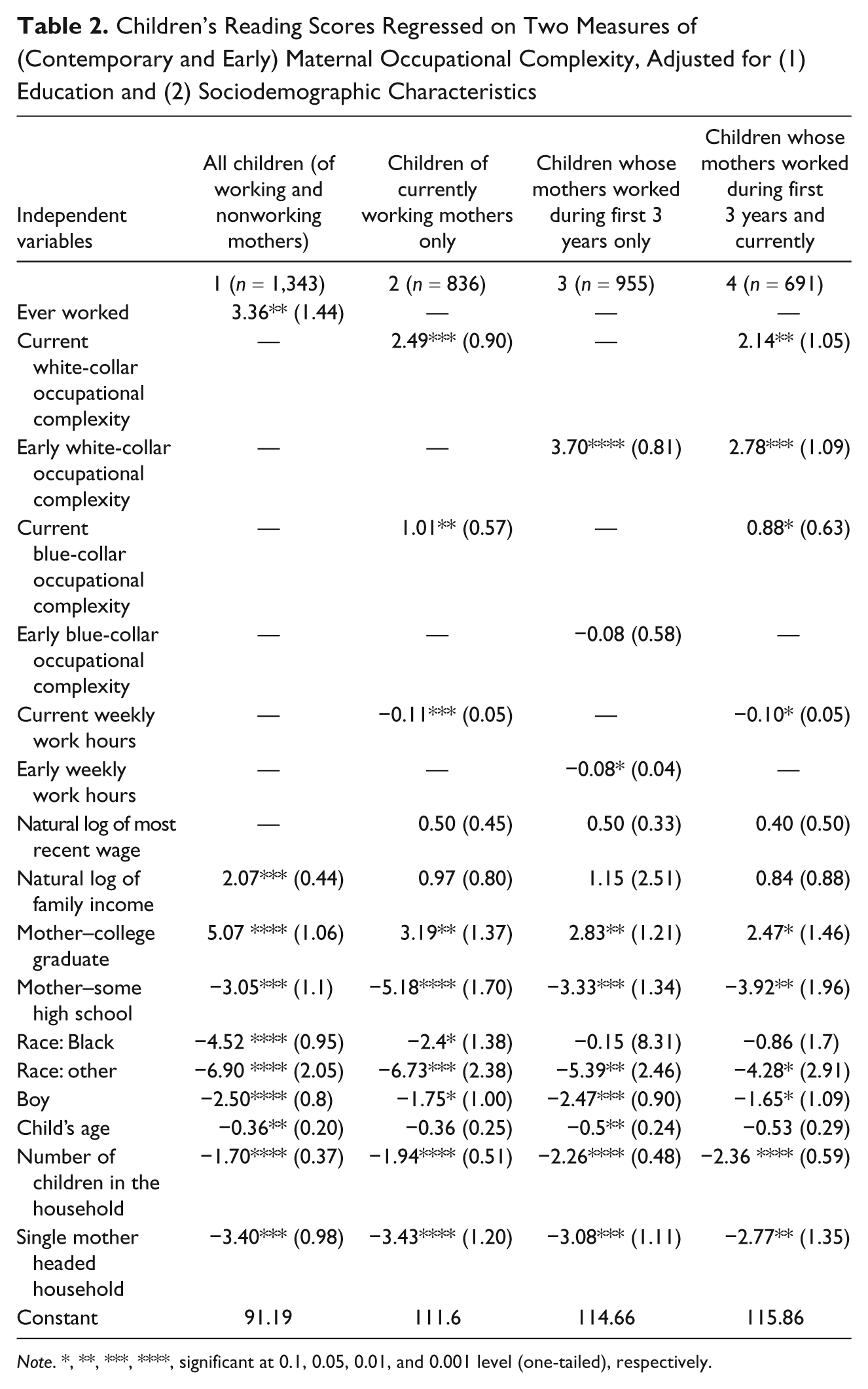
Note. *, **, ***, ****, significant at 0.1, 0.05, 0.01, and 0.001 level (one-tailed), respectively.
Because previous research suggests that maternal employment is more strongly related to daughters’ outcomes, compared to those of sons, we test for statistical interactions between child gender and our occupational complexity indicators in predicting test scores. We also estimate models to see if there are interaction effects between individual occupational complexity measures, work hours, being a single parent, race, and education.
Findings
Tables 2 and 3 present the results of regressing children’s reading and mathematics achievement on mother’s employment measures. The first model 4 in both tables estimates the link between maternal employment on reading and mathematics achievement, respectively, controlling for maternal education and family sociodemographic characteristics. Hypothesis 1 is strongly confirmed in respect to both reading and mathematics achievement: Having an employed mother is significantly associated with higher child reading and mathematics scores, net of control variables included in the model. The strong positive effect of “ever worked” indicates there may be positive selection into employment on factors not included in the model that also predict higher cognitive outcomes for children. Failing to control for this selection would overestimate the positive effects of employment characteristics on child outcomes. Among the included control variables we see that, as in past research, indicators of socioeconomic class (family income, maternal educational attainment, and race/ethnicity) are significantly associated with reading and mathematics achievement; children of higher earning, higher-educated, married, and White mothers having higher reading and mathematics scores.
Children’s Mathematics Scores Regressed on Two Measures of (Contemporary and Early) Maternal Occupational Complexity, Adjusting for (1) Education and (2) Sociodemographic Characteristics
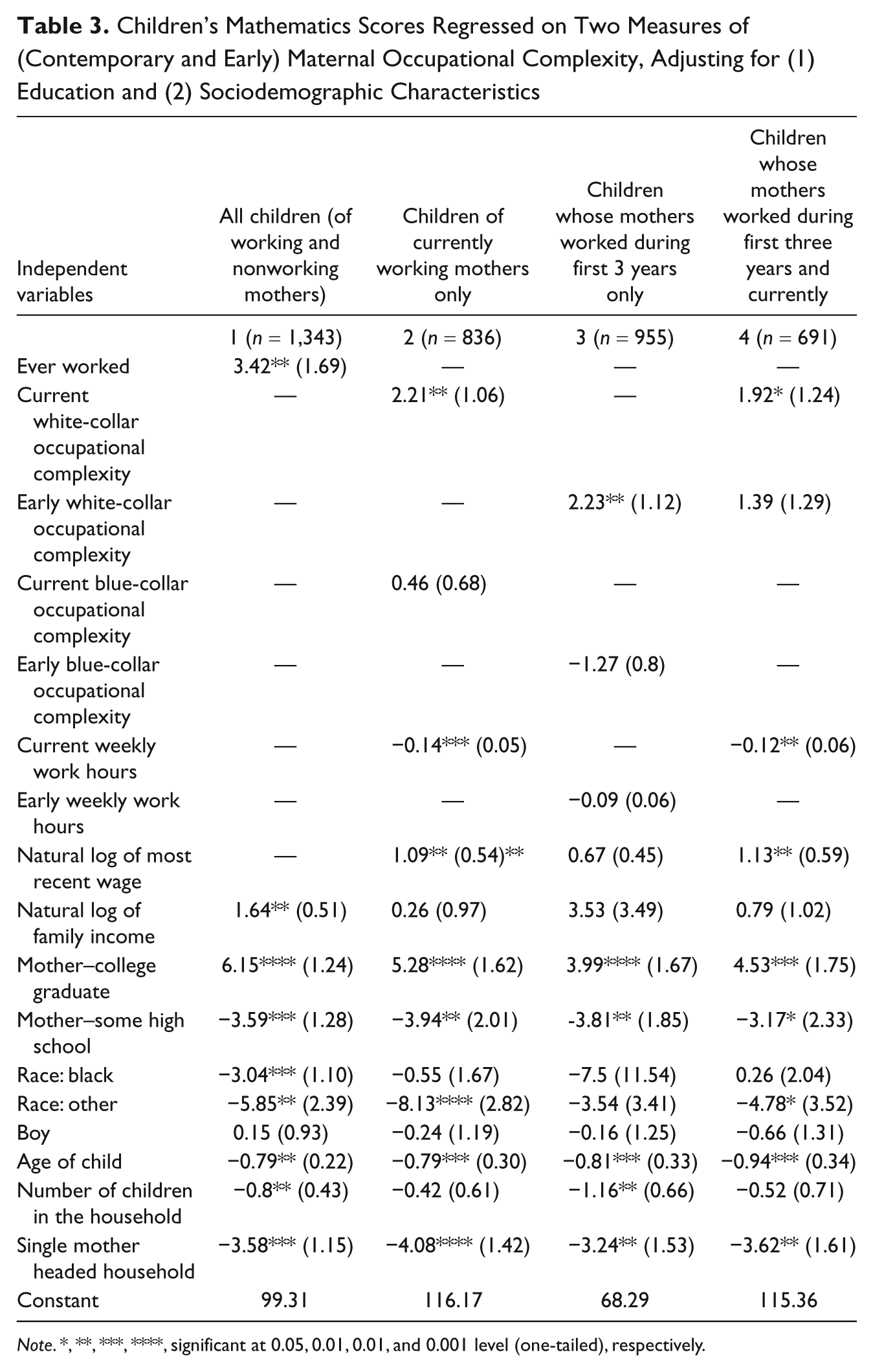
Note. *, **, ***, ****, significant at 0.05, 0.01, 0.01, and 0.001 level (one-tailed), respectively.
Models 2 to 4 show the results from Heckman two-stage models where we first predict the probability of employment using our selection criteria (family income, race, and presence of a child under three), and in the second equation, adjust for those differential probabilities in estimating the effects of occupational complexity and other independent variables on child outcomes. Tables 2 and 3 show the influence of employed mothers’ work hours and occupational complexity on child achievement. We test our second and third hypotheses with the introduction of two measures of current and early childhood occupational complexity. 5 A one standard deviation increase in white-collar occupational complexity is associated with almost 2.5 points higher reading scores and 2.21 points higher math scores. The effect of blue-collar occupational complexity on reading is smaller (1.01) and it is not significantly associated with math scores. For reading scores, Hypothesis 2 is supported for both current white- and blue-collar occupational complexity. Only current white-collar occupational complexity is associated with higher math scores. The weight of the evidence is consistent with the proposition that current maternal occupational complexity enhances children’s achievement.
In model 3, we test whether the complexity of early maternal employment has any significant effect on children’s later test scores. Average early white-collar occupational complexity is associated with positive and significant increases in children’s reading and mathematics scores. Hypothesis 3 is supported only for early white-collar occupational complexity. One standard deviation increase in early white-collar occupational complexity is associated with almost 3 points higher reading scores. Having an employed mother in complex blue-collar job during a child’s first 3 years of life is unrelated to reading and math scores in preadolescence. This finding means that any lagged effects of early maternal employment on children’s math skills disappear, as children get older.
In model 4, we include the measures of occupational complexity that were significant in models 2 and 3. For reading this is current middle and blue-collar occupational complexity and early childhood white-collar complexity. Current and early white-collar job complexities still have substantively large effects on reading scores. Current blue-collar occupational complexity is now only significant at the 0.10 level. For math, neither occupational complexity measure is significant when both are in the model. Since both were significant when entered alone, we are not able to distinguish whether the observed effects of white-collar occupational complexity on math scores are the result of mother’s current or past employment. 6
Overall the models provide more support for Hypothesis 2, that current occupational complexity (rather than maternal occupational complexity during early childhood) influences reading and math scores. The only strong evidence for Hypothesis 3, that mother’s occupational complexity during early childhood is beneficial, is for children whose mothers were employed in jobs with white-collar occupational complexity.
The effects of measures of mother’s education are significant in all models—even when we introduce measures of occupational complexity. This is not surprising since the relationship between education and labor market outcomes is well established in the literature. What is important is that occupational complexity measures are significant even when education measures are in the model.
In results not shown, we tested whether the effects of maternal occupational complexity on child test scores differed for sons and daughters. Past research has suggested that mother’s employment had beneficial reading score effects for daughters and negative effects for sons (Kovacs, 1999; Parcel & Menaghan 1994a). In testing for interactions between child gender and maternal occupational complexity, we found only one significant interaction: maternal current occupational complexity had stronger positive effects on boys’ math skills relative to its effect on girls’ math skills. 7
In supplemental analyses not shown, we also tested whether the effects of maternal occupational complexity varied by mother’s level of education, racial/ethnic group, and marital status. The impact of maternal occupational complexity on child test scores did not vary by maternal educational level. However, we found that maternal white-collar occupational complexity when the child was young has stronger positive effects on reading scores for African American children (p = . 047). This implies that maternal white-collar job quality has more positive impacts for African American families when it comes to reading comprehension. In regard to marital status we found consistently that maternal occupational complexity had weaker effects on both math and reading scores in single mother households, relative to married households. 8 For reading, children of married mothers currently employed in blue-collar jobs tend to score 1.77 points higher than children of single mothers employed in the same type of jobs. For math, children of married mothers currently employed in white- and blue-collar jobs tend to score almost 5.5 points, and 1.25 points higher respectively than children of single mothers. This suggests that the greater stress single parents encounter in balancing work and parenting responsibilities overwhelms the efficacy of higher job quality in reducing parenting stress in single-mother households, relative to married households.
Discussion
This article investigates the influence of both early and current maternal occupational complexity on child academic development. We have found that current occupational complexity, net of mothers’ human capital measures and differential selection into employment, has significant and positive effects on children’s reading and mathematics scores. Mother’s occupational complexity during the first 3 years of life has enduring positive effects on both math and reading if the occupational complexity revolved around white-collar skills such as complex work with data or people, autonomy, and supervisory responsibilities.
Our findings are consistent with the literature that argues that maternal employment tends to be beneficial for child outcomes. That maternal occupational complexity in the first 3 years of life continues to influence child outcomes 3 to 9 years later is a new finding in the literature. This finding, in particular, is contrary to Coleman’s (1988) argument that predicts a decline in the social capital of the household when high-skilled mother works outside the house. Second, among those mothers who work, occupational complexity is positively correlated with child test scores. The few studies that found negative effects of mother’s employment on children’s development were for very small children. By using a slightly older group of children (6- to 13-year olds) we are able to consider whether the impacts of early maternal employment on child outcomes for younger children shown in past research persist as children age.
Contrary to previous literature that suggested mothers’ employment was beneficial particularly for girls (Desai et al., 1989; Kovacs, 1999; Parcel & Menaghan, 1994a; Vandell & Ramanan, 1992), we found that mother’s white-collar occupational complexity was particularly advantageous for boys’ mathematics scores. Otherwise the positive influence of maternal occupational complexity was the same for boys and girls.
We also speculated that children in disadvantaged households would receive stronger benefits from maternal occupational complexity. There was almost no evidence to support this expectation. On the contrary, we found that the children of single mothers did not receive any benefits from having mothers doing complex work; while children in coupled households received strong benefits from mother’s occupational complexity. The positive effect of occupational complexity does not extend to children of single mothers, presumably because other time and emotional stresses in these households overwhelm any additional skills or dispositions learned in the workplaces, rendering them unable to convert their workplace skills and resources into household resources. In addition, due to intramarital homogeneity, married employed mothers are mostly likely to be married to men with similarly high (or low) occupational complexity scores. 9 It could be the reinforcement of this intramarital homogeneity and reduction of parental stress in a two-parent household that benefits child test scores.
Even though we chose to use variables from the DOT to measure occupational complexity, measures from DOT are only occupational aggregates and so there is measurement error resulting from the mismatch between occupational data from DOT, and the conditions of the actual jobs the mothers in our sample hold. Occupations are not monolithic structures that produce for all its members the same conditions of work (Gerstel & Clawson, 2001). For example, an intensive care nurse usually has more responsibility than a school nurse. Since we used occupational-level data to analyze mothers’ skill sets our models are quite likely to be underestimates of the true relationship between mother’s occupational complexity and child test scores. Whenever possible, future research should focus on job-level measures of occupational complexity to see how these factors affect workers’ lives outside the workplace.
Conclusion
The primary aim of this article was to replicate and extend Parcel and Menaghan’s (1994b) insight that occupational complexity, rather than simple employment, influences mother to child human capital transmission. Importantly, we extend Parcel and Menaghan’s strategy of controlling for relevant background characteristics of the mother that could a priori influence child outcomes by explicitly modeling differential selection into employment with Heckman two-stage corrections. In this article we replicate the core hypothesis that complex jobs increase children’s academic achievement with a new sample of older children. We also show that early childhood advantages can endure into later childhood.
We introduce a measure of occupational complexity tied to the manipulation of objects, a type of occupational complexity more often found in blue-collar jobs. Skilled blue-collar jobs also lead to better child outcomes, although the effects are not as strong or as enduring. We cannot tell if this is because this skill set only becomes useful after a child starts school or for some reason dissipates over time. In addition, as we discussed briefly in the introduction, and later in the data section, the use of different samples and methodologies may render different findings. Differences in findings may be due to differences in research design. However, the similarity between models using different samples suggest robustness of measurement issues and findings.
We think that the interpretation of the positive influence of maternal occupational complexity on child outcomes can also be usefully understood in the framework of class reproduction. Parents in jobs that are advantaged or powerful in the labor process can transmit some of the skills and habits they learn at work to their children. This effect of the labor process on the child development is over and above any generic educational, family structure or even family income resources available at the household level. While it might not be surprising to see class reproduction around white-collar tasks (Kohn & Schooler 1982), we discover the potential for upward class mobility in blue-collar families when mothers hold complex jobs. However, this positive spillover for higher white- and blue-collar occupational complexity also means that children of parents with lower white- and blue-collar occupational complexity perform worse on reading and math tests. Our estimates suggest that mothers’ employment is associated with a gain of 3.4 points in both math and reading scores. When mothers are employed in very routine jobs (two standard deviations below the mean for middle class job quality) children’s predicted reading scores decline by a predicted 3.5 point for reading and 2.8 for math. Thus, the positive effect of mother’s employment on child development may be canceled out, but not reversed, in the very lowest skilled jobs. In other words, when parents’ hold low-complexity, white- or blue-collar jobs the effect of mother’s employment is probably to reproduce, but not deepen, class disadvantages.
We began this article with the observation that the literature was mixed as to the influence of maternal employment on child outcomes. Our models show that children tend to do better when their mothers work. This reflects both the positive selection of women into employment and that paid work gives at least some women access to jobs that enhance their abilities to solve problems at home. We also find no evidence that when women work when their children are very young that there are any negative consequences in academic achievement by preadolescence. The prior literature that found these negative outcomes may have been correct, but our estimates suggest that any lag in initial development vanishes as children mature. However, it is important to be cautious on the effects of lower complexity white- or blue-collar jobs on the reading and math achievement of children. If there are enduring negative effects of mother’s employment on children’s development they are likely limited to women who are employed in the most deskilled jobs.
Footnotes
Appendix A
Comparison Chart
| Study (year) | Data | Age range | Child outcome measures | Maternal employment measures | Outcomes |
|---|---|---|---|---|---|
| Desai, Chase-Lansdale, and Michael (1989) | Children of the NLSY (1986) | 4-year-olds | PPVT | Employment in infancy (continuous/intermittent employment) | (-) of cont. employment for high income boys |
| Hsueh and Yoshikawa (2007) | The New Hope Project | 5-12-year-olds | [parent-reported] school engagement and performance | Nonstandard and variable work shifts | Decreased school engagement and performance |
| Ruhm (2004) | NLSY | 10-11-year- olds | PPVT, PIAT-M, PIAT-R, BPI, childhood obesity | Work hours at ages 1, 3, 10, and overall | PPVT (+), PIAT-M (+), PIAT-R (+), BPI (−), childhood obesity (−) |
| McGroder, Zaslow, Papillo, Ahluwalia, & Brooks (2005) | Child Outcomes Study (samples LFA and HCD) | 3-5-year-olds | PCBI, BBCS, BPI | Employment in the last month to the 2- year survey | NS for LFA, (+) PCBI for HCD |
| Vandell and Ramanan (1992) | Children of the NLSY (1986) | Second graders | PIAT-R, PIAT-M, PPVT | Early maternal employment (first 3 yrs of child’s life), employment during second grade | PIAT-R and PPVT (+) for current employment; PIAT-M (+) for early employment |
| Parcel and Menaghan (1994) | NLSY (1986/1988) | 3-6-year-olds | PIAT-R, PIAT-M, PPVT-R | Occupational complexity, work hours | Higher scores supplemented with better HOME environments |
| Brooks-Gunn, Han, and Waldfogel (2002) | The NICHD Study of Early Child Care | 1-36-month- olds | Bayley MDI at 15 months, revised Bayley MDI at 24 months, and Bracken School Readiness Scale at 36 months | Mothers’ employment status/hours at 1, 3, 6, 9, 12, 15, 24, and 36 months | Employment by 9 months: lower Bracken score by 36 months; more pronounced for those whose mothers worked 30 hours or more |
| Waldfogel, Han, and Brooks-Gunn (2002) | NLSY | 3-8-year-olds | PPVT-R (3-4 yrs old); PIAT-R and PIAT-M (5-6 and 7-8 yrs old) | Mother’s employment status/hours during each year of her child’s life | (−) of white/early employment; (−) of PIAT-M current employment; (−) of second and third year for Hispanic. |
| Brooks-Gunn, Han, and Waldfogel (2010) | The NICHD Study of Early Child Care | 3-5-year-olds, and first graders | Bracken School Readiness Scale; Preschool Language Scale; (WJ-R); social skills rating system; current school performance; (mother/caregiver or teacher reported) Child Behavior Checklist; subscales of the social skills and peer competence | FT/PT employment or no employment | (−) of FT employment @ 12 mos; (+) if PT rather than FT @ 1st year. |
| Blau and Grossberg (1992) | NLSY (1986) | 3-5-year-olds | PPVT | Weeks worked at ages 1 and 2 | (−) @ age 1 |
| Parcel, Nickoll, and Dufur (2000) | NLSY (1992) | 9-12-year-olds | PIAT-R, PIAT-M | Occupational complexity | Not significant |
| Kovacs (1999) | Private data | Third graders | Reading/math/language scores | Full-/part-time employment or no employment | No employment: lowest scores |
| Enchautegui-de-Jesus, Yoshikawa, and McLoyd (2006) | The New Hope Project | 5-12-year-olds | School performance, problem and positive behaviors | Job quality (no. of benefits, complexity of job functions, overall perceived job quality, job stress) | Behavioral outcomes (+) except for job stress |
| Current study | PSID-1997 | 6-12-year-olds | Woodcock–Johnson test of achievement (reading/math) | Occupational complexity (autonomy, complexity of tasks, supervisory power) | (+) of current white/blue collar occ.compl. on reading and math; (+) of early white collar occ.compl. on reading |

Note. NLSY = National Longitudinal Survey of Youth; PIAT-M = Peabody Individual Achievement Test—Math; PIAT-R = Peabody Individual Achievement Test—Reading; BPI = Behavior Problems Index; LFA = Labor Force Attachment; HCD = Human Capital Development; PCBI = Positive Child Behavior Index; BBCS = Bracken Basic Concept Scale; NS = not significant; PPVT-R = Peabody Picture Vocabulary Index; HOME = Home Observation for Measurement of the Environment; NICHD = National Institute of Child Health and Human Development; MDI = Mental Development Index; WJ-R = Woodcock Johnson Achievement and Cognitive Batteries; FT = full time; PT = part time; PSID = Panel Study of Income Dynamics.
Appendix B
Measurement Model: Latent Variable and Factor Loadings of Observed Indicators (n = 1,343)
| Latent variable | Observed indicator | Factor loading |
|---|---|---|
| White-collar occupational complexity index | Complexity with people | 0.79 |
| Complexity with data | 0.83 | |
| Autonomy | 0.89 | |
| Supervisory authority | 0.64 |
Acknowledgements
The authors thank Joya Misra, Naomi Gerstel, the editor, and the two anonymous reviewers of Work and Occupations. The authors are also indebted to the many colleagues and friends who read multiple versions of this article and offered their encouragement and advice.
Declaration of Conflicting Interests
The author(s) declared no potential conflicts of interest with respect to the research, authorship, and/or publication of this article.
Funding
The author(s) received no financial support for the research, authorship, and/or publication of this article.