



Abstract
Restitution as a social practice can simultaneously have a punitive effect and add to a person’s criminal justice debt load, while maintaining a reparative and therefore restorative component. We use principles of restorative justice to assess restitution as a concept and a practice, drawing on data from a survey experiment administered to a nationally representative sample (n = 433). We find that the common and strongly preferred conception of restitution is “direct,” entailing a convicted person compensating a victim for quantifiable loss. Evidence from Victim Compensation Funds (VCFs) in all 50 states demonstrate the widespread use of “indirect” restitution, through which funds from various sources are distributed to qualifying victims. Broader trends in criminal justice policy related to the centering of the victim and a managerial approach to punishment help explain our findings. We conclude that the divergence between common conception and widespread practice indicates a need for a revised notion of restitution.
Introduction
Although incarceration dominates scholarly work and advocacy efforts, many millions more people are subjected to the punishment of paying a criminal fine, fee, or restitution. In fact, since monetary sanctions inhere with any contact with the criminal justice system for any level of offense, they are commonplace. Monetary sanctions have been a constant even as scholars note the shift away from the rehabilitative ideal and toward a retributive approach to criminal justice (Garland 2001). The burgeoning prison population, the expansive use of probation, and the punitive laws and policy that contribute to both are well documented. Monetary sanctions have followed these trends in terms of proliferating in number and increasing in severity (e.g., Martin 2018). Throughout this period, however, a restorative approach to addressing crime has also grown in prominence (e.g., Roach 2000).
Although the organized encounters in which a person who has committed a crime meets with the victim(s) and others with a stake in the resolution are rarely used in American adult criminal justice, the principles of restorative justice inform criminal justice practice and discourse (Daly 2016; Roach 2000). The co-existence of retributive and restorative impulses raises interesting questions in the domain of monetary sanctions, because one of these sanctions has the potential to be used in service of both. Restitution as a social practice can simultaneously have a punitive effect and add to a person’s criminal justice debt load, while it also maintains a reparative and therefore restorative component. The question, then, is how does this tension resolve in restitution? One route to answering this question is to inquire about people’s understanding of restitution and to compare this perception with how restitution is implemented. Doing so should bring to light its relative retributive and restorative aspects.
As protecting the victim is now a political imperative (Garland 2001) at the same time as managerialism and actuarial approaches increasingly define criminal justice policy, the result is a fracturing of restitution into types with more or less restorative components. Here, we explore how the divergence between common conception and widespread practice indicates a need for a revised notion of restitution.
Restitution is typically conceived of as a court-ordered monetary sanction requiring a person convicted of a crime to compensate a victim for losses directly associated with that crime. Central to this concept is the notion of repairing the harm caused by the crime, thereby restoring the victim to their precrime status as much as possible. At the core of this version of restitution lies the dyad of “victim” and “offender.” Compensating the victim seeks to restore the damaged relationship between them. In practice, however, this conception often fails to accurately describe restitution.
We propose that “restitution” refers to two different forms of monetary sanction, with differing penological functions: (1) direct restitution and (2) indirect restitution. “Direct” restitution is court-ordered and directly connects a person who is convicted of an offense to the victim of their crime. It provides an opportunity for both victim restoration and rehabilitation of the transgressor. In contrast, “indirect” restitution is the distribution of funds collected from various sources to victims who apply and qualify for compensation. In this institutionally mediated form of restitution, revenue is collected in a tax-like manner from anyone convicted of any type of offense, often in the form of a “Crime Victim Assistance Fee” or similar surcharge. Although this form of restitution can provide critical assistance to victims, it severs the link between perpetrator and victim, thereby undermining the potential for restorative effects on both.
In order to develop a refined conception of restitution that reflects its compound nature, we examine both the meaning and implementation of this monetary sanction. To do so, we proceed as follows. We first explore the tenets of restorative justice to identify the restorative function of restitution. We then consider the defining characteristics of direct restitution as revealed through a brief overview of its legal theory, history, and practice.
Next, we address the first empirical question: What is the public perception of restitution? We draw on data from a survey experiment administered to a nationally representative sample (n = 433) to demonstrate that the common conception of restitution is “direct” and restorative, entailing a convicted person compensating a victim for quantifiable loss. Survey respondents strongly favor direct restitution, even when controlling for sociodemographic factors, fiscal and social views, and criminal justice contact.
After establishing the prevailing beliefs about restitution, we ask the second empirical question: How is restitution implemented? Evidence from VCFs in select states demonstrate the existence of “indirect” restitution, in which funds from various sources are distributed to qualifying victims. This finding suggests that (restorative) beliefs and (managerial, retributive) practice are not well aligned.
Altogether, the evidence reveals the diminished restorative core of indirect restitution, as well as exposes the shortcomings of mixing divergent sanctions under the single moniker “restitution.” Insights from broader trends in criminal justice policy, including institutional dynamics and the role of the victim in influencing policy, help make sense of our findings. The emergence of a form of restitution with curtailed restorative capacity comports with the increased managerialism of criminal justice policy, in which expanded bureaucracies and actuarial approaches dominate. At the same time, this form of restitution elevates the symbolic, generalized victim even as it eschews a direct connection between the perpetrator of a crime and a victim.
Thinking of “restitution” as a single, inherently restorative practice obscures the dual nature of this particular monetary sanction. Our goal, therefore, is to provide enhanced conceptual clarity to spur advancements in knowledge about an ancient and ubiquitous sanction. We begin by querying the relationship between restitution and principles of restorative justice.
Restorative Justice Principles
Restitution traditionally and historically has a restorative function. As Van Ness and Heetderks Strong (2014) explain, As a formal way of holding an offender accountable, restitution is a prime way for the justice system to respond restoratively to the harm done to victims. Restitution requires the offender to recompense the victim for the harm sustained. Restitution is typically made by returning or replacing property, by financial payment, or by performing direct services for the victim (P. 88).
As opposed to reinforcing social values via punishment, restitution benefits the victim via reparation. By addressing the harm caused by crime, restitution aims to restore a victim to their precrime status. From restorative justice principles, we can derive what restoration entails and then inquire about the extent to which restitution evinces it.
Restorative justice is a complex, contested, and evolving idea (see Daly 2002; Van Ness and Heetderks Strong 2014). Howard Zehr (1990) described restorative justice in these terms: “Crime is a violation of people and relationships. It creates obligations to make things right. Justice involves the victim, the offender, and the community in a search for solutions which promote repair, reconciliation, and reassurance.” Indeed, a through line in conceptions of restorative justice is the notion that crime harms multiple stakeholders–including the “community” that comprises everyone from family and friends to the wider society–and that justice entails healing them all (Van Ness and Heetderks Strong 2014). Daly (2002) finds that there are both “purist” and “maximalist” conceptions of restorative justice. In the former, all those with a stake in a crime come together to determine how to respond to it (Marshall 1996; McCold 2000). In the latter, restorative justice is “every action that is primarily oriented towards doing justice by repairing the harm that has been caused by crime” (Daly 2002:58 citing Bazemore and Walgrave 1999:48). Taken together, restorative justice has a clear focus on repairing harm, with varying degrees of involvement of stakeholders.
Across the differing notions of restorative justice, three core concepts are common (Johnstone and Van Ness 2006): “Encounter” or stakeholder meetings where collective decisions are made about a crime’s aftermath 1 ; “Reparation” where justice entails repairing the harm crime causes; and “Transformation” which expansively grapples with “broken relationships at multiple levels of society” (Van Ness and Heetderks Strong 2014:42). The extent to which any of these factors occurs depends on the specific circumstances of a restorative justice effort. But the ideal, especially in the purist sense, entails all three.
The common notion of restitution, in which a person convicted of a crime compensates the victim(s) for the resulting harm and loss, reflects certain of these restorative justice principles. While a formal encounter session is not typically part of a restitution order being made, a judge does hear facts about the case and loss/harm to make a specific determination. The decision is not collective, but it is multiparty and mediated by a judge. Restitution is by definition reparative insofar as it monetizes and compensates for harm. Importantly, restitution does preserve the connection between perpetrator and victim, even if it is via court processes. The extent to which restitution is transformative remains an open question. Determining whether and how it engages in repairing multilevel societal relationships requires on-going and innovative inquiry. Overall, restitution encompasses restorative principles, and the question is: to what extent is that true?
Defining Characteristics of Direct Restitution
Contrasting direct restitution with other monetary sanctions illuminates its defining characteristics. Monetary sanctions—fines, fees, and restitution—are used as sanctions for all levels of criminal offenses, from parking infractions to murder. Fines are the monetary sanction that are meant to punish. Judges assess both mandatory and discretionary fines as part of a person’s sentence. While fines are long-standing in the law, recent scholarship has revealed the burgeoning presence of fees and surcharges as a dominant form of monetary sanction (Harris et al. 2017b). These sanctions are meant to recoup costs and can function as either a progressive tax (e.g., a percentage of an underlying fine amount) or a tariff (e.g., a $25 surcharge for all misdemeanor offenses). While all forms of punishment ostensibly act for the sake of all those with a stake in the crime’s resolution, restitution centers on the relationship between the offender and the victim.
It follows that direct restitution has a different legal history than other monetary sanctions. While fines featured in the earliest manifestations of U.S. law (Massey 1987) and fees/surcharges are a relatively new phenomenon, the first instances of restitution date back centuries (e.g., Pollock and Maitland 1968). The current widespread use of both types of restitution can be traced to the victims’ rights movement launched in the 1970s. In 1982, Congress passed the federal Victim and Witness Protection Act, and the President’s Task Force on Victims of Crime published its final report. The report urged judges to assess restitution in “all cases in which the victim has suffered financial loss” (Herrington 1982), as opposed to being tied to probation as it had been previously (Dickman 2009). In 1996, Congress passed the Mandatory Victim Restitution Act, which removed judges’ discretion to consider a defendant’s ability to pay and mandated that restitution be ordered in the full amount of a victim’s losses (Dickman 2009). Between 1980 and 2015, more than 40 states followed suit—establishing laws on restitution, including constitutional rights to restitution for victims (Haynes, Cares, and Ruback 2015). Although this slew of legislation guided direct restitution, they set the stage for VCFs to administer indirect restitution as discussed below.
How and when judges assess direct restitution further sets it apart from other monetary sanctions. For instance, Rosenmerkel, Durose, and Farole (2009) find that less than one in five felony cases included orders of restitution compared with two in five for fines in a nationally representative sample of state courts across 1.13 million cases in 2006. This finding reflects the practice of restitution compensating a specific victim. Indeed, the need to identify both a recognizable victim and the quantifiable harm associated with the offense is unique to restitution. In addition, the imposition of restitution follows patterns distinct from other monetary sanctions. Women, white individuals, and those convicted of property offenses, more serious offenses, and without prior records of offenses are more likely to receive restitution orders (Haynes 2011; Ruback, Ruth, and Shaffer 2005). In contrast, fines and fees have been found to be higher in cases involving Latinx or male defendants and those involving drug versus violent offenses, (Beckett, Harris, and Evans 2008; Harris, Evans, and Beckett 2011).
Although direct restitution and other forms of monetary sanctions are often used in combination by judges (Harris et al. 2017a, 2017b), the statutory parameters guiding how restitution is collected is yet another difference between restitution and other monetary sanctions. Figure 1 shows that 28 states have some form of legislation that discusses the priority of monetary sanction payments. Of these 28 states, 20 specify that restitution must be paid first. A further three states prioritize restitution. Only five states with statutory language on priority of monetary sanction payments do not prioritize restitution. However, restitution is not immune to the countervailing forces of revenue and justice found with other monetary sanctions (e.g., Martin 2018). Sarnoff (2014), for instance, argues that the prioritization of restitution may create perverse incentives for court systems to limit restitution and instead focus on recouping other monetary sanctions due to the latter’s ability to recover the costs of operating growing criminal justice systems.

Restitution priority of payment statutory language by state 2019.
Concern with such perverse incentives and the myriad negative consequences of unpaid criminal justice debt are common themes in the existing literature on monetary sanctions (e.g., Bannon, Nagrecha, and Diller 2010; Harris 2016; Harris et al. 2017b; Martin et al. 2018). Restitution contributes to both overall criminal justice debt from unpaid monetary sanctions and any deleterious effects therefrom.
As the number and magnitude of monetary sanctions have increased over the past few decades, so too has evidence of their individual and societal costs. People who are unable to pay court-ordered monetary sanctions end up being subjected to prolonged surveillance by the courts and law enforcement, in addition to being at risk of increased penalties that include incarceration (Bannon et al. 2010; Harris 2016; Harris et al. 2017a; Martin et al. 2018). Although debtor’s prisons were eliminated under federal law in 1833, failure to pay criminal justice debt leads to incarceration around the country (American Civil Liberties Union [ACLU] 2010; ACLU 2015; ACLU 2016; ACLU of Louisiana 2015; ACLU of Washington and Columbia Legal Services 2014; Bannon et al. 2010; Hager 2015; Regnier 2015; Shapiro 2014). Probation and parole can be revoked or denied for nonpayment. Warrants for arrest are issued for missed payments or failure to appear at debt-related proceedings (Bannon et al. 2010). Beyond criminal consequences, the repercussions of unpaid criminal justice debt permeate civic life. Unpaid court-ordered debt can affect credit scores in many states (Bannon et al. 2010), curtail voting rights in 30 states (Fredericksen and Lassiter 2016), affect driver’s licenses in 43 states and the District of Columbia (Salas and Ciolfi 2017). They can also subject people to garnished wages, intercepted tax refunds, and garnished prison commissary funds.
Even as scholars document the impact of monetary sanctions and the consequences for nonpayment, restitution is often set aside as a sacrosanct form of monetary sanctions. Beckett and Harris (2011), for example, exclude restitution from their analysis of fines and fees, explaining that they do so because restitution is ordered only in a distinct subset of criminal cases with direct victims who have quantifiable financial losses. In contrast, some scholars focus exclusively on restitution, eliminating other forms of monetary sanctions from their analyses (e.g., Haynes, Cares, and Ruback 2014; Ruback et al. 2018). The emphasis on rehabilitation in the juvenile justice system helps explain why scholars have often focused on the connection between recidivism and restitution specifically (see Ruback et al. 2018). Yet, even in efforts to identify effects specific to restitution, available data tend to only capture direct restitution, are unable to account for debtors’ knowledge that they are paying restitution (vs. other monetary sanctions), or both (e.g., Haynes et al. 2014; Ruback et al. 2018).
This overview of direct restitution reveals how a connection between the victim and the perpetrator of the offense, consistent with the principles of restorative justice, is a defining characteristic. From legal theory to codified statute, the emphasis in direct restitution is the making whole of a specific individual by another specific individual. We designed this analysis to address the subsequent questions of: what do people think restitution is and how is it implemented? Our concern is in how well-aligned the answers are with each other, as well as the extent to which each embodies a restorative impetus.
Common Conceptions of Restitution
This study has two components: an online survey and a systematic document review. The first component provides insight into individual perceptions of restitution, whereas the second component illuminates restitution as commonly implemented. We begin by reporting the methods and results for the survey component.
Methods I
To examine common understandings of restitution, we conducted an online survey, recruiting 466 participants via Amazon Mechanical Turk (MTurk) in February 2020. MTurk is a crowdsourcing platform in which researchers can recruit participants to perform tasks, such as a survey, in exchange for monetary compensation. The platform was chosen as it is an efficient method for recruiting a largely representative sample. MTurk is widely used to recruit participants across the social science disciplines, and studies suggest MTurk samples produce reliable and quality data (Buhrmester, Kwang, and Gosling 2011; Shank 2016). To enhance data reliability and quality, researchers can specify the number of previous tasks, known as a Human Intelligence Task (HIT), that workers have completed to participate in the task. Once a worker completes an HIT, researchers may approve or reject the submission. Researchers can also specify a minimum percentage of approved HITs, known as the HIT approval rate, to participate in their task. These worker qualifications are considered to be standard data collection practices for research on MTurk (Peer, Vosgerau, and Acquisti 2014).
Survey participation was restricted to those who had a U.S. ZIP code, an HIT approval rate greater than or equal to 95 percent, and at least 100 approved HITs. Upon recruitment, participants were directed to the Qualtrics.com online survey platform, where the questionnaire was administered. Participants were compensated $1.00 for completed surveys, which was considerably more than the average pay rate for similar social science surveys on MTurk. The study was reviewed by the University of Washington Human Subjects Division of the Institutional Review Board.
Participants were first asked about their level of familiarity with restitution in the criminal justice context and then were asked to describe “restitution” in their own words. Next, participants were randomly assigned to one of four conditions, varying the definition of restitution (rehabilitative, punitive, restorative, or undefined). After seeing one of four possible definitions of restitution, participants were asked which form of restitution they thought provided a better description of what it should be. The descriptions defined direct and indirect restitution. The remainder of the questionnaire asked about the criminal justice system involvement of respondents and their families, as well as soliciting demographic information, including race, gender, age, and political ideology.
We limit our analysis to participants who entered a U.S. ZIP code and passed the embedded attention checks. Attention checks are embedded in the survey by including a simple question (e.g., “Please select the last response option”) at the midpoint of the survey to ensure participants are reading the questions. One observation was removed for a non-U.S. ZIP code and 32 observations were removed for failing the attention check. The final sample comprised 433 participants. We tested the balance of randomization by regressing gender, race, and age on respondents’ assigned condition. The results indicate that the groups were not statistically different with regard to gender, race, and age.
Table 1 shows respondents’ demographic characteristics and involvement with the criminal justice system. Women are underrepresented in the sample (42.8 percent) compared to the overall U.S. population. White persons account for 75.7 percent of the total sample, a figure that closely aligns with the U.S. population. Similarly, the percentage of Asian (6.3 percent) and mixed race (3.7 percent) respondents corresponds with national figures. However, Black (6.8 percent), Hispanic (7.2 percent), and Native American (0.2 percent) respondents are underrepresented. As with many MTurk survey samples, our sample is younger on average than the U.S. population, with over half (52.0 percent) of respondents aged 34 or younger. Lifetime criminal justice involvement among our sample is comparable with the general population. More than half (53.8 percent) of the respondents had been stopped by police, 12.6 percent had been arrested, 11.6 percent served a community sentence, 10.3 percent had been on probation or parole, and 7.4 percent had been incarcerated at some point in their lifetime. At the same time, 10.8 percent reported experience working in the criminal justice system. In the general population, incarceration is very stratified by race and gender: 3 percent of the total population has served time in prison, whereas the rate is 15 percent for Black men (Shannon et al. 2017); men overall have about an 11 percent lifetime likelihood of incarceration (Bonczar 2003). About 19 percent of people born 1967–1978 have been arrested, whereas 23 percent of those born 1979–1988 have been arrested (Smith 2019).
Respondent Demographic Characteristics and Criminal Justice System Involvement.
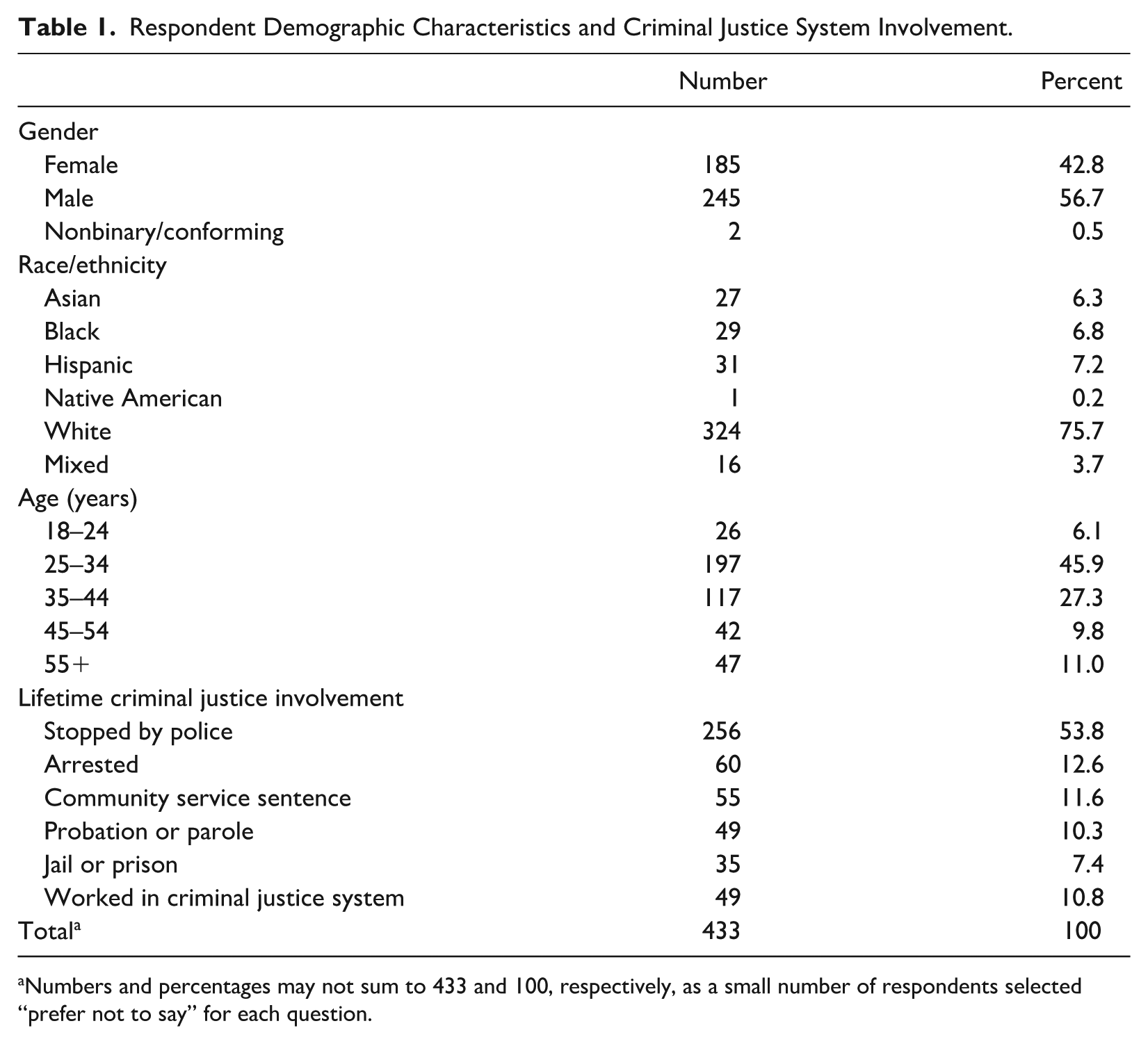
Numbers and percentages may not sum to 433 and 100, respectively, as a small number of respondents selected “prefer not to say” for each question.
Results I
At the beginning of the survey, respondents were asked about their familiarity with restitution and then prompted to describe, in their own words, what they think restitution is. More than 78 percent of respondents report being somewhat or very familiar with restitution in the context of the criminal justice system (see Table 2). Open-ended responses to the prompt to describe restitution consistently referenced a version of direct restitution. For example, a typical description stated that “restitution is when the person committing the crime pays back the person that was affected by the crime.” Approximately 60 percent of respondents defined restitution as direct. In contrast, only approximately 4 percent of respondents described restitution using terms that could be coded as indirect restitution, using words such as “society” or “government” (e.g., “Paying back society for crimes”). Less than 1 percent of respondents provided the “correct” answer: that restitution entails both direct and indirect forms. An example of an answer that defines both is: “this is where the criminal will have to pay back the government or the person whom they have wronged.” Remaining responses to the question described restitution as compensation for wrongful conviction (approximately 10 percent of respondents), defined restoration more broadly (9 percent of respondents), provided a definition that had been looked up online (approximately 9 percent of respondents), or reported not knowing what restitution was (2 percent of respondents).
Respondents’ Familiarity with Restitution.

Respondents were also asked which of two options 2 were a better description of restitution: (1) a person who commits a criminal offense should pay restitution to the victim of that offense, or (2) anyone who commits any criminal offense should pay restitution to a fund that repays any crime victim who requests and is eligible for compensation. We find that 71.4 percent of respondents selected the first option, which describes direct restitution, compared with 28.6 percent for the second option, which describes indirect restitution (see Table 3). These differences held across race, gender, and criminal justice contact experiences.
Respondents’ Preference for Restitution.

These differences were also not sensitive to how restitution was framed. After respondents provided their own definitions, the survey presented them with a definition of restitution that centered restoration, rehabilitation, or punitiveness. For example, the punitive frame was: “State law explains that restitution is ‘part of the punishment’ for people who are convicted of committing a crime.” Yet, regardless of the frame used, preferences for direct restitution remained the same.
Common Implementation of Restitution
Although the common conception of restitution is definitively “direct,” and people tend to prefer restitution in that form, evidence suggests that direct restitution is neither the sole nor dominant form of restitution. Instead, U.S. restitution mostly rests on a foundation of tax-like collections and multiple agency disbursement. As a result, the connection between perpetrator and victim is just as often nonexistent as it is severed. This section reports the methods and results of a systematic analysis of documents related to state VCFs to examine the common implementation of restitution.
VCFs are the linchpin of restitution in the United States (but see Evans 2014 for an overview of their limitations). Every state in the country, the District of Columbia, and several U.S. territories have some type of VCF or its equivalent. Such funds provide vital services to victims of crime, ranging from serving as a clearinghouse for resources, such as therapy and crime scene cleanup, to offering direct cash assistance. Funds typically compensate victims for losses directly related to a crime committed against them such as medical or dental costs or lost wages. Because of their central role in collecting and disbursing restitution, we focus on what their finances reveal about the system.
Methods II
We conducted a document review to identify how restitution operates across all 50 states, focusing on the role of VCFs. Specifically, we investigate quantitative financial information on VCF revenue and compensation and qualitative information on funding sources and disbursement practices.
Financial data on victim compensation come from two main sources. For victim compensation and application data, we gathered each state’s Annual Performance Measures Report submitted to the Office for Victims of Crime (OVC) for fiscal year 2017. These reports were publicly available on the OVC Web site. For three states where there was a missing report or incomplete data, we contacted the state’s VCF or its equivalent to obtain the full data. For financial data on revenue from court fines and fees, restitution, administrative costs, and state appropriations that fund victim compensation, we obtained state VCF (or equivalent) annual reports. These reports were obtained through VCF and attorney general Web sites via online searches.
We also reviewed each state’s statutes related to restitution and crime victim assistance. These statutes were obtained using the “Law Explorer” on the 50-State Criminal Justice Debt Reform Builder Web site, which is hosted by the Criminal Justice Policy Program at Harvard Law School. The Web site contains the most comprehensive public database of state statutes governing monetary sanctions. To ensure legislation had not been missed, for states that did not have statutes referring to restitution we conducted additional searches using databases containing the relevant state’s statutes.
Results II
Portion of individual payments
Examining how much direct restitution contributes to overall restitution reveals that individual payments represent a small fraction of the monies involved with overall victim compensation. We calculate this amount using the ratio of total victim compensation (numerator) to VCF revenue 3 from individual defendants (denominator). Victim compensation data are comprehensive due to a federal Victims of Crime Act (VOCA) reporting requirement that mandates an annual accounting of these data. The denominator is more complicated, since there is no national requirement, standard, or process for tracking how much individuals pay in restitution. However, the data can be gleaned from sources such as annual reports and budgets from state VCFs, court systems, and probation/parole agencies, in addition to state budgets and legislative reports. Some states, nevertheless, do not track revenue from individuals either at all or not in a way that is useful for the present purposes. For example, Alaska simply withholds the Permanent Fund Dividend to which people would otherwise be entitled. Note that some VCFs are dependent on legislative appropriations (e.g., New York), whereas others receive nothing from the state (e.g., Nevada). Twenty-two states in total have sufficient data. These states represent 58 percent of the total prison population and 56 percent of the overall population (U.S. Bureau of Justice Statistics 2019).
Figure 2 shows the ratio of victim compensation to VCF revenue from individuals, arrayed from smallest to largest. Connecticut and Hawaii are the only states in which individual restitution payments constitute the bulk of victim compensation (i.e., approximately a 1:1 ratio or greater). In contrast and in most states, total victim compensation is many multiples of the VCF revenue from individual restitution payments. The highest is in New York where victim compensation is 287 times the amount the VCF brings in from individual restitution payments. In 2016–2017, New York paid out nearly $21 million to victims through its VCF while receiving approximately $76,000 in individual restitution payments. Notably, New York has a mandatory Crime Victim Assessment fee that ranges from $25 to $50, depending on the level of offense.
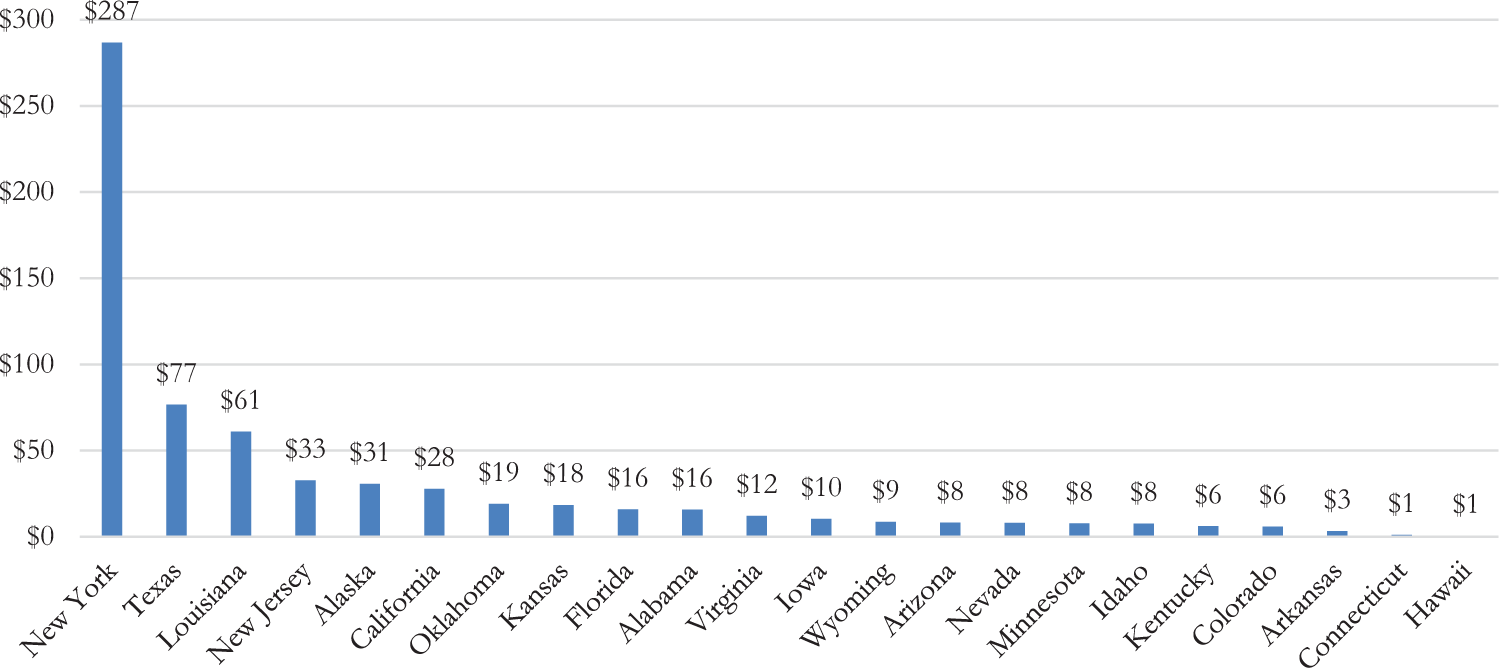
Amount state VCFs pay to victims for every $1 collected from individual defendants for restitution.
Federal funding
Although individuals convicted of state-level offenses provide significant capital for VCFs, people convicted of federal offenses also play a key role. U.S. Attorney’s Offices, U.S. Courts, and the Bureau of Prisons collect criminal fines, forfeitures, and special assessments paid by people convicted of federal crimes. These monies are deposited in the Crime Victims Fund, which had a balance of over $12 billion in 2018. The federal OVC manages this money and provides financial support to state VCFs in the form of VOCA compensation and assistance grants.
Compensation grants directly reimburse crime victims for unreimbursed, out-of-pocket expenses directly related to the crime, such as medical and funeral costs, mental health support, and lost wages. VOCA crime victim compensation grants are disbursed to each state’s Crime Victim Compensation Program and are equal to 60 percent of annual compensation benefits paid by the state. In 2014, $398 million was paid out to state VCFs in the form of VOCA compensation grants.
In contrast, assistance grants fund public and private nonprofit organizations that provide victim assistance services such as counseling, emergency shelter, legal advocacy, and criminal justice system support. Each state receives at least $500,000 per year, with additional funds based on a formula using the state’s population (National Association of VOCA Assistance Administrators [NAVAA] 2017). In 2014, more than 4,000 organizations received VOCA assistance funding, amounting to approximately 22,000 full-time equivalent crime victim assistance positions. These organizations served more than 3.5 million victims.
These compensation and assistance grants provide robust evidence that, despite common conception and preference, a sizeable portion of restitution operates in an indirect manner. Crime victims may receive assistance, but the perpetrator of the crime may pay either a vanishingly small portion of their compensation or none whatsoever.
Source diversity of VCF funding
Our review of statutes, annual reports, and government Web sites reveals that VCFs get their revenue from a wide variety of sources. While three-quarters of state VCFs do bring in revenue from individual restitution payments, the vast majority rely on fines, surcharges, court costs, or fees to indirectly fund restitution. Excluding federal funding, almost one-half of VCFs receive funding from three or more sources (Table 4).
VCF Funding Sources.

Note. VCF = Victim Compensation Funds; VOCA = Victims of Crime Act.
Includes commissary and savings accounts.
Some states have a dedicated fee or surcharge for collecting monies to be distributed to victims who apply to VCFs and qualify for funding. In Hawaii, for instance, most funds come from the mandatory “Crime Victim Compensation Fee,” which is $30 for petty misdemeanors, $55 for misdemeanors, and $105–$505 for felonies. Whether or not a state has a statute for a fee specifically designated for crime victims, most have statutes directing the disbursement of other fines or fees to VCFs. VCFs can, in fact, receive funding from any category of monetary sanction. Kansas provides a good example of source diversity. There, the Crime Victims’ Compensation Fund receives 10.94 percent of all fines, penalties and forfeitures remitted from Kansas district courts; five percent of the gross wages of inmates employed in a private industry program other than work release, a portion of supervision fees from parolees and probationers, and administrative fees assessed to inmates for maintenance of their trust accounts.
4
(Crime Victims Compensation Board 2015)
Similarly, Connecticut funds its Victims’ Compensation Assistance Program by levying an 18 percent surcharge on all criminal offenses, including motor vehicle offenses. Connecticut’s Fund also gets revenue from interest on probation fees. In Alabama, the Crime Victims’ Compensation Fund receives $2 from each moving traffic violation. It also receives funds from an “additional court cost” for every misdemeanor ($10), municipal ordinance ($10), or felony ($15). In addition, the Fund receives the bulk of the misdemeanor (minimum $25, maximum $1,000) and felony victim assessment fees (minimum $50, maximum $10,000) 5 (Alabama Crime Victims’ Compensation Commission 2014). With this structure, people who have contact with the criminal justice system provide 68 percent of Alabama’s Crime VCF, whereas less than 4 percent is funded through direct restitution (Crime Victims Compensation Board 2014).
One-fifth of VCFs get funds from garnishing the money people earn while working in prison or any money they have in commissary or savings accounts or both (e.g., Oklahoma). New Jersey is distinct in that it has a “Commissary Surcharge” on all items purchased in the Department of Corrections facilities, which adds up to 33 percent of the state’s VCF revenue.
Some states’ VCFs stand out for a particularly heavy dependence on a tax-like income stream. For instance, Ohio’s VCF draws approximately 20 percent of its revenue solely from a Driver’s License Reinstatement Fee, making the fund dependent on the state suspending driver’s licenses. Texas has “Offender Inmate Telephone Revenue,” of which the first $10 million each year goes to the state’s VCF and 50 percent of all commissions thereafter.
While the specific ways in which states support their VCFs vary significantly, the consistent feature is a disconnect between individual victims and perpetrators. Across the country, anyone convicted of any level of offense (from traffic to felony) ends up contributing to a fund. VCFs exemplify indirect restitution because, rather than solely funneling direct restitution payments (i.e. from a person convicted of a crime to a specific victim), anyone who comes into contact with the justice system ends up paying into these funds. Fines for traffic offenses, misdemeanors, and felonies; surcharges on these fines; and myriad related court costs and fees are, in fact, a predominant source of funds used to compensate victims.
Discussion
Overall, although people think of and prefer restitution in its “direct” form, our data reveal that the widespread practice of restitution in the United States is more precisely described as “indirect.” Not only do people spontaneously provide a description of direct restitution when asked to describe it in their own words, but the preference for this form of restitution is robust to framing differences. Moreover, there are no significant differences in preferences as a function of race, gender, ideological orientation, or criminal justice system involvement. The lack of impact of these factors is notable, especially for race. A consistent finding in social psychology is that race can be a significant predictor of policy preferences (e.g., Gilliam and Iyengar 2000; Gilliam et al. 1996; Hurwitz and Peffley 2005; Peffley and Hurwitz 2007). Yet, with restitution, respondent race did not seem to influence responses. Although we did not use a priming technique to prompt people to have race top of mind, prior research shows a strong connection between crime-related concepts and Black people (e.g., Eberhardt et al. 2004). Thus, our punitive frame likely subconsciously raised race, even though it did not seem to affect the results along racial lines.
The concept of restitution as direct and the preference for it stand in contrast to the ubiquitous form of restitution in the United States. Evidence from VCFs illuminates how restitution does not require a direct transfer from perpetrator to victim. Instead, the main source of victim compensation relies on tax-like monetary sanctions broadly assessed and collected, irrespective of an identifiable victim.
This divergence between belief and practice indicates a need to broaden the scope of “restitution.” While both direct and indirect restitution can result in victim compensation, only the former has restorative capacity for the crime dyad. By relying on a transfer of money from convicted person to victim, direct restitution preserves the former’s role in making the latter whole. In contrast, indirect restitution also ends with victim compensation, but it does so by drawing on diffuse and myriad sources of revenue. The end results may ultimately be comparable, but the underlying mechanisms are so disparate as to render materially inaccurate use of a single moniker for both.
Two aspects of the broader sociolegal context stand out as being helpful for interpreting our findings: the role of the victim in criminal justice policy and institutional dynamics in flux. Our findings also have implications for the expressive function of punishment.
Role of the Victim
Further insight into our findings can be found in the role of victims in modern penal policy. Garland (2001) argues that the centrality of the victim to criminal justice concerns is a “new and significant social fact” proposing that “[t]here is, in short, a new cultural theme, a new collective meaning of victimhood, and a reworked relationship between the individual victim, the symbolic victim, and the public institutions of crime control and criminal justice” (pp. 11–12). VCFs, by their nature, display a collective notion of victimhood. Victims are understood to be an enduring segment of the population deserving reliable access to compensation.
VCFs also support the notion that “the symbolic figure of the victim has taken on a life of its own, and plays a role in political debate and policy argument that is often quite detached from the claims of the organized victims movement” (Garland 2001:11). Indeed, O’Hara (2005: 244) finds victims have largely advocated for “(1) reforms designed to make conviction easier; (2) reforms designed to ensure victims better treatment in the criminal justice process; and (3) reforms designed to ensure victims active participation in the criminal proceedings”. Yet, VCFs animate the notion of a generalized victim to meet the reparative needs of specific victims, regardless of what actual victim advocacy seeks.
Returning to the notion of restorative justice, our findings show that the dominant form of restitution omits the link between transgressor and victim. Although the victim may still be compensated, the connective aspect of restoration plays no role. In this way, the generalized, symbolic victim comes to stand in for specific victims, getting redress from the person who caused them harm or loss. This is so because indirect restitution cannot deliver a central tenet of restorative justice: “what truly vindicates is acknowledgment of victims’ harms and needs, combined with an active effort to encourage offenders to take responsibility, make right the wrongs, and address the causes of their behavior” (Zehr 2002: 59).
Yet, where indirect restitution diminishes the restorative power of direct restitution for victims, it may expand the restorative aspect for the community. That is, rather than having to be part of the crime dyad to benefit from restitution, indirect restitution makes more funds available to more people—both to eligible victims and through organizations with reparative and restorative functions. Although it has the potential to meet the needs of more victims, indirect restitution imposes greater passivity on both offenders and victims. Offenders are party to restitution, whether there is an identifiable victim to their crime or not. Victims have access to restitution, whether the perpetrator of the crime against them can afford to pay it or not. If “wrongful acts are public harms,” then indirect restitution—because it collects reparation from a broader swath of people—better reflects the public nature of crime (Van Ness and Heetderks Strong 2014:89–90). Consequently, our evidence suggests that indirect restitution does not completely resolve the tension between retributive and restorative inclinations. A tariff-like payment into a fund has retributive qualities at the same time that expanded access to compensation has restorative properties.
Institutional Dynamics
Being a mechanism of achieving distributive justice, or “how a society or group should allocate its scarce resources or product among individuals with competing needs or claims” (Roemer 1998:1), indirect restitution calls into question the role of institutions in its administration.
One way to understand our findings is to consider the rise of indirect restitution as emblematic of changes in the structure of criminal justice institutions. For instance, as they “map the more submerged, serpentine forms of punishment that work in legally hybrid and institutionally variegated ways,” Beckett and Murakawa (2012) posit that “the penal system has become not only larger, but also more legally hybrid and institutionally variegated than is sometimes recognized” (p. 222). Rather than restitution being anchored in the crime dyad and mediated in court, a plethora of victim service agencies now play a role in its administration. A multifaceted network of VCFs and nonprofits obtain revenue from myriad sources and dispense reparative services and funds outside of formal court proceedings. In this way, indirect restitution reflects the “institutional variegation” that increasingly characterizes the U.S. criminal justice system.
An additional aspect of relevant institutional change is the routinization of crime and punishment. As Garland (2001) explains, “[c]ontemporary criminology increasingly views crime as a normal, routine, commonplace aspect of modern society, committed by individuals who are, to all intents and purposes, perfectly normal” (p. 15). If crime is routine, then the routinization of compensating victims flows naturally from this premise. “Normal people” contributing funds that support victims fits with the logic of unremarkable criminal activity and the automatically imposed costs thereof. Indeed, indirect restitution processed through VCFs and other organizations manifests the managerialism and actuarialism that affects all the other aspects of criminal justice (Garland 2001; Feeley & Simon 1992). It can also be seen as part of the “historical process of professionalization, bureaucratization, and rationalization” of criminal justice that Foucault describes (Garland 1991:140).
Expressive Function of Punishment
Indirect restitution reflects a change in the expressive or communicative function of punishment. Rather than centering the victim/perpetrator dyad in a criminal offense, they foreground all eligible victims and cast any perpetrator of any offense as sharing the responsibility of restoring victims. In so doing, it shifts restitution’s emphasis from reparative to retributive, akin to the broader move from rehabilitative to retributive criminal justice approaches (Garland 2001). Retributive justice relates “to both the punishment of those who have violated societal rules and the reinforcement of those societal values violated by the offences” (Gromet and Darley 2009:50; see also: Tyler et al. 2019; Vidmar and Miller 1980).
Our findings cast new light on previous studies of how people think about retribution. For example, Gromet and Darley (2009) find that “. . . when people are initially confronted with wrongdoing, their default orientation is to focus on the offender and be retributive, rather than, for instance, focus on the victim and be restorative” (p. 51). We find that when confronted with defining restitution, people do indeed focus on the specific victim but not on a sense of collective harm. Our findings also comport with previous studies showing that people think it is fairer if the offender has input into how harm is repaired than if they do not (Gromet and Darley 2009; Okimoto, Wenzel, and Feather 2009). By expanding the pool of people paying restitution, VCFs also expand the reach of the expressive function of restitution. The “reinforcement of social values” thereby is broader, although perhaps not deeper.
At the same time, people prefer retribution to be proportional (“just desserts”), where the severity of the punishment matches the severity of the crime (Carlsmith, Darley, and Robinson 2002; Gromet and Darley 2009). Victim fees and surcharges alter this accounting, since by definition they operate as a tariff and do not necessarily reflect the circumstances of any given offender or victim. In some ways, this approach challenges the rationality of punishment. If we seek “to advance any rational social purpose,” then “we must understand his crime; but it cannot by itself dictate the kind or severity of punishment” (Hart 1968:160). Surcharge-based restitution, however, is blind to understanding the precipitating offense and directly dictates both the type and severity of one component of the punishment. Importantly, even if it is not the intent of decision-makers, “reparation may be experienced as ‘punishment’ by offenders” (Daly 2002:60; see also Lollar 2014).
Study Limitations
This analysis has a few limitations. First, as indicated in the descriptive summary of survey participants, the MTurk sample is younger than the general U.S. population. To the extent that age may be an important factor in determining beliefs about restitution, the relative scarcity of older participants may skew the research findings. The direction of this effect is not clear, however, as beliefs about restitution may not track more generalized beliefs about the criminal justice system or even monetary sanctions. Further analysis also indicates there were not statistically significant differences in perceptions of restitution by age.
Second, collecting data via MTurk provides researchers with limited ability to confidently track participant motivation, cognitive understanding, and attention. Compared to administering an in-person survey, it is more difficult to deduce why participants are completing the survey, participant comprehension, and to what extent they are paying attention or are interrupted throughout the survey. However, some of these limitations are addressed by the use of eligibility criteria that, for example, restricted participants to those with high HIT approval ratings. An attention check question also acted as an additional quality control measure.
Third, although VCF monies represent a significant portion of restitution as implemented in the United States, it is not known how this amount compares to direct restitution ordered by judges. Because judicial decisions to order direct restitution are discretionary and systems for collecting individual restitution vary significantly by jurisdiction, constructing a national picture of direct restitution would be a formidable and costly task. Therefore, results on the common implementation of restitution should be not be interpreted as a complete picture of restitution, but rather as an initial examination that reveals new understanding warranting further research. There is also considerable variation in the comprehensiveness of states’ reporting on VCF revenue and disbursement. Although some federal reporting requirements exist, for example, regarding VOCA funds, definitions of different revenue sources may not be entirely consistent across states.
Future Research
This analysis illuminates several paths for future research. We find significant state variation in the priority of restitution payments in statutory language as well as in the ratio of VCF victim payments to individual restitution contributions. However, our analysis does not allow us to explain the source of this variation. The variation raises the question of whether it might be a driving or resultant factor in differing perceptions of restitution across states and how it relates to other aspects of each state’s criminal justice policy environment.
Our analysis also raises questions about the equity implications of restitution policy. Indirect restitution as implemented through VCFs draws revenue primarily from individuals who are involved in the criminal justice system, regardless of whether their offenses have an identifiable victim. Individuals who are more often involved in the system may therefore contribute disproportionately more to VCFs. However, given the impoverishment and indigence of many who come into contact with the criminal justice system, it may be that the burden of indirect restitution manifests as prolonged surveillance and enmeshment for the sake of collection. Either way, indirect restitution may be another vector for higher costs—be it money or liberty—for those on whom they are most often imposed.
Finally, many VCFs prohibit individuals with criminal records from receiving victim compensation. The combination of penalizing all individuals who become involved in the criminal justice system while excluding those who have a conviction history likely exacerbates the criminal justice system’s racial inequities. Future research could investigate the full extent to which the United States’ emphasis on indirect restitution disproportionately extracts and withholds money from people of color.
Conclusion
In classic legal theory, “[r]estitution is the study of unjust enrichment” (MacAulay 1959). Although most scholarship in this domain is concerned with torts and business dealings, a similar concept of “unjust enrichment” undergirds restitution in the realm of criminal justice for individuals. Practically, it is rational for an offender to compensate a victim for property or bodily harm or any losses suffered as a result of a crime. Morally, restitution satisfies the desire for an offender to make amends to a victim. In this way, restitution echoes the goals of restorative justice: addressing the harm caused by crime, typically by creating or drawing upon a connection between the victim and the perpetrator. Here, we have sought to investigate how a monetary sanction with both retributive and restorative capacity manifests each. We address the question of whether common understanding and practice align when considering restitution as a social practice. We find that they do not and that the two versions of restitution differ in expectations for and manifestations of restorative capacity.
In keeping with Garland’s (2018) notion that “punishment is a social institution not an automatic reaction or a mechanical response” (p. 15), our analysis advances current understanding about how the meaning of restitution has changed over time. We draw on administrative data and a survey experiment to illuminate the divergence between the common conception of restitution and how restitution often functions in practice. We find that direct restitution and its virtuous rationale are in tension with indirect restitution and the realities of its revenue sources. Rather than being a one-to-one transaction between the victim and the offender, arbitrated by a judge, restitution is increasingly mediated through state agencies. In this form of restitution, a jurisdiction collects restitution from anyone convicted of an offense and then, typically through state-run VCFs, disburses restitution to victims who apply for funds and meet certain requirements (e.g., ability to prove loss from crime, crime reported in a timely fashion, no prior criminal conviction). Indirect restitution relies on monies collected in the absence of one or more of direct restitution’s constitutive factors: a victim, person convicted of a crime, and quantifiable harm. An important consequence of this disconnect is not only its potential to leave many victims’ needs unsatisfied, but its propensity to deprive convicted people of direct restitution’s restorative aims. As such, it misses opportunities to repair relationships and strengthen civic interconnection.
Illuminating the gap between prevailing perceptions of restitution and its widespread implementation—and finding a way to bridge it—is important to establishing a clear conceptual basis for future scholarly work. To that end, our proposal that restitution takes two often-conflated forms advances the burgeoning scholarship on monetary sanctions. Our concern is that conflating two variants of a ubiquitous sanction hinders efforts to improve justice outcomes in the domain of monetary sanctions.
Although restitution may seem to be the most commonsense and well-justified monetary sanction, its popular conception differs in important ways from the reality of its implementation. The fracturing of restitution into two types reflects broader trends of the modern era of criminal justice policy. The rise of VCFs and other organizations and agencies that mediate the relationship between those who are convicted of crimes and those who are victims of them comports with increasing managerialism in criminal justice. It also centers a generalized, symbolic victim in a way that bears out the central role of victims qua victims in criminal justice policy. Furthermore, the diminished restorative capacity of indirect restitution is consistent with both trends. An emphasis on efficiency presages bureaucratized compensation, while a move to assist vastly more victims underscores their importance in policy decision-making.
Note that the concerns raised here do not constitute an argument against restitution. To the contrary, direct restitution’s ability to compensate crime victims for their losses, with an unambiguous connection between convicted person and victim, has a clear moral and practical appeal. As such, direct restitution should arguably be the principal form of monetary sanction. Yet pursuing this aim requires acknowledging that restitution takes two forms. As opposed to using “restitution” to refer to all forms of victim compensation, we must accept that the restorative pillar of monetary sanctions has fractured into two. Here, we advance concepts to assist in moving forward.
Supplemental Material
sj-pdf-1-spx-10.1177_0731121420970599 – Supplemental material for Restitution without Restoration? Exploring the Gap between the Perception and Implementation of Restitution
Supplemental material, sj-pdf-1-spx-10.1177_0731121420970599 for Restitution without Restoration? Exploring the Gap between the Perception and Implementation of Restitution by Karin D. Martin and Matthew Z. Fowle in Sociological Perspectives
Footnotes
Acknowledgements
The authors would like to thank Andrew Taylor for valuable research assistance.
Declaration of Conflicting Interests
The author(s) declared no potential conflicts of interest with respect to the research, authorship, and/or publication of this article.
Funding
The author(s) received no financial support for the research, authorship, and/or publication of this article.
Supplemental Material
Supplemental material for this article is available online.
Notes
Author Biographies
References
Supplementary Material
Please find the following supplemental material available below.
For Open Access articles published under a Creative Commons License, all supplemental material carries the same license as the article it is associated with.
For non-Open Access articles published, all supplemental material carries a non-exclusive license, and permission requests for re-use of supplemental material or any part of supplemental material shall be sent directly to the copyright owner as specified in the copyright notice associated with the article.
