




Abstract
The importance of monetary sanctions as a topic of sociological inquiry derives from both their ubiquity in American criminal justice and the socioeconomic realities of many people, especially those ensnared in the criminal legal system. This essay reviews the literature on monetary sanctions across various fields, including applied research, economics, criminology, political science, public policy, and sociology. Early approaches tended to be more system evaluations, whereas later work emphasizes the structural determinants of monetary sanctions and their impacts. Insights from research across time and discipline foreshadow the contemporary debate about monetary sanctions and are important precursors to the work in this volume.
“Reasons for taking people’s property always exist, and once started down this path, there is no stopping…” Niccolò Machiavelli, The Prince (1513)
Monetary sanctions have long been a part of society’s response to criminalized behavior. To date, far more scholarly attention has focused on incarceration and other means of embodied surveillance and control, although questions of social stratification, punishing poverty, and racial disparities pertain to monetary sanctions as well. Over the course of the last decade or so, sociologists and other scholars have explored the effects of monetary sanctions in increasingly robust and rigorous detail. Indeed, the 2014 events in Ferguson, MO, and the subsequent U.S. Department of Justice (2015) investigation and report helped ignite sustained interest in monetary sanctions among scholars, legal professionals, and advocates alike.
The importance of monetary sanctions as a topic of sociological inquiry derives from both their ubiquity in American criminal justice and the socioeconomic realities of many people, especially those ensnared in the criminal legal system. In the United States, these sanctions have a sordid history since they “were integral to systems of criminal justice, debt bondage, and racial domination in the American South for decades” (Harris, Evans, and Beckett 2010:1758). These sanctions exist today at every jurisdictional level across the United States, from small municipalities and rural counties to state and federal government and everything in between. They can also originate from any criminal justice entity therein, including courts, jails, prisons, community supervision, mandated treatment providers, and more (Martin et al. 2018). The sheer magnitude of the monetary sanction system reaches deep into American jurisprudence, with 13 million misdemeanors filed each year (Natapoff 2018), 3 percent of the U.S. adult population having a felony conviction (Shannon et al. 2017), and many more with traffic tickets or infractions.
The inequality-generating effects of monetary sanctions are heightened in an era of growing economic insecurity. Forty-one percent of Americans report not having $400 available to cover an emergency expense (Federal Reserve 2020) and 71 percent of people worry about covering regular expenses (The Pew Charitable Trusts 2015). Moreover, the Federal Reserve recently reported that six percent of adults have debt specifically from court costs or legal fees, a figure that rises to 20 percent among those with an immediate family member in jail or prison (Federal Reserve 2020). In fact, the subjects of one report left prison with more than $13,000 in legal debt on average (deVuono-Powell 2015). These figures comport with the Brennan Center’s analysis of three states that concluded unpaid court-ordered debt increased by $1.9 billion between 2012 and 2018 (Menendez et al. 2019). With this “growing normativity” of fees and fines (Katzenstein and Nagrecha 2011), it is perhaps unsurprising that, of the cities in the United States with law enforcement institutions, 80 percent collect revenue from fines, fees, and asset forfeitures (Sances and You 2017). That said, reform efforts are underway around the country (Fernandes et al. 2019). Recent policy changes include bench cards 1 for judges (e.g., Biloxi Bench Card 2016), amnesty programs (e.g., California Courts 2015; Iowa Department of Revenue), or repeals 2 of some types of monetary sanctions (e.g., Valle and Carson 2016).
This volume of Sociological Perspectives thus comes at a time of heightened concern about income inequality and the role of the carceral state therein. It also arrives during a notable inflection point in the study of monetary sanctions where the scholarly discussion is shifting from illuminating the multifaceted and often problematic impacts of monetary sanctions to interrogating their rationale, second-order effects and implications for the carceral state more broadly. Initial explorations tended to take a systems evaluation approach. The questions were more instrumental in nature and pertained to how these sanctions work, in what ways, in what contexts, and for whom. Scholars often centered fines and occasionally included supervision fees as they focused on investigating variants of the question, “How are fines used in sentencing?” Common questions related to the interrelationship between these sanctions and “extralegal” factors, such as race, gender, education, or all of the above. The relationship between monetary sanctions and custodial or supervision sentences was also a common topic. Although some research continues to explore these questions, more recent literature tends to examine the structural determinants and outcomes of monetary sanctions to expose how monetary sanctions reinforce systemic inequalities. This work is often concerned with versions of “How do monetary sanctions affect individuals and institutions?” Overall, cross-cutting lines of inquiry have emerged in the fields of economics, public budgeting, criminology, political science, public policy, and sociology.
This special issue presents insights from research on monetary sanctions at a key moment as the field expands and deepens. Insights from research across time and discipline foreshadow the contemporary debate about monetary sanctions and are important precursors to the work in this volume. Indeed, despite the wide-ranging inquiries thus far, gaps and unexplored territory remain. I propose that each discipline introduces new questions to the study of monetary sanctions and that many remain active areas of exploration. The articles selected for this special issue help address both.
In this introductory essay, I aim to provide an overview of the state of knowledge about monetary sanctions in the United States to allow the reader to better appreciate the articles that follow. I trace the intellectual history of monetary sanctions, organized by discipline. Doing so clearly reveals how scholars, advocates, and legal professionals have all contributed to our current base of knowledge. As Table 1 shows, overlaps exist in the topics and themes found in largely siloed literatures. That is, some issues are common across literatures despite a general lack of cross-referencing. The table also shows that most approaches have been more system evaluations than examining structural determinants. As discussed below, this shift is a major contribution from the field of Sociology. Throughout this overview, I indicate where open questions remain in the literature and highlight the pieces in this issue that advance knowledge on these fronts. I conclude with a more in-depth preview of the articles that follow, to serve as a guide for the interested reader.
Historical Summary of Major Themes and Topics in Research on Monetary Sanctions by Discipline.
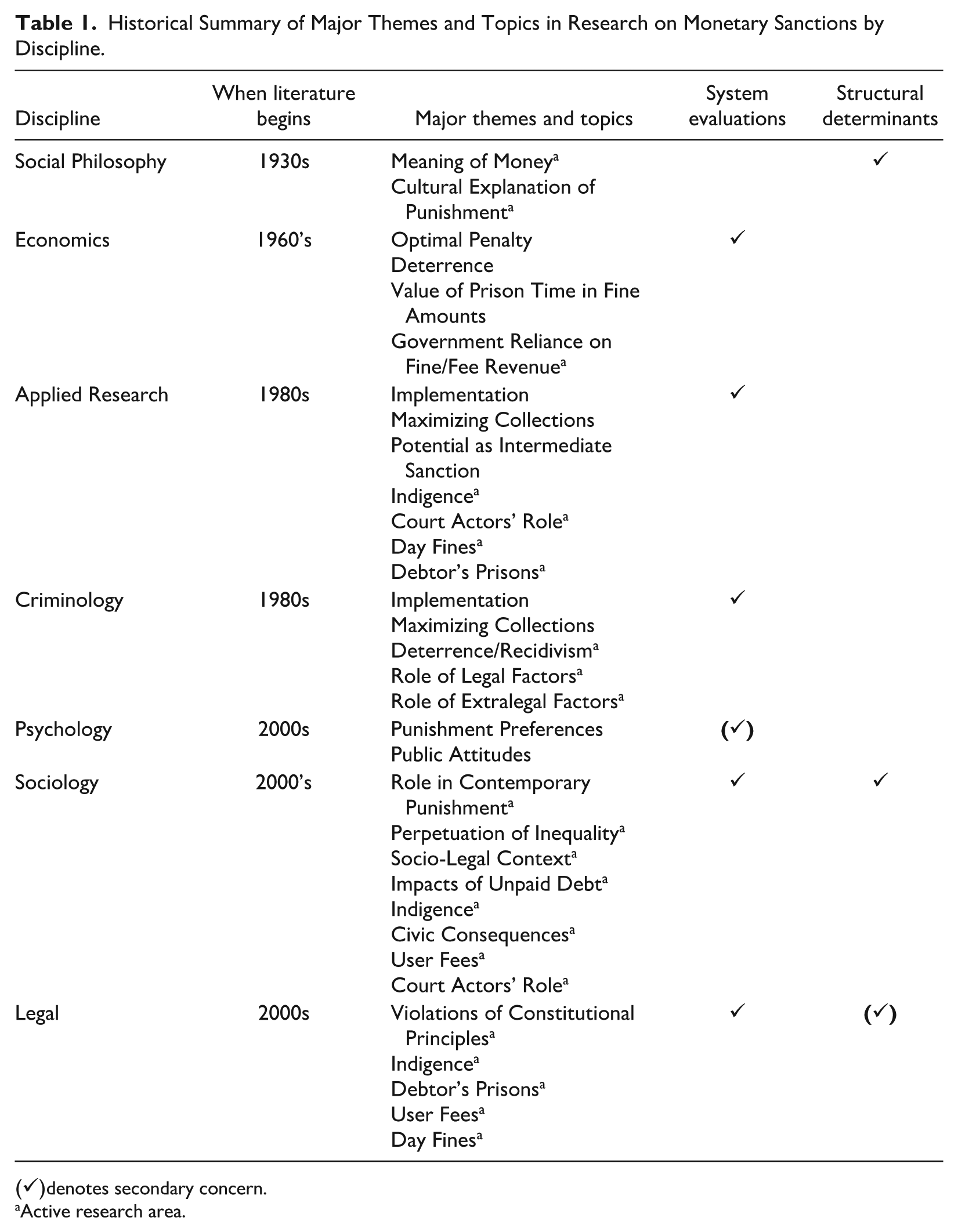
(✓)denotes secondary concern.
Active research area.
Social Philosophy
Inflicting punishment in the form of mandated relinquishing of personal funds to the state is an ancient social practice. Biblical and Ancient Babylonian sources reference monetary sanctions (Zamist and Sichel 1982), there are indications of fines/restitution being used across centuries and continents (Simmel [1978] 2004), and evidence that resistance to fines helped precipitate the Magna Carta (Zitzer 1989), a foundational document for the U.S. Constitution. Despite this long history, a dearth of theoretical work on monetary sanctions exists outside of a few notable pieces (O’Malley 2009a; O’Malley 2009b).
One early endeavor illuminated the ways in which the meaning and enactment of punishment are tied to the economy (Rusche and Kirchheimer 1939). “Buy off the spear or bear it,” says an English proverb, which describes the impetus for paying a fine or suffering the corporal consequences in the punishment regime of the Middle Ages (Rusche and Kirchheimer 1939). From that perspective, fines are only practicable insofar as the populace can afford to pay them. However, the historical record is mixed on that point (O’Malley 2009b) and the issue of ability to pay continues to animate scholarly inquiry, such as with day fines as discussed below.
The questions of who is assessed monetary sanctions and why point to broader functions of the criminal legal system. One reading of the proliferation of fines is a “bifurcated” penal scheme in which those convicted of crimes who are seen as socially integrated can be effectively punished with a lighter sentence (Bottoms 1983), such as a fine. More punitive responses, including incarceration, are reserved for those seen to be more marginal or threatening (Bottoms 1983; Garland 1995).
Social theorists and philosophers have also grappled with the meaning of money more broadly (e.g., Simmel [1978] 2004; Zelizer 1989), yet few have engaged the specific instance of fines and fees for criminalized behavior in the American context. Simmel’s tome The Philosophy of Money includes a discussion of fines in the chapter entitled “The Money Equivalent of Personal Values.” Here, Simmel confronts an abiding question about monetary sanctions, which is how to value a human life. That is, how do we translate harm, especially bodily or lethal harm, into dollar amounts for the sake of punishment? 3 He also notes some of the benefits and limitations of punitive fines, such as being adjustable to personal circumstances but being incapable of conferring expiation for serious offenses.
To the limited discourse on theory, O’Malley contributes the notion of “a distinction between a domain of penalty that is correctional, disciplinary, and scientific, and a domain of regulation, which exists in large measure outside of the concern with individual normalization” (O’Malley 2009b:72). O’Malley then makes the case that the “modern fine” is one of the costs of existing in the consumer society (p. 77), of which “the poor are not the intended target” (p. 79). He notes that in England and Wales, use of “traditional fines” for indictable offenses declined between 1990 and 2000. Monetary sanctions were, however, expanding in scope and severity in the United States during this time. Thus, the importance of O’Malley’s conclusion that “if the fine is adequately to be theorized, the diversity of history and governmental meanings and practices remains a major consideration” (p. 79). Indeed, theory-building related to using money as punishment endures as an enterprise ripe for development. The Kirk, Fernandes, and Friedman piece in this issue tackles head-on the issue of history and governmental meanings. The origin story of the various types of fees in the world of monetary sanctions remains largely unexplored. Thus, the detailed accounting of the emergence of pay-to-stay fees provides useful clarity on the rationale, motivating a now-ubiquitous form of monetary sanction.
Economic Approaches
In contrast to the cultural perspectives offered by the major social theorists of monetary sanctions, Becker (1968) argues for an economic approach to understanding crime and punishment. This position set the stage for a generation of econometric scholarship on fine use. Becker’s thesis has been immensely influential in the study of crime more broadly, affecting how many economists grapple with the question of the best use of fines and incarceration. This orientation toward the study of fines revolves around the cost of crime to society and the cost of punishment to the convicted person. In this framework, incarceration is the source of notable social costs. The costs of correctional and supervisory personnel, along with infrastructure and food, far outweigh the comparably negligible costs of administering and collecting fines—the former totaling $1 billion at the time of Becker’s writing. In assuming that “the social cost of fines is about zero,” fines were seen primarily as revenue (Becker 1968:180). This take on fines distinguishes much early economic work on monetary sanctions.
A predominant focus in the economic approach to the topic is the notion of optimizing penalties and the role of fines therein. A key question is whether wealth should determine punishment (e.g., Friedman 1981), with some arguing that it should (e.g., Posner 1985). A competing argument is that varying the likelihood of conviction on the basis of wealth instead of punishment (prison sentence length) is actually more consistent with optimized penalties (Lott 1987). Still others argue that the optimal fine is higher for those with greater wealth, whereas optimal incarceration may be shorter or longer (Polinsky and Shavell 1984). One of the rare applications of actual sentencing data to the predictions of optimal penalty theory concludes that higher income offenders may suffer more punishment from monetary sanctions than lower income offenders, if prospective earnings and reputation costs are also taken into account (Lott 1992). Such studies are part of a subset of the literature on monetary sanctions that utilizes formal modeling in a microeconomic approach to understanding how to maximize their efficiency (e.g., Chu and Jiang 1993; Levitt 1997; Garoupa and Mungan 2019; Piehl and Williams 2010; Polinsky and Shavell 1979, 1984; Polinsky 2006).
As with any punishment, there is a question about the deterrent effect of monetary sanctions, especially as they relate to incarceration. One econometric analysis finds that maximized fines may not maximize deterrence (Chu and Jiang 1993), implying that increases in the scope and severity of monetary sanctions may undermine their deterrent effect. An experimental study of how to increase payment rates of court-ordered financial obligations finds that the deterrent effect of possible incarceration is what induces compliance (Weisburd, Einat, and Kowalski 2008).
Monetary sanctions gained prominence as an alternative to prison, so some scholars address the question of what time in prison is therefore “worth.” Such studies calculate an exchange rate of money for time/liberty and make explicit the trade-off undergirding the whole enterprise of monetary sanctions. An examination of white-collar crime, for example, concludes that those who pay a fine receive less prison time and that race influences monetary sanction sentencing. Specifically, the reduction in prison time is greater for white individuals, likely because they were able to pay more and therefore have more time forgiven (Schanzenbach and Yeager 2006). Another study determines that the exchange of prison time for fine amount in white-collar convictions is $4,371 for a month of incarceration (Schanzenbach and Yaeger 2006), 4 while a third finds that a month of prison is worth between $1,500 and $2,000 (Waldfogel 1995).
Economists and political scientists have more recently taken up the question of how revenue from criminal monetary sanctions relates to various aspects of governance. For example, evidence indicates that a relationship exists between the use of fines and court fees for local revenue and the size of a city’s African American population (Sances and You 2017). This analysis of data on more than 9,000 cities shows that using revenue from fines is common and has a significant association with the proportion of a city’s Black population. Moreover, the connection between the Black population and fine-based revenue diminishes as a function of Black representation on city councils (Sances and You 2017). Similarly, neither budgetary need nor public safety costs drives a city’s reliance on fines. Rather, such dependence is associated with the racial composition of the population and of law enforcement (Singla, Kirschner, and Stone 2020). In addition, reliance on revenue from fines seems to undermine public safety provision, since the rate of solving violent and property crimes is much lower in cities with a greater share of revenue from fees (Goldstein, Sances, and You 2020). Studies along these lines raise many unanswered questions of theory and impact related to the connection between demographics, institutions, and monetary sanctions. By focusing on county budgets and the role of revenue from monetary sanctions therein, the Mai and Rafael piece in this issue helps fill in this gap by developing a novel methodological approach to addressing the nexus of state policy, public agencies, and monetary sanctions.
Applied Research and Criminological Approaches
Much contemporary academic and policy-oriented research into fines can be traced to work conducted by the Vera Institute in the early 1980s. Their excavations unearthed historical insights including a turning point in the history of fines: The phrase “to pay a fine” first appeared in law in the year 1383, which “completed the transition of monetary payment from compensation to punishment” (Zamist and Sichel 1982:4). Scholars at Vera reviewed all state statutes, model codes, federal law, and literature relating to fines in the early 1980s (Sichel 1982a, 1982b, 1982c; Zamist and Sichel 1982), with some emphasis on white-collar crime and setting restitution apart from other monetary sanctions (Zamist and Sichel 1982). These studies typify the systems evaluation approach to the study of monetary sanctions by focusing on the mechanics of their implementation. This work also framed contemporary lines of inquiry such as fines being used with incarceration and probation, fine amounts, time to pay, enforcement, and how to treat indigence.
The next iteration of monetary sanction scholarship occurred during the penal expansion and increased punitiveness of the 1980s and 1990s. As the prison population burgeoned and concern with the failures of probation spread, an influential book 5 (N. Morris and Tonry 1991) popularized alternatives to prison and probation (Petersilia 1999). This new attention to alternatives to incarceration, or “intermediate sanctions,” occasioned more consistent consideration of monetary sanctions. At the federal level, there was a question about the collection of fines and restitution and indications of a lack of “clear, specific policy guidance” for probation officers supervising payment (U.S. Government Accounting Office 1998:2). Evidence also suggested that judicial circuit or district and offense type had the most influence over whether a monetary sanction was imposed (U.S. Government Accounting Office 1999). Even now, a lack of clear policies and jurisdictional variation characterize monetary sanction policy (Shannon et al. 2020).
In this period of early exploration of monetary sanctions, uncertainty about monetary sanctions’ merits dominated. An advantage of fines was their potential to achieve punishment goals (Hillsman 1990; Tonry and Lynch 1996; Hillsman et al. 1984). However, the judicial buy-in for using them widely was lacking (Cole et al. 1987; Tonry and Lynch 1996). A 1987 survey of judges’ attitudes about fines concluded that there was insufficient knowledge about the effective use of fines and that judges did not see fines as a “meaningful alternative” to incarceration or probation (Cole et al. 1987:333). The prevailing sentiment was that the unproven efficacy of monetary sanctions was a significant limiting factor to their widespread use (Tonry 1997). Although judges may have been circumspect, the likely targets of monetary sanctions were less so. A rare examination of incarcerated people’s view of fines at the time finds that those who were eligible for intermediate sanctions as part of an intensive community service program rated fines up to $5,000 as being “relatively easy” (75 percent chance of being able to pay) to “not difficult” (90 percent chance of being able to pay) (Petersilia and Deschenes 1994). However, many respondents expressed concerns with ability to pay and complicated collection processes, which made incarceration preferable to some. The issues of a gap between the perceptions of judges and people with unpaid debt, as well as convoluted collection, persist as active research areas. In particular, the literature is scant on the perspective of those tasked with enforcing and collecting monetary sanctions, particularly in the domain of community supervision. The Hyatt, Powell, and Link article in this issue helps address this omission by investigating the views probation and parole chiefs have about the purpose of monetary sanctions and officers’ role in collecting them.
A distinct strand in the literature on monetary sanctions focuses on their instrumental aspects or how they function as a means to an end. Much of the early criminological literature, for example, overlaps with the purely econometric approach to focus on the “efficiency” of fines (e.g., Waldfogel 1995; Weisburd et al. 1990). For instance, an analysis of which factors drive the use of prison and fines for fraud offenses using sentencing data finds that the harm caused by the offense and the defendant’s criminal history determine prison sentences, whereas income and the dollar amount involved in the offense determine fines (Waldfogel 1995:129).
A perennial concern is how to maximize collection of court-ordered obligations and the related issues of enforcement (Einat 1999; Hillsman and Mahoney 1988; Lewis 1988; McDonald, Greene, and Worzella 1992; A. Morris and Gelsthorpe 1990; Moxon, Sutton, and Hedderman 1990; Moxon and Whittaker 1996). At stake is whether failure to collect can reflect poorly on the efficiency of the court system in general (Hillsman 1988). A related question is about the performance of court administrators in collecting fines. An unprecedented multimethod study examined this issue by drawing on a telephone survey of the chief clerk or court administrator of 126 courts in 21 states, on-site visits to 38 courts, and an original analysis of case records in New York City’s 10 misdemeanor and felony courts 6 (Hillsman and Mahoney 1988). A key finding was that although courts collect a substantial amount of revenue from criminal fines—an estimated $2 billion annually, or approximately $4.5 billion in 2020 dollars—success with collection was highly variable between courts. The conclusion was that collection techniques and enforcement strategies are central factors in understanding how much of a person’s court-ordered debt will be paid.
The link between the performance of court administrators and collections also raises the question of sentencing outcomes and recidivism. Being sentenced to monetary sanctions precedes collections and recidivism impacts it, so both warrant scrutiny. One of the first studies to look at both judicial decision-making about monetary sanctions and outcomes for those on whom they are imposed analyzed 824 probation cases in Los Angeles (sampled from a population of 22,000) (Gordon and Glaser 1991). The authors find that low-risk cases were more likely to receive a monetary sanction without jail and that offense type strongly influenced the sanction amount. They also find that, controlling for individual and offense characteristics, the odds of arrest and incarceration were significantly less for people sentenced with a monetary sanction compared with those sentenced to jail. More recently, analyses of sentencing data in Pennsylvania examine related questions about the role of individual and offense characteristics. The results show that both legal and extralegal factors affect the likelihood of monetary penalties (Outlaw and Ruback 1999; Ruback 2004; Ruback, Ruth, and Shaffer 2005; Ruback and Shaffer 2005; Ruback, Shaffer, and Logue 2004; see also Olson and Ramker 2001), there is a trade-off between types of sanctions (e.g., fines vs. restitution; Ruback 2004), and there are significant differences across jurisdictions (Ruback 2004).
The literature on proportionate fines links instrumental concerns about monetary sanctions (“Do they work?” or “How do they work?”) to experiential ones (“How do they affect people?” or “What is the experience of being sentenced with them?”). Concern with basing a fine amount on a person’s ability to pay is longstanding (e.g., Beccaria [1764] 1819; Colgan 2014, 2018; Simmel [1978] 2004; Tonry and Lynch 1996). In more than 30 European and Latin American countries, monetary sanctions take the form of “day fines” to address this concern at the sentencing stage (Zedlewski 2010). Day fines are calculated based both on an offender’s financial situation (typically by calculating a percentage of income) and on the severity of the offense 7 (Greene 1988; Hillsman and Mahoney 1988; Kantorowicz-Reznichenko 2015; Tonry and Lynch 1996; Vera Institute of Justice and United States of America 1995). The United States has experimented with day fines since the 1990s, with mixed degrees of success and no permanent widespread adoption (e.g., Mahoney 1995; Turner and Greene 1999; Turner and Petersilia 1996). However, this history provides lessons for how day fines might be successfully used again (Colgan 2017). Key aspects would be, for example, an accurate assessment of ability to pay and applying proportionality to all forms of monetary sanctions and not just fines (Colgan 2017). Doing so could have a neutral or positive impact on fiscal outcomes while enhancing fairness and equality (Colgan 2017).
Related lessons can be drawn from Germany’s day fine system, which is one of the largest and oldest. It confers fines as the sole sanction in 84 percent of all criminal sentences. 8 A recent analysis of Germany’s system drew on evidence from a year of observation and interviews with more than 50 judges and prosecutors (Nagrecha 2020). A critical insight is that although it may be philosophically compelling to consider a person’s ability to pay, a “bare-bones requirement” doing so is not enough (Nagrecha 2020). Moreover, reforms centering on ability-to-pay will fail to address many of the structural problems common to misdemeanor courts in the United States (Nagrecha 2020). Taken together, this work on American and foreign approaches suggests that addressing the harm of monetary sanctions with proportionate fines is not a panacea. Instead, more complex questions about the proper role of these sanctions in U.S. punishment endure.
Psychological Perspectives
The psychological perspective on monetary sanctions largely pertains to punishment preferences and public attitudes about monetary sanctions. In this field, attitudes about fines and restitution are typically examined as part of a larger exploration of punishment preferences. The effort to parse retributive justice from other forms may use fines as an option presented to study participants as they select appropriate punishments for a survey experiment. One study asks participants whether a variety of sanctions—including prison, probation, public condemnation, community service, and fines—fulfill the five justice goals, which include “punish offender,” “reinforce community values,” and “restore community” (Gromet and Darley 2009). The authors find that 80 percent of respondents believe that fines “punish the offender,” compared with 75 percent for probation and 70 percent for community service (93 percent believed prison punishes). Fines and community service were much more likely to be seen as achieving the “restore community” goal (at 84 and 86 percent), compared with prison (34 percent). Support for fines is also reflected in a national study of attitudes about appropriate sentencing: People often view fines as being a preferred sentence, especially for those with no prior offenses (Cohen, Rust, and Steen 2002). These indications of public support for fines have yet to be fully incorporated into sociocultural accounts of the growth and impact of monetary sanctions. The Martin and Fowle article in this issue investigates the gap between public perception of a specific monetary sanction—restitution—and the reality of how it is administered. The type of insight this study provides can facilitate better integration between public support and reform efforts, as well as enriching cultural explanations of punishment.
Sociological Inquiries
Sociologists set the stage for illuminating how monetary sanctions can inflict disparate and disproportionate punishment, exacerbate inequality, and potentially induce illicit behavior. An early study brings to light the arbitrariness of imposing monetary sanctions, the significant toll the sanctions can take on people, and the possibility of people engaging in illicit activity in connection with having unpaid criminal justice debt (Beckett, Harris, and Evans 2008). This analysis also finds that debt from unpaid monetary sanctions is a significant barrier to reentry and that some people, many of whom are parents with dependent children, give up paying altogether. Related findings show the extensive use of monetary penalties, the problems with the resulting debt, and the capacity for unpaid debt from monetary sanctions to “reproduce disadvantage” via reduced family income and opportunities (Harris et al. 2010). The increased likelihood of involvement with the criminal justice system also plays a role in exacerbated disadvantage (Harris et al. 2010). Another analysis reveals the role of sociocultural factors (e.g., race/ethnicity) in how monetary sanctions are assessed, finding that Latino drug offenders receive larger monetary penalties, as do violent offenders in counties with large black populations (Harris, Evans, and Beckett 2011). A deep dive into several counties in Washington State finds a pervasive use of fines and fees, with extensive negative effects on people with unpaid criminal legal debt (Harris 2016). The conclusion is that monetary sanctions “serve as perpetual punishment and both emotionally and structurally marginalize indigent defendants” (Harris 2016:159). These studies mark an important turning point in the literature because they expand the lines of inquiry beyond monetary sanctions as a punishment. In fact, they reveal the specific role of these sanctions in contemporary U.S. punishment as a mechanism of perpetuating inequality. These studies also relocated the issue as one of general sociological interest, thereby helping launch a renewed research agenda.
Evidence of progress on this research agenda is the recent effort by researchers in eight states (California, Georgia, Illinois, Minnesota, Missouri, New York, Texas, and Washington) to collect and analyze administrative, survey, interview, and ethnographic data over the course of five years in an effort to understand how the system of monetary sanctions operates across the country. Initial reports from this comprehensive study reveal a lack of transparency in the process of punishment via monetary sanctions, wide variation by court type and jurisdiction in how these sanctions are imposed and collected, and how failure to comply with monetary sanctions sentences can result in increased debt and extralegal consequences (Shannon et al. 2020; see also Harris et al. 2016).
A major theme in the literature on monetary sanctions is the pronounced and myriad impacts unpaid monetary sanctions can have on people’s lives. An examination of the practices in 15 states with the highest prison populations (accounting for 60 percent of all state criminal filings) found that inability to pay ensnares people in an “endless cycle of debt,” debtors’ prisons exist in the form of reincarceration for failure to pay, and criminal justice debt poses a formidable challenge to the reentry process (Bannon, Nagrecha, and Diller 2010; see also Bastien 2017). In addition, outstanding criminal legal debt can prompt liens, wage garnishment, and tax rebate interception (Bannon et al. 2010). It can also lead to civil judgments, thereby potentially affecting credit scores (Bannon et al. 2010; Rosenthal and Weissman 2007). Sociologists and others have similarly found that people who have criminal justice debt report that the debt negatively affects their ability to get loans or credit cards and has caused their driver’s license to be revoked (Harris et al. 2016 9 ). In many states, this debt also disenfranchises people who owe or miss payments on their monetary sanctions (Fredericksen and Lassiter 2016; Sebastian, Lang, and Short 2020). Families are also often involved with payment, creating additional strain on households (deVuono-Powell 2015; Katzenstein and Waller 2015; Nagrecha, Katzenstein, and Davis 2015). Overall, there is consistent evidence of disproportionate harm from monetary sanctions for impoverished and marginalized individuals, especially those with a history of incarceration (e.g., Council of Economic Advisers 2015; Harris 2016; Harris et al. 2010; Henricks and Harvey 2017; Link 2019; U.S. Commission on Civil Rights 2017; see also Friedman 2020).
A number of studies explore how criminal justice debt affects the reentry process (e.g., Beckett and Harris 2011; Iratzoqui and Metcalfe 2017; Link 2019; Link, Hyatt, and Ruhland 2020; Pleggenkuhle 2018; Ruhland, Holmes, and Petkus 2020). The results reveal a connection between being under supervision and having debt, as well as between debt and revocation. For instance, an analysis of the Returning Home data (N 740) finds that many people under community supervision owe debts—with employment, income, and race being significant predictors of debt amount (Link 2019). On the whole, community supervision factors were the strongest predictors of both having debts and having higher debts in this study (Link 2019; see also Ruhland 2020). A study of recidivism examines outcomes for adolescents convicted in Allegheny County, PA, and finds that “financial burden increases the likelihood of recidivism” (Piquero and Jennings 2017). Such findings illuminate how monetary sanction debt can thwart successful reintegration, and scholars continue to investigate how the two interrelate. The Harper, Bardelli, and Barrenger article in this issue, for example, deepens our understanding of how debt from monetary sanctions interacts with other forms of debt to exacerbate the difficulties people experience after incarceration. By situating the study of monetary sanction debt in a broader discussion of financial insecurity during the reentry process, the study usefully expands the scope of the literature.
Over time, scholars have improved our understanding of the experiential aspect of having unpaid monetary sanctions. Evidence shows that the cycle of court surveillance that unpaid monetary sanctions precipitate interferes with people’s ability to access and maintain stable employment (Cadigan and Kirk 2020). It also affects housing security: Taking into account race, age, and gender, those with unpaid legal fines experienced 22.9 months of additional homelessness in a study conducted in Seattle, WA (Mogk et al. 2020). Notions of justice are also undermined by unpaid debt since, while monetary sanctions may serve retributive goals, they fall short of achieving constitutional, procedural, or distributive justice (Pattillo and Kirk 2020). People who owe legal debt are often confused about what they owe (Cares and Haynes 2018; Ruback et al. 2014; Spencer-Suarez and Martin 2020), with the complexity of the guiding statutes playing a role (Ruback and Clark 2011; Spencer-Suarez and Martin 2020). Although evidence consistently points to confusion among people who owe monetary sanctions, the literature is just beginning to investigate the origins of this uncertainty. The Needham, Mackall, and Pettit piece in this issue offers an original accounting of the structural and interpersonal dynamics that precipitate legal confusion. Each finding of this nature provides essential insight and nuance into the ubiquitous sanction that can so often be overshadowed by incarceration (Harris et al. 2010)
Yet, incarceration as a result of unpaid monetary sanctions was an early, and remains an abiding, concern. This important constitutional issue has motivated considerable legal advocacy and scholarship. Advocacy organizations, especially the American Civil Liberties Union (ACLU), started producing reports on debtor’s prisons and related topics around the same time of the Brennan Center’s report (e.g., ACLU 2010). Although there is a Supreme Court ruling (Bearden v. Georgia, 461 U.S. 660 1983 10 ) against failure to pay being the basis of probation revocation or reincarceration, scholars and advocates have found evidence that inability to pay is indeed associated with expanded custody (ACLU 2010, N.d.b; ACLU of Louisiana 2015; ACLU of Washington & Columbia Legal Services 2014; Harris et al. 2016). In fact, this issue often motivates the questions legal scholars explore in the realm of debt from unpaid monetary sanctions, many of whom emphasize the resurgence of debtor’s prisons and the resulting implications for constitutional law (e.g., Appleman 2016; Bellacicco 2013; Eaglin 2015; James 2002; Logan 2019; Levingston and Turetsky 2007; Meredith and Morse 2017; Wagner 2010; Sobol 2017; Zatz 2015).
States also structure their budgets around fees related to criminal convictions, which remains an active topic in the literature. Along with the notoriously rapid increase in prison population grew a sentiment that those who “use” the criminal legal system should be the ones to pay for it (Bannon et al. 2010; Beckett and Harris 2011; Friedman and Pattillo 2019; Katzenstein and Waller 2015; Nichol 2020). On the one hand, this notion is anathema to many, including the courts themselves. The Conference of State Court Administrators asserts that it is “axiomatic” that general tax revenues support core government functions, such as the court system (Reynolds and Hall 2011). On the other hand, the number and type of monetary sanctions continue to proliferate, indicating that some municipalities have in fact developed a dependence on the revenue they produce (Fernandes et al. 2019; Henricks and Harvey 2017; Maciag 2019; Martin 2018).
The move toward a “user fee” version of monetary sanctions and the link between the revenue they bring in and other facets of governing speak to broader socio-legal context in which this all occurs. On this front, the laws governing monetary sanctions are suffused with “neoliberal logics of personal responsibility and carceral expansion” (Friedman and Pattillo 2019). They thereby provide a rationale for shifting public costs onto those involved with the criminal justice system. These laws also fail to mitigate poverty while maintaining punitive penalties for unpaid monetary sanctions (Friedman and Pattillo 2019). Although monetary sanctions engender an incentive for revenue (e.g., Martin 2018), the actual costs of collecting the debt from monetary sanctions are both difficult to determine (Crowley, Menendez, and Eisen 2020) and make monetary sanctions an inefficient source of revenue (Menendez et al. 2019).
Considering the literature as a whole paints a picture of a field with disparate disciplinary roots but of clear sociological relevance. It also shows how the field is primed for novel takes on established ideas and new notions of the sociological impact of monetary sanctions. The early literature on monetary sanctions engaged questions of how monetary sanctions, fines in particular, are used in criminal sentencing. This work tended to take a systems evaluation approach to understanding monetary sanctions and focused on issues like how often fines were assessed and to whom. Such work illuminated questions that scholars and practitioners still confront, such as determining appropriate fine amounts and length of time to pay, enforcement considerations, and how to account for poverty or indigence.
Interest in monetary sanctions grew alongside that in alternative sanctions. At the time, monetary sanctions were seen as promising, but requiring more research and judicial acceptance to be useful. The econometric approach to understanding monetary sanctions focuses on their efficiency as a punishment and provides insights into issues of deterrence and the trade-off with time in prison. Work examining the influence of defendant and offense characteristics finds that both play a role in determining monetary sanction use and amount, as does jurisdiction. Psychologists have found popular support for fines in sentencing, whereas theoreticians grapple with questions about what it means to punish with money and why doing so is or is not common across societies. Day fines bridge instrumental questions with experiential ones, where the link between how fines are used and their effect on people lies at the heart of the topic.
Scholars have confronted the structural determinants of monetary sanctions and their impacts, identifying the myriad material consequences of unpaid monetary sanctions that extend deep into people’s civic and financial lives. Monetary sanctions have been shown to play a role in the reentry process as well as to be thoroughly enmeshed with incarceration as both a cause and a consequence. Monetary sanctions exact sizable personal and social costs for people, often exceeding the bounds of proportionality in punishment. The resulting complexities and idiosyncrasies exacerbate and reify race and poverty disparities throughout the criminal justice system. Some scholars are beginning to unearth the effect of revenue from monetary sanctions on institutions, whereas others seek to ascertain the socio-legal context that produces all of the above. These perspectives engage theoretical questions related to social stratification, poverty and its management, and the nexus of race and criminalization.
Advancing the Literature
Research on monetary sanctions is now at a maturation point and is poised to diversify in several directions. One promising direction is the evolution of theory related to monetary sanctions. Thus far, theoretical insights have largely been oriented toward the consequences and expansion of monetary sanctions. Drawing on insights from Durkheim (1997) and others about the expressive function of punishment, Harris et al. (2011) propose a “socio-cultural theory of punishment” in which race and ethnicity interact with offense type and demographic context to produce differentials in monetary sanction sentencing outcomes. A finding congruent with this theory is harsher punishment for Latino defendants convicted of stereotype-consistent offenses. Scholars also view monetary sanctions as part of the broader phenomenon of criminal convictions exacerbating racial inequality and perpetuating poverty (e.g., Harris 2016; Harris et al. 2010; Harris et al. 2016). The neoliberal impulse in American governance helps explain the popularity of these sanctions (e.g., Friedman 2020; Friedman and Pattillo 2019). The next frontier in theory-building will need to confront matters such as not just whether unpaid monetary sanctions are associated with illicit behavior, but the mechanisms thereof. Advancements in theory can bring about frameworks to fruitfully compete with the notion of punishing poverty. Altogether, new revelations of theory will ideally provide both testable hypotheses and schemata for understanding the individual, institutional, and societal functions of these sanctions.
Aside from theory, another direction of exploration is the universe of impacts of monetary sanctions beyond those directly related to financial strain. That is, while abundant evidence demonstrates the material consequences of these sanctions and the debt they produce, open questions remain about their social, psychological, and political effects more broadly. For instance, scholars have yet to explore how criminal justice debt affects attitudes about the criminal justice system and governance or whether and how this form of debt operates differently from others in terms of its effect on political participation, civic engagement, or family dynamics.
Finally, much territory remains to be explored pertaining to the socio-legal contexts prompting expansion, reform, and resistance related to monetary sanction policies. As the carceral state grew, the scope and severity of monetary sanctions grew with it (Reitz 2015). Yet, in comparison with incarceration—and the vast empirical and theoretical knowledge scholars have produced about it—monetary sanctions are lacking. While deprivation of liberty via prison or jail inflicts a different nature of harm than deprivation of property via monetary sanctions, the massive scale of the latter argues for it to receive sustained scholarly attention.
The contributions to this special issue make inroads into these areas and offer insights on several fronts. They engage questions such as the following: What are the effects of monetary sanctions beyond the individual with debt? How is governmental budgeting implicated? How do criminal legal practitioners view their role in the system of monetary sanctions? In “Who Pays for the Welfare State? Austerity Politics and the Origin of Pay-to-Stay Fees as Revenue Generation,” Kirk, Fernandes, and Friedman provide insight into the revenue rationale undergirding expanded use of monetary sanctions. Their comparative historical analysis of legislative transcripts and historical documents in Illinois and Michigan presents a novel account of the development of pay-to-stay fees. These fees are designed to cover the cost of incarceration and are an ideal point of entry for understanding how “states conceptualize correctional systems in moments of crisis within broader contexts of the welfare state.” Mai and Rafael also center government to investigate monetary sanctions within their article, “User Funded? Using Budgets to Examine the Scope and Revenue Impact of Fines and Fees in the Criminal Justice System.” This analysis takes budgets as its data source and finds that revenue from fines and fees can represent a small portion of a state’s total budget, but can be significant source of funds for specific agencies. In addition, the study offers a replicable methodology for assessing monetary sanction collections, which will be increasingly important as reform efforts expand.
In an analysis that shifts from a state-level to an agency-level focus, Hyatt, Powell, and Link use survey data to examine perceptions of monetary sanctions among Chiefs of Probation and Parole in Pennsylvania in “Agency-level Perceptions of Monetary Sanctions: Current Landscape and Impediments to Reform.” In examining the perspective of governmental stakeholders tasked with imposing, collecting, and enforcing consequences for nonpayment, the authors discover significant variation within a single jurisdiction. Their findings add complexity to what we know about both officer discretion and reliance on revenue from monetary sanctions.
Two articles move toward individual experiences with, and perspectives on, monetary sanctions. In “Making Sense of Misdemeanors: Fine Only Offenses in Convivial Court Rooms,” Needham, Mackall, and Pettit draw on data from 62 interviews and 240 hours of ethnographic observation to analyze the “common legal entanglements” people experience when convicted of misdemeanors in Texas and receive a sentence of exclusively a fine. They find that the convivial interactions with court officials coupled with the lack of attorney representation are part of the direct experiences with the court that engender legal confusion. The authors discern the “consequential inconsistencies between the design and organization of misdemeanor justice and defendants’ everyday lives” in a system that both discourages self-advocacy and exacerbates inequality between those with and without resources. Harper, Bardelli, and Barrenger widen the scope on unpaid monetary sanctions to interrogate these and other forms of debt in “‘Let Me Be Bill-Free’: Consumer Debt in the Shadow of Incarceration.” From a combination of structured and in-depth interviews with 31 people with mental illness and a recent history of incarceration in New Haven, CT, the authors identify the “interlinkages of many different types of financial obligation” of which criminal justice extraction is a key part.
In a shift toward public perception and bureaucratic administration of monetary sanctions, Martin and Fowle find a divergence between the common conception and widespread practice of restitution in “Restitution Without Restoration? Exploring the Gap between the Perception and Implementation of Restitution.” Using data from a survey experiment administered to a national sample (n 433), the authors find that while people tend to expect and prefer that restitution constitutes a direct payment to a victim, restitution in practice follows an indirect route through Victim Compensation Funds that diminishes some of direct restitution’s restorative aspects. The fracturing of the restorative pillar of monetary sanctions indicates the need to understand that restitution takes two forms: direct and indirect.
Monetary sanctions have always been a part of the criminal legal system, even as they receive less and different kinds of scrutiny relative to incarceration. Nevertheless, their sizable potential for exacerbating social inequities renders them a topic worthy of careful consideration. Indeed, the literature on monetary sanctions has brought to light the immense burden they can be at the same time that they remain an alluring source of public revenue. As economic insecurity continues to grow, the capacity for monetary sanctions to perpetuate inequality imbues a certain urgency to advancing knowledge about them. The literature is now ready to build on the consistent findings of myriad negative individual consequences, among other problematic aspects. Insights into how and why state actors justify them and clarity on the repercussions beyond the individual and family are ripe for discovery. Similarly, exploring the interconnected social, political, and economic functions of monetary sanctions within the carceral state writ large promises to be a fruitful endeavor. Together, these efforts stand to promote theory-building across disciplines.
While monetary sanctions, as an object of theoretical and empirical consideration, have attracted the attention of economists, psychologists, sociologists, socio-legal scholars, legal theorists, criminologists, and others, the literature has been mostly separated over time and across disciplines. The resulting silos of understanding hinder both robust knowledge and reform efforts. Interdisciplinary collaboration can be pivotal to expanding the purview of research on monetary sanctions. In that spirit, this special issue was designed to help usher in and contribute to new theoretical, substantive, and methodological inquiries into monetary sanctions. In so doing, we can better understand—and reform—an ancient social practice with a pervasive role in modern American punishment.
Footnotes
Declaration of Conflicting Interests
The author(s) declared no potential conflicts of interest with respect to the research, authorship, and/or publication of this article.
Funding
The author(s) received no financial support for the research, authorship, and/or publication of this article.