




Abstract
Few have considered the role of White managers in longstanding Black ethnic labor market disparities. Drawing on ethnoracism theory, I conceptualize the previously documented White manager preference for Afro Caribbeans as a form of prejudice that contributes to the relative success of Afro Caribbeans. White managers say they prefer Afro Caribbeans because they work harder and are less racially antagonistic than African Americans. However, using the National Survey of American Life, I show that these populations are virtually indistinguishable in terms of labor quality and racial attitudes. Moreover, net labor quality and racial attitudes, the incomes of English and non-English speaking Afro Caribbeans are greater when working for White managers, but African Americans with White managers receive no greater income than those without a White manager. I conclude with a call for the formal development of a new ontological framework for the study of these kinds of ethnoracially dynamic relationships.
Introduction
Various unadjusted estimates from the U.S. Census show that English-speaking Black immigrants from the Caribbean 1 have greater earnings than African Americans (Corra and Borch 2014: 110; Dodoo 1997: 534; Hamilton 2014: 985; Mason 2010: 312; Model 2008d: 42). Some argue that these disparities result from the fact that Afro Caribbeans have a greater cultural value for work than African Americans (e.g., Portes and Zhou 1993; Sowell 1978). However, many believe that comparing African Americans to Afro Caribbean immigrants is not to compare “African American values” to “Afro Caribbean values,” but to compare the attributes of migrants to non-migrants (e.g., Chiswick 1978; Hamilton 2019; Model 2008d). These selectivity theorists argue that people who migrate are positively self-selected on soft skills that also contribute to success in the U.S. labor market. While most speculate that earnings disparities between African Americans and Afro Caribbeans are a result of differences in these population characteristics, other studies suggest that differences in values and skills may play only a limited role in this form of labor market inequality (Ifatunji 2016, 2017; Model 2008a).
When compared with studies that focus on population differences, much less is known about the ways in which contextual factors might structure Black ethnic labor market disparities. Contextual factors also shape labor market trajectories but lay outside the control of individual workers (Baron and Bielby 1980; Reich, Gordon, and Edwards 1973). Manager 2 prejudice and discrimination are contextual factors that are often considered when investigating labor market disparities (Gaddis 2015; Giuliano, Levine, and Leonard 2009; Pager, Western, and Bonikowski 2009; Rivera 2012, 2015; Stoll, Raphael, and Holzer 2004; L. Wilson and Gilmore 1943). Although immigrants have long experienced prejudice and discrimination from natives (Higham 1955), when compared with African Americans (W. J. Wilson 1996), White managers report a preference for Afro Caribbean workers (Foner and Napoli 1978; Waters 1999b, 1999c, 1999d). They often attribute this preference to their belief that Afro Caribbeans “work harder” and “complain less about race relations” in the workplace (Foner and Napoli 1978; Waters 1999b, 1999c, 1999d). However, if these perceptions and preferences are prejudiced, or biased in ways that favor Afro Caribbeans (Bryce-Laporte 1972; Domínguez 1975; Model 2008c), meaningful portions of the relative labor market success of Afro Caribbeans may be attributable to a unique form of ethnoracism (Aranda 2006b; Aranda and Rebollo-Gil 2004; Grosfoguel 2004; Grosfoguel and Georas 2000), or favoritism on the part of White managers, rather than differences in the values and/or skills of Afro Caribbeans and African Americans (Chiswick 1978; Sowell 1978).
There are important limitations to existing studies on the role of White manager preferences in Black ethnic labor market disparities. First, studies that report a preference for Afro Caribbeans among White managers are ethnographic and focus on the Northeast (Foner and Napoli 1978; Waters 1999a). Therefore, much of what we currently know is regionally specific. Second, studies that document White manager preferences do not adequately consider the potential role of bias, discrimination, or favoritism (Waters 1999b, 1999c, 1999d). That is, most concede the “merits” for this preference—a kind of “statistical discrimination,” which would assert that on average Afro Caribbeans actually do work harder and complain less about race relations than African Americans (Arrow 1973; Foner and Napoli 1978; Phelps 1972; Waters 1999a). This orientation to understanding preferences is different from White manager favoritism (Bryce-Laporte 1972; Domínguez 1975; Model 2008c), where White managers retain their preference for Afro Caribbeans despite the fact that they have work ethics and racial attitudes that are the same as, or at least very similar to, the ethics and attitudes of African Americans (Ifatunji 2016, 2017; Model 2008a). Last, the only large scale effort to consider favoritism among White managers relies on queuing theory, arguing that if Afro Caribbeans benefit from this kind of bias then, “the larger the percentage of African Americans in a metropolitan area, the better the economic outcome[s] of [Afro Caribbeans] working in that area” (Model 2008a: 139). However, while this study did not satisfy its criteria for favoritism, it also did not test for income differences between African Americans and Afro Caribbeans with and without White managers.
The present study contributes to existing research on racialization and the role of White managers in the relative success of Afro Caribbeans by conceptualizing White favoritism as a unique form of ethnoracism (Aranda and Rebollo-Gil 2004; Grosfoguel 2004) and providing the first nationally representative estimates of the association between having a White manager and the incomes of African Americans and Afro Caribbeans. By broadening our conception of prejudice and discrimination to “include how ethnicity, culture, national origin, and the historical relationship between minorities’ country of origin and the country of settlement have been racialized” (italics added; Aranda and Rebollo-Gil 2004: 911; Grosfoguel 2004), the concept of ethnoracism allows for the idea that White managers may have different racialized stereotypes for African Americans and Afro Caribbeans (Waters 1999b, 1999c), resulting in favoritism, or a biased preference for Afro Caribbeans (Bryce-Laporte 1972; Domínguez 1975; Model 2008c). After reviewing this perspective, I test for the role of ethnoracism and White favoritism using the only nationally representative social survey of African Americans and Afro Caribbeans, the National Survey of American Life (NSAL; Heeringa et al. 2004; Jackson, Torres, et al. 2004).
My findings are in line with the idea that Afro Caribbeans benefit from ethnoracism among White managers. That is, I show that not only are African Americans and Afro Caribbeans very similar in terms of the qualities that White managers reference in their self-reported distinctions and preferences (Waters 1999c, 1999d), but also that, while occupational status plays an important role, both English- and non-English-speaking Afro Caribbean incomes are greater when working for a White manager than when working for a non-White manager, net labor quality and racial attitudes. However, the incomes of African Americans with White managers are no different from those without White managers, irrespective of occupational status. I conclude the paper by situating the present study within the larger “ethnoracial turn” that is now underway in the social sciences and join others in the call for the formal development of an ontological 3 framework for “ethnoraciality,” which might better guide social scientists in their studies of “race and ethnicity” (Lewis and Forman 2017).
White Manager Perceptions and Preferences
One of the oldest and most common working assumptions in labor market economics is that managers select and promote employees as part of an objectively cognitive process focused on identifying and rewarding attributes that are associated with productivity, including hard and soft skills (Chiswick 1978; Heckman and Kautz 2012; Moss and Tilly 2001; Sowell 1978). In addition to the skills we often associate with worker productivity, recent studies show that “. . . employers may actively seek workers whom they believe will . . . make them feel good on and off the job” (italics added; Rivera 2012, 2015: 1,342). White manager preferences for Afro Caribbeans reflect both interests. That is, their preference for Afro Caribbeans results from their belief that Afro Caribbeans offer more productive labor quality and that Afro Caribbeans make them feel better about race relations as they are less racially antagonistic than African Americans. For instance, while many Whites feel as though African Americans have betrayed the “moral values embodied in the Protestant work ethic” (Kinder and Sears 1981: 416), Afro Caribbeans are often “. . . portrayed by the ‘White’ establishment . . . as a ‘hard working model minority’ as opposed to the ‘laziness’ of African Americans” (Grosfoguel 2004: 330). Orlando Patterson has said that Afro Caribbeans are “. . . very visible to the Whites who quickly stereotype them as more adaptable and hardworking than [African Americans]” (Patterson 1995: 24) and the White managers whom Mary Waters (1999a) interviewed in her canonical text Black Identities often perceived Afro Caribbeans as “more ambitious [and] more hard-working . . . than . . . African Americans” (p. 121).
With respect to race relations, many White managers also believe that Afro Caribbeans are less racially antagonistic than African Americans (Waters 1999b, 1999c, 1999d). For example, some White managers read Afro Caribbeans as “not being angry and blaming Whites for historical wrongs” (Waters 1999a: 174–75) and accepting of “the fact that even though you are White, it is not because you are White that you are dictating to them, but because you are the person in authority” (italics in the original; Waters 1999a: 173). Conversely, Whites describe African Americans as having a “chip on their shoulder” (Foner 1985; Waters 1999a: 174). One White manager “thought [African Americans] unfairly saw racism where none exists” (Waters 1999a: 178). Referencing the racial tensions that exist between Whites and African Americans, one White manager explained that “. . . it’s more and more that the [African Americans] are creating it, and I think it’s a shame . . . if they would stop blaming us, you know, for everything, then it would be a little easier” (Waters 1999a: 179–80). Given these perceptions, Mary C. Waters (1999a) concludes that “[Afro Caribbeans] who do not see encounters with supervisors or customers as having racial overtones will no doubt be preferred by supervisors [and] managers . . . over [African Americans] who do” (p. 184).
White Manager Prejudice
Since the worker attributes that managers are interested in are often not readily observable, many use indirect “signals” that they believe indicate these attributes (Becker 1957; Spence 2002). These signals are then used to “statistically discriminate” between job applicants and employees based on the belief that—on average—certain populations are more likely than others to have their sought after qualities (Arrow 1973; Phelps 1972). However, experimental studies show that statistical discrimination is inaccurate and most often represents a form of prejudice that leads to inequality in the labor market (Gaddis 2015; Pager et al. 2009). Therefore, the perceptions and preferences that White managers have for Afro Caribbeans over African Americans might represent a form of statistical discrimination and, if so, it might be that “[Afro Caribbean] success . . . has indeed also been fostered by a frequent prejudice among White Americans in favor of [Afro Caribbeans] over [African Americans]” (Bryce-Laporte 1972; Domínguez 1975: 55; Model 2008c).
Although many White managers believe that Afro Caribbeans have a greater value for work and offer more productive labor quality than African Americans, several population studies suggest that—on average—African Americans and Afro Caribbeans have very similar soft skills and work ethics. For instance, a recent study shows that African Americans and Afro Caribbeans are not meaningfully different on at least two measures of soft skills (Ifatunji 2017). According to this study, Afro Caribbeans report slightly more John Henryism (James 1994) 4 than African Americans, but African Americans report slightly more personal mastery (Pearlin and Schooler 1978) than Afro Caribbeans (Ifatunji 2017). There are also no differences between African Americans and Afro Caribbeans on a self-reported measure of work ethic (Ifatunji 2016), and a survey of a New York Labor Union shows that, African Americans are more likely than Afro Caribbeans to believe that “America is a land of opportunity in which you only need to work hard to succeed” (Greer 2013: 107).
As with labor quality, several population studies run counter to the idea that Afro Caribbeans and African Americans have very different racial attitudes. Three studies show that they have similar levels of linked fate, or are about equally likely to believe that their likelihood of success in the United States depends on the success of other Blacks (Benson 2006; Ifatunji 2016; Smith 2013). African Americans are also slightly less likely than Afro Caribbeans to either believe that spending on affirmative action should increase or stay the same (Greer 2013: 96). Providing some nuance to this trend, Milton Vickerman reports that many of the Afro Caribbeans he interviewed try not to “see race” but that most become critics of American racial politics and a good portion are not shy about sharing their discontents in public after living in the United States for some time (Vickerman 1999).
Evidence for White manager prejudice comes from studies which show that White managers respond to the same attitudes and behaviors differentially when the worker is Afro Caribbean or African American. With respect to labor quality or worker productivity, Waters (1999a) notes that White managers often grant Afro Caribbeans “slack” when their work performance is not up to par, a relief from standards she did not see for African Americans. She notes that (p. 121) . . . where [African Americans] are blamed for their lack of a work ethic and for not showing up to work on Mondays, the immigrants are often granted cultural or ethnic explanations for why they behave in a particular way. One manager explained that when new immigrants were late “on island time” or did not show up for work when it rained, he understood that they just did not understand the “American way of work,” and then cut them some slack.
Moreover, when Afro Caribbeans present with antagonistic racial attitudes, it does not trouble relations between Whites and Afro Caribbeans in the way that it does relations with African Americans. For instance, Waters (1999a) notes that . . . a significant number of the White managers describe [Afro Caribbeans] as being very outspoken, very aware of race, and very likely to be blunt about what they want. Yet, this did not seem to dampen relations between Whites and [Afro Caribbeans] in the same way that it dampened relations between African Americans and Whites. (P. 175)
Ethnoracism and White Favoritism
Although interactions between Whites, African Americans, and Afro Caribbeans represent forms of Black-White relations, since African Americans and Afro Caribbeans generally share the same racial appearance or perceived racial phenotype 5 (i.e., a multivariate distribution of skin color, hair texture and bone structure; Du Bois 1897), we cannot draw on traditional theories of racial prejudice and racism 6 to explain the differential perception and treatment of these populations (Sowell 1978), as these theories rely on corporeal racial ontologies (Du Bois 1897; Essed 1991; Feagin and Sikes 1994; Omi and Winant 2014), and African Americans and Afro Caribbeans are both perceived as “Black,” sharing a multivariate distribution of skin color, hair texture, and craniofacial bone structure. In addition, since Afro Caribbeans are being favored relative to African Americans, we cannot rely on traditional theories concerning nativism, anti-immigrant prejudice, or racist nativism (Higham 1955; Huber et al. 2008), as these theories would lead us to suspect that White managers would favor African Americans over Afro Caribbeans. Therefore, to better understand the nature of these intergroup relations, I draw from recent thinking on the racialization of nativity status (García 2017b; Kim 1999; Ngai 2004; Tuan 1998) and ethnoracism (Aranda 2006a; Aranda and Rebollo-Gil 2004).
Previous studies have shown that we often employ nativity status in the process of racialization (García 2017b; Kim 1999; Ngai 2004; Tuan 1998). That is, the racial stereotypes that we have for Asian or Latinx populations involve thoughts and beliefs about “foreignness” and “illegality” (García 2017b; Tuan 1998). Studies of this kind usefully incorporate concepts that are associated with nativity into our understanding of the process of racialization. However, while they show that nativity can be a source of “racialized meaning,” they leave questions concerning whether nativity might also function as a cue in the process of racialization. To illustrate, if when we see a person who “looks like” they are Asian we come to think or believe they are a “foreigner,” then our racialized cue for this belief is their appearance and our source for the racialized meanings that we assign to their person is “nativity” (e.g., Tuan 1998). Similarly, if when we see a person who “looks like” they are Latinx and come to think or believe this person is “in the country illegally,” then our racialized cue for this belief is their appearance and we source the racialized meanings that we assign to their person in a particular conception of nativity, “illegality” (e.g., García 2017b). Therefore, while studies of these populations have broadened the scope for studies of racialization, nativity status does not appear to be working as the cue for assigning racialized meanings. Instead, concepts that are associated with nativity are functioning as sources, providing us with particular racialized meanings (e.g., “foreignness” or “illegality”) that we then assign to people based on our perception of their racial appearance (e.g., skin color, hair texture and bone structure).
Since African Americans and Afro Caribbeans share the same racial appearance, but differ in their nativity status, comparative studies of these populations allow for the study of nativity status as a cue in the process of racialization. That is, after an actor is “cued in” to whether they are engaging with an African American or an Afro Caribbean, they might then deploy different racialized meanings or stereotypes (whereby African Americans are assumed to be racially paranoid and lazy workers and Afro Caribbeans are assumed to be hard working and racially compliant). Moreover, while it is important to know that thoughts and beliefs about nativity status are part of the process of racialization (García 2017b; Kim 1999; Ngai 2004; Tuan 1998), since “the Black population” in the United States is not uniformly racialized as “foreign” (i.e., African Americans are not associated with foreignness; Kim 1999), nativity status does not factor in the process of racialization for Blacks in the same way that it does for Asian and Latinx populations, as these populations are often associated with varying conceptions of foreignness, irrespective of their actual nativity status.
Ramon Grosfoguel offers key components of a framework that allows for theorization on the use of nativity status as a non-physical cue in the process of racialization, proposing that, “[it] is crucial to locate each racial/ethnic group within the boarder context of the core-periphery relationships between their state of origin and the United States” (Grosfoguel 2003, 2004: 317; Grosfoguel and Georas 2000). Elizabeth Aranda and Guillermo Rebollo-Gil then extend and develop this argument, offering the concept of ethnoracism to describe forms of prejudice and discrimination that “include how ethnicity, culture, national origin, and the historical relationship between minorities’ country of origin and the country of settlement have been racialized” (Aranda 2006b; Aranda and Rebollo-Gil 2004: 911). Taken together, we can posit that nativity status might function as a non-physical cue in the process of assigning different racialized stereotypes to African Americans and Afro Caribbeans.
Although ethnoracism might also produce additional burdens for some foreign-born Blacks in some situations (Aranda and Rebollo-Gil 2004; Bryce-Laporte 1972), Waters describes what can be thought of as a unique form of ethnoracism that might result in White manger bias in favor of Afro Caribbeans vis-à-vis African Americans. That is, Waters (1999a, 1999c) identifies the “comfort factor,” or a racialized “feel good” (Rivera 2015: 1,342), that she observed between White managers and Afro Caribbean workers. She reports that [Afro Caribbeans] provide a Black face for Whites to look into without seeing the sorry history of American race relations mirrored back. This puts Whites at ease, and a cycle of expectations is created. [Afro Caribbeans] don’t expect strained relations with Whites and Whites don’t expect strained relations with [Afro Caribbeans]. (Waters 1999a: 172)
This observation suggests that differences in the “country of origin” and “colonial situation” (Grosfoguel and Georas 2000: 87) of African Americans and Afro Caribbeans shapes their relationships with White managers. Since Afro Caribbeans have “state” or “national origins” that exist outside the scope of American colonialism and slavery (Aranda and Rebollo-Gil 2004; Grosfoguel 2004), their bodies do not signify the history of Black-White racial antagonism and conflict in their “country of settlement” (Aranda and Rebollo-Gil 2004: 911). However, since the “country of origin” for African Americans is the United States, relations between Whites and African Americans stem from the “colonial situation” of American slavery (Blauner 1969; Grosfoguel and Georas 2000: 87; Jordan 1968) and the mere presence of African Americans connotes or symbolizes the “sorry history of American race relations,” irrespective of their actual attitudes and behaviors. Given these distinctions in the colonial histories of Whites, African Americans, and Afro Caribbeans, Black nativity (i.e., being Black and either native or foreign) works as a signal, marker, or cue that imbues the Black body with different racialized meanings for White managers. As a result, White managers might read very similar attitudes and behaviors differently when expressed by African Americans and Afro Caribbeans. While foreign-birth is usually associated with discrimination and exclusion (Higham 1955), foreignness marks Black bodies and populations as existing outside the “colonial situation” of American slavery (Grosfoguel 2004; Grosfoguel and Georas 2000), resulting in a unique form of ethnoracism that elevates, privileges, or favors Afro Caribbeans relative to African Americans. 7
In her wide-ranging text on Black ethnic labor market disparities, West Indian Immigrants, Susan Model (2008c, 2008d) tests three major explanations for labor market disparities between African Americans and Afro Caribbeans, including a test of the “White favoritism hypothesis.” To test this explanation, Model (2008c) draws on queuing theory and the expectation that employers “give first preference to members of the group they esteem most and [then] move down the line only as the supply of more favored groups declines” (p. 132) and argues that “. . . the larger the proportion of African Americans in a United States labor market, the more successful its [English-speaking Afro Caribbeans] will be” (p. 116). Model (2008c) finds, “no relationship between the proportion of the local labor force that is African American and the attainment of its [English-speaking Afro Caribbean] population” (p. 140) and concludes that her findings “dispute the linkage between White favoritism and Caribbean advantage” (p. 142).
However, since Model does not test for the relationship between White managers and the relative labor market success of these Black populations, there is still more to learn about the role of White managers in Black ethnic labor market disparities. Below, I again test for ethnoracism and White favoritism using nationally representative survey data to assess the relationship between having a White manager and the incomes of African Americans and Afro Caribbeans, net labor quality and racial attitudes.
Data and Methods
Fieldwork for the NSAL was conducted from February 2001 to June of 2003 by the Program for Research on Black Americans (PRBA) and the Survey Research Center (SRC), which are part of the Institute for Social Research (ISR) at the University of Michigan (Jackson, Neighbors, et al. 2004; Jackson, Torres, et al. 2004). The PRBA and SRC designed the sampling frame for the NSAL based on the national distribution of self-identified Blacks, as opposed to the distribution of all U.S. households (Heeringa et al. 2004; Jackson 1991; Jackson et al. 2012). The NSAL is the only survey to have nationally representative samples of both African Americans and Afro Caribbeans—that is, with known f probabilities of selection for both groups (Heeringa et al. 2004; Kish 1965). This study only includes employed respondents, ages 18 to 65. The analytic sample includes 2,003 African Americans and 756 first-generation foreign-born Afro Caribbean immigrants (516 English-speaking and 240 non-English speaking). 8 The dependent variable is self-reported annual personal income. I truncated incomes at 200,000. 9
There are two parts to the survey. First is a household face-to-face interview and then, after the first interview, the interviewer left a re-interview pamphlet for the respondent to complete. The response rates are comparatively high for the face-to-face portion of the survey (Brick and Williams 2013; De Leeuw and De Heer 2002; Groves 2006): 71 percent for African Americans and 78 percent for Afro Caribbeans (Heeringa et al. 2004). The response rate for the re-interview was similar to response rates in longitudinal and mail surveys (Kaplowitz, Hadlock, and Levine 2004; Watson and Wooden 2009): 61 percent of African American and 43 percent of Afro Caribbean returned the re-interview pamphlet (Jackson et al. 2012). Respondents who completed the re-interview were more likely to be female, unemployed, and more educated than respondents who did not (Jackson et al. 2012). I used sampling weights to correct for differential probabilities of selection (Heeringa et al. 2006).
Independent Variables
The primary independent variable is whether the respondent has a White manager. To assess the presence of a White manager, all employed respondents answered the question, “Is your work supervisor a Black male, White male, Black female or White female?” I recoded responses to this question so that respondents with a White manager were coded one and those with a non-White manager were coded zero, which also includes a response choice for “Other.” 10 To capture related aspects of the labor market context, I created an index of labor market racial discrimination using three questions: “At any time in your life, have you ever been unfairly fired?” “For unfair reasons, have you ever not been hired for a job?” and “Have you ever been unfairly denied a promotion?” If a respondent answered yes to any of these questions, the surveyor then asked the respondent to attribute their experience to a single factor from a list. If a respondent attributed their experience to “race,” I assigned the respondent a 1 and if respondents either said they did not have the experience or they did not attribute their experience to race, I assigned the respondent a 0 (following, Brown 2001). 11
Secondary independent variables include measures of labor quality and racial attitudes. To assess labor quality, I use measures of hard and soft skills. For hard skills I measure years of education. Surveyors asked respondents, “How many years of school did you finish?” Respondents gave a number that ranged from 0 to 17. Those who argue for immigrant selectivity posit that immigrants do better than natives in the labor market because they have more soft skills, including greater motivation (Hamilton 2014; Model 2008b). I assess aspects of the soft skills dimension of immigrant selectivity by using a scale for personal mastery (Ifatunji 2017; Pearlin and Schooler 1978), which is a measure of personal motivation and includes five items: “There is really no way I can solve some of the problems I have,” “Sometimes I feel that I’m being pushed around in life,” “I often feel helpless in dealing with the problems of life,” “There is little I can do to change many of the important things in my life,” and “I have little control over the things that happen to me.” The Cronbach alpha for all five items is .76 for African Americans and Afro Caribbeans. Factor analysis revealed a single factor with an Eigen-value of 1.85 for African Americans and 1.84 for Afro Caribbeans. 12
With respect to racial attitudes, I assess answers to questions that best approximate the kinds of attitudes that White managers reference in their preferences. 13 Surveyors queried responses to the statement, “I would not mind if a suitably qualified White person was appointed as my boss.” Another question evaluated the role of minorities in racial inequality, “If racial minorities don’t do well in life they have no one to blame but themselves.” Finally, participants responded to the question, “Whites and racial minorities can never be really comfortable with each other, even if they are close friends.” The response options for all three questions were in the form of Likert scales that ranged from strongly agree to strongly disagree.
Control Variables
Since I observe separate models for African Americans and both English and non-English speaking Afro Caribbeans, and because there are so few non-English speaking Afro Caribbeans in the sample, I include a parsimonious set of controls. 14 First, I control for gender because men have greater labor market participation rates and earn more than women, and because historically, women have lead in migration from the Caribbean (Watkins-Owens 2001). 15 I control for age and marital status because older and married people have greater incomes than those who are younger and/or not married. I include a dummy variable for those respondents living in the South because most African Americans live in the South where incomes are lower than other U.S. regions and I control for living in Florida and New York, as both states have a large concentration of Afro Caribbean immigrants, each has elevated earnings due to relatively high costs of living, to account for queuing in the labor market (Model 2008c), and issues related to prejudice and population size (Blalock 1957). Given a recent study on the importance of occupational niching in disparities between African Americans and Black immigrants (Hamilton, Easley, and Dixon 2018), I include a measure of occupational status: service workers, laborers, helpers, and operatives = 1; craft workers, administrative support, and sales workers = 2; and technicians, professionals, officials, and managers = 3. 16 Finally, since the dependent variable is personal income, I control for self-employment. 17
Data Management and Analysis
Since the racial attitude questions were on the re-interview, I also assessed whether respondent racial attitudes influenced decisions to complete the re-interview. I gathered a set of questions that surveyors asked respondents during the face-to-face part of the survey, concerning their attitudes toward various kinds of Blacks (e.g., professional Blacks, working-class Blacks) and I gauged whether scores on this scale were associated with returning the re-interview. Results from bivariate and multivariate models (with controls listed above) show no relationship between this summary measure of racial attitudes and returning the re-interview (bivariate: b = .132, p = .160; multivariate: b = .083, p = .383). As a result, I assume that missingness is “missing at random” (Allison 2002; Rubin 1987) and used multiple imputation with linked chained equations to generate and analyze 50 imputed datasets to address missingness (Allison 2002; Davey, Shanahan, and Schafer 2001; Rubin 1987; White, Royston, and Wood 2011).
The analysis plan includes four stages. First, given field reports from White managers concerning the greater labor quality and reduced levels of racial antagonism among Afro Caribbeans, I assess unadjusted mean differences in labor quality and racial attitudes between African Americans and Afro Caribbeans. Then, I evaluated unadjusted means for income among African Americans and Afro Caribbeans with and without White managers. Next, I assessed separate ordinary least squares (OLS) regression models for African Americans and Afro Caribbeans that show the relationship between having a White manager and income, net social background controls, labor quality, and racial attitudes. While there are a range of interesting and important findings, I focus my description of the results on the central aim of the study—that is, the relationship between having a White manager and income for African Americans and Afro Caribbeans.
Results
Table 1 presents unadjusted sample means for personal income, labor quality, racial attitudes, perceived discrimination, White management, and social background characteristics for African Americans and Afro Caribbeans that were ages 18 to 65 and employed at the time of the survey. 18 In line with other studies, the table shows that Afro Caribbeans have greater income than African Americans (p = .059) and that this pattern is particularly true for English-speaking Afro Caribbeans (p = .062). The remaining comparisons reveal very few differences. Counter to immigrant selectivity theory and field reports from White managers, African Americans report more personal mastery (or motivation) than Afro Caribbeans, and there are no other differences in labor quality or racial attitudes. 19 Employed Afro Caribbeans are no more likely than African Americans to have a White manager or to report personal experiences with labor market racial discrimination. 20 Otherwise, Afro Caribbeans are slightly older, less likely to live in the South, more likely to live in New York or Florida, more likely to be married, and more likely to have high occupational status than African Americans. 21
Descriptive Statistics for Study Variables by Black Ethnicity and Immigrant Language (Unadjusted Means).
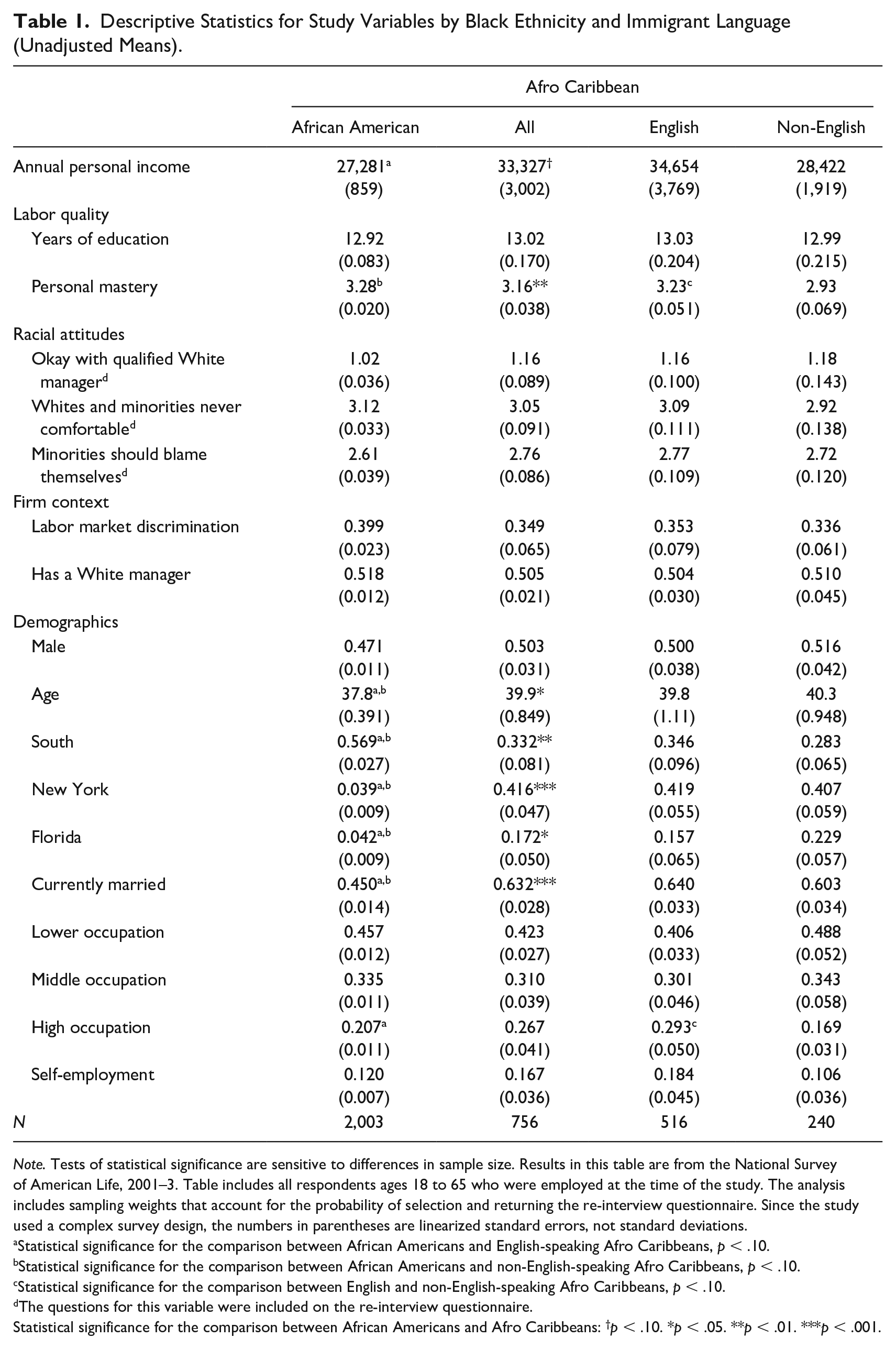
Note. Tests of statistical significance are sensitive to differences in sample size. Results in this table are from the National Survey of American Life, 2001–3. Table includes all respondents ages 18 to 65 who were employed at the time of the study. The analysis includes sampling weights that account for the probability of selection and returning the re-interview questionnaire. Since the study used a complex survey design, the numbers in parentheses are linearized standard errors, not standard deviations.
Statistical significance for the comparison between African Americans and English-speaking Afro Caribbeans, p < .10.
Statistical significance for the comparison between African Americans and non-English-speaking Afro Caribbeans, p < .10.
Statistical significance for the comparison between English and non-English-speaking Afro Caribbeans, p < .10.
The questions for this variable were included on the re-interview questionnaire.
Statistical significance for the comparison between African Americans and Afro Caribbeans: †p < .10. *p < .05. **p < .01. ***p < .001.
Tables 2 to 5 present the unadjusted and adjusted associations between having a White manager and the incomes of African Americans and Afro Caribbeans. Table 2 shows that while there are no unadjusted differences in income between African Americans with and without White managers, Afro Caribbeans who have a White manager report about 32 percent more income than those without White managers ($12,736; p = .021). While the unadjusted benefits of White management obtain for Afro Caribbeans in the aggregate, this pattern concentrates among those from English-speaking countries ($15,778; p = .020). That said, the unadjusted incomes of African Americans with White managers are about the same as those for Afro Caribbeans without White managers and Afro Caribbeans with White managers report about 43 percent more income than African Americans with White managers ($11,992; p = .027). 22 Table 3 shows that basic demographic differences play an influential role in shaping the association between having a White manager and the incomes of Afro Caribbeans. While demographic factors explain about 39 percent of the relationship between having a White manager and the incomes of English-speaking Afro Caribbeans ([15,778 − 9,653]/15,778 = .389), adjusting for these differences also reveals the benefit of White management for non-English-speaking Afro Caribbeans ($5,233; p = .003).
Descriptive Statistics for Study Variables by Black Ethnicity and Immigrant Language (Unadjusted Means).
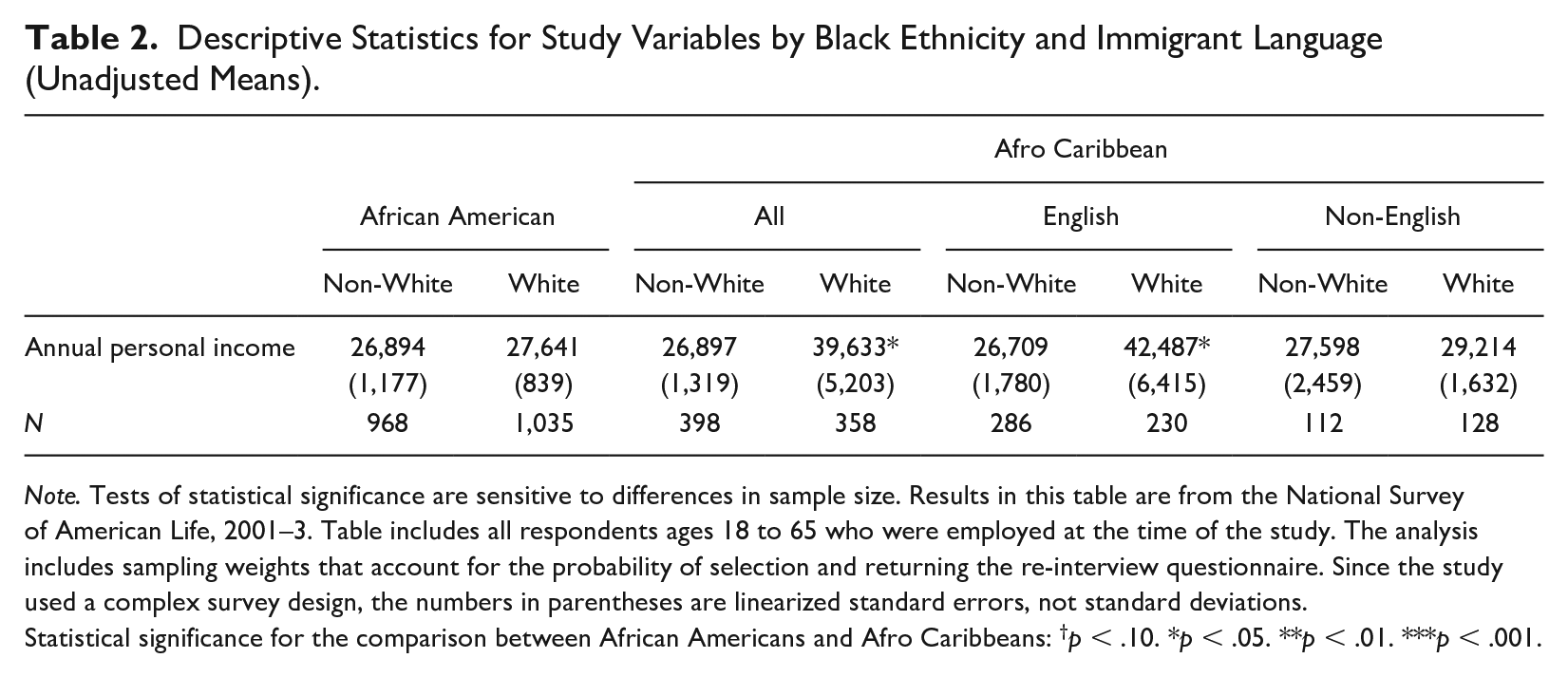
Note. Tests of statistical significance are sensitive to differences in sample size. Results in this table are from the National Survey of American Life, 2001–3. Table includes all respondents ages 18 to 65 who were employed at the time of the study. The analysis includes sampling weights that account for the probability of selection and returning the re-interview questionnaire. Since the study used a complex survey design, the numbers in parentheses are linearized standard errors, not standard deviations.
Statistical significance for the comparison between African Americans and Afro Caribbeans: †p < .10. *p < .05. **p < .01. ***p < .001.
Ordinary Least Squares Regression Models of Annual Personal Income on White Management and Social Demographic Controls.

Note. Tests of statistical significance are sensitive to differences in sample size. Results in this table are from the National Survey of American Life, 2001–3. Table includes all respondents ages 18 to 65 who were employed at the time of the study. The analysis includes sampling weights that account for the probability of selection and returning the re-interview questionnaire.
Results from a two-tailed z-test for the difference between African Americans and all Afro Caribbeans = p < .05.
Results from a two-tailed z-test for the difference between African Americans and all English-speaking Afro Caribbeans = p < .05.
Results from a two-tailed z-test for the difference between African Americans and all non-English speaking Afro Caribbeans = p < .05.
Statistical significance: †p < .10. *p < .05. **p < .01. ***p < .001.
Ordinary Least Squares Regression Models of Annual Personal Income on White Management, Social Demographic Controls, Labor Quality, Racial Attitudes, and Racial Discrimination.

Note. Tests of statistical significance are sensitive to differences in sample size. Results in this table are from the National Survey of American Life, 2001–3. Table includes all respondents ages 18 to 65 who were employed at the time of the study. The analysis includes sampling weights that account for the probability of selection and returning the re-interview questionnaire.
Results from a two-tailed z-test for the difference between African Americans and all Afro Caribbeans = p <.05.
Results from a two-tailed z-test for the difference between African Americans and all English-speaking Afro Caribbeans = p <.05.
Results from a two-tailed z-test for the difference between African Americans and all non-English speaking Afro Caribbeans = p <.05.
Statistical significance: †p < .10. *p < .05. **p < .01. ***p < .001.
Ordinary Least Squares Regression Models of Annual Personal Income on White Management, Social Demographic Controls, Labor Quality, Racial Attitudes, and Racial Discrimination.

Note. Tests of statistical significance are sensitive to differences in sample size. Results in this table are from the National Survey of American Life, 2001–3. Table includes all respondents ages 18 to 65 who were employed at the time of the study. The analysis includes sampling weights that account for the probability of selection and returning the re-interview questionnaire.
Results from a two-tailed z-test for the difference between African Americans and all Afro Caribbeans = p < .05.
Results from a two-tailed z-test for the difference between African Americans and all English-speaking Afro Caribbeans = p < .05.
Results from a two-tailed z-test for the difference between African Americans and all non-English speaking Afro Caribbeans = p < .05.
Statistical significance: †p < .10. *p < .05. **p < .01. ***p < .001.
Table 4 shows that adding controls for skills, racial attitudes, and perceptions of discrimination to the models presented in Table 3 accounts for an additional 18 percent of the White manager benefit for English-speaking Afro Caribbeans ([9,653 − 7,889]/ 9,653 = .182) but results in about a 24 percent increase ([6,513 − 5,233]/5,233 = .244) in the benefit for non-English-speaking Afro Caribbeans. 23 That said, English-speaking Afro Caribbeans with White managers continue to report about $7,889 more income than those without White managers and non-English-speaking Afro Caribbeans with White managers report about $6,513 more income than those without White managers. The table also shows differential associations between skills, attitudes, discrimination, and income for African Americans and Afro Caribbeans. While greater skills are associated with more income for both African Americans and Afro Caribbeans, hard skills matter more for African Americans and soft skills matter more for English-speaking Afro Caribbeans. Racial attitudes are not associated with income, but greater income is associated with more perceived discrimination for Afro Caribbeans, particularly those from English-speaking countries. Moreover, while the models show some differences across Black populations in the relationship between personal income and model covariates, the most consistent difference is the “White manager benefit.” 24
Table 5 shows that the relationship between White management and income varies across levels of occupational status. For English-speaking Afro Caribbeans the White manager benefit obtains for those working in the middle and high occupational strata but is not present when working for White managers in occupations in the lower occupational strata. 25 The inverse is true for non-English-speaking Afro Caribbeans. For these Black immigrants, there is no White manager benefit to income when working in middle and higher occupations, but there is a benefit associated with having a White manager when working in lower status occupations. However, parsing the effect of having a White manager across occupational status does not reveal a White manager benefit for African Americans. African Americans do not experience a benefit to White management at any of the three occupational strata. Therefore, while there is some variation in the relationship between White management and income across occupational strata for Afro Caribbeans, only Afro Caribbeans experience a White manager benefit.
Discussion
Most studies of Black ethnic labor market disparities have focused on the role of differences in various population characteristics—for example, values, attitudes and skills (Chiswick 1978; Sowell 1978). To date, the role of White managers and their preference for Afro Caribbeans has remained underexplored. While several studies speculate or report that White managers prefer Afro Caribbeans (Domínguez 1975; Foner and Napoli 1978; Waters 1999a, 1999c, 1999d), the only large scale study to investigate the role of White manager favoritism in Black ethnic labor market disparities did not find support for favoritism (Model 2008c). In this study, I argue that because African Americans and Afro Caribbeans have different historical relationships to American colonialism and slavery (Aranda and Rebollo-Gil 2004; Grosfoguel 2004; Grosfoguel and Georas 2000; Waters 1999b, 1999c), Afro Caribbeans benefit from a particular form of ethnoracism (Aranda and Rebollo-Gil 2004; Grosfoguel 2004) that results in White manager prejudice in favor of Afro Caribbeans over African Americans (Bryce-Laporte 1972; Domínguez 1975; Model 2008c). I support this argument by showing that contrary to the field reports of White managers, African Americans and Afro Caribbeans are nearly indistinguishable in terms of their labor quality and racial attitudes and, more importantly, both English and non-English speaking Afro Caribbean incomes benefit from having a White manager. However, I find no corresponding benefit for African Americans with White managers.
While these results suggest an alternative direction for future research on ethnoracism and Black ethnic labor market disparities, they are not without limitations. First, although the survey used to complete the analysis is notable in terms of its quality, unique in terms of its measures, and novel in that it includes a nationally representative sample of both African Americans and Afro Caribbeans, it is still exceedingly difficult to engage in casual inference when using cross-sectional surveys. Therefore, while this study offers evidence of an association between having a White manager and the incomes of Afro Caribbeans, it is difficult to settle the directionality of this association. Second, although I have done my best to compare African Americans and Afro Caribbeans that are alike in the ways that White managers say matter, statistical controls are an imperfect substitute for controlled experimental manipulations that might directly test the differential evaluation and treatment of African American and Afro Caribbean workers under White management (i.e., White manager/African American worker and White manager/Afro Caribbean worker dyads). Third, Afro Caribbeans have long and concentrated histories within certain regions of the United States—for example, New York and Florida. Therefore, it is unfortunate that the study sample size restricted my ability to stratify the analysis by region, leaving me unable to assess the regional specificity of the White manager benefit.
These limitations aside, there are reasons for cautious confidence in moving forward with further explorations into the role of ethnoracism in Black ethnic labor market disparities. First, while this is the first study to systematically test for the association between White managers and Black ethnic labor market disparities, earlier studies by different investigators in different places and at different times have noted differential relations between Whites, Afro Caribbeans, and African Americans (Bashi Bobb and Clarke 2001; Bryce-Laporte 1972; Domínguez 1975; Foner and Napoli 1978; Greer 2013; Patterson 1995; Vickerman 1999; Waters 1999a). Second, while it is difficult to assess labor quality and racial attitudes in social surveys, there is no reason to believe that African Americans and Afro Caribbeans answer such questions differently. Therefore, while these measures may not be ideal, variance in measurement between African Americans and Afro Caribbeans is not likely to account for the White manager benefit among Afro Caribbeans. Finally, while there may be some concerns about the potential for regional concentration, I note that aggregating regions does not dissolve the White manager benefit for Afro Caribbeans, suggesting that, on average the benefit obtains for Afro Caribbeans.
Other than ethnoracism, there are several potential alternatives that might also explain the association between White management and income for Afro Caribbeans. First, Afro Caribbeans may be more likely to work in higher status occupations where Whites are more likely to work as managers. My findings show that while African Americans and Afro Caribbeans are equally likely to have a White manager (see Table 1), English-speaking Afro Caribbeans are more likely to work in high status occupations than African Americans (see Table 1) and Afro Caribbeans in high status occupations are also more likely to have White managers than African Americans in high status occupations (see Supplemental Appendix H). However, the benefit to having a White manager does not only hold for English-speaking Afro Caribbeans in high status occupations; it also holds for those in middle status occupations (see Table 5). Moreover, the White manager benefit does not hold for non-English-speaking Afro Caribbeans in middle or higher status occupations and instead only holds for those in lower status occupations. Finally, African Americans in lower, middle, and higher status occupations do not make more money when working for White managers (see Table 5). That is, if the “main effect” of White management on the incomes of Afro Caribbeans was just a result of working in high status occupations that are more likely to have White managers, then we would also observe a White manager effect for African Americans in higher status occupations. This expectation does not hold.
Another, more nuanced, alternative explanation is that Afro Caribbeans change their behavior in the presence of White managers. That is, it may be that the methodological approach taken in this study masks the fact that Afro Caribbeans simply behave differently when in the presence of White managers and that African Americans do not engage in similar behavioral changes. There are some indications of this behavioral response in a study of stereotype threat. That is, not only were test scores among Afro Caribbeans not suppressed under the condition of stereotype threat when the experimenter was Black, but their test scores actually improved under the stereotype threat condition when the experimenter was White (Deaux et al. 2007). This suggests that when compared with African Americans, Afro Caribbeans may respond differently to the presence of Whites. If true, Whites might perceive Afro Caribbeans in the way that they do because Afro Caribbeans behave differently in their presence, even while holding orientations to work and race that are very similar to that of African Americans when Whites are not present.
These limitations and alternative perspectives aside, this study offers an important discovery concerning the association between White management and the incomes of Afro Caribbeans and presents ethnoracism as a workable potential explanation for labor market disparities between African Americans and Afro Caribbeans. However, while ethnoracism offers a way to think about experiences with racialized forms of prejudice and discrimination that are not entirely decided by how a person looks, it conflates experiences with ethnoracial discrimination with the process of developing and assigning different racial or ethnoracial stereotypes to specific bodies and/or populations. That is, the idea that the immigrant experience with ethnoracism in America is partially determined by the relationship between the United States and the immigrant country of origin is useful (Aranda 2006a; Aranda and Rebollo-Gil 2004; Grosfoguel 2003, 2004; Grosfoguel and Georas 2000), but it assumes or relies on the idea that the racialized meanings or stereotypes that we assign to bodies and populations do not only turn on widely recognized “racial phenotypes” (e.g., skin color, hair texture and bone structure; Du Bois 1897; Omi and Winant 2014), but are also shaped, informed, or determined by “ethnic characteristics” (e.g., language, religion or nationality; Gans 1979; García 2017b; Hall 1988; Selod and Embrick 2013; Waters 1990; Wimmer 2008).
For the better part of a century, social scientists have elaborated theories of race, racialization, and racism that focus on perceived physical appearance (e.g., skin color, hair texture and bone structure; Du Bois 1897; Omi and Winant 2014). More recently, as the U.S. population has grown increasingly non-White, non-Black and non-Native, scholars have begun to revise racialization theory to include “ethnic characteristics” in the process of assigning racialized meanings to people and populations (e.g., language, religion, and nationality; Bonilla-Silva 2004; Kim 1999; Selod and Embrick 2013; Urciuoli 1996). However, while studies show that ethnic characteristics are involved in racialization, they are less clear about whether these characteristics function only as sources of racialized meaning (e.g., the belief that a person is lazy, hard working, or criminal) or if they also function as cues for determining group membership (e.g., is a person White, Black or Latinx). That is, do we only use concepts that are widely associated with ethnicity to supply the qualitative meanings for our racialized stereotypes or do we also use these concepts to determine racial or ethnoracial group membership?
Studies that assess the different racialized experiences of African Americans and Black immigrants might be uniquely suited for inquiries into whether ethnic characteristics serve as cues for population membership in the process of assigning racialized meanings or stereotypes. Most of the evidence in support of the idea that we use ethnic concepts (e.g., country of origin) as source material in the process of assigning racialized meaning show that these meanings are applied after the observation of racialized physical features (García 2017b; Kim 1999; Ngai 2004; Tuan 1998). That is, both the classical and revised models of racialization reference physical features as cues for the determination of group membership (e.g., skin color, hair texture and bone structure). However, while the classical model sources racialized meaning in real or imagined biological material (e.g., blood quantum and/or genomics; Davis 1991; TallBear 2013), the revised model expands the number and kind of sources of racialized meaning to include non-physical “ethnic characteristics” (e.g., language, religion, and nationality; García 2017b; Kim 1999; Ngai 2004; Tuan 1998).
As African Americans and Black immigrants share a racial appearance, those who assign different racialized stereotypes to these populations are not using physical appearance as the cue for group membership. Instead, they are using non-physical or ethnic cues. Therefore, the comparative study of African Americans and Black immigrants allows us to examine the viability of non-physical characteristics as cues in the process of assigning racialized meanings to human population groups. We might further study this process as ethnoracialization—or the process of assigning racialized meanings to bodies and populations based on a varied set of physical and non-physical characteristics, to include skin color, hair texture, bone structure, language, religion, and nationality.
Given the possibility that racialized stereotypes are modified by nativity, further thought needs to be given to whether ethnoracialization is best understood as evidence of intersectionality in the process of racialization (García 2017a; Valdez and Golash-Boza 2017) or as evidence of the presence of what we might refer to as an ethnoracial assemblage. While both approaches can be used to make sense of the findings in this study (i.e., they can both be used to explain that racialized stereotypes are modified by nativity status), they make different ontological assumptions about the nature of the basic concept under study. Intersectionality theorists would assume that there are multiple concepts under study (i.e., race and nativity status) and that these concepts are orthogonal to one another, or distinct but related (García 2017a; Valdez and Golash-Boza 2017). From this perspective, the experience of a person with a given social status (e.g., their race is Black) might be modified by their position vis-à-vis another related but distinct social status (e.g., their gender is Woman or their nativity is foreign). This perspective is different from assemblages in subtle but important ways. That is, assemblage theorists (e.g., Deleuze and Guattari 1988) would assume that there is a singular concept being studied, say ethnoraciality, not two related but distinct concepts (e.g., race and nativity), and that membership in a given ethnoracial group or the determination of a particular “ethnoracial kind,” as it were, is determined by making inferences from a set of equally constituent elements (in this case, skin color, hair texture, bone structure, language, religion and/or nationality).
In conclusion, theories of ethnoracism and ethnoracialization fit well within larger trends toward “racial multidimensionality” and the increasing use of “ethnoracial terminology” across assorted studies of race and ethnicity within the social sciences but we have yet to develop a formal ontology for ethnoraciality. For instance, a number of scholars are now arguing that we experience race “not as a single, consistent identity but as a number of conflicting dimensions . . . including racial identity, self-classification, observed race, reflected race, phenotype and racial ancestry” (Roth 2016: 1,310). As this trend continues to develop, others are simultaneously pointing toward a shift from this kind of “racial ontology” toward a kind of revised multidimensional ontology that jointly references “racial” and “ethnic” elements (Alcoff 2009; Aranda and Rebollo-Gil 2004; García 2017b; Goldberg 1993; Lewis and Forman 2017; Monk 2016; Paredes 2018). Important signs of the coming turn toward such an ontology include the rapidly increasing use of the term ethnoracial in place of race or ethnicity and the development of theories that reference the racialization of “ethnic characteristics,” or markers or cues that “may even be orthogonal to the category under consideration” (e.g., language, religion and nationality; García 2017b; Kim 1999; Monk 2015: 406; Ngai 2004; Selod and Embrick 2013; Urciuoli 1996). Given the rise of ethnoracial nomenclature, it may very well be that social scientists require the formal development of an ethnoracial ontology for the study of race and ethnicity in settler and colonial societies (Lewis and Forman 2017).
Supplemental Material
sj-xlsx-1-spx-10.1177_07311214211010842 – Supplemental material for White Managers, Ethnoracism, and the Production of Black Ethnic Labor Market Disparities
Supplemental material, sj-xlsx-1-spx-10.1177_07311214211010842 for White Managers, Ethnoracism, and the Production of Black Ethnic Labor Market Disparities by Mosi Adesina Ifatunji in Sociological Perspectives
Supplemental Material
sj-xlsx-2-spx-10.1177_07311214211010842 – Supplemental material for White Managers, Ethnoracism, and the Production of Black Ethnic Labor Market Disparities
Supplemental material, sj-xlsx-2-spx-10.1177_07311214211010842 for White Managers, Ethnoracism, and the Production of Black Ethnic Labor Market Disparities by Mosi Adesina Ifatunji in Sociological Perspectives
Supplemental Material
sj-xlsx-3-spx-10.1177_07311214211010842 – Supplemental material for White Managers, Ethnoracism, and the Production of Black Ethnic Labor Market Disparities
Supplemental material, sj-xlsx-3-spx-10.1177_07311214211010842 for White Managers, Ethnoracism, and the Production of Black Ethnic Labor Market Disparities by Mosi Adesina Ifatunji in Sociological Perspectives
Footnotes
Declaration of Conflicting Interests
The author(s) declared no potential conflicts of interest with respect to the research, authorship, and/or publication of this article.
Funding
The author(s) received no financial support for the research, authorship, and/or publication of this article.
Supplemental Material
Supplemental material for this article is available online.
Notes
Author Biography
 ).
).
References
Supplementary Material
Please find the following supplemental material available below.
For Open Access articles published under a Creative Commons License, all supplemental material carries the same license as the article it is associated with.
For non-Open Access articles published, all supplemental material carries a non-exclusive license, and permission requests for re-use of supplemental material or any part of supplemental material shall be sent directly to the copyright owner as specified in the copyright notice associated with the article.
