




Abstract
How do the economic and cultural components of social class separately contribute to social class–based inequality? I argue that one approach to disentangle the effects of economic and cultural markers is to consider how decision-makers’ own social positions influence their evaluations of others in micro-level processes. I posit that decision-makers’ social positions influence their understandings and evaluations of the economic and cultural components of social class, giving rise to bias and inequality. In a series of original survey experiments, I manipulate the economic and cultural markers of a fictitious college applicant on subjects with elite and nonelite university degrees. The results show that the markers of social class affect individuals with elite degrees and individuals without elite degrees differently. I find that it is the cultural markers of social class, not the economic markers, that affect the judgments of evaluators with elite degrees. Applicants’ perceived competence and status help to explain the positive effect of cultural markers on evaluators with elite degrees. These results show the importance of social position and micro-level evaluation processes to help explain social class–based inequality.
Introduction
Social class bias is one of the fundamental explanations for inequality based upon social class origins. Bias based upon social class often occurs whenever decision-makers make consequential decisions about others—such gatekeepers include educational authorities (Calarco 2014; Stevens 2007), health care professionals (Lareau 2002; Lutfey and Freese 2005), and employers (Jackson 2009; Rivera and Tilcsik 2016). But how do decision-makers use markers of social class at the moment of decision-making? Do all decision-makers evaluate the markers of social class in the same way, or might evaluators’ judgments depend on their own social positions? And, what are the ramifications for inequality if evaluators interpret these markers differently?
In this article, I theorize that decision-makers perceive and evaluate the various components of social class differently based upon their own locations in the social order, giving rise to biased decision-making. I posit that one missing explanation for social class–based inequality may be the different ways that decision-makers make sense of, and give meaning to, the various components of social class. On one hand, decision-makers might be reacting to an individual’s economic signals of class origin, such as parental educational credentials, occupational prestige wealth, or income (Chan and Goldthorpe 2007a; Weber 1978). On the other hand, decision-makers might be reacting to an individual’s cultural characteristics of social class, as signaled by the cultural practices into which an individual has been socialized, such as a person’s tastes or tools for interaction (Bourdieu 1984; Lamont 1992; Small, Harding, and Lamont 2010; Swidler 1986; Weber 1978).
In this study, I posit that decision-makers’ own social positions within society might allow them to differentially value, and be differentially influenced by, the economic and cultural markers of social class. I theorize that the economic markers of social class carry broadly shared social meanings that allow most decision-makers, regardless of their own social positions, to organize others into established hierarchies (Correll and Ridgeway 2003; Fiske and Markus 2012). Contrastingly, broad social meanings may be less established about where the symbolic boundaries should be drawn around the cultural markers of social class (Lamont and Molnár 2002; Small et al. 2010). Moreover, the meanings decision-makers give to cultural markers may be more dependent upon their own social positions (Allen 2002). Thus, elites may be more likely to use cultural markers of social class, rather than economic markers, when evaluating others to draw boundaries between themselves and others.
Bias based upon social class might, therefore, be more sensitive to the types of individuals involved in the micro-level evaluation processes than scholars have previously explored. This study, then, asks the following research questions:
I undertake a series of original survey experiments in which I vary the economic and cultural markers of a fake college applicant, presented as real in a simulated college admissions process, to evaluators with elite and nonelite college degrees. I find evidence that the economic and cultural markers of an applicant matter differently for evaluators with elite versus nonelite degrees. The evaluations for individuals with elite degrees are significantly affected by an applicant’s cultural markers of social class, while the reviews for evaluators with nonelite degrees are unaffected by cultural markers. I find that highbrow cultural markers cause elites to give applicants better reviews because evaluators with elite degrees perceive these applicants to be higher status and more competent. In contrast, economic markers do not differentially affect the reviews of elite or nonelite evaluators. In some cases, economic markers of social class may modify the effect of cultural markers for evaluators with elite degrees. For instance, I find some evidence that the economic and cultural markers of an applicant can combine, in a multiplicative way, to create differential payoffs for a student with lower economic markers versus a student with higher economic markers. Taken together, the results from this study show that the markers of social class work differently, depending upon evaluators’ social positions. This article contributes to important theoretical debates about how micro-level decision-making can give rise to larger patterns of social class discrimination in society.
Background
Disentangling Social Class–based Inequality—Economic and Cultural Markers
Bias is one of the mechanisms through which social class inequality emerges in educational institutions, health care institutions, and the labor market (for reviews, see Fiske and Markus 2012; Grusky 2014; Small et al. 2010). Yet, because the concept of social class is multidimensional, an important missing link is determining upon which dimensions of social class decision-makers discriminate. On one hand, the markers of social class origin may be based upon participation in economic life and the labor market (Chan and Goldthorpe 2007a; Weber 1978). Labeling these markers as “economic” reflects the theoretical tradition to cluster together indicators of economic life which can include, but are not limited to, educational attainment, occupations, wealth, or income of the origin household. Research suggests that gatekeepers evaluate people differently based upon these economic signals of social class. For instance, individuals with a family background of elite educational credentials versus nonelite degrees (Hurwitz 2011), upper class occupations versus lower class occupations (Fiske et al. 2002), or high wealth versus low wealth (Ridgeway et al. 1998) are favored, considered more competent, and receive more differential treatment from decision-makers. 1
On the other hand, the markers of social class might be cultural, organizing people based upon the cultural practices into which they were socialized. Research suggests that the cultural elements of social class also contribute to inequality, both in educational institutions and the labor market (Small et al. 2010). The types of tastes, preferences, and pastimes people engage in are consequential for how they are perceived and evaluated by others. Participation in “highbrow” forms of culture typically garner more prestige, esteem, and rewards, while “lowbrow” forms of culture typically do not (Bourdieu 1984; Bryson 1996; DiMaggio 1982; Lareau 2002; Rivera 2012). For instance, researchers have found that highbrow practices such as attending art museums or listening to classical music are associated with receiving positive evaluations from others (DiMaggio 1982; Rivera and Tilcsik 2016; Thomas 2018). 2 Beyond these tastes and preferences, individuals within different social classes have varying cultural toolkits and patterns for interaction that signal their belonging to specific strata (Small et al. 2010; Swidler 1986). Decision-makers differentially evaluate individuals’ toolkits and interactional patterns, causing some individuals to be perceived as good fits within educational institutions and organizations in the labor market (Calarco 2014; Carter 2005; Lareau 2002).
The economic and cultural markers of social class can be difficult to disentangle. Social class is multidimensional, consisting of multiple indicators that often overlap. For instance, cultural markers of social class may serve as a way to signal one’s economic position when economic signals are not readily available (Bourdieu 1984). Moreover, Americans tend to associate certain forms of cultural signals with specific economic positions (Lizardo and Skiles 2016). Yet, when the economic and cultural markers of social class are both salient in evaluation processes (as they sometimes are), how might decision-makers be differentially attuned to these various signals? What remains unclear is how these social class markers are differentially perceived by evaluators at the moment of decision-making.
Theoretical Motivation
Why might evaluators be differentially attuned to the economic and cultural markers of social class? I posit that decision-makers might make sense of the cultural and economic markers of social class in different ways, depending upon their own social positions. Social psychological frameworks suggest that micro- or meso-level processes can alter social systems and macrostructures (Mcleod and Lively 2003). This study aims to provide one possible explanation for how macrostructures, such as discrimination based upon social class, endure. I posit that one way social class bias and discrimination occurs is through decision-makers’ own micro-level processes of evaluation. It is at the moment of evaluation that decision-makers’ own positions within the social order can influence how they perceive and evaluate others’ markers of social class, producing unequal outcomes for others.
Social Position, Evaluation, and Markers of Social Class
An individual’s social position within the macrostructure influences the way they evaluate themselves and others (Fiske and Markus 2012; Lynn and Ellerbach 2017; Valentino 2021). For instance, an individual’s location in the social class hierarchy influences how they view themselves compared to others, the judgments they make about others, and their views on their own and others’ belonging and fit. An individual’s location in the social class hierarchy can cause them to come to different judgments and evaluations compared to someone in a different location on the hierarchy (Small et al. 2010). While scholars have debated whether this is due to processes of socialization or structural constraints, it remains clear that different locations in the social class hierarchy beget different types of judgments, evaluations, and actions (Lamont 1992; Lareau 2002; Small 2004; Swidler 1986). This research suggests that individuals higher on the social class hierarchy may attribute different meanings to, and interpretations of, the various markers of social class than individuals lower on the social class hierarchy. I outline these possibilities below.
The economic markers of social class, in contrast to the cultural markers, are familiar social categories that are recognizable to most people in Western societies (Correll and Ridgeway 2003). Experimental studies suggest that a person’s class, signaled by economic markers such as occupation or income, can be quickly identified and determined, immediately following a person’s gender and race or ethnicity (Fiske and Markus 2012). Because the economic elements of social class carry broad social meanings and create readily available social categories, most people can use economic markers to understand and evaluate the world around them (Correll and Ridgeway 2003; Fiske et al. 2002). This research suggests that most individuals, despite their location in the social order, carry readily available heuristics to judge and evaluate others based upon their economic markers of social class. Yet, just because the heuristics surrounding the economic markers of social class are readily available does not mean that all evaluators will use economic markers to evaluate others, especially if other types of markers (i.e., cultural markers) are salient to inform their evaluations.
In contrast to economic markers, cultural markers might function as more ambiguous and less objective markers of social class for some decision-makers. The value and judgments one attributes to cultural markers are more dependent upon one’s location in the social order (Small et al. 2010). For instance, individuals in different locations in the social hierarchy may value certain forms of cultural markers, like extracurricular activities, differently than others (Lamont 1992; Lareau 2002; Rivera 2012). Highbrow forms of culture, such as an appreciation for classical music, are familiar to individuals at the top of the social order like a lock and key match. For those at the top of the social order, their personal experiences with highbrow forms of culture cause them to unconsciously evaluate highbrow culture as “for me” and lowbrow culture as “not for me” (Allen 2002; Bourdieu 1984). Consequently, those at the top of the social order might view highbrow forms of culture, or people who engage in highbrow forms of culture, as “fitting like a glove” (Allen 2002).
Decision-makers at the top of the social order make distinctions between highbrow and lowbrow cultural markers because these markers allow them to draw symbolic boundaries between themselves and others (Lamont and Molnár 2002). For decision-makers at the top of the social order, highbrow cultural tastes signal when someone might “fit” with them because they share similar cultural interests (Lamont 1992; Rivera 2012). In contrast, the presence of lowbrow cultural markers signals to those at the top to draw boundaries between themselves and others. For decision-makers at the top of the social order, individuals who engage in lowbrow cultural practices may not seem like a good fit. Fit with others and a given institution matters because research shows that an individual’s perceived fit predicts their belonging, longevity, and performance in an institution (Goldberg et al. 2016; Kristof-Brown, Zimmerman, and Johnson 2005; Rivera 2012; Walton and Cohen 2007). Cultural markers are how decision-makers at the top of the social order determine this fit. Subsequently, this study examines the effect of economic and cultural markers not only on admittance to institutions but also on perceived evaluation and fit—all of which facilitate access to valued institutions that foster life outcomes.
In sum, this research suggests that cultural markers, particularly highbrow markers, of social class might be distinctly used by those at the top of the social order as a way of recognizing those individuals who fit with them like a glove and distancing themselves from those who do not. Even though decision-makers at the top of the social order may use economic markers as a way of organizing others, cultural markers likely serve as primary frames through which these decision-makers distinguish between applicants who are similar to or different from themselves, making economic markers less essential frames and signals for understanding applicants. The cultural markers of social class may be more readily available categories deployed by evaluators at the top of the social order to organize the world around them, while evaluators across the social order may be less likely to impose similar judgments about highbrow forms of culture. Because decision-makers often use cultural markers as a signal for drawing symbolic boundaries between those who are similar to and different from themselves, I anticipate that the evaluation of these markers will be consequential not only for access to institutions and perceived performance in the institution but also for perceived fit. Based upon these theoretical frameworks, I hypothesize that the economic and cultural markers of social class will differentially affect the evaluations of decision-makers with elite and nonelite degrees. I predict that cultural markers will affect the evaluations of decision-makers with elite degrees and will not affect the evaluations of decision-makers with nonelite degrees.
Theoretical Extensions—The Intersection of Economic and Cultural Markers and Mediation
The challenge of disentangling cultural markers of social class from economic markers is that there is debate about how much these two markers of social class overlap. Some theoretical traditions and empirical research suggest that the cultural and economic markers of social class map onto one another in a one-to-one match (Lareau 2002; Weininger, Lareau, and Conley 2015). This research claims that cultural markers of social class are mere indicators and/or expressions of economic conditions. The participation of certain cultural markers may require economic resources, meaning that cultural and economic markers cannot be decoupled. More recent scholarship claims that in modern societies, the one-to-one match between cultural and economic markers is becoming less rigid, with individuals of different economic conditions showing wide arrays of cultural markers (Chan and Goldthorpe 2007b; Peterson and Kern 1996). This research suggests that cultural markers and economic markers have become decoupled. Finally, more contemporary scholarship shows that educational institutions may actually equip individuals in poorer economic conditions with a diverse array of cultural markers to support their educational advancement (Jack 2016). In these cases, cultural markers of class may be orthogonal to economic markers; individuals from poorer economic conditions may have cultural markers that are nonprototypical for their social class. The more recent scholarship by Tak Wing Chan and John H. Goldthorpe (2007b) and Anthony Abraham Jack (2016) suggests that we are now in a world where individuals display unique and unexpected combinations of cultural and economic markers of social class. Following these latter two traditions, an important empirical question is what are the implications when the markers of social class combine in processes of evaluation in nonprototypical ways?
Theories on intersectionality, social categorization, and expectation states suggest that social categories can combine together in nonadditive ways that are more complex than merely considering each category independently (Collins 2019; Nicolas, de la Fuente, and Fiske 2017; Ridgeway and Kricheli-Katz 2013). These theories suggest that individuals who are “off-diagonal,” or individuals who are nonprototypical group members, may experience different rewards than those individuals who are prototypical. While these theories traditionally apply to the intersection of broad social categories, like race and gender, Cecilia L. Ridgeway and Tamar Kricheli-Katz (2013) suggest that social class may also play an important role in creating intersectional experiences (e.g., experiences of poor White people). Subsequently, I apply these theories to understand how the economic and cultural signals can intersect to provide rewards to those individuals with nonprototypical components of social class. For instance, individuals who are economically poor would typically be perceived as less competent and deserving of status, which would decrease their overall evaluation from others. However, if this same individual who is economically poor also has highbrow cultural markers, theories on intersectionality suggest that the presence of highbrow cultural markers could offset the negative effect of being economically poor. Thus, I predict that individuals who are economically poor may receive better evaluations for having highbrow cultural markers compared to either economically wealthy or poor individuals with lowbrow cultural markers.
In addition, this study aims to explain why evaluators may be differentially affected by the cultural and economic markers of social class. I do this by examining how known mediators—such as warmth, competence, and status—could explain the relationship between the markers of social class and outcomes. The stereotype content model (Fiske et al. 2002) and status theory (Correll and Ridgeway 2003) predict that an evaluator generates stereotypes about a target across three general dimensions—warmth, competence, and status. Stereotypes of warmth and competence jointly act in opposition of each other—an individual who is typically perceived as highly competent is also perceived as lacking warmth. These opposing stereotypes allow more privileged groups to maintain their advantage. For example, an individual who is upper class is perceived as more competent and higher status but less warm than an individual who is working class. These stereotypes work to maintain the upper class individual’s advantage because the working-class individual is perceived as nonthreatening and lacking the ability to cause harm (high warmth, but low competence). Status theory further suggests that an evaluator’s perception of competence, warmth, and status can lead to differences in how a target is perceived and evaluated (Correll and Ridgeway 2003). Research repeatedly finds that the upper class individual is granted more power, prestige, and access to socially valued resources such as jobs and promotions, for instance.
However, previous research does not fully disentangle whether perceived status, competence, and warmth are associated with the economic or cultural components of social class. On one hand, the stereotypes about status, competence, and warmth that are associated with social class could be the result of the perceptions an evaluator has about an individual’s economic markers of social class. On the other hand, perceptions of an individual’s cultural markers of social class may influence the types of stereotypes an evaluator has about the target’s status, competence, or warmth. Prior research finds that competence mediates the effects of highbrow cultural markers; however, the extent to which other known mediators, like warmth or status, explain the relationship between cultural markers and how a target is evaluated remains unknown (Thomas 2022). My contribution is to test the roles of economic and cultural markers in evaluation processes, allowing me to examine which mechanisms (status, competence, or warmth) explain the relationship between markers of social class and evaluative outcomes.
Finally, recent research by Kyla Thomas (2022) takes up the similar empirical task of interrogating the social meanings and values of traditional highbrow culture. Thomas (2022) finds that survey respondents’ perceptions of a fictitious online profile are influenced by the presence of highbrow tastes in the profile. Highbrow tastes cause survey respondents to rate the online profile as higher class and more competent. This effect was greater in magnitude for high-class survey respondents. These results suggest that the evaluation of the markers of social class differs based upon the social class of respondents or decision-makers. This study extends the work of Thomas (2022) in three important ways. First, this study examines how the markers of social class affect reviewers in an evaluation task, specifically college admissions. Moreover, I examine how evaluators’ social identities influence this process of evaluation by sampling respondents who are likely to be in positions that allow them to make consequential decisions about applicants. I do this specifically by sampling evaluators with elite and nonelite college degrees. Moments of evaluation, like college admissions, have important implications for inequality, making this study an important extension of prior work. Second, this study examines how cultural and economic markers of social class intersect in nonprototypical ways to affect reviewers’ evaluations. Third, this study tests other mechanisms, beyond competence, that may explain the relationship between markers of social class and evaluative outcomes. The methodological and theoretical extensions of this study contribute to important debates about how social class bias contributes to inequality in decision-making processes.
Data and Methods
To empirically test the predictions articulated above, I implemented a series of original survey experiments that examine the effects of economic and cultural markers on evaluators’ perceptions of an individual in a simulated college admissions process. I sought two separate samples for the experiment—elite and nonelite college degree samples—to ascertain whether the causal effects of economic and cultural markers differ depending upon evaluators’ social positions.
Recruitment
A rich debate within sociology exists regarding how to best specify an individual’s social position within society. Social position may be determined by income, occupation prestige, educational credentials, as well as other factors (Chan and Goldthorpe 2007a; Fiske and Markus 2012; Grusky 2014). For this study, social position is determined by evaluators’ educational prestige—namely, whether the evaluator attended an elite or nonelite university. Although an imperfect measure to holistically capture elitism (indeed, stratification scholars continue to debate how to address this issue), the distinction between elite and nonelite university degrees provides variation across two samples for whom the markers of social class may matter most.
The first survey experiment utilized Amazon’s Mechanical Turk crowdsourcing tool to evaluate the effects of economic and cultural markers on a sample of U.S. college graduates who did not attend elite universities (n = 308). Evaluators were paid a prorated rate based upon California’s minimum wage. Evaluators with nonelite degrees were limited to individuals in the United States with a college degree from a university ranked below the top 10 universities in the United States, according to U.S. News and World Report. 3 While there was some variation in the type of universities attended by evaluators with nonelite degrees, a large majority of these respondents attended public universities or small, private colleges that ranked well below the top 40 universities in the United States.
For the second survey experiment, evaluators with elite degrees were recruited from alumni from an elite university in the United States which frequently ranks within the top 10 universities in the United States, according to U.S. News and World Report. These alumni were recruited through a university-led program that facilitates alumni engagement with university research. Respondent characteristics for respondents with elite and nonelite degrees are presented in Table 1.
Nonelite and Elite Degree Evaluator Characteristics.

Note. Respondents outside of the United States were restricted in the nonelite experiment. “Nonbinary” gender category was not provided in the elite experiment.
Anytime respondents are asked to make evaluative decisions in an experimental setting, it is important to consider the external validity of respondents’ abilities to engage in said task. This study aims to identify biases associated with the markers of social class in simulated evaluative processes. These biases often drive decision-making, even when the task or context changes, because these stereotypes are deeply and widely held beliefs across society. Although this study examines the case of college admissions as an evaluative process, the stereotypes that drive the decision-making of respondents in this study are likely robust to other settings. Thus, this study follows the tradition of previous research that uses general samples to identify bias in simulated decision-making tasks (Correll, Benard, and Paik 2007; Hart 2019; Pedulla 2014). 4 Moreover, respondents in both samples represent potential decision-makers for evaluative processes in society. The individuals in these samples are part of the 30 percent of individuals in the United States with college degrees. A college degree, despite the level of degree prestige, qualifies an individual like these respondents to serve in gatekeeper roles for important processes like hiring, educational admissions, or granting access to social services. Thus, individuals in both samples are likely familiar with evaluative processes where they make consequential judgments about others. All results should be interpreted with these constraints in mind.
Study Design
Evaluators were randomly assigned to one of the four experimental conditions. In each condition, evaluators were presented with one fictitious college applicant, who was presented as real. The college applications differed only in their economic and cultural markers of social class. The application crossed the economic (high vs. low) and cultural (high vs. low) markers of social class. This pairing generated four experimental conditions, where participants rated an applicant who had social class markers that were (1) economically low and culturally highbrow, (2) economically low and culturally lowbrow, (3) economically high and culturally highbrow, or (4) economically high and culturally lowbrow. Participants were randomly assigned to one of these four conditions. Thus, the result was a 2 × 2 between-subjects factorial design.
Study process
Respondents participated in an online survey that simulated a college admissions process. Respondents were asked to imagine that they were an admissions officer at an elite university in the United States and to decide which applicants to admit into the freshmen class. Respondents were informed that they would evaluate an information profile from a real student’s actual college application. Next, participants viewed the applicant profile, which contained the experimental manipulations and general information about the applicant. Then, participants responded to a series of questions based upon the applicant profile. The survey questions were ordered in line with standard practice for experiments testing mediating variables and dependent variables (Imai et al. 2011). The order of questions was as follows: question items for mediating variables (competence, status, and warmth); recommendation to admit; question items for other outcome variables (evaluation, fit with professors, fit with university culture); and basic demographic questions. Finally, the participants responded to manipulation checks.
Simulating college admissions
The college admissions process was chosen as the context of evaluation because it is an evaluative process in which both the economic and cultural components of social class are available to evaluators (Stevens 2007). However, the goal of this project is not to holistically explain bias in college admissions. College admission merely provides a research context in which social class–based bias can be observed. The availability of social class signals coupled with the importance of these decisions for determining an individual’s life outcomes makes the college admissions context the ideal setting for disentangling social class–based bias and inequality.
I presented evaluators with an “Applicant Profile,” which contained information about an applicant’s demographics, “Academic Information,” “Background Information,” “Extracurricular Activities,” and “College Application Personal Essay Scores.” See Appendix A for an example. The application’s demographic information, academic information, and essay scores remained constant across all conditions. The demographic information included the applicant’s name (Greg Miller), sex (male), and race (White/Caucasian). Drawing on existing research (Bertrand and Mullainathan 2004; Correll et al. 2007), I utilized a White-sounding name to help control for the race of the applicant across all conditions. As a White male, the applicant is relatively advantaged on gender and racial hierarchies. This allows for a test of whether cultural and economic markers of social class produce differential effects in a context less confounded by other forms of bias.
The academic information included the applicant’s high school grade point average (B+), SAT percentile (87th percentile), and class rank (89th percentile). The college application personal essay scores included a quality score (9/10 points) and a content score (8/10 points). This information signaled academic performance on the borderline of acceptability for an elite university, thus introducing ambiguity into the decision context (Fiske 1998). By presenting the applicant as academically ambiguous, evaluators were less likely to make their admissions decision solely based upon academic performance or merit.
Signaling economic markers of social class
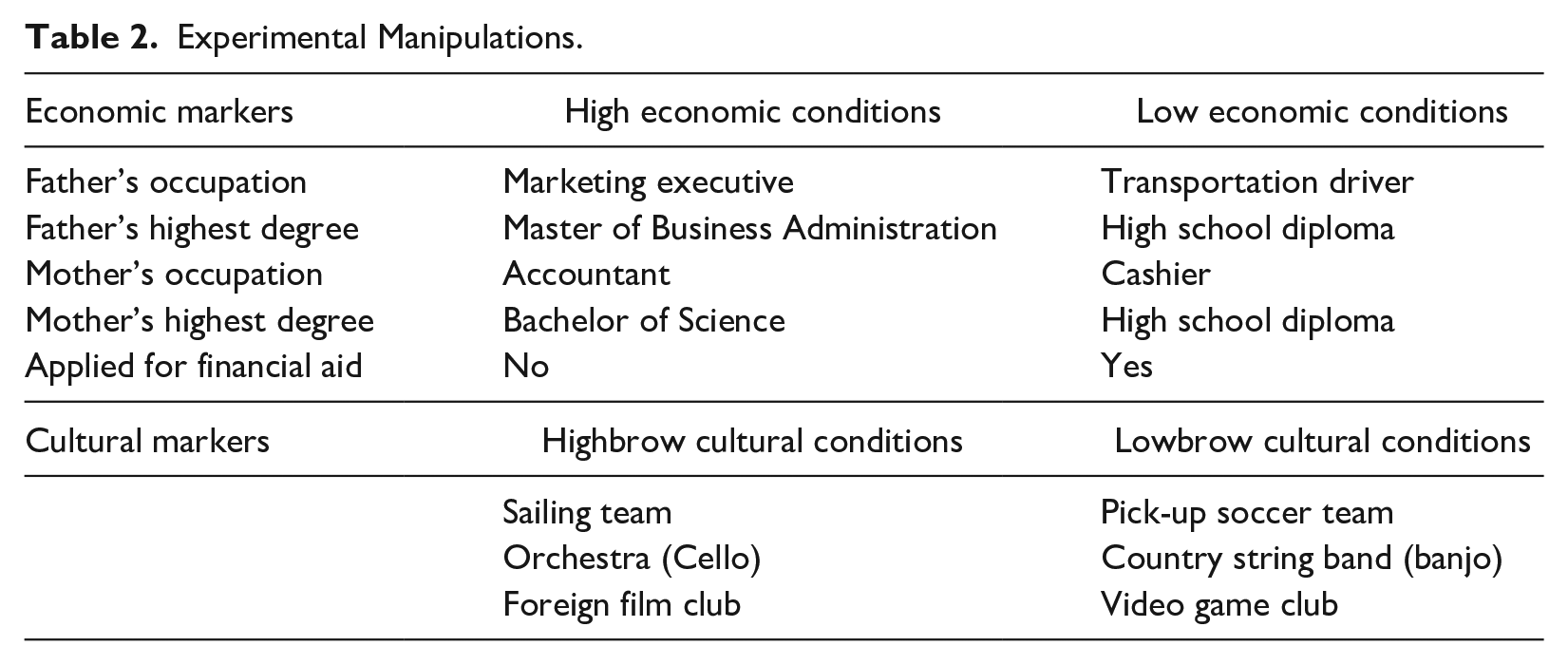
I signaled an applicant’s economic markers separately from the cultural markers. Economic markers were signaled in the “Background Information” section. This information included the applicant’s father’s occupation, father’s highest degree, mother’s occupation, mother’s highest degree, and whether the applicant applied for financial aid. Signaling economic class in this way is an externally valid way to signal economic class, since most universities in the United States consider this information in the application process. Depending on the condition, the applicant profile displayed an applicant with either high or low economic resources. Table 2 summarizes these manipulations. For the profile with high economic conditions, the father was a marketing executive with a Master of Business Administration degree. The mother was an accountant with a Bachelor of Science degree. For the economically high profile, the applicant did not apply for financial aid. For the profile with low economic conditions, the father was a transportation driver with a high school diploma. The mother was a cashier with a high school diploma. For the economically low profile, the applicant applied for financial aid. The economic markers were developed based upon intensive pretesting and prior scholarly research. I systematically pretested the high and low economic conditions to ensure that the manipulations I chose signaled distinct, stratified economic markers. See Appendix B for a description of the all pretest methods and results.
Experimental Manipulations.
Signaling cultural markers of social class
Cultural markers of social class were signaled in the “Extracurricular Activities” section of the applicant profile. Signaling cultural markers through extracurricular activities is a direct way to indicate an applicant’s consumption patterns and lifestyle markers (Bourdieu 1984; Jackson 2009; Rivera and Tilcsik 2016). An applicant profile presented a set of three highbrow or three lowbrow extracurricular activities, shown in Table 2. Each set of extracurricular activities included an athletic sport, musical participation, and visual consumption. I conducted extensive pretesting of the activities to ensure that the activities represented a set of cultural markers that distinctly signaled highbrow versus lowbrow cultural markers. These pretests involved (1) testing the perceived status of dozens of extracurricular activities selected based upon prior research, (2) testing for statistically significant differences between individual highbrow and lowbrow extracurricular activities, and (3) combining highbrow activities into a group and lowbrow activities into a group and testing for statistically significant differences between highbrow and lowbrow activity groups. Appendix C describes the pretesting methods and results in full.
Highbrow and lowbrow athletic participation were signaled by the applicant’s participation in sailing team and pick-up soccer, respectively. The prestige and esteem that are associated with different types of athletic participation vary (Rivera and Tilcsik 2016). Sailing team versus pick-up soccer denote different levels of prestige, formality, and types of cultural tastes. The second extracurricular activity signaled an applicant’s musical participation, since musical tastes often signal status distinctions between groups (Bourdieu 1984; Chan and Goldthorpe 2007b). The highbrow applicant profile indicated playing cello in an orchestra, and the lowbrow applicant profile indicated playing banjo in a country string band. 5 The third extracurricular activity signaled an applicant’s visual consumption tastes. Highbrow and lowbrow tastes were signaled as participation in a foreign film club and video game club, respectively. Attendance at the cinema can be a marker of highbrow consumption patterns, while video game club is a similar type of visual consumption activity, albeit with less prestige.
Each pair of activities—sailing team versus pick-up soccer team, cello versus banjo, and foreign film club versus video game club—all required participants to have similar levels of skill, broadly defined. Sailing team and pick-up soccer team both require an applicant to engage in an athletic, team sport. Playing cello in the orchestra and banjo in the country string band both require musical ability at a string instrument, and they require an applicant to collaborate within a group. Foreign film club and video game club both indicate participation in club-based activities that require similar levels of audio and visual consumption. Thus, the cultural markers do not indicate a difference in skill but instead a difference in their status associations and perceptions.
Dependent Variable Constructs
The outcome variables were the likelihood of admission, overall evaluation, fit with professors, and fit with university culture. I estimated whether competence, status, and warmth functioned as mediators to explain the relationship between economic markers, cultural markers, and these outcomes. Table 3 provides all question items, variable constructs, results from factor analyses, and Cronbach’s α tests.
Dependent Variable Constructs and Associated Question Items, Factor Loadings, Eigenvalues, and Cronbach’s α.
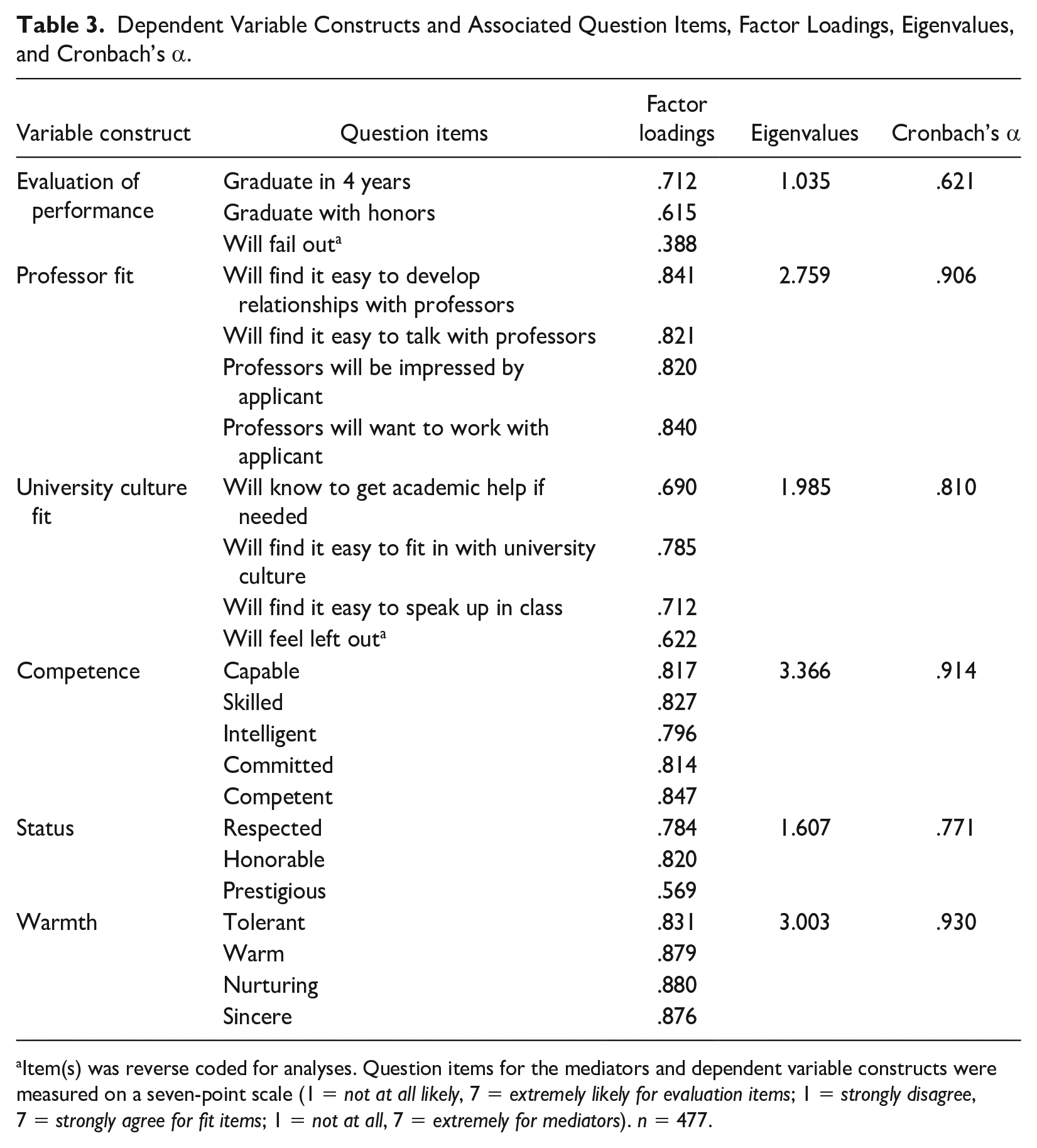
Item(s) was reverse coded for analyses. Question items for the mediators and dependent variable constructs were measured on a seven-point scale (1 = not at all likely, 7 = extremely likely for evaluation items; 1 = strongly disagree, 7 = strongly agree for fit items; 1 = not at all, 7 = extremely for mediators). n = 477.
Participants first rated the applicant profile on three basic dimensions of social judgment, used as mediators in this study: competence, status, and warmth (Correll and Ridgeway 2003; Fiske et al. 2002). Each construct comprised the individual question items provided in Table 3. Each question item asked participants to rate the extent to which the applicant exhibited a specific trait (e.g., capable) on a seven-point scale. Then, participants evaluated the applicant on items used to generate the four outcome variables. First, participants rated the applicant profile on the likelihood of admission to the university on a seven-point scale (1 = not at all likely, 7 = extremely likely). Second, participants rated the applicant profile on an evaluation measure, with question items that focused on the applicant’s ability to perform well within the organization (Correll et al. 2007). Third, participants rated the applicant profile on two constructs of perceived fit—fit with professors and fit with the university culture. For each mediator and dependent variable construct, the associated question items loaded onto a single factor and were averaged for a composite measure of the construct.
Control Variables
All models control for respondents’ region within the United States, age, race (White and not White), and income (measured ordinally across 14 categories). 6 Covariate balance was achieved across all control variables for both samples, except for age within the elite degree sample. However, whenever age is included in the analyses, its effect is only significant for one outcome, and the effect size is substantively small (see Table 5). The randomization of participants into experimental conditions assumes that participant characteristics should be uncorrelated with their assignment into each treatment group. Indeed, I find no significant differences in participant demographics across the treatment and control groups, within each sample. The covariate balance across all other control variables in both samples indicates that the random assignment of participants was effective, and the effects of the independent variables are real causal effects rather than effects based upon the sample characteristics.
Analytic Plan
I conduct ordinary least squares (OLS) regressions to examine the effects of cultural and economic markers on outcome variables. I conduct separate regressions for nonelites and elite degree holders to test whether cultural and economic markers affect these types of gatekeepers differently. In Tables 4 to 7, Models 1a and 2a test whether the effects of economic and cultural markers have different effects for nonelite versus elite degree holders. Models 1b and 2b include an interaction term that tests whether the effect of cultural markers is different for economically high applicants versus economically low applicants. I test whether the significant effects of economic and cultural markers are statistically significantly different for evaluators with elite and nonelite degrees using pooled models that combine both samples (see Appendix D, Tables D1–D4). Coefficients that are statistically different between nonelites and elite degree holders are noted.
Ordinary Least Squares Regression Coefficients for the Effects of Cultural and Economic Markers on Recommendation to Admit.

Note. Robust standard errors in parentheses. Coefficients in bold indicate the coefficients for nonelites and elites are statistically significantly different, indicated in Table D1 in Appendix D.
p < .05. **p < .01. ***p < .001.
Ordinary Least Squares Regression Coefficients for the Effects of Cultural and Economic Markers on Evaluation.

Note. Robust standard errors in parentheses. Coefficients in bold indicate the coefficients for nonelites and elites are statistically significantly different, indicated in Table D2 in Appendix D.
p < .05. **p < .01. ***p < .001.
Ordinary Least Squares Regression Coefficients for the Effects of Cultural and Economic Markers on Fit with Professors.

Note. Robust standard errors in parentheses. Coefficients in bold indicate the coefficients for nonelites and elites are statistically significantly different, indicated in Table D3 in Appendix D.
p < .05. **p < .01. ***p < .001.
Ordinary Least Squares Regression Coefficients for the Effects of Cultural and Economic Markers on Fit with University Culture.
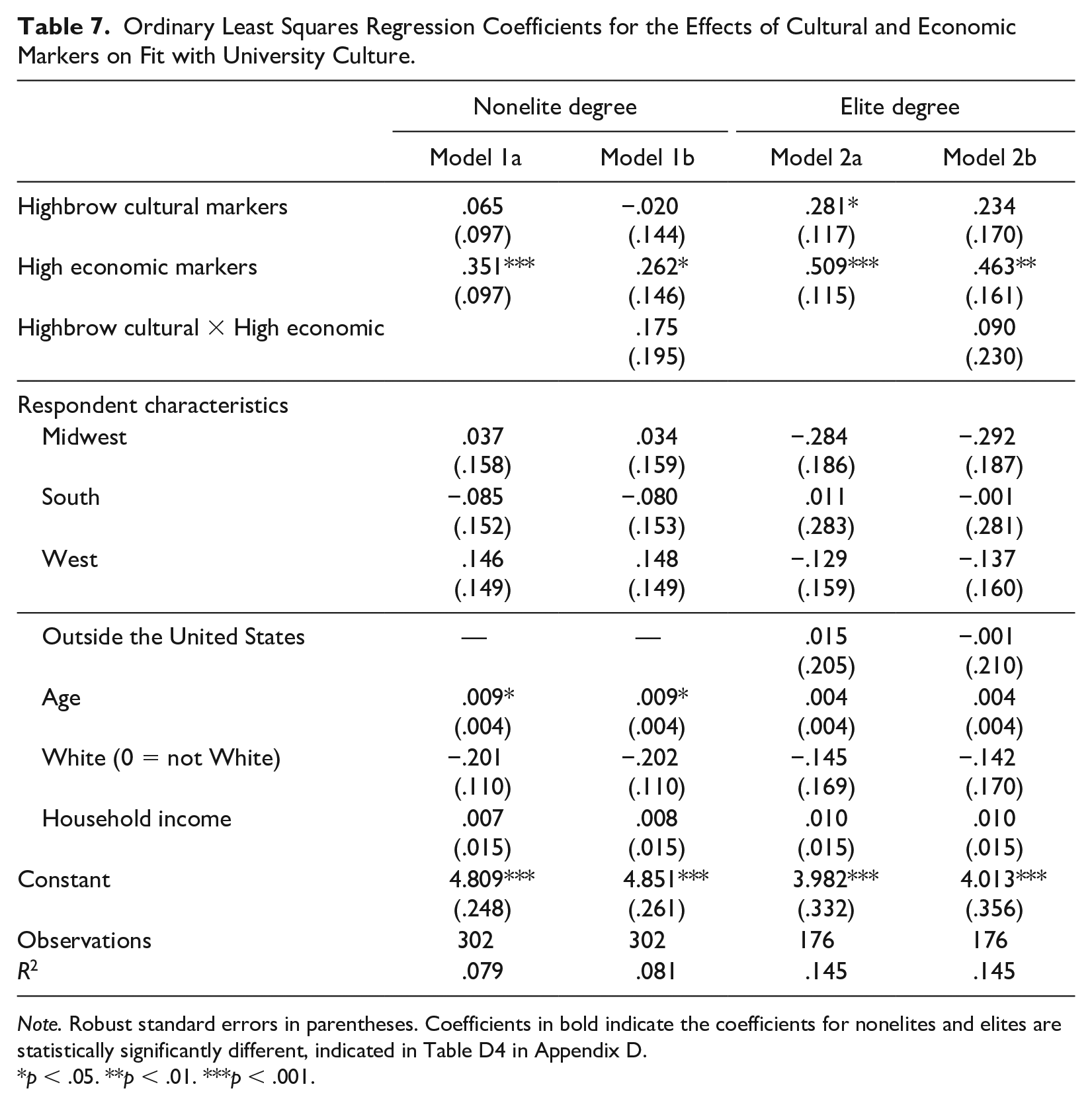
Note. Robust standard errors in parentheses. Coefficients in bold indicate the coefficients for nonelites and elites are statistically significantly different, indicated in Table D4 in Appendix D.
p < .05. **p < .01. ***p < .001.
I also test the mechanisms that may explain the relationships between cultural markers and the dependent variable constructs. I conduct mediation analyses utilizing a causal mediation framework proposed by Kosuke Imai, Luke Keele, and Dustin Tingley (2010). This approach offers an estimation for causal mediation effects without predication on any type of statistical modeling. I conduct sensitivity analyses to assess how sensitive the mediation results would be to some unobserved confounding variable that could induce bias (see Appendix E).
Results
Likelihood of Admission
Tables 4 to 7 present the OLS regression coefficients for the main effects of cultural and economic markers on each of the four dependent variables, respectively. As predicted, Table 4 indicates that economic markers of social class do not produce differences in the nonelites and elite degree holders’ recommendations to admit an applicant; however, cultural markers of social class do produce significant differences across these groups.
Specifically, highbrow cultural markers, relative to lowbrow markers, significantly increase the likelihood that an applicant is recommended for admission by evaluators with elite degrees by .418 points, net of controls (p < .05). This means that if an applicant engages in highbrow culture, evaluators with elite degrees are more likely to admit the applicant to the university, compared with an applicant who engages in lowbrow culture. This effect for evaluators with elite degrees is significantly different from the effect identified for evaluators with nonelite degrees. As predicted, economic markers do not appear to differentially affect the likelihood that an applicant is admitted by elite degree holders versus nonelite degree holders; however, cultural markers only influence the formers’ decisions about admission.
Evaluation of Performance
Cultural markers of social class also differentially affected nonelite and elite degree holders’ perceptions of how successful the applicant will be at the university, measured by the evaluation score. Indicated in Table 5, highbrow culture significantly increased the positive evaluation an applicant received from evaluators with elite degrees by .338 points, net of controls (p < .05). As predicted, this effect is significantly different for elite versus nonelite degree holders. On the other hand, markers of high economic resources do not differentially affect the evaluation score of nonelite and elite degree holders. Although high economic conditions significantly increase the average evaluation rating an applicant receives from nonelite degree holders by .224 points, net of controls (p < .05), this effect is not significantly different from the effect identified for elite degree holders.
Additionally, the significant interaction effect identified in Table 5 Model 2b indicates that for the overall evaluation score, the effect of highbrow cultural markers is different for economically high versus economic low applicant profiles. For elite degree holders, the effect of highbrow culture on receiving a positive evaluation for an economically low applicant (high economic markers = 0), is .623 points (p < .01); however, the effect of highbrow culture on receiving a positive evaluation for an economically high applicant (high economic markers = 1) is .090 points (.623 + (−.533)) net of controls (p < .05). This means that when economic and cultural markers are interacted, economically low students receive a .533-point premium for engaging in highbrow culture compared with their economically high counterparts. Substantively speaking, working-class students receive a premium on their evaluation scores from evaluators with elite degrees whenever they engage in highbrow culture; however, upper class students do not receive this same premium. These results support the prediction that the cultural and economic markers of social class interact in significant and consequential ways.
Fit with Professors
The findings for fit with professors again suggest that elite and nonelite degree holders differentially respond to the cultural markers of social class. Indicated in Table 6, the effect of highbrow culture, compared with lowbrow culture, on elite degree holders’ perceptions of an applicant’s fit with professors is .281 points, net of controls (p < .05). For evaluators with elite degrees, these cultural markers may provide a frame through which they can determine an applicant’s ability to fit in with authority figures on campus. Although the main effects of highbrow culture for elite and nonelite degree holders are not significantly different, significant differences between these samples are identified once highbrow culture and economic markers are interacted. The interaction results are described in the following paragraph. Additionally, no main effect of cultural or economic markers is detected for nonelite degree holders.
A significant interaction effect is found for perceived fit with university professors when cultural and economic markers are interacted. As Table 6 indicates for elite degree holders, the effect of highbrow culture on perceived fit with professors is dependent upon the applicant’s economic markers. The effect of highbrow culture for an economically low applicant (high economic markers = 0) is .562 points (p < .01); however, the effect of highbrow culture for an economically high applicant profile (high economic markers = 1) is .035 points (.562 + (−.527)), net of controls (p < .05). This means that economically low applicants receive a .527-point premium for engaging in highbrow culture compared with their economically high counterparts. Moreover, the significant interaction effect identified for elite degree holders is significantly different from the effect identified for nonelite degree holders. Substantively speaking, working-class students receive a premium from evaluators with elite degrees on their perceived fit with professors whenever they engage in highbrow culture; however, upper class students do not. These results further suggest that cultural and economic markers can combine in interactive ways.
Fit with University Culture
Finally, the results for an applicant’s fit with the university culture diverge from the previous findings. Highbrow cultural markers significantly affect elite degree holders’ perceptions of an applicant’s fit with university culture; however, this effect is not significantly different across the samples. As Table 7 indicates for evaluators with elite degrees, engaging in highbrow culture significantly increases an applicant’s perceived fit with the university culture by .281 points, net of controls (p < .05). This means that if an applicant engages in highbrow culture, evaluators with elite degrees may be more likely to view this applicant as a good fit with the university culture, compared with an applicant who engages in lowbrow culture. However, readers should be cautious about the interpretation of this effect as the results for elite degree holders are not significantly different from nonelite degree holders. One possible reason for this may be because of the uncertainty surrounding the elite estimate for this outcome (see Table D4). While the estimate may be approaching significance, the smaller sample size of the elite sample makes it difficult to identify statistically significant differences between the nonelite and elite samples for this outcome.
Markers of high economic resources positively influence perceptions of an applicant’s perceived fit with university culture in both samples, indicated in Table 7. Yet again, these effects are not significantly different between the two samples. For nonelite degree holders, markers of high economic resources increase an applicant’s perceived fit with the larger university culture by .351 points (p < .001), net of controls. Similarly, markers of high economic resources increase an applicant’s perceived fit with the university culture by .509 points, net of controls (p < .001). These results indicate that all evaluators are more likely to view an applicant with markers of high economic resources as a good fit compared with an applicant with markers of low economic resources. As the economic markers of social class carry broadly shared meanings, it is not surprising that these markers could influence evaluators with both nonelite and elite degrees for some outcomes. University culture, in particular, is a broad concept—encompassing university resources, classroom culture, and social settings. Evaluators with elite and nonelite degrees may view economic markers as more helpful than cultural markers when navigating across university, classroom, and social settings. For instance, it is possible that highbrow cultural markers might prove useful in the classroom setting where students can draw on cultural knowledge when making references to academic material. However, these cultural markers may be less useful in social settings. Instead, economic markers might be a better signal of an applicant’s ability to navigate across university and social settings because they can use their financial resources to participate in university events and engage in social gatherings.
Finally, it is important to note two other patterns in the data. First, the control variables for living outside the United States, age, and income sometimes have a statistically significant effect on some outcomes. This effect is reasonable, considering the elite sample is considerably older, more international, and wealthier; however, any identified effects of control variables are marginal compared with the effects identified for the material and cultural markers of social class. 7 The small effects of the control variables suggest that these demographic characteristics of the samples are not largely responsible for the patterns identified in this study.
Second, it is important to note that respondents with elite degrees rated the applicant lower on average than their nonelite degree counterparts across all outcomes except one (evaluation of performance). This is indicated by the negative effect of having an elite degree in the pooled models in Tables D1, D3, and D4. These results suggest that this study finds more conservative effects, or an underestimation, of cultural markers than what may actually be present in evaluative processes. Because this sample of elite respondents was particularly discerning, any identified effects of cultural markers might be smaller than they would be with a less discerning sample. This suggests that the effect of cultural markers on the reviews of individuals with elite degrees could actually be larger than what is reported here.
In sum, I find that the economic markers of an applicant, such as an applicant’s need for financial aid, do not produce significant differences between nonelite and elite degree holders’ evaluations; however, the cultural markers of an applicant, such as an applicant’s participation in the orchestra, do. The results are summarized below in Table 8, which report any significant main effects, interaction effects, and differences between the samples. These findings suggest that the economic and cultural markers of social class affect evaluators differently, depending upon the evaluator’s social position. Evaluators with elite degrees appear to draw on the cultural markers of social class, rather than economic markers, to make judgments and evaluations of others in simulated decision-making processes. Cultural markers appear to provide frames through which evaluators with elite degrees can understand others and distance themselves from others across the social hierarchy. Economic markers rarely have effects on how elite degree holders evaluate an applicant. When economic markers do influence outcomes, it is to modify the impact of cultural markers.
Summary of Cultural and Economic Marker Main Effects, Elite Degree and Nonelite Degree Differences, and Interaction Effects on Dependent Variable Outcomes.
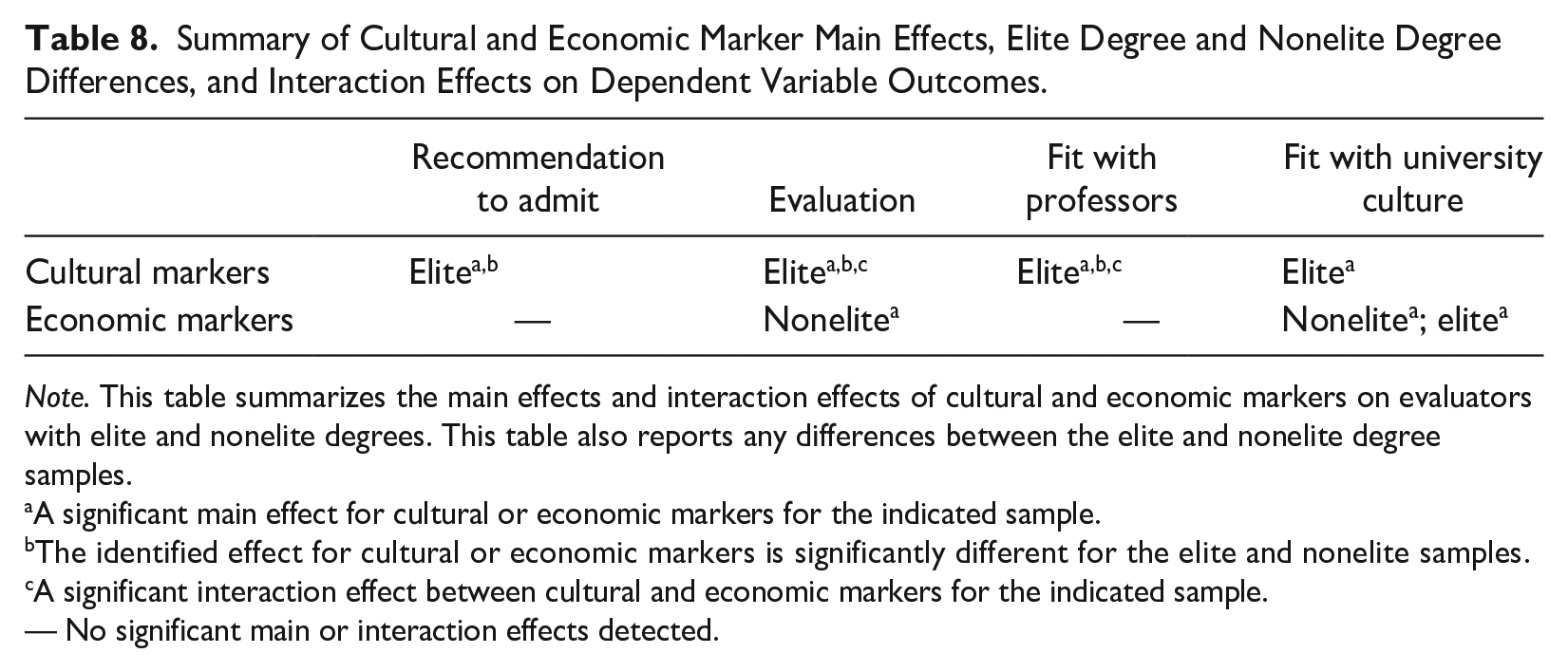
Note. This table summarizes the main effects and interaction effects of cultural and economic markers on evaluators with elite and nonelite degrees. This table also reports any differences between the elite and nonelite degree samples.
A significant main effect for cultural or economic markers for the indicated sample.
The identified effect for cultural or economic markers is significantly different for the elite and nonelite samples.
A significant interaction effect between cultural and economic markers for the indicated sample.
— No significant main or interaction effects detected.
It is important to note that these results reflect decision-making in a simulated admissions process, rather than an actual admissions process. There is strong reason to believe that the processes that produce social class bias identified in this study would replicate in an actual admissions process. Research finds that survey experiments which conduct simulated decision-making processes on hiring or college admissions often replicate once these experiments are conducted in actual decision-making processes in the field (cite: motherhood; hart vs. de la rosa; college admissions). However, the results from this study are limited to simulated decision-making processes.
Mediation Effects
What explains the causal relationships between cultural markers and the outcomes of interest for elite degree holders? Table 9 presents the results from the mediation analyses which test whether status, competence, or warmth explain the relationships between cultural markers and outcomes for evaluators with elite degrees. Table 9 presents the average causal mediation effects (ACMEs) and the proportion of the total effect explained for each mediator. ACMEs indicate how much of the total effect between a treatment (e.g., cultural markers) and outcome (e.g., recommendation to admit) is explained by the mediator (e.g., status). Ninety-five-percent confidence intervals are in brackets. Bold ACME estimates indicate the confidence intervals do not include zero, meaning the mediator significantly mediates a portion of the effect of cultural markers on an applicant’s outcomes.
Mediation Analysis of the Role of Mediators in Explaining the Effects of Highbrow Cultural Markers on Dependent Variables for Evaluators with Elite Degrees.
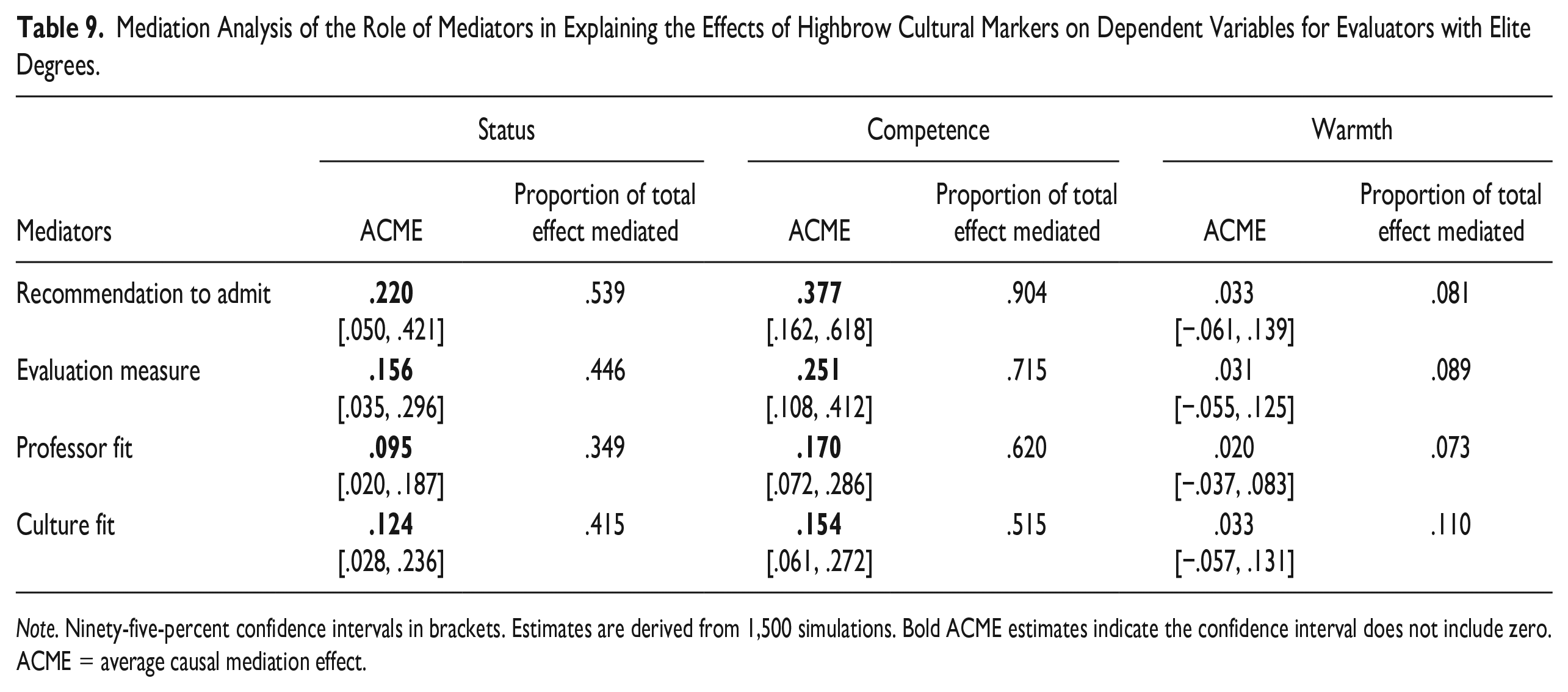
Note. Ninety-five-percent confidence intervals in brackets. Estimates are derived from 1,500 simulations. Bold ACME estimates indicate the confidence interval does not include zero. ACME = average causal mediation effect.
The results suggest that cultural markers affect evaluations of elite degree holders through distinct pathways. Status and competence attributed to the applicant by elite degree holders mediate the causal relationship between highbrow cultural markers and outcomes. Highbrow culture advantages applicants by signaling that the applicant is high status and competent rather than warm or likable. Perceived status explains 53.9 percent of the positive effect of highbrow culture on the likelihood that a profile is recommended for admission. Similarly, perceived status explains 44.6, 34.9, and 41.5 percent of the positive effect of highbrow culture on the evaluation measure, perceived fit with professors, and perceived fit with university culture, respectively. A similar pattern follows for perceived competence. The perceived competence of an applicant explains 90.4 percent of the positive effect of highbrow culture on the likelihood that the profile is recommended for admission. In addition, perceived competence explains 71.5, 62.0, and 51.5 percent of the positive effect of highbrow culture on the evaluation measure, perceived fit with professors, and perceived fit with the university culture, respectively. The perceived warmth of an applicant profile does not explain the relationship between highbrow culture and outcomes. While past research suggests that the positive effects of social class are partially explained by perceived competence, status, and warmth (Correll and Ridgeway 2003), these results suggest that when social class is dissected into its economic and cultural elements, the effects of cultural elements are partially explained by an applicant’s perceived competence and status, rather than warmth. Highbrow cultural markers appear to carry meanings about status and competence, causing evaluators with elite degrees to give applicants with these markers better reviews. These markers do not carry similar types of signals about an applicant’s warmth.
For robustness checks on all mediation results, I conduct sensitivity analyses presented in Appendix E (Imai et al. 2010). The sensitivity analyses indicate that these results are generally robust, when the results are compared with previous research (Hart 2019; Pedulla 2016). For an additional robustness check, I compare the results in Table 9 with results using a structural equation modeling approach, and the results across both methods for mediation analysis are identical. These results further suggest that the reported results in Table 9 are generally robust for identifying mediation effects.
Discussion and Conclusion
From original survey experiments with elite and nonelite degree holders, I uncover one micro-level pathway through which inequality based upon social class emerges. I theorize that decision-makers’ own social positions may influence the way they perceive and evaluate the components of social class. I posit that cultural markers of social class will be more influential for elite degree holders that nonelite degree holders; however, economic markers will not produce differences in evaluations across these two groups. The results generally support these predictions. Evaluators with elite and nonelite degrees show no differences in their evaluations based upon an applicant’s economic markers of social class. Even though economic markers have significant effects on the evaluations of nonelite degree holders, these effects are not significantly different from those identified for elite degree holders. These results suggest that elites and nonelite degree holders do not differentially value applicants based upon economic markers. The presence of cultural markers, however, appears to produce different types of evaluations for nonelite and elite evaluators. For evaluators with elite degrees, highbrow cultural markers positively influence their evaluations of an applicant, while these markers do not positively influence the evaluations of nonelite degree holders. For elite degree holders, an applicant’s economic markers alone are insufficient for signaling the applicant’s belonging, worth, and future success. Instead, elite degree holders look to cultural markers of social class to inform their decisions. These results suggest that evaluators’ use of cultural markers is contingent upon their own social position. Elite degree holders may use cultural markers as a tool to categorize others, allowing them to engage in symbolic exclusion in evaluative processes (Bryson 1996; Lamont 1992; Rivera 2012; Stevens 2007). Elite evaluators may use these cultural markers to draw boundaries between applicants with highbrow versus lowbrow cultural markers because individuals with highbrow cultural markers may seem more familiar and similar to themselves.
Additionally, elite degree holders are rarely affected by the economic markers of social class; when economic markers do have effects on outcomes, it is to modify the impact of cultural markers. In these cases, an applicant who is economically low and engages in highbrow culture receives a boost in average scores on overall evaluation and perceived fit with university professors, while an applicant who is economically high and engages in these same highbrow activities does not receive this same boost. This premium allows working-class applicants who engage in these activities to be rated higher on average than upper class applicants who do not engage in highbrow activities. These findings extend research on intersectionality and nonprototypical group membership by showing how the markers of social class (e.g., economic and cultural markers) can combine in ways to create different outcomes for individuals in nonprototypical groups versus prototypical groups (Collins 2019; Nicolas et al. 2017; Ridgeway and Kricheli-Katz 2013). While this research typically examines the intersection of social categories like race, class, and gender, the results from this study suggest that even markers within an individual category can combine in nonprototypical patterns with important implications for inequality.
Previous research on social class has explored the mechanisms that explain the relationship between social class and positive rewards (Lareau and Weininger 2003; Rivera and Tilcsik 2016). This study extends this line of research by dissecting social class and studying the causal pathways for the cultural components of social class. I find that the cultural markers of social class signal a person’s competence and status, which suggests that elite degree holders might use cultural markers as a tool to determine an applicant’s intellectual merit, location on the status hierarchy, and similarity to oneself. Furthermore, while warmth has been found to mediate the effects of social class in other research, this study finds that when social class is dissected into its various components, warmth does not explain the relationship between the cultural markers social class and various outcomes.
These findings have important implications for some of the most persistent trends in the fields of social stratification and cultural sociology. Even though social class and its relationship to various outcomes has long been studied, it is only more recently that scholars have identified social class–based discrimination as an explanation for some of these disparate outcomes (Jackson 2009; Rivera and Tilcsik 2016). Yet, many of the pathways through which social class–based discrimination may occur remain unexplained. This study illuminates one possible explanation for social class–based discrimination. I find that decision-makers’ social positions affect the types of judgments and evaluations they give to others. These micro-level processes of judgment and evaluation alter larger social systems, like social stratification and inequality.
These findings have important implications for future research. Scholars have often used elite or white-collar gatekeepers to identify bias and discrimination based upon social class (Jackson 2009; Rivera and Tilcsik 2016). Yet, the results from this study suggest that elites’ evaluations might be affected by the components of social class differently than nonelites. Cultural sociologists suggest that individuals from different social stratum may react to cultural elements differently (Lamont 1992; Lizardo 2008), and yet, scholars of social stratification often make the theoretical assumption that most gatekeepers, regardless of their social position, will similarly react to signals of social class. These results suggest that researchers of social stratification should be more attuned to the micro-level decision-making processes that are consequential for macro-level processes. Beyond the educational setting, these findings provide a potential framework to understand how cultural and economic markers could play out in other types of settings—such as the labor market, housing market, promotions and evaluations in the workplace, or the criminal justice system.
Inequality based upon social class is a persistent social problem across many domains in society, yet this problem often fails to consider the social position of the decision-makers who contribute to this stratification process. The results from this study suggest that decision-makers’ own social positions influence how they make sense of the various components of social class. Determining which components of social class—economic or cultural—decision-makers are most attuned to can have serious consequences for inequality. Together, these findings deepen our understanding of how social position and micro-level interactions can have powerful consequences for social class–based inequality.
Footnotes
Appendix A
Below is an example of the applicant profile. Economic markers of social class were indicated in the “Background Information.” Cultural markers were indicated in the “Extracurricular Activities.” Only the Background Information and Extracurricular Activities were manipulated in the experiment. All remaining information remained the same across conditions.
Within each category (e.g., Academic Information), details were listed in a bullet point format. Formatting the profile in this way allowed all the applicant’s information to be considered by the evaluator at one time. Additionally, presenting applicant information in this way is consistent with how admissions officers make final admissions decisions at some universities (Stevens 2007).
The study was described to participants as follows: As part of a broad project on the college admissions process, we are interested in the way people evaluate college applications. For this task, please imagine that you are an admissions officer at an elite university in the U.S. You are deciding which applicants to admit into the incoming freshmen class. On the following screen, you will be presented with information about a college applicant. The information profile you will read has been taken from a student’s actual college application.
Appendix B
I systematically pretested the economic markers of social class for the applicant profiles to ensure that the occupations and associated educational degrees used in the manipulation signaled distinct and stratified manipulations. The pretest sample used participants from Amazon Mechanical Turk who had IP addresses within the United States and had some college experience. Participants engaged in a two-condition, between-subjects experiment where they were presented with an individual profile, containing only the applicant’s name, gender, race, and background information. In the background information section, participants viewed a participant with economically high or economically low resources. Participants rated the profile based upon four outcomes—applicant’s estimated family income, social class categories, level of material comfort, and placement on a graphic ladder to indicate where the family would be placed relative to other families in the United States. Across all four outcomes, participants rated the applicant profile with economically high resources as significantly different from the profile with economically low resources (p < .001). The pretests confirmed that the manipulations of the economic markers of social class provided accurate and distinct signals of high versus low economic conditions.
Appendix C
To test whether the manipulations for the cultural markers of social class distinctly signaled highbrow versus lowbrow cultural markers, I conducted a series of pretests. For the first pretest, I chose an array of dozens of extracurricular activities used in prior research and representing a large breadth of activity types (Bourdieu 1984; Chan and Goldthorpe 2007b; DiMaggio 1982; DiMaggio and Mukhtar 2004; Eitle and Eitle 2002). Amazon Mechanical Turk participants rated each activity independently based upon the perceived status, likelihood that a person engaging in the activity would engage in other highbrow activities, and likelihood that a person engaging in the activity would receive a positive evaluation by other adults. Based upon these results, I identified pairs of similar types of activities (e.g., sports) that were comparable in skill and team collaboration but differed in their perceived status. These results of this pretest are provided below in Table C1. For athletics, sailing team in comparison with pick-up soccer team was rated statistically significantly higher on all pretest scales (p < .001). For musical consumption, playing cello in the orchestra, compared to banjo in a country string band, was rated statistically significantly higher on all pretest scales (p < .001). These results aligned with previous research which found status distinctions between classical versus country music and sailing versus soccer (Rivera and Tilcsik 2016). Pretests of foreign film club and video game club found that the former was rated statistically significantly higher on all pretest scales (p < .001). These results allowed me to generate sets of extracurricular activities that were considered highbrow and lowbrow cultural practices.
The final pretest involved combining the highbrow activities into a single highbrow profile and the lowbrow activities into a lowbrow profile to ensure that the activities did not interact with each other in unintended ways. The pretests indicated that the combined highbrow activities (sailing team, orchestra [cello], and foreign film club) and combined lowbrow activities (pick-up soccer, country string band [banjo], and video game club) represented significantly different cultural constructs (p < .001).
Appendix D
Tables D1 to D4 present OLS regression coefficients for pooled models for the effects of cultural and economic markers on the outcomes of interest. The pooled models include the independent variables of interest, controls for respondent characteristics, and the interactions of each of these variables with whether a decision-maker is an elite degree holder. These models test whether the effects identified for elite degree holders are statistically significantly different from the effects identified for nonelite degree holders. A significant interaction effect between an independent variable (i.e., highbrow cultural markers) and the elite degree holder sample indicates that the effect for evaluators with elite degrees is statistically significantly different from the effect for evaluators with nonelite degrees. The significant differences between nonelite and elite degree holders are indicated accordingly in Tables 4 to 7.
Appendix E
Table E1 reports the sensitivity analyses using the method described by Imai et al. (2010). The sensitivity parameter (p) indicates the correlation that would need to exist between an omitted variable and both the mediator and dependent variable for the mediation effect to be zero. According to Imai, Keele, and Yamamoto (2010), one way to consider whether the mediation results of a study are robust is to compare the sensitivity parameter with significant mediation effects found in other studies. As Table E1 indicates, the sensitivity parameters range from .308 to .509, which are well within the range of previous studies that have utilized a similar approach to causal mediation (Hart 2019; Pedulla 2016; Suhay and Erisen 2018).
Declaration of Conflicting Interests
The author(s) declared no potential conflicts of interest with respect to the research, authorship, and/or publication of this article.
Funding
The author(s) received no financial support for the research, authorship, and/or publication of this article.

Notes
Author Biography
The author would like to thank Cecilia L. Ridgeway, Michelle Jackson, Ariela Schachter, Tomás R. Jiménez, Joe D. Nichols, and Get Nichols for their helpful feedback and comments. The author would also like to thank the Inequality Workshop and Social Psychology and Gender Workshop at Stanford University for their feedback. This research was supported by grants obtained through Stanford University’s Laboratory for Social Research and the National Science Foundation’s Enhancing Diversity in Graduate Education Doctoral Fellowship. Please direct all correspondence to Bethany J. Nichols [address: 450 Jane Stanford Way/Building 120, Room 160/Stanford, CA 94305; email: nicholsb[at]stanford.edu].