




Abstract
Climate change is among the most pressing problems of our time, yet it remains a marginal topic in sociology. This study draws on citation network analysis, qualitative coding, and computational text analysis of articles published between 2015 and 2020 in select journals in U.S. elite sociology, environmental sociology, and science and technology studies (STS) to better understand differences and similarities in how these (sub)fields approach—or ignore—climate change. We map the structural relations of the research on climate change in these (sub)fields and analyze patterns in the substantive and theoretical engagement with the topic. Building on our analysis, we conclude by suggesting potential paths for stimulating further climate change research at the intersection of environmental sociology and STS and to propose tentative strategies for researchers to bring climate change into the sociological mainstream.
Keywords
Climate change is among the most pressing social problems of our time, yet it remains a marginal topic within the discipline of sociology. Recent calls to make climate change a core disciplinary concern suggest that a changing climate has far-reaching implications for many sociological subfields that have largely ignored the problem (Elliott 2018; Klinenberg, Araos, and Koslov 2020; Koehrsen et al. 2020). Change may be on the horizon, but with few exceptions, the broader discipline of sociology has largely met the climate crisis with silence. 1
This predicament is not without precedent. Long before climate change became a metonym for environmental crises more generally, environmental sociologists and science and technology studies (STS) scholars pointed to sociology’s general failure to account for the role of nonhuman nature. Researchers in these fields have developed approaches for studying environmental problems including climate change for decades, often explicitly criticizing sociology’s stubborn indifference to environmental problems in the process.
In this article, we map out some of the terrain of climate change research in these adjacent (sub)fields to understand the extent to which long-standing debates continue to shape the differences among them and identify actual and potential areas of overlap. We draw on qualitative and computational methods to analyze a corpus of 383 articles published between 2015 and 2020 in select journals within mainstream sociology (specifically, the two “top” U.S. general interest sociology journals), environmental sociology, and STS to better understand differences and similarities in how these (sub)fields approach—or ignore—climate change. We use qualitative coding to compare the depth and character of engagement of climate change across (sub)fields. Using citation network analysis, we map the structural relationships among the journals represented in our corpus. Finally, we use computational text analysis to analyze differences and similarities in the discursive themes of articles published across subfields. While our primary goal is diagnostic, we conclude by suggesting potential paths for cross-pollination among (sub)fields and to propose tentative strategies for researchers to bring climate change into the sociological mainstream.
Charges of Sociology’s Indifference to the Natural Environment
The charge of sociology’s indifference to the natural environment is not new. Such criticisms catalyzed the formation and shaped the development of the fields of environmental sociology and STS in the first place. Here, we illustrate the charges against sociology’s alleged analytical deficiencies with respect to the natural environment from influential and programmatic works in each (sub)field. We do not claim to provide an exhaustive intellectual history of these debates, which are inevitably more complex and multifaceted than we can fully account for here. In particular, our discussion and subsequent analysis is heavily skewed toward English language sociology and especially debates that have taken hold in the United States, even if they began elsewhere or involved significant international intellectual exchange. Overall, our illustration shows how scholars in each (sub)field responded to perceived deficiencies with the traditional Durkheimian framing of sociology as the study of sui generis social facts yet opened up two distinct research programs grounded in different diagnoses and remedies for sociology’s alleged deficiencies.
Despite being internally fragmented and lacking a clear jurisdiction over specific problem areas (Lybeck 2019), there is reasonably wide agreement on sociology’s substantive jurisdiction: “the social.” There is, of course, no generally accepted definition of what counts as “social.” There are, however, limited and familiar answers to what it is not. Durkheim’s foundational attempt to carve out a specific domain for the discipline of sociology is revealing, not because contemporary sociologists necessarily subscribe to his precise program, but because he articulates two oppositions that continue to shape sociology’s self-definition. 2
Both oppositions are present in Durkheim’s discussion of “social facts,” the analysis of which he argues defines and delimits the domain of sociology. 3 The first and most explicit opposition that Durkheim mobilizes is between the individual and the social. When Émile Durkheim ([1895] 1938:10) writes that a “social fact is to be recognized by the power of external coercion which it exercises or is capable of exercising over individuals,” he is distinguishing it from “psychological phenomena, which exist only in the individual consciousness and through it” (Durkheim [1895] 1938:3). Thus, in the individual/social binary, the “social” connotes something collective.
The second opposition present in Durkheim’s discussion of social facts is between the natural and the social. This distinction is not always explicitly articulated. One way that Durkheim confronts the issue is when he distinguishes sociology’s domain of study from that of biology. He acknowledges that humans are living beings, and as such their biological nature remains a topic of legitimate study in its own right but is distinct from sociology (Durkheim ([1895] 1938:1–3). Relatedly, Durkheim’s dismissal of geographic explanations of the characteristics of societies rests not only on a set of causal claims about the implausibility of geographic determinism, but more essentially on the postulate that an analysis that intermingles natural and social phenomena will inherently suffer from a lack of clarity (Durkheim 1972:87).
Thus, because Durkheim defines the social as a unique and irreducible substratum, the study of nature, whether focused on the biological faculties of individuals, or the broader nonhuman environment in which they live, is considered to be separable from sociology. This implication follows from the claim that social facts are sui generis, and “the determining cause of a social fact should be sought among the social facts preceding it” (Durkheim ([1895] 1938:110).
Although social psychologists may find reasons to question Durkheim’s neat division between the individual and the social, environmental sociologists and STS scholars have, for obvious reasons, mainly taken issue with the opposition between the natural and the social. To be sure, Durkheim himself did not simply meet the question of nonhuman nature with silence. The Durkheimian approach to the relationship between nature and society is mainly one of symbolic projection. For instance, the material features of any particular sacralized animal are incidental to Durkheim’s understanding of totemism. The totem is ultimately understood to be a collective representation of society (Durkheim [1912] 1995). Treating “nature” as a cultural category in this way continues to animate rich sociological research on the environment (see e.g., Angelo and Jerolmack [2012] for a helpful discussion of this approach). Yet, as we discuss below, this analytical strategy has also been taken to task for its alleged insufficiency for understanding the social dynamics of many environmental problems.
Environmental Sociology
Early environmental sociologists led the first and most direct attack on the traditional approach of delimiting sociology’s domain in a way that excludes nature at worst, or at best treats nature as a cultural construct. Among the first, most coherent, and influential programmatic statements appeared under the banner of the New Ecological Paradigm (NEP). As the progenitors of the NEP, William R. Catton and Riley E. Dunlap (1980) argued that sociology was grounded in what they call the “Human Exemptionalist Paradigm” (HEP). The HEP, they argued, was shaped by a dominant Western worldview that saw humans as fundamentally different from all other creatures, masters of their own destiny in a vast world with (seemingly) unlimited resources that provide the basis for unlimited technical progress. Catton and Dunlap explicitly pointed to Durkheim’s legacy as a barrier for moving beyond the HEP. This, they claimed, is because attempts to establish sociology’s autonomy have not only relied on distinguishing “the social” from “the natural,” but have in effect resulted in sociologists discarding nature from their domain of analysis.
The NEP was proposed as a corrective of this view. It acknowledges humans’ exceptional characteristics without assuming that we are exempt from the ecological laws and planetary limits. It also maintains the conceptual distinction between human society and culture and their biophysical environment. However, the NEP is defined by an understanding that humans are influenced, dependent on, and constrained by a finite biophysical environment.
Catton and Dunlap (1980) emphasize that as a “paradigm” (cf. Kuhn 1962), the NEP remains compatible with a number of possible social scientific theories. However, in practice, adopting the NEP implies the incorporation of biophysical data into sociological analysis. With this implication of the NEP in mind, they distinguish their vision of environmental sociology from a “sociology of environmental issues,” which brings to bear a more traditional sociological toolkit on environmental topics without taking the relationship between human society and the biophysical environment as its empirical object. 4
While few would claim that environmental sociology was perfectly or permanently molded in NEP’s image, recent reviews suggest that Catton and Dunlap’s vision was at least partly borne out in the subdiscipline. Apollonya Maria Porcelli and Jordan Fox Besek (2021) discuss environmental sociology’s reliance on natural science as a resource (as opposed to STS scholarship, for which it is an object of analysis). Scott and Johnson’s (2017) systematic review of environmental sociology’s relationship to mainstream sociology shows an increasing proportion of environmental sociological articles published in mainstream sociology journals relying on biophysical data after the programmatic statements on the NEP were published.
Science and Technology Studies
If early environmental sociologists sought to place limits on human agency by bringing a finite biophysical environment into sociological explanation, STS scholars have challenged traditional social scientific analysis in a different way: by distributing agency to nonhuman entities. While this move also takes aim at the Durkheimian opposition between the social and the natural, its main effect has been, not to revalue the nature that sociologists have so often ignored, but to discard the very distinction between the natural and social. 5 Here we will not report in detail the many variations of and critical responses to proposals within STS to distribute agency to nonhumans (see the 1992 volume edited by Pickering for a helpful survey of earlier debates and Sayes [2014] for a more recent critical analysis). Instead, we will focus on particularly influential charges against mainstream sociological approaches made by STS scholars, and the positive proposals that accompanied them.
As an interdisciplinary field, contemporary STS has many intellectual roots, but Merton’s influence as a foundational figure in the sociology of science is uncontested. Merton had a central place in mid-twentieth century sociology, and the sociology of science figured centrally in his own research program (Merton 1968). Thus, the origins of contemporary STS (in contrast to environmental sociology) at least partly stem from the center of the discipline of sociology. Unlike environmental sociology, the sociology of science (in Merton’s rendition) looked a lot like any other subfield and did not challenge Durkheimian oppositions.
Challenges to Merton’s approach came in two steps. First, proponents of an ascendant “sociology of scientific knowledge” (SSK) criticized the traditional Mertonian approach for asking “how, and to what extent, ‘social factors’ might influence the products of the mind,” without interrogating the neat division between “social” and “cognitive” factors (Shapin 1995:289). Whereas Merton took as his object the group dynamics of scientists, SSK focused more squarely on the social constitution of the content of scientific knowledge itself. In what came to be known as the “strong programme,” SSK’s tenants were summarized as having four components: causality, impartiality, symmetry, and reflexivity. The symmetry postulate is arguably the most important and radical. It suggests that the analyst ought to explain scientific success and failure, true and false claims, and rationality and irrationality using the same factors (Bloor 1976).
The second challenge came from proponents of Actor-Network Theory, the most vocal of whom being Latour (see also, e.g., Callon 1984). 6 Taking aim at what he understood to be an asymmetry in the applications of the strong program’s symmetry postulate, Latour argued that the strong program grants “Society privileges refused to Nature.” Latour’s solution centered on the positive claim that the analyst “should consider symmetrically the efforts to enroll and control human and nonhuman resources” (Latour 1987:144).
The claim that the tools of SSK were unable to account for nonhuman agency resulted in complex and sometimes acrimonious debates that will not be recounted here (see, e.g., Bloor 1999; Latour 1999). What matters for our purposes is that accounting for nonhuman agency became an important intellectual focus of many STS scholars since Latour’s interventions (Sayes 2014). For Latour in particular, developing this project involved explicitly taking aim at Durkheim’s opposition between nature and society in order to distribute agency to nonhuman “actants” and to explain how we “moderns” attempt to purify messy processes that implicate humans and nonhumans as to make them appear to us as straightforwardly “Natural” or “Social” (Latour 1993, 2004).
Two Challenges to Sociological Anthropocentrism
There have thus been two major challenges to what we might call mainstream sociological anthropocentrism. First, environmental sociologists have claimed that sociologists need to do more to account for environmental processes. As originally articulated in the NEP, this challenge rested on the claim that sociologists must bring nature, and especially the limits it imposes on humans, into sociological explanation. Practically speaking, this means mobilizing both social and biophysical data in the same analysis.
The challenges led by STS scholars have focused less on placing limits on human agency represented by the environmental systems in which society is embedded. They have instead focused more on distributing agency more widely to include nonhumans on par with how humans are treated in traditional social scientific analysis. Because science is an object of analysis for STS scholars, this approach has often been understood as being less amenable to bringing in biophysical data as a resource (Porcelli and Besek 2021), but instead seeks to explain how scientific claims become possible in the first place.
Against this broad intellectual historical backdrop, we consider how climate change is articulated in environmental sociology, STS, and U.S. elite sociology today. We do not stake out a position in the debates summarized above, which raise challenging substantive, epistemological and methodological questions that we do not claim to fully articulate, much less resolve (cf. Freudenburg, Frickel, and Gramling 1995; Frickel and Arancibia 2021; Lidskog and Sundqvist 2018; Stuart 2016; Van Koppen 2017). Instead, we are interested in understanding the extent to which they shape existing research on climate change across (sub)fields in relation to other plausible axes of differentiation. We do so to better understand how structurally distinct (or overlapping) these fields are now, the different (or similar) ways that they approach the same analytical object (climate change), and what future opportunities may exist for collaboration across their boundaries to bring climate change into its rightful place at the disciplinary center of sociology.
Data and Methods
Our argument is based on a citation network analysis, qualitative coding, and computational text analysis (structural topic modeling) of all articles containing “climate change” (or the synonymous “global warming”) published between 2015 and 2020 (inclusive) in the two top U.S. sociology journals (the American Sociological Review and American Journal of Sociology), the journal Environmental Sociology, and three leading STS journals (Social Studies of Science; Science, Technology and Humans Values; and Science as Culture). Given the clear analytical limitations of using journals as proxies for fields, we conducted a supplementary analysis using an alternative sampling procedure (using the database Sociological Abstracts) to situate and test the plausibility of our main findings. The methods, results, and implications of this supplementary analysis are discussed in Appendix.
Data
While it comes at the expense of greater breadth, we chose the top two journals in U.S. sociology to represent the elite mainstream of the discipline because they reflect and have an outsized influence on how sociologists (and particularly those located in the United States) perceive the state of the field (McDonnell and Stoltz 2020). 7 In the field of U.S. sociology, the American Journal of Sociology and American Sociological Review are widely regarded as being in a league of their own. They are considered the “flagship” journals of the discipline, the former being founded in 1895 as the first scholarly journal in the discipline at the University of Chicago and the latter in 1936 as the official journal of the American Sociological Association. Both are known for high prestige and low acceptance rates (Wang 2022).
Although environmental sociologists publish in an array of journals, we limited ourselves to one specialty journal, Environmental Sociology. 8 This is because many other journals that feature environmental sociologists are interdisciplinary, and sampling them would not be a clear reflection of the field of environmental sociology alone. For example, many important works in environmental sociology have been published in Environmental Politics, but that journal also publishes a significant amount of work by political scientists (and others) that would not be recognized as environmental sociology by practitioners in the field. Similarly, journals like Society & Natural Resources publish work from a wide variety of environmental social scientists. Environmental Sociology, on the contrary, is strongly and exclusively associated with the subfield. It is the official journal of the International Sociological Association’s Research Committee on Environment and Society (the American Sociological Association has no official journal dedicated to environmental sociology). While much of the research published in Environmental Sociology is authored by researchers based in the United States, the majority of the editorial board members are located outside of the United States.
STS is an inherently interdisciplinary field. Because of how it cuts across several disciplines, organizationally, it cannot be understood as a subfield of sociology any more than it is a subfield of anthropology, or perhaps history or philosophy, among other disciplines. Because no one STS journal clearly dominates the field and each STS journal has a unique theoretical or methodological style that is not exclusively associated with any STS-adjacent discipline, we chose to sample three major STS journals rather than rely on one. Social Studies of Science is a leading STS journal, the longest running of the three STS journals included in our analysis and may be the most legible STS journal to U.S. sociology (although this is of course subject to debate). Science, Technology, and Human Values is the official journal of the Society for Social Studies of Science, the international association of STS scholars. Science as Culture has roots in the critical science movements of the 1970s in the United Kingdom, and of the three journals, remains most closely associated with the Critical Theory tradition (Levidow 2018). The editorial boards of all three journals contain significant international representation, although unlike the other two journals, the majority of editorial board members of the Social Studies of Science have U.S. affiliations.
The result of our data collection was a sample of 383 articles published between 2015 and 2020 in any of the six journals listed above. The vast majority of these articles are standard research articles, but our data set also includes an American Sociological Association presidential address published in the American Sociological Review, editorials published in Environmental Sociology, and a few introductions to special issues. We omitted standard book reviews (e.g., book reviews published in the American Journal of Sociology) but included longer review essays occasionally published in the included STS journals.
Table 1 shows the breakdown of articles by journal. Our three STS journals have nearly identical numbers of articles mentioning climate change, but Environmental Sociology has by far the most articles out of the six outlets in our data, dwarfing the handful of articles in each of the flagship American sociology journals.
Counts of articles by journal in the full sample.

Note. Articles appear in the full sample if they mention “climate change” or “global warming” anywhere in the article (including title, abstract, and body, but excluding references), and were published in an included journal between 2015 and 2020 inclusive.
Our choice of journals to sample was shaped by our perspective as U.S.-based scholars with research interests in STS and environmental sociology, but our sample was evenly split between authors with U.S. affiliations and international authors. Among the 696 authors of articles in our study, 9 50 percent (348) had U.S. affiliations, 3 percent (18) were located in Asia, 6 percent (44) were located in Australia or New Zealand, 6 percent (39) were located in Canada, 33 percent (231) were located in Europe (including the United Kingdom), and 2 percent (16) were located in Latin America.
There are significant differences across (sub)fields. Among the articles in our sample published in the American Journal of Sociology or the American Sociological Review 95 percent (41) of authors had U.S. affiliations, with only 5 percent (2) being international. Among the articles in our sample published in Environmental Sociology, 60 percent (199) of the authors had U.S. affiliations, with 40 percent (133) being international. Our STS sample was the most international by comparison, with 34 percent (108) of articles published in the three included STS journals having U.S. affiliations, 66 percent (213) being international. The U.S.-centricity of the two flagship journals as compared to the more international author pool of authors in the environmental sociology and STS journals in our sample is striking. While our sample sizes are small, and these fields differ in innumerable other ways, the provinciality of elite American sociology journals as compared to the more international nature of environmental sociology and STS research on climate change is one factor that could potentially explain the near-absence of climate change in the pages of the American Journal of Sociology and the American Sociological Review.
Qualitative Coding
Articles that mention climate change (or the synonymous global warming) do not engage with the topic to the same degree of intensity. To understand the patterning of the depth of engagement across (sub)fields and journals and to isolate articles that are centrally about climate change for further analysis, our qualitative coding process began by dividing articles into three mutually exclusive categories. Each article was independently coded by two undergraduate research assistants for its depth of engagement with climate change according to the coding scheme described below. In instances in which the two coders disagreed about the depth of engagement with climate change, the authors of this study deliberated to reach a consensus on the final coding.
Articles were coded as being centrally about climate change if they are mainly about climate change in an explicit way. To be coded into this category, climate change did not have to be the only topic that could be considered central to the article’s argument, but it needed to be a core part of the paper that could not be removed from the article without it losing coherence.
Articles were coded as being about another environment topic if the article was substantively about an issue that would be broadly considered “environmental,” but climate change was only mentioned in passing. If the environmental topic of the article was not framed as being a clear cause, effect, solution, or dimension of climate change, we coded it in this way. The article could be on the intersection of an environmental topic and some other nonenvironmental topic and still be in this category. Articles in this category would still make sense if all mentions of climate change were removed.
Finally, we coded articles into the peripheral category if the article was not substantively on an environmental topic at all. This means that climate change was mentioned only incidentally, perhaps as a brief aside or example, in reference to other work in a literature review, as a speculative extrapolation of the study’s implications, or in some other tangential manner. Articles in this category would still make sense if all mentions of climate change were removed and were not on an environmental topic at all.
This coding allowed us to confine particular analyses described below to only articles with a deep engagement with climate change. For instance, the first author of this study coded the subset of articles that were centrally about climate change in random order along several qualitative variables in order to understand their substantive content. The specific variables included in this round of qualitative coding are discussed below. 10 This qualitative analysis included several closed-coded variables, and one open-coded variable to capture each article’s overall subject, the results of which are presented in the form of word clouds below.
Computational Analyses: Citation Networks and Topic Modeling
We complement our qualitative analysis with computational approaches. To better understand the structure of the (sub)fields’ engagement with climate change in relational terms, we conducted a citation network analysis. To systematically analyze the content of articles that are centrally about climate change in our corpus, we employed a computational text analysis. This approach allows us to overcome some of the limitations of qualitative coding.
For these computational portions of our analysis, we collected each article’s full text and metadata using Web scraping techniques based on the package {rvest} for the R statistical programming language. Among the metadata categories, we collected Google Scholar links for each citation in every article. Using these Google Scholar links, we constructed a network model to visualize the degree of common scholarly engagement among the different journals in our data. Our network treats each article as a network “node” connected to another article if they share at least one common citation. This provides a broad diagnostic for the level of scholarly connection or isolation between the subfields and individual journals in our analysis. We produced network visualizations for both the entire dataset and the subset of articles coded as centrally about climate change.
To produce a broad comparison of the content of the articles in our data and to compare the substance of engagement with climate change, we trained a structural topic model (STM) using the R package {stm}. Topic modeling identifies latent themes in a text corpus, defined as groups of words that tend to cluster together in documents. There are different algorithms used for topic modeling, including Latent Dirichlet Allocation (LDA), the most well-known method (Blei, Ng, and Jordan 2003). We used STM because, unlike LDA, it allows the researcher to include metadata categories as “covariates” which are considered when identifying topics (Roberts et al. 2013). This is especially important for our purposes because it allows us to estimate a linear regression model on the identified topics (using STM’s built in function “estimateEffect”) that treats these covariates as predictor variables and the topics themselves as independent variables. Thus, by including a binary variable for “STS vs. Environmental Sociology” in our model, we can quantitatively measure the prevalence of various topics in either scholarly field. Moreover, STM has proven to be a useful tool for environmental sociologists (Farrell 2015), including for producing similar meta-analyses of the field to the one we present in this paper (Bohr and Dunlap 2018).
Prior to training our STM, we cleaned the text by removing a standard set of stop words, or extremely common words with little bearing on a text’s meaning as well as a custom list of stop words tailored to our corpus. We arrived at this list iteratively by training several models and removing words we deemed too general (such as “climate,” “change,” “sociology,” and “science”) as well as words relating to methodological approaches rather than substantive topical engagement (such as “interview,” “data,” or “variable”).
One important parameter for the researcher to consider with topic modeling is the number of topics, “K,” to identify in the model. This decision is made before training the model, and there is no single set of criteria accepted as the standard for determining it. To inform this decision, we used STM’s “searchK” function, which provides diagnostic statistics for models trained with different values of K. We compared models ranging from five to 30 topics, which produced the diagnostic statistics included in Figure 1. We balanced our interpretive comparison of the coherence of various models with the statistical measures provided by this quantitative approach to settle on a model with 10 topics (K = 10). We judged that the topics in this model were conceptually distinguishable from each other and that it scored strongly for both “semantic coherence” (Mimno et al. 2011), implying the most probably words in a topic frequently co-occur, and held-out log-likelihood (Wallach et al. 2009).

Topic model diagnostic statistics.
Depth of Engagement with Climate Change
Figure 2 and Figure 3 report on the findings of the qualitative coding of our entire corpus aimed at measuring the depth of engagement with climate change across included journals. We find that, in addition to very few articles in U.S. sociology’s top journals mentioning climate change (also shown in Table 1), among those that do mention climate change, the depth of engagement with the topic is low. The vast majority of articles mentioning climate change in U.S. sociology’s top two journals mention climate change in a peripheral manner, with a small minority being about environmental issues. Furthermore, only a single article published in either of the top U.S. sociology journals between 2015 and 2020 is centrally about climate change (Entwisle, Verdery, and Williams 2020).
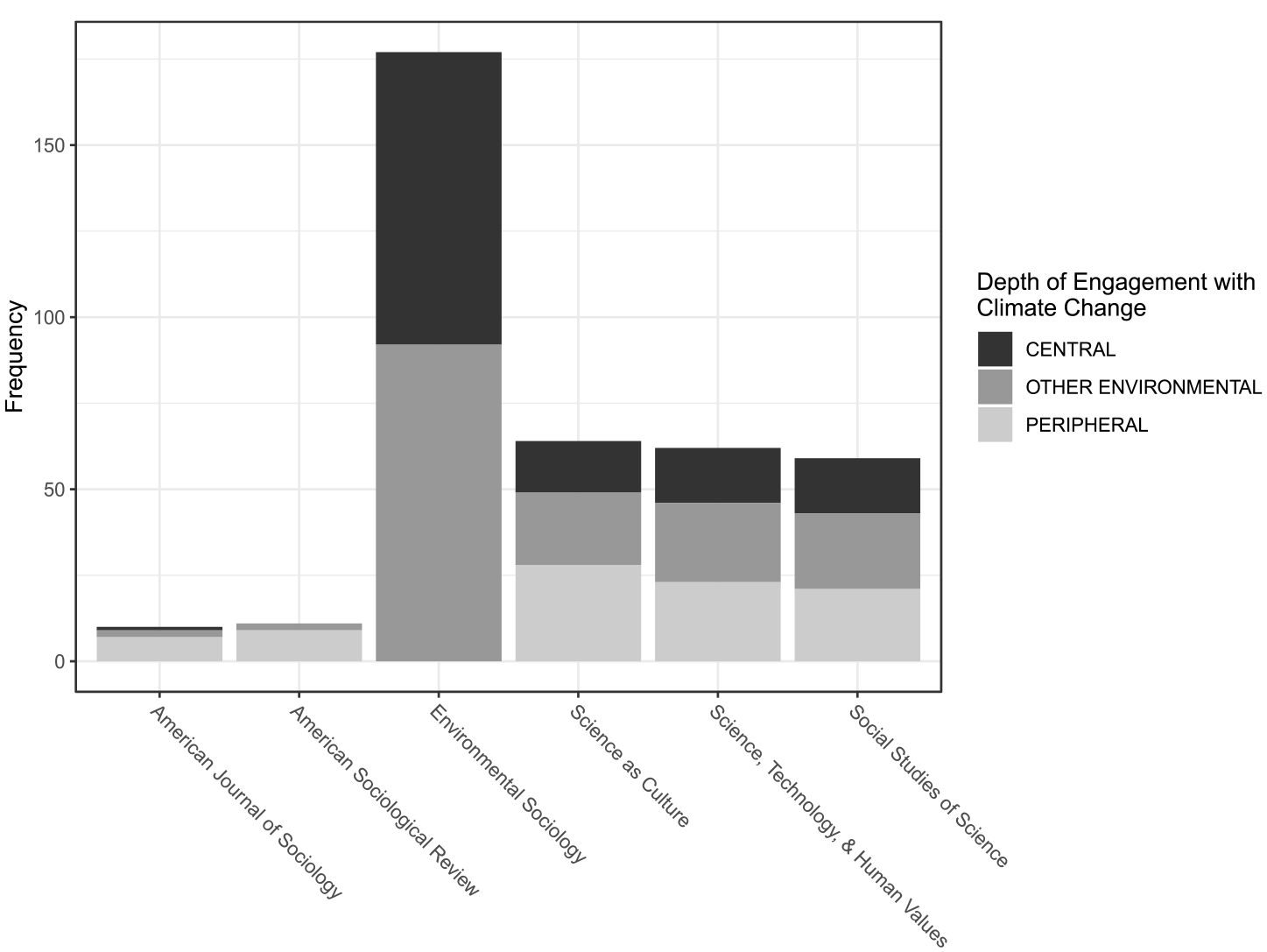
Frequency of articles mentioning climate change (2015–2020) by depth of engagement.
In Environmental Sociology, articles mentioning climate change were nearly evenly divided between being centrally about climate change and being about another environmental topic. Among the included STS journals, there were many articles in each category. Somewhat fewer articles were centrally about climate change than were about another environmental topic, and a small plurality had only a peripheral mention of climate change.
Our findings about environmental sociology are unsurprising. The subfield, as the name suggests, is defined by an interest in environmental topics. Nor are our findings about STS surprising, given that the field is not exclusively focused on environmental issues but contains a significant amount of environmental work. Our findings on the top general interest U.S. sociology journals are striking. They show that even though there are mentions of climate change in a handful of articles from 2015 to 2020, only a small minority of those articles is focused on environmental topics, and only one article from that period was centrally about climate change. Our supplementary analysis presented in Appendix using an alternative sampling procedure places these findings in context. In that analysis, we find modest engagement with climate change in a broader set of general interest sociology journals, while uncovering no unanalyzed hub for the sociology of climate change.
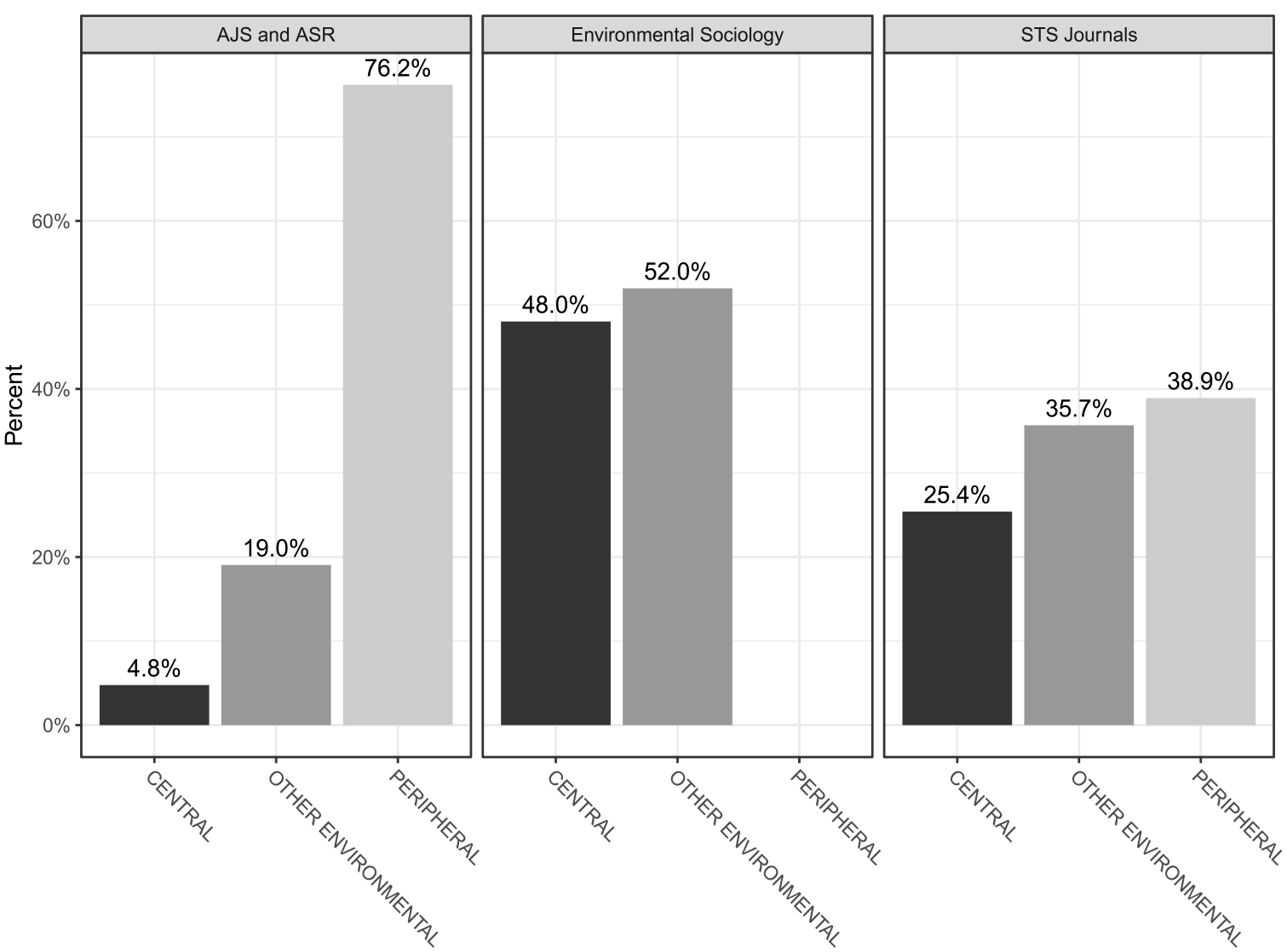
Percent of articles mentioning climate change (2015–2020) by depth of engagement.
The Relational Structures of (Sub)Fields
To understand the relationship among (sub)fields, we conducted a citation network analysis. This helps us understand the extent to which articles in a (sub)field or journal cohere around a set of common references. We conducted this analysis with two specifications: one to understand the relational structure of all of the articles in our data set; and another looking exclusively on articles that we coded as being centrally about climate change.
Figure 4 is a diagram of the citation network for the entire dataset created using the Fruchterman-Reingold algorithm (Fruchterman and Reingold 1991). Nodes in the diagram are color coded by journal and the opacity of edges corresponds to the number of shared citations between connected articles (where darker lines indicate more shared citations). This figure shows a strong degree of coherence within some of our journals, and modest structural overlap between (sub)fields. Environmental Sociology is particularly tightly clustered, as is Social Studies of Science. There is significant overlap among the other STS journals (Science as Culture and Science, Technology & Human Values) and between those journals and Environmental Sociology. As shown in Figure 5, the same overall patterns hold when limiting the analysis to articles that are centrally about climate change.
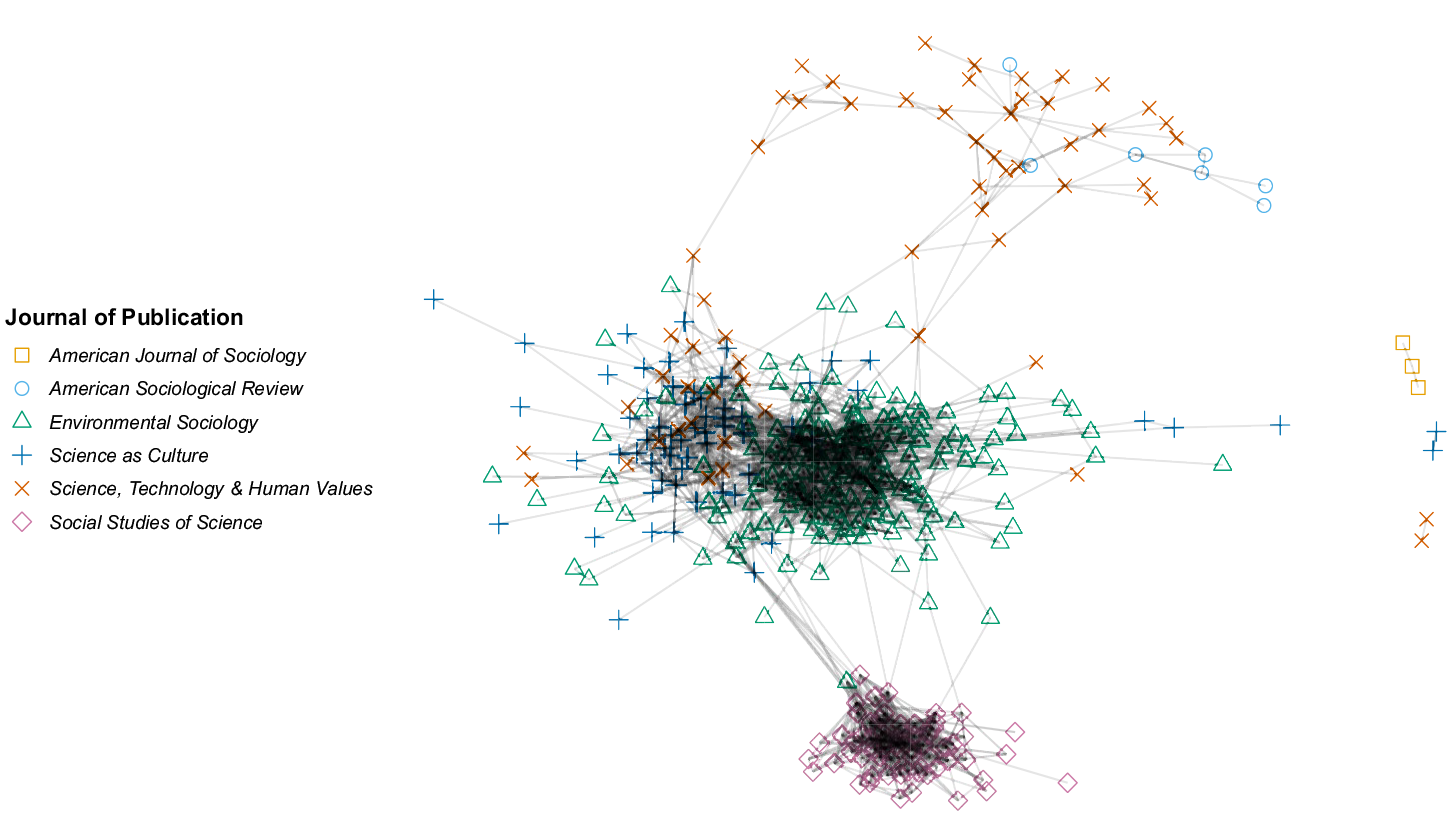
Citation network analysis of all articles mentioning climate change (2015–2020).
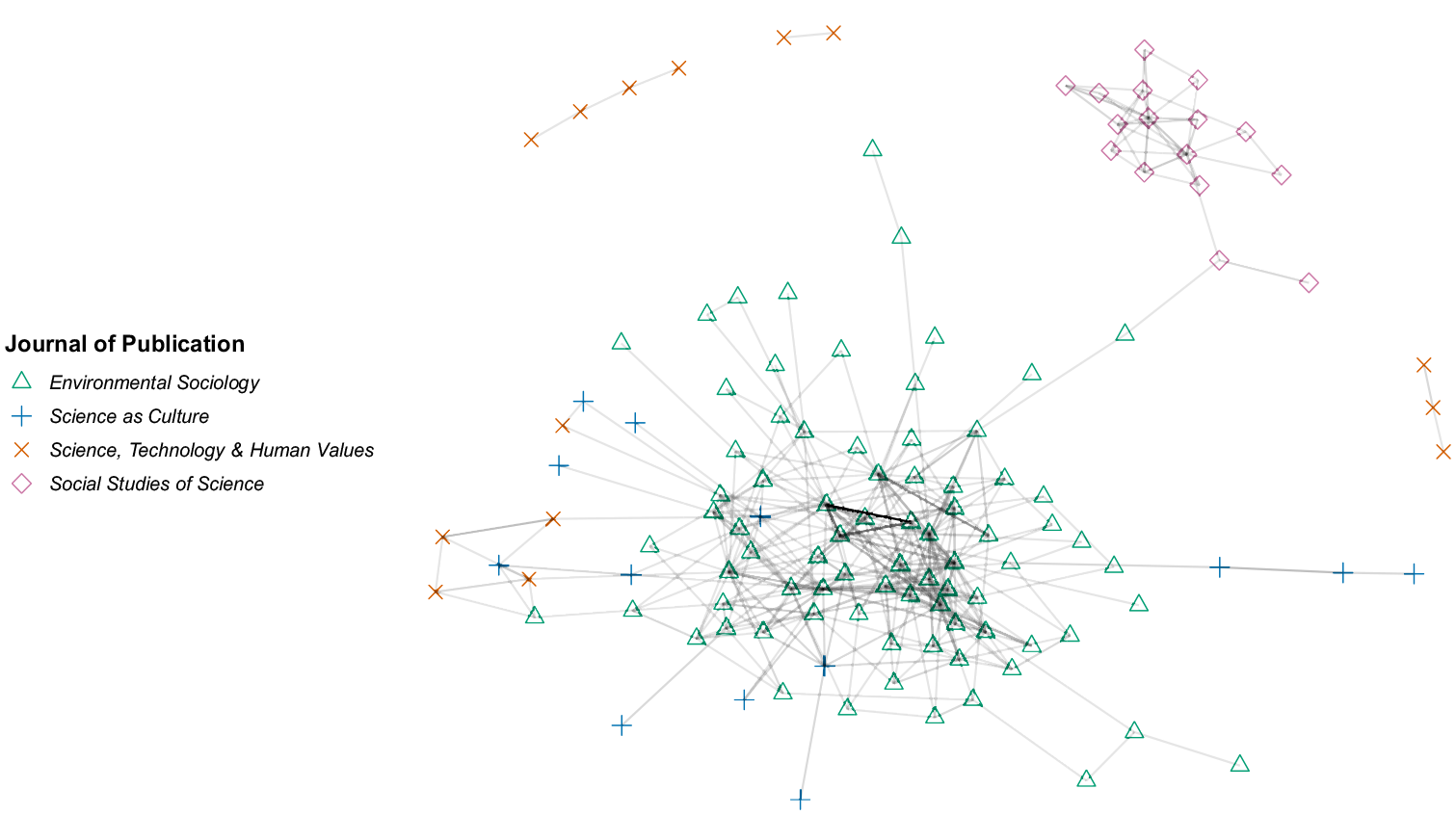
Citation network analysis of articles centrally about climate change (2015–2020).
As discussed above, there are relatively few articles that mention climate change in the top two U.S. sociology journals. Among those that do mention climate change, they do not collectively form a cluster (except for three articles published in the American Journal of Sociology in the citation analysis of the entire data set shown in Figure 4). In Figure 4, we see some structural embedding of articles published in the American Sociological Review in the cluster mostly made up of articles published in Science, Technology & Human Values; however, this relationship does not hold for articles that are centrally about climate change. Only a single article from one of the top U.S. general interest sociology journals was centrally about climate change, and given that it does not share a citation with any other article in our data set, it does not appear in Figure 5.
Taken together, these results broadly align with Rebecca Elliott’s (2018) characterization that environmental sociology (to the extent that Environmental Sociology, the journal, is a proxy for the subfield by the same name) operates as a “silo” for research in sociology on the topic of climate change. 11 This condition has two plausible and mutually compatible explanations. First is simply that there are a shared set of references among environmental sociology articles, forming a tightly clustered intellectual community. Second, is the apparent indifference to climate change of much of mainstream sociology, as represented by U.S. sociology’s top journals. The relative importance of each of these explanations may also be influenced and reinforced by authors choosing where to submit their research, and the decisions of editors and reviewers. As discussed above, the fact that the overwhelming majority of authors in our sample of articles published in the American Journal of Sociology or American Sociological Review have U.S. affiliations, compared to the more international author pool in the other sampled journals, suggests that the provinciality of U.S. elite sociology may also be a contributing factor to explaining this indifference. While we only offer this as a hypothesis, a diachronic analysis of the global structure of the sociology of climate change would likely provide important insights into understanding the sources of the field’s development and continued (even if waning) marginality.
As for STS journals, there is significant variation across journals within the field. Social Studies of Science is clearly the most structurally coherent among the three STS journals in our analysis, with little connection to Environmental Sociology. Among articles published in STS journals, those published in Science as Culture (and to a lesser extent Science, Technology & Human Values) tend to share the most common references with Environmental Sociology. Among the shared citations linking Environmental Sociology and Science as Culture articles, the two most common links are Ulrich Beck’s 2009 book World at Risk and Beck’s classic Risk Society. These two citations alone account for 16 of the 31 total shared citations between these journals, the two most closely linked in our data set.
What Sort of Object Is Climate Change for Environmental Sociology and STS?
The structural analysis of climate change research in the (sub)fields under consideration provides limited insights into why climate change has yet to become a core disciplinary concern for sociology, and more generally how environmental sociology and STS do treat the topic. For this reason, we complement our citation network analysis with qualitative coding and computational text analysis. This section presents the results of our qualitative coding, and the subsequent section presents the results of our computational text analysis. Whereas our computational text analysis provides a sense of the general thematic trends in our corpus in an unsupervised manner, we use qualitative coding to ask specific questions about the articles in our corpus that are centrally about climate change.
As discussed above, environmental sociology and STS have long been shaped by a critical stance to the dominant sociological orientation of largely omitting nature/the nonhuman environment from its analytical jurisdiction. Despite sharing this complaint, foundational work in the (sub)fields proposed distinct solutions. For environmental sociology, the main proposal was to incorporate biophysical factors and systems into sociological explanation. For STS, an important proposal was to distribute agency to nonhumans.
We employed qualitative coding to understand the extent to which such attempts to go beyond the social/natural or human/nonhuman divides pattern contemporary research on climate change in environmental sociology and STS. Our aim was to understand both the extent to which the incorporation of biophysical factors and nonhuman agency shape contemporary work on climate change in these fields, and how these emphases are distributed across them.
Figure 6 shows the results of the qualitative coding of all articles in our data set that were coded as being centrally about climate change that were published in Environmental Sociology and the three STS journals included in our analysis. 12 We find that the majority of articles that are centrally about climate change in both (sub)fields do not include claims of nonhuman agency and do not rely on biophysical data. This suggests that, while there may be other analytical barriers to bringing climate change (and other environmental issues) into the sociological mainstream, explaining climate silence in sociology solely in these terms is unsatisfactory.
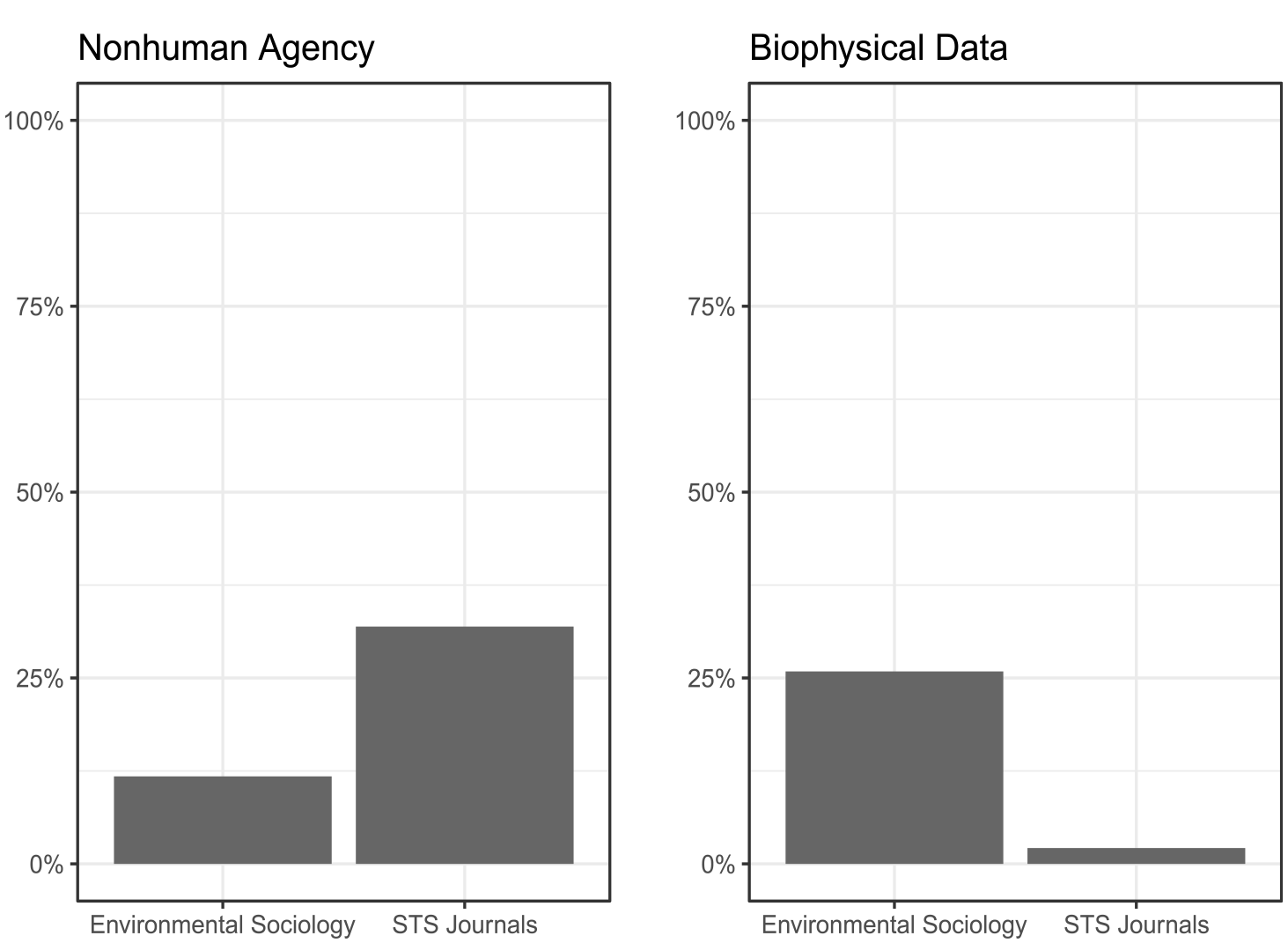
Qualitative coding results for articles centrally about climate change for the reliance on biophysical data or presence of claims of nonhuman agency.
A second finding of this analysis is that the patterning of the results of our qualitative coding breaks down as the foundational criticisms of sociological anthropocentrism in each (sub)field would predict. Articles on climate change in STS journals are more than twice as likely to invoke nonhuman agency than work in environmental sociology. Articles on climate change published in Environmental Sociology are far more likely than articles in STS journals to draw on biophysical data. This is unsurprising because, as Porcelli and Besek (2021) argue, environmental sociologists have traditionally treated natural science as a resource for analysis, whereas environmental STS researchers have tended to treat natural science as an object of analysis. It also suggests that the legacy of the NEP (Catton and Dunlap 1980) may still be shaping the field of environmental sociology to some extent.
This brings us to the second line of analysis for which we employed qualitative coding. One possibility for bringing climate change into the sociological mainstream is to focus on the aspects of climate change that do not disrupt sociology’s traditional analytical jurisdiction. Understanding climate science, attitudes, and politics in traditional sociological terms is thus a pathway for making climate change central to sociology without having to revolutionize sociology’s relationship to nature or nonhumans.
Figure 7 compares the Environmental Sociology and the STS journals in our analysis across three qualitative coding categories. Each article that was centrally about climate change was coded for whether its object (or one of its objects) was: science and expertise; public opinion, lay attitudes and/or popular media; and, more specifically, climate change denial, skepticism and/or obstruction.
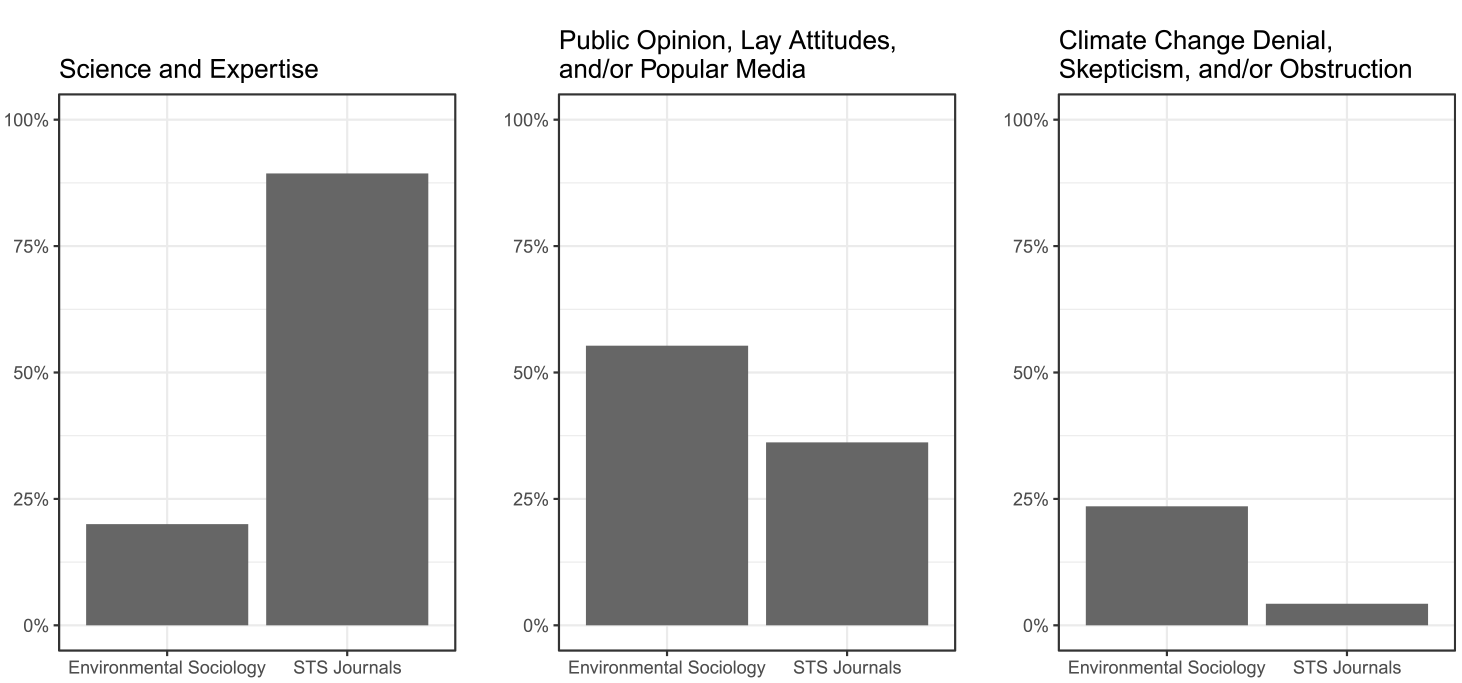
Qualitative coding results for articles centrally about climate change for select objects of analysis.
Unsurprisingly, the vast majority of STS articles included an analysis of science and expertise. A significant minority of Environmental Sociology articles did as well. Slightly more than half of the Environmental Sociology articles included an analysis of public opinion, lay attitudes, and/or public media, with a somewhat smaller, but still significant proportion of STS articles including such an analysis. Finally, just under one quarter of Environmental Sociology articles in our sample included an analysis of climate change denial, skepticism, and/or obstruction, with very few in the STS journals having this emphasis.
In a third line of analysis, for which we employed qualitative coding, we considered what kinds of actors played an important role in the analysis of each article. We coded each article that was centrally about climate change in Environmental Sociology and the three STS journals in our analysis for whether or not they included an analysis of the actions of three broad types of entities: governmental actors; corporate/business interests; and social movements. These were not mutually exclusive codes (so articles could include any combination of these actors), and articles could be coded as not including any of these types of actors.
The results visualized in Figure 8 show that proportions varied across actors but were similar across sub(fields) for each actor. Roughly half of both Environmental Sociology and STS articles both focused on governmental actions, with a slightly greater proportion of STS articles having that emphasis. A sizable minority of articles focused on corporate/business interest actions, with a somewhat greater proportion of Environmental Sociology articles having this focus as compared to STS. Less than a quarter of articles in both (sub)fields focused on social movement action, with a slightly greater proportion of Environmental Sociology articles having this focus as compared to STS.
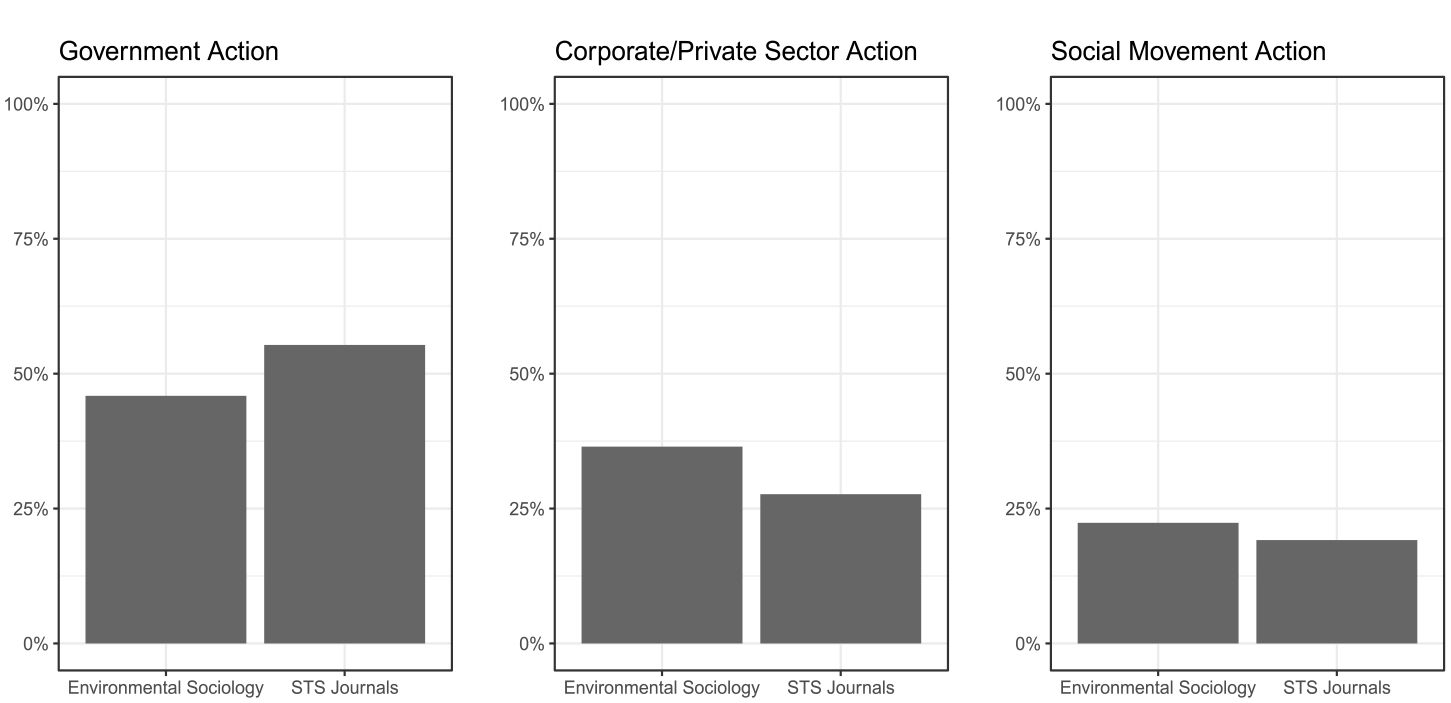
Qualitative coding results for articles centrally about climate change for select types of social actors.
Finally, for each article that was centrally about climate change, the first author assigned a single term or short phrase to describe, in the simplest terms possible, the subject of the article. This is an imperfect proxy for the thematic content of articles, so we supplement this approach with computational text analysis. However, because closed-ended qualitative coding described above necessarily only allows for the analysis of aspects of the corpus which are defined in advance, including this variable allows us to include a more holistic assessment of articles’ thematic content. While the computational text analysis results reported below in more detail and are not subject to the same kinds of subjective biases of judgment, the open-ended coding has the benefit of not being shaped by (sub)field jargon or writing conventions that may pattern the discursive differences across journals.
Figure 9 presents these results in the form of two word clouds: one for Environmental Sociology articles (left), and one for STS journals (right). These figures provide a sense of the overall substantive themes prioritized in each (sub)field’s treatment of climate change. The patterns they show are consistent with the results of the qualitative coding visualized in Figures 6 to 8 (e.g., more STS articles emphasize terms associated with science and expertise, and more Environmental Sociology articles emphasize terms associated with public opinion, lay attitudes, popular media, climate skepticism, denial and obstruction). Yet these figures provide additional substantive content, showing for instance that the anthropocene and geoengineering are important topics in STS articles about climate change, and that topics like environmental justice, labor, and specific fossil fuels are themes that appear in Environmental Sociology articles about climate change.
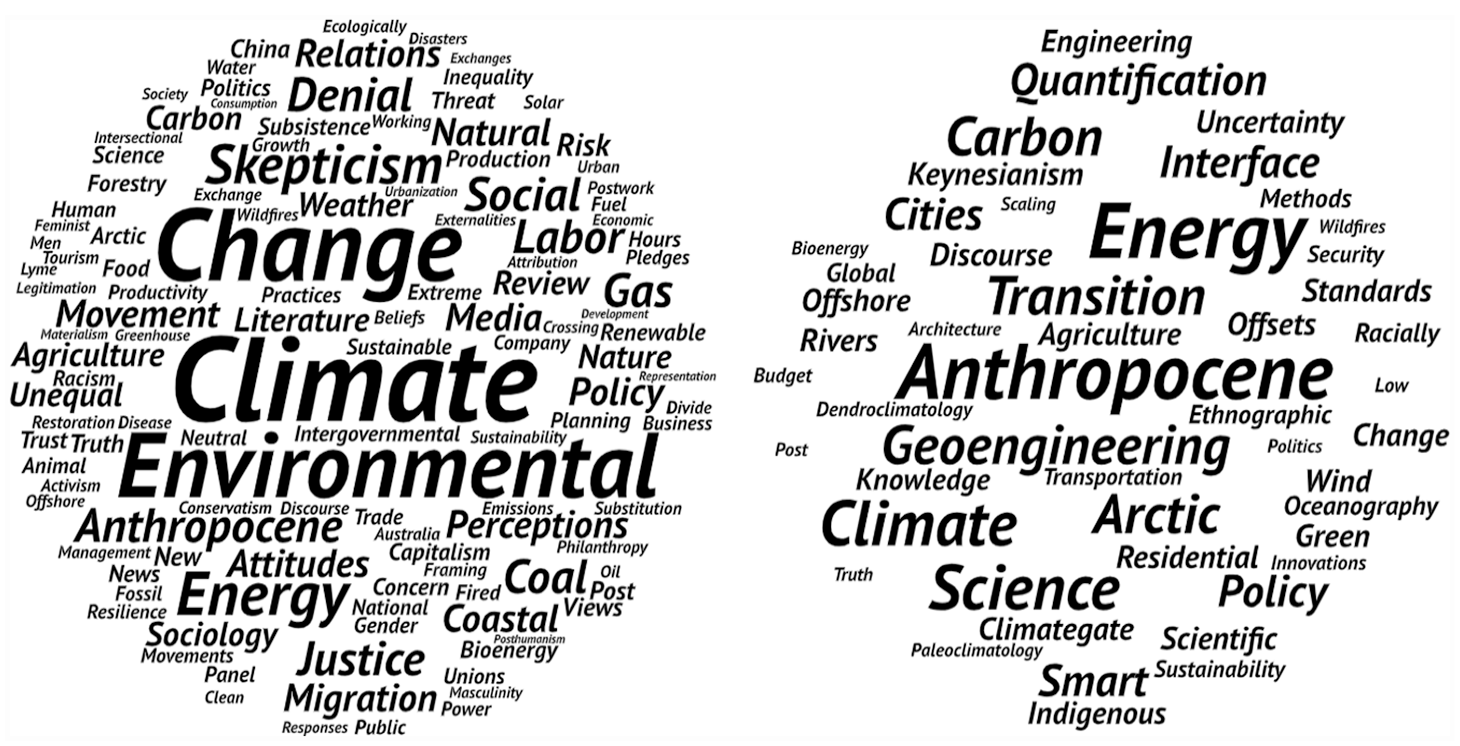
Word clouds of open-coded article subjects for articles centrally about climate change published in Environmental Sociology (left) and STS journals (right).
Thematizing Climate Change Discourse in Environmental Sociology and STS
Whereas citation network analysis allows for an understanding of the relational structure of (sub)fields, and qualitative coding allows for a comparison of the content of articles across a set of standardized variables, we use structural topic modeling to understand the broad discursive themes that exist among articles that are centrally about climate change, and how those discursive themes are patterned by (sub)field. This approach allows us to understand thematic differences and overlaps between environmental sociology and STS without having to determine the content of those themes in advance or rely on subjective coder judgments.
As discussed above, we use a 10-topic STM to analyze how latent topics vary across documents. Figure 10 is a corpus-level visualization of all topics along with the top words in each topic, and the expected proportions associated with each topic. The authors of this article arrived at the topic labels for our model through deliberation. We considered the top terms in each topic by probability of occurrence (beta), referring to word clouds generated by STM as interpretive aids.

Topic model results.
We used STM’s built-in “estimateEffect” function to visualize how these topics vary across (sub)field journals (Environmental Sociology versus STS journals). This function conducts a linear regression, producing coefficients for each metadata variable’s estimated effect on the prevalence of each topic identified in the topic model. Our regression contains a variable identifying the sub(field) journal or journal group in which each article was published. The variable identifies whether the article was published in Environmental Sociology versus STS journals, which were pooled for this analysis. The only article centrally about climate change in a top U.S. sociology journal was dropped from our computational text analysis.
Figure 11 shows the coefficients and confidence intervals for this regression representing the estimated effect of an article being published in an STS journal on the prevalence of each topic journal’s subfield on each topic. In this analysis, Environmental Sociology should be understood as the reference category. Higher values indicate a greater likelihood of a topic appearing in articles from STS journals as opposed to Environmental Sociology, whereas negative values indicate greater likelihood of appearing in Environmental Sociology.

Structural topic modeling analysis results.
This analysis shows that of the 10 topics identified in our model, three topics were statistically significantly associated with Environmental Sociology (Extreme Weather, Global Development, Energy Politics), three topics were statistically significantly associated with STS journals (Anthropocene, Environmental Science, Green Sociotechnical Imaginaries), and four topics were not statistically significantly associated with either, meaning that they represent areas of overlap between (sub)field journal/journal groups (Carbon Emissions, Environmental Governance, Energy Sector, Local Resource Management).
Where Do We Go from Here?
The terrain of climate change research in U.S. elite sociology, environmental sociology, and STS is highly varied. Whereas research in U.S. sociology’s top two journals have met the climate crisis mostly with silence, there has been a flurry of work on climate change in environmental sociology, and it represents a significant area of research in STS. Judging by our citation network analysis (Figures 4 and 5), work within environmental sociology on climate change is highly structurally clustered, with articles mentioning and centrally about climate change in the journal Environmental Sociology tending to share common references more than other journals included in our study. The structure of research on climate change in the STS journals under consideration are more varied, with one journal (Science as Culture) overlapping significantly with Environmental Sociology, and another (Social Studies of Science) showing a relatively high degree of clustering without significant overlap with Environmental Sociology. 13
Overall, these findings lend some support to the claim that environmental sociology operates as a semiautonomous “silo” (Elliott 2018). However, this claim must be placed in relation to the near-silence with which the top journals in the broader discipline have met climate change. While the largely self-referential nature of environmental sociology vis-à-vis the larger discipline may partly explain why few environmental sociologists publish in top sociology journals, that we find no evidence of the existence of a robust sociology of climate change in the top two American general interest sociology journals suggests that the broader discipline may still be shaped by an enduring aversion to taking on such topics.
The similar but distinct criticisms of sociology’s inability to account for nonhuman nature put forth decades ago by environmental sociologists and STS scholars offer one genre of explanation for this enduring divide. Our findings on this point are mixed. As expected, we find that environmental sociology articles about climate change are more likely to draw on biophysical data, and STS articles about climate change are more likely to invoke nonhuman agency (Figure 6). However, in both (sub)fields, such engagements account for a minority of articles that are centrally about climate change. This suggests that the marginalization of climate change research in sociology cannot be fully explained in terms of the criticisms of the discipline at large that were levied by early environmental sociologists and STS scholars: that mainstream sociology is mired in an anthropocentric frame of analysis that is unable to account for nature/nonhumans as core explanatory factors. To be clear, these criticisms may still rest on accurate observations about mainstream sociology. However, most articles in environmental sociology and STS that we analyzed objectify climate change in ways that are likely to be legible to the sociological mainstream, including those who are least inclined to distribute agency to nonhumans or incorporate biophysical data into their analysis.
What potential paths lie ahead if we set aside the longstanding criticisms of sociological anthropocentrism? One is to consider that, as adjacent and sometimes overlapping (sub)fields, there are significant opportunities for more work on climate change at the intersections of STS and environmental sociology. Unsurprisingly, a greater emphasis on science and expertise in STS journals is mirrored in environmental sociology’s greater emphasis on public opinion, lay attitudes and popular media (although, as Figure 7 shows, the latter asymmetry is less pronounced than the former). A potentially promising area of further articulation between the two (sub)fields (with potential mainstream sociological appeal) is the complex relationship between different forms of climate knowledge (including expert and lay, and knowledge that challenges this dichotomy altogether) as they are refracted through various institutional domains. Relatedly, research on climate change denial, skepticism and obstruction has mostly taken place in environmental sociology (Figure 7), but STS scholars and environmental sociologists have significant lessons to learn from each other on the political, cultural, and sociotechnical conditions under which various forms of climate change skepticism and denial is produced, and how these processes relate to the production and circulation of expert climate change knowledge. 14
Despite modest differences in the emphasis of the types of social actors analyzed in climate change research across (sub)fields shown in Figure 8, the overall similarities between environmental sociology and STS suggests that scholars in both (sub)fields are well-equipped to take on these intersections. Our structural topic modeling results (Figure 11) show that there is already substantial overlap in emphasis across (sub)fields in local resource management, environmental governance, carbon emissions, and the energy sector. The topics that are significantly associated with either environmental sociology or STS may reflect distinct conceptual repertoires (e.g., green sociotechnical imaginaries in STS) and substantive areas of research interest (e.g., global development in environmental sociology), but they hardly seem to indicate unbridgeable chasms between (sub)fields.
While it will surprise few environmental sociologists or STS scholars that the sociological mainstream has been slow to take on climate change as a major topic of research, we believe that the time is ripe for change. Owing to the existential nature of the threat and wide-ranging impact of the problem, the broader discipline is likely to be more receptive to climate change than many other environmental issues (Klinenberg et al. 2020). However, the robust body of research in environmental sociology and STS, and the near-climate-silence in the elite U.S. general interest journals represents a kind of impasse. What is to be done? More than a deep set of unbridgeable epistemological differences, we suggest that the largest barriers to bringing climate change to the center of the broader discipline may simply be existing research habits.
Our citation network analysis in particular suggests that the marginality of climate change research in the discipline reflects a deep engagement with a fairly bounded body of research by environmental sociologists and to a somewhat lesser extent by STS scholars. Given this condition, and the largely unrealized but palpable receptivity of the discipline to the topic of climate change, we believe that there is a significant and largely untapped opportunity for scholars working on climate change in environmental sociology and STS to translate their work to other subfields that are already highly legible to the sociological mainstream. 15
Our analysis suggests that many environmental sociologists and STS scholars are already working on climate change in ways that will be easier to translate to the sociological mainstream than the foundational criticisms of sociological anthropocentrism would seem to suggest. For instance, as our word clouds of open-coded article subjects for articles centrally about climate change in Figure 9 shows, environmental sociologists in particular are working on climate change’s relationship to various forms of social inequality that are already central to the discipline of sociology. While important connections among such subfields already exist more broadly (e.g., Arcaya, Raker, and Waters 2020; Carrillo 2021; Deb 2020; Seamster and Purifoy 2021), there remain significant opportunities to further develop climate (in)justice as an area for the broader subfields of sociology which center on inequality and stratification, migration, race and ethnicity, and gender and sexuality.
More generally, our qualitative coding and computational text analysis show that climate change is often treated as a cultural, political, and governance object (and potentially others) in environmental sociology and STS. Thus, we believe that further articulations between environmental sociology, STS, and subfields that are closer to the sociological mainstream but have not engaged extensively with climate change (e.g., cultural sociology, political sociology, economic sociology, the sociology of law, and demography) provide a promising path forward to bringing climate change into sociology’s disciplinary core. While this places the burden on environmental sociologists and STS scholars to engage with literatures that may be outside of their own areas of specialization, or to form collaborations with scholars in other subfields, our findings give us little faith that the disciplinary core of sociology will spontaneously rise to the occasion of the climate crisis. Nevertheless, we believe that the conditions have never been better to bring environmental problems into the sociological mainstream and that such an endeavor will enrich both the broader discipline and the (sub)fields that have already demonstrated a deep investment in them. If climate change deserves a place at the disciplinary center of sociology as we believe it does, we hope that our analysis will provide useful insights into what is to be done.
Footnotes
Appendix
Acknowledgements
Margot Durfee, Ilisa Lama, Lauren Pollak, and Rachel Richman provided excellent research assistance on this project. Jordan Fox offered insightful critical comments on an earlier version of this paper that resulted in its improvement. We thank Fernando Dominguez Rubio and Juan Pablo Pardo Guerra for editing this symposium and soliciting thoughtful and constructive feedback that strengthened the paper. The authors are responsible for all errors of fact or judgment.
Authors’ Note
Andrew McCumber is also affiliated to Stony Brook University, Stony Brook, NY, USA.
Declaration of Conflicting Interests
The author(s) declared no potential conflicts of interest with respect to the research, authorship, and/or publication of this article.
Funding
The author(s) received no financial support for the research, authorship, and/or publication of this article.
