



Abstract
This longitudinal study was conducted to determine (a) the rate of co-occurrence of reading disabilities (RDs) in a writing disability (WD) population of students followed from first grade to fourth grade and (b) the cognitive burden that is assumed by having a WD and a RD (WD + RD). The sample included 137 first-grade students from a single school district who initially were placed into three groups based on the Wechsler Individual Achievement Test–Second Edition (WIAT-II) Written Expression subtest: Typically Developing (TD; n = 83), WD-Only (n = 38), and WD + RD (n = 16). Results indicated that the rate of a WD + RD increased with advancing grades, ranging from 30% in first grade to 47% in fourth grade. This increase was secondary to the instability of group membership across all three groups. The number of students with a WD + RD remained relatively constant over the 4 years, with about 50% of first-grade students with a WD + RD continuing to manifest this co-occurrence through the fourth grade. There was increased cognitive burden for the students in the WD + RD group across the four grades in language and executive dysfunctions. Along with the use of progress monitoring strategies for both reading and writing in the early grades, these findings suggest the importance of assessing the cognitive underpinnings for students with a WD + RD.
Keywords
The development of writing and reading skills begins in the preschool years and continues throughout the school-age years, possibly extending into adulthood. Although it seems likely that writing and reading skills evolve concomitantly in early development (i.e., childhood years), there are few empirical studies that have addressed this linkage; specifically, data are needed to understand the co-occurrence of disabilities in both areas and the underlying neurocognitive burden that can be associated with a co-occurring writing disability (WD) and reading disability (RD). This study addresses the key issues of the rate of co-occurrence of a writing and reading disability (WD + RD) in early elementary school students over a 4-year period and compares the neurocognitive burden in students with comorbid WDs and RDs. A brief overview of both WD and RD is provided, with a subsequent review of what is known about the reading–writing connection and how this manifests in co-occurring learning problems in writing and reading.
WDs and RDs
WDs
Writing reflects the ability to communicate an idea by producing connected text. This traditionally has included three main components: planning, translating, and revising (Hayes & Chenoweth, 2006). A breakdown in any of these components can cause a child to have a WD (Berninger & Richards, 2010). In addition, there are a variety of cognitive factors that contribute to the development of the ability to produce connected text. These include fine-motor speed and control (Cornhill & Case-Smith, 1996; Graham, Harris, & Mason, 2005; Katusic, Colligan, Weaver, & Barbaresi, 2009), attention regulation, language/linguistic abilities (Berninger, Nagy, & Beers, 2011; Hooper et al., 2011; Puranik & Al Otaiba, 2012), visual-spatial abilities (Cahill, 2009), short- and long-term memory (Hayes, 2000), and executive functions (Altemeier, Abbott, & Berninger, 2008; Altemeier, Jones, Abbott, & Berninger, 2006; Hooper et al., 2011; Hooper, Swartz, Wakely, de Kruif, & Montgomery, 2002), particularly working memory (Hayes & Chenoweth, 2006; Kellogg, 2001; Swanson & Berninger, 1996a, 1996b). Additional empirical support addressing the cognitive factors related to written expression has come from subtyping efforts (Hooper, Wakely, de Kruif, & Swartz, 2006; Sandler et al., 1992; Wakely, Hooper, de Kruif, & Swartz, 2006), with these studies showing significant multidimensionality in the area of written expression—even for typically developing (TD) writers.
The frequency of WDs is relatively high, rivaling the rates reported for RDs. The National Center for Education Statistics (NCES, 2007) reported that only 28% of students in the 4th grade scored at or above the Proficient Level on the National Assessment of Educational Progress (NAEP) Writing Assessment; 31% of 8th-grade students and 24% of 12th-grade students scored in the same range. More recently, the NCES (2012) reported that 29% of the United States’s 8th-grade public school students scored at the Proficient Level on the 2011 NAEP Writing Assessment, whereas 57% of the nation’s 8th-grade students scored at the Basic Level, 13% scored at the Below Basic Level, and only 2% scored at the Advanced Level.
From a clinical perspective, Mayes and Calhoun (2006) noted that although RDs are thought to be the most common learning disability, a deficit in compositional writing skills actually may exceed this rate. Internationally, high rates of childhood writing problems have been reported in middle school students, with approximately 22% of students with a WD experiencing difficulties in spelling and 24% in narrative composition (Fasting, Thygesen, Berge, Evensen, & Vagle, 2009). These rates are similar to those obtained by Hooper et al. (1993) more than 20 years ago using a large middle school sample. In addition, in an epidemiological sample of school-age children, Katusic et al. (2009) reported rates of WDs that ranged from 6.9% to 14.7% depending on the definition used (i.e., simple discrepancy, regression, and low achievement).
RDs
Reading is a complex task that is comprised of several subskills such as fluency, phonological awareness, phonics, vocabulary, and comprehension (Shaywitz & Shaywitz, 2005). Over the past several decades, there has been a greater recognition of the importance of phonological processing in the development and proficiency of reading skills. Any disruption of these processes will produce a specific RD (Liberman & Shankweiler, 1991; Shankweiler, Liberman, Mark, Fowler, & F. F. William, 1979; Shaywitz, 2003) or a phonological subtype of a RD (Morris et al., 1998). In general, a RD is characterized by difficulty in word recognition, fluency, and/or comprehension (Lyon, Shaywitz, & Shaywitz, 2003). Those with a RD have difficulty decoding words, which then affects reading fluency and comprehension (Snowling, 2013). In addition, a number of other underlying cognitive abilities have been identified as important for proficient reading skills including attention regulation (Finn et al., 2013; Reynolds & Besner, 2006; Shaywitz & Shaywitz, 2008), verbal working memory (Willcutt et al., 2010; Willcutt & Pennington, 2000; McGrath et al., 2011; Sexton, Gelhorn, Bell, & Classi, 2012), and other executive functions (Booth, Boyle, & Kelly, 2010).
In terms of frequency, reading problems reflect one of the most common learning disability. Rivaling the rates of a WD, a RD affects 5% to nearly 18% of the population (Shaywitz & Shaywitz, 2005). Furthermore, RDs have been estimated to comprise approximately 80% of all learning disabilities (Eden & Vaidya, 2008).
WDs–RDs Connection
Although reading and writing are both linguistic processes, they are often studied as separate entities (Parodi, 2007). There is evidence indicating that writing and reading share a reciprocal relationship in early literacy development (Berninger, Cartwright, Yates, Swanson, & Abbott, 1994; Hooper, Roberts, Nelson, Zeisel, & Kasambira-Fannin, 2010; Puranik, Lonigan, & Kim, 2011; Shanahan & Lomax, 1986), perhaps through the evolution of phonological processing; consequently, a high frequency of WD + RD has been speculated. Yet, to date, there are few empirical data supporting or denying this notion, and certainly no data documenting the frequency over multiple grade levels.
From the perspective of the WDs–RDs connection, Katusic et al. (2009) reported that among all cases with a WD (N = 806), 25% had a WD without a RD; conversely, 75% had both WD and RD. Mayes and Calhoun (2006) found that among clinical samples, 92% had a WD, and 14% of the children had a WD + RD (Mayes & Calhoun, 2006). Taken together, these frequency data are compelling in that they indicate the widespread presence of WDs and the potentially high co-occurrence of RDs. Although the respective prevalence rates of either a RD or a WD appear to be relatively similar in magnitude, it is not known how often the two disorders co-occur or how this relationship may change over time.
Furthermore, a number of studies have shown that similar cognitive processes may play a crucial role in both text generation and reading (Graham & Hebert, 2010, 2011). For example, both writing and reading require core linguistic skills that perhaps emanate from basic phonological processes, knowledge of vocabulary, syntax, self-regulation, problem-solving capabilities (Harris, Graham, Brindle, & Sandmel, 2009), and subject knowledge (Cox, Shanahan, & Sulzby, 1990). Similarly, Altemeier et al. (2006) concluded that “executive functions contribute uniquely to the integration of the reading–writing process over and above reading and writing achievement alone” (p. 170). In accordance with the Multiple Deficit Model for RD and attention-deficit/hyperactivity disorder (ADHD; Willcutt et al., 2010), which has advanced our understanding of the similarities and differences in underlying cognitive abilities in RD, ADHD, and RD + ADHD, there are unanswered questions pertaining to what cognitive abilities overlap with a WD, a RD, and a WD + RD. Are there core cognitive functions that are critical to both areas? Do these cognitive functions contribute to the apparent difficulties that young elementary students encounter?
In general, as age increases, so do the demands on connecting reading and writing in school curricula (Altemeier et al., 2008; Altemeier et al., 2006). Furthermore, with advancing grades, children incorporate an increasing amount of purpose into their writing, implying that they are writing with the intention of their work to then be read. It is not sufficient for students to simply write to present information or to read to obtain information, but they must give meaning to the text by considering both the audience and the author when reading and writing (Fitzgerald, 2013). From an instructional perspective, emergent data have shown that written language instruction can improve reading comprehension and reading fluency; conversely, instruction in note-taking and concept mapping, two functions involved in the writing process, can improve reading skills (Graham & Hebert, 2010, 2011). In that regard, Conner, Ingebrand, and Dombek (2014) determined that writing is important not only to reading assessment but also to reading interventions.
Despite these emergent findings, there are few data examining the cognitive burden of young students with a WD without a RD (WD-Only) versus those with a WD + RD. Currently, most of the information regarding the reading and writing relationship is gathered from instruction that emphasizes reading over writing (Shanahan, in press). In addition, Willcutt and colleagues (e.g., Willcutt & Pennington, 2000; Willcutt, Pennington, Olson, & DeFries, 2007; Willcutt et al., 2010) have begun to show the importance of studying the comorbidity of complex disorders. Specifically, Willcutt et al. (2010) suggested that “complex disorders are heterogeneous conditions that arise from the additive and interactive effects of multiple genetic and environmental risk factors” (p. 1346); thus, understanding the underlying cognitive similarities and differences between reading and writing provides a mechanism for determining how to approach these types of conditions from an intervention perspective and may have important implications for classroom instruction for this subgroup of children with special learning needs.
The Present Study
Few research studies have focused on the connection between written expression and reading, and even fewer have focused on the co-occurrence of a WD + RD in a sample of students with a WD. The primary purpose of this study was to answer two questions addressing the interrelationship of a WD and a RD in a sample of young elementary school students with writing problems. The first question addresses the rate of co-occurrence of a RD in a sample of elementary school students with a WD and the stability of this co-occurrence over time by tracking them from Grades 1 through 4. It is suspected that the rate of a WD + RD will increase over time. Using a longitudinal sample, this study will be one of the first to document this co-occurrence and to demonstrate how the relationship of a WD and a RD changes over the course of Grades 1 through 4. The second question addresses the cognitive burden that is assumed by having a WD-Only versus having a WD + RD, and the relative similarities and differences of targeted cognitive functions across TD, WD-Only, and WD + RD groups. It is suspected that the cognitive burden for the students with a WD + RD will be higher than for students with a WD-Only, given that the additional cognitive difficulties from the RD may be additive and that students in both WD groups will have greater cognitive burden than the TD students. Data addressing this question should increase our understanding of the magnitude of the cognitive burden experienced by students with a WD by characterizing the similarities and differences of cognitive functions across different groups of writers.
Method
Participants
Students from seven elementary schools in one suburban–rural school system in North Carolina were eligible to participate in a longitudinal study examining a targeted evidence-based intervention for a sample of students with a WD. Altogether, 950 students in 54 first-grade classes across two cohorts were initially screened for potential participation using the Written Expression subtest from the Wechsler Individual Achievement Test–Second Edition Form A (WIAT-II; Wechsler, 2002). From this school-based sample, 545 students were recruited to participate in the study, 223 (41%) signed consent forms were received, and 205 students ultimately participated in the original study. Of the 205 students, 67 were TD writers, and 138 struggled with written expression. The participants in the study who were identified as struggling writers were randomly assigned to either the intervention group (n = 68) or the control condition (n = 70). Students were randomly selected for the intervention, and there was no difference between those students and the students in this study in terms of chronological age, race, gender, socioeconomic status, or IQ. Students who participated in the intervention (n = 68) were not included in the analyses for the current study, thus leaving a total sample of 137 for this study (see Hooper et al., 2011, for a completed description of the sample).
All participants in this sample had a primary placement in the regular education setting, completed kindergarten, and spoke English as a primary language. The sample was 57% male, and their ages ranged from 6 years 3 months to 7 years 4 months at the time of recruitment in the first grade. Approximately 74% of the students were of European American ethnicity, 20% were African American, and 6% were multi-racial, Native American, or Asian American. Based on their initial screening results, students were placed into three groups in the first grade: WD (n = 38), WD + RD (n = 16), and TD (n = 83). Students were classified into the WD-Only or WD + RD groups if they fell into the bottom quartile (standard scores < 90) on the WIAT-II Written Expression and/or Word Reading tasks. A re-examination of these classifications occurred for each grade level, and reassignment of cases to one of the three groups occurred as appropriate. The attrition rate never exceeded 7%; specific data on attrition across the groups can be seen in Table 2.
Measures
Each year, the study participants received a cognitive battery that had theoretical relationships to both writing and reading. The research team, which consisted of a research specialist and an educational specialist, as well as Educational Psychology and School Psychology doctoral students, collected all of the data. All measures were double-scored by the research team prior to giving the scores to data management; data were subsequently verified by the research team after data entry. The assessment measures were divided into two blocks, and these blocks were randomized in the first grade and the administration order alternated in subsequent grades in an effort to minimize order effects (e.g., fatigue, learning).
Disability grouping measures
The Written Expression and Word Reading subtests of the WIAT-II (Wechsler, 2002) were used to place students into the TD, WD-Only, or WD + RD groups. The WIAT-II is a standardized measure designed to assess core academic skills. Specifically, the WIAT-II Written Expression subtest measures alphabet writing, written word fluency, sentence combining, and essay composition. At Grades 1 and 2, the participant is given 15 s to write the lowercase letters of the alphabet (i.e., handwriting task) and 60 s to write words related to a topic (i.e., written word fluency task). Finally, the participant is asked to combine two simple sentences into one well-written sentence with the same meaning (i.e., sentence combining task). At Grades 3 and 4, the participant is asked to write a paragraph in accordance with a specific writing prompt, in addition to the written word fluency and sentence combining tasks. Participants who fell in the bottom quartile on this task (i.e., age-based standard score ≤90) were identified as having a WD; otherwise, they were identified as TD. The WIAT-II Word Reading subtest assesses decoding skills, phonological awareness, and word recognition. At Grades 1 and 2, the participant identifies rhyming words, identifies beginning and ending sounds, and matches sounds with letter blends presented in front of them. At Grades 3 and 4, the participant reads a list of words aloud as quickly as possible. Internal consistency reliability estimates of the WIAT-II Written Expression and Word Reading subtests were .85 and .92, respectively.
Cognitive measures
Six conceptual domains were created that comprised measures with theoretical relevance for both reading and written language. These included fine-motor, language, short-term memory, long-term memory, working memory, and executive functions. Fine-motor speed and control were measured using the Finger Sense Succession task for both the dominant and nondominant hands from the Process Assessment of the Learner–Second Edition (PAL-II; Berninger, 2007). This task was based on the classic finger sequencing procedure proposed by Denckla (1973), and later by Wolf, Gunnoe, and Cohen (1983), and required the student to touch the thumb against each finger in sequence with each hand. This task has been identified as a potential predictor of beginning writing (Berninger & Rutberg, 1992). We also used the PAL-II Alphabet Writing task, which required the student to write the letters of the alphabet, in order, under timed conditions (i.e., the number of letters in 15 s). We are aware of the potential overlap of this task with the WIAT-II Alphabet Writing task at this age level, as well as the subtle demands on phonological and orthographic knowledge, but the PAL-II Alphabet Writing task also provided an estimate of graphomotor functions for students into fourth grade. Reported reliability coefficients for these tasks ranged from 0.87 to 0.89 (Berninger, 2007).
Within the language domain, three PAL-II subtests were administered to assess language development: Rapid Automatic Naming–Letters, Word Choice, and Syllables and Phonemes. The Rapid Automatic Naming–Letters subtest is a timed task of rapid automatic naming in which the student demonstrates fluency by quickly naming an array of letters and letter groups. Reported stability coefficients for this task ranged from 0.84 to 0.92 (Berninger, 2007). The Word Choice subtest measures the student’s orthographic coding abilities. The student circled the correctly spelled word within a set of three words, in which the other two words were spelled incorrectly but would be pronounced similarly. Internal consistency estimates ranged from 0.66 to 0.83 (Berninger, 2007). Phonological processing was assessed using the Syllables and Phonemes subtests in second, third, and fourth grades. The student is asked to identify syllables and sounds in words. This task was used to replace our original phonological processing measure, the Comprehensive Test of Phonological Processing (CTOPP; Wagner, Torgesen, & Rashotte, 1999) Elision subtest at the request of the school system. The CTOPP Elision subtest was administered in the first grade only and required students to repeat words with a part omitted. The CTOPP Elision subtest and PAL-II Syllables and Phonemes were combined for analysis into a single phonological processing variable (i.e., Phonemes). Reliability estimates for the PAL-II Syllables and Phoneme subtests ranged from 0.74 to 0.92 (Berninger, 2007), and from 0.89 to 0.90 for the CTOPP Elision subtest (Wagner et al., 1999). In a similar vein, receptive vocabulary was assessed using two different tasks at the request of the school system. In the first grade, the Peabody Picture Vocabulary Test–4 (PPVT-4; Dunn & Dunn, 2007) was used, whereas in subsequent grades, we used the Comprehensive Receptive and Expressive Vocabulary Test–Second Edition (CREVT-2; Wallace & Hammill, 2002). Both receptive language tasks required students to select a target picture from an array of pictures representing a designated vocabulary word. Reported reliability estimates were 0.94 and 0.91 for the PPVT-4 and CREVT-2, respectively.
Short-term memory was measured using the visual and verbal recall and recognition tasks from the Wide Range Assessment of Memory and Learning–2 (WRAML-2; Adams & Sheslow, 2003). Two subtests were administered to assess short-term memory: Picture Memory (i.e., visual recall) and Story Memory (i.e., verbal recall). For Picture Memory, the examiner presented four stimulus picture cards one at a time for 10 s and then provided a similar picture scene in which the student had to identify the parts of the picture that had been moved, changed, or added. During the Story Memory subtest, the examiner read two stories to the student. After each story, the student was asked to verbally recall the parts of the story. Internal consistency estimates for these tasks ranged from 0.78 to 0.91 (Adams & Sheslow, 2003).
For the Long-Term Memory domain, the recognition tasks associated with Picture Memory and Story Memory were used. The Picture Memory Recognition and Story Memory Recognition subtests were administered approximately 25 min following the immediate recall conditions. Students were given a four-page booklet with 44 different pictures for the Picture Memory Recognition task and were asked to decide whether the picture was seen earlier or not. For Story Memory Recognition, the child was asked multiple-choice questions about each story. Internal consistency estimates for these tasks ranged from 0.46 to 0.81 (Adams & Sheslow, 2003).
Several tasks were administered to measure verbal and nonverbal working memory. Verbal working memory at Grade 1 was assessed using the CTOPP Nonword Repetition subtest, and at the request of the school district, the Wechsler Intelligence Scale for Children–IV–Integrated (WISC-IV-I; Wechsler, 2004) Digit Span subtest was used in subsequent grades. On the CTOPP Nonword Repetition subtest, the child listened to a recording of a series of pseudowords and then was asked to repeat the nonwords exactly as heard. Internal consistency for this task was 0.80. For WISC-IV-I Digit Span subtest, students were asked to repeat an increasingly longer sequence of digits, first forward and then backward. Reliability estimates for this task ranged from 0.69 to 0.83. The CTOPP Nonword Repetition subtest and the WISC-IV-I Digit Span subtest were combined to form a single variable called Verbal Working Memory. Nonverbal working memory was assessed using the WISC-IV-I Spatial Span subtest. Similar to the Digit Span subtest, Spatial Span includes forward and backward sequence tasks. During the forward component of the Spatial Span subtest, the student watched as the examiner tapped a series of blocks, and then the student repeated the sequence. During the backward component, the student watched the examiner touch a series of blocks, and then the student repeated the sequence in reverse order. For the WISC-IV-I Spatial Span task, reliability estimates ranged from 0.68 to 0.83.
Additional executive function measures were selected to assess planning, retrieval fluency, and attention regulation. For this domain, we administered two subtests from the Woodcock–Johnson III Tests of Cognitive Abilities (Woodcock, McGrew, & Mather, 2001): Planning and Retrieval Fluency. The Planning subtest assessed the student’s planning and problem-solving abilities by asking the student to trace increasingly more difficult drawings without lifting the pencil from the paper. The Retrieval Fluency subtest provided an estimate of the student’s verbal retrieval and efficiency by asking the student to name as many different items as possible within 1 min related to a specific category (i.e., things you eat and drink, first names of people, and animals). Reliability estimates for these two tasks were 0.80 and 0.75, respectively. Attention regulation was assessed using the Vigil Continuous Performance Test (CPT; The Psychological Corporation, 1998). The VIGIL CPT is an 8-min computerized task that requires the student to watch a computer screen as a series of single letters appeared at the rate of about 1 per second. They are asked to press the space bar as quickly as possible when the letter K appeared immediately after a letter A. Both errors of omission and errors of commission are generated as indices of selective attention and impulsivity, respectively. Test–retest reliability was approximately 0.70 for both errors of omission and commission.
Data Analysis
Initial descriptive statistics for each variable were generated using Stata 13.0. To address the first research question of co-occurrence of a WD + RD, we calculated the ratio of students with a WD + RD (i.e., WD + RD/WD) and students with a WD-Only (i.e., WD-Only/WD). We also examined the stability of these classifications across each of the four grades by calculating the probabilities for each of the adjacent grade-to-grade comparisons.
To answer the second research question, we conducted a series of multivariate analysis of variance (MANOVA) using Stata 13.0. One MANOVA was conducted for each of the six cognitive domains at each time point, and post-estimation Lawley–Hotelling Trace tests were used to determine the nature of the group differences. Specifically, we included all of the measures for one construct at each time point and then tested to determine whether there were significant differences across the three groups on the overall grouping of tests. Effect sizes were calculated for any significant group differences to determine the magnitude of the group difference.
Results
Descriptive Statistics
The data (i.e., means and standard deviations) presented in Table 1 indicated that the students’ scores across the tasks could be considered normally distributed. As expected, the children in the two WD groups (i.e., WD-Only and WD + RD) attained relatively lower scores on selected measures across the four grades. In general, most of the results for the students in the TD group were in the average range across the four grades. The overall normal distribution of the data permitted determination of potential group differences with multivariate procedures.
Descriptive Statistics for Tests and Overall Group Comparisons at Each Time Point.
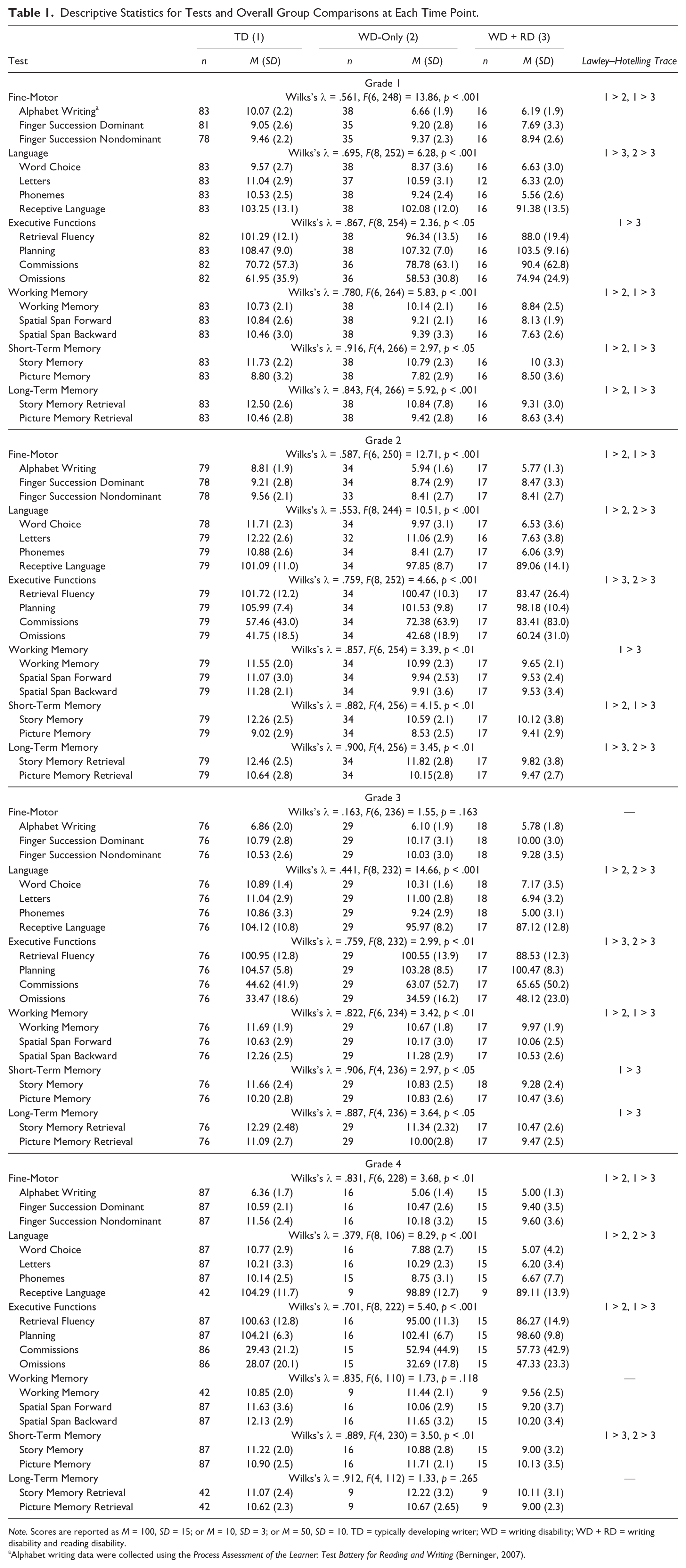
Note. Scores are reported as M = 100, SD = 15; or M = 10, SD = 3; or M = 50, SD = 10. TD = typically developing writer; WD = writing disability; WD + RD = writing disability and reading disability.
Alphabet writing data were collected using the Process Assessment of the Learner: Test Battery for Reading and Writing (Berninger, 2007).
What Is the Rate of Co-Occurrence and Stability of WD + RD in Grades 1 Through 4?
What is the rate of co-occurrence of WD + RD?
To address the first research question regarding the co-occurrence of a WD + RD, we calculated the ratio of students with a WD + RD compared with the total number of students with a WD. Results indicated that as students moved from first to fourth grade, the percentage of students with a WD + RD increased from about 30% in Grade 1 to nearly 47% by Grade 4. Despite this apparent percentage increase over the four grades, it is important to note that the absolute number of students with a WD + RD remained relatively stable from first (n = 16) to fourth grades (n = 15), as seen in Table 2. Together, these results indicated relatively stable number of students with a WD + RD, but that as students changed group membership over the years (e.g., WD-Only moved into the Typical Group), the percentage of students with a WD + RD seemingly increased.
Classification Changes in Adjacent Grades From Grades 1 Through 4.
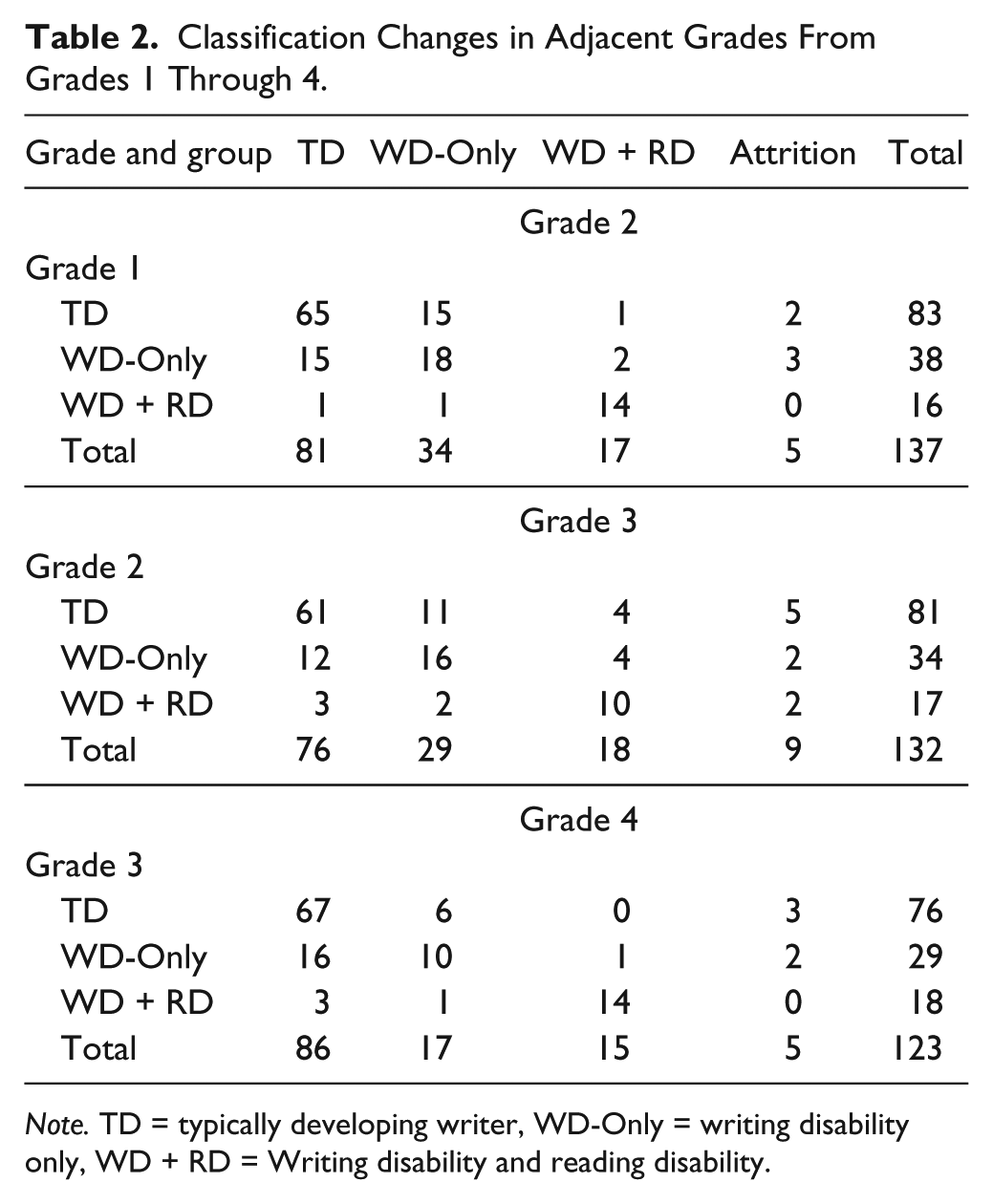
Note. TD = typically developing writer, WD-Only = writing disability only, WD + RD = Writing disability and reading disability.
What is the classification stability of WD + RD?
Across all three groups of writers, there was a large amount of movement between groups indicating instability of a classification in the early elementary grades. From the initial classification of students in first grade, and taking into account attrition over the 4 years, 44.1% of the students remained in their original classifications. This included 4 students from the WD-Only group, 8 students from the WD + RD group, and 40 from the TD group. Of the 83 TD writers in first grade, nearly 39% (n = 32) met criteria for a WD at some point over the 4 years. Of the 54 students who met criteria for a WD in first grade (i.e., 38 WD-Only and 16 WD + RD), 35.6% continued to manifest a WD through fourth grade. In addition, the percentage of students at each grade level who satisfied criteria for a WD was relatively stable: 39.4% in Grade 1, 38.6% in Grade 2, 38.2% in Grade 3, and 37.2% in Grade 4. Finally, 56% of students meeting criteria for a WD in first grade advanced into the TD group by the fourth grade, with most of this movement coming from students in the WD-Only group.
For students in the WD + RD group, taking into account attrition, 50% continued to manifest a WD + RD through the fourth grade. When adjacent grades were considered (see Table 2), of the original 16 first-grade students with WD + RD students, 14 (87.5%) continued to meet criteria for this classification in the second grade, with three new students moving into this group (1 from TD, 2 from WD-Only) and two students moving out (1 to TD, 1 to WD-Only). From the 17 second-grade students with WD + RD, 10 (58.8%) retained this classification into the third grade, with 8 students moving into this classification from the TD (4) and WD-Only (4) groups and 5 students moving out (3 to TD, 2 to WD-Only). Finally, of these 18 third-grade students with WD + RD, 14 (77.8%) remained in this classification in fourth grade, whereas 1 student moved into this group from the WD-Only group and 4 students moved out (3 to TD, 1 to WD-Only).
What is the cognitive burden of WD + RD?
To answer the second research question, we conducted a series of MANOVAs using Stata 13.0. As can be seen in Table 1, results indicated group differences across all of the cognitive domains except third-grade fine-motor, and fourth-grade long-term memory and working memory. Follow-up Lawley–Hotelling Trace tests revealed a general trend for the TD group to perform at a higher level than either of the WD groups on most of the cognitive domains at each of the time points. As expected, the WD + RD group performed more poorly than the WD-Only group across most of the cognitive domains.
Grade 1
As can be seen in Table 1, the MANOVAs showed the groups to be significantly different on each of the six cognitive domains. Follow-up Lawley–Hotelling Trace tests showed the TD group to perform significantly higher than the two WD groups across nearly all of the domains, with the WD + RD group performing lower than the WD-Only group in the Language domain, F(4, 126) = 7.54, p < .001. Eta-square showed a large effect size for this comparison (η2 = .19).
Grade 2
At Grade 2, the groups continued to reflect significant differences across all of the cognitive domains, with the TD group again outperforming the WD groups. Follow-up Lawley–Hotelling Trace tests revealed that at Grade 2 there were three domains that evidenced significant differences between the WD-Only and the WD + RD groups, in favor of the WD-Only group: Language, F(4, 122) = 7.98, p < .0001; Executive Functions, F(4, 126) = 4.69, p < .0015; and Long-Term Memory, F(2, 128) = 3.07, p < .05. Effect sizes ranged from small (η2 = .05) to medium (η2 = .13) to large (η2 = .21) for Long-Term Memory, Executive Functions, and Language, respectively.
Grade 3
For Grade 3, five of the six cognitive domains remained significantly different across the three groups on the MANOVA procedures (see Table 1). The Fine-Motor domain was the single cognitive domain that did not show significant group differences. In third grade, the typical group continued to outperform the WD groups, with the majority of the pairwise comparisons showing less differences between the TD group and WD-Only group, as compared with the first two grades, with no differences noted on the Fine-Motor, Executive Functions, Short-Term Memory, and Long-Term Memory domains. Follow-up Lawley–Hotelling Trace tests showed two domains to be significantly different between the WD-Only and the WD + RD groups: Language, F(4, 116) = 14.96, p < .001; Executive Function, F(4, 116) = 3.79, p < .01. In each instance, the WD-Only group performed at a higher level than the WD + RD group. Effect sizes were medium (η2 = .12) and large (η2 = .34) for Executive Functions and Language domains, respectively.
Grade 4
At Grade 4, the three groups showed equivalent performance for two domains: Working Memory and Long-Term Memory. The serial MANOVAs showed significant differences across the four remaining cognitive domains, with the TD group outperforming both WD groups on Fine-Motor, Language, and Executive Functions domains, and the TD and WD-Only groups outperformed the WD + RD group on Short-Term Memory. As can be seen in Table 1, the Lawley–Hotelling Trace test revealed significant differences between the WD-Only and WD + RD groups on Language, F(4, 53) = 3.91, p < .01; and Short-Term Memory, F(2, 115) = 3.74, p < .05. In each instance, the WD-Only group performed at a higher level than the WD + RD group. Effect sizes ranged from small for Short-Term Memory (η2 = .06) to large for Language (η2 = .23).
Discussion
The current study was conducted to address two issues: the rate of co-occurrence of a WD + RD and its associated stability in elementary school students from Grades 1 through 4, and the cognitive burden that is present in the WD + RD group versus WD-Only and TD groups. Addressing these issues provides some of the first data examining the relationship between these two learning disabilities and serves to increase our understanding of the broader writing–reading relationship.
Rates of Co-Occurrence of WD + RD
From our first-grade sample of students with a WD, an initial examination revealed that approximately 30% manifested a WD + RD, with this rate climbing to nearly 47% by the fourth grade. Despite this apparent increasing rate over the four grades, the actual number of students at each grade with a WD + RD did not change significantly from grade to grade. In fact, when adjacent grades were examined, stability rates of co-occurrence ranged from about 59% (Grades 2–3) to about 88% (Grades 1–2). Overall, of the original sample of 16 first-grade students with WD + RD, 50% continued to manifest this co-occurrence into the fourth grade. More generally, in our examination of the classification of students across each of the grades, there was a relatively high rate of instability in the group membership, which was consistent with earlier studies showing that learning disabilities do not begin to stabilize until approximately third grade (Francis, Shaywitz, Stuebing, Shaywitz, & Fletcher, 1996).
Certainly, any disorder could co-occur with a WD, and efforts to address other relationships have been studied in children exhibiting ADHD symptoms (Re, Pedron, & Cornoldi, 2007), reading comprehension deficits (Carretti, Motta, & Re, 2014; Carretti, Re, & Arfè, 2011), and developmental dyslexia (Berninger, Nielsen, Abbott, Wijsman, & Raskind, 2008); however, data from the present study provide some of the first rates of WD + RD co-occurrence in a young elementary school population. Conversely, it is important to note that although there appears to be an overlap of WDs and RDs, there were equal percentages of students who experienced a WD-Only across each of the four grades. These results suggest that although these two learning disabilities can co-occur, a WD-Only can exist apart from a RD. This is consistent with Berninger et al. (2008) who evidenced a similar pattern of findings in a population of students with developmental dyslexia.
Cognitive Burden of WD + RD
It has long been suspected that the cognitive precursors to writing and reading, and associated learning problems in each of these areas, likely manifest in early childhood, indicating that the co-occurrence of these learning disorders may have a common set of cognitive functions (Hooper et al., 2010). This has been demonstrated by Willcutt et al. (2010) in their development of the Multiple Deficits Model for Dyslexia and ADHD wherein there appears to be an overlap of key cognitive abilities that influence both conditions (e.g., processing speed). Furthermore, Berninger, Abbott, Nagy, and Carlisle (2010) showed that there are different developmental trajectories for many of these underlying cognitive functions, with word-level phonological awareness, orthographic awareness, and morphological awareness showing the most rapid growth in the early elementary grades—factors likely important to the development of both reading and writing. In fact, Berninger et al. (2010) noted that all three types of linguistic awareness are necessary for proficient reading and writing to develop, and how these targeted linguistic functions develop in students with WD + RD remains to be determined. For the current study, there was a clear distinction between the groups on the cognitive domains across each of the grades, which was particularly noteworthy for the WD + RD group performing below the TD group on nearly all of the cognitive domains at each time point.
Language
Consistent with the findings from Berninger et al. (2010), our findings showed that persistent language problems distinguished the WD + RD group from the WD-Only group across all four grades. Furthermore, the effect sizes for language differences between these two groups were large. As defined in our study, these language measures included estimates of phonological processing, morphology, and receptive vocabulary, key components for the formative development of both writing and reading skills. For the WD + RD group, the burden of language difficulties appears to be a significant contributor to this co-occurring condition.
Executive functions
Executive functions differentiated the WD + RD group from the WD-Only group in Grades 2 and 3 with moderate effect sizes being present. Furthermore, executive functions for the WD + RD group were significantly less efficient than the TD group at all four grades. These findings suggest that a student’s ability to regulate the multiple demands inherent in both reading and writing may be underlying the WD + RD condition. Recognizing the importance of executive functions to older writers, it will be important to determine whether these executive difficulties continue to be contributory to WD + RD as students move through middle and high school.
Memory functions
To a lesser extent, significant group differences were demonstrated between the WD + RD group and the other two groups. When compared with the TD group, the WD + RD group differed on working memory and short-term memory across all grades, and on long-term memory at Grades 1 through 3, with the largest effect sizes in working memory. The WD + RD group differed from the WD-Only group on long-term memory at Grade 2, and short-term memory at Grade 4, with negligible effect sizes. Taken together, these findings are consistent with aspects of the Not-So-Simple View of Writing Model (Berninger & Winn, 2006), as well as other theoretical models of written expression (e.g., Hayes, 2012) that stress the importance of memory abilities, particularly working memory, to the writing process. There appears to be additional burden on the WD + RD group with respect to both short-term and long-term memory abilities, although the magnitude of this burden appears minimal at this developmental time point.
Fine-motor
In contrast, although the expected differences on all of the cognitive abilities with the TD group were evident across all four grades, there did not appear to be additional cognitive burden assumed by the WD + RD group in the area of fine-motor speed and control. The effect sizes for the differences between the TD group and the disability groups were largest in first and second grades, and then dramatically decreased to third and fourth grades.
Summary
These findings suggest that the cognitive burden experienced by the WD + RD is significantly greater across nearly all of the cognitive abilities. This burden was apparent when compared with the TD group, but there also was additional cognitive burden experienced by the WD + RD group when compared with the WD-Only group. In particular, the WD + RD group experienced significantly greater cognitive burden in the language domain across all four grades. This burden likely is contributory to the manifestation of both writing and reading problems, with key components in this study reflecting the development of phonological processes, morphology, vocabulary, and rapid naming skills—all functions related to proficient reading and written expression. To a lesser extent, additional cognitive burden for the WD + RD group was noted in executive functions, short-term memory, and long-term memory at different developmental time points. Conversely, no differences were noted between the WD + RD and WD-Only groups on working memory or fine-motor speed at any of the time points in early elementary school. This lack of group differences is likely due to the strong linkages of both functions (i.e., working memory and fine-motor) to written expression and, thus, provides clues to the underlying writing problems in both groups.
Limitations
First, the original intent of this study was to study a targeted sample of students with a WD; consequently, we did not ascertain a similar sample of students with a RD. This undoubtedly contributed to bias in the sample, thus limiting the generalizability of these data to the WD + RD population, and the inclusion of a RD sample would have added an additional dimension to the already difficult to interpret group comparisons. Second, the participants in this study were selected as TD or WD based on their performance on a standardized writing assessment. The participants with a WD were identified if they scored in bottom quartile. Once selected, a similar classification strategy was used to obtain a RD. In addition to the sampling bias mentioned above, the use of a different operational definition of a WD or a RD may have produced a different set of outcomes for the rate of co-occurrence of a WD + RD, the stability of classifications over the four grades, and the cognitive burden noted for the WD + RD group. Third, the WIAT-II Written Expression tasks comprised different types of writing tasks at different grades, with a key difference emerging at Grades 3 and 4 when an essay is required. We assumed that the age-based standard scores would address the WIAT-II Written Expression task differences at this time point; however, it is likely that the task differences influenced not only our rate of co-occurrence but also group stability. In contrast, the stability of the percentage of students with a WD from first to fourth grades appears to be relatively stable, ranging from 37.2% to 39.4%, with the change in percentages of students with a WD being remarkably similar at the second- to third-grade task transition (Grade 2 = 38.6%, Grade 3 = 38.2%). Fourth, a related issue to our operational definition of a WD and a RD pertains to our reading measure. We collected reading data only on word reading capabilities. The rates of co-occurrence of a WD and a RD may have been different not only if we used a different operational definition of these conditions (i.e., bottom quartile) but also if we had used children with difficulties in reading fluency or reading comprehension. Finally, although we recognize that more sophisticated analyses are available to examine the influence of cognitive abilities at one grade on academic performance in later grades, the sample size was not large enough to utilize these lagged types of models.
Implications for Practice
Findings from this study hold a number of implications for practice. First, the high rates of a WD + RD in first-grade students are important signs that over a quarter of our first graders are at-risk for difficulties in learning core literacy skills as they begin their formal schooling. Relatedly, although the increasing rates of co-occurrence with advancing grades may have been an artifact of the instability of classification across all of the students, the total number of students with a WD + RD remained relatively stable across the four grades, with 50% continuing to show the co-occurrence of a WD + RD consistently across all four grades. These results indicate that there is a 1:2 chance of a student not improving their writing or reading skills to grade level by the fourth grade if they have WD + RD in the first grade. This raises significant concerns with the overall preparedness of a large percentage of our students as they move into the upper elementary school and beyond where content instruction begins to overtake the teaching of basic skills. Consequently, students with a WD + RD remain at significant risk for ongoing academic struggles and challenges.
Second, these high rates raise issues related to the nature of reading and writing instruction in the preschool and early elementary years. Are classroom instructional programs and strategies for all students evidence-based? Are writing and reading being taught such that both academic domains are receiving equal attention? How are students with or at-risk for specific learning disabilities being taught with respect to their learning of these core academic skills? Given the overall cognitive burden experienced by students with a WD + RD, they may require specific instructional approaches to address their needs. Indeed, emergent instructional data reinforce the writing–reading connection by showing that instructional strategies for writing also can improve reading development. In particular, children who are identified with a WD + RD should be given appropriate educational services before their learning deficits become more severe; consequently, early intervention will be critical for this group.
Third, the general instability of classification rates across grades—even for the TD students—suggests the need for frequent progress monitoring of reading and writing skills throughout the early elementary grades. The general instability of classification rates is of concern, but likely relates to a number of factors that include both endogenous (i.e., child characteristics) and exogenous (i.e., quality of instruction, home environment) factors, and is generally consistent with earlier findings of the stability of learning problems (Francis et al., 1996).
Fourth, the cognitive burden experienced by students with a WD + RD appears to be significantly greater than evidenced in their WD-Only peers. In particular, when we examine the cognitive burden associated with a WD + RD, it appears that language abilities are significantly lower in the WD + RD group than in the WD-Only group across all time points. Given the importance of intact language abilities for the development of both writing and reading skills, a thorough language evaluation of students with a WD + RD—even in the first grade—may be a critical element to addressing their complex learning needs.
Finally, these findings implicate the need for additional research to address the writing–reading connection and its underlying cognitive mechanisms, particularly with respect to the WD + RD connection. This study has provided some of the first clues as to the WD + RD relationship by using a WD population, but there is a need to examine this relationship in more detail, perhaps by using theoretical approaches such as the Multiple Deficit Model and extending the initial time points downward into the preschool years where emergent literacy skills begin and early identification can occur. Furthermore, although this study attempted to examine the WD + RD relationship across first through fourth grades, how these associated skills and deficits evolve remain unknown without a true longitudinal approach to these developmental trajectories for both reading and writing.
Footnotes
Acknowledgements
The authors wish to extend their appreciation to the Orange County Schools in Hillsborough, North Carolina for their ongoing support of these research efforts, and to the children and families who have participated in this project.
Declaration of Conflicting Interests
The author(s) declared no potential conflicts of interest with respect to the research, authorship, and/or publication of this article.
Funding
The author(s) disclosed receipt of the following financial support for the research, authorship, and publication of this article: This study was funded with grant support from the U.S. Department of Education Institute for Educational Science (R305H06042) awarded to Stephen R. Hooper, University of North Carolina School of Medicine.