



Abstract
Recent educational policy has raised the standards that all students, including students with disabilities, must meet in mathematics. To examine the strategies currently used to support students with learning disabilities, the authors reviewed literature from 2006 to 2014 on mathematics interventions for students with learning disabilities. The 12 articles reviewed contain various instructional focuses, including systematic instructions, problem-based instruction, and visual representation. This review includes discussion of the interventions used, including the success of interventions used for both students with disabilities and students without disabilities. Implications for practice and future research are also discussed, including the need for continued research on middle and high school interventions to address a variety of mathematical skills and concepts.
Teachers are currently under significant pressure to help all students achieve success in mathematics, as well as in other academic courses (Every Student Succeeds [ESS], 2015; Individuals With Disabilities Education Improvement Act [IDEA], 2004). Current legislation has granted students with disabilities access to the general education curriculum (IDEA, 2004) and requires that these students be tested on the general education curriculum with statewide standardized testing (ESS, 2015). ESS (2015) promotes rigorous accountability and gains toward college and career readiness for all students, which puts pressure on educators to help all students achieve success with challenging mathematics and develop high levels of thinking and problem-solving skills.
One goal of the Common Core Standards is to promote an educational culture of high expectations for students with disabilities and success with the general education curriculum (Council of Chief State School Officers & National Governors Association [CCSSO & NGA], 2010). For example, to receive a score of proficient or higher on high-stakes grade-level mathematics assessments, eighth-grade students must demonstrate a fundamental understanding of algebraic and geometric concepts in problem solving (Lee, Grigg, & Dion, 2007). Many students with learning disabilities (LD) often perform significantly below their peers without disabilities; the National Longitudinal Transition Study–2 (2009) found that 14% to 27% of students with LD scored 2 standard deviations or more below the mean of students without disabilities on mathematics subtests (Wagner, Newman, Cameto, Levine, & Garza, 2006).
As students enter middle and high school grades, mathematics content becomes more difficult and requires higher-order thinking skills (Confrey et al., 2012). The Common Core Standards are intended to be integrated into the curriculum as well as the state assessments. The rising expectations of the Common Core for students with disabilities require teachers to teach students to solve lengthy problems and demonstration of complex thinking skills, such as abstract and quantitative reasoning (CCSSO & NGA, 2010). Students in the upper grade levels typically receive less individualized attention than struggling learners in the elementary grades (Hughes, Maccini, & Gagnon, 2003), and many leave the school system without the skills necessary to solve the types of problems encountered in modern careers (Murnane & Levy, 1996). Middle and high school educators need to make content meaningful for students by building the foundation for success through achievement of high school graduation requirements (National Council of Teachers of Mathematics [NCTM], 2000; Teuscher, Dingman, Nevels, & Reys, 2008) and development of the necessary skills for appropriate postsecondary options (CCSSO & NGA, 2010). Mathematics educators have emphasized the necessity of procedural fluency, conceptual understanding, and problem-solving competence and reasoning for all students to be successful with mathematics (National Mathematics Advisory Panel [NMAP], 2008; National Research Council, 2001). Higher levels of mathematical and technical skills are needed for most current jobs, and all students, including those with LD, must have sufficient skills to solve problems in challenging situations (NCTM, 2000; NMAP, 2008). According to mathematics education researchers, practitioners, and policy makers, the goal of learning mathematics is development of problem-solving skills, which is a component of all five curricular content standards (NCTM, 2000), and has become essential to success in today’s job market (Hudson & Miller, 2006).
Mathematics Curriculum and Students With LD
These expectations may present challenges for all middle and high school students, but they are especially demanding for those with LD due to their general learning characteristics (Geary, 2004). These students identify problem solving as one of the most difficult parts of mathematics (Hudson & Miller, 2006). Students with LD tend to struggle with poor conceptual understanding of many foundational mathematics skills, deficits in working memory, difficulty coordinating problem-solving steps, and lack of ability to use retrieval-based skills to solve computations and word problems (Geary, 2004). All these skills are necessary for successful problem solving, which is highly correlated with overall mathematics achievement (Bryant, Bryant, & Hammill, 2000). For students with LD in middle and high school, it is essential that the interventions they receive support the higher-level skills they are required to demonstrate on standardized tests (Foegen, 2008). However, the interventions used with these students typically target lower-level skills such as fact recall or competency with equation procedures (see Miller & Hudson, 2007), instead of teaching processes for problem solving and showing students how to apply them to the mathematics curriculum (Foegen, 2008; Maccini, Mulcahy, & Wilson, 2007).
Purpose of the Study
Due to the difficulty students with LD typically have with mathematics, effective and efficient strategies must be used to help them gain meaningful access to curriculum. Special education researchers (e.g., Foegen, 2008; Maccini et al., 2007) have called for more research on students with LD in secondary school mathematics. It is necessary to determine if the need for more research is being met and to synthesize recent findings for future research and practitioner implementation. The purpose of this literature review was to examine the focus of recent research on mathematics interventions for students with LD between Grades 6 and 12 to describe the strategies currently used to support students with LD and to identify where more research is needed. The specific research questions are as follows:
Method
The researchers conducted an extensive search of peer-reviewed research articles (i.e., articles with clearly defined method, results, and discussion sections) on mathematics interventions for students with LD from 2006 to 2014 to extend the review of relevant literature in the field since the most recent review of the topic by Maccini and colleagues (2007). Studies were included in the review if (a) the sample included at least one student with LD in middle school (sixth grade to eighth grade) or high school (ninth grade to twelfth grade), (b) the study included a mathematics intervention as the independent variable, (c) the article was published in a peer-reviewed journal in English between 2006 and 2014, and (d) the study was conducted in the United States (because other identification criteria for special education services are used in other countries). Studies were excluded if (a) the grade range of the participants included grades outside of middle and high school levels, (b) the data for participants with LD were aggregated with data for other disabilities and could not be isolated, (c) the study did not report demographics that included the number of students with LD and without LD, and/or (d) the studies were conducted in countries other than the United States. Articles focused on summarizing intervention strategies, comparisons of curricula or textbooks, descriptions of characteristics of students with disabilities, error analyses (e.g., follow-up studies of previously researched interventions), position papers, and practitioner papers were also excluded.
In this literature review, we use the term intervention to describe the type of teaching practice used in the literature selected. We defined an academic intervention as a planned procedure used with the intention of teaching mathematics. We operated under the assumption that interventions are typically planned to be implemented over time and monitored to determine whether a student or group of students showed progress toward the targeted skill.
The researchers conducted the search using multiple methods. We used a keyword search to locate studies using online databases, including EBSCOhost, Education Research Complete, Education Resources Information Center (ERIC), Psychology and Behavioral Sciences Collection, and Teacher Reference Center. For the search, we used keywords such as math* intervention, learning disab*, middle school, high school, and problem solv*. The keyword search yielded a total of 2,655 results. Of these results, we deemed approximately 200 items to be most relevant; after 200 items, the results became too distant from the topic of this review. Based on the titles, keywords, and abstracts of the studies, we gathered a pool of 23 possible studies for inclusion. Items were excluded if they were not research articles (i.e., practitioner articles, books, etc.) or clearly did not meet inclusion criteria. After further analysis, nine of the 23 studies met the inclusion criteria.
We also completed an ancestral search using the articles already collected for the study and a hand search of six key journals in the field, including Journal of Learning Disabilities, Learning Disability Quarterly, Learning Disabilities Research and Practice, The Journal of Special Education, Remedial and Special Education, and Exceptional Children, which resulted in the addition of one study that met inclusion criteria. The researchers also collaborated through data collection meetings where two newly published articles that met inclusion criteria were identified for the study.
The researchers identified a total of 12 articles that met inclusion criteria. We then divided the articles by intervention type for analysis. The studies were grouped as follows: systematic instruction interventions (seven studies), problem-based learning interventions (three studies), and visual representation interventions (two studies). In many studies, the researchers used components of multiple types of interventions, but groupings were made based on the characteristic most essential to the nature of each intervention. The results of the analysis are discussed in depth in the next section.
Results
Twelve studies were found that included data-driven work involving a mathematics intervention for students with LD in middle or high school grades published between 2006 and 2014 (see Tables 1 and 2). The majority of the studies included participants in middle school grades (i.e., sixth–eighth) and were focused on interventions that involved the use of a systematic instruction. Other studies were focused on problem-based learning and visual representations. Many studies included participants with and without LD. The researchers disaggregated outcomes for students with LD and students without LD. Students were classified as “average-achieving students” or “low achieving students” for a variety of reasons (e.g., performance on state assessments, history of success or failure in mathematics), or the classification of students was left undefined by the researchers. In all studies, the students without LD were peers who were not considered exceptionally high achieving in mathematics and were placed by the schools in inclusion settings. The results of the review will be organized according to the method of intervention categories, from most common to least common type. General information on each included study can be found in Table 1, and content-specific information for each study can be found in Table 2.
Studies of Mathematics Interventions for Students With LD: 2006–2014 General Information.

Note. LD = learning disability; EAI = enhanced anchored instruction; CRA = concrete-representational-abstract.
Studies of Mathematics Interventions for Students With LD: 2006–2014 Content Information.
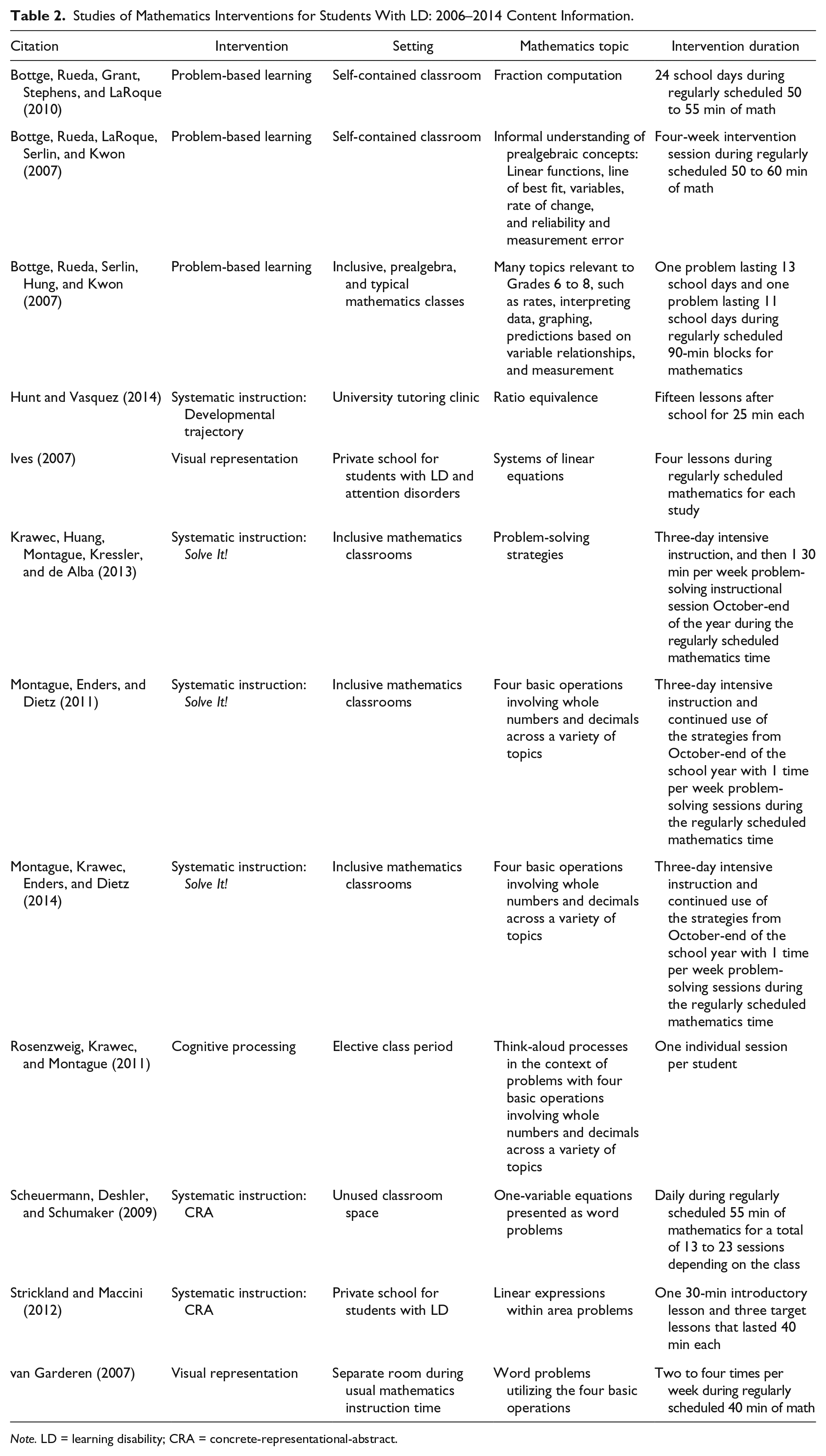
Note. LD = learning disability; CRA = concrete-representational-abstract.
Systematic Instruction Interventions
Seven of the studies focused on the use of systematic instruction to teach problem-solving strategies. For these studies, the intervention involved strategic presentation of the material in a series of contexts or degrees of sophistication (i.e., problems became more complex as the students progressed), or the students were taught a specific sequence to solve the problems. The researchers in these studies collected data on the outcomes of a predetermined teaching structure that targeted a mathematical concept compared with students in a control group. The studies that utilized systematic instruction interventions were grouped into subcategories to better explain the nature of the instruction, including Solve It!, concrete-representational-abstract, and developmental trajectory instructional sequences.
Solve It!
An instructional sequence called Solve It! was used in four studies focused on systematic instruction. Solve It! is an instructional method that teaches students to problem solve using cognitive and metacognitive processes. This intervention is based on teaching of thinking processes and skills for monitoring their thinking processes. Students reflect and consider whether they used the taught thinking processes effectively (see Montague, 1992). Solve It! is taught using an explicit instructional approach with scripted lessons and instructional supports for the teacher where students are shown how to use the processes, practice on their own, and are given feedback (Krawec, Huang, Montague, Kressler, & de Alba, 2013; Montague, Enders, & Dietz, 2011; Montague, Krawec, Enders, & Dietz, 2014). The processes that form the basis for Solve It! include read, paraphrase, visualize, hypothesize, estimate, compute, and check (Montague et al., 2011).
Montague et al. (2011) used Solve It! with eighth-grade students for a cluster-randomized study to discuss the outcomes of the intervention on success with word problem solving as measured by curriculum-based measures (CBMs) and the standardized state assessment required for the state where the study was conducted. The authors also compared the intervention’s outcomes based on student academic level, including students with LD, low-achieving students, and average-achieving students. The study measured the CBMs of a group of students who were instructed using Solve It! and a control group where students were taught using standard instruction. Montague et al. (2014) also used Solve It! to replicate the cluster-randomized study with seventh-grade students.
The studies had similar results. The study of eighth-grade students found that students receiving Solve It! instruction outperformed the students in the comparison group across ability level on the CBMs. The students with LD scored lower than the low-achieving and high-achieving students who were also instructed using Solve It!; however, the students with LD outscored the average-achieving students offered standard instruction by the end of the academic year. The findings were similar on the standardized state assessment; the students with LD scored higher than their peers without LD in the control group (Montague et al., 2011). Montague et al. (2014) also found that seventh-grade students with and without LD who received the intervention scored higher on the CBMs than students who did not receive Solve It! instruction. The results showed the intervention to have a positive impact on all ability levels of learners (Montague et al., 2014).
Krawec et al. (2013) used Solve It! with a sample of seventh-grade students and a sample of eighth-grade students to analyze the outcomes of the intervention on students’ knowledge of problem-solving strategies across ability levels through a pretest–posttest design combined with structured interviews. The results indicated that students with and without LD who were provided Solve It! instruction used more strategies during problem solving than students in the comparison group. Throughout the entire study, the students with LD performed lower than the average-achieving students; however, the intervention improved scores for both students with LD and average-achieving students. This study also showed that students with LD included in the intervention group scored higher in strategy knowledge than the average-achieving students who were in the comparison group (Krawec et al., 2013).
Rosenzweig, Krawec, and Montague (2011) further investigated students’ strategy use during cognitive and metacognitive processes (as used in studies of Solve It!) of students in eighth grade through coding and analysis of transcribed think-aloud procedures used by average-achieving students, low-achieving students, and students with LD. These researchers emphasized the importance of metacognition in successful learning and problem solving, while students were engaged in mathematics word problems. The study was intended to examine the difference in metacognitive verbalizations of students of different ability levels and the relationship between verbalizations and problem complexity. The students were taught to think aloud while solving problems with varying numbers of steps, while the researchers coded the verbalizations based on the cognitive processes included in the Solve It! intervention (i.e., reading, paraphrasing, visualizing, hypothesizing, estimating, computing, and checking; Rosenzweig et al., 2011). The researchers found that the students with LD used substantially more verbalizations than their peers; however, they produced more nonproductive verbalizations (i.e., verbalizations that did not aid in problem solving) than productive verbalizations. Students with LD not only increased their number of productive verbalizations when moving from one-step problems to two-step problems but also increased their number of nonproductive verbalizations as the number of steps in the problem increased (Rosenzweig et al., 2011). All students produced more overall verbalizations, showing a relationship between the quantity of verbalizations and the difficulty of the problem.
Concrete-representational-abstract
Two of the seven studies focused on a systematic instruction sequence called the concrete-representational-abstract (CRA) approach. This graduated sequence emphasizes the importance of teaching a concept beginning with concrete learning (i.e., the use of manipulatives or other methods) where students can see and manipulate the problem. Students then move toward representational, or semi-concrete, learning where the representation is primarily visual representations in the form of pictures, drawings, or two-dimensional shapes. Finally, students move to the abstract phase where equations, symbols, and mathematical language are used to represent and solve the problem (Scheuermann, Deshler, & Schumaker, 2009; Strickland & Maccini, 2012).
Scheuermann et al. (2009) utilized the CRA instructional approach with participants in Grades 6 through 8 with a multiple-probe-across-students design that focused on solving one-variable equations. The authors developed a specific CRA-type approach, called the explicit inquiry routine (EIR), to support students with LD as they transitioned from concrete to abstract concepts. EIR was based on explicit, systematic instruction and sequenced, scaffolded experiences to ensure that students mastered a concept before advancing in the curriculum. Students were also taught to demonstrate thinking through dialog with the teacher, a peer, and themselves. During each type of dialog, students were instructed to use concrete, representational, and abstract methods to drive the conversation (Scheuermann et al., 2009).
Almost all students had 80% accuracy or higher by the final instructional probe. Students improved their scores for both instructed and uninstructed problems during the intervention phase and demonstrated maintenance (percentage of nonoverlapping data = 63% for uninstructed problems and 93% for instructed problems). The students were also able to transfer their skills and knowledge to textbook problems and standardized measures of achievement (i.e., Wilcoxon Signed-Ranks Test and KeyMath-R; Scheuermann et al., 2009).
Strickland and Maccini (2012) also conducted a multiple-probe-across-students design study on the outcomes of using a CRA instructional approach with students in eighth and ninth grade with LD. The researchers in this study analyzed the outcomes of CRA instruction for linear algebraic expression multiplication problems. The students began with a manipulative program where they were able to move blocks to manipulate problems, then moved to think-alouds with modeling (e.g., “Tell me how . . .”), and finally used a graphic organizer to support their problem solving with abstract notation (Strickland & Maccini, 2012). The results of the study showed that all three of the participants increased their overall accuracy after the intervention. Two of the three students also showed high retention rates of what was learned. Performance varied when the students were tested on how well the knowledge they gained during the intervention would transfer to other types of problems. The students were also surveyed on the benefits they saw in the intervention, and responded that it was beneficial, enjoyable, and would recommend it for other students (Strickland & Maccini, 2012).
Developmental trajectory
A developmental trajectory instructional sequence organizes instruction in a way that presents students with more challenging problems as they develop the skills and knowledge necessary to support their thinking. Hunt and Vasquez (2014) focused on an intervention designed to support three sixth-grade through eighth-grade students as they developed understanding of the concept of ratio equivalence through a multiple-baseline-across-participants design. The researchers targeted the outcomes of a developmental trajectory intervention designed to match the developmental progressions of students in problem solving within the context of ratios (Hunt & Vasquez, 2014). The researchers designed a sequence of ratio problems intended to require more sophisticated problem-solving strategies as the students progressed in the intervention to facilitate growth in mathematical reasoning. Students were encouraged to think aloud and describe their problem-solving process to think about why a strategy worked. The strategies demonstrated by the students were coded as “build-up” strategies, “emerging unit” strategies, “unit” strategies, or other (nonsensical, guess, and check, “I don’t know”). When the student answered incorrectly, the researchers used prompts to draw attention to the flaws in the student’s strategy. If the student’s strategy was deemed unproductive, the researchers modeled the solving of the problem with a think-aloud approach to explicitly demonstrate how to correctly solve the problem. The results showed that all three students made progress with the problems as evidenced by the upward trend of percentage correct as the intervention was implemented. As students progressed in the developmental trajectory, the sophistication of their strategies increased and the amount of less sophisticated strategies decreased (Hunt & Vasquez, 2014).
Problem-Based Learning Interventions
Problem-based learning is an instructional technique that allows students to learn through interaction with an open-ended problem scenario. Three studies used a specific problem-based learning approach called enhanced anchored instruction (EAI) that immerses students in the context of the problem through a combination of video-based problems and real-world scenarios where students have the opportunity to take a hands-on approach to mathematics concepts (Bottge, Rueda, Grant, Stephens, & LaRoque, 2010; Bottge, Rueda, LaRoque, Serlin, & Kwon, 2007; Bottge, Rueda, Serlin, Hung, & Kwon, 2007).
In 2007, Bottge and colleagues conducted two studies to test the outcomes of EAI in middle and high school special education settings as a way to provide opportunities for students to interact with problem solving in a meaningful way. In the first study, the researchers used a pretest–posttest control group design to determine if EAI could improve students’ mathematics skills related to speed and distance problems and graphs. Bottge and colleagues placed the 100 middle and high school students with LD into two groups to receive the EAI intervention instruction and the control instruction (i.e., business as usual) in an alternating sequence. Both groups were pretested at the beginning of the study. Then, one group received EAI instruction, while the other received the control and, afterward, both groups were tested. Then, the instruction was reversed, and the first group received the control while the second received the EAI intervention. Both groups were tested a third time to measure any level of maintenance demonstrated by the first group and whether the second group showed results similar to the first group post-EAI instruction. Bottge and colleagues also used multiple case studies to give the teachers the opportunity to respond to the key teaching and learning factors that may have contributed to the results. The results indicated that the problem-based learning instruction was successful at supporting students with LD to develop their problem-solving skills using the Kim Komet Problem-Solving Test; however, there were mixed results as to whether the intervention assisted with computation. Based on the feedback from the teachers, the researchers found that the problem-based instruction was motivating for the students (Bottge, Rueda, LaRoque, et al., 2007).
In the second study, Bottge and colleagues used repeated waves within a nonequivalent dependent variables design to further determine the successes of EAI instruction. The researchers used the Kim Komet Problem Solving Test again and the Fraction of the Cost Challenge to additionally measure growth with measurement, estimation and computation of fractions and whole numbers, and interpretation of graphs with emphasis on real-world knowledge. The students were pretested with both assessments, received Kim Komet instruction, were retested with both assessments, received regular class instruction, were retested, received Fraction of the Cost Challenge instruction, and then posttested. The study also showed EAI to be beneficial for students with LD and students without disabilities (Bottge, Rueda, Serlin, et al., 2007).
Bottge et al. (2010) conducted a study to test two instructional approaches for teaching computation of fractions embedded in an EAI learning environment: instruction on an as-needed basis versus formal instruction of fraction computation. The researchers designed a pretest–posttest cluster-randomized experiment study involving sixth-grade through eighth-grade students, most of whom had LD in mathematics, and all of whom were receiving mathematics instruction in a self-contained classroom, to analyze the outcomes of informal and formal instruction of fractions combined with EAI on computation and problem solving. The computation instruction took place in two separate groups: a formal group that participated in two EAI units and one unit that consisted of explicit teaching of fraction computation and an informal group that participated in three EAI units and received no formal fraction instruction (Bottge et al., 2010).
The results showed that both groups of students made progress with fraction computation throughout the study. On the fractional computation test, used to measure growth of fractional addition and subtraction skills, the students in the formal instruction group scored higher on the posttest than students in the informal instruction group, while the problem-solving test, used to assess the skills and concepts students learned with EAI, showed no difference between the two groups (Bottge et al., 2010).
Visual Representation Interventions
Two studies were designed to investigate the use of visual representation interventions. Visual representation interventions are defined as any intervention that relies on a visual as the primary means to scaffold learning. The researchers in one study utilized graphic organizers to help students break down linear systems of equations while the other used visual representations to represent word problems. Ives (2007) used a two-group comparison design to determine whether secondary students were more successful with systems of two and three linear equations when the use of graphic organizers was taught. The visuals consisted of generic groups of cells that were drawn to align with different parts of equation-solving process; each cell could be used to store information by adding problem-specific information into the cells, and then using the cells help support the student when thinking through the equation-solving process. Ives focused on two groups of students in seventh through twelfth grade, the majority of whom had LD in mathematics or literacy-related LD, to compare the outcomes of the use of graphic organizers as a way to break down and organize the problem-solving process for complex systems of equations.
In the first part of the study, the intervention group received instruction that included the use of a graphic organizer, and performance was compared with a control group using a researcher-constructed test. The assessment included a short answer section to assess the students’ conceptual understanding of systems of two equations and a computation portion. The study also included a two-to-three-week maintenance test. The results showed that the intervention group outperformed the control group on the conceptual portion; however, there was not a notable difference between the two groups on the computational component of the maintenance test (Ives, 2007).
The second part of the study was similar; however, it included less participants, and no maintenance test was given. The same graphic organizer was used with the intervention group, but the second part was focused on teaching a system of three equations instead of two. On the same posttest used in the first part of the study, the intervention group outperformed the control group on the computation portion of the assessment as well as the conceptual portion. Another difference was the consistent use of the graphic organizer on the assessment. In the first study, only two of the 14 students in the intervention consistently tried to use the taught graphic organizer. However, in the second part, four of the five students in the intervention group consistently tried to use the graphic organizer. The students who used graphic organizers demonstrated more conceptual knowledge of systems of linear equations (Ives, 2007).
van Garderen (2007) utilized a multiple-probe-across-participants design and taught three eighth-grade students with LD to generate and use diagrams to represent and solve one-step and multi-step word problems. The study focused on the outcomes of the intervention on students’ ability to create the diagrams, use the visuals to solve mathematics word problems, and translate their skills to real-world problems. The students received diagramming instruction on how to represent problems in a meaningful way and strategies for solving word problems, including visualization and backward chaining (van Garderen, 2007). Results supported that all three students were able to generate diagrams following the intervention. The diagrams created evolved from pictorial diagrams, or pictures of the contextual components of the problems (e.g., simply drawing a bicycle for a problem about computing distance), to schematic diagrams that represent the mathematical relationships between problem components. The students improved their problem-solving ability for problems with both one and two steps and were able to transfer their knowledge to real-world problems that were nonroutine. Postintervention questionnaires indicated that the students were pleased with the instruction and strategies used in the intervention (van Garderen, 2007).
Discussion
The purpose of this review was to describe recent studies of interventions (from 2006 to 2014) for teaching mathematics to middle school and high school students with LD to determine gaps in the literature and to inform further research and practice. The findings suggest three major conclusions: (a) There are a variety of interventions that have shown positive outcomes for students with LD; (b) many of the successful strategies are beneficial not only for students with LD but also for students without LD; and (c) more research needs to be conducted on strategies to support secondary-level students with LD in both the middle and high schools.
Successful Strategies for Students With LD
In this review, we categorized studies by the type of intervention used by the researchers to demonstrate the variety of ways to support students with LD to develop problem-solving skills. Problem solving is connected to overall mathematics achievement (Bryant et al., 2000). All included interventions taught problem-solving skills either through examples of teaching strategies practitioners can incorporate into their teaching style to support students with LD or through examples of skills to teach students with LD to support themselves.
The reviewed studies offer a variety of interventions that incorporate systematic instruction to increase the problem-solving skills of students with LD. Instruction delivered in a graduated manner where problems build on knowledge and increase in complexity can help students with LD to develop their problem-solving skills and can be especially beneficial with the use of interactive teaching environments and manipulatives (Scheuermann et al., 2009; Strickland & Maccini, 2012). Through appropriate support and carefully designed problems, students can develop a repertoire of problem-solving strategies that they are better able to apply with increased mathematical complexity and efficiency (Hunt & Vasquez, 2014). Also, problem-based instruction seems to motivate students with LD, especially when prior knowledge and experiences relate to the learning context (Bottge, Rueda, LaRoque, et al., 2007; Bottge, Rueda, Serlin, et al., 2007).
The reviewed literature supports previous research that teaching visual strategies can be beneficial for struggling learners (Gersten et al., 2009). Students with LD tend to struggle with deficits in working memory and difficulty coordinating problem-solving steps (Geary, 2004); therefore, strategies that promote students’ organization of mathematical information and their thought processes may provide students with ways they can self-support during challenging mathematics problem solving. As struggling students receive less individualized attention as they get older (Hughes et al., 2003), it is important that they develop independent strategies for problem solving.
Explicit instruction where students are taught specific problem-solving processes and how to apply them (to a variety of contexts) has been found to be beneficial for students with LD by introducing thinking strategies with the intention that they will become routine for problem solving and be generalizable to multiple mathematical situations (Krawec et al., 2013; Montague et al., 2011; Montague et al., 2014). Some students may need to organize their thinking processes through verbalizations and may benefit from “think-alouds” that allow them to verbally plan and process a problem (Rosenzweig et al., 2011). If students develop the ability to ask themselves questions to scaffold their own thinking processes while problem solving (whether mentally or verbally), they may have better opportunities to self-talk themselves through complex problems. Students with LD also tend to benefit from diagrams and other visuals because visual supports can help alleviate the amount of information students need to process while increasing their understanding of the concepts addressed in the problem (Jitendra et al., 2009; van Garderen, 2007). When students are able to organize complex problems into graphic representations or graphic organizers, they are better able to solve problems (Ives, 2007; van Garderen, 2007) potentially due to a more consistent and efficient method of information storage, which relieves working memory and allows for faster processing (Keeler & Swanson, 2001).
Benefits for Students With and Without LD
Many of the reviewed studies included students with and without LD and compared the success of the intervention between students’ groups (i.e., Krawec et al., 2013; Montague et al., 2011; Montague et al., 2014; Rosenzweig et al., 2011). Results of all these studies demonstrated student improvement on the targeted skill or concept for students with LD and students without disabilities. In most studies, the intervention group outperformed the control group postintervention, indicating that the majority of students were able to excel with the intervention (Krawec et al., 2013; Montague et al., 2011; Montague et al., 2014) and in some studies, the students with LD in the intervention group outperformed the students without LD in the control group postintervention (Krawec et al., 2013; Montague et al., 2011). Strategies that focus on the specific learning difficulties that affect students with LD may also be beneficial for their peers without disabilities.
Implications for Practice
The findings of the current review identify a number of implications for educators who work with students with LD and other students who struggle with mathematics at the middle and high school levels. The literature reviewed provides support for the idea that students with LD can achieve success with difficult mathematical concepts when supports are put in place to help them gain access to challenging mathematics. Interventions that are designed to minimize barriers faced by students with LD in ways that are often also beneficial for students without disabilities may provide support for all learners. Curriculum that allows students to access concepts at an appropriate level and becomes more difficult as the students develop the problem solving strategies required can help to keep students with LD challenged with high expectations. When students with LD are able to support themselves with thinking strategies and visual representations, they may have better opportunities to succeed with middle and high school mathematical content.
The previous literature review on the topic (Maccini et al., 2007) called for educators to continue to use teaching practices such as graduated sequencing of instruction, teaching representation of mathematics problems, and contextualizing problem solving. The articles included the same features, indicating that researchers in the field are still exploring similar strategies for practice. Also, current standards and guides for mathematics recommend that teachers use a combination of these strategies to help students develop the ability to communicate about and defend their problem-solving processes as well as increase their flexibility with mathematics (CCSSO & NGA, 2010; NCTM, 2000; Star et al., 2015; Woodward et al., 2012). We also recommend that teachers continue to include these strategies in their instruction for students with LD as they can help eliminate the barriers students with LD face when accessing and finding success with challenging mathematics.
Implications for Future Research
Although we have described multiple studies that provide promising interventions for students with LD, there are still areas that need attention. The field could greatly benefit from further investigation of many of the interventions discussed in the current review to include larger sample sizes to determine generalizability of the results. Also, many mathematical concepts taught in the middle school grades have not yet been addressed. And while the number of successful interventions for supporting students with LD at the middle school level is encouraging, the lack of studies involving high school students with LD is a cause for concern. Three studies (25%) focused on high school students by combining middle school and high school students in the same study (Bottge, Rueda, LaRoque, et al., 2007; Ives, 2007; Strickland & Maccini, 2012) and, in a previous review of the literature, two studies (8%) included students at the high school level (Maccini et al., 2007), indicating that there is still a need for more high school-focused interventions.
The field could also benefit from future research on the topics and skills that students will need as they transition from middle to high school. It is possible that students with LD in higher-level mathematics courses will have instructional needs that require more or different supports than the current intervention techniques provide. Further research on strategies to support students with concepts such as algebra, geometry, and statistics (CCSSO & NGA, 2010) is needed. Although the study by Ives (2007) investigated the use of graphic organizers while solving systems of equations, there is still a need for research to be extended to the many topics students with LD will face in high school courses (e.g., polynomials, quadratics, and geometric theorems). This recommendation is not new; other scholars in the field (e.g., Foegen, 2008; Maccini et al., 2007) have also called for interventions to focus on the content standards for middle and high school, not only remedial skills for students with LD (see Table 2, column 4).
Mathematics content in high school becomes more difficult due to the abstract and requires higher-order thinking skills (CCSSO & NGA, 2010; Foegen, 2008; NCTM, 2000). Middle school students must demonstrate a fundamental understanding of algebraic and geometric concepts in problem solving to pass eighth-grade high-stakes assessments (Lee et al., 2007) and be prepared for high school (CCSSO & NGA, 2010). More research on the problems created by high school curriculum and the interventions needed to support students with LD is necessary to give students with LD access to the general education curriculum (IDEA, 2004), prepare them for the high-stakes assessments required for high school graduation (ESS, 2015; Teuscher et al., 2008; Ysseldyke et al., 2004), and support them in developing the problem-solving strategies necessary for success in appropriate postsecondary opportunities (CCSSO & NGA, 2010; Murnane & Levy, 1996).
Footnotes
Declaration of Conflicting Interests
The author(s) declared no potential conflicts of interest with respect to the research, authorship, and/or publication of this article.
Funding
The author(s) received no financial support for the research, authorship, and/or publication of this article.