




Abstract
The purpose of this study was to understand the impact of a work-based learning program on the work lives of Direct Care Workers (DCWs) at assisted living (AL) residences. The research questions were addressed using focus group data collected as part of a larger evaluation of a work-based learning (WBL) program called Jobs to Careers. The theoretical perspective of symbolic interactionism was used to frame the qualitative data analysis. Results indicated that the WBL program impacted DCWs’ job satisfaction through the program curriculum and design and through three primary categories: relational aspects of work, worker identity, and finding time. This article presents a conceptual model for understanding how these categories are interrelated and the implications for WBL programs. Job satisfaction is an important topic that has been linked to quality of care and reduced turnover in long-term care settings.
Keywords
Long-term care (LTC) settings depend on both licensed and unlicensed workers to provide services to older and disabled persons. Unlicensed workers provide the vast majority of hands-on, personal care in these settings (Stone, 2010). Frontline workers, referred to in this article as direct care workers (DCWs), hold many job titles, such as certified nursing assistant in nursing homes, personal care attendant in home care, and caregiver or resident assistant in assisted living (AL). Workforce issues are significant for LTC, with studies showing multiple ways that DCWs influence the quality of care experienced by residents (Hannan, Norman, & Redfern, 2001; Kane, 2001; Menne, Ejaz, Noelker, & Jones, 2007) and ways in which organizational characteristics affect the worklife of DCWs (Castle, 2008; Robison & Pillemer, 2007; Sikorska-Simmons, 2006). AL is a major segment of LTC and has grown rapidly over the past three decades (Harrington, Chapman, Miller, Miller, & Newcomer, 2005). Already at about one million AL beds (Park-Lee et al., 2011), the need for AL is expected to increase (Golant, 2008).
Regardless of setting type, a stable, qualified, and adequate workforce affects the success of LTC. Research on workforce stability and turnover has examined factors such as ownership type, economic factors, type of setting and location (Konetzka, Stearns, Konrad, Magaziner, & Zimmerman, 2005), and job satisfaction, the focus of this article. Job satisfaction has been linked to several positive outcomes for health care providers in LTC, such as lower job turnover and better quality of care in both nursing facilities (NFs) and AL settings (Castle & Engberg, 2006; Karsh, Booske, & Sainfort, 2005; Robertson, Gilloran, McKee, McKinley, & Wight, 1995; Waxman, Carner, & Berkenstock, 1984). Much of the published research thus far has focused on the job satisfaction of certified nursing assistants in NFs. Less is known about the meaning and importance of job satisfaction to DCWs who work in AL settings. In this article we examine a work-based learning (WBL) program developed for DCWs in AL. The Jobs to Careers in Assisted Living (JTC-AL) WBL program was designed to help workers achieve job-related competencies, increase job satisfaction, increase opportunities for career advancement, and improve quality care (Quimby & Star, 2008). This article is based on focus group interviews conducted with DCWs during the first phase of the evaluation of the JTC-AL program. Informed by a symbolic interactionist perspective (Mead, 1934), and using grounded theory methods for analyzing qualitative data, (Glaser & Strauss, 1967) we describe DCW perceptions of job satisfaction after beginning a WBL program. For descriptions of quantitative aspects of the evaluation, see White and Cadiz (2013).
Training Needs
Training for DCWs is limited, as are opportunities for career advancement and mentoring programs (Castle & Engberg, 2006; Stott, Brannon, Vasey, Dansky, & Kemper, 2007). For DCWs across LTC settings, education and training requirements are negligible, and actual levels of education and training are inadequate (Institute of Medicine, 2008). This is especially problematic in AL where, unlike NFs, certification is rarely required. Although specific training requirements vary by state and from one AL organization to another, DCW training in these settings is minimal (Ball, Hollingsworth, & Lepore, 2010; Wilson & Goldberg, 2010). A national study of ALs (Assisted Living settings) found that most DCWs receive between 1 and 16 hr of training and that few states require staff to complete a competency exam (Hawes & Phillips, 2000). Oregon regulations are consistent with this finding, where administrative rules specify only that ALs have a training program, that direct care staff be able to demonstrate knowledge and performance of key topics, and that they receive 12 continuing education credit hours of training annually. Most states, including Oregon, require additional training for DCWs who administer medications (Zimmerman et al., 2011) and/or work in dementia care (Mollica, Johnson-Lamarche, & O’Keeffe, 2005).
Adequate training has been linked to job satisfaction and quality care. Saks and Ashforth (1997) found that training provides socialization on the job and can reduce uncertainty for workers and enhance learning, resulting in greater role clarity, skill acquisition, person-job/organization fit, and social integration. In their recent meta-analysis of the science of training and development, Salas and his colleagues identified key elements for effective training programs (Salas, Tannenbaum, Kraiger, & Smith-Jentsch, 2012). These include best practices related to preparation for training (e.g., conducting a job-task analysis, scheduling), during training (e.g., building self-efficacy, using a valid training strategy and design), and after training (e.g., evaluation, training, transfer).
When DCWs view peer mentoring, job orientation, and continuing education programs as adequate for their needs, they are more likely to be satisfied with their supervision (Noelker, Ejaz, Menne, Bagaka’s, 2009). Training programs for DCWs in NFs have resulted in higher job satisfaction, lower turnover, more confidence, and pride among trainees (Dill, Morgan, & Konrad, 2010; Hollinger-Smith, & Ortigara, 2004; Morgan, Haviland, Woodside, & Konrad, 2007; Stone et al., 2002), which in turn contribute to better outcomes for residents. On-the-job or skills-based training has been associated with higher levels of DCW satisfaction and competence, which can lead to higher quality of care (Braun, Cheang, & Shigeta, 2005). DCWs in AL frequently identify the need for additional training (Ejaz, Noelker, Menne, & Bagaka’s, 2008), including on basic skills (Ball et al., 2010). The benefits of DCW training in AL, therefore, can be great for workers, residents, and providers.
In spite of the demonstrated importance of DCW education and training, and the availability of best practices in training effectiveness, training remains a low priority in LTC policy discussions (Stone & Dawson, 2008). Implementing educational programs with DCWs can be challenging because these workers often cannot afford to pay for courses outside of work, cannot fit training into their schedules, and additional training might not be valued or expected by either the worker or his or her supervisors. Successful LTC training programs address these challenges by offering low- to no-cost courses, flexible hours, and convenient locations (Braun et al., 2005). Work-based learning (WBL) is an example of this approach. WBL is an on-the-job, competency-based approach to educating and training adults. It highlights work as the location of learning, with learning objectives derived from the skill requirements of the job and competency demonstrated by new skills. Learning is rewarded through academic credit or recognized credentials, enabling workers to advance onto career ladders (Raelin, 2008.)
Job Satisfaction
Job satisfaction is a multifaceted concept without an agreed on definition (Coomber & Barriball, 2007). It is conceptualized and measured differently across studies, with some focusing on intrinsic factors such as achievement, recognition, advancement, and the work itself, and others on extrinsic factors such as relationships at work, working conditions, and compensation (Kuo, Yin, & Li, 2008). Some LTC studies emphasize global satisfaction while others examine specific components of job satisfaction. For example, Perkins, Adelman, Furlow, Sweatman, and Baird (2010) used a general measure of job satisfaction as a predictor of DCW turnover in AL and found an indirect relationship mediated through intentions to quit. Sikorska-Simmons (2005) used an overall job satisfaction measure to explore the relationship of the work environment and quality care in AL, finding that overall job satisfaction and positive views of the organization’s culture were linked to greater resident satisfaction. Bishop and her colleagues conceptualized job satisfaction more specifically in terms of pay, benefits, and chance for promotion (Bishop et al., 2008) in their study of DCWs in NFs. Their research on the relationship between this measure of job satisfaction and other components of job satisfaction (e.g., job autonomy, teamwork, and supervision) found positive associations between job satisfaction and relations with supervisors and intent to stay. Furthermore, intent to stay was linked to resident satisfaction with relationships to staff and their reports of quality of life (Bishop et al., 2008). Purk and Lindsay (2006) studied the relationship of job satisfaction, as well as personal characteristics and attitudes, with intent to quit. They found that workers who experienced dissatisfaction with elements of their job were more likely to report their intent to quit. Based on a LTC stress and support model, Ejaz and her colleagues (2008) found that personal and job-related stressors, including inadequate training, predicted job dissatisfaction among DCWs in multiple types of LTC settings. Ball, Lepore, Perkins, Hollingsworth, and Sweatman (2009) reported that DCWs in AL who feel they are taking good care of residents are more satisfied with their jobs. In summary, regardless of how it is conceptualized and measured, understanding job satisfaction is fundamental to improving work place environments in such a way that will contribute to quality care, resident well-being, and workforce stability.
Conceptual Framework and Research Questions
Symbolic interactionism is a framework that focuses on the meanings that individuals derive from interactions with others (Blumer, 1969). Through social interactions, people create order and shared meanings. One’s identity, including work-based identity, is formed, or negotiated, over time through a process of verbal and nonverbal communication, activities, and interactions with others (Charon, 1998; Mead, 1934; Stryker, 2008). This framework differs from behavioral theories that measure how individuals respond to specific interventions. Mead’s (1934) notion of “perspective” explains that when individuals interact, they enter into the perspective of others and that this process shapes their own meaning, or definition of the situation.
Examining training through a symbolic interactionist framework provides insight into the process of skill acquisition and role development as understood by trainees. Socialization in a job role is a type of social interaction that can influence whether workers view the job as positive, negative, or mixed. Workers’ identities are influenced by interactions with each other and with their clients. On-the-job training gives workers a sense of the organization, its goals and priorities, and their individual role within the organization (Reichers, 1987). Thus, using a symbolic interactionist framework provides a lens for understanding how DCWs perceive themselves as workers, including how they describe satisfaction with their jobs.
This article is based on DCWs experiences with a WBL program for AL. Two research questions were addressed:
Research Question 1: What is the impact of WBL on the work lives of the DCWs, as described by the DCWs who experience it?
Research Question 2: How do these experiences influence the ways that DCWs view their work roles?
Examining training through a symbolic interactionist framework (Blumer, 1969) provides insight into ways that workers derived meaning from the WBL program and how they negotiated their past and evolving roles as DCWs. Through that inductive approach, it became clear that the workers’ discussions of the program, and their perceptions of work, were categories of job satisfaction and that topic became the focus of analysis.
Method
Blumer (1969) theorized that the benefit of collecting data from small groups of people was derived from the complexities of discussion and negotiation of meaning and agreement or disagreement between participants. We used focus groups to collect qualitative data from DCWs who participated in the JTC-AL training program. This WBL program includes 27 competency-based modules covering topics such as infection control, personal care, nutrition, and transferring residents (Wilson & Goldberg, 2010). Training was provided by AL administrators, nurses, and peers and took place during work hours one-on-one or in groups of no more than six DCWs. Each training session typically took 30 min or less. Focus group interviews were held soon after DCWs began taking the modules. More information about the design and evaluation of JTC-AL is presented in White, Cadiz, and Lopez (2010) and White and Cadiz (in review).
Portland State University’s guidelines for recruitment, consent, and research with human subjects were followed; the DCWs were informed about the study, that their participation was voluntary, and that their decision to participate or not participate would not affect their employment status. Each participant received a US$10 gift card.
Sample
Four AL settings were selected initially for the WBL program and all four participated in this phase of the study. They represented a range of settings, including urban and rural locations, and for profit and not-for-profit organizations. Urban locations included an AL that accepted private pay residents only and one that served low-income seniors, many with chronic mental health conditions. Other participating ALs served seniors with a range of income and cognitive status. Each ALs designated a site coordinator who served as a liaison between the project and AL staff. Site coordinators facilitated evaluation activities, including scheduling and recruiting participants for the focus groups. Participants included 27 DCWs who attended one of the focus group interviews, with four to eight in each group. These DCWs reflected different ages, genders, and work histories. Most were native English speakers but several nonnative English speakers participated. The majority was female; some had been employed for several years as a DCW and others described their current position as their first job in LTC. At the time of data collection, most had completed three or more WBL modules.
Data Collection
Each focus group was held at the AL residence and lasted approximately 1 hr; the principal investigator moderated each one with support from the project’s research assistant (the first author) who asked follow-up questions. A structured interview guide was used, though participants were encouraged to discuss related topics as suggested by Morgan (1997). Participants were asked about their experiences with the JTC-AL, including on-the-job learning, and their ideas for improving working conditions. They were not asked directly about job satisfaction; this subject arose during analysis. Key questions addressed work in the AL (e.g., “Why did you decide to work here?” “How prepared were you to do this job when you first started here?”), WBL (e.g., “What is your understanding about the project?” “How has JTC changed the way you learn how to do your job?” “What is your experience with the modules?”), how working conditions and support for learning could be improved (e.g., “What additional training or skills would help you with your job?” “What things could the administration do differently to help you with your job?”), and career plans (e.g., “How will JTC affect your career choices?” “What kind of work do you hope to be doing in about five years?”).The interviews were audio-recorded, transcribed, and audited for consistency and accuracy by listening to the tape while following along in the transcript and correcting errors (MacLean, Meyer, & Estable, 2004). Special attention was paid during the auditing phase to transcribe and audit the words of nonnative English participants.
Analysis
Grounded theory, a qualitative method based in symbolic interactionism, was used to generate codes and categories (Strauss & Corbin, 1998). The broad analytic goal was to generate an explanation of how (or whether) WBL influenced the DCWs work lives. As a first step, the transcripts were coded on a line-by-line basis by the first two authors; this effort produced the initial code list. These codes were applied to the text, using a process called “constant comparison” (Glaser & Strauss, 1967) in which newly coded sections of text are compared with previously coded sections to see if they both fit the code’s definition. One goal was to reach theoretical saturation, when no new codes or code meanings were derived from the data (LaRossa, 2005).
Constant comparison and theoretical saturation are standard grounded theory practices used to establish study credibility. In addition, the larger research team, including those who attended focus group interviews and developed training modules, met regularly to discuss data collection and analysis. Finally, to assess coding reliability, the first two authors independently coded sections of text and found an agreement rate of 81%, with 8 out of 43 excerpts coded differently. After discussion, the codes were revised and the entire data set was recoded and reviewed by the coauthors.
Another step using grounded theory methods involved axial coding. Specifically, a matrix was created to develop categories, or analytic units of meaning that encompass several codes (Glaser & Strauss, 1967). Three categories (described further in the results section) were developed based on DCWs’ descriptions of the WBL program: relational aspects of work, worker identity, and finding time. The final stage of category development and refinement, called selective coding, involved linking codes and categories, with supporting quotes from the DCWs, into narrative form. For example, links between two key categories (relational aspects of work and worker identity) were affected by the WBL program’s curriculum and design. The context in which DCWs work, one of constant and sometimes unanticipated time demands, influenced the development of the third, cross-cutting category, “finding time.” The results of this analytic process are described below.
Results
This study explored DCW perceptions of their job during participation in a WBL program designed for AL settings. The program had two components, curriculum and delivery design, founded on evidence-based practices for effective training (White & Cadiz, in review). The DCWs’ discussions of the job training program revealed three distinct categories of work life—relational aspects of work, worker identity, and finding time. These categories, along with the two components of the job training program, are related to these workers’ perceptions of work life and inform our understanding of job satisfaction in AL, as depicted in Figure 1. The model uses one-directional arrows to indicate that both the curriculum and program design features influenced the relational aspects of work and worker identity. Two-directional arrows between the three work life categories indicate that these elements of the model are interrelated. In addition, we suggest that job satisfaction is both influenced by, and influences, these three categories. Finding time is placed on either side of the model because it arose as a cross-cutting issue for the DCWs, as described below.
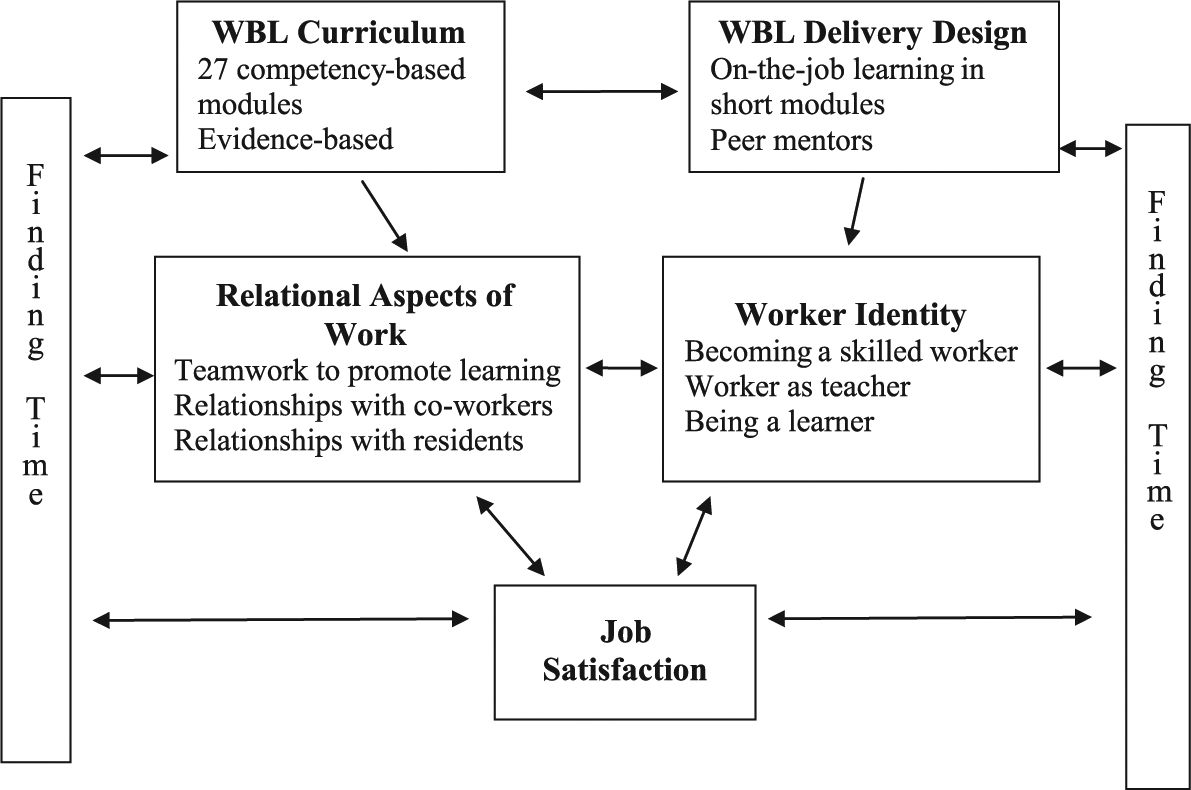
Working model of work-based learning and job satisfaction.
Relational Aspects of Work
The DCWs described how WBL affected relational aspects of their work life. Specific topics included teamwork to promote learning, relationships with coworkers, and relationships with residents.
Teamwork to promote learning
Teamwork and training have been identified by DCWs in multiple settings as ways to improve their jobs (Kemper et al., 2008). The reciprocal impact of the WBL program and DCWs’ attitudes toward the work environment were evident in the way the participants described themselves as working on teams. Although many indicated they had been on good teams before starting the program, they reported that they were able to rely on coworkers even more following training. The WBL curriculum provided common baseline knowledge, which assured individuals that their team members had received the same knowledge and skills related to their jobs. One said, “I would feel confident in their care [of residents], because they would have this training and they would know [what to do].” This element of the program’s design also influenced teamwork:
At the end of this we want everybody to be at the same spot, going, we all know exactly the same thing. Like robots, we have the same information! So we can all go to twenty different locations and do it exactly the same everywhere else.
This contrasts with workers’ prior on-the-job training experiences, which some described as inconsistent and lacking the information needed for them to do their jobs, leaving employees feeling dissatisfied, not completely trained, and unsure of what their fellow employees knew how to do. It appears that the training program helped to reduce uncertainty, which in turn has been associated with increased work performance (Saks & Ashforth, 1997).
In addition to their increased confidence in their peers, DCWs gave examples of how the teamwork ethic led them to help each other learn. One DCW, who was also a peer trainer, related this story:
I had a body mechanics situation where one person was teaching another person. And when I was watching them doing it, it was scary. I thought they were going to break their ankles [laughs]. And so that’s when I jumped in and I went, “Okay, this is how you got to do to it” . . . and you could literally see on their face that the light bulb went on.
Improved relationships with coworkers
Participants reported that relationships with coworkers, although they had been strong previously, improved with the program as DCWs supported each others’ work preferences.
We accommodate, as much as we can, each other’s personal preferences because when you come to work and you’re unhappy, you may not prefer to do something and somebody else doesn’t mind doing it . . . it’s showing that we care about each other’s workload and we care that somebody else is doing something they enjoy doing and not doing something they’re going to leave in five minutes and want to quit.
The one-on-one WBL training design provided an opportunity for sharing, and DCWs became more connected to their coworkers through discussion of their experiences.
I think also just personal experience comes up within the module, so the module might say it’s fifteen minutes long or whatever, but it may take a little longer because you end up sharing, “Oh, this happened.” . . . And so you just kind of get a deeper knowledge of the person you’re talking to, and just relationship-wise it helps, I think, to have that connection.
Developing relationships with residents
Relationships with residents were often described as close and family-like. Consistent with the literature (Kemp, Ball, Hollingsworth, & Lepore, 2010), workers took pride in this closeness and in their ability to forge relationships with residents.
There’s probably not a handful of residents here that each person could say, on one hand that they could count, that they didn’t know very much about that person. We know everything about everybody, and that’s what makes everybody so close here.
In one case, a DCW described how learning about dementia and communication in the Roles and Responsibilities modules of the curriculum helped her better understand residents’ needs, which helped both her and the residents: “You are not as frustrated or tense as you would have been before, and you may not think it shows, but they feel it. They feel it, they know. So it’s easing you and it’s easing them.” These communication skills were beneficial in working with all residents. For example, one DCW reported about the module as follows:
It teaches you, as far as communication skills, eye contact so you keep in eye contact with the elderly and you don’t have to yell at them as long as they can read your lips . . . and just listening to the resident, what they have to say, that’s part of communication. I’ve learned a lot of listening. I was a terrible listener, at one time, and now I’m really good, I feel I am. I’ve advanced in that.
In addition to listening skills, DCWs talked about knocking on doors before entering a room, asking residents how they are and what they need, reassuring residents that they would help them, and an overall better understanding of older persons. All of these examples illustrate the tools the curriculum provided to DCWs to enable them to improve already valued relationships with residents. These approaches to working with residents, supported by the organization through the training program, are likely to improve staff–resident relationships, an aspect of work that contributes both to DCW job satisfaction and to resident well-being (Ball et al., 2009; Bishop et al., 2008).
Worker Identity
The curriculum influenced the negotiated concept of DCW worker identity, the second key category identified through this research. Worker identity included elements such as becoming a skilled worker, worker as teacher, and being a learner.
Becoming a skilled worker
The DCWs described ways that the program increased their knowledge and helped them to review and improve in areas where they already had skills. For example, some described new skills based on new knowledge about infection control and hand washing:
Changing our gloves, like when we enter the room of a resident. After taking the dirty sheets from the bed we need to change the gloves in order to get the clean sheets on. And also sanitizer . . . the sanitizing is more frequent.
The improvement of skills made workers feel they were gaining knowledge that they could apply to their work, thus becoming better workers: “This is our job. That’s what we do every day. And that helps. To learn more, if we know something, we can, you know, read the modules and know more.” Such findings indicate that the training program supported worker self-efficacy and motivation to learn, elements of best practices for training effectiveness (Salas et al., 2012).
Worker as teacher
The program design created new roles for some DCWs, including that of peer trainer. Participants who were peer trainers at two ALs described new challenges and responsibilities. For example, peer trainers were the primary troubleshooters of the scheduling issues that challenged the implementation of the curriculum. As noted by one, “If it’s looking like we’re going to have fifteen or twenty minutes of downtime, we say, ‘Hey, come over here for a minute, I want to talk to you about this.’”
Peer trainers learned a variety of teaching techniques and the importance of adjusting their techniques to each DCW’s preferred learning style.
With your first couple of modules that you do with somebody, you realize what their learning style is. And with her, you know that she’s not going to remember if I tell her an acronym, she’s not going to remember if I show her a picture what it was. I just need to say it to her…lecture, say, “Okay, here’s your competency”, she can get it.
Additionally, trainers took on the extra responsibility of making sure their coworkers knew what to do and were using the skills that they had been taught.
. . . if we catch each other doing something wrong anyway, we will say, you know, “Hey, I think there’s a better way to do that,” because we’re constantly watching out for each other to make it easier and safer for each other and the residents. So I don’t think any of us would let something go by without trying to talk to the person to help them.
The trainer also became a go-to person for questions:
I think it helps you relate to that person or to the trainer, you know, and I can go to this person with this question.
Being a learner
While participants frequently mentioned that “Every day we learn something new” on the job, many took on the role of learner in a new way. This was seen in the expressed desire to learn more, and to keep learning, as one DCW stated, “I enjoy everything we do . . . everything . . . I enjoy studying, I think it’s going to benefit me.”
The role of learner also extended to the peer trainers. Trainers also took their responsibilities very seriously, making sure that they were prepared and had the knowledge they needed to train their peers:
I’ve had to go back and learn things the right way, because you don’t want to teach things the wrong way, especially when you are being held to a certain standard or responsibility . . . It’s a matter of, am I doing it right? So I’m teaching myself before I teach anybody else.
It appears that becoming a learner was tapping into staff motivation and frontline empowerment subsystems described by Chuang, Dill, Morgan, and Konrad (2012) as high-performance work practices necessary for positively influencing job satisfaction and quality care.
Finding Time
The DCWs spoke often of their caregiving work in terms of busy schedules, leading to the final analytic category of finding time. An important issue that DCWs discussed during each of the focus groups concerned the lack of time to schedule the modules and accomplish them while working. This was particularly important because the DCWs were being trained by peers or other coworkers, all of whom were busy. “Finding time to do them sometimes is the hard part. Because they [the organization] want it when you’re working, and when the other person’s working, and that’s not always possible.”
In addition, DCWs found it difficult at times to follow some of the WBL program recommendations, for example, taking time to communicate with residents, due to time constraints and the busyness of their shifts:
I’m sorry, but that really means a lot to at least have a conversation [with a resident]. I couldn’t think of anything to talk about because my mind was going, “Okay, now I’ve got to go do this one, gotta go do this one”.
One curriculum module that some DCWs found difficult to implement was related to “self-care.” Due to time constraints, one DCW said it was difficult to follow the recommendations.
Well, they tell you about rest, and self-care. . . . they tell you to back away, take a break, but after you get to lunch, that the only time you can really take a break because as soon as you sit down somebody call. And some of the workers don’t want to respond. You just put your food down. You got to leave it and go to some person, and then come back and start again in maybe a half hour. You’re timing yourself to just try to push food in your mouth for fifteen minutes . . .
On the positive side, several DCWs appreciated the possibility of receiving college credit for completing the program and the ability to learn at work rather than taking college classes, which they lacked the time to do. Staff perceptions of the organizational culture have been linked to resident satisfaction (Sikorska-Simmons, 2006). How facilities address issues of finding time through practices such as supervisor support and flexible scheduling (Chuang et al., 2012) is likely to be critical in removing obstacles to training effectiveness (Salas et al., 2012).
Discussion
This study explored DCW experiences of a work-based learning program designed for AL through the Jobs to Careers Initiative (Quimby & Star, 2008). A symbolic interactionist framework helped illustrate the dynamic nature of job satisfaction, informed partly by how the DCWs negotiate meanings through interactions with coworkers and AL residents. The WBL program consisted of a competency-based curriculum taught during work hours, often with the aid of peer mentors. After completing only a few training modules, participants described how the program was contributing to improved knowledge, skills, and abilities to do their job, to greater teamwork, and to improved relationships with coworkers and residents, all aspects of job satisfaction, as indicated in Figure 1.
The two different but complementary components of the WBL program (curriculum and delivery design) illustrates the importance of multidimensional approaches for effective training programs (Chuang et al., 2012; Morgan et al., 2007; Salas et al., 2012). Beginning with the curriculum, DCWs described how the modules were helping them to improve their own work practices as well as those of their coworkers. They highlighted the importance of consistency in training, with each worker receiving the same materials and instruction. The curriculum contributed directly to shaping DCW identities as AL workers. DCWs were able to combine the knowledge that they brought to their caregiving work with knowledge acquired from the training. Successful completion of the modules, which included demonstration of competency, enhanced the workers’ views of themselves as skilled and competent workers, contributing to self-efficacy. Self-efficacy results in higher job performance (Stajkovic & Luthans, 1998). Participating in the comprehensive curriculum helped workers identify with the role of learner. The modules were perceived as relevant to the job and several workers expressed eagerness to take the next modules in the series. The motivation to learn was reflected in the way they valued receiving materials they could read on their own.
Kemper and colleagues (2008) noted that one of the primary improvements for DCWs’ work lives is positive work relationships. The curriculum contributed to relational aspects of work, including improved relationships with residents. Examples provided by the focus group participants included increased skills in communicating with residents because they had greater understanding of resident behaviors and needs. Workers also acquired basic tools to help build relationships, including courtesies of knocking on doors before entering and listening to residents to determine whether their needs had been met.
Menne and her colleagues (2007) found that teamwork was one of the most important training topic areas for LTC workers. Ejaz et al. (2008) discovered similar findings in their study of the impact of stress and support on DCWs’ job satisfaction. Although teamwork was not the focus of the WBL program, DCWs described ways that the curriculum itself contributed to improved relationships with coworkers. DCWs found that the increased consistency in training helped them feel more confident in one another’s skills, thereby fostering teamwork. The training design also contributed to building relationships, particularly with coworkers. In addition, the opportunity to share work experiences promoted camaraderie among all levels of staff.
Positive work identities were also influenced by the WBL delivery design. The DCWs discussed how the program design, particularly on-the-job learning and peers as mentors, led them to think differently about their own work. Saks and Ashforth’s (1997) views on socialization in a job role relate to the experiences of the DCWs in the study, particularly in the areas of enhanced learning and skill acquisition. These outcomes result in higher employee morale overall and higher job satisfaction, among other results. In addition, DCWs appreciated getting trained in shorter but more frequent sessions across different work shifts. Morgan and her colleagues (2007) also found that providing training onsite and during work hours contributed to a supportive learning environment. The interactive learning with other DCWs, whether in small groups or one-on-one with a peer trainer or a manager was preferred over traditional in-service training. The design may have resulted in DCWs being more engaged and active in their learning. Use of peer trainers led to new roles, including those of teachers for some of the DCWs. The role of worker as teacher is illustrative of an empowered worker, which contributes to positive outcomes for workers (Chuang et al., 2012). These trainers found new ways to use their skills and abilities on the job. Peer trainers took their responsibilities very seriously, learning teaching skills and mastering the content of the modules they taught. These new identities were reinforced by their coworkers who viewed the peer trainers as resource persons to consult during their day-to-day work. The DCWs’ positive feelings about teaching and being taught by peers echoes the assertion of Noelker et al (2009) that these factors can improve satisfaction on the job. The role of worker as teacher also has the potential of becoming part of a career ladder for top-performing DCWs, which contributes to job satisfaction (Purk & Lindsay, 2006).
The JTC-AL approach is promising in addressing the coverage issues that arise when longer training sessions are offered. At the same time, the challenge of finding time was pervasive, particularly in the beginning stages of the WBL program described here. Even the short one-on-one sessions were challenging from a coverage standpoint. Trainings sometimes were postponed due to inadequate staffing or increased workload due to emerging resident needs. Although finding time was clearly a challenge during these early phases of implementation, the benefits from the program, at least from the point of view of the focus group participants, appeared to outweigh the difficulties. Still, these findings emphasize the importance of attending to posttraining issues, including obstacles related to finding time for training, to ensure sustained success (Salas et al., 2012). The issue of finding time is one that must be addressed through refinements to the WBL program and by residence management as they begin such a program. (See White et al., 2011, for more discussion of this issue).
Using a symbolic interactionist framework to examine the DCWs’ perspectives served two primary purposes in this study. First, because meanings are negotiated, this framework enhanced our understanding of the DCWs’ evolution of their views of themselves as both individual workers and as team members through participation in WBL. Specifically, increased competence, ability to learn from and teach others, and relationships with coworkers influenced workers’ views of themselves. Second, because the nature of the focus group data is one of negotiation and discussion, the actual negotiation of these views could be charted, at least for the duration of each focus group. The data showed how workers’ experiences arose from both inner thoughts and interactions with coworkers. Thus, the experiences of their jobs were inherently socially constructed. Although role definition and clarity are influenced by organizational culture (Meyer, 1977), workers also cocreate their own views of their roles with others. The new role of peer trainer as a negotiated reality is a good example of role negotiation in action. Beyond the specific training tasks that they needed to complete, peer trainers became people that their coworkers could ask for advice. Others took on the responsibility of watching out for their coworkers to make sure they were using the practices and techniques that they had trained them to do. These roles were not prescribed, but rather emerged over time. If the trainers’ coworkers had not gone to them for advice, the role of trainer-as-advice-giver would not have been a facet of the trainer experience.
Study Limitations
Although the findings might not be generalizable to all DCWs in AL settings, due to the relatively personal and unique nature of the focus group interviews, these data provide new knowledge about DCW attitudes toward WBL and job satisfaction. It is possible that only DCWs who were the most satisfied with the WBL program participated in focus groups and those that were dissatisfied did not. However, focus groups were scheduled during work hours and an incentive was provided to encourage the participation of a variety of workers. Consistency in the findings across the four settings can be construed as supportive evidence, and more coverage of the target participants was achieved than if only one site had been relied on for data.
It is unclear from this study the extent to which this program is relevant for DCWs in other settings. For example, DCWs who work in nursing homes already have established training programs required by law. The job analysis indicated that completion of the WBL modules will prepare workers for entry level into a certified nursing assistant job. It is likely, however, that the WBL design, with its on-the-job focus and short, frequent training opportunities could be beneficial in nursing home and other settings.
The job satisfaction literature indicates that increased job satisfaction is associated with at least two topics that are not addressed in this study: quality of care (Ball et al., 2010; Sikorska-Simons, 2005) and employee pay (Bishop et al., 2008). While the DCWs did at times talk about how their new knowledge made them better listeners, gave them new insights into dementia, or emphasized the importance of hand washing, all aspects of quality care, the data are not detailed enough to provide new insights on whether WBL improves quality of care. Similarly, the topic of pay was not mentioned. The lack of data on these topics is likely related to the study’s focus on how WBL affects work life. The impact of the JTC-AL WBL program on job satisfaction over time cannot be known from this analysis; other research explores that topic (see White & Cadiz, in review).
Directions for Future Research and Practice
More research is needed to strengthen understanding of the links between training, quality of care, and staff retention. Also needed is information about different DCW types, such as those who administer medications versus those whose job involves personal care provision (Carder, 2012). Furthermore, from this preliminary examination of the JTC-AL program, we do not know if, or to what extent, the DCWs who complete the modules will climb a career ladder or stay on the job longer than they would have without this training. Results reported here, however, suggest that the WBL approach as implemented by these four AL residences offers a promising approach to meeting the training and organizational support needs for DCWs. Additional research is needed to further understand the connections between components of the training program and job satisfaction, particularly as it relates to staff retention and quality of care. Future studies could use our working model to test and refine these categories and relationships. For example, while some of the DCWs did describe aspects of their work that likely resulted in improved quality of care to residents, we did not specifically ask them about quality of care. This model could be used to guide further evaluation of a WBL program, including observation of workers and interviews with residents to document their experience of care quality before and after the training. In addition, these categories could be used to develop specific, rather than general, measures of job satisfaction in the AL residence. These data suggest ways to improve the WBL program. First, effective teams are essential to quality of care, but as LeMieux-Charles and McGuire (2006) note, research in the area of health care teams has not resulted in clear findings about how to create or maintain teams that function well. More research could be undertaken to increase our understanding of how WBL and peer training contribute to team building. Second, Ejaz and her colleagues (2008) reported that scheduling issues can be a primary stressor for DCWs. The WBL program appeared to ease the DCWs’ work lives even as it added another layer to their scheduling issues. Because scheduling can impact the DCW experience, a new module on scheduling and stress is warranted. Third, it was clear from these DCWs that implementing the self-care recommendations in the JTC-AL module was very difficult. DCWs’ experiences could be used to update the self care module. Although modules were developed with input from DCWs, more attention paid to this very important aspect of caregiving would be beneficial. In general, workers’ feedback needs to be integrated into the continuing development and implementation of the JTC-AL program as a way to improve the work environment to facilitate greater job satisfaction (Noelker et al., 2009). Finally, considering the impact that becoming a trainer had on the trainers and on their coworkers, it might be beneficial to consider promoting all interested and experienced workers who meet predetermined criteria to a trainer position. This approach could add depth to the training expertise in the organization and support program sustainability.
Conclusion
Given the increasing demand for LTC workers and the costs associated with recruiting and retaining quality DCWs, it is crucial to identify how to create a satisfying work experience for DCWs, and how satisfaction can be translated into higher quality care for older adults in LTC settings. By recognizing that job satisfaction can be achieved in part through WBL programs, AL administrators can make informed choices about the benefits and trainings provided to workers, and policy makers can support programs that work. This study provides a starting point in exploring the impact of a WBL program at ALs. As Stone (2004) notes, improving and sustaining the job satisfaction of DCWs can result in better quality of care in LTC. Providing opportunities for DCWs to improve their job skills through training at work can lead to LTC system improvements that benefit workers and consumers.
Footnotes
Acknowledgements
The authors would like to recognize Ms. Suanne Jackson for her knowledge of work-based learning and for assisting with access to AL residences. We are grateful to the AL management and DCWs and two anonymous reviewers who provided very insightful and careful reviews of the manuscript.
Authors’ Note
IRB protocol approved by Portland State University, Human Subjects Research Review Committee, Proposal No. 08583
Declaration of Conflicting Interests
The authors declared no potential conflicts of interest with respect to the research, authorship, and/or publication of this article.
Funding
The authors disclosed receipt of the following financial support for the research, authorship, and/or publication of this article: This research was supported by a grant from the Robert Wood Johnson Foundation (Grant No. 63057) to Dr. White.