



Abstract
Little research has examined the relationship between addressing older adults’ spiritual needs and overall satisfaction with service provision during hospitalization, despite the importance of spirituality and religion to most older adults. This study examined this relationship, in tandem with the effects of eight potential mediators. Toward this end, structural equation modeling was used with a sample of 4,112 adults age 65 and older who were consecutively discharged over a 12-month period from hospitals in California, Texas, and New England. As hypothesized, addressing spiritual needs was positively associated with overall satisfaction. The relationship between spiritual needs and satisfaction was fully mediated by seven variables: nursing staff, the discharge process, visitors, physicians, the admissions process, room quality, and the administration of tests and treatments. The diverse array of mediating pathways identified highlights the importance of health care practitioners working collaboratively to address older adults’ spiritual needs.
Older adults are disproportionally likely to experience hospitalization. For example, older adults use emergency departments (EDs) more than any other age group in the United States (Gruneir, Silver, & Rochon, 2011). The elderly population accounts for approximately one third of all hospitalizations, and their time as inpatients tends to be longer than average (Russo & Elixhauser, 2006).
Hospitalization typically elicits spiritual needs and the importance of providing care that addresses these needs is widely recognized across disciplines (Canda, 2008; Koenig, 2007; Narayanasamy, 2010; Ross, 2008). Major supervisory organizations emphasize the salience of services that address spiritual needs, including the Joint Commission (2010), the largest and most influential health care accrediting body in the United States, the National Institute for Clinical Excellence (2004) in the United Kingdom, and the World Health Organization (WHO; 1990). In the United States, the standards articulated by the Joint Commission and Medicare suggest that every hospitalized older adult should receive services tailored to their spiritual values (Koenig, 2012). For instance, the Joint Commission (2010) recommends an assessment be conducted to identify spiritual, religious, or cultural beliefs that may impact service provision.
Despite this emerging consensus, little is known about the relationship between addressing older adults’ spiritual needs and their overall satisfaction with service provision while hospitalized (Koenig, 2007). The paucity of knowledge about this relationship represents a significant gap in the literature. If practitioners are to respond effectively to patients’ spiritual needs, then it is critical to understand the processes through which patients’ spiritual needs are satisfactorily addressed (Nixon & Narayanasamy, 2010). Understanding the pathways through which spiritual needs impact overall satisfaction with service provision can help practitioners provide more effective services in this area (Cavendish et al., 2006). Toward this end, the relevant literature is reviewed and two hypotheses posited in the following section.
Literature Review
Although the terms spirituality and religion are often used interchangeably, attempts have been made to distinguish the two concepts, with some commentators viewing spirituality as the broader, more encompassing construct (Catterall, Cox, Greet, Sankey, & Griffiths, 1998; Crisp, 2010; Miller & Thoresen, 2003). Reflecting this perspective, the WHO (1990) expert committee on cancer pain relief and palliative care conceptualized spirituality as those aspects of human existence that transcend sensory phenomena. Similarly, the consensus conference on improving palliative care, sponsored by the Archstone Foundation of Long Beach, California, defined spirituality as aspects of humanity that refer “to the way individuals seek and express meaning and purpose and the way they experience their connectedness to the moment, to self, to others, to nature, and to the significant or sacred” (Puchalski et al., 2009, p. 887).
Conversely, religion is often understood as a shared set of beliefs, practices, and rituals related to spirituality (Koenig, 2007; McBrien, 2010; Noble & Jones, 2010). For instance, Praglin (2004) defined religion “as a culturally shared system of values, beliefs, and rituals which include spiritual concerns” (p. 74). Thus, spirituality is an individually experienced, universal phenomenon that is typically, but not universally, expressed in the organized, communal context of religion (Canda & Furman, 2010; Derezotes, 2006).
As is the case with the underlying construct, no consensus conceptualization of spiritual needs has emerged in the literature (Sharma, Astrow, Texeira, & Sulmasy, 2012). In keeping with individuals who define spirituality as a fundamental component of human experience (Crisp, 2010), Narayanasamy (2010) posited that spiritual needs are universal in nature. Thus, at a theoretical level, spiritual needs encompass non-religious, more existentially oriented spheres (e.g., hope, meaning, purpose, existential connection with others) and religious spheres (e.g., visitation from clergy, the administration of communion; Murray, Kendall, Boyd, Worth, & Benton, 2004; Tanyi, Recine, Werner, & Sperstad, 2006). This is the perspective implicitly reflected in the Joint Commission’s (2008) spiritual assessment protocol, which includes sample questions on hope, meaning, and faith, as well as items on church, synagogue, and clergy. Although the specific manifestation of each individual’s spiritual needs is unique, patients’ existential and religious needs are frequently intertwined (P. A. Clark, Drain, & Malone, 2003).
Qualitative research that has attempted to map the specific parameters of patients’ spiritual needs suggests they are diverse and span the experience of hospitalization from admission through discharge (Anderson, Anderson, & Felsenthal, 1993; Cavendish et al., 2006; Hermann, 2001; Hodge, Horvath, Larkin, & Curl, 2012; Murray et al., 2004; Pardue, 1991; Tanyi et al., 2006). For example, patients may express spiritual needs for kind and reassuring treatment during the admission process as fear of the unknown is encountered (Jang et al., 2004; McBrien, 2010); a quiet, ascetically pleasing room that is conducive for prayer or meditation (Hermann, 2001); kosher or halal food that is respectfully served (Davidson, Boyer, Casey, Matzel, & Walden, 2008); nurses who take the time to warmly respond to patients’ requests and concerns (Nixon & Narayanasamy, 2010; E. J. Taylor, 2003); information about tests and treatments that is provided in a courteous, caring manner (Hodge & Horvath, 2011); visits from friends, family, and clergy (Conner & Eller, 2004); physicians who express concern and respect regarding patients’ spiritual values as they intersect treatment decisions (Ellis & Campbell, 2004; Galanter, Dermatis, Talbot, McMahon, & Alexander, 2011), and discharge plans to process the existential sense of loss and grief that emerged during hospitalization (Koenig, 2012; Meert, Thurston, & Briller, 2005). Furthermore, across the hospitalization experience, spiritual needs are expressed for courteous, caring interactions with hospital personnel that communicate support for patients and their personal spiritual paths (Anderson et al., 1993; Hodge & Horvath, 2011; Tanyi et al., 2006).
Addressing patients’ spiritual needs in a satisfactory manner has been associated with higher perceptions of overall satisfaction with service provision in a number of quantitative studies (Astrow, Wexler, Texeira, He, & Sulmasy, 2007; P. A. Clark et al., 2003; Williams, Meltzer, Arora, Chung, & Curlin, 2011). For example, Williams and associates (2011) examined perceptions of satisfaction among inpatients (N = 3,141) at a hospital providing general internal medicine services in Chicago. The sample was disproportionately older (M age = 56 years) and reported moderate levels of self-rated health. Specifically, using a 0 to 100 scale, in which 0 represents the worst possible health and 100 the best possible health, the sample broke down as follows: < 40 (20% of respondents), 40 to 54 (29%), 55 to 75 (28%), > 75 (23%). Post-discharge, patients were asked to rate the quality of the care they received during their hospitalization using items drawn from the Picker-Commonwealth patient satisfaction survey.
These researchers found a relationship between addressing patients’ spiritual concerns and overall satisfaction (Williams et al., 2011). More specifically, patients who discussed their spiritual concerns reported higher levels of satisfaction with the care they received. This finding is consistent with other studies that have found that addressing spiritual needs in a satisfactory manner is associated with a number of salutary outcomes, including increased: quality of life (T. A. Balboni et al., 2007; T. A. Balboni et al., 2010; Kang et al., 2012), quality of care (Astrow et al., 2007), spiritual meaning and peace (Pearce, Coan, Herndon, Koenig, & Abernethy, 2012), and decreased medical costs (T. Balboni et al., 2011), and symptoms of depression (Ganatra, Zafar, Qidwai, & Rozi, 2008; Pearce et al., 2012).
This research suggests that addressing older adults’ spiritual needs may be associated with higher levels of overall satisfaction with service provision while hospitalized. The importance attributed to spirituality tends to be more pronounced among older adults. Musick, Traphagan, Koenig, and Larson (2000) reported that, among those 55 and older, approximately 90% reported moderate or high levels of spirituality and religion. Previous studies that have documented an association between spiritual needs and overall satisfaction have been conducted using samples in which the mean age fell between 55 and 60 (Astrow et al., 2007; Williams et al., 2011). Among all age groups, adults aged 65 and above are more likely than any other age group to report that spirituality and religion are highly important to them (Newport, 2006; Newport, 2012b; R. J. Taylor, Chatters, & Jackson, 2007). For instance, according to Gallup data, 72% of older adults report that religion is very important in their lives (Newport, 2006). Given the heightened importance of spirituality and religion to older adults, it seems reasonable to posit that addressing their spiritual needs will be associated with higher levels of overall satisfaction.
Overall satisfaction with service provision is an important outcome as it is widely viewed as a proxy for the overall quality of care received during hospitalization (Jackson, Chamberlin, & Kroenke, 2001; Shea et al., 2008). Consequently, the quality of services provided to patients in health care settings is commonly evaluated through the use of patient satisfaction measures (Gribble & Haupt, 2005; Press, 2002). In addition, patient satisfaction is associated with a number of important constructs. Included among these are increased: patient compliance with health care directives, loyalty toward service providers, profitability, and better clinical outcomes, in tandem with decreased likelihood of filing professional malpractice suits (Kaldenberg, 2001; Moscato et al., 2007; Press, 2002; C. Taylor & Benger, 2004).
The salience of patient satisfaction is underscored by changes mandated by the U.S. Patient Protection and Affordable Care Act (P.L. 111-148). The Affordable Care Act links Medicaid reimbursements to patient satisfaction scores (Geiger, 2012; Neuhausen & Katz, 2012). Hospitals that record higher levels of patient satisfaction will receive more funding (Rau, 2011). Although many of the specifics of the Affordable Care Act are still in the process of being implemented and adjusted, the new reimbursement methodology went into effect in 2012. The Affordable Care Act also seeks to reduce Medicaid costs by constraining future payments to hospitals (Davis, Hahn, Morgan, Stone, & Tilson, 2010). Taken together, these changes suggest that the importance of patient satisfaction as a critical outcome is likely to increase in the future.
While positing a direct relationship between addressing older adults’ spiritual needs and overall satisfaction may be a relatively safe supposition, the pathways that explain this relationship are more obscure. In other words, little is known about the factors that mediate the relationship between spiritual needs and satisfaction, at least from a quantitative perspective. Qualitative research suggests spiritual needs are manifested throughout the course of service provision. As implied, major domains of service delivery in which spiritual needs manifest include: the admission process, room quality, meal service, nursing staff, tests and treatments administration, visitors, physicians, and the discharge process. In each of these areas, hospital personnel have the potential to address older adults’ spiritual needs through the application of various attitudes, behaviors, and skills. As these dimensions of service provision are also typically related to overall satisfaction, the conditions for mediation exist (Baron & Kenny, 1986).
Accordingly, the following hypotheses were posited:
To test these two hypotheses, a secondary data analysis of Press Ganey inpatient satisfaction data was conducted using structural equation modeling (SEM).
Method
Sample Characteristics
The study sample consisted of 4,112 adults age 65 and older who were consecutively discharged over a 12-month period from hospitals in three geographically diverse regions of the United States: California, Texas, and New England. As presented in Table 1, the sample was approximately 50% female and primarily European American. Given that self-identified African Americans, Latinos, Native Americans, Asians, and Hawaiians/Pacific Islanders collectively comprised approximately 11% of the sample, these respondents were collapsed into a single category for statistical analysis.
Demographic Characteristics of Older Hospitalized Adults (N = 4,112).
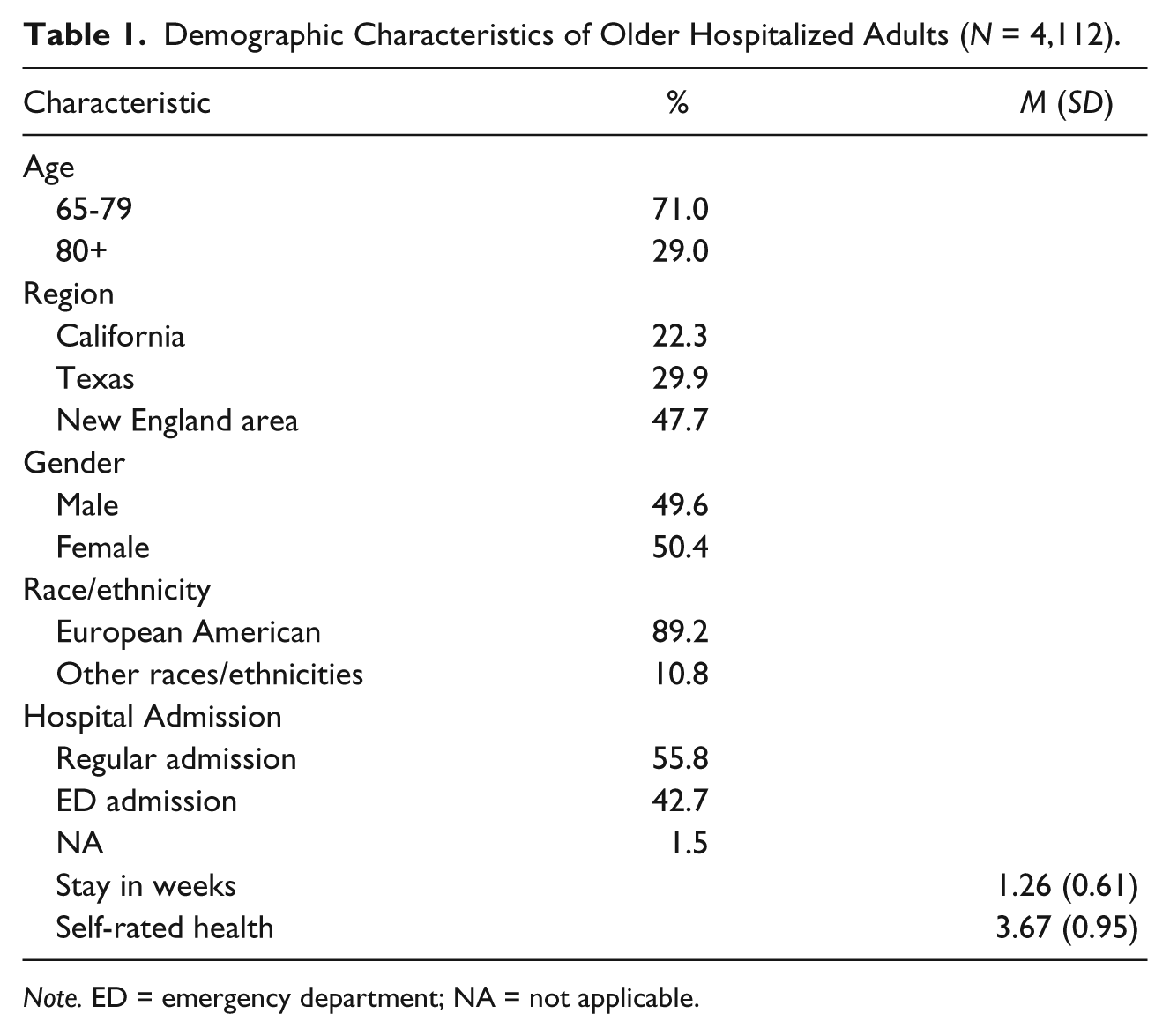
Note. ED = emergency department; NA = not applicable.
Although most respondents were admitted through the regular admissions process, 42.7% were admitted through the ED. Respondents were asked to compare their health to others their age on a 5-point scale ranging from very poor (1) to very good (5). In aggregate, the sample fell roughly between the fair (3) and good (4) categories. This level of self-rated health was similar to the rating recorded in other research examining the relationship between spiritual needs and satisfaction with service provision among hospitalized inpatients (Williams et al., 2011).
Procedures
In keeping with the importance attributed to patient satisfaction, American hospitals typically evaluate perceptions of overall satisfaction with service provision (Chandra et al., 2011). To evaluate this outcome, hospitals frequently contract with organizations that specialize in patient satisfaction measurement and management. Press Ganey Associates, Inc., the largest of these organizations in the United States (Press Ganey Associates, 2011), provided the data for the present study.
All hospitals in the Press Ganey database were potentially eligible to be included in the study. Hospitals, however, frequently request different information. Press Ganey provides hospitals with a basic survey instrument that can be customized with a variety of additional items. For instance, the spiritual needs question is an optional item that can be requested. Hospitals were included in the study if they collected information that was deemed to be relevant to the present study (e.g., items designed to tap spiritual needs, ED admission, self-rated health, etc.).
Hospital-specific information was eliminated as part of the de-identification process. Patients from hospitals in the same geographic region were pooled to remove any possible information that might be used to identify individuals. The study was conducted with the approval of a university Institutional Review Board (IRB).
Measures
Spiritual needs
Older adults’ perceptions of how well hospital staff addressed their spiritual needs were operationalized with a single item. Specifically, potential respondents were asked to indicate the “degree to which hospital staff addressed your spiritual needs” on a 5-point, Likert-type response key that ranged from very poor (1) to very good (5). This item is similar to one used in prior quantitative work examining the relationship between spiritual needs and patient satisfaction (Astrow et al., 2007). For the purposes of the present study, this exogenous variable was assumed to be measured without error.
Satisfaction
The latent construct of overall satisfaction with the care provided during hospitalization was assessed with three indicators. These three items are listed in Table 3. A Cronbach’s alpha of .93 was obtained in the present study. The alpha obtained in this study was similar to the level of reliability recorded in previous research, as is the case with the following mediating variables (Kaldenberg, 2001).
Mediating variables
The study included eight variables that prior qualitative research suggest may mediate the relationship between spiritual needs and satisfaction. These variables were developed by Press Ganey to assess different aspects of service provision from admission through to discharge. These areas capture the key areas of service provision articulated in the service quality literature and the National Library of Health Care Indicators (Kaldenberg, 2001).
These latent constructs, along with the corresponding alphas obtained in this study, are as follows: admission process (α = .79), room quality (α = .86), meal service (α = .83), nursing staff (α = .94), tests and treatments administration (α = .87), visitors (α = .83), physicians (α = .94), and the discharge process (α = .83). The indicators for each construct are listed in Table 3. The 5-point, Likert-type response key previously described was used with each item.
Data Analysis
Preliminary analysis was conducted using SPSS 20.0, and the main SEM analysis was preformed with AMOS 20.0. SEM allows researchers to test hypothesized relationships between observed and latent variables (Schumacker & Lomax, 2010). Latent variables refer to constructs that are not directly observable, such as perceptions of overall satisfaction with service provision. Observed variables or indicators refer to specific items that are used to define or infer a latent variable or construct (e.g., Items So1-So3 in Table 3). Compared with more commonly used procedures such as ordinary least squares (OLS) regression, SEM offers the advantage of being better suited to testing complex mediation models while simultaneously taking into account measurement error.
Missing data were not judged to be a particular concern, given that less than 2% of cases were missing data across variables (Kline, 2011). The only categorical variable with missing data was ED admission. To retain the complete sample, cases with an affirmative response where grouped together, and the 62 missing cases were grouped with those who did not indicate they were admitted through the ED. Given that the ordered categorical variables are conceptually continuous and consisted of five categories, they were treated as continuous variables for the purpose of analyses (Finney & DiStefano, 2006). Accordingly, for these variables, missing data were imputed using the EM (Expectation Maximization) algorithm procedure (Schafer & Graham, 2002).
The continuous variables were transformed to improve their normality resulting in skew and kurtosis values < 2. Although Mardia’s test of multivariate normality was not supported, Maximum Likelihood (ML) estimation is considered to be relatively robust (Schumacker & Lomax, 2010). Under conditions of moderate non-normality (i.e., skew < 2, kurtosis < 7) with ordered categorical data consisting of at least five categories, Finney and DiStefano (2006) recommended using ML estimation. Accordingly, this approach was used for all models.
As summarized in Table 2, a traditional two-step approach was used to test each hypothesis (Schumacker & Lomax, 2010). In the first step, a measurement model was constructed to ensure that the observed variables do, in fact, appropriately measure the underlying construct. After establishing the validity of the measurement model, the hypothesized relationships were examined in a subsequent structural model.
Two-Step Analysis Plan for Testing Hypotheses.

Confirmatory Factor Analysis of the Measurement Model.
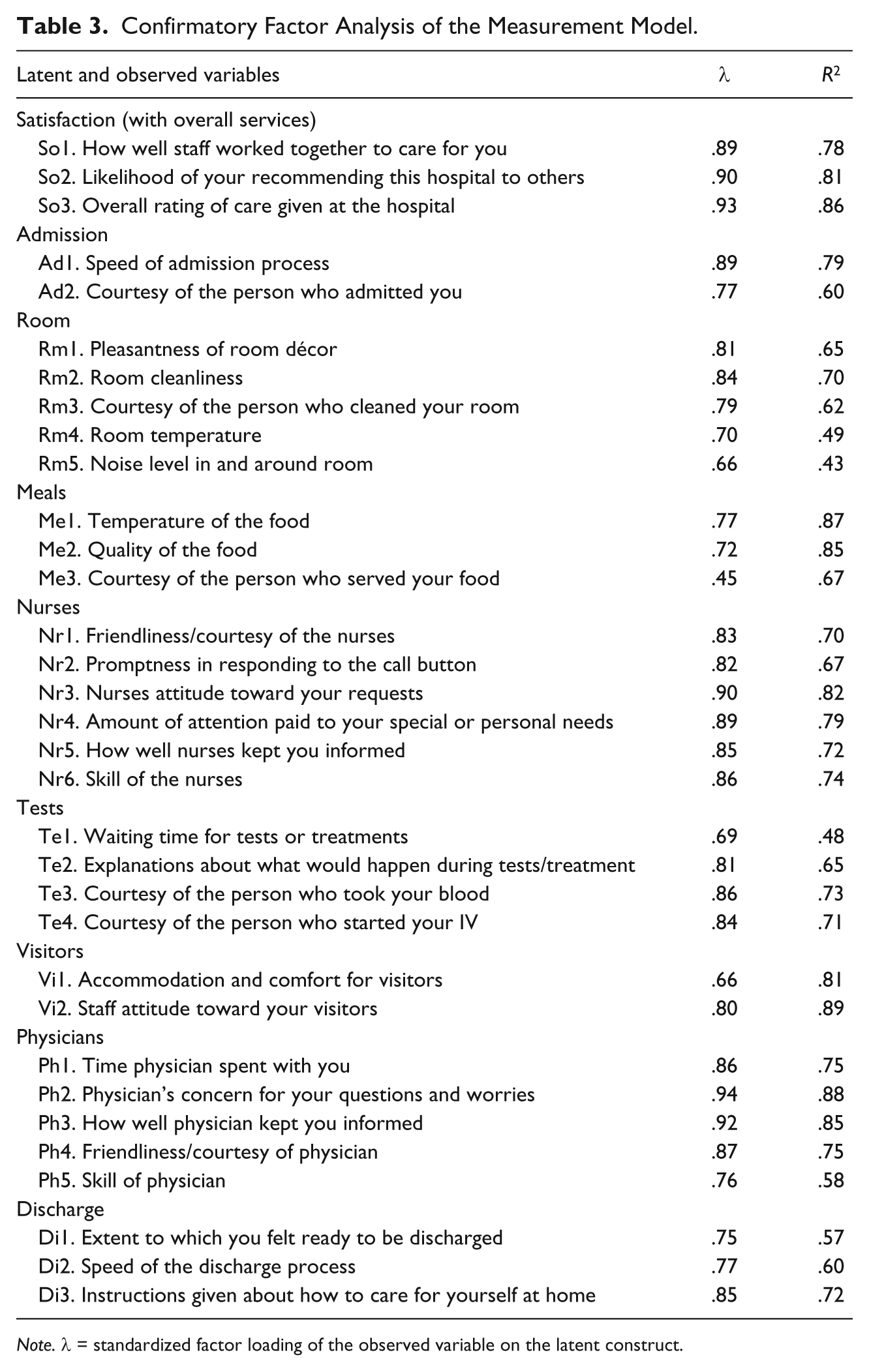
Note. λ = standardized factor loading of the observed variable on the latent construct.
To assess the fit of each model, three different approaches were used (i.e., incremental, parsimonious, and absolute). More specifically, the following three indices were used: the Comparative Fit Index (CFI), the Root Mean Square Error of Approximation (RMSEA) with 90% confidence intervals [CIs], and the Standardized Root Mean Square Residual (SRMR). In addition to offering different methods to assess model fit, these indices also offer the advantage of being among the most widely recommended indices (Byrne, 2010; Garson, 2012; Mueller & Hancock, 2008; West, Taylor, & Wu, 2012).
Results
Treatment of Control Variables
Prior research has revealed weak and inconclusive relationships between various demographic traits and overall satisfaction (Naidu, 2009). To obtain the most parsimonious model, tests of association were conducted between each of the demographic variables listed in Table 1, and the three indicators of overall satisfaction, to identify potential control variables. Among this sample, only race/ethnicity was unrelated to any of the three indicators of overall satisfaction (analysis not shown). Accordingly, the subsequent structural model controlled for the effects of age, gender, region, ED admission, length of stay, and self-rated health.
Various methods for handling control variables in SEM have appeared in the literature (Fletcher, Selgrade, & Germano, 2006; Kammeyer-Mueller & Wanberg, 2003). In this study, the approach recommended by Mueller and Hancock (2010) was used. Specifically, all control variables were allowed to covary as exogenous predictors within the model. To simplify the presentation, the structural paths between each control variable and the exogenous and endogenous variables are not shown. Similarly, the paths and associated indicators in the measurement model are omitted from the depicted structural model in the interests of clarity.
Hypothesis 1
To proceed with the first hypothesis, a measurement model was constructed consisting of the latent construct overall satisfaction and its three indicators. Standardized factor loadings and R2 values were calculated for each of the observed variables. The factor loadings function as validity coefficients, indicating how accurately the item measures the latent construct. Coefficients > .70 indicate relatively high loadings (Kline, 2011). The R2 values provide an assessment of the reliability of each observed measure with respect to its underlying latent construct (Joreskog & Sorbom, 1993). Ideally, the R2 values should be > .50 for each indicator in a confirmatory factor analysis (Kline, 2011). For this initial model, factor loadings ranged from .86 to .94 and the R2 values ranged from .74 to .88.
After establishing the validity of the measurement model, the structural model was constructed to test the first hypothesis. The model fit was assessed using the three fit indices mentioned above (i.e., CFI, RMSEA, and SRMR). For the CFI, values > .90 indicate a marginal fit while values > .95 indicate a good fit (Byrne, 2010). For the RMSEA, values < .08 represent a reasonable fit and values < .05 represent a good fit (Byrne, 2010), with values > .10 indicating a poor fit (Garson, 2012). For the SRMR, values less than 0.09 represent a good fit between the proposed model and the data (Mueller & Hancock, 2008). The values for the present model suggested the model fit the data well: χ2 = 94.847 (df = 16, p < .001), CFI = .994, RMSEA = .035 (90% CI = [.028, .042]), and SRMR = .0078.
Accordingly, the first hypothesis was supported—satisfaction with hospital staff’s efforts to address older adults’ spiritual needs was directly and positively associated with higher levels of overall satisfaction with service provision. The relationship between spiritual needs and overall satisfaction was significant (p < .001), with a standardized path coefficient of .55. Spiritual needs accounted for 34% of the variance in overall satisfaction. In terms of an effect size, the magnitude of the relationship between spiritual needs and satisfaction is commonly considered large (Cohen, 1988).
Hypothesis 2
To proceed with the second hypothesis, a measurement model was constructed consisting of the nine latent constructs—the eight mediators and overall satisfaction—and the corresponding indicators for each of the nine latent variables. All factor loadings were statistically significant. As presented in Table 3, the factor loadings and R2 values for each of the indicators were typically acceptable.
The values for the measurement model suggested a fairly reasonable fit: CFI = .945, RMSEA = .057 (90% CI = [.056, .059]), and SRMR = .0458. An examination of the modification indexes suggested adding measurement error covariances between the following indicators: Te3 and Te4, Ph4 and Ph5, and Rm3 and Me3. These recommendations may stem from the use of similar language to assess some of these items. Redundant wording—(i.e., “courtesy of the person who . . . ) can cause a method effect that, in turn, can be addressed through the application of an error covariance (Byrne, 2010). The addition of the recommended error covariances improved the model fit to a satisfactory level: CFI = .96, RMSEA = .050 (90% CI = [.048, .051]), and SRMR = .0450.
To test the second hypothesis, a structural model was constructed in which the relationship between spiritual needs and satisfaction was mediated by the eight constructs validated in the measurement model (see Figure 1). The fit indices for resulting mediation model were as follows: χ2 = 6,955.05 (df = 649, p < .001), CFI = .95, RMSEA = .049 (90% CI = [.048, .050]), and SRMR = .0396. These values suggest a reasonably good model fit. Given a good correspondence between the model and the data, the path coefficients can be examined.

Mediation model with standardized parameter estimates.
As implied in Figure 1, the eight potential mediators fully mediated the relationship between addressing spiritual needs and overall satisfaction. The coefficient for the path between spiritual needs and satisfaction was reduced from .55 to .02 in the mediation model. The non-significant .02 value suggests the significant mediators fully explained the relationship between spiritual needs and overall satisfaction. The final model explained 74% of variance in overall satisfaction.
All the potential mediators were significant with one exception. As the non-significant coefficient for the meal service variable indicates, satisfaction with the meal service did not mediate the relationship between spiritual needs and overall satisfaction. The strongest mediator was the nursing variable. The discharge process, visitors, and physicians were also important mediators, followed in magnitude by the admissions process, room quality, and the administration of tests and treatments.
Discussion
As perhaps the first study to examine the relationship between addressing older adults’ spiritual needs and overall satisfaction with service provision, this study sheds new light on this connection. As hypothesized, addressing inpatients’ spiritual needs was directly and positively associated with higher levels of overall satisfaction. This finding is consistent with prior research that has documented a similar relationship between spiritual needs and overall satisfaction (Astrow et al., 2007; P. A. Clark et al., 2003; Williams et al., 2011). The present study replicates this finding and extends it to older adults, a population for whom spirituality and religion are especially salient (Newport, 2012b; R. J. Taylor et al., 2007).
This study also posited that satisfaction with service delivery in a number of domains would mediate the relationship between spiritual needs and satisfaction. This hypothesis was confirmed. Of the seven significant mediators that emerged in this study, nursing played the most prominent role in accounting for the positive relationship between spiritual needs and satisfaction. Other variables that help explain the relationship were the discharge process, visitors, and physicians. Less prominent mediators were the admissions process, room quality, and the administration of tests and treatments.
Implications for Practice
The findings have important implications for practice with elderly hospitalized inpatients. Specifically, the direct relationship between spiritual needs and satisfaction underscores the importance of conducting a spiritual assessment. As Koenig (2012) recommends, some member of the health care team—a nurse, social worker, or a physician—should administer a spiritual assessment to identify older adults’ spiritual needs and concerns. Despite the Joint Commission and Medicare recommendations, research suggests that many patients’ spiritual needs are not addressed (Daaleman, Usher, Williams, Rawlings, & Hanson, 2008; Sharma et al., 2012; Williams et al., 2011). The first step in addressing spiritual needs is to identify them. The most appropriate way to identify the existence of spiritual concerns is through the administration of a spiritual assessment (Pargament, 2007).
Hospitals and other health care organizations may benefit from adopting a qualitative spiritual assessment tool. Although a number of quantitative approaches exist, every quantitative instrument reflects a certain set of culturally based suppositions about the nature of spirituality (Hill & Pargament, 2008). These instruments may have limited validity with populations for whom the instruments were not developed and standardized, an important concern in an American society characterized by increasing spiritual and religious diversity (Eck, 2001).
Accordingly, qualitative tools are typically recommended (Hodge, 2003; Koenig, 2007; Pargament, 2007). Although the Joint Commission (2008) does not specify the specific content and scope of a spiritual assessment, the sample spiritual assessment protocol featured on their website uses a qualitative approach. These approaches allow for the assessment of individualized expressions of spiritual needs and concerns across cultural groups. A number of qualitative assessment tools have been developed. An example of a brief assessment tool is the FICA model (Puchalski, 2001). Examples of conceptually distinct comprehensive assessment tools include spiritual: histories, lifemaps, genograms, eco-maps, and ecograms (Hodge, 2005).
The findings underscore the importance of health care practitioners in the process of addressing older adults’ spiritual needs. Although visiting clergy and congregants, in tandem with hospital chaplains, are often instrumental providers of spiritual care, the results of this study imply that the task of addressing older adults’ spiritual needs cannot be relegated solely to these individuals (Williams et al., 2011). Rather, nurses, social workers and other discharge planners, and physicians are also central players in this process.
As the health care practitioners who interact with patients most frequently, nurses play an instrumental role in addressing patients’ spiritual needs. As implied in the introduction, qualitative research suggests nurses’ provide spiritual care in diverse ways, including, for example, responding to requests, keeping patients fully informed, and treating older adults with courtesy and compassion. To increase their effectiveness in this realm, nurses must familiarize themselves with common manifestations of spiritual needs, among the general inpatient population (Davidson et al., 2008; Nixon & Narayanasamy, 2010) and older adults more specifically (Hodge et al., 2012; R. J. Taylor et al., 2007). Developing familiarity with common spiritual needs provides practitioners with the knowledge to pro-actively inquire about patients’ spiritual needs as well as to suggest ways in which they might be addressed.
Social workers and other discharge planners perform an array of tasks during the discharge process, including assessment, counseling, and the coordination of post-hospitalization services (Judd & Sheffield, 2010; Kadushin & Kulys, 1993). As part of this process, practitioners should typically include a “spiritual care discharge plan” (Koenig, 2012). As the length of hospitalization has decreased, often to just a few days, the importance of addressing patients’ spiritual needs during the discharge process has increased. Spiritual concerns that emerge during hospitalization may not be adequately processed during such brief time periods. Moreover, discharge planning plays an important role in preventing hospital readmission (Shepperd et al., 2010). A substantial body of research has linked spirituality with health and wellness (Koenig, King, & Carson, 2012). Developing a discharge plan that addresses any emergent spiritual needs while seeking to operationalize patients’ spiritual assets may foster health and wellness and prevent readmission.
Relative to other practitioners, physicians are uniquely positioned to address certain spiritual needs (Ellis & Campbell, 2004; Hodge & Horvath, 2011). As the lead member in the heath care team, physicians often play a critical role in helping patients sort through the ramifications of their diagnoses and subsequent treatment options (Koenig, 2007). To assist older adults in this process, physicians must familiarize themselves with commonly encountered spiritual belief systems (Koenig, 1998; Richards & Bergin, 2000), and their ramifications for medical care (Johnson, Elbert-Avila, & Tulsky, 2005). Such tradition-specific knowledge, in tandem with the provision of time, friendliness, and concern, can aid in addressing older adults’ spiritual needs.
Lack of education and time constraints can inhibit the provision of spiritual care (M. J. Balboni et al., 2013; Daaleman et al., 2008). Educational sessions might be implemented to assist practitioners become more comfortable and conversant in the process of administering spiritual assessments and providing spiritual care. In working with administrators to prioritize such trainings, advocates might highlight the new Affordable Care provisions that link funding to patient satisfaction, and the role that addressing patients’ spiritual needs can play in enhancing perceptions of overall satisfaction (Geiger, 2012; Neuhausen & Katz, 2012). This approach might also be useful in advocating for structural changes that allow dedicated time to address older adults’ spiritual needs.
Time constraints might also be addressed through the creation of Spiritual Care Committees, consisting of hospital chaplains, local clergy, patient representatives, and other relevant personnel. Such committees can support practitioners in addressing older adults’ spiritual needs by, for example, procuring information about medical options and discussing the spiritual ramifications of various options (Johnson et al., 2005). In other situations, they may be able to directly link patients with spiritual resources or facilitate spiritual interventions. Utilizing a team approach to identify and address patients’ spiritual needs may improve the provision of spiritual care and, indirectly, overall patient satisfaction.
Indeed, the results highlight the importance of collaboration in the provision of spiritual care. The diverse mediating pathways identified in this study suggest that no single person can completely address all the spiritual concerns that manifest during hospitalization. Rather, a collaborative approach is clearly warranted. Thus, the results of a spiritual assessment—depending on the nature of the information shared and the comfort level of the patient—might be shared with members of the Spiritual Care Committee and relevant practitioners. By identifying specific needs and working collaboratively as a unit, hospital personnel and allied individuals can help ensure that older adults’ diverse spiritual needs are adequately addressed.
Hospitals and other health care organizations might improve their capacity to address older adults’ spiritual needs by drawing from the experience of hospice care. The hospice movement, which has long emphasized the provision of holistic services (D. Clark, Small, Wright, Winslow, & Hughes, 2005), frames the spiritual needs of terminally ill individuals and their families as a central element of end-of-life care (Angeli, 2013). This approach is noteworthy as research on the experience of hospice patients suggests that the practice of addressing the spiritual needs of individuals has important implications in terms of patient satisfaction and the effective provision of services (Stephenson, Draucker, & Martsolf, 2003). Drawing from this approach, leaders in palliative care have followed suit by advocating for the integration of spiritual care as an essential component of the end-of-life services offered to individuals in hospital-based palliative care settings (Puchalski, 2007; Puchalski et al., 2009). To this end, recent efforts have been made to incorporate education in spirituality into the formation of health care practitioners bound for careers in palliative care (Bosma et al., 2010; Marr, Billings, & Weissman, 2007; Yardley, Walshe, & Parr, 2009).
Drawing from the basic approach utilized in end-of-life care, health care practitioners in hospital settings might make efforts to integrate a focus on spiritual needs into the care plans of patients. For instance, as is often the approach with terminal patients (Higginson & Evans, 2010), practitioners might be organized into care teams in which providers of various disciplines collaborate to address the holistic needs of patients, including spiritual needs. Following the example of palliative care, this approach might involve the integration of spiritual content into the curriculum of nursing, medical, social work, and other schools where health care workers are educated.
Indeed, studies across disciplines have found that most health care practitioners have received little, if any, training in spirituality and religion during their educational careers (Koenig, 2013). These findings underscore the need to integrate content on spirituality and religion into curricula. Instruction on these topics is critical to the provision of ethical and effective services. For example, education can help counter misperceptions that addressing spiritual needs is a not a component of health care (Puchalski et al., 2009). Similarly, training in the process of administering spiritual assessments can help health care practitioners develop the necessary skill sets needed to conduct such assessments in an ethical manner that respects patients’ value systems.
Limitations
As with any study, there are limitations that should be considered when interpreting the findings. For example, the use of a single-item measure to assess spiritual needs may have biased the findings in a number of ways. Assuming the spiritual needs question measured the underlying construct without error is untenable. For example, although research suggests older adults tend to view spirituality and religion as largely synonymous terms (Musick et al., 2000), it is possible that some respondents may have understood spirituality in a more restrictive manner that did not include religion. This would limit the validity of the spiritual needs question for such individuals, particularly if they viewed their needs in exclusively religious terms.
Additional limitations include: the cross-sectional nature of the data, the use of self-report measures, and the possibility of various types of response set bias. ML estimation is relatively robust but its use with moderately non-normal data may attenuate parameter estimates (Finney & DiStefano, 2006). It should also be noted that alternative models, untested in this present study, may also exist that fit the data.
Although the use of a geographically diverse sample helps to counter possible regional biases, the use of a non-random sampling design precludes generalizing the results to other samples of older adult inpatients (Babbie, 2013). For instance, as noted in the Method section, the spiritual needs question is an optional item that must be requested by hospitals. It is possible that hospitals requesting the inclusion of this item in the survey may be particularly committed to addressing patients’ spiritual needs relative to hospitals that did not request its inclusion.
The issue of clustered data should also be noted (Krull & MacKinnon, 2001). The older adults in this study were nested in hospitals. It is plausible that individuals who attended a given hospital may differ from those who attended a different hospital in the same geographic region. Although the study controlled for geographic region, hospital-specific information was unavailable due to IRB considerations. The inability to control for the possible effects associated with attending a specific hospital may have biased the results.
Racial and ethnic minority respondents were also under-represented in the sample relative to the national population (Administration on Aging, 2011). As spirituality tends to be more salient among African Americans and Latinos, this may have introduced some bias into the findings (Newport, 2012a). Further research is needed with other samples comprised of older adults from various racial and ethnic groups. Such research should include hospitalized inpatients as well as those in other health care settings.
Conclusion
Spirituality plays an important role in the lives of most older adults (Newport, 2006; Newport, 2012b; R. J. Taylor et al., 2007). As one of the first studies to examine the relationship between addressing older adults’ spiritual needs and overall satisfaction with service provision during hospitalization, this study fills an important gap in the literature. The results indicate that addressing spiritual needs is positively associated with overall satisfaction and that this relationship is fully mediated by seven variables: nursing staff, the discharge process, visitors, physicians, the admissions process, room quality, and the administration of tests and treatments.
The diverse array of mediating pathways identified highlights the importance of practitioners working collaboratively to address older adults’ spiritual needs. Concurrently, nurses and, to a lesser extent, discharge planners, visitors, and physicians appear to play a particularly salient role in addressing the spiritual needs of elderly inpatients. By working together, practitioners can optimize service provision in an area that is often of critical importance to older adults.
Footnotes
Declaration of Conflicting Interests
The author(s) declared no potential conflicts of interest with respect to the research, authorship, and/or publication of this article.
Funding
The author(s) disclosed receipt of the following financial support for the research, authorship, and/or publication of this article: Preparation of this article was supported by a grant from the John A. Hartford Foundation.