



Abstract
Responding to the limited literature on computer use in ethnic minority older populations, the present study examined predictors of computer use and computer anxiety in older Korean Americans. Separate regression models were estimated for computer use and computer anxiety with the common sets of predictors: (a) demographic variables (age, gender, marital status, and education), (b) physical health indicators (chronic conditions, functional disability, and self-rated health), and (c) sociocultural factors (acculturation and attitudes toward aging). Approximately 60% of the participants were computer-users, and they had significantly lower levels of computer anxiety than non-users. A higher likelihood of computer use and lower levels of computer anxiety were commonly observed among individuals with younger age, male gender, advanced education, more positive ratings of health, and higher levels of acculturation. In addition, positive attitudes toward aging were found to reduce computer anxiety. Findings provide implications for developing computer training and education programs for the target population.
In the past few decades, the rate of computer use in the aging population has substantially increased. According to the Pew Research Internet Project (2014), more than half (59%) of the U.S. adults aged 65 and older are users of computers and the Internet, and this figure reflects a considerable increase from the 20% reported a decade earlier. The benefits that the use of computer offers to older adults are multiple, including convenience in daily life (e.g., bill payment, online shopping, and online banking), social connectedness, information acquisition, cognitive gain, and the enhanced quality of life (Chen & Persson, 2002; Sum, Mathews, Hughes, & Campbell, 2008; Wagner, Hassanein, & Head, 2010; Wong, Yeung, Ho, Tse, & Lam, 2013; Xie, 2012).
A higher rate of computer use in older adults with younger age, male gender, and higher socioeconomic status has consistently been reported (Choi & Dinitto, 2013; Werner, Carlson, Jordan-Marsh, & Clark, 2011). The health profiles of older computer-users have also shown to be more favorable than non-users (Gracia & Herrero, 2009; Werner et al., 2011); however, some studies suggested a particular benefit of computer use among older adults with health issues or functional challenges (Laken, Órourke, Duffy, Swinton, & Jordan, 2004; Pew Research Internet Project, 2011). For such individuals, the use of computers might serve as a mechanism in which their loss of health and function is compensated and their continued social engagement is enabled.
With regard to race and ethnicity, it is widely known that older African Americans and Hispanics are less likely to use computers than older Whites (Choi & Dinitto, 2013); however, there has been limited attention to other groups of racial/ethnic minorities (Wong et al., 2013). For example, Asian American population in general has shown to have a high rate of computer use (U.S. Census Bureau, 2012b), but not much is known about its older members. Recognizing the diversities within Asian Americans and age group variations, the present study focuses on older members of its fifth largest subgroup, Korean Americans (U.S. Census Bureau, 2012a). The number of Korean Americans increased by 214% between 1990 and 2010, from 798,846 to 1,706,822, making up about 10% of the total Asian American population (U.S. Census Bureau, 2012a).
The present study examined both the levels and the predictors of computer use and computer anxiety in older Korean Americans. Due to the potential overlap between the two constructs, we treated computer use and computer anxiety as separate outcome variables. It was also anticipated that the exploration of factors associated with each of the outcome variables would provide practical implications that can effectively address the broad issues on computer use in the target population. The set of variables considered includes demographic characteristics (e.g., age, gender, marital status, and education), physical health indicators (e.g., chronic conditions, functional disability, and self-rated health), and sociocultural factors (e.g., acculturation and attitudes toward aging).
Building upon the aforementioned literature on the role of demographics and physical health in computer use, a particular attention was paid to the sociocultural factors. We selected acculturation and attitudes toward aging as variables of interest as they represent important personal resources that may shape older individuals’ perceptions and behaviors. Acculturation, defined as the degree to which a person from another culture has learned new language, customs, and behaviors expected of persons who live in the host culture, is widely known to have a positive impact on social adaption in older immigrants (Berry, 2002; Suinn, 2010). Older immigrants with higher levels of acculturation tend to have a better access to resources and services and be more likely to be engaged in social and educational opportunities (Jang, Kim, Chiriboga, & King-Kallimanis, 2007). Along the same line, acculturation is expected to reduce older immigrants’ anxiety about computers and serve as a promoter of the computer use. The inclusion of attitudes toward aging is based on the recognition of its strong association with better adjustment to changes in old age and desire for autonomy and independence in older populations (Jang, Poon, Kim, & Shin, 2004; Levy, Slade, Kunkel, & Kasl, 2002). It is anticipated that individuals with positive attitudes toward aging would be more likely to use computers and experience lower levels of computer anxiety.
Method
Participants
After obtaining approval from the university’s Institutional Review Board, surveys with older Korean Americans (aged ≥ 60) were conducted during the spring of 2013 in Central Texas. Participants were recruited through a variety of sources including local Korean religious organizations, businesses, senior centers, and ethnic elder associations. Referrals from a variety of sources were actively sought to reach a wide range of individuals who were not affiliated with those groups or organizations. The survey questionnaires were in Korean and developed through a back translation and reconciliation method. Although questionnaires were designed to be self-administered in Korean, trained bilingual interviewers were available for anyone who needed assistance. Data collection was conducted in locations convenient to the participants, such as meeting rooms and cafeterias in churches and community centers. A total of 209 individuals signed consent forms, completed the survey, and were paid $10 for their participation. None of them had more than 5% missing information on the variables used in the present investigation.
Measures
Outcome variables
Computer use was assessed with a single yes/no question: “Are you a computer-user?” Computer anxiety was measured with a 10-item subscale of the Loyd–Gressard Computer Attitude Scale (Loyd & Gressard, 1984). The scale has been validated and used with diverse groups of older adults and racial/ethnic minorities (Czaja et al., 2006; Xie & Bugg, 2009). Participants were asked to report how much they agreed with such statements as “Working with a computer would make me very nervous” and “Computers make me feel uneasy and confused.” The responses were coded as 0 (strongly disagree), 1 (disagree), 2 (agree), and 3 (strongly agree). Total scores range from 0 to 30 with higher scores indicating greater levels of computer anxiety. Internal consistency for the present sample was high (α = .98).
Physical health indicators
The three indicators used for the assessment of physical health were chronic conditions, functional disability, and self-rated health. Participants were asked to report existing chronic conditions diagnosed by medical doctors from a 9-item list (e.g., heart diseases, diabetes, arthritis, and cancer). The total number of the diagnosed chronic conditions was used for the analysis.
Functional disability was assessed with a 9-item composite measure adapted from the Older Americans Resources and Services questionnaire (Fillenbaum, 1988). Participants were asked to report whether they could perform each activity, such as eating, preparing meals, taking medication, and traveling. The responses were coded as 0 (without help) and 1 (with help), and total scores range from 0 (no functional disability) to 9 (severe functional disability). Internal consistency was satisfactory in the sample (α = .81).
Self-rated health (SRH) was measured with a single question asking, “How would you rate your overall health?” The four-point scale response was dichotomized into 0 (excellent/good) or 1 (fair/poor).
Sociocultural factors
The level of acculturation was assessed with a 12-item inventory of acculturation (Jang et al., 2007). The items address English proficiency, frequency of English use, consumption of audiovisual media, consumption of printed media, food consumption at home, food consumption outside the home, ethnicity of friends, social gathering, sense of belonging, getting along, familiarity to culture and custom, and celebration of holidays. Each response was coded from 0 to 3. Total scores range from 0 to 36, with higher scores indicating greater levels of acculturation. Internal consistency for the present sample was high (α = .93).
Attitudes toward aging were assessed with a 5-item subscale of the Philadelphia Geriatric Center Morale Scale (Lawton, 1975). The items include, “Do things keep getting worse as you get older?” “Do you have as much pep as you had last year?” “Do you feel that as you get older you are less useful?” “As you get older, are things better than you thought?” and “Are you as happy now as you were when you were younger?” Responses were coded on a yes/no format. Total scores range from 0 to 5, with higher scores indicating more positive attitudes toward aging. Internal consistency for the present sample was low but acceptable (α = .67).
Demographic variables
Demographic information included age (in years), gender (0 = male, 1 = female), marital status (0 = married, 1 = unmarried), and education (0 = <high school graduation, 1 = ≥ high school graduation).
Analytic Strategy
In addition to the descriptive characteristics of the overall sample, comparisons between computer-users and non-users were explored using t test and χ2 analysis. After assessing correlations among study variables, regression models were tested. For the binary outcome variable (computer use), logistic regression model was used, and linear regression model was estimated for the continuous outcome variable (computer anxiety). The predictors considered were (a) demographic variables, (b) physical health indicators, and (c) sociocultural factors. All analyses were performed using IBM SPSS Statistics 22.
Results
Descriptive Information
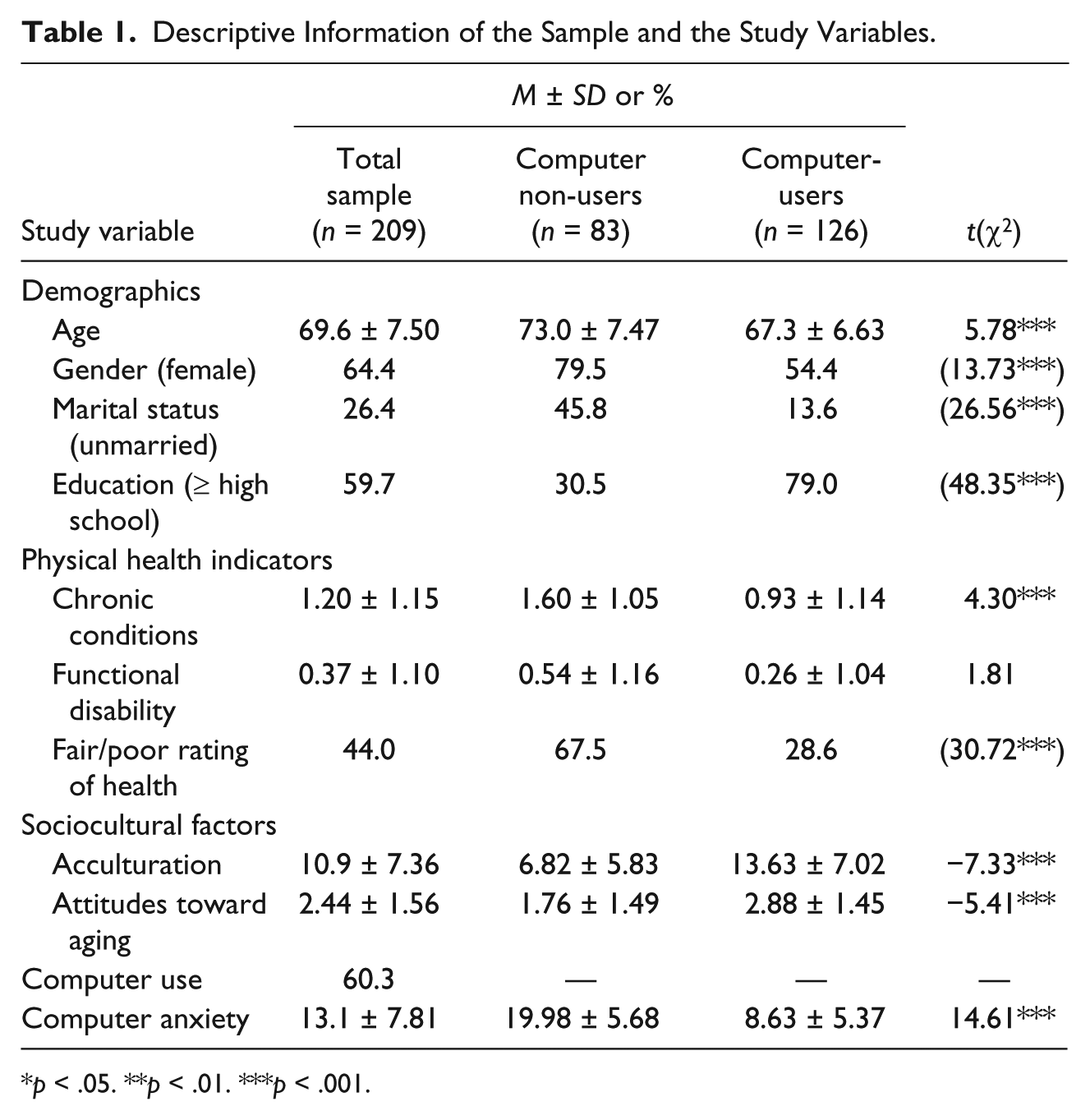
Table 1 summarizes descriptive information on the total sample and comparisons between computer-users and non-users. The sample consisted of 209 Korean Americans aged 60 to 95, with an average age of 69.6 years (SD = 7.50). More than 60% of the participants were females. More than a quarter (26.4%) of the participants were unmarried, and 60% received a high school education or more. The scores of chronic conditions and functional disability averaged 1.20 (SD = 1.15) and 0.37 (SD = 1.10), respectively. About 44% of the sample rated their health as either fair or poor. The mean scores of acculturation and attitudes toward aging were 10.9 (SD = 7.36) and 2.44 (SD = 1.56), respectively. The level of computer anxiety was at a moderate level with an average of 13.1 (SD = 7.81) with a range between 0 and 30. About 60% of the participants were found to be computer-users.
Descriptive Information of the Sample and the Study Variables.
p < .05. **p < .01. ***p < .001.
In comparisons between computer-users and non-users, a substantial difference was observed. Those who were using computers were more likely to be younger, male, married, more educated, and healthier than non-users. With regard to sociocultural factors, computer-users had higher levels of acculturation and more positive attitudes toward aging than their counterparts. As expected, computer-users had significantly lower levels of computer anxiety than non-users.
Predictive Models of Computer Use and Computer Anxiety
Prior to conducting regression analyses, bivariate correlations among study variables were assessed (not shown in tabular format). All correlation coefficients were in the expected direction, and no concern about collinearity was detected except the correlation between computer use and computer anxiety (r = −.71, p < .001). As might be expected, those who did not use computers were likely to have higher levels of computer anxiety. The finding from the bivariate correlation analysis validated the proposed approach of treating computer use and computer anxiety as separated outcome variables.
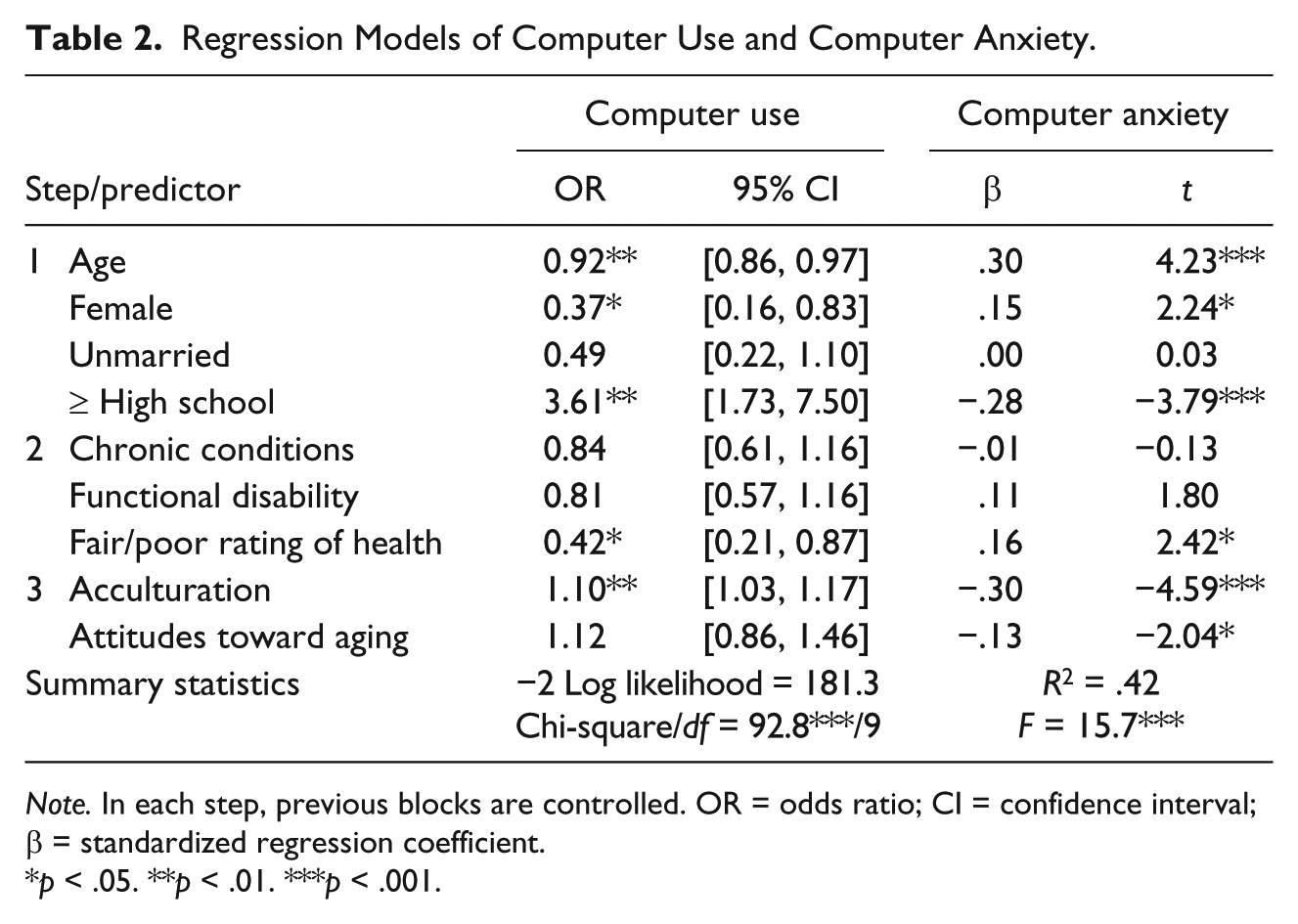
Table 2 summarizes the results of the regression analyses. In the initial model of computer use, age, gender, and educational attainment emerged as significant predictors. In the subsequent entry of physical health indicators, the likelihood of computer use was reduced by 58% when an individual had a fair/poor rating of health. In the final model with sociocultural factors, higher levels of acculturation substantially increased the likelihood of using a computer.
Regression Models of Computer Use and Computer Anxiety.
Note. In each step, previous blocks are controlled. OR = odds ratio; CI = confidence interval; β = standardized regression coefficient.
p < .05. **p < .01. ***p < .001.
In the linear regression model of computer anxiety, advanced age, female gender, lower education, a fair/poor rating of health, and lower levels of acculturation emerged as significant predictors. In addition, the level of computer anxiety was found to be significantly reduced by positive attitudes toward aging. The total amount of variance explained by the estimated model was 42%, F(9, 194) = 15.7, p < .001.
Discussion
In response to the limited literature on computer use in ethnic minority older populations, this study explored the factors associated with computer use and computer anxiety with a sample of 209 older Korean Americans. Approximately 60% of the participants were computer-users, and they had significantly lower levels of computer anxiety than their non-computer-using counterparts. The higher likelihood of computer use and lower levels of computer anxiety were commonly observed among individuals with younger age, male gender, and advanced education. The findings are in accordance with the general demographic profiles of older computer-users (Pew Research Internet Project, 2014). Findings suggest that a digital divide exists for certain segments of the sample and call attention to individuals with advanced age, females, and the less educated. In particular, the fact that older women were not only less likely to be a computer-user but also experienced higher levels of computer anxiety suggests that various types of motivational strategies should be considered for older women to help them become interested in and familiar with the use of computers. In addition, educational programs should attend to the psychological aspects (i.e., reducing computer anxiety) as well as providing computer skills training.
Among the three physical heath indicators considered, only self-rated health reached the statistical significance in predicting computer use and computer anxiety. Similar to the findings from previous literature (Gracia & Herrero, 2009; Werner et al., 2011), those who had positive ratings of health were likely to use a computer and be less anxious about computer use. In other words, older adults with adverse physical health conditions might be more prone to the emotional and behavioral challenges in the use of computers (Pew Research Internet Project, 2014).
Supporting the hypotheses, sociocultural factors were shown to make an important contribution to the predictive models after adjusting for demographic and health profiles. Acculturation emerged as a significant predictor for both computer use and computer anxiety whereas attitudes toward aging were significant only for computer anxiety. Because acculturation is a proxy for socioeconomic status (Berry, 2002; Suinn, 2010), older individuals with high acculturation might be relatively more advantaged than individuals with low acculturation in terms of their access to computers and training opportunities, which makes them feel more comfortable with the computer use. Both acculturation and positive attitudes toward aging were found to play an anxiety-reducing role. It is speculated that older individuals with high levels of acculturation and favorable perceptions of aging may be more willing to embrace new challenges (e.g., computers and technologies).
Given the nature of a non-representative and regionally defined sample and a cross-sectional design, the findings are only suggestive. Future studies should revisit the topic with a representative sample and longitudinal approach. The use of self-reported measures and the lack of diagnostic assessment of health conditions add to the limitations. Future research should utilize objective health indicators. Despite these limitations, findings from the present study help better understand the factors associated with computer use and computer anxiety in older Korean Americans. Findings provide implications for designing and implementing computer training and education programs for the target population.
Footnotes
Declaration of Conflicting Interests
The authors declared no potential conflicts of interest with respect to the research, authorship, and/or publication of this article.
Funding
The author(s) disclosed receipt of the following financial support for the research, authorship, and/or publication of this article: This work was supported by the St. David’s Center for Health Promotion and Disease Prevention Research (CHPR) Pilot Grant Program (#30-2142-4351, PI−Yuri Jang, PhD).