



Abstract
The study examined the effect of a body-mass-based home exercise program on cognitive functioning among 170 male and female elderly people (52-81 years). This program comprised five kinds of resistance exercises that elderly people can perform at home without supervision or specialized equipment using only their body mass for resistance. Various cognitive tasks were used to assess cognitive functioning, including a simple reaction task, Go/No-Go reaction task, Stroop task, serial subtraction task, and coincident timing task. These tasks were performed before and after a 3-month body-mass-based home exercise program. Although there were no significant improvements in the simple reaction and coincident timing tasks, significant improvement was shown in the Go/No-Go reaction task and serial subtraction task. This study shows that even simple resistance exercise, using only body mass for resistance, may be an effective method for preventing age-related cognitive decline of inhibitory control and working memory among elderly people.
Introduction
Cognitive functions that underlie daily living activities, such as memory and information processing speed, reach their peak during early adulthood; show a gradual decline from middle to late adulthood; and, after the age of 60 years, show a rapid decline (Baltes & Lindenberger, 1997; Park et al., 2002; Park et al., 1996; Salthouse, 1996; Schaie, 2008). However, individual differences exist in the degree of cognitive aging, such as in the decrease of perceptual speed or memory (Baltes & Lindenberger, 1997). Therefore, various interventions to prevent cognitive aging have been developed; moreover, in recent years, the effects of physical exercise have received attention. In particular, the present study focused on the effect of a long-term body-mass-based home exercise program, which includes five kinds of resistance exercises that elderly people can easily perform at home without supervision or specialized equipment because they use only their own body mass for resistance, on various cognitive functions in elderly people.
Cognitive aging is thought to be accompanied by the deterioration of brain tissue and functioning in a number of brain regions (e.g., Erickson, Leckie, & Weinstein, 2014; Fjell & Walhovd, 2010; Park, Polk, Mikels, Taylor, & Marshuetz, 2001). For example, studies with humans have clarified that people with higher levels of physical fitness have preserved brain functioning in the prefrontal, parietal, and temporal cortices as well as in the hippocampus (Colcombe et al., 2003; Erickson et al., 2009; Tian et al., 2014) and that fitness improved by interventions correlates with changes in hippocampal volume (Liu-Ambrose, Nagamatsu, Voss, Khan, & Handy, 2012; Maass et al., 2015; ten Brinke et al., 2015). Therefore, people with greater physical fitness demonstrate better performance on tasks that measure higher order cognitive functions than do those with poorer physical fitness. Specifically, those who are more physically fit outperform those who are less physically fit on executive function tasks and memory tasks (Chodzko-Zajko & Moore, 1994; Hillman, Buck, Themanson, Pontifex, & Castelli, 2009; Sibley & Etnier, 2003; Themanson & Hillman, 2006; Voss et al., 2010). Moreover, physical exercise is thought to increase brain-derived neurotrophic factors (BDNFs; Erickson et al., 2011; Griffin et al., 2011; Laske et al., 2010), which are known to foster neuronal growth in the brain (McAllister, Katz, & Lo, 1999); bring about structural and functional changes in specific areas of the brain, such as the prefrontal area and hippocampus (Colcombe et al., 2006; Colcombe et al., 2004; Erickson et al., 2007); and facilitate performance on cognitive tasks (Colcombe & Kramer, 2003). Indeed, physical fitness strongly correlates to brain and cognitive functioning; thus, physical exercise may be a powerful way to prevent cognitive aging.
The majority of the literature on the links between physical fitness and cognitive functioning has focused on cardiovascular fitness and aerobic exercise. For instance, in a meta-analysis by Colcombe and Kramer (2003), it was reported that the combination of resistance exercise and aerobic exercise had a greater effect on cognitive functioning than did aerobic exercise alone. There have also been some findings related to muscle fitness and the effect of resistance exercise on cognitive functioning (Cassilhas et al., 2007; Dorner et al., 2007; Liu-Ambrose et al., 2010; Nakamoto et al., 2012). These studies have focused on comparisons between resistance exercise and no exercise (Liu-Ambrose et al., 2008; Perrig-Chiello, Perrig, Ehrsam, Stähelin, & Krings, 1998) and comparisons of various types of exercise, including aerobic exercise (Brown, Liu-Ambrose, Tate, & Lord, 2009). Moreover, some studies have compared exercise intensity (Cassilhas et al., 2007) and frequency (Liu-Ambrose et al., 2010; also see Chang, Pan, Chen, Tsai, & Huang, 2012, for review). In these studies, it was reported that muscle fitness is positively related to cognitive functioning and that cognitive aging could be prevented by resistance exercise.
Thus, there is an increasing need to establish practical exercise programs that can be performed at home without supervision, or to create specialized equipment to prevent age-related loss of muscle mass and cognitive functioning (Yoshitake, Takai, Kitamura, Kawanishi, & Kanehisa, 2011). However, previous research (Cassilhas et al., 2007; Liu-Ambrose et al., 2010) has focused on moderate- and high-intensity resistance exercise. Furthermore, recent evidence has shown that body-mass-based exercises have the potential to improve muscle fitness and cognitive functioning in middle-aged and older adults (Nakamoto et al., 2012; Yoshitake et al., 2011). For instance, Nakamoto et al. (2012) examined the effects of a body-mass-based home exercise program on cognitive functioning in men without disabilities; they used the same exercises as used by Yoshitake et al. (2011) and reported that the strength capability of the knee extensor was associated with global cognitive functioning of older adults (age 61-79 years). Moreover, the absolute change in the strength capability of the knee extensor after a 3-month body-mass-based home exercise program was significantly correlated with cognitive functioning. However, Nakamoto et al. used the Mini-Mental State Examination (MMSE), which assesses global cognitive functioning (Folstein, Folstein, & McHugh, 1975); therefore, they did not report the type of the cognitive functioning that improved after body-mass-based resistance exercise. Thus, it is still unknown which cognitive functions are affected by body-mass-based resistance exercise. This seems important to determine as previous studies (Colcombe et al., 2004) have demonstrated that aerobic exercise selectively promotes memory and executive functions. Taken together, it seems possible that body-mass-based exercise selectively promotes some cognitive functions, but not others. Moreover, simple resistance exercise using only their body mass as resistance could be the most useful exercise program especially for elderly people who cannot frequently go to the gym. That is, additional studies are needed to clarify the effects of a body-mass-based home exercise program on cognitive aging.
Therefore, the purpose of the present study was to examine the types of cognitive functions that would be improved by a body-mass-based home exercise program in a sample of elderly individuals. To this end, the present study used a simple reaction task (information processing speed), a Go/No-Go reaction task (inhibitory function), a Stroop task (attentional function), a serial subtraction task (working memory), and a coincident timing task (timing ability) as the cognitive tasks. The cognitive tasks were administered to the participants before and after a 3-month body-mass-based home exercise program (Yoshitake et al., 2011).
Method
Participants
In this study, participants were recruited separately with the cooperation of the local government. We included those who (a) could participate in both the pre and posttests of five kinds of cognitive function, (b) were living independently in their own home, and (c) were permitted to perform the exercise after medical screening before participation. On the contrary, we excluded those who (a) were participating in a specific program of physical exercise, (b) needed a cane or walking aid to walk, and (c) had some type of disease or stroke (as stated in the next paragraph). As a result, 144 (39 males, 105 females) and 26 (10 males, 16 females) participants with an age range of 52 to 81 years were recruited as the training group and control group, respectively.
All participants were medically screened before participation. They were required to answer questions on a medical interview sheet, which asked them whether they were under medical treatment for any cardiovascular, metabolic, immunologic, and neurological disorders, as well as about orthopedic abnormalities. They were all free from these diseases or stroke and not on any medication for impaired muscle functioning. In addition, in this interview sheet, they were asked to report the intensity of their daily activity.
Each participant was informed about the purpose of the study, the procedures, and the possible risks before the study began. Written informed consent was obtained from all participants. This study was approved by the ethics committee of the National Institute of Fitness and Sports in Kanoya, Japan, and was conducted in accordance with the Declaration of Helsinki.
Body-Mass-Based Exercise Program
One week after the cognitive tasks were first administered (i.e., pretest), 144 participants completed a 3-month body-mass-based home exercise program. The program consisted of five exercises: (a) sitting down and standing up from a chair, (b) hip joint extension and flexion, (c) calf raises, (d) side leg raises in a standing position, and (e) trunk flexion and extension in a seated position. Participants were asked to continuously perform each exercise 16 times at a tempo of once per 2 s. As such, performing one exercise took about 35 s. In addition, participants were asked to perform another exercise after finishing one exercise, as in circuit training. That is, one circuit of all five exercises took about 3 min. The participants were instructed to perform two or three circuits every day. All participants performed the exercises 6 days a week in their own house, and once a week at a local gym as part of an exercise class. The participants were asked to record the number of circuits they performed every day. In contrast, the 26 participants in the control group took part in the pre- and posttests, but did not perform the 3-month body-mass-based home exercise program. They were instructed to maintain their lifestyle as usual.
Cognitive Tasks and Measurements
Five cognitive tasks were used to examine which cognitive functions were promoted by the body-mass-based resistance exercise. Of these tasks, the simple reaction task (Lee et al., 2012), Go/No-Go reaction task (Ben-Itzhak, Giladi, Gruendlinger, & Hausdorff, 2008), and Stroop task (Liu-Ambrose et al., 2008; Liu-Ambrose et al., 2010) have been used to measure the cognitive function of elderly people. All tasks were administered via a custom LabVIEW program (LabVIEW 7.1; National Instruments, Austin, TX, USA). The task was run on a laptop with a 15.6-inch monitor (ProBook 4510s, Hewlett-Packard, Tokyo). Each task began with a white cross displayed for 3 s on the laptop screen.
Simple reaction task
The simple reaction task evaluates participants’ information processing speed. Participants were required to press the “Enter” key on the laptop keyboard in response to a circle (blue or red) that appeared after the white fixation cross disappeared on the monitor. Participants were instructed to respond as quickly as possible. Ten trials were presented to each participant. The mean response time of the interval between the appearance of the circle and the key press was used as the performance measure for this task.
Go/No-Go reaction task
The Go/No-Go reaction task evaluates participants’ inhibitory control. During this task, participants were instructed to press the “Enter” key as quickly as possible only when the blue circle appeared (not when the red circle appeared). Each circle (i.e., blue and red) was presented 10 times in a random order. The mean response time to the blue circle was used as the performance measure for this task.
Stroop task
The Stroop task measures participants’ attentional control. This task consists of the name of a color printed in colored ink that either matches the color (e.g., “red” printed in red ink: a congruent condition), or mismatches the color (e.g., “red” printed in blue ink: an incongruent condition). Participants named the written word by pressing the corresponding key to the color word as quickly as possible; this required them to ignore the ink color. There were nine possible stimuli (i.e., 3 words × 3 colors) that were presented in random order 5 times. The mean reaction time to the incongruent condition was used as the performance measure for this task.
Serial subtraction task
The serial subtraction task, which is subtest of the MMSE, assesses participants’ working memory. During this task, an examiner asked the participants to perform serial subtraction of 7 s (backward from 100 to 65). The test continued until the participants either failed to calculate or correctly answered five subtractions. The number of correct answers out of all five subtractions was used as the performance measure for this task.
Coincident timing task
The coincident timing task evaluates participants’ timing ability. During this task, a target moved horizontally from left to right toward a fixed target on the screen over 1.5 s. However, the moving target disappeared for the last 500 ms of the 1.5 s. Participants had to press the “Enter” key at the time that the moving target would have reached the top of the fixed target. Ten trials were presented to each participant. The mean absolute temporal error, which is the interval between the time when the moving target reached the top of the fixed target and the participants’ key press, was used as a performance measure for this task.
Statistical Analysis
First, regarding the characteristics of the control and training groups, a t test and chi-square test for cross-tabulation were used to compare the age, height, weight, and self-reported intensity of daily activity between the groups. Second, concerning the effect of the 3-month body-mass-based home exercise program on each cognitive task, a two-way ANOVA, with a 2 (group: control, training) × 2 (test: pretest, posttest) design, was used. If there was a significant interaction, the Bonferroni post hoc test was performed. Statistical significance was set at p < .05. Third, a post-power analysis was conducted using G*Power, which is a free power analysis program for a variety of statistical tests, to confirm whether the sample size was adequate.
Results
Table 1 shows the characteristics of the control and training groups before intervention. Although the weight of the training group (55.7 ± 7.9 kg, M ± SD) was significantly more than that of the control group (52.1 ± 10.4 kg), t(167) = −2.02, p < .05, there was no significant difference in age and height between the training and control groups. Regarding the self-reported intensity of daily activity, the highest response rate was for answering “very low” in both the training and control groups (66.7% and 50%), and there was no significant difference for all response rates between the two groups. However, the post-power analysis indicated the power of .50 to .74.
Characteristics of the Control and Training Groups Before Intervention.

Note. The values are the M ± SD or n (%), as noted. The p values for group differences were computed from the t test or chi-square test for cross-tabulation, as appropriate.
Figure 1 shows the performance of the control and training groups at pre- and posttests for each cognitive task. First, our analysis of the response time of the Go/No-Go reaction task showed a significant main effect of test, F(1, 168) = 4.04, p < .05,
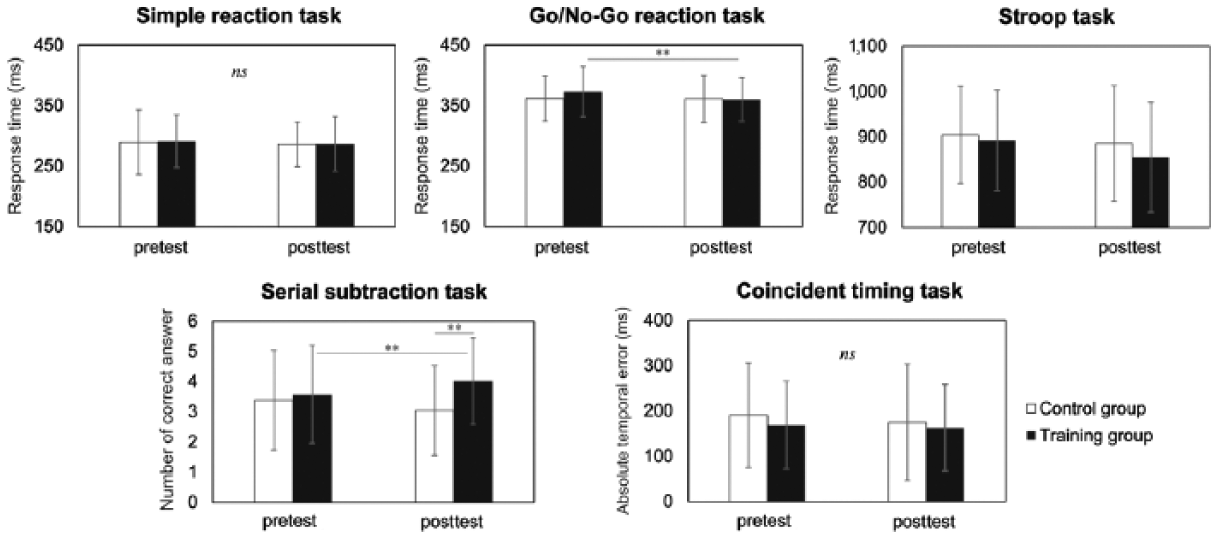
Performance on each of the five cognitive tasks.
Discussion
The goal of this investigation was to examine the types of cognitive functions that would be improved in a sample of elderly individuals by a body-mass-based home exercise program that includes five kinds of resistance exercise that elderly people can easily perform at home without supervision or specialized equipment because they use only their own body mass for resistance. The results indicated that inhibitory control and working memory did improve after completing a body-mass-based home exercise program, while processing speed, attentional control, and timing ability were not improved by the intervention. There are several hypotheses in the existing literature that offer explanations for individual differences in cognitive aging. For instance, Hasher and Zacks (1988) proposed that age-related decline of linguistic performance could be accounted for by the reduction in the storage capacity of working memory due to inefficient inhibitory control. Moreover, Shigemori, Ohgi, Okuyama, Shimura, and Schneider (2010) reported that the MMSE subtests are grouped into three main factors and that, of those three factors, working memory was most closely related to the earliest stage of dementia. Thus, it seems that inhibitory control and working memory play important roles in the prevention of cognitive aging. Importantly, the results of the present study indicated that participants who completed the body-mass-based resistance exercise for 3 months improved their inhibitory control (i.e., the Go/No-Go task) as well as their working memory (i.e., the serial subtraction task). Therefore, the improvement in cognitive functions from body-mass-based resistance exercise could be used to prevent cognitive aging.
It has been reported that aerobic exercise induces structural and functional changes in the brain. This effect occurs by facilitating the secretion of BDNF and insulin-like growth factor–1 (IGF-1); these are known to help neurogenesis, which may help to improve cognitive functioning (Erickson et al., 2011). It has been also shown that changes in brain functioning occur following resistance exercise (Cappola, Bandeen-Roche, Wand, Volpato, & Fried, 2001; Coelho et al., 2012). For instance, Cappola et al. (2001) reported a positive correlation between the blood lactate concentration of IGF-1 and the strength capability of knee extensor muscles. Furthermore, Coelho et al. (2012) demonstrated that the peripheral level of BDNF in older people increased after 10 weeks of resistance training. Thus, the body-mass-based resistance exercise would facilitate the secretion of IGF-1 and/or BDNF, and these increases influence the observed improvement of executive functioning, which includes inhibitory control and working memory, as with aerobic exercise.
In the current study, information processing speed, attentional control, and timing control did not improve following the intervention. These results could reflect the relative level of performance that was shown by the participants at pre- and posttest. First, regarding the simple reaction task, the mean response times of the training (291.3 ms) and control groups (289.2 ms) were clearly shorter than the response times shown by the elderly people with a mean age of 70.7 years (533.1 ms) in Lee et al. (2012). Taken together, it seems that the body-mass-based exercise had no effect due to the ceiling effect of response times of elderly people. To the contrary, the mean response times of the Stroop task of the training (892.4 ms) and control groups (904.1 ms) at pretest were obviously longer than the response times shown by the elderly people with a mean age of 64.8 years (747.7 ms) in Tam, Luedke, Walsh, Fernandez-Ruiz, and Garcia (2015). This difference implies that, regardless of the group, participants showed a delayed response time in the Stroop task at pretest because they were performing that task for the first time, while they shortened their response time from pre- to posttest due to familiarization with the task. The significant main effect of test being found only in the Stroop task supports this explanation. These factors may have caused there to be no significant effect of body-mass-based resistance exercise. Regardless, it appears that the effect of body-mass-based resistance exercise on cognitive functioning is selective.
However, there are some problems with the present study that need to be addressed in future. For example, in this study, the sample size of the control and training groups was imbalanced because the participants were not randomly allocated to each group but were recruited separately, which could have damaged the probability of truly balancing interpersonal characteristics. Some power values were below .80, which is regarded as an adequate value (Cohen, 1992). These results mean that there is a risk of a Type II error. Therefore, it is necessary to examine the selective effect of body-mass-based resistance exercise on cognitive function with a larger and better balanced sample. Moreover, it was not clear whether some characteristics of each group, such as education level or marital status, were the same or different because we did not ask for this information. Therefore, it will be necessary to control these variables when examining the effect of body-mass-based resistance exercise.
In conclusion, the body-mass-based home exercise program examined herein was an effective tool for preventing cognitive aging in elderly people. In previous studies, multiple intellectual tasks have been adopted to identify methods for preventing cognitive aging. However, in these studies, it appears that only functioning specific to the intellectual task used in the intervention was improved; the lack of a transfer effect to other cognitive functions is problematic (Owen et al., 2010). That said, physical fitness appears to be the most effective method for preventing age-related declines in cognitive functioning because it has been shown to improve information inhibitory control and working memory; these capabilities comprise executive functions that support human goal-directed behavior (Meyer & Kieras, 1997; Perner & Lang, 1999).
Footnotes
Acknowledgements
The authors thank Dr. T. Fukunaga (National Institute of Fitness and Sports in Kanoya) for his contribution to the study.
Declaration of Conflicting Interests
The author(s) declared no potential conflicts of interest with respect to the research, authorship, and/or publication of this article.
Funding
The author(s) received no financial support for the research, authorship, and/or publication of this article.