




Abstract
This study examined the benefits of expanding upon the “home-like” design by introducing an immersive creative space for residents, staff, and visitors to explore in a long-term care facility in Eastern Ontario, Canada. Data were collected through guestbook comments (N = 93) and coded for themes according to guidelines for thematic analysis. Selected themes included visitors’ enjoyment of the winter aesthetic, expressions of gratitude to the artists, time spent socializing with family and visitors in a creative milieu, and the experience of remembering in an evocative space. The results indicate that residents and visitors benefited from the experience of a creative space that was neither institutional, nor “home-like.” Implications for future research are discussed.
Introduction
The culture change movement has improved the quality of life for residents in long-term care by transforming care spaces into more “home-like” environments (Shield, Tyler, Lepore, Looze, & Miller, 2014). In North America, person-centered environmental enhancements are emphasized (Cohen et al., 2016; Hung, Chaudhury, & Rust, 2016; White-Chu, Graves, Godfrey, Bonner, & Sloane, 2009). Researchers have suggested that downsizing facilities to smaller, “home-like” residential care settings can improve the subjective well-being of residents living with dementia (Fleming, Kelly, & Stillfried, 2015; Verbeek, Zwakhalen, van Rossum, Kempen Gertrudis, & Hamers, 2012). The present authors ask, “Can long-term care design go beyond the ‘home-like’–institution dichotomy?”
Physical changes to space can “boost morale and well-being and can help shift the focus to the resident’s experience instead of the resident’s condition” (Shield et al., 2014, p. 386). Researchers have found that environmental balance affects the subjective well-being of people living with dementia (Young, Tischler, Hulbert, & Camic, 2015). For people in residential care, quality of life was improved by going to a restaurant (Cassolato et al., 2010), taking day trips and outdoor walks, visititing with family and friends (Cooney, Murphy, & O’Shea, 2009), and having opportunities to change activities and travel outside the facility (Choi, Ransom, & Wyllie, 2008). Residents and caregivers reported that the change of scenery led to feelings of pleasure and liberation with “something new and different from their home environment” (Cassolato et al., 2010, p. 112). In contrast, research findings from virtual field trip programs found no significant benefits to long-term care residents’ perceived social support, levels of depression, or physical and mental health (Shaunfield, Wittenburg-Lyles, Oliver, & Demiris, 2014). This suggests that a physical break from the routine environment may be a determining factor in well-being.
Combining human geography and social gerontology, Skinner, Cloutier, and Andrews (2015) argued for increased focus on “the role of place and space in actively shaping personal identity, relations, mobilities . . . and the changing dynamics, forces, and structures that influence the lives of older people and the ageing communities in which they live” (p. 792). Long-term care facilities are predominantly medical geographies, but room can be made for more creative geographies within these communities of collective aging. The Yorkare Care Home in England recently built an innovative care home for people living with dementia in collaboration with artists. Together, designers created a variety of immersive spaces that provided residents and visitors with the experience of going, for example, to a cinema, a piano bar, or a music store within the care home itself. Staff reported that visits could take place beyond residents’ bedrooms, dining rooms, and lounges (Connick, 2017). These immersive creative spaces provide residents and visitors with places to spend time together and do things they have always done together.
The present report investigates visitor responses to an environmental redesign project that changed the physical space of a long-term care facility in Eastern Ontario, Canada, with an immersive creative art installation. The installation was immersive because the entire hallway was adorned in winter scenery and materials: The walls were covered with floor-to-ceiling painted winter scenes, the ceiling was decorated with swooping branches and hanging stars and icicles, and the back cabin was partially sectioned off by a hanging frosted pane-glass window that enclosed visitors in a private space. The installation was a “creative” space because the paintings and decorations were made by residents and depicted a winter story, guiding visitors through sequential winter scenes.
Method
Procedure
The goal of “Winter Wonderland” was to provide residents at the long-term care home an indoor winter experience (December 2016-January 2017). The lead staff artist (and second author of this article) created the vision for the installation based on 10 years working at the facility and extensive knowledge of resident-focused art projects. From October to November 2016, residents created installation elements during 2-hr art classes led by staff artists, 4 days a week, in the arts studio and on the units. Classes hosted 10 to 12 male and female residents (aged 60-99). Residents painted hanging snowflakes and garlands suspended from tree branches (see Figures 1 and 2) and made other elements in art classes (see Figures 3 and 4). The painted fence (see Figure 3), the cabin wall paneling and the chimney stone work (see Figure 5) were completed by residents in the creative arts studio, but installed by staff artists. The order of the scenes of the installation guided visitors on a winter story, beginning in a sleepy winter village with ice skating ponds, through a magical birch tree forest with animals looking back at visitors, and ending in a cozy winter cabin with a comfortable armchair and faux fireplace.

View from entrance of installation.
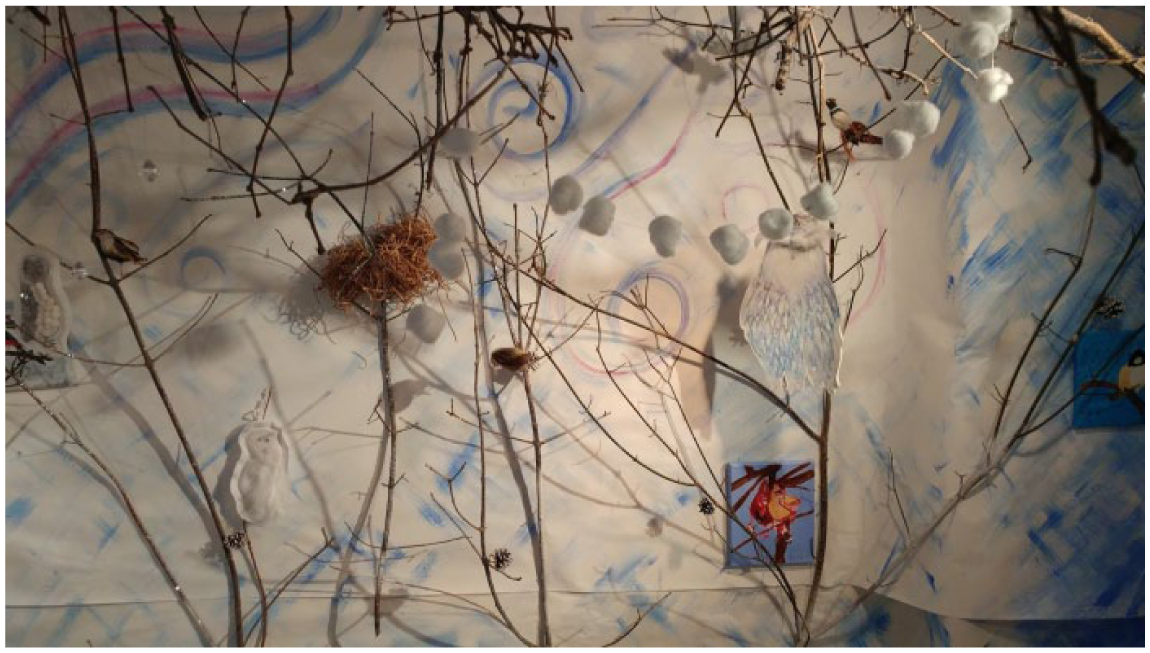
Resident-made details along installation walls.
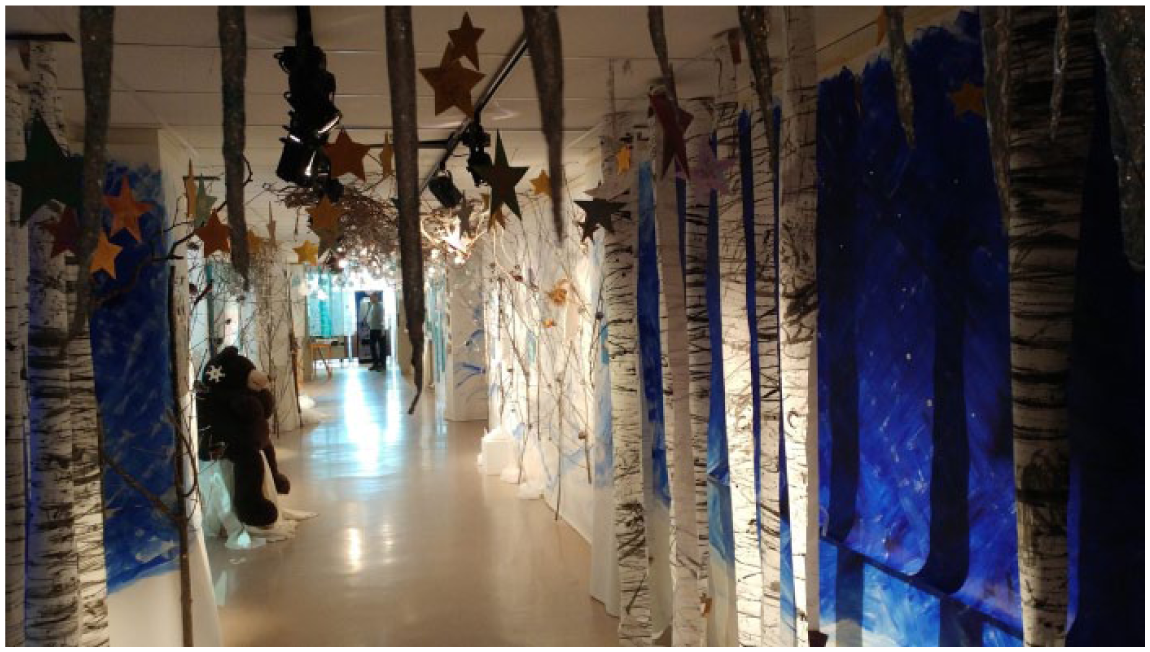
View from the back toward the entrance of the installation.
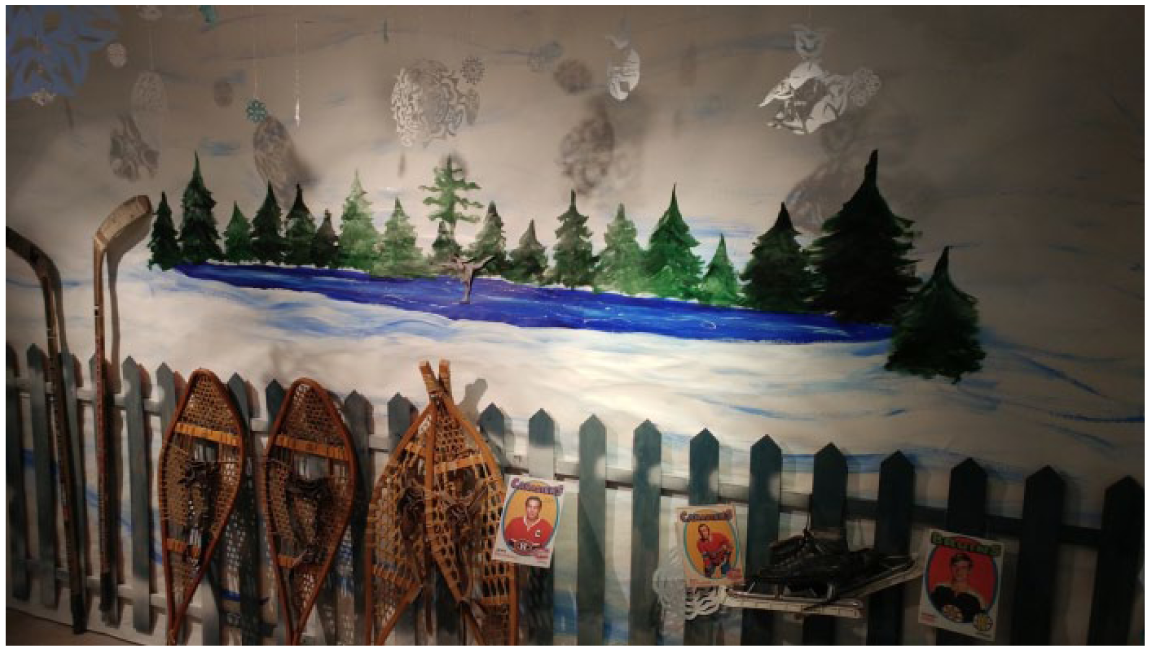
Images of famous hockey players and old sports equipment assist memory recall.
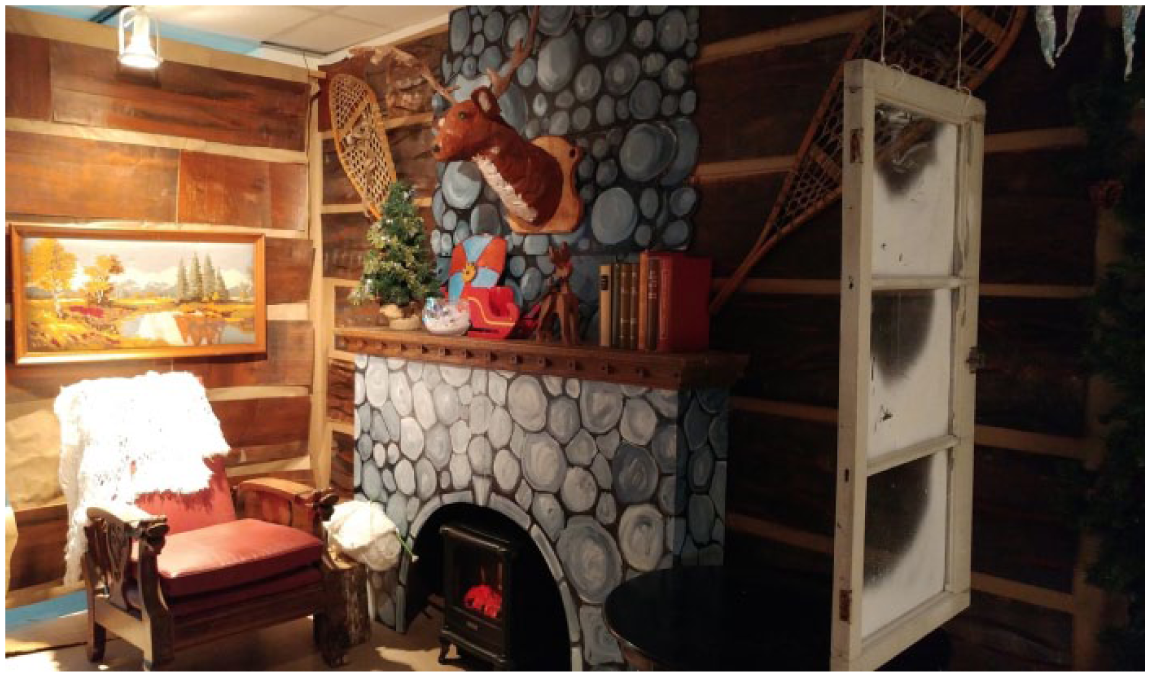
Santa’s cabin at the back of the installation.
Data Collection and Analysis
The project was part of a larger ethnographic study about the role of creative arts in performances of sociality among long-term care residents, which was approved by the first author’s university (IRB 102012). Data were collected using a guestbook at the installation exit. Visitors were free to share any length of comment: No minimum or maximum parameters were stipulated. A total of 102 individual entries were recorded: 93 entrants left comments, while nine left a signature. Comments ranged in length from one to 21 words (average length = 5.85 words). Comments were transcribed and coded according to Braun and Clarke’s (2006) guidelines for conducting thematic analysis. The two coauthors of this article coded comments separately using inductive analysis, first using codes drawn from the text, then grouped into broader categories according to similarity. The coauthors then compared and discussed their codes and categories and through an iterative process refined and devised a final set of themes that informed the research question. Following Braun and Clarke (2006), the themes were selected for the strength of connection to the data without intent to conform to preexisting frameworks. Comparison and discussion between coauthors increased the trustworthiness of the findings and improved the credibility of the coding (Sutton & Austin, 2015). Through member checking, the coauthors conferred with the staff who accompanied visitors to the installation and could confirm the fittingness of the findings.
Results
From the coded data, four themes were identified (see Table 1). Visitors remarked on the creation of a winter aesthetic indoors; they responded to both the overall design and specific details. Many comments were written thanking the artists for their creativity and effort putting together the installation. Residents and their guests commented on the ability to socialize together in the installation; it afforded the opportunity to visit in an interesting, novel setting, different from the care facility’s residential spaces. Finally, the installation’s winter environment and elements within it prompted memories of times past.
List and Categorization of Visitor Experiences Based on Guestbook Comments.
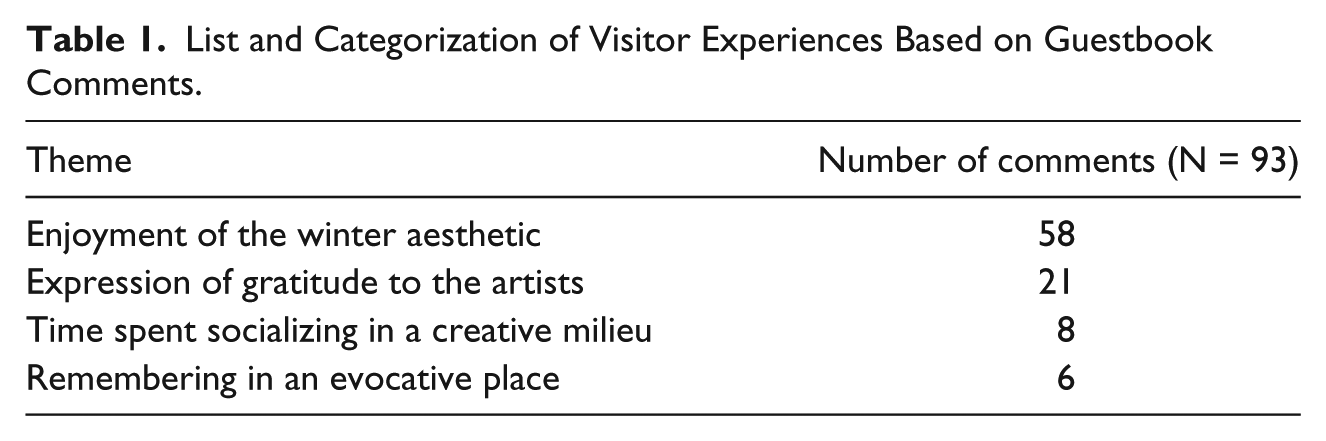
The most frequent theme of visitors’ comments was the enjoyment of the winter aesthetic of the installation. This theme captured visitors’ experience of wonder, magic, and enchantment. Visitors’ comments reflected aesthetic judgments about the space, particularly its beauty. Comments also included self-reported feelings of being transported to a milieu that was markedly different than other indoor spaces at the facility. Direct quotations from the guestbook read, A magical place. I didn’t want to leave. The snow, fireplace, and animals. So many things to explore and see. (Caregiver and resident) Wonderful show. The tree trunks look so real! Truly enchanting—like having winter inside! (Resident) True artists at work here—totally lovely—one can get caught up in the winter wonderland of beauty. (Resident) Transports you into a winter destination. (Resident and family visitor)
Another theme frequently present in the comments was the expression of gratitude to those who created the installation. This theme captured visitors’ comments in the form of thanking the staff and residents who created the installations for their work. Visitors often left a simple “Thank you” in the guestbook or elaborated upon their appreciation for the talent and dedication to the enrichment of the community. Visitors wrote, Delightful! How gratifying to have such talent and dedication among us! (Staff) A gorgeous exhibit—thank you for all the things you do here to enrich the lives of staff and residents. (Resident) This is so amazing. What a treat for the residents and all of us. (Volunteer)
Visitors’ comments also spoke to how they used the installation to spend time with other people. This theme captured visitors’ use of the installation as a social hub. Comments show that some people integrated the installation into their daily routine on walks through the facility, while others visited only once. The installation space was neither “home-like,” nor institutional, but rather an immersive creative space. Comments were often signed by a resident accompanied by a caregiver, visitor, or family member: A lovely morning together! We had our tea in the cozy cabin corner and read by the fire. (Resident and family) I love bringing my mom here. So many beautiful things for her to look at. (Resident and visitor) We walk down this beautiful “Winter Wonderland” every day. (Resident and caregiver)
Following from the above, the subtheme of hosting captured the experience of the installation as a place where residents not only could themselves be brought but also where they could bring visitors. One resident remarked poignantly, “This is so wonderful. I love to show it off!” The guestbook comments indicated that residents’ children, grandchildren, and great-grandchildren enjoyed the “Winter Wonderland” exhibit. An evocative message was written in the guestbook by the 5-year-old great-granddaughter of a resident, “It’s like the night before Christmas house” and her 9-year-old brother, “I like the sleds popping out.”
The final theme captured visitors’ experience of remembering in the installation. The comments suggest that the winter scenery of snowy villages, skating ponds and birch trees, winter sports memorabilia, and the all-encompassing cozy cabin at the end of the installation, evoked residents’ memories of events they lived during winters. The installation prompted dimensions of memory related to winter that might not have been elicited on the residential care unit where there typically was little reference to, let alone immersion in, the changing seasons. Comments read, Truly wonderful and so evocative of happy winter memories. (Resident and family visitor) Just like stepping back in time 60 years again. (Resident) So many souvenirs. Just like Fort Churchill. (Resident)
Overall, although the number of comments was not excessive, visitors pointed to many benefits of the creative installation.
Discussion
The culture change movement in long-term care has recognized that the physical environment affects quality of life (Shield et al., 2014). The scope of the culture change movement has been limited to creating “home-like” environments to assist residents living with dementia (Fleming et al., 2015; Verbeek et al., 2012). Researchers have found that long-term care residents also want to experience a physical change of scenery (Cassolato et al., 2010; Choi et al., 2008). People’s well-being improves when they visit outdoor places for a “change of scenery” (Zelenski & Nisbet, 2014). Ingold (2011) wrote that movement is fundamental to the human experience, emphasizing that life itself is “a movement of opening, not closure” (p. 4). Echoing Cassolato et al. (2010), the results of the present study indicate that visitors benefited from physical movement beyond their care unit as a result of the installation’s creative space.
The written comments suggested that visits to the installation were pleasurable. Social connectedness is an important factor for good quality of life and well-being among long-term care residents. Some people stayed in the space to read and have tea together. Research has found that stress from moving into a new residence is reduced when the environment supports the maintenance of everyday life, such as providing hosting areas for residents and their visitors (Williams, 2013). The installation was also used for this very purpose.
Visitor comments showed that residents were proud to show off the installation to their friends and family members across generations. This points to the potential of creative space to reduce social barriers in long-term care. Indeed, relationships may have been improved by relating in a space beyond the facility’s medical geography. Hatton (2014) stated that care spaces are constructed through the repetitive acts of work-related activities that elicit patterned responses. She proposed that if care spaces are redesigned with creative awareness, they can be an opportunity for people to become something else. “Winter Wonderland” was an immersive creative space that carried neither the trappings nor the patterned behaviors of typical care spaces. The installation provided a change of scenery that opened new possibilities for relationships.
Visitor comments also indicated that the installation evoked residents’ memories and associations with winter activities of the past. Following Hatton (2014), these memories might not be evoked in the “home-like” living spaces marked by routinized care tasks; the novel space provided residents with an opportunity to become something more. This is an important insight regarding memory and resident identity. Bassett and Graham (2007) argued that memory is socially situated and co-constructed. Through a cooperative process of remembering in a particular social milieu, an individual’s identity can be relocated. Thus, if the social context of remembering is expanded by varying the spaces and materials with which people remember, then perhaps additional meaningful dimensions of one’s identity can be recovered.
Furthermore, visitors to the installation expressed gratitude for the experience of the installation. However, the coauthors believe it is significant that some visitors’ comments moved beyond gratitude for the installation to include a more global gratitude for the artists’ efforts at the facility. Researchers have found that solidarity among long-term care staff must be cultivated. It can be fostered when people feel their efforts are recognized and appreciated, and this in turn positively affects residents’ quality of life (Cramm, Strating, & Nieboer, 2013). The guestbook comments indicate the installation provided an opportunity for enhancing solidarity through written expressions of appreciation. Further research is required to investigate the impact of a creative arts installation on residents’ quality of life and the long-term care community.
Study Limitations
Study limitations included a small convenience sample of people in a single long-term care facility. Following Doering (1999), the coauthors recognize that the data provide an analysis of comments, not of the visitor population or the exhibition, because only a small sample of visitors chose to sign the guestbook. In addition, the coauthors acknowledge that data coding of visitor comments was an inherently subjective process that raises questions about the trustworthiness (credibility, transferability, dependability, and confirmability) of the interpretation and representation of the data. As noted, the coauthors took steps to improve the credibility and confirmability of the findings; however, the study design did not include separate checks for transferability or dependability. The design and analysis limitations could restrict generalizability to more diverse populations living in long-term care facilities. Additional study is required to investigate the impact of immersive creative spaces in other long-term care communities.
Conclusion
“Winter Wonderland” was an immersive creative art installation project designed to offer a novel experience to a long-term care community. Guestbook comments indicated that the installation had myriad benefits, including a change of scenery that transported visitors beyond the medical geographies of long-term care. The creative space promoted new modes of socialization and organizational solidarity and provided an evocative place for remembering. The coauthors suggest that in order for long-term care facilities to meet the diverse needs of residents living with and without dementia, creative spaces are important additions to existing “home-like” designs. Future research would benefit from a more rigorous design, including a larger sample size and comparison with a control group. Additional research should investigate the clinical benefits for different populations, including people living with dementia, and continue to explore and compare the benefits of various types of immersive creative experiences including mixed media (e.g., soundscapes and tactile experiences). Overall, the present study shows that long-term care design can go beyond the “home-like”–institution dichotomy and can open new research trajectories.
Footnotes
Declaration of Conflicting Interests
The authors declared no potential conflicts of interest with respect to the research, authorship, and/or publication of this article.
Funding
The authors received no financial support for the research, authorship, and/or publication of this article.