



Abstract
The benefits of physical activity for successful aging are well established. Few interventions however, target older Asian Americans who may have distinct needs for cultural and linguistic tailoring. The heterogeneity among Asian Americans underscores the need to elucidate specific physical activity preferences by ethnic subgroup. To better understand older Chinese Americans’ perceptions about physical activity, we conducted a community-engaged, mixed methods study with 60 participants. Through survey and focus groups, four emerging themes characterized perceptions of physical activity: (a) physical activities benefit the body and mind, (b) traditional Chinese culture influences perceptions and preferences for physical activity, (c) physical activity presents opportunities for social engagement, and (d) physical activity facilitates family harmony. Design recommendations includes encouraging mind–body approaches, incorporating culturally specific practices, highlighting opportunities for social engagement, and emphasizing the potential for improved harmony.
Introduction
The federal guideline for U.S. adults >18 years recommends 150 to 300 min of moderate-intensity physical activity (PA) per week (U.S. Department of Health and Human Services, 2018). Although more than half (51.7%) achieved this goal (Clarke, Ward, Norris, & Schiller, 2017), participation is lowest among older adults aged 65 to 74 years (44.9%), and those >75 years (29.3%) (Clarke et al., 2017). For older adults, physical inactivity is highest among Blacks (33.1%), Hispanics (32.7%), Other (multiracial, Asian, Native American; 27.1%) and lowest among Whites (26.2%) (Watson et al., 2016). Approximately 13% (40 million people) in the United States are older adults >65 years (Hoeffel, Rastogi, Kim, & Shahid, 2012). Of these, older Asian Americans (AA) comprise 3.4% (1.3 million). AA are the fastest growing racial group, increasing by 43% from 2000 (10.2 million) to 2010 (14.7 million) (Hoeffel et al., 2012). Chinese Americans (CA; 24%) are the largest AA sub-group (Lopez, Ruiz, & Patten, 2017), of which 12% (600,000) are older adults (>65 years old; Cillufo & Patten, 2015). Thus, a growing older AA population with lower PA warrants a better understanding of factors contributing to PA engagement to design and deliver effective PA promotion programs.
PA provides physical, psychosocial, and cognitive benefits for older adults. Regular PA reduces cognitive decline, improves memory, processing, and attention (Bherer, Erickson, & Liu-Ambrose, 2013); prevents falls (Sherrington, Tiedemann, Fairhall, Close, & Lord, 2011); and enhances muscle mass, strength, and improves bone density and endurance (Seguin & Nelson, 2003). Group-based PA promotes socialization, reduces isolation, and encourages consistent PA (Mahmood et al., 2012). Furthermore, PA may mitigate disease progression and delay the onset of chronic illnesses like diabetes and hypertension, the consequences of which, bear medical costs of US$66 billion (Wang, McPherson, Marsh, Gortmaker, & Brown, 2011) to US$389.9 billion (Benjamin et al., 2017).
Older adults experience numerous PA barriers including risk of injury (Costello, Kafchinski, Vrazel, & Sullivan, 2011), lack of time (Chao, Foy, & Farmer, 2000), low exercise self-efficacy (McAuley et al., 2011), comorbidities (Franco et al., 2015), competing work and caregiving responsibilities (Schneider, Eveker, Bronder, Meiner, & Binder, 2003), and low motivation (Baert, Gorus, Mets, Geerts, & Bautmans, 2011). Physically inactive older adults report intimidation with group PA as they believe they will delay the group (Costello et al., 2011). Cultural differences in perceived PA barriers persist across racial and ethnic groups. Major obstacles include the inaccessibility of built environments for older American Indians, and the unaffordability of gyms for African Americans (Mathews et al., 2010). Mexican immigrants report language barrier as a hindrance to engaging in PA (Salinas, Messias, Morales-Campos, & Parra-Medina, 2014). Furthermore, older CA dislike activities leading to overexertion, stating that this arises from unharmonious activities perceived as ineffective for PA (Mathews et al., 2010).
The Chinese have distinct health beliefs influenced by four main philosophies: Confucianism, Taoism, Yin and Yang, and Buddhism (Chen, 2002). Collectively, these emphasize familial responsibility, maintaining balance for Qi (life force) to promote wellness (Chen, 2002), and performing kind and charitable acts to arouse peace and deter illness (Chen, 2002). These core beliefs’ influence on Chinese health perceptions is well-known. However, a recent systematic review finds that few interventions targeting PA for older Asians incorporate “deep level” adaptations reflecting the long-standing culturally related PA preferences and beliefs (Katigbak, Flaherty et al., 2018). Similarly, others call for examinations of PA among specific Asian subgroups due to cultural and linguistic heterogeneity (Bender, Choi, Won, & Fukuoka, 2014). Thus, this exploratory study aims to bridge a critical gap in the literature by eliciting older CA’s perspectives on acceptable forms of PA that reflect their cultural values and contextual experience as immigrant older adults. The purpose of this study was to better understand the culturally bound attitudes, behaviors, and beliefs related to PA among older CA. Results will inform design considerations for researchers developing culturally tailored PA interventions for older CA.
Method
Design and Sample
A community-engaged, mixed-methods study was conducted from March to May 2017 in Boston’s Chinatown. Community engaged research involves a process of collaboration among those with shared interests on an issue (Agency for Toxic Substances and Disease Registry, 2011). A telephone administered demographic and PA survey characterized the sample; these data were augmented with qualitative focus group discussions about PA among older CA. A convenience sample size of 50 to 60 participants aligns with the conventional practice of recruiting 6 to 10 individuals per group for a total of 4 to 6 focus groups to reach data saturation (Morgan, 1998). Recent work reinforces this approach by clarifying that 2 to 3 focus groups are necessary to discover 80% of themes, although 90% of themes are discoverable within 3 to 6 focus groups (Guest, Namey, & McKenna, 2017). Eligibility criteria were Mandarin- or Cantonese-speaking CA adults, >55 years old, residing in the greater Boston area.
Recruitment
Research participants were recruited in partnership with a community-based organization through advertisements in local Chinese newspapers, flyers in grocery stores, restaurants, community centers, word of mouth promotion, and the Chinese social networking application, WeChat. More than 116 people responded and contacted the research team, 23 were lost to follow-up, 22 could not attend any of the proposed focus group dates, 4 did not appear for their scheduled focus group appointment, and 7 contacted the study team after focus groups were completed.
Data Collection
Bilingual, trained research assistants (RAs) provided information about the study by orally reviewing the consent document with each participant, providing time for question and answer before the telephone survey and focus groups. Oral, and written informed consent were respectively provided at these two time points. Before the focus groups, RAs explained the study objectives, reviewed the consent form with participants, and provided an opportunity for an independent review of the consent document before informed consent was obtained.
Measures
RAs screened for eligibility, and if applicable, the 37-item telephone survey was administered in Mandarin, Cantonese, or English. The survey included demographic questions and scales with established reliability and validity in the Chinese population—Chinese versions of the Lubben Social Network Scale (LSNS; Lubben, 1988), and the PA Scale for the Elderly—Chinese Version (PASE-C) (Vaughan & Miller, 2013). The LSNS is a 12-item scale with a maximum score of 60, where higher scores indicate greater social engagement. The LSNS-12 has good internal reliability with Cronbach’s alpha = .70 (Lubben, 1988). The PASE-C is a 12-item scale measuring self-reported PA in older adults during the previous 7-day period. Individual items are weighted and scores are summed with total scores ranging from 0 to 500, where higher scores represent greater PA (Vaughan & Miller, 2013). The PASE-C is a valid and reliable (intraclass correlation coefficient [ICC] = 0.81) tool to assess PA in the older Chinese population (Ngai, Cheung, Lam, Chiu, & Fung, 2012).
Focus group data collection. After survey completion, a focus group appointment was scheduled in the participant’s preferred language. A semi-structured interview guide (See Online Appendix) was developed to elicit participant perspectives on PA and the role of culture in participating in PA. A community collaborator reviewed the interview guide for cultural appropriateness and translation accuracy. Ethics approval was obtained from Boston College’s Institutional Review Board approval for Human Subjects research, along with permission to conduct research from the community organization’s Board of Directors.
Following Krueger and Casey’s (2015) process for conducting focus groups, all interviews were held in private, dedicated classroom space at the community center, or a private conference room at the university. Trained, bilingual facilitators used the semi-structured interview guide to conduct discussions in Mandarin or Cantonese. Interviews were digitally recorded, ranging from 60 to 130 min. All participants who completed the survey participated in the focus groups, and each received a US$50 gift card for their participation. The final sample consisted of 60 participants (for eight focus groups).
Data Analysis
Survey data were analyzed with SPSS version 24. Descriptive statistics were performed to characterize the sample. More than 13.75 hr of focus group audio were professionally translated and transcribed into English. Transcripts were compared with the original audio recordings to verify its accuracy. Qualitative data were analyzed with Atlas.ti. following methods described by Krueger and Casey (2015). Each transcript was read to gain a general sense of its contents, then re-read to identify codes. Two coders independently coded the data, discussed these codes and grouped commonly occurring codes into higher order themes. Discrepancies were resolved to reach 100% agreement. Qualitative rigor was maintained by keeping an audit trail and by paraphrasing and summarizing statements during the interview to ensure an accurate interpretation of participants’ words.
Results
As shown in Table 1, the majority of participants were female (64%), foreign-born (96.7%), a mean age 75.6 years old (SD = 8.77), with length of U.S. residence an average of 15.8 yrs (SD = 10.14). Most (57.7%) had a college education or higher. Of note, 27.1% were at high risk for social isolation, and only 6.8% were deemed “socially integrated” based on clinical cut-points suggested in the literature (Lubben et al., 2006). PASE scores ranged from 40 to 156, with a total mean score of 86.02 + 27.64. Following procedures described by Stehling et al. (2010), subjects were divided into three groups with the same PASE range of 38; 42.4% were categorized as low activity (PASE score 40% to 78); 42.4% with medium activity (PASE score 79 to 117); and 15.3% as highly active (PASE score 118 to 156). Analysis of PASE responses (where participants could indicate performing multiple activities) showed that sedentary activities such as watching TV and reading predominated for the overall sample (43%), and PA most commonly consisted of walking (7%), tai chi (5%), swimming (4%), and ping pong (4%). Among “low-activity” participants, 40% reported sedentary activity, whereas 9% reported walking, and 8% swimming. In the “medium activity” category, 39% reported sedentary activities, whereas 7%, respectively, reported a mix of tai-chi and weight bearing activities, and walking. Only 15% of “highly-active” reported sedentary activity, although 15% used exercise machines, and 9% walking. An overview of the four emerging qualitative themes is presented in Table 2. Representative quotes characterizing these themes are described below.
Demographics and Participant Characteristics (n = 59).
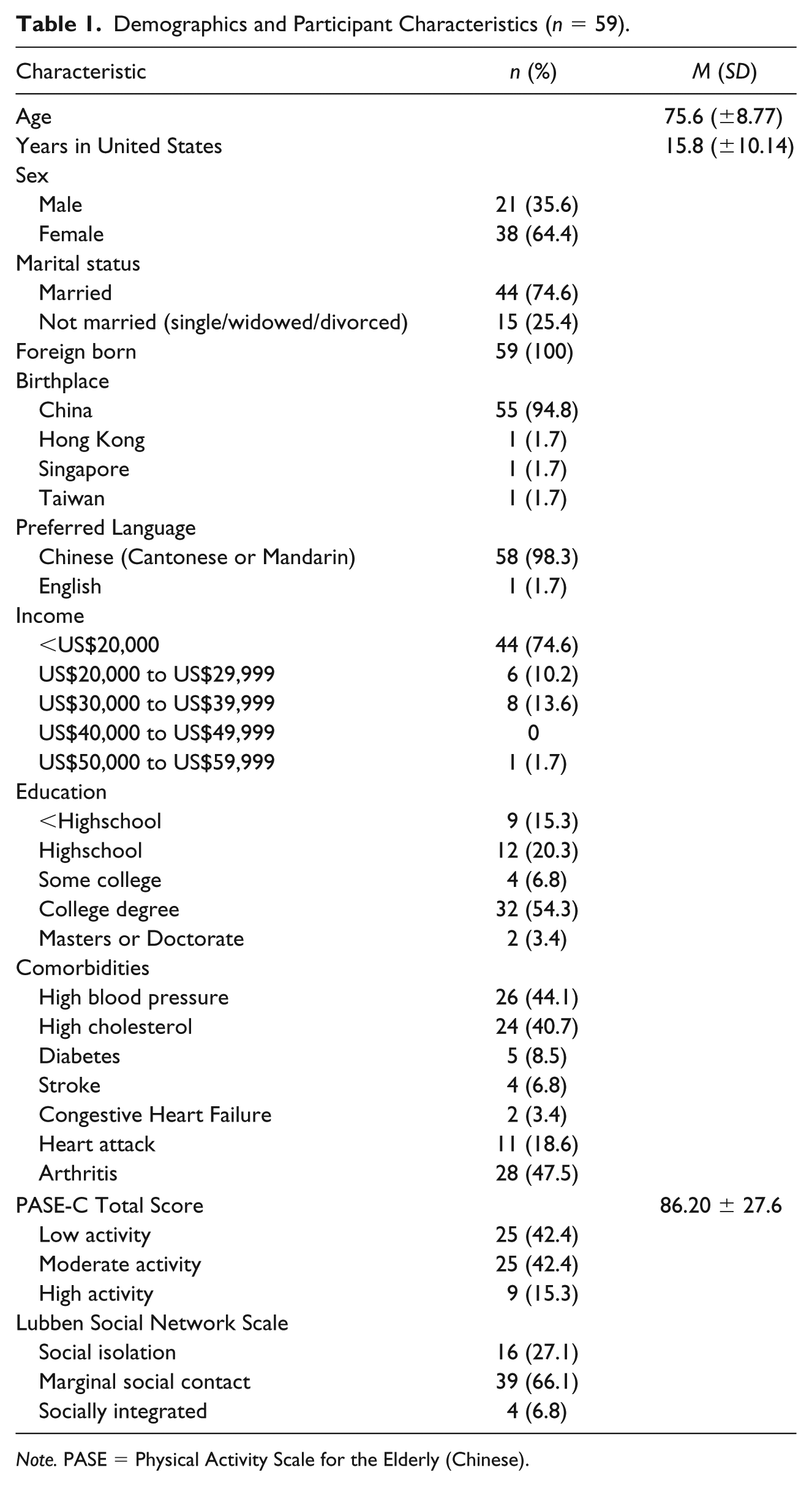
Note. PASE = Physical Activity Scale for the Elderly (Chinese).
Overview of Physical Activity Themes and Recommendations for Older Chinese Americans.

Note. PA = physical activity; CA = Chinese Americans.
Theme 1: PA Integrates the Mind and Body
Older CA view PA as an amalgamation of physical and mental activities. Consistent with PASE results, participants described these activities to include walking, swimming, and dancing. Others reported that PA also includes social activities like playing ping-pong, billiards, and musical instruments. A 75-year-old woman shared her understanding of PA as comprising both large- and small-scale body movements: Another form is resting activity, which is also good for our bodies. These could be in the form of reading, painting and other static activities. As for dynamic activities, I can do some sports, singing and dancing, or using certain fitness equipment. In addition, things like swimming and playing basketball also have benefits towards our body.
Another 66-year-old male respondent emphasized the importance of incorporating mental activities as part of PA: Technically, there are two kinds of exercise: physical exercise and mental exercise. I think mental exercise is also very important . . . Through mental exercise, you can learn new knowledge and expand your interests.
A 73-year-old male discussed incorporating PA into his daily routine based on his environment and access to spaces and special events: I also walk. At least 5 miles per day . . . in the morning, in the afternoon and in the evening. I can play Tai Chi Chuan and Tai Chi Sword. When there is an event, say Chinese holidays, I go to Tennessee to perform (Tai Chi Chuan and Tai Chi Sword) in a church. My daughter works in the Church, which creates an opportunity for me to participate in the church events. I like sports a lot and take exercise at home quite often.
Participants see PA as a dynamic interplay of activities benefiting aspects of their mental and physical selves. For example, activities such as Chinese calligraphy were described as a form of exercise, “When you write with a Chinese writing brush, your body is working, [and] so are your mind and your brain” (72-year-old female). PA among older CA integrates physical, cognitive, and mental functions.
Theme 2: Traditional Chinese Culture Influences Perceptions and Preferences for PA
Older CA’s understandings of PA are shaped by cultural influences. One participant contrasted Western and Eastern intentions for performing PA as a dichotomy between competitive individualism, and maintaining social ties and building longevity: Westerners emphasize being competitive . . . But for Chinese people, especially elderly people, the purpose of participating in sports is mainly to maintain health and strengthen their bodies . . . It seems like we don’t have the same strong desire (to fulfill ourselves) as they [Westerners] do. We just hope to strengthen bodies and develop friendships via exercise. (77-year-old female)
Participants believed that longevity is tied to physical health, “Don’t expect a long life if you don’t have a healthy body” (80-year-old female). Maintaining one’s physical health is associated with longevity (shòu), one of the “Five Blessings” of traditional Chinese beliefs and the notion of enjoying one’s old age and retirement.
Consistent with the low-impact activities identified through the PASE scale, participants further described their preference for traditional Chinese activities involving constant movement: I think there are many sports which are affected by the traditional culture, right? Such like Qigong, Tai Chi Chuan, Tai Chi Sword, calligraphy, embroidery . . . they are all affected by the traditional culture. These sports emphasize physical and mental self-cultivation. (81-year-old male)
These preferences, influenced by the Yin and Yang equilibrium which emphasizes harmony and balance of the mind and body, thereby prompts older CA to avoid unnatural movements and strenuous activities (e.g., ballistic movements or weight lifting). Others described playing musical instruments unique to the Chinese community as a form of PA. For example, a 75-year-old man drew linkages between his physical health and playing musical instruments, “I play Erhu, which make my fingers deft and my brain clever. I also play bamboo flute, which increases my lung capacity.”
Theme 3: PA Presents Opportunities for Social Engagement
Most participants described PA within a group context. Older adults believed that group activities created and sustained new networks, fostered new ideas, and kept people motivated and engaged. A 78-year-old male shared that group PA helps him develop new friends and have thoughtful discussions: “Through these exercises, I have made a lot of friends . . . I have expanded my mind . . . And talking with friends can keep me from feeling lonely.” Participants shared their beliefs that PA mitigates social isolation by helping them remain affiliated to others. A 75-year-old man discussed his experiences with activities that keep him socially connected: I retired four years ago. After that, I took part in the dance, Taichi and aerobic exercise at the YMCA every day . . . Every day I met different people and received different information. It’s just like the old days before retirement, and I never felt lonely . . . I felt I’m reliving my young life.
Group PA organized by community organizations are preferred by older CA as they are cost-effective, accessible, and often led by professionals, “I prefer formal exercise organized by the apartment, because the organizer will invite professionals to instruct us how to exercise.” (69-year-old female)
Despite the benefits of group PA, reported barriers included tensions between Mandarin and Cantonese speakers and difficulties communicating outside one’s ethnolinguistic group. A 79-year-old female shared her experience, “We don’t speak English and don’t know what is going on outside the apartment.” Nevertheless, participants expressed a preference for group PA, emphasizing that this format motivates older CAs to exercise, and facilitates connections to a social group. These preferences for group activities are deeply intertwined with maintaining a sense of community—a key feature of the importance placed on relationships and interdependence across Asian cultures.
Theme 4: PA Facilitates Family Harmony
Harmony is an imperative cultural value among the Chinese. Participants shared their belief that performing low-impact, non-strenuous PA maintains bodily harmony and balance. Respondents were acutely aware of the challenges of aging and discussed taking careful injury prevention measures: You are worried about falling down thus you don’t want to go out. As long as I see the streets are shiny, I don’t dare to go out. At this age, there is nothing we can do to prevent ourselves from falling down, because our sense of balance is not as good as before when we were young. (80-year-old female)
Low-impact, fluid movements were described as preferred activities to stay healthy and avoid injury thereby reducing the possibility burdening one’s family. Interestingly, many participants drew parallels to their health and maintaining family equilibrium. In their older age, participants noted that they care for their grandchildren, which alleviates a considerable financial and time burden for working adult children. A disruption to the older adult’s health through illness or injury upsets this harmony, “when they [the adult children] call to check up, you can tell them, ‘I am doing good. I go out to walk and do exercises everyday’. Then their families feel more at peace” (66-year-old woman). One 81-year-old man shared this similar sentiment: The whole family may have a good feeling towards the fact that the . . . grandfather or grandmother is engaging in group outdoor activities. This enhances their feeling of happiness and stability. The young [adult children] may feel happier and more secure when out at their workplace.
Conversely, some participants perceived caregiving as a barrier to PA as one 71-year-old female says, “grandchildren come to visit once or twice per month. When they invite me, I need to stop other activities and go with them.” Although PASE analysis did not indicate frequency of caregiving activities, this dimension of activity emerged during focus groups, and recent work speaks to the multidimensionality of activities for older adults (Hong, Chokkanathan, & Rozario, 2018). Reframing child care as an opportunity for PA may address this barrier while maintaining family harmony. For example, one 75-year-old woman described her volunteer work at a local preschool caring for children, “I volunteered as a grandma there for four years. I think this is also a kind of exercise because you need to take care of little kids.”
Discussion
This mixed-methods study provides insight into the types of PA that community-dwelling Chinese elders perform and the cultural influences for these preferred activities. Although our quantitative data reveal that many participants were classified as “low-activity” (e.g., sedentary behaviors like watching TV or reading), our qualitative data elucidate that participants believe that these mentally challenging activities are inextricably linked to one’s physical health, reflecting a holistic orientation to health and wellness. Furthermore, the preferred low-impact activities of walking, tai-chi, and swimming appear to reflect Chinese cultural values emphasizing harmony and balance, importance of family, and promoting wellbeing and longevity. Based on the emerging themes, we provide a set of design considerations for future PA interventions.
Integrated Mind and Body Approaches May Be Beneficial for Older CA
Participants define PA to encompass activities that promote an overall sense of balance and wellbeing. These range from fine motor (e.g., Chinese calligraphy) to large-scale body movements. Similar work exploring perceptions of PA among minority groups found that repeated physical movements like walking, dancing, and biking defined PA (Miller, Marolen, & Beech, 2010). However, our participants notably included reading, painting, and playing musical instruments in their definitions of PA. Respondents described the mental benefits of PA and the reciprocal effect of a calm mind for overall wellbeing. Given the importance of “exercising” both the body and the mind articulated across all focus groups, we recommend that future programs consider employing integrated, holistic views of PA. Integrated approaches resulted in significant improvements in weight control for middle aged and older adults with diabetes (Liu, Miller, Burton, Chang, & Brown, 2011), improved physical function (Takeshima et al., 2017) and better performance on memory tasks (Chan et al., 2017) and tests of executive function (Wayne et al., 2014). However, a review of yoga-based interventions failed to find improvements in PA (Barrows & Fleury, 2016). Incorporating mind–body activities may increase older adults’ acceptance of new programs and sustained participation.
Incorporating Traditional Chinese Practices May Encourage Participation in PA
Participants broadened Western definitions of PA to highlight activities with cultural linkages such as Tai Chi or Qigong. These practices are under the general umbrella of Chinese martial arts (Guo, Qiu, & Liu, 2014) and employ movements of varied paces (slower and faster form), along with meditative aspects that emphasize balance and form. Notably, respondents further specified that PA includes fine-motor activities like playing musical instruments, calligraphy, and embroidery that are commonly linked to maintaining cognitive function (Noice, Noice, & Kramer, 2014). Participants described PA as an overall wellbeing and harmony of the body and mind that is associated with Chinese traditional beliefs (Chen, 2002). Similar to literature on immigrant groups’ preferred activities (Marquez et al., 2014), our participants’ preferences for dance and martial arts were described as ways to retain and express their ethno-cultural identity and connect to the larger Chinese community.
A Broad Range of Activities May Promote PA and Reduce Social Isolation
As the majority (93.2%) were classified as having “marginal social contacts” to being “socially isolated” our data present unique perspectives into preferred activities for hard-to-reach populations. Social isolation is associated with poor physical health (Cornwell & Waite, 2009), and older adults are at higher risk due to reduced networks and physical and psychological barriers (Nicholson, 2009). Social isolation for Chinese elders might be further compounded by language barriers and lower acculturation (Dong, Chang, Wong, & Simon, 2012). Participants discussed multiple benefits from PA including improved flexibility and mental health, better sleep, and increased energy all of which are commonly reported among older adults performing regular PA (Windle, Hughes, Linck, Russell, & Woods, 2010). Importantly, group PA was seen to reduce social isolation. This benefit aligns with collectivism which emphasizes relationships and minimizing burdens to the community (Bradford et al., 2018). Accessible, structured group-based activities provide opportunities for interaction, promoting wellbeing and community integration. Thus, highlighting the potential for “friendship” and “togetherness” when promoting and recruiting for PA programs may resonate with collectivist values.
A suggested recommendation is to offer an assortment of culturally appropriate activities promoting social interaction and allowing for a proactive assessment of performance capacity, and guidance on goal setting. Strategies to improve self-efficacy for PA are critical since this construct is known to predict behavior and health outcomes (French, Olander, Chisholm, & Mc Sharry, 2014). Finally, many participants were receptive to using smartphone-based group chats and instant messaging. These platforms may facilitate active engagement with older CA. Future work could examine how mobile platforms can be dually employed to improve social engagement and promote self-management.
Emphasize the Roles of PA in Promoting Longevity and Maintaining Family Harmony
In contrast to Western perceptions, aging in the East Asian context may be interpreted as a positive experience because of the centrality of the family unit in Chinese society and the concept of filial piety (xiao), which emphasizes children’s obligations toward their elders (Dong & Xu, 2016). Similarly, increasing age is associated with greater respect and influence within the family (Dong & Xu, 2016). Thus, older adults may wish to “enjoy their old age” and reap the benefits of their position. Although filial piety is a strongly held value among the Chinese, our participants were aware of the tolls of caregiving, noting that they wished not to impose on their adult children. Within Confucian philosophy, the concept of harmony influences family interactions by providing an emphasis on maintaining positive relations, social hierarchy, and practices that venerate the elderly (Zhang, Lin, Nonaka, & Beom, 2005). Similar to previous work describing older Asian adults’ efforts to curtail health behaviors to maintain family harmony (Katigbak, Maglalang et al., 2018; Maglalang et al., 2017), our participants worried about the care burden and family disruption that could arise from poor health or injury.
Familial duties emerged as notable deterrents to PA. Respondents shared that caring for grandchildren occupies much of their time. Cross-generational caregiving is an integral aspect of productive aging where longer life expectancy results in women, in particular, caring for their spouses, grandchildren, and siblings (Gonzales, Matz-Costa, & Morrow-Howell, 2015). Although this may alleviate caregiving costs and help maintain harmony, it can pose health risks for older adults if caregiving is perceived as a stressor due to lack of support and resources (Sands, Goldberg-Glen, & Thornton, 2005). Reframing conflicting caregiving demands into new opportunities for engaging in intergenerational PA (e.g., grandparent-grandchild tai chi), or training on how to incorporate PA into caregiving may broaden perceptions. Formalized movements may be included into caregiving activities while playing or interacting with grandchildren.
Limitations
This study has several limitations. A small sample of older CA in Boston precludes a complex statistical analysis and limits transferability of our findings to other Chinese immigrant communities. Similarly, using WeChat ™ as a recruitment tool limits the scope and reach of the study advertisements as these postings are shared within social groups, and may not have reached those without WeChat access. Finally, social desirability bias may have influenced participant responses and behavior during focus groups. Nonetheless, the results provide some direction for future PA studies with older CA.
Conclusion
Focus group interviews to elucidate culturally bound attitudes and beliefs about PA among CA older adults reveals an integrated mind–body PA perspective. Older CA prefer activities that allow them to maintain their ethnic identity through culturally salient art forms, and socialization. The emerging themes reflect commonly held values and beliefs among Asians pertaining to holism, harmonious interactions, and collectivism; these may serve as a broad foundation in designing future interventions for older AA, whereby an assessment of local needs may guide the application of specific tailoring and adaptations by ethnic subgroup. Our study highlights potential strategies for PA promotion that are grounded in participants’ cultural values and experiences. Efforts to maximize the impact and sustainability of PA programs for older CA may benefit from considering the cultural salience of proposed strategies and matching these strategies to optimize community strengths that mitigate barriers to engaging in PA.
Supplemental Material
Supplementary_online_appendix_JAG_1.20.19 – Supplemental material for Older Chinese Americans’ Perspectives on Physical Activity: A Mixed Methods Study
Supplemental material, Supplementary_online_appendix_JAG_1.20.19 for Older Chinese Americans’ Perspectives on Physical Activity: A Mixed Methods Study by Carina Katigbak, Dale Dagar Maglalang, Tam Nguyen, Minna Wang and Cheuk-Lam Lo in Journal of Applied Gerontology
Footnotes
Acknowledgements
The authors thank Dr. Sai Zuo, Ms. Silver Y. Li-Situ, and Ms. Helen Au for their efforts in community outreach and recruitment. We thank Mr. Paul Chan, Ms. Jean Kuang, Ms. Wendy Feng and the Chinese Consolidated Benevolent Association of New England for their partnership and collaboration on this project.
Declaration of Conflicting Interests
The author(s) declared no potential conflicts of interest with respect to the research, authorship, and/or publication of this article.
Funding
The author(s) disclosed receipt of the following financial support for the research, authorship, and/or publication of this article: This research was funded by the Institute on Aging at Boston College.
Institutional Review Board
This study was reviewed and approved by the Boston College Institutional Review Board, Office for Research Protections (Protocol # 17.059.01-1).
Supplemental Material
Supplemental material for this article is available online.

References
Supplementary Material
Please find the following supplemental material available below.
For Open Access articles published under a Creative Commons License, all supplemental material carries the same license as the article it is associated with.
For non-Open Access articles published, all supplemental material carries a non-exclusive license, and permission requests for re-use of supplemental material or any part of supplemental material shall be sent directly to the copyright owner as specified in the copyright notice associated with the article.
