



Abstract
Introduction
Older people’s health is largely determined by income security or lack thereof. In economic terms, it has been argued that poverty generally reduces access to essential goods and causes chronic stress and unhealthy behaviors (Marmot, 2002, 2017; Najman et al., 2010). Among older adults in particular, lack of income security restrains them from maintaining their social relationships and limits their ability to pay for quality health care (Grundy & Holt, 2001; Hirayama, 2010). However, income may not necessarily represent one’s economic conditions accurately, and income and assets may not be substituted for each other accordingly. As far as retired older people are concerned, they usally have limited regular income even when they own valuable assets (Yun et al., 2017). This is a critical housing policy issue, particularly in developed East Asian economies where homeownership has been actively promoted by the government without building a sustainable national welfare system to support older people’s needs because liquidating residential properties to supplement welfare services is not readily accepted by older people in these countries (Hirayama, 2010; Ronald & Doling, 2010).
The Republic of Korea (hereafter Korea) is currently facing a rapid increase of its aging population. The number of persons aged 65 years or above accounted for 13.2% of the total population in 2015 and is expected to reach 40% by 2050 (Korean Statistical Information Service [KOSIS], 2016). In Korea, as in many other countries, the rate of owner-occupiers among older adults is much higher (75.7%) than the national average of 57.7% (Ministry of Land, Infrastructure and Transport, 2018). 1 However, the proportion of older people living below the poverty line (45.7%) is also large, marking the highest among the members of the Organization for Economic Co-operation and Development (hereafter OECD, 2017). 2 While there have been accumulated studies on the relationship between older adults’ wealth and health (Costa-Font, 2008; Ellaway & Macintyre, 1998; Grundy & Holt, 2001; McCann et al., 2012), there is little known about how homeownership and income concomitantly relate to older adults’ health in countries where home buying has been encouraged to supplement institutional welfare benefits in later life. Therefore, this article examines how older adults’ income and asset (i.e., homeownership) are concurrently associated with their mental health in Korea.
Literature Review: Wealth, Health, and Aging
An asset-based welfare system centered on homeownership has both positive and negative implications. Asset ownership enables individuals or households to have a “stake” in the society, which brings them great ontological security and social stability and a high quality of essential services (Connolly et al., 2010; McCann et al., 2012; Smith et al., 1999; Windle et al., 2006). From the economists’ perspective, owner-occupied housing is seen as “permanent income” as people can sell it or borrow money against it to maintain their consumption (Friedman, 1957), and homeownership policy is believed to advance the development of loan markets and financial institutions (Phang, 2001).
However, economic inequalities between homeowners and non-homeowners may exist as outright owners can live in their housing with no rent (Schwartz & Seabrooke, 2008). When housing markets go down, property assets can easily lead to negative equity for homeowners with outstanding mortgage loans (Izuhara, 2016). Moreover, the strong tendency to purchase a home before retirement constrains households’ overall cash savings (Castles, 1998; Doling & Ronald, 2010). Extending this “trade-off” point of view, Doling and Horsewood (2011) demonstrated that house price increases are associated with the decrease in overall public expenditures on older people among OECD countries. Hence, in a society where wealth accumulation through homeownership takes the place of state welfare, older adults may be “asset rich,” but may not necessarily be “income rich” when assets are not readily liquidated (McCarthy et al., 2002).
This discrepancy between the notions of “assets” and “income” in the welfare context has caused the research on the relationship between older adults’ economic conditions and health to diverge into two streams. First, the positive association between household income and health conditions has been widely acknowledged, regardless of age groups, arguably due to more available resources to access health care services (Dalstra et al., 2006). Second, assets have been considered to reflect the older adults “lifetime income” and produce accumultive benefits enabling them to feel stable and comfortable in their own house where they have built up memories with family members over a long time (Costa-Font, 2008; Costa-Font et al., 2009; S. Park et al., 2017). Previous studies supported the assumption that older owner-occupiers, in comparison to renters, have fewer problems with self-rated health (Windle et al., 2006), mental health (Pledger et al., 2019), chronic diseases and functional ability (Avlund et al., 2003), and mortality (Connolly et al., 2010), after controlling for income.
While several studies have paid attention to both income and assets as the social determinants of older adults’ health (e.g., Costa-Font, 2008; Hurd & Kapteyn, 2003), they tend to lack an understanding of how they interact with each other (Dunn, 2002) and focus predominantly on Western countries which have formed different welfare regimes and housing policy development trajectories from those in East Asia. Despite the variations within the region, East Asian countries (e.g., Korea, Japan, Taiwan, Hong Kong) appear to share a commonality that homeownership has been promoted by the post-war governments committed to nation-building through economic growth (Holliday, 2000; S.-Y. Park, 2012). As the housing system and composition of housing tenure vary across countries (Dalstra et al., 2006; Pledger et al., 2019), homeownership by older populations in East Asia may have different implications for their mental health than seen in Western countries.
Homeownership and Health Among Older People in Korea
According to Holliday’s (2000) analysis of the East Asian welfare model, the earlier form of Korea’s welfare system is categorized as the “productivist” welfare model in which welfare is purposively extended to the productive working population by the developmental state. Despite the introduction of public pensions in 1988, they did not cover the entire population until 1999. As a result, a large proportion of the aged population were unable to contribute sufficiently to the social benefit programs when they were in the labor market. Moreover, the current public welfare system does not seem to solve the poverty problem among the aged population (Roh, 2015). For example, among the total beneficiaries of the National Basic Livelihood Scheme (NBLS), the social security assistance scheme for low-income households in Korea, older people account for a relatively higher share (25.5%) than other age groups (KOSIS, 2018). In effect, the public expenditure on older individuals, compared to the GDP in Korea, ranked the fourth lowest among the OECD countries (OECD, 2020). This situation has led older adults to continuously depend on family support or on their scanty income from low-skilled and labor-intensive jobs (Kwon, 2008).
Meanwhile, there has been a strong cultural tendency to desire homeownership in Korea. The rapid urbanization and economic growth have been accompanied with large-scale housing production in both private and public sectors, and the increased affluence among the middle-income working class has fueled the demand for urban housing since the 1960s (S.-Y. Park, 2012). In addition, family wealth accumulated through owner-occupied housing has been presumed to compensate for the weak public welfare benefits (Ronald & Jin, 2010). Therefore, homeownership has been fostered by supply- and demand-side policy measures to accelerate economic growth and solve housing shortage problems through property development and welfare provisions (B.-G. Park, 1998; Ronald & Jin, 2010). Consequently, the housing markets in Korea have been expanded considerably, and homeownership rates have increased significantly for a short period (OECD, 2018).
Despite the high homeownership rate among older adults, owning a home does not generate rental income to owner-occupiers who need to pay recurrent housing management fees and maintenance costs. Although about two-thirds of the older population currently benefits from the Basic Pension introduced in 2008, the income replacement rate is relatively lower than that of other OECD countries. 3 Moreover, although the reverse mortgage scheme was introduced in Korea in 2007, older people are reluctant to use their property as collateral because they prefer to bequeath housing to their offspring. Therefore, only 50,000 older homeowners currently receive payouts through the reverse mortgage program (M. Kim, 2018). In short, it seems that some older adults in Korea have financial problems due to the limited income while being homeowners. Yet, there has been insufficient evidence of the association between homeownership and mental health in later life in Korea when income conditions are considered.
Data and Method
Data
This study used the dataset derived from the 2017 Survey of Living Conditions and Welfare Needs of Korean Older Persons conducted jointly, from June to August in 2017, by the Korean Ministry of Health and Welfare and the Korea Institute for Health and Social Affairs targeting adults aged 65 years or older. The dataset consisted of a total of 10,299 individuals, concerning only older adults living in regular residential accommodations and excluding those in long-term care homes. In Korea, the proportion of older adults accommodated in long-term care facilities, including group homes and nursing homes (8.3% among the people aged 65 years and older), is lower than the OECD average (10.8%) (OECD, 2019b), and living in long-term care facilities is not usually considered as another type of housing tenure. Therefore, excluding older adults accommodated in long-term care homes does not seem to skew the findings of this study significantly. As family size may determine housing characteristics (e.g., size, tenure) (Connolly et al., 2010), we limited participants to those who live alone or with a spouse, but without children. After excluding the missing variables, the sample size came to 6,624 individuals.
Independent Variables
We divided study participants into four groups in terms of tenure in private housing sector: (a) owner-occupiers, including those whose houses are already willed to their children; (b) monthly renters; (c) renters within the Jeonsei system (rental system in which a tenant pays a lump-sum deposit equivalent to 40%–70% of the house price, which is fully refundable upon termination of 2-year contract without additional payment of monthly rents); and (d) private renters subsidized by charities and the local governments (hereafter, subsidized renters). To measure income poverty, we used the total household income that the respondents receive from labor, social assistance, and financial support from family members. We divided the income by the square root of household size for standardization. Median income was used as a cut-off poverty line, as it is a widely used method in the international literature and also officially used by the national government’s statistics authority in Korea. If their equalized income is below half the median income of study participants, we coded them as “income poor” and otherwise considered not in income poverty.
Dependent Variable
We selected the prevalence of depression measured on the Korean version of the Geriatric Depression Scale—Short Form (GDS-K) as a dependent variable representing older people’s mental health. The original GDS was first developed by Yesavage et al. (1983) to identify older adults’ depression. Considering that more than 60% of older Korean adults are illiterate, it is inappropriate to ask them questions using multichoices in surveys (Bae & Cho, 2004). Therefore, the GDS Short Form containing 15 questions with “yes” or “no” responses was used to examine older adult psychiatric patients in Korea to construct this dataset. Previous studies have proved the consistency and validity of this measure in comparison to other relevant clinical measures, such as Hamilton Rating Scale for Depression (HRS-D) and the Center for the Epidemiological Studies Depression Scale (CES-D; Bae & Cho, 2004). Following the annotation of the dataset and the suggestion of the previous research using the same measure (Bae & Cho, 2004; J. Y. Kim et al., 2008), we coded the respondents as “having depression” (= 1) if a person’s score was 8 or above (cut-off point) and “not having depression” (= 0) if it was below 8.
Covariates
Age and gender (female/male) were adjusted as demographic characteristics. For socioeconomic status, educational attainment (junior high or less, high school graduate, and college graduate or higher), working status (currently working/not working), and region of residence (urban/rural) were adjusted. For health conditions, chronic conditions and functioning level measured by the Activities of Daily Living (ADL) and Instrumental Activities of Daily Living (IADL) were accounted for. Satisfaction with current economic conditions was added to examine its mediating effects. Using a five-scale question (ranging from highest satisfaction to lowest satisfaction), “How much are you satisfied with your current economic conditions?,” we categorized the respondents into two groups: satisfied (1 to 3) and not satisfied (4 to 5).
Statistical Analysis
We first analyzed the distribution of study participants by demographic and socioeconomic status and the prevalence of depression by covariates. Then, we conducted bivariate logistic regression, based on the independent and dependent variables set out above, to examine the effect of housing tenure and income poverty on depression among older adults. For the next step, we added all control variables in multivariate logistic regression. The same approaches were used to test the interactive effects of housing tenure and income poverty on depression. Finally, the mediating variable, dissatisfaction with the current economic conditions, was appended to multivariate logistic regression.
Results
Descriptive Analysis of the Study Population
Table 1 shows the distribution of the study population and the prevalence of depression. Overall, owner-occupiers (75.1%) were the most common type of housing tenure, followed by monthly renters (11.6%) and subsidized renters (7.6%). The proportion of Jeonsei renters was the smallest (5.6%) among study participants. More than half the participants were female (58.2%), had educational attainment of junior high school or less (61.1%), and were not currently working at all (66.4%); 10.5% of participants fell into income poverty, and overall, the prevalence of depression was 11.5%. There was a higher prevalence of depression among monthly renters (18.6%) or those in income poverty (20.9%). Older adults who were not satisfied with their economic conditions and have both functional disabilities (ADL and IADL) reported having depression at a higher rate—20.3% and 33.2%, respectively.
Distribution of the Study Population and Their Prevalence of Depression (N = 6,624).
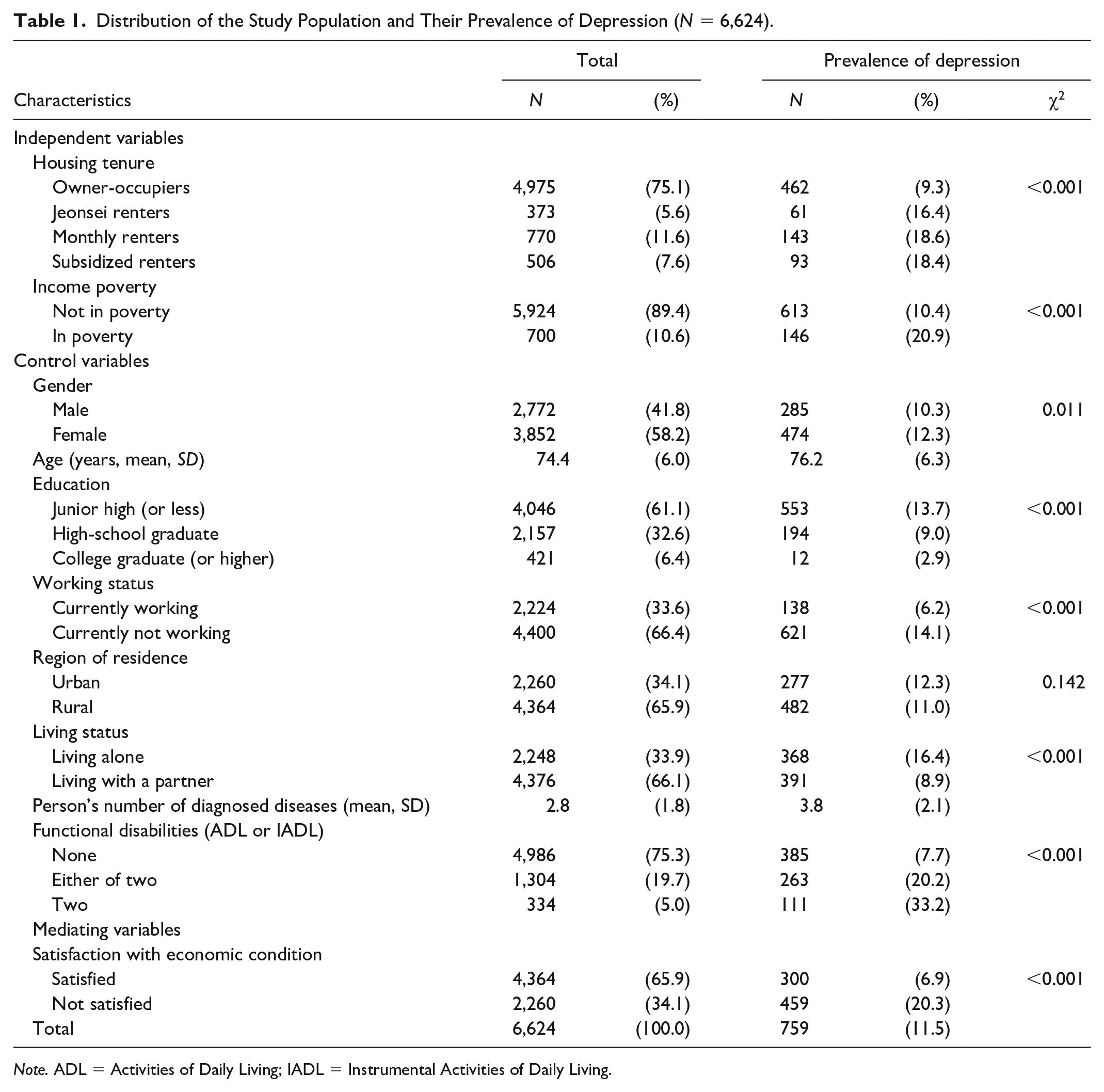
Note. ADL = Activities of Daily Living; IADL = Instrumental Activities of Daily Living.
Figure 1 shows the prevalence of depression and dissatisfaction with economic conditions by both housing tenure and income poverty. Among all tenure groups, subsidized renters in income poverty showed the highest prevalence of depression (28.4%), followed by monthly renters in poverty (23.7%), and Jeonsei renters in poverty (21.1%). However, monthly renters in poverty showed the highest level of economic dissatisfaction (76.2%), followed by subsidized renters in poverty (66.3%), and Jeonsei renters in poverty (63.4%). Owner-occupiers who were not in poverty showed the lowest prevalence of depression (8.4%) and economic dissatisfaction (24.8%).
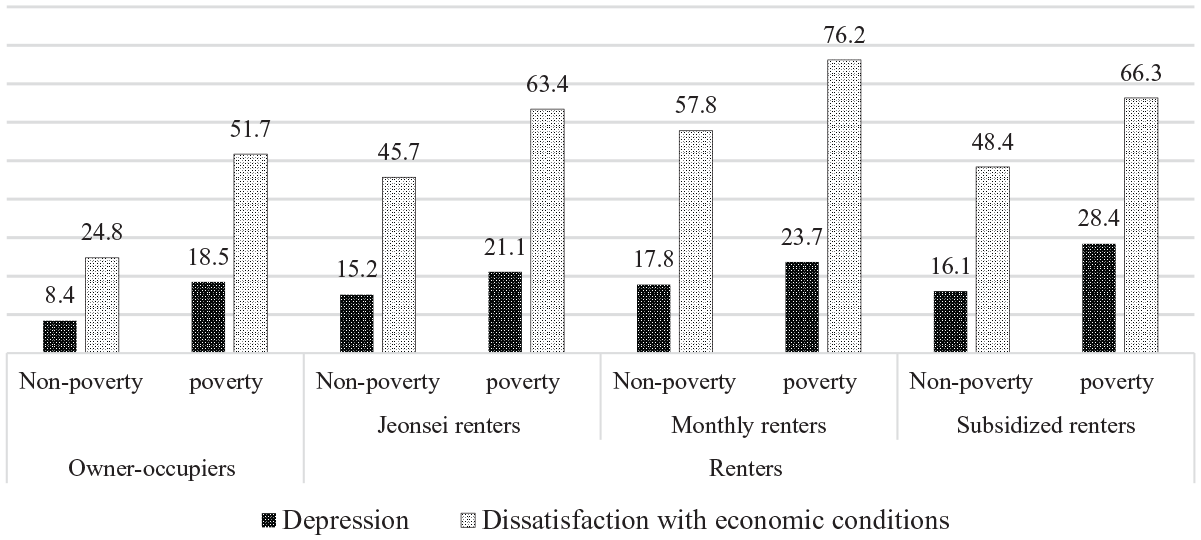
The prevalence of depression and dissatisfaction with economic conditions by housing tenure and income poverty among the study population (%, N = 6,624).
An Association of Housing Tenure and Income Poverty With Depression
Table 2 shows an association between housing tenure or income poverty and depression. In comparison to owner-occupiers as the reference group, monthly renters had the highest probability of having depression (odds ratio [OR]: 2.23, 95% confidence interval [CI]: [1.81, 2.74]) in the unadjusted model (Model 1). The other two types of tenants, Jeonsei (OR: 1.91, 95% CI: [1.43, 2.55]) and subsidized renters (OR: 2.20, 95% CI: [1.72, 2.81]) were also more likely to report depression than owner-occupiers. In the fully adjusted model (Model 2), while monthly renters showed the most significant probability of reporting depression (OR: 1.69, 95% CI: [1.34, 2.23]) similarly to the unadjusted model, Jeonsei renters were the second highest to report depression (OR: 1.49, 95% CI: [1.09, 2.05]), followed by subsidized renters (OR: 1.40, 95% CI: [1.06, 1.81]). In the fully adjusted model, those in poverty had a higher probability of having depression than those not in poverty (OR: 1.84, 95% CI: [1.49, 2.28]).
An Association Between Housing Tenure/Income Poverty and Depression Among the Study Population (N = 6,624).
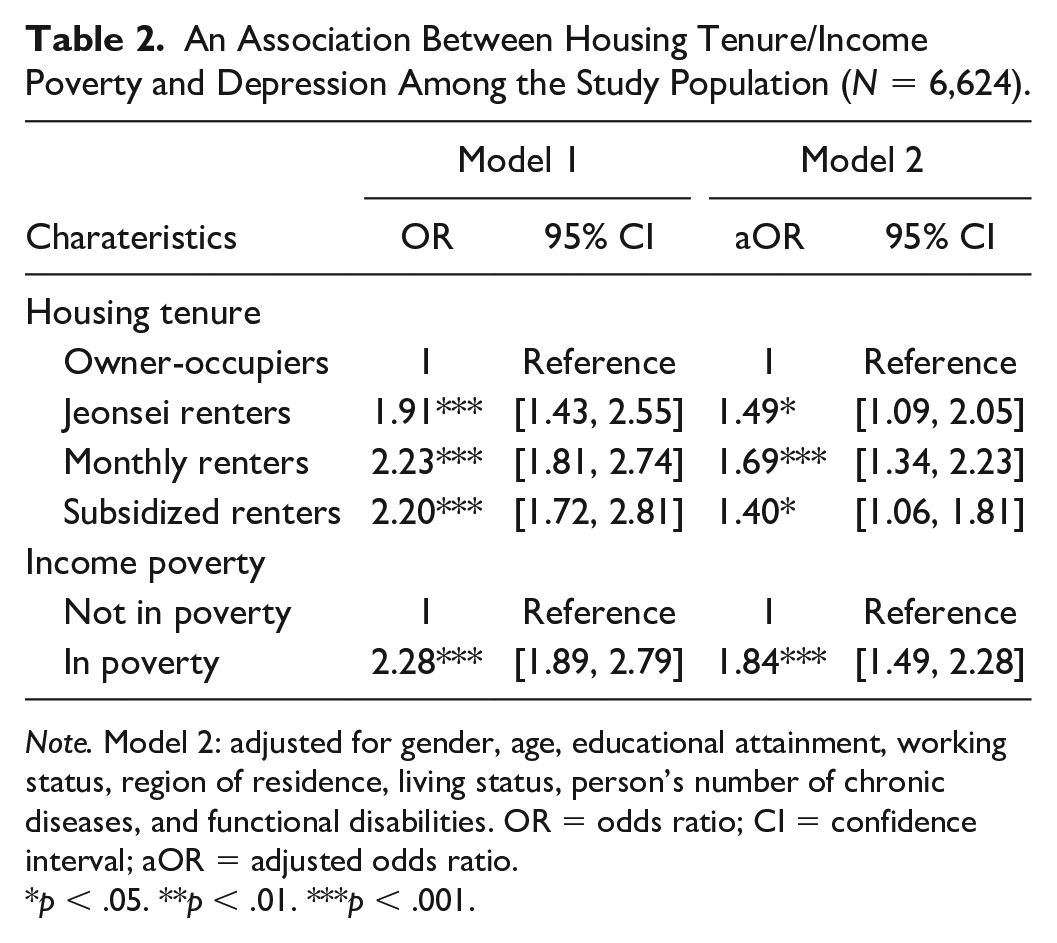
Note. Model 2: adjusted for gender, age, educational attainment, working status, region of residence, living status, person’s number of chronic diseases, and functional disabilities. OR = odds ratio; CI = confidence interval; aOR = adjusted odds ratio.
p < .05. **p < .01. ***p < .001.
An Association of Housing Tenure and Income Poverty With Dissatisfaction With Economic Conditions
Table 3 indicates an association between housing tenure, income poverty, and dissatisfaction with economic conditions. Monthly renters had a higher likelihood of dissatisfaction with their economic conditions (OR: 4.04, 95% CI: [3.45, 4.73]), followed by subsidized renters (OR: 2.89, 95% CI: [2.39, 3.46]) and Jeonsei renters (OR: 2.58, 95% CI: [2.09, 3.19]) as compared to the reference group. In comparison to those who are not in poverty, older adults in poverty were likely to be dissatisfied with their economic conditions (OR: 3.07, 95% CI: [2.62, 3.61]), which was also statistically significant in the fully adjusted model (OR: 2.71, 95% CI: [2.30, 3.21]).
An Association Between Housing Tenure/Income Poverty and Dissatisfaction With the Economic Condition Among the Study Population (N = 6,624).

Note. Model 2: adjusted for gender, age, educational attainment, working status, region of residence, living status, person’s number of chronic diseases, and functional disabilities. aOR = adjusted odds ratio; CI = confidence interval; OR = odds ratio.
p < .05. **p < .01. ***p < .001.
Interactive Effects of Housing Tenure and Income Poverty on Depression
The result of the interactive effects of the two independent variables on depression is presented in Table 4. In the unadjusted model, the odds of reporting depression were higher among older adults in income poverty than among those not in poverty across different types of housing tenure. Its OR was the highest among subsidized renters in poverty (OR: 4.33, 95% CI: [2.74, 6.85]). The second group was monthly renters in poverty (OR: 3.39, 95% CI: [2.10, 5.48]). Among older adults who owned their homes, those who fell into income poverty were more likely to report depression (OR: 2.48, 95% CI: [1.91, 3.23]). In Model 2, where all covariates were adjusted, we found that owner-occupiers in poverty were more likely to report depression (OR: 1.87, 95% CI: [1.42, 2.47]), compared to owner-occupiers not in poverty. The odds of reporting depression were highest among subsidized renters in income poverty (OR: 2.60, 95% CI: [1.59, 4.24]).
Interactive Effects of Housing Tenure and Income Poverty on Depression and Mediating Effects of Dissatisfaction With Economic Conditions Among the Study Population (N = 6,624).

Note. aOR = adjusted odds ratio; CI = confidence interval; OR = odds ratio. aThe proportion in each group of housing tenure (%). bModel 2 and Model 3: adjusted for gender, age, educational attainment, working status, city of residence, living status, number of chronic diseases, and functional disabilities. cPercentage of difference = (adjusted OR in model 2 – adjusted OR in Model 3)/(adjusted OR in Model 2) × 100.
p < .05. **p < .01. ***p < .001.
Dissatisfaction With the Current Economic Conditions as a Mediator
In Model 3, where we added dissatisfaction with the current economic conditions that we assumed as the mediator, adjusted ORs decreased for all respondents compared to the adjusted ORs in Model 2, which implies possible mediating effects of their self-content with their economic conditions. Respondents who were not satisfied with their economic conditions showed higher odds of reporting depression (OR: 2.31, 95% CI: [1.95, 2.74]) compared to those who were content with their economic conditions. Its effect remained significant in some groups, as presented in Model 3. To be specific, significant mediating effects of dissatisfaction with economic conditions were found among homeowners in income poverty (OR: 1.53, 95% CI: [1.15, 2.03]), monthly renters not in poverty (OR: 1.38, 95% CI: 1.08, 1.78), and subsidized renters in poverty (OR: 1.95, 95% CI: [1.19, 3.21]).
Discussion
A series of analyses examined the relationships among housing tenure, income, and depression among older adults in Korea. The findings provided us with valuable implications in a few aspects which are worth highlighting.
First, this study demonstrated that low-income older adults in monthly private rental housing are more likely to suffer financial hardship than other tenure groups. The poverty group among monthly renters showed the highest dissatisfaction with their economic conditions (76.2%). Older Koreans usually show a high homeownership rate (75.1%) and a low proportion of Jeonsei lease (5.6%) than the national average (15.5%). As Jeonsei functions primarily as the critical rung of the Korean housing ladder to becoming a homeowner, a considerable number of older adults in Korea seem to have already passed that rung (i.e., Jeonsei), paid off the mortgage, and attained homeownership. Given that Jeonsei does not require tenants to pay additional monthly rent in cash during the contract period, and older homeowners usually have very little or no outstanding mortage loan to pay off, more than 80% of older adults (owner-occupiers and Jeonsei renters) in Korea may have low pressure of income generation. However, the remaining 20% (i.e., monthly renters and subsidized renters) still need to bear the housing costs incurred repetitively regardless of their employment status.
Second, this study affirms that income poverty is associated significantly with depression among older adults. The odds of reporting depression were higher among those in income poverty than those not in poverty, and its significance remained valid after covariates were controlled for (Table 2), which is similar to the pattern observed in previous studies (e.g., S. Park et al., 2017; Stolz et al., 2017). Despite various welfare programs in Korea, older adults are often forced into precarious employment conditions (Jones & Urasawa, 2014; Kwon, 2008; Lee & Kim, 2017), and as our study indicates, those with income poverty are likely to have mental health problems. In effect, Korea ranked the highest in both poverty rates of older adults and suicide rates among the OECD (2019a, 2019c) member countries. Therefore, mental health problems of older Korean adults should not be dealt with merely as personal medical cases, but tackled from a structural perspective.
Another important finding is the relationship between housing tenure and depression. Older non-homeowners were more likely to report depression than older homeowners, and the odds were the highest in monthly renters, followed by Jeonsei renters and subsidized renters in Model 2 (Table 2). Considering that mental health conditions of older non-homeowners have not been sufficiently researched in Korea, this result seems to have meaningful implications. When we tested interactive effects of housing tenure and income poverty on depression, the likelihood of reporting depression was higher among older homeowners in income poverty than among older homeowners not in poverty (Table 4). This implies that, even though older adults own their own home, they are also greatly vulnerable to depression when experiencing income poverty.
Finally, older adults’ satisfaction with their economic conditions is a potential mechanism through which both housing tenure and income poverty are correlated to depression, particularly among older owner-occupiers living in income poverty, monthly renters not in income poverty, and subsidized renters in income poverty. Older homeowners, regardless of their income status, showed a relatively lower level of dissatisfaction with their economic situation compared to monthly renters not in income poverty and subsidized renters in income poverty (Figure 1). However, older homeowners’ negative perception of their economic conditions, presumably due to the lack of income security, has a mediating effect on depression (Table 4). While the mediating effects were partially examined in some of the housing tenure groups, this result is important, as it verifies the potential mediating effects in explaining older Korean adults’ health problems which have been suggested by the previous studies (J. Kim, 2011; Lee & Kim, 2017).
This finding suggests reconsidering the legitimacy of the homeownership-oriented policy to help citizens’ well-being in their later life. While Korea has achieved a certain level of homeownership over the past decades, homeownership does not seem to have necessarily assured older adults’ financial stability and better psychosocial well-being, as this study identified. Homeowners still need to pay for property-related tax, management, maintenance, and utilities even if they are cash poor. If the older adults’ property assets are not timely liquidated or accompanied with a constant income source, homeownership is likely to engender nothing but “living poor to die rich” (Rowlingson, 2006).
Conclusion
Social policies in many countries have been realigned dynamically with the aging population, and the focus has been placed on how effectively the entire socioeconomic system can support the well-being of an ever-growing older population. This study articulated the mechanism linking housing tenure and mental health of older adults in Korea, which has not been sufficiently examined in the literature. Moreover, it divided the economic determinants of healthy aging into “asset” and “income” and provided an in-depth understanding of the role of homeownership in older adults’ well-being. The findings revealed that in an asset-based welfare regime, like Korea’s, older adults who are non-homeowners in adverse financial conditions (i.e., asset poor and income poor) are more likely to suffer depression than income-rich homeowners. However, it is noted that homeownership does not necessarily ensure favorable mental health of older persons if sufficient income is not secured. In summary, to achieve a healthy aging society in Korea, the welfare system should be formulated based on more integrated approaches considering both wealth accumulation through asset building and cash benefits based on social insurance and pension programs.
This is the critical point where governments that have consistently subsidized homeownership without nurturing sustainable social security system should reconsider their policy direction in terms of older adults’ financial well-being and health. The Korean government has recently expanded the public pension systems to increase cash benefits for older adults and relieved the eligibility criteria for the reverse mortgage scheme to help capitalization of their assets. However, the amount of monthly pension payout for older adults is not enough to catch up with the rapidly increasing housing and living expenses in urban areas, and the benefit from the reverse mortgage is beneficial primarily to those who own relatively expensive high-rise housing in the capital region (M. Kim, 2018). Hence, older homeowners who have not saved enough in public or private pension schemes, but resist utilization of their assets for welfare, are likely to fall into depression. Therefore, to develop a more effective welfare system for older populations’ mental health, the government’s homeownership policy should be in balance with sustainable pension schemes and flexible tenure mobility for capitalization of housing assets, and for non-homeowners, securing affordable tenancy and subsidies for housing stability should also be sought.
Despite the valuable policy implications, this study has some limitations which can be improved upon in follow-up studies. First, as this study used a cross-sectional dataset, we were unable to examine how long older adults have remained in their current housing tenure and income condition, which might have an accumulated impact on their mental health over time. Reverse causation may exist when those diagnosed with depression can decide to change their housing tenure—for example, by selling a home to pay for health care. Also, we cannot deny the possibility that unhealthy older adults are less likely to purchase a home (Costa-Font, 2008). Second, we could not reflect upon the quality of housing conditions, such as ventilation and the sanitary system, which might affect the association between housing tenure and health (Ellaway & Macintyre, 1998). These are compositional effects of housing tenure on its physical characteristics that should be accounted for in future studies. As recent studies have a tendency to consider residential care homes for older adults (e.g., nursing home, group home, assisted living) as another type of housing tenure for older persons (S. Park et al., 2017), more sophisticated categorization of older adults’ living arrangements would produce more in-depth understanding of their wealth and health.
Footnotes
Declaration of Conflicting Interests
The author(s) declared no potential conflicts of interest with respect to the research, authorship, and/or publication of this article.
Funding
The author(s) received no financial support for the research, authorship, and/or publication of this article.
