



Abstract
The literature indicates that perceived neighborhood social cohesion is related to later life physical activity. However, there is no research that examines the role of childhood socioeconomic status (SES) in shaping this relationship. We use data from the Health and Retirement Study (2006–2016; N = 8,754) and a structural equation modeling approach to examine whether perceived neighborhood social cohesion and adulthood wealth mediate the relationship between childhood SES and physical activity. Perceived neighborhood social cohesion and adulthood wealth have small but statistically significant mediational effects in the relationship between childhood SES and physical activity. Research on the relationship between health and place should consider the potential impact of childhood circumstances on the neighborhood one lives in during adulthood.
Introduction
Physical activity confers numerous benefits in later life, including reduced risk for dementia (Tolppanen et al., 2015), cardiovascular disease (Kyu et al., 2016), and mental health symptoms (Kim et al., 2019). Nonetheless, older adults are less physically active than younger counterparts (Nelson et al., 2007). Perceived neighborhood social cohesion, defined in this study as “perceptions of trust, reciprocity, and shared values among neighbors” (Kim et al., 2019) and measured at the individual level, is positively associated with physical activity among older adults (Fisher et al., 2004; Kim et al., 2019; Robinette et al., 2018). These studies have led some researchers to suggest that community-based interventions to increase perceived neighborhood social cohesion are promising ways to increase physical activity in later life (e.g., Kim et al., 2019).
Previous studies, however, indicate that residence in a particular neighborhood is patterned by social class. Individuals who have less resources may either never be able to move out of their childhood neighborhoods or are only able to move to a neighborhood with low levels of cohesion (Chauhan et al., 2017). Previous studies indicate that children with low socioeconomic status (SES) have reduced levels of physical activity in later life (Elhakeem et al., 2015; Juneau et al., 2015; Pudrovska & Anishkin, 2013). Perceived neighborhood social cohesion may be one of many mechanisms in which inequality is transmitted over the life course to perpetuate disparities in physical activity. An elucidation of the relationship between childhood SES, perceived neighborhood social cohesion, and physical activity may help inform timing and types of interventions that are most effective in reducing disparities in physical activity. This study is the first to examine whether perceived neighborhood social cohesion is a channel in which inequality is transmitted to influence later life physical activity.
Theoretical Framework
Previous studies find a positive association between perceived neighborhood social cohesion and physical activity (Fisher et al., 2004; Kim et al., 2019; Robinette et al., 2018). Neighborhoods with higher levels of perceived social cohesion promote physical activity by creating an environment where individuals model healthy behaviors for each other such as walking for exercise (Suglia et al., 2016). Residents may also be more likely to exercise with each other and participate in exercise groups (Kim et al., 2019). Exercise outside may also be more pleasant in neighborhoods high in perceived cohesion because physical deterioration (e.g., graffiti, trash) is reduced due to better upkeep. Residents in neighborhoods they perceive to be cohesive may also be more invested in crime prevention, leading to increased perceptions of safety and a higher likelihood of walking outdoors for exercise (Suglia et al., 2016).
Residence in a particular neighborhood, however, is not a chance occurrence. The life course perspective emphasizes that a person’s beliefs and outcomes are highly influenced by the past (Elder & George, 2016). According to the cumulative inequality theory, which builds on the life course framework, social structures such as class differences generate inequality beginning in childhood. These inequalities then grow wider over time by differentially exposing individuals to risk (Ferraro & Shippee, 2009).
Childhood SES may influence levels of physical activity in part by providing individuals with differing abilities to accumulate wealth throughout the life course. Childhood SES is independently related to wealth in adulthood (Killewald & Bryan, 2018). Parents can directly transfer wealth to their children; additionally, parents can influence patterns of savings behavior and provide children with differing educational opportunities (Killewald & Bryan, 2018). Diminished levels of wealth accumulation over the life course may influence the type of neighborhoods individuals can afford to live in during adulthood.
Childhood SES may also be related to later life physical activity because childhood neighborhood conditions influence the neighborhood one lives in during adulthood. Children who are of low SES are more likely to live in poor neighborhoods (Roubinov et al., 2018). Although not synonymous with neighborhood cohesion, neighborhood poverty is associated with diminished neighborhood social cohesion in many studies (e.g., Joshi et al., 2017; Kohen et al., 2008; Rios et al., 2011). Individuals who reside in poor neighborhoods are less likely to own their homes and are more likely to experience residential instability, which detracts from investments in creating social relationships and a desire to maintain social control (Browning et al., 2017). This lack of investment leads to reduced levels of perceived neighborhood social cohesion. Racial segregation and isolation also likely contribute to the relationship (Laurence, 2017).
Research indicates that neighborhood characteristics are indeed transmitted across generations (Sharkey, 2008; Van Ham et al., 2014). For example, Van Ham and colleagues (2014) find that children who live in a poor neighborhood during childhood are more likely to live in a poor neighborhood in adulthood. As theorized by Hedman and colleagues (2013), growing up in a poor neighborhood can result in a lack of access to good schools and job centers (Hedman et al., 2013); it can also contribute to norms and beliefs that are formed during childhood, such as the need to maintain employment, which may influence later life earning potential. These factors may be associated with an inability to move into a neighborhood high in resources. Conversely, some research indicates that neighborhood social cohesion moderates the relationship between forms of disadvantage, such as neighborhood poverty, and health outcomes, such as depressive symptoms (e.g., Dawson et al., 2019; Erdem et al., 2016).
There are also likely other mechanisms linking childhood SES to later life physical activity that are not related to perceived neighborhood social cohesion. Individuals with less wealth are also less likely to have access to gym memberships, exercise equipment, and other means of promoting physical activity (Cohen et al., 2010). Education is also a factor as it impacts later life earning potential (Killewald & Bryan, 2018), further influencing an individual’s ability to afford health-promoting mechanisms. Individuals with less education are also less likely to have the knowledge about the appropriate amount and duration of physical activity (Chen & Gu, 2018). Engrained health habits also likely play a role in the relationship between childhood SES and later life physical activity. Children whose parents are of higher SES may be more likely to be exposed to health-promoting habits such as physical activity because their parents model these behaviors (Cohen et al., 2010).
The Present Study
The purpose of our study is to examine whether perceived neighborhood social cohesion and wealth mediate the relationship between childhood SES and later life physical activity (see conceptual model in Figure 1).
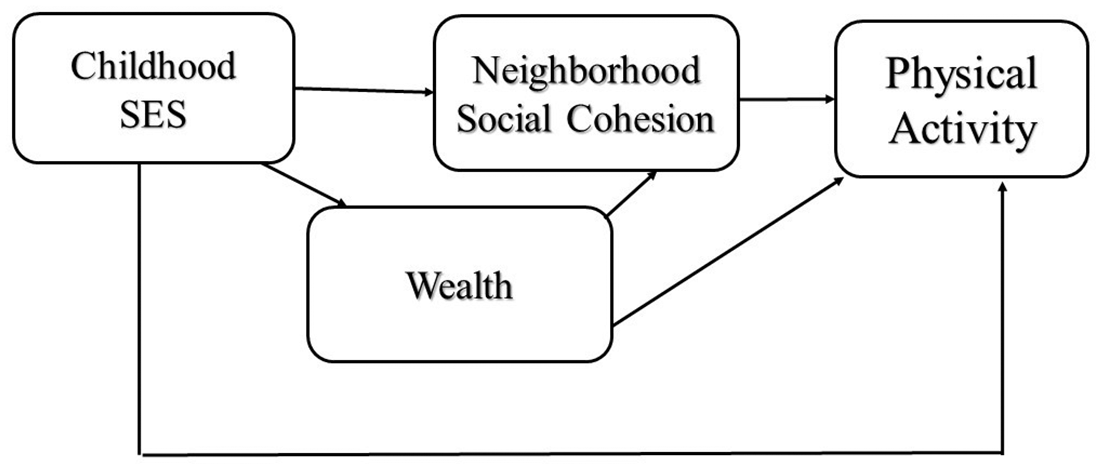
Conceptual model of the study relationships.
Method
Data
Data come from the Health and Retirement Study (HRS), a nationally representative study of adults, aged 50 and above, and their spouses in conjunction with the RAND HRS data file (HRS, 2016; RAND, 2016). The HRS utilizes a multistage stratified area probability sampling design. Floridians, Blacks, and Hispanics (majority Mexican heritage) are oversampled. Data have been collected every 2 years since 1998. In 2006, the HRS began a self-administered questionnaire termed the Leave-Behind Questionnaire that contains psychosocial measures, including measures of perceived neighborhood social cohesion. Only half of the full HRS sample receives the leave behind in each wave, with the other half receiving it in alternating waves 2 years later. We pool data from two waves by including individuals who filled out the Leave-Behind Questionnaire in either 2006 or 2008 to increase the sample size. We also pool data from the 2010 and 2012, along with data from 2014 and 2016 from the same respondents.
Of the 16,952 respondents alive and eligible to receive the psychosocial questionnaire in the 2006 and 2008 waves, 14,768 completed the survey. We exclude the 70 nursing home residents and 731 spouses under aged 50 for a total of 13,967 participants. Between the three waves, 3,350 individuals died, 178 were admitted to a nursing home, and an additional 1,173 did not respond to the survey. Due to a small sample size, we delete 225 people of a race other than non-Hispanic Black, Hispanic, or non-Hispanic White. Of the remaining respondents, 287 are deleted because they were missing information on an exogenous variable. Thus, we have a total analytic sample of 8,754 individuals.
We compare characteristics of people who were excluded with those who were included using t tests and chi-square tests; results are in Table 1. Participants who are excluded are more likely to have lower levels of childhood SES and lower levels of education than participants who are included in the study.
The t Test and Chi-Square Comparisons of Baseline Characteristics Between Analytic Sample and Excluded Participants.
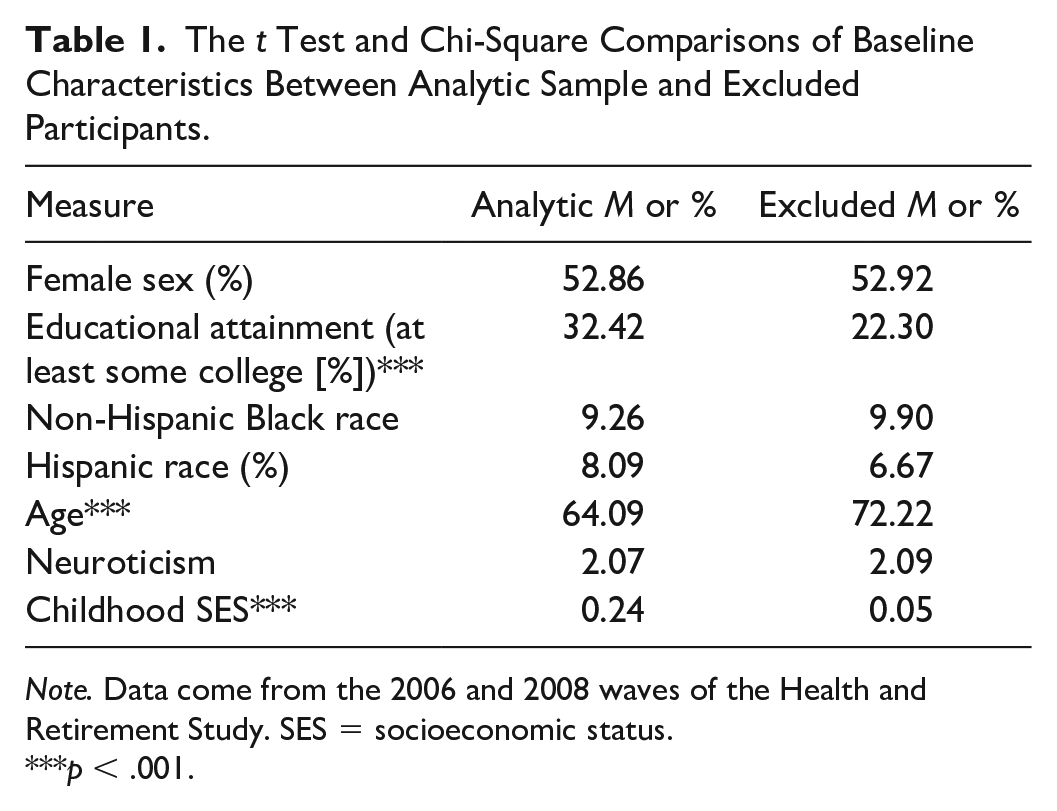
Note. Data come from the 2006 and 2008 waves of the Health and Retirement Study. SES = socioeconomic status.
p < .001.
Measures
Physical Activity
We create a score of physical activity that ranges from 9 to 45 and has been used in a previous study (Robinette et al., 2018). Participants are asked, “How often do you take part in sports or activities that are vigorous, such as running or jogging, swimming, cycling, aerobics or gym workout, tennis, or digging with a spade or shovel?” to gauge vigorous activity. Participants are asked, “And how often do you take part in sports or activities that are moderately energetic, such as gardening, cleaning the car, walking at a moderate pace, dancing, floor or stretching exercises?” to gauge moderate activity. To gauge light activity, interviewers ask, “And how often do you take part in sports or activities that are mildly energetic, such as vacuuming, laundry, or home repairs?” Responses are 1 = every day, 2 = more than once per week, 3 = once per week, 4 = one to three times per month, or 5 = never. After reverse-coding the items, we multiply the moderate physical activity score by 3 and the vigorous physical activity score by 5. Scores are added from all three domains to form a composite score of physical activity. Physical activity measures in the HRS are self-reported but are similar to measures that have been previously validated with data from accelerometers (Innerd et al., 2015). Physical activity measures for this study come from the 2014 and 2016 waves.
Childhood SES
We utilize a previously validated index of childhood SES created by Vable and colleagues (2017; see https://hrs.isr.umich.edu/data-products/access-to-public-data?_ga=2.114313743.98083987.1578511266-2000109843.1562096478). The authors use 18 respective measures that form three distinct components of SES: social capital (i.e., social connections), financial capital (i.e., income and wealth), and human capital (i.e., strength and quality of relationships) (Vable et al., 2017). Example measures included are mother’s highest level of education and poverty experienced during childhood. Previous studies suggest that retrospective measures are reasonably reliable and valid (e.g., Batty et al., 2005).
To create the index, the three SES measures are averaged; the final index is again standardized using z scores for interpretation. Higher scores indicate higher childhood SES.
Perceived Neighborhood Social Cohesion
Perceived neighborhood social cohesion (α = .86) measures come from the 2010 and 2012 waves of the HRS. The questionnaire asks respondents how they feel about the area within a mile of their homes; participants mark on a dotted line indicating on a scale from 1 to 7 how they feel about the following statements: (a) I really feel part of the area/I feel that I don’t belong in this area; (b) Most people in the area can be trusted/most people in this area cannot be trusted; (c) Most people in the area are friendly/most people in this area are unfriendly; and (d) If you were in trouble, there is nobody in this area that would help you. We reverse code items for use in this study. Perceived neighborhood cohesion is a latent variable (i.e., a measure that cannot be observed directly). Therefore, we incorporate each item of perceived neighborhood social cohesion in a confirmatory factor analysis to measure the extent each item is linked to the underlying latent variable. This measurement model is incorporated into the full structural equation models (SEMs) in this study. For the descriptive statistics summary table, we sum the measure.
Other Measures
Adulthood wealth and education come from the 2006 and 2008 waves of the HRS. We utilize the RAND cleaned and imputed values for wealth; this measure is calculated as the sum of all components of wealth minus debt (Bugliari et al., 2016). The logged version of wealth is used due to the skewness of this measure.
We measure educational attainment as a dichotomous measure of whether the respondent has at least some college education. We use a dichotomous measure of education based on research that suggests categorical measures perform better in predicting health outcomes than years of education. Years of education do not have a linear relationship with health outcomes (Rogers et al., 2010).
Control Measures
Some control measures come from the 2006 and 2008 waves of the HRS. We control for the sex of the respondent. We create two indicators for race, non-Hispanic Black and Hispanic. Age is measured in years. Consistent with previous literature, we add a measure of neuroticism to control for the fact that some individuals may be more predisposed to believing their neighborhoods lack cohesion when they do not (Robinette et al., 2018). Neuroticism (α = .72) is assessed by asking participants how well the following describe them: worrying, nervous, moody, and calm. We reverse code all items except for calm, create the average of the scale, and set the final score to missing if more than half of the items are missing within the scale (Smith et al., 2017). This measure comes from baseline because more respondents answer the question at baseline than at later years and because neuroticism is conceptualized as a stable personality trait (Steunenberg et al., 2005).
Health status is related to childhood SES and physical activity in later life (Pudrovska & Anishkin, 2013). Thus, we adjust for the number of diagnosed chronic conditions the respondent reports; these diseases include cancer, high blood pressure, lung disease, heart disease, stroke, psychiatric problems, and arthritis. Finally, we adjust for whether the respondent moves residences between the second and third time points assessed in this study (0 = does not move, 1 = moves).
Statistical Analysis
We use SAS (Version 9.4, SAS Institute) and Mplus (Version 8, Muthen & Muthen) to perform the analysis. To measure the study relationships, we use structural equation modeling. Advantages of structural equation modeling include the ability to incorporate measurement error in the latent construct of perceived neighborhood social cohesion and the ability to test multiple mediation pathways simultaneously (Byrne, 2013). The maximum likelihood (ML) estimator is utilized because it can incorporate full information maximum likelihood (FIML) to account for missing data (Byrne, 2013). To account for the complex sample design, we use the stratification weight (STRATUM) and the cluster weight (SECU) variables from the HRS. We also used the 2006 and 2008 weights from the psychosocial questionnaire (KLBWGTR, LLBWGTR), which correct for differential response to the leave-behind portion of the survey (Smith et al., 2017). The root mean square error of approximation (RMSEA), comparative fit index (CFI), and Tucker–Lewis index (TLI) are used to assess model fit. A RMSEA of <0.08, a CFI of >0.9, and a TLI of >0.9 indicate that a model has adequate fit. In large sample sizes, a nonsignificant p value for chi-square test of model fit is rarely obtained (Byrne, 2013).
First, we perform confirmatory factor analysis to examine the fit of the measurement model for the perceived neighborhood social cohesion scale. We follow this analysis with SEMs to examine pathways linking childhood SES to later life physical activity, which we display in Table 2. In our first model, we regress physical activity on childhood SES, perceived neighborhood social cohesion, and control measures (i.e., race, age, sex, neuroticism, whether the participant moved, and chronic conditions). We also regress perceived neighborhood social cohesion on childhood SES. In this first model, we do not incorporate wealth and education because they are potential pathways in the relationship between childhood SES and later life physical activity.
Weighted Descriptive Statistics of the Study Measures (N = 8,754).

Note. Data come from the 2006–2016 waves of the Health and Retirement Study. SES = socioeconomic status.
In Model 2, we add wealth to the model. We regress perceived neighborhood social cohesion on childhood SES and wealth. In addition, we regress wealth on race, age, and sex. In Model 3, we also regress wealth and physical activity on education. We test the statistical significance of the indirect effects linking childhood SES to physical activity through perceived neighborhood social cohesion and wealth in Models 2 and 3 using the Sobel test. We do not explicitly test whether education is a mediator in the study relationships because it is dichotomous in nature; therefore, the assumption of the Sobel test of normally distributed residuals is not met (Geldhof et al., 2018). However, we add education to Model 3 as the last step to examine the role it may play in explaining the study relationships. An attenuation in the relationship between childhood SES and physical activity or wealth between Models 2 and 3 would suggest that education is another potential mediator in the relationships. Another set of supplemental analyses using SEMs test an interaction between perceived neighborhood social cohesion and childhood SES because some literature finds that perceived neighborhood social cohesion moderates the relationship between disadvantage and health-related outcomes (e.g., Dawson et al., 2019; Erdem et al., 2016). Results of these supplemental analyses are discussed below. The Miami University Institutional Review Board exempts this research from human subjects review.
Results
Weighted descriptive characteristics can be found in Table 2. In general, participants report relatively high levels of cohesion; on a scale from 4 to 28, the mean score is 22. However, there is variability in this metric (interquartile range [IQR] = 9). The average physical activity score is 21 (IQR = 17).
The RMSEA, CFI, and TLI of the measurement model for perceived neighborhood social cohesion display adequate fit (RMSEA < 0.08, CFI > 0.99, TLI > 0.99). The unstandardized and standardized coefficients of the direct effects from the structural models are shown in Table 3. Within the text, we report standardized coefficients. Model 1 has adequate fit (RMSEA < 0.06, CFI > 0.98, TLI > 0.97). Higher childhood SES is associated with increased levels of physical activity in later life (β = .06, p < .001) and greater levels of perceived neighborhood social cohesion (β = .11, p < .001). Perceived neighborhood social cohesion is positively related to physical activity levels holding other measures constant (β = .06, p < .001).
Results From the Structural Equation Models (N = 8,754).

Note. Data come from the 2006–2016 waves of the Health and Retirement Study. SES = socioeconomic status.
Reference category is no college education.
Reference category is non-Hispanic White.
Coefficient rounds to 0 but is not 0.
Reference category is male.
p < .05. **p < .01. ***p < .001.
Model 2 has adequate fit (RMSEA = 0.049, CFI = 0.974, TLI = 0.960). Wealth is positively associated with perceived neighborhood social cohesion (β = .21, p < .001). Childhood SES is positively associated with wealth in adulthood (β = .15, p < .001). Wealth is positively related to physical activity (β = .14, p < .001). The relationship between childhood SES and physical activity is slightly attenuated in this model.
The RMSEA, CFI, and TLI of Model 3 indicate that the model fits the data adequately (RMSEA < 0.05, CFI > 0.98, TLI > 0.96). Education attenuates the relationship between childhood SES and physical activity. After incorporating the measure of education, childhood SES is no longer significantly associated with physical activity. Education is positively associated with childhood SES and wealth in adulthood.
The coefficients from the indirect effects are presented in Table 4. In Model 1, perceived neighborhood social cohesion is a statistically significant mediator in the relationship between childhood SES and later life physical activity (b = 0.07, p < .001). In Model 2, after we add wealth to the model, the indirect effect linking childhood SES and physical activity in later life is slightly attenuated yet remains statistically significant. We also report a statistically significant indirect effect linking childhood SES to physical activity through adulthood wealth (b = 0.03, p < .001). There is an additional mediational pathway linking childhood SES to physical activity through wealth and perceived neighborhood social cohesion (b = 0.01, p < .001). In Model 3, we observe that the statistically significant pathway linking childhood SES to physical activity through wealth is modestly reduced. Other indirect effects remain the same.
Direct and Indirect Effects.

Note. Data come from the 2006–2016 waves of the Health and Retirement Study.
The coefficient is rounded to 0 but greater than 0.
p < .05. **p < .01. ***p < .001.
We conduct supplementary analyses to investigate whether perceived neighborhood social cohesion moderates the relationship between childhood SES and physical activity. Results, shown in Supplemental Table 1 in the Appendix, indicate that the interaction term is not significantly associated with later life physical activity (β = .01, p = .68).
Discussion
In the present study, we examine perceived neighborhood social cohesion within the context of its relationship with childhood SES and physical activity later in life. We find that childhood SES and wealth are significantly associated with later life neighborhood social cohesion. Neighborhood social cohesion is significantly associated with increased levels of physical activity. Wealth and neighborhood social cohesion are statistically significant mediators in the relationship between childhood SES and later life physical activity, albeit the standardized coefficient is relatively small. Our work does not find evidence for a moderating effect of neighborhood social cohesion on physical activity.
Our findings support the cumulative inequality theory, which describes how inequality in social class is exacerbated over time. The ability to select a neighborhood or move out of one’s childhood neighborhood is likely patterned by class. Individuals who are of a low SES in childhood accumulate less wealth in adulthood, causing them to either never leave their childhood neighborhood or only be able to move to a new neighborhood that similarly lacks cohesion. Childhood neighborhood may also play a role, as children of a low SES are more likely to live in poor neighborhoods (Roubinov et al., 2018). Neighborhood characteristics, such as neighborhood poverty and neighborhood cohesion, are transmitted across generations (Sharkey, 2008; Van Ham et al., 2014). This literature suggests that as a whole, individuals who reside in a neighborhood low in quality in early life continue to reside in a low-quality neighborhood in later life. Despite emerging evidence of the importance of the life course perspective for health, a large body of research on health and place does not incorporate life course measures or use a longitudinal methodology, potentially overestimating the importance of an individual’s current residential setting (Clarke et al., 2014).
Although we cannot explore the effect of cumulative exposure to the neighborhood environment in this study, this is a natural extension to our work. One study finds that accumulated exposure to a poor neighborhood over a 15-year period is associated with increased risk of functional decline and mortality (Clarke et al., 2014). Thus, cumulative exposure may play an important role in explaining later life health and health behaviors.
Although we find that neighborhood social cohesion is related to wealth and SES in childhood, it remains a statistically significant predictor of physical activity even when controlling for these measures. The direct effect of perceived neighborhood social cohesion and physical activity in later life echoes what has been found in previous studies (Fisher et al., 2004; Kim et al., 2019; Robinette et al., 2018). Individuals who feel their neighborhoods are socially cohesive may be more likely to exercise together (Suglia et al., 2016). Public health strategies to influence levels of neighborhood social cohesion may thus be impactful at increasing levels of physical activity. Peters and colleagues (2010), for example, propose that creating urban parks can stimulate social interactions, increasing levels of cohesion. Additional research is needed to examine what types of interventions are effective in influencing neighborhood cohesion and whether physical activity levels are also increased.
Our study finds that there is also a statistically significant indirect effect linking childhood SES and later life physical activity independently of neighborhood social cohesion. This study confirms the findings of Pudrovska and Anishkin (2013), who find that socioeconomic achievement in adulthood mediates 44% of the effect of parental SES on later life physical activity in their sample. Our study also finds that education partially explains the relationship between childhood SES and later life physical activity. This relationship is expected, given that education influences both adulthood earning potential and levels of physical activity (Cohen et al., 2010).
This study has some limitations. Few studies contain data collected throughout the entire life course; to our knowledge, none of these studies contain information on childhood SES and later life perceived neighborhood social cohesion. Thus, the childhood SES index used in this study relies on retrospective measures. There may be some measurement error because respondents may not be able to recall their childhood socioeconomic circumstances accurately. Additional bias may result if some individuals are more likely to report that they had a low SES than others. Although we control for neurotic personality, it is possible we do not entirely adjust for this possibility. In addition, we do not explicitly test whether education mediates the study relationships.
Furthermore, individuals who experience the lowest SES in childhood are more likely to be excluded from the study than individuals who were included. Therefore, the effect of childhood SES on physical activity is likely underestimated. We also do not estimate the effect of neighborhood poverty that may play a role in the study relationships. This work would be another extension to our study.
Measures in the study are self-reported and may contain some bias. Individuals who are less educated are more likely to overestimate their daily physical activity (Van Sluijs et al., 2007). Similarly, our measure of neighborhood social cohesion is measured at the individual level. Neighborhood-level geographic information is not available in the public use files of the HRS. We postulate that, on average, individuals will have similar perceptions of cohesion as others who reside in their neighborhoods. We control for neuroticism to account for the fact that some individuals may be more predisposed to believing their neighborhoods lack cohesion than others. However, we cannot completely control for individual differences in perception. Future research can examine whether aggregated measures of neighborhood social cohesion produce similar results (Mendes de Leon et al., 2009).
Similarly, there could be alternative explanations for why individuals who had a low SES in childhood reported lower levels of perceived neighborhood cohesion in later life. Zimmerman and colleagues (2019) postulate that children who had parents who were authoritarian or absent would be less likely to have expectations for perceived neighborhood social cohesion. The scholars find that parents’ perceptions of collective efficacy are the strongest predictor of their children’s collective efficacy even after controlling for objective neighborhood characteristics. Parents of low SES may transfer their feelings of the neighborhood environment to their children. In turn, children may perceive less cohesion in adulthood despite moving into a more advantaged neighborhood. More research is needed to uncover the mechanisms underlying the relationships found in this study.
To conclude, perceived neighborhood social cohesion mediates the relationship between childhood SES and physical activity, although the effect is small. The relationship is further explained by wealth in adulthood. The literature currently provides limited exploration of whether and how the current residential environment mediates the relationship between childhood SES and later life health habits. Such an exploration can help inform the timing and types of public health interventions that can help eliminate disparities. A lack of attention to childhood socioeconomic circumstances may miss early times in which trajectories of low physical activity are set in motion.
Supplemental Material
sj-pdf-1-jag-10.1177_0733464820969312 – Supplemental material for Childhood Socioeconomic Status and Physical Activity in Later Life: The Role of Perceived Neighborhood Cohesion and Wealth in Adulthood
Supplemental material, sj-pdf-1-jag-10.1177_0733464820969312 for Childhood Socioeconomic Status and Physical Activity in Later Life: The Role of Perceived Neighborhood Cohesion and Wealth in Adulthood by Cassandra L. Hua and J. Scott Brown in Journal of Applied Gerontology
Footnotes
Declaration of Conflicting Interests
The author(s) declared no potential conflicts of interest with respect to the research, authorship, and/or publication of this article.
Funding
The author(s) disclosed receipt of the following financial support for the research, authorship, and/or publication of this article: This work was supported, in part, by the Agency for Health Research and Quality T32 training grant (Grant Number T32HS000011).
IRB Approval
This work was exempt from human subjects review by the Miami University Institutional Review Board (Reference Number 02197e). Informed consent was not required for this project because it used secondary data.

Supplemental Material
Supplemental material for this article is available online.
References
Supplementary Material
Please find the following supplemental material available below.
For Open Access articles published under a Creative Commons License, all supplemental material carries the same license as the article it is associated with.
For non-Open Access articles published, all supplemental material carries a non-exclusive license, and permission requests for re-use of supplemental material or any part of supplemental material shall be sent directly to the copyright owner as specified in the copyright notice associated with the article.
