



Abstract
Telemedicine has provided older adults the ability to seek care remotely during the coronavirus disease (COVID-19) pandemic. However, it is unclear how diverse medical conditions play a role in telemedicine uptake. A total of 3379 participants (≥65 years) were interviewed in 2018 as part of the National Health and Aging Trends Study. We assessed telemedicine readiness across multiple medical conditions. Most chronic medical conditions and mood symptoms were significantly associated with telemedicine unreadiness, for physical or technical reasons or both, while cancer, hypertension, and arthritis were significantly associated with telemedicine readiness. Our findings suggest that multiple medical conditions play a substantial role in telemedicine uptake among older adults in the US. Therefore, comorbidities should be taken into consideration when promoting and adopting telemedicine technologies among older adults.
Introduction
The coronavirus (COVID-19, SARS-CoV-2) pandemic created an unexpected crisis around the globe (Hoertel et al., 2020). Mitigation strategies have led to increased use of telemedicine to provide clinical care while minimizing mortality, economic impact, and viral spread, as promoted by the Department of Health and Human Services (Hoertel et al., 2020).
Prior to the pandemic, Medicare and Centers for Medicare and Medicaid Services (CMS) valued the role of telemedicine, but despite efforts to expand its use, this service was limited to specific scenarios. The expansion of telemedicine during the COVID-19 pandemic allowed beneficiaries to receive this service from any location (not just rural areas) and to be reimbursed at levels consistent with in-person visits, as promoted by CMS and Medicare. For example, CMS has allowed the use of 2021 guidelines for the evaluation and management level of service for telemedicine visits, as opposed to prior complex guidelines (Sinsky & Linzer, 2020). These waivers and incentives allowed an uptake in these services.
Prior studies indicated that older adults accessed telemedicine efficiently (Hawley et al., 2020). Evidence also showed telemedicine-related improvements in health outcomes (Hong et al., 2017; Karhula et al., 2015; Liu et al., 2011; Trief et al., 2013), quality of life (Hägglund et al., 2015; Liu et al., 2011), medication management (Patel et al., 2013; Trief et al., 2013), and health literacy (Liu et al., 2011; Patel et al., 2013) among patients using telehealth prior to the pandemic. However, about 15% of older adults experienced a disruption in medical care during the pandemic (NORC, 2020), and it has been estimated that about 13 million older adults in the US may have difficulty using or adopting telemedicine services (Lam et al., 2020); physical and technical barriers, cognitive impairment, frailty, and social disparities, which are strongly associated with medical conditions, may play a role (Ellison-Barnes et al., 2021; Foster & Sethares, 2014; Keränen et al., 2017; Kruse et al., 2020). However, it is not known whether and to what extent there is an association between telemedicine readiness and chronic medical conditions among older adults and how this could impact available adoption models. The Technology Acceptance Model (TAM) and the Unified Theory of Acceptance and Use of Technology (UTAUT) models have been used in the evaluation of telemedicine adoption, and although these focus on end-user acceptance, attention has to be given to medical conditions potentially limiting its adoption in older adults (Harst et al., 2019).
Older adults are at higher risk of having multiple medical conditions and therefore are more likely to seek care (Bähler et al., 2015). Also, chronic medical conditions and mood disorders are associated with increased physical and functional limitations, recurrent hospitalizations, social isolation, and higher health care needs among older adults (Picco et al., 2016; Roland & Paddison, 2013). In addition, older age and the presence of chronic conditions, such as diabetes, cardiovascular diseases, obesity, and kidney diseases, puts patients at a higher risk of developing serious complications from COVID-19 infection, including death (Gupta et al., 2020; Zhou et al., 2020). Therefore, older adults are encouraged to stay at home and use telemedicine alternatives to continue care.
Prior work on internet use across multiple cohorts of older adults showed greater usage among those with younger age, White race/ethnicity, higher educational level, higher income, good state of health, and multiple diseases (Boulton-Lewis et al., 2007; Carpenter & Buday, 2007; Greysen et al., 2014; Heart & Kalderon, 2013; Kim et al., 2019; Levine et al., 2016). Prior to the COVID-19 pandemic, US seniors engaged more in telemedicine, contacting physicians or filling prescriptions using telephone, cell phone or computers, despite regulatory restrictions (Levine et al., 2016). In regard to the modality of communication, older adults preferred telephone over videoconference (Levine et al., 2016), and recent work in a Canadian cohort indicated that frailty and absence of a caregiver were associated with lower likelihood for a videoconference assessment in seniors (Liu L et al., 2020).
To advance our understanding of the relationship between telemedicine use and chronic medical conditions, it is necessary to evaluate the capabilities of older adults to adopt telemedicine alternatives based on their comorbidities. Assessments and education are required to evaluate older adults’ abilities to use telemedicine. Therefore, understanding the potential relationships of medical comorbidities with telemedicine readiness can help support evidence-based policy decisions and facilitate telemedicine usage and adoption among older adults. This study will expand the scarce evidence on end-user facilitating or limiting factors on theoretical models evaluating telemedicine acceptance in older adults.
Methods
Sample
The present work is a cross-sectional study of community-dwelling participants from the 2018 National Health and Aging Trends Study (NHATS) including 4977 individuals (Freedman & Kasper, 2019). Of these, 934 (19%) participants were excluded because they were non-community residents (residential care or nursing home), and 863 (17%) were excluded because of cognitive decline, as detailed elsewhere (Rodríguez-Fernández et al., 2017). The remaining 3379 individuals were included in the analysis. The NHATS survey protocol was approved by the Johns Hopkins University Institutional Review Board and all participants provided informed consent.
Telemedicine readiness, unreadiness, and medical conditions
Telemedicine readiness was defined as being able to do one of the following: (1) contact medical providers online; (2) handle medical insurance matters online (coverage, compare providers, bill status, or filing a claim); or (3) obtain information about medical conditions online.
Telemedicine unreadiness was defined as having any physical or technical factor that could limit the communication between health care providers and patients. Physical limitations included any of the following: difficulty hearing, difficulty watching television or reading a newspaper even with glasses, or difficulty speaking or making self-understood. Technical limitations included not owning a working telecommunication device (computer, cell phone, or telephone), not knowing how to use them, or not using email, texting or the internet during the previous month.
Regarding medical conditions, participants or their proxies were asked whether they had been diagnosed with any of the following medical conditions: cancer, myocardial infarction, heart disease (separate from myocardial infarction), hypertension, stroke, diabetes, lung disease, osteoarthritis, and osteoporosis. Self-report of chronic conditions shows good diagnostic accuracy against claims and medical records (kappa values ranging from 0.6 to 0.82) (Miller et al., 2008). Depression and anxiety were assessed using two validated screening questionnaires: the Patient Health Questionnaire-2 (PHQ-2) and the Generalized Anxiety Disorder-2 scale (GAD-2). We used a PHQ-2 score ≥3 to define substantial depressive symptoms and a GAD-2 score ≥3 for anxiety symptoms; both questionnaires are validated clinical tools among older adults (Boyle et al., 2011; Wild et al., 2014).
Statistical analysis
Demographic characteristics and medical conditions of community-dwelling participants were compared between each telemedicine group (those who met any of the readiness criteria and those who did not) and between those with unreadiness (physical or technical) and those without this condition using χ2 tests. To account for age effects, we dichotomized age as younger than 80 years versus 80 years or older, since the latter group lacks technological exposure and has higher frailty levels, limiting technological implementation and acquisition (Harvie et al., 2014, 2016). Frequency rates of telemedicine readiness and unreadiness factors across medical conditions were also calculated. Adjusted logistic regression models were used to estimate telemedicine readiness and unreadiness due to physical or technical factors by medical condition. We adjusted for confounding variables including age, gender, race/ethnicity, education, and marital status as covariates. For all associations, we performed residual analyses to assess the fit of the data, checked assumptions, and examined the potential influence of outliers. Because our analyses were mainly exploratory, statistical significance was fixed a priori at a two-sided p value <0.05. Statistical analyses were conducted using Stata 12 SE version (StataCorp, TX) and in R version 4 (R Foundation for Statistical Computing, Vienna, Austria).
Results
Demographic characteristics by telemedicine category
Demographic characteristics by telemedicine category.

*Each p Value represents the comparison between each readiness or unreadiness subgroup using χ2 tests.
aData are given as number (percentage) for each group.
bHeart disease is separate from myocardial infarction.
Telemedicine factors by medical condition
Telemedicine factors by medical condition.
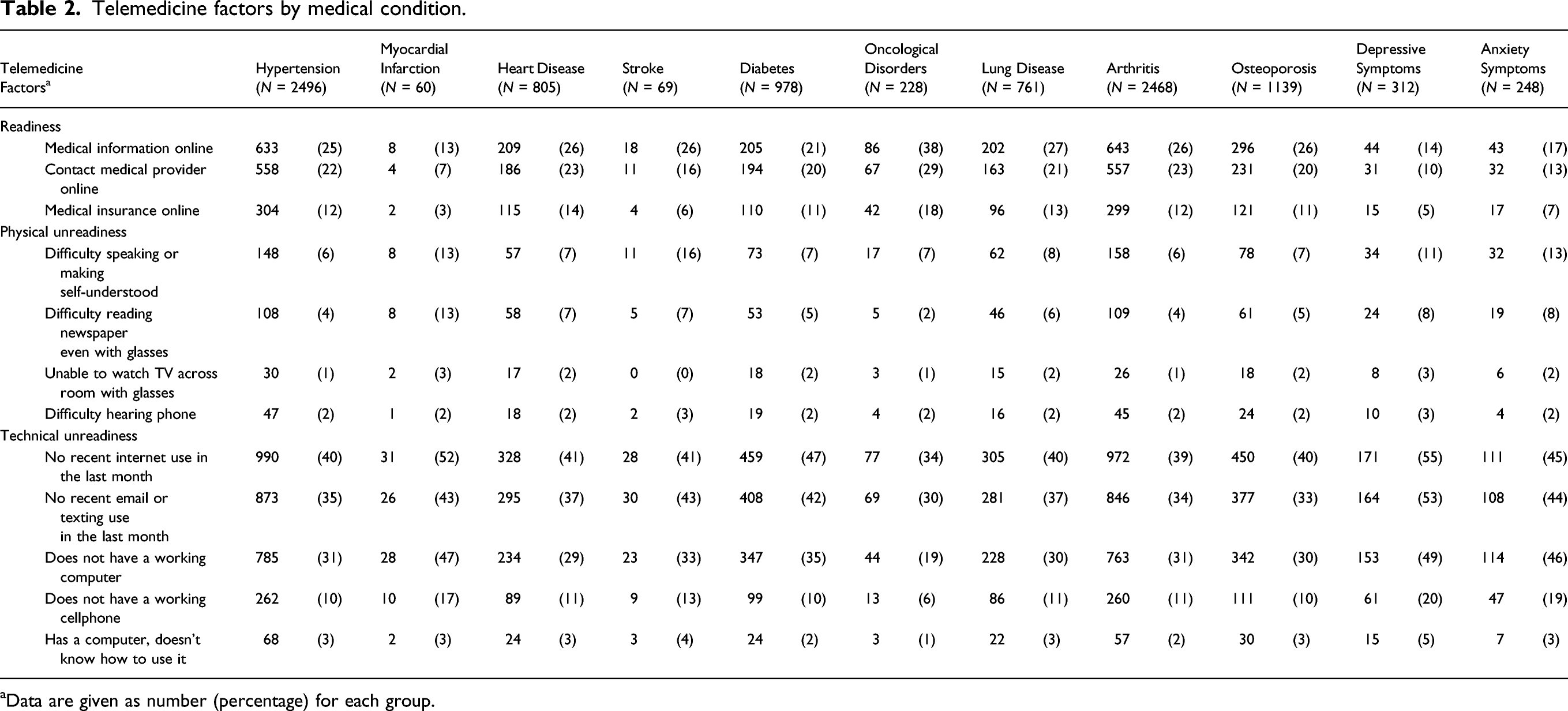
aData are given as number (percentage) for each group.
Telemedicine readiness and unreadiness across medical conditions
Adjusted odds ratios for telemedicine readiness and unreadiness across medical conditions.
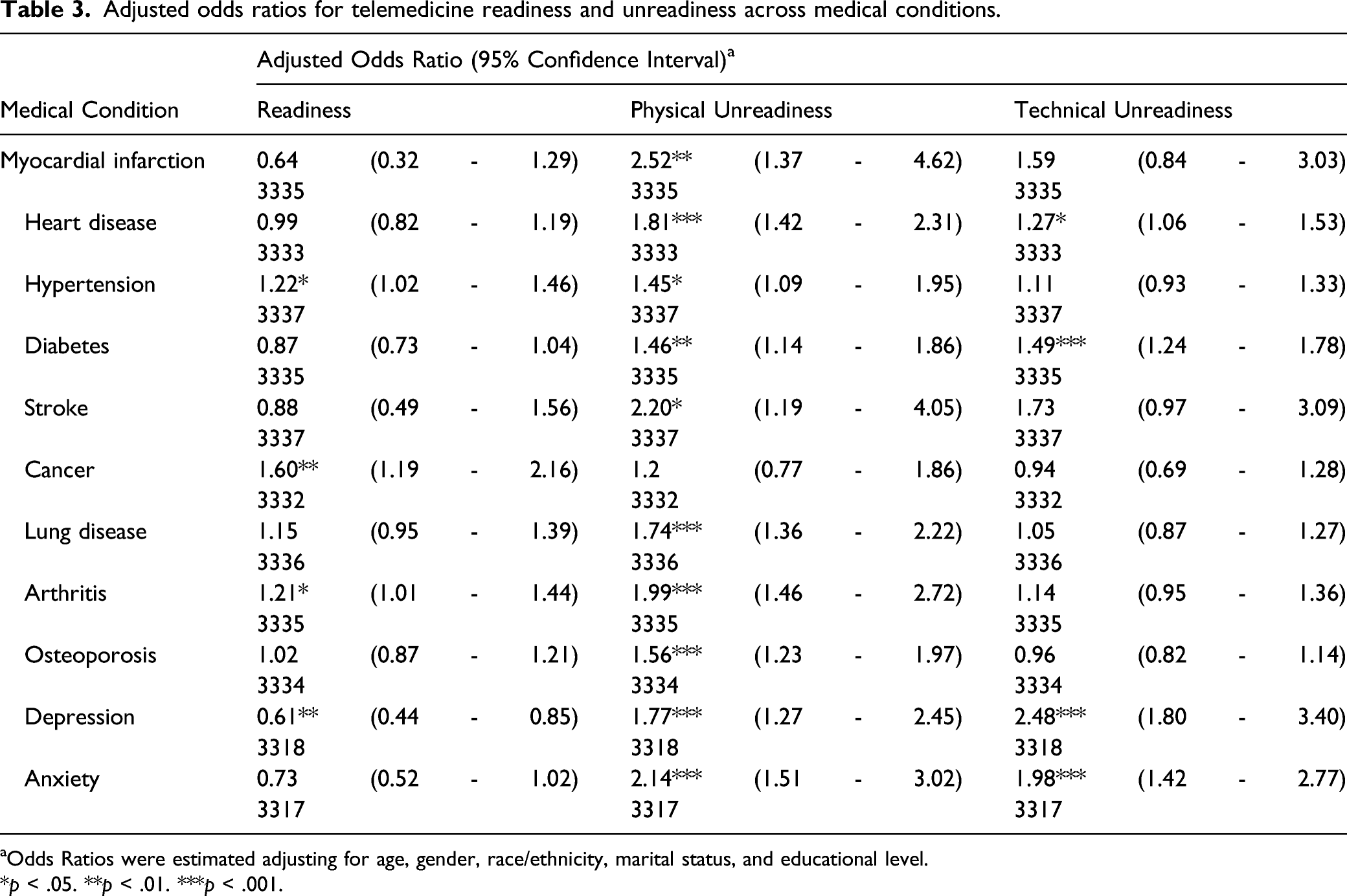
aOdds Ratios were estimated adjusting for age, gender, race/ethnicity, marital status, and educational level.
*p < .05. **p < .01. ***p < .001.
Discussion
Our study identified a significant association between telemedicine readiness and cancer, arthritis, and hypertension; in addition, readiness was challenged by the presence of physical factors and technical factors across medical conditions. These findings support the concept that comorbidities play a role in telemedicine adoption and use among older adults. They also suggest that these factors must be taken into consideration while using end-user technology acceptance models. Several explanations could account for these associations. We know that despite the underlying communication barriers in patients with cancer due to complex medical terminology, type of information given, and older age (McDonald-Miszczak et al., 2005; van Weert et al., 2011), strong efforts to empower these patients to recognize and communicate their needs to healthcare workers have been successful. Prior studies show increased popularity of digital resources among patients with a cancer history (Shea–Budgell et al., 2014), not only to provide information regarding diagnosis and treatment but to continue care after initial treatment, including during remission, recurrence, metastasis, and end of life; this framework is often referred to as the cancer continuum model (Fletcher et al., 2017; Gorin et al., 2017). A recent meta-analysis indicates that telemedicine plays a crucial rule helping to coordinate care over different stages in the model (Gorin et al., 2017), improving symptom management, patient-to-clinician communication, and quality of life and reducing hospitalization (Chumbler et al., 2007a; Chumbler et al., 2007b; Mkanta et al., 2007). This has led to opportunities for older adults with cancer to engage in their healthcare, increasing information and communication at the time of diagnosis, treatment or after (Gorin et al., 2017; Shea–Budgell et al., 2014). In regard to arthritis, a systematic review on osteoarthritis and rheumatoid arthritis shows that telemedicine provides an equally effective intervention compared to a traditional clinic visit, such that patients are satisfied with the type and quality of the delivery of care (Piga et al., 2017). In regard to hypertension, meta-analysis and systematic review highlight that telemedicine in hypertension is feasible, well-accepted, and able to improve outcomes including blood pressure control in the community setting, even in underserved areas or ethnic minorities (Agarwal et al., 2011; Omboni et al., 2013). A recent manuscript by the American Heart Association on telemedicine and management of hypertension during the pandemic highlights that older adults should be a target population for the development of healthcare models while including remote monitoring, medication adherence and education on lifestyle and risk factors (Omboni et al., 2020). Overall, telemedicine helps to empower patients with cancer, arthritis, and hypertension by promoting self-management, improving patient–physician communication, and influencing behaviors and attitudes.
Confirming results from prior studies in older adults, we found that telemedicine unreadiness is more likely to be found in older females who are unmarried, non-White, with a high school degree or less. Also, unreadiness due to technical factors is more prevalent (N = 1817) than unreadiness due to physical factors (N = 344). Conversely, telemedicine readiness is found in 34% of the cohort (N = 1145) and is more common among younger females who are married, White, with a college degree or beyond (Foster & Sethares, 2014; Greysen et al., 2014; Heart & Kalderon, 2013; Kruse et al., 2020; Levine et al., 2016).
Previous studies demonstrate telemedicine barriers in older adults including technical issues, physical factors, frailty, and social disparities (Ellison-Barnes et al., 2021; Keränen et al., 2017; Patel et al., 2013), limiting the use of videoconference compared to telephone visits in telemedicine (Lam et al., 2020; Stevens et al., 2021). In addition, recent studies during the pandemic report that despite interest in telemedicine adoption, the aging population has lower use compared to younger individuals, mostly due to technical limitations (Fischer et al., 2020; Horrell et al., 2021). In our study, physical factors across most comorbidities are associated with unreadiness; this finding is consistent with prior research on cardiovascular, pulmonary, inflammatory, or mood disorders leading to physical limitations (Nascimento et al., 2015; Eisner et al., 2008; Hawker, 2019; King et al., 2018; Lenze et al., 2001; Welmer et al., 2013). In addition, it has been noted that subjects with visual, hearing, or communication problems are more likely to suffer from the conditions above (Flowers et al., 2016; Grosmaitre et al., 2013; Mulrow et al., 1990; Rovner & Ganguli, 1998); furthermore, sense impairment is known to lead to communication difficulties (Jonas & Loeb, 2010). Technical limitations are observed in heart disease, diabetes, and mood disorders; although prior trials show the feasibility of device usage (mobile or telephone) for health communication or monitoring across different comorbidities in older adults (Raphael et al., 2017), our study highlights that these comorbidities might entail technical challenges for telemedicine adoption. For example, a recent literature review on diabetes care and eHealth indicates that lack of technological skills, computer access, resistance to change given mistrust in care, and privacy concerns can limit final implementation (Gurung & Neupaney, 2020). The same has been noted among patients with heart disease, where difficulty operating technology can account for up to 75% of refusals (Anglada-Martínez et al., 2016; Karhula et al., 2015). Therefore, certain studies use telemedicine alternatives to complement regular care (Goyal et al., 2016).
Of note, few medical conditions among older adults have an impact on unreadiness for telemedicine, including both technical and physical limitations. Depressive and anxiety symptoms have the strongest association, followed by history of heart disease and diabetes. Telemedicine alternatives in mental health care can facilitate therapy delivery, information resources, counseling, and networking (Cooper, 2013; Dölemeyer et al., 2013; So et al., 2013). Despite these efforts, challenges remain, including technical issues, awareness of telemedicine options, end-user friendliness, privacy, functionality, and mental health wellbeing (Fulford et al., 2016; Vis et al., 2018). Furthermore, physical impairments are often associated with mood symptoms (Mulrow et al., 1990; Rovner & Ganguli, 1998). Barriers to remote mental health care have initiated efforts to understand such factors. A systematic review on the topic highlights two determinants that affect telemedicine adoption beyond technical issues: first, building mutual expectations and preferences, and second, developing interventions tailored for telemedicine, promoting adequate patient-to-provider interaction (Vis et al., 2018).
Our results have multiple implications. First, they suggest that clinicians should be aware that older adults with chronic conditions or mood symptoms face limitations for telemedicine access and adoption, extending prior work on the barriers for telemedicine among older adults (Foster & Sethares, 2014; Kruse et al., 2020). Conversely, patients with cancer, hypertension, and arthritis seem to be better prepared for telemedicine. Our findings also suggest the potential value of optimizing and facilitating telemedicine acceptance while evaluating readiness and unreadiness, factors that should be considered in conjunction with the proposed telemedicine implementation models such as TAM, UTAUT, and the Senior Technology Acceptance Model (STAM) (Chen & Chan, 2014; Hoque & Sorwar, 2017). Design considerations accounting for unreadiness factors by comorbidity must be taken into account to enhance usability. In addition, given social distancing recommendations, remote monitoring systems using a copresence-enhanced model might be beneficial to monitor health-related data among older adults with chronic medical conditions (Liu N et al., 2020). Our results suggest that assessing, implementing, and evaluating strategies to optimize equitable access to telemedicine among older adults are important to minimize the gap of care across medical comorbidities.
The strengths of our study include a relatively large sample size and its representativeness. Results should also be interpreted in the light of limitations common to most large-scale surveys. First, diagnoses of medical conditions relied on patient report and were not confirmed by independent physician assessment, leading to increased variance and attenuation of correlations; nonetheless, self-report of chronic conditions has good diagnostic accuracy against claims and medical records (Miller et al., 2008). Furthermore, reporting devices or technical issues can potentially lead to over or underestimation of the true rates of readiness or unreadiness. Second, severity and possible consequences of telemedicine unreadiness were not evaluated, leaving the impact on older adults’ health over time unclear. Longitudinal data are needed to examine the course of those barriers and to evaluate older adults’ responses to either unreadiness or readiness.
Despite these limitations, our study constitutes a critical step in the understanding of medical conditions and mood symptoms and their impact on telemedicine unreadiness and readiness in the US. We found that in a large and nationally representative sample of older US adults, common medical conditions and mood symptoms were associated with telemedicine unreadiness, whereas cancer, hypertension, and arthritis were associated with telemedicine readiness. Given the ongoing efforts to provide and enhance care through telemedicine for older adults during the COVID-19 pandemic, these results suggest that more attention may be needed to comorbidities among older adults to facilitate telemedicine usage and adoption.
IRB Review
The NHATS has benefited from full ethical review and been approved by specific commissions to detail. Since all the analyses were performed on de-identified NHATS data, which is publicly available for download, local IRB Review was not required.
Footnotes
Declaration of conflicting interests
The author(s) declared no potential conflicts of interest with respect to the research, authorship, and/or publication of this article.
Funding
The author(s) received no financial support for the research, authorship, and/or publication of this article.
