



Abstract
This study examines the relationship between age, cognitive reserve (CR), and driving-related cognitive abilities in a sample of oldest old drivers undergoing evaluation of fitness to drive. Structural equation modeling was used to investigate the associations between age, CR, and performances to a standardized set of cognitive tests assessing fitness to drive. Education and work complexity were used as proxy measures of CR. The results showed both measures of CR, but not age, were significantly associated with higher general intelligence. Education also predicted higher decision speed, and decision speed partly mediated the effect of education on general intelligence. These findings suggest that over age of 80 years old, CR was a better predictor of driving-related cognitive abilities than age. Education was associated with better performance across different cognitive domains including processing speed.
Introduction
As the population ages, the percentage of licensed elderly drivers is increasing (Organisation for Economic Co-operation and Development, 2001), and a larger number of drivers are still getting behind the wheel in their 90s (Hajek et al., 2019; Hollis et al., 2013). Older adults report that driving a car is very important for maintaining their autonomy of and the quality of their lives (Hjorthol, 2013; Karthaus & Falkenstein, 2016); relatedly, driving cessation has been found to correlate with depression, health problems, cognitive impairment, and social isolation (Edwards et al., 2009). However, since advancing age can bring a decline in many cognitive abilities that are relevant to safely drive a motor vehicle (Anstey et al., 2005; Clay et al., 2009; Karthaus & Falkenstein, 2016), public safety concern has raised about older adults’ driving performance and fitness to drive (Li et al., 2003). Many countries worldwide have adopted screening polices for elderly drivers based on chronological age (Dobbs, 2008; Grundler & Strasburger, 2020; Siren & Meng, 2012).
The idea that driving competence declines with increasing age has been challenged by research results showing that old drivers do not have a higher risk of crash than other drivers when controlling for yearly driving distance (Hakamies-Blomqvist et al., 2002; Keall & Frith, 2006; Langford et al., 2006). Only drivers aged 75 and above who drive fewer than 3,000 km per year were found to exhibit increased accident risk (Langford et al., 2006). Relatedly, a few studies focusing on the subgroup of oldest old drivers (i.e., ≥80 years) have found that people aged 80 or older who are still driving have relatively good health and higher levels of cognitive functioning compared to nondrivers (Brayne et al., 2000; Hajek et al., 2019). Moreover, no significant differences have been found when comparing the driving skills of a group of very old drivers aged 80 to 89 years with those of a second group aged 90 years and older (Hollis et al., 2013). Overall, these findings suggest that advanced age alone is not a determinant of driving competence and that other variables should be considered to identify at-risk drivers (Grundler & Strasburger, 2020).
In this regard, since several studies (e.g., Adrian et al., 2011; Baldock et al., 2007; Mathias & Lucas, 2009) have shown that the scores obtained at tasks measuring various cognitive abilities are predictive of crash risk and on-road driving performance among adults aged 60 or older, it may be important to identify which factors can help maintain driving-related cognitive functions in later life. A protective factor is cognitive reserve (CR; Stern, 2002), a concept proposed in the field of cognitive aging to account for the observation that brain pathology does not always imply the presence of clinical symptoms of disease (Mortimer et al., 2003). CR has also been proposed as a relevant factor to cope with the decline in cognitive functioning associated with normal aging through either more efficient pre-existing cognitive functions or by compensatory processes (Stern, 2002, 2009). In this sense, CR is thought to be the result of a combination of life experiences and activities such as education, occupation, and cognitively stimulating leisure activities (Andel et al., 2007; Baldivia et al., 2008; Colombo et al., 2019; Richards & Deary, 2005; Tucker & Stern, 2011).
Several studies have documented the relationship between CR and numerous cognitive functions in healthy older people (e.g., Le Carret et al., 2003; Opdebeeck et al., 2016; Tucker-Drob et al., 2009; van Hooren et al., 2007). However, recent studies have found that CR is not related to motor performance and processing speed as indexed by information-processing tasks of low complexity such as reaction times (Lavrencic et al., 2018; Ritchie et al., 2013). Since processing speed is conceived as a cognitive “primitive” underlying higher cognitive abilities (Salthouse, 1996), it has been suggested that this basic aspect of cognitive functioning may be less susceptible to compensatory processes and that CR may act at some higher cognitive level (Lavrencic et al., 2018; Tucker-Drob et al., 2009).
Understanding whether the enhancing effect of CR extends to processing speed seems particularly relevant in the context of the assessment of fitness to drive: driving is a complex daily living task involving operational and higher cognitive skills (Groeger, 2000; Michon, 1985). Such an understanding could contribute to the improvement of screening protocols (e.g., clarifying whether the tests used are biased by CR) and lead to better interventions (Lavrencic et al., 2018).
The Present Study
This study examines the relationship between age, CR, and driving-related cognitive abilities in a sample of oldest old drivers referred for cognitive evaluation by the public health services. To our knowledge, this is the first study to consider the relationship between CR and the performance to a standardized set of cognitive tests assessing fitness to drive in a sample of individuals aged 80 and above.
Concerning CR, we employed two commonly used proxy measures (Harrison et al., 2015; Opdebeeck et al., 2016): education (operationalized using years of education; Then et al., 2016) and work complexity (Dodich et al., 2018; Forstmeier & Maercker, 2008), which was operationalized using the latest version (2010) of the Occupational Information Network (O*NET; Peterson et al., 1999, 2001).
Driving-related cognitive abilities were measured employing the standard test battery from the Vienna Test System (VTS; ©Schuhfried GmbH; Schuhfried, 2005), as significant correlations have been documented between the scores obtained at the VTS tests and driving performance in standardized road tests (Risser et al., 2008). The battery taps different cognitive domains (Groeger, 2000), including reaction times, reactivity under sensory stress, selective attention, obtaining an overview, and inductive reasoning. Notably, reaction times were measured using a rest and a response button, allowing discrimination between decision and motor time (MT). Decision time (DT) was used as an index of processing speed (Salthouse, 2000).
Two alternative hypotheses were considered. The first hypothesis was that proxy measures of CR would show significant associations with cognitive abilities except for information-processing speed (Lavrencic et al., 2018; Ritchie et al., 2013). By contrast, the second hypothesis was that CR would be associated with driving-related abilities across all domains. Since processing speed is thought to constrain performance on all cognitive tasks (Salthouse, 1996), we also hypothesized that decision speed would mediate the effect of CR on the other cognitive functions.
Method
Participants
The data were derived from a database provided by the service of psychodiagnostic assessment of fitness to drive of the Catholic University of the Sacred Heart, Milan, Italy. The database contained data of people referred for cognitive assessment by the Provincial Medical Commissions of Public Health Services to get their driving license renewed over the period 2015 to 2019. This study included people referred for an assessment because of their age (>80).
In more detail, 223 old adults (mean age = 87.09, SD = 3.32, range = 80–97; 96% male) were included in the study. The inclusion criteria for this study were (a) being cognitively healthy (i.e., no diagnosis of either cognitive impairment or neurological disease); (b) no severe motor/sensory impairment; (c) no diagnosis of psychiatric disorders; (d) no sleep disorders; (e) no diagnosis of epilepsy, and (f) no reported use of benzodiazepines or antidepressant medication.
Demographic information
The 76% of our sample was married, 21% widow, and 3% single. Concerning education, the 8% of the sample accomplished less than 5 years of school, 27% reported to have accomplished primary school (5 years), 21% had up to 8 years of education, 24% up to 13 years, and finally the 20% reported to have attended school for more than 13 years. 95% of the sample was retired.
Health status
In general, the participants reported chronic conditions (Table 1) that are common in people over age 80 (Jaul & Barron, 2017). Moreover, none of the medications reported by our sample is known to interfere with cognitive functions.
Health Status Information: Physical Health and Medication Use.

Note. Heart disease included: pacemaker (31%), chronic ischemic heart disease (17%), atrial fibrillation (13%), bypass (10%), angioplasty/stent (7%), oral anticoagulant therapy (5%), coronary artery disease (3%), angina (2%), and arrhythmia (2%). Cardiac medication therapy included: antithrombotic (43%), diuretic (44%), beta blockers (41%), ACE inhibitors (29%), cardio aspirin (31%), calcium channel blockers (21%), and angiotensin receptors blockers (19%).
Driving behavior and habits
Few drivers (12%) reported to have been involved in car accidents over the past 5 years. However, a significant number of drivers (26%) reported current restrictions to driving imposed by the authorities (i.e., driving in highway or at night not permitted, driving permitted only within a certain distance of home). Most of our sample (94%) reported to drive regularly (at least twice a week) along urban routes, but a significant percentage also reported to drive along suburban routes (50%) as well as on the highway (30%). The 39% of older drivers reported to self-limit their driving along brief urban routes (<5 km). Driving a car was reported to be the main means of transportation to accomplish the needs of daily living.
Procedure
Participants were assessed in a quiet, well-lit room. The assessment was conducted by a traffic psychologist according to the following procedure. First, participants were asked to read and sign a written informed consent and privacy forms compliant with the General Data Protection Regulation (GDPR). They were also asked to give their consent if they agreed that their data would be used for research purposes in an aggregate and de-identified way. Second, a clinical interview took place to collect anamnestic information including health status and driving behavior. Then, the psychologist administered the cognitive tests including Raven’s Colored Progressive Matrices (Basso et al., 1987; Raven, 1947) and four tests from the VTS (Schuhfried GmbH). The psychologist explained the instructions of all the tests to the participants. The whole procedure lasted on average 2 hours.
Measures
CR: Education and work complexity
During the clinical interview, the participants were asked questions concerning their education and their current occupation (or the occupation they held before retirement). Four indices of work complexity were then derived as follows. First, O*NET occupational codes were assigned by two independent coders selecting the O*NET occupation that matched the job reported by the participant in terms of activities and duties. Second, for each occupational code, the O*NET scores corresponding to the worker cognitive abilities (i.e., the cognitive abilities required for effective job performance) and basic skills (i.e., the capacities that enable learning and acquisition of new knowledge; for more details, see Peterson et al., 2001) were assigned to the participants. Four composite scores of work complexity were computed: verbal abilities (Cronbach’s α = .96), reasoning abilities (Cronbach’s α = .92), quantitative abilities (r = .94), and process skills (Cronbach’s α = .94).
Convergent validity was examined using the scores of work complexity with data, people, and things derived by the Dictionary of Occupational Titles (DOT, Miller et al., 1980, Appendix F; U.S. Department of Labor, 1991). Correlations between the DOT index “complexity of work with data” and the four composite scores ranged from to .62 to .83; correlations between the DOT index “complexity of work with people,” and the four composite scores ranged from.28 to .62.
Standardized assessment of driving-related cognitive abilities
The assessment included four tests from the computerized test battery of the VTS and a paper-pencil test to assess inductive reasoning (Raven’s colored matrices).
Reaction time (decision and motor time)
In the Reaction Test (RT), the respondent is instructed to react to a critical stimulus combination (acoustic signal + visual stimulus). The mean DT is computed as the interval between the onset of the target stimulus to the lifting of the finger from the rest button, while physical MT is measured by the latency from the start of the finger-lifting movement to the moment when the response key is pressed. Five indices were derived: mean DT, mean MT, DT standard deviation (DTSD), MT variability (MTSD), and number of errors.
Reactivity under sensory stress
The Determination Test requires to quickly respond to rapidly changing visual and auditory stimuli, thus tapping the abilities of cognitive shifting and flexibility. The test is administered so that the stimuli are presented a little faster than would be optimal for the respondent’s reaction speed. Two indices were derived: number of correct responses and mean reaction time.
Selective attention and concentration
In the Cognitrone (COG) test, the respondent’s task is to determine whether an abstract target figure matches one of four comparison figures. The respondent must press the green button on the response panel if the figures match or the red button if they do not. Two indices were derived: the mean time of correct rejections and the total number of errors.
Obtaining an overview
The Adaptive Tachistoscopic Traffic Perception Test (ATAVT) assesses observational ability by briefly (<1 second) presenting pictures of traffic situations. After viewing the picture, the respondent is asked to identify whether the picture included pedestrians, vehicles, bicycles/motorbikes, road signals, and traffic lights. The score represents the number of items for which all visible object classes were correctly identified by the respondent and no object class that was not visible in the traffic scene was marked.
Inductive reasoning
Raven’s Colored Progressive Matrices (Basso et al., 1987; Raven, 1947) were used to evaluate inductive reasoning. The test consists of 36 visual matrices of ascending difficulty. The respondent’s task is to identify the rules which govern each matrix and fill out the empty space by selecting the correct answer from eight alternatives. The total raw score range is between 0 and 36.
Data Analysis
After computing descriptive statistics, preliminary analyses were conducted: T-scores were used when available in the VTS software to compare the performances of our sample to those of a normative sample. Moreover, we tested whether old drivers who had current restrictions to driving imposed by the authorities and/or reported to self-limit their driving obtained lower scores than other drivers.
Then, we performed the main analyses. After computing bivariate Pearson’s correlations between the study variables, structural equation modeling (SEM) was used to examine the interrelations among age, CR, and driving-related cognitive abilities. Following Clay et al. (2009), two analysis steps were used. First, an exploratory factor analysis (EFA) was run using SPSS 21 to examine whether the selected measures could be represented by respective latent constructs. A confirmatory factor analysis (CFA) was then run to further test the measurement model using AMOS 24 (Arbuckle, 2016) and maximum likelihood (ML) as the estimation method. Second, a structural model tested the associations between measures of driving-related cognitive abilities and proxy measures of CR. In more detail, age, education, and work complexity were assessed as predictors of cognitive abilities. Restricted and self-limiting drivers were collapsed into a dichotomous variable that was included as a control variable. Work complexity was included in the model as a latent variable with four observable measures loading on it. Decision speed was assessed as a mediator of the effect of CR measures on higher cognitive abilities. The fit of the models was assessed using several fit indices: the chi-square (χ2), the Comparative Fit Index (CFI), the Tucker–Lewis fit Index (TLI), and root mean square of approximation (RMSEA). Generally, model fit is considered acceptable when CFI and TLI are ≥.90, good when CFI ≥ .95. In addition, RMSEA values ≤.08 are indicative of acceptable fit and ≤.06 of good fit (Hu & Bentler, 1999). To test mediation, indirect effects were estimated in AMOS using bootstrap bias-corrected percentile method (95% confidence interval) with 5,000 samples.
Results
Preliminary Analyses
Descriptive statistics and T-scores are reported in Table 2. When comparing the scores obtained by our sample to those obtained by the normative sample (T-score = 50), the results showed a significant difference for DT, reactivity under stress, selective attention and obtaining an overview, with our sample performing worse than the normative sample. No significant differences emerged for MT, DTSD, and MTSD.
Descriptive Statistics (Means and Standard Deviations) and T-Scores.

Note. SD = standard deviation.
For this test, the age range of the normative sample was 55 to 94 years old. For all the other VTS tests, the normative sample included drivers aged 80 to 94 years.
p < .05. **p < .01. ***p < .001.
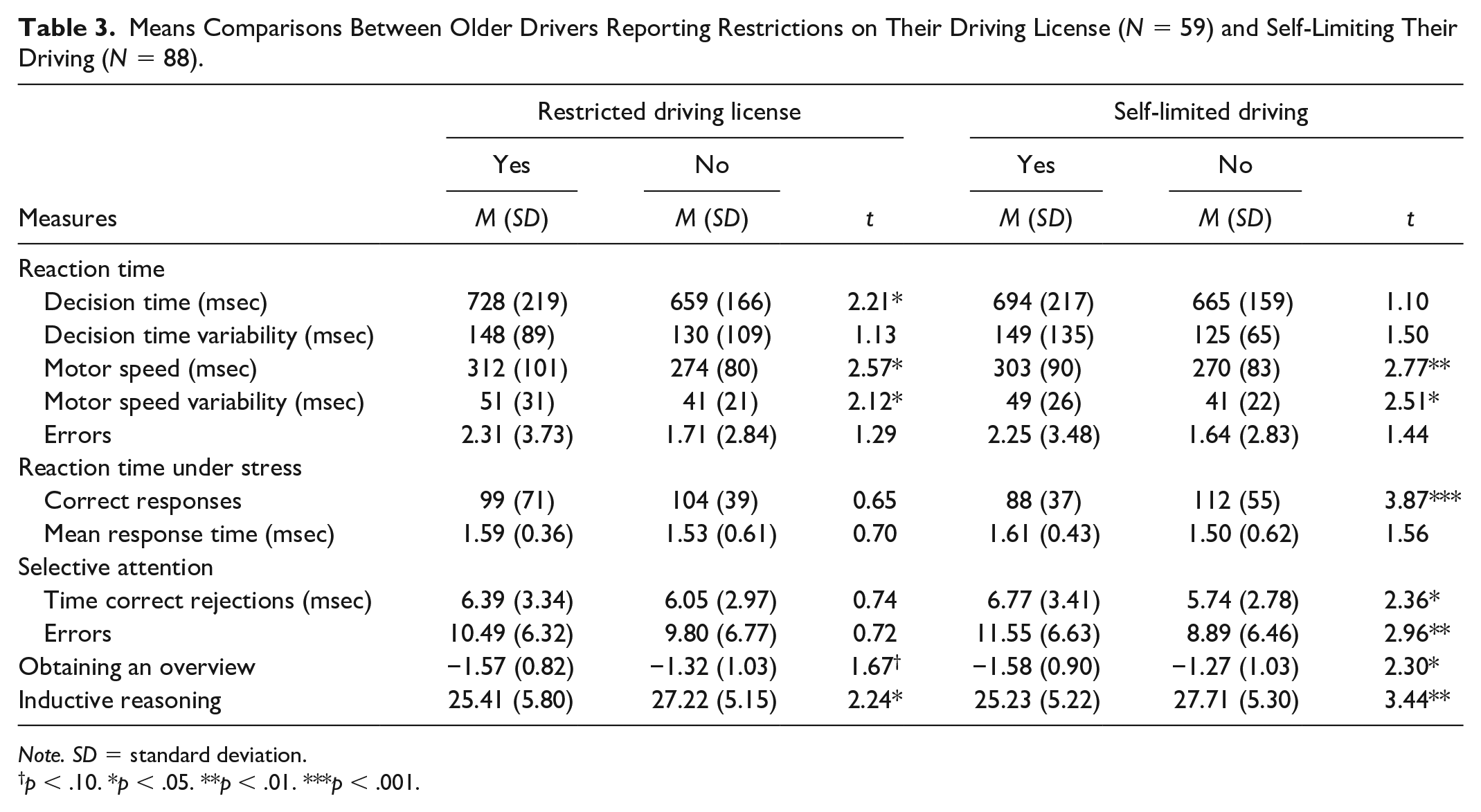
Notably, significant differences in test scores emerged when comparing restricted and self-limiting drivers to other drivers (Table 3).
Means Comparisons Between Older Drivers Reporting Restrictions on Their Driving License (N = 59) and Self-Limiting Their Driving (N = 88).
Note. SD = standard deviation.
p < .10. *p < .05. **p < .01. ***p < .001.
Main Analyses
Concerning bivariate correlations (Table 4), age was positively related to the number of errors in the selective attention test only. By contrast, education and indices of work complexity were associated with better performances across all the abilities, with the exception of MT and MTSD.
Bivariate Pearson’s Correlations Among Measures of Cognitive Abilities, Age, and Proxies of CR.

Note. CR = cognitive reserve.
p < .05. **p < .01.
An EFA with OBLIMIN rotation revealed that the measures of driving-related cognitive abilities were explained by three factors accounting for the 50% of variance. DT and DTSD loaded on the first factor (decision speed), MT and MTSD loaded on a second factor (motor speed), while the remaining measures loaded on a third factor (named general intelligence). This measurement model was further tested using CFA, revealing acceptable fit, χ2(41) = 88.99, p < .001, CFI = .940, TLI = .920, RMSEA = .073 (CI = .052, .093). The standardized estimates are presented in Figure 1(a). Estimates were significantly different from zero, p values < .05 and the latent variables were found to have significant correlations with each other.
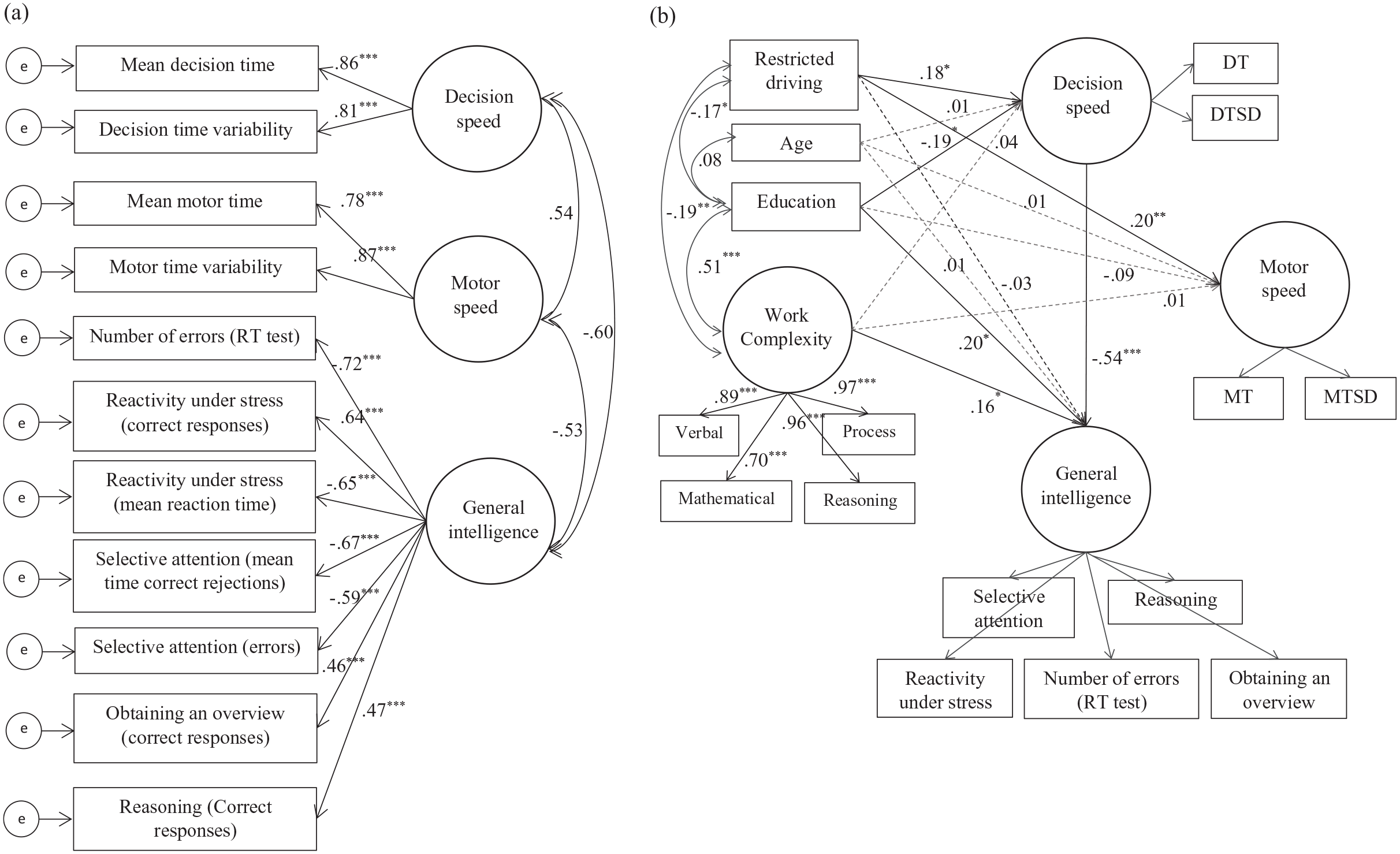
Structural models assessing (a) the measurement model and (b) the relationship between driving related cognitive abilities and CR.
The structural model examining the associations between driving-related cognitive abilities, age, restricted driving, and proxy measures of CR yielded good fit, χ2(119) = 214.96, p < .001, CFI = .95, TLI = .94, RMSEA = .060 (CI: .047, .073). Estimates were significantly different from zero, p values < .05. The paths from age to cognitive abilities were nonsignificant. Education showed a significant association with increased decision speed and general intelligence, while the path to motor speed was nonsignificant. Work complexity was significantly associated with higher general intelligence only. Restricted driving was significantly associated with lower decision and motor speed (Figure 1(b)).
Concerning the mediation hypothesis, the indirect effect of education through decision speed on general intelligence was significant (β = .10, SE = .044, CI = .03, .20, p = .011). By contrast, work complexity showed a nonsignificant indirect effect (β = −.02, SE = .047, CI = −12, .07, p = .699).
Discussion
The main goal of this study was to examine the relationship between age, CR, and driving-related cognitive abilities in a sample of oldest old drivers, testing whether CR predicts improved processing speed (Lavrencic et al., 2018; Ritchie et al., 2013). Several cognitive abilities including reaction time are thought to underlie safe driving behavior (Groeger, 2000; Michon, 1985).
First, the results showed that our sample performed worse than the normative sample in mean DT, reactivity under stress, obtaining an overview, and selective attention. Overall, our sample’s scores were located below the average (though generally within the range of one standard deviation), thus indicating somewhat lower ability levels. We also found that restricted and self-limiting drivers showed a significantly poorer performance at cognitive tests than other drivers. Notably, previous research has shown that older drivers traveling few kilometers per year have higher crash risk (Langford et al., 2006).
Second, from SEM analyses, three latent factors emerged underlying the scores obtained by older drivers at the standardized tests for the assessment of fitness to drive. The first factor represented decision speed and was loaded by DT and DTSD. The second factor was loaded by MT and MTSD, thus representing motor speed. The scores tapping the remaining cognitive abilities (i.e., reactivity under sensory stress, selective attention, obtaining an overview, and inductive reasoning) loaded on a third factor, which was named general intelligence. This factor was also loaded by the number of errors in the RT test, possibly reflecting inhibitory control. Overall, the third factor seemed to reflect a set of attentional-executive abilities and fluid intelligence.
When adding age, proxy measures of CR, and restricted driving in the model, the results showed that age did not account for different levels of driving-related cognitive abilities, as no significant associations with the latent factors emerged. Although this result seems surprising, since previous research has consistently found that driving-related cognitive abilities decline with age (Anstey et al., 2005), the age of the samples used in these studies generally spans four decades (ages 60–90 years and older), thus including both robust adults still in employment and frailer very old adults. In this article, we focused on drivers aged 80 years and older, considering a more limited (though still wide) age range (80-97-years old). In this regard, other studies have found no significant differences between 90+ years old drivers’ cognitive performance and that of drivers 10 years younger (Hollis et al., 2013).
Concerning CR, consistent with previous research, education and work complexity were not significantly related to motor speed (Lavrencic et al., 2018) but were significant predictors of higher general intelligence in later life (Le Carret et al., 2003). However, in our results, education predicted higher decision speed, which partly mediated the effect of education on general intelligence. This latter result differs from recent evidence suggesting that the effect of CR does not extend to processing speed and may be limited to higher cognitive functions (Lavrencic et al., 2018; Ritchie et al., 2013). This difference may be explained in different ways. A first explanation may lie in the different type of task used to measure processing speed. Lavrencic et al. (2018) used four-choice RTs, while Ritchie et al. (2013) employed simple and four-choice RTs. Lavrencic et al. (2018), however, also employed a go/no go RT task (similar to the one we used in this study) and, in their results, CR (years of education) was not predictive of higher speed. A second reason may be that prior studies did not distinguish between decision and MT (as we did in this study), and therefore motor speed may be responsible for nonsignificance. Third, prior studies used multiple regression analyses on each measure rather than structural modeling. A fourth explanation is that we did not control for childhood IQ: In Ritchie et al.’s (2013) study, the association between processing speed and CR was no longer significant after controlling for this variable.
Notably, it has been argued that efficiency in processing speed influences other cognitive functions (Clay et al., 2009; Salthouse, 1996). In this regard, it has been shown that age-related decline in processing speed mediates the (impairing) effects of age on other cognitive domains (Clay et al., 2009). Our results seem consistent with this view, showing that processing speed may (at least partly) mediate the effect of years of education on other driving-related cognitive abilities. Further studies are needed to deepen our understanding of the potential differential effect of CR on the major cognitive domains: If decline in processing speed plays a pivotal role in cognitive aging, it is important to determine whether CR impacts this fundamental aspect of cognitive functioning. As several different tasks have been used to measure processing speed (with varying levels of complexity), it would be important for future research to employ multiple measures.
Unlike education, work complexity was related to the general intelligence factor, but not to decision speed. The fact that only one of the two proxies showed the predicted association brings up questions about the possibility to drive conclusions on the relationship between CR (as overall construct) and processing speed. Although more research is needed to conclude for an effect of CR on this cognitive function, one speculative hypothesis is that the two proxies may show differential effects. Education is generally thought as an early cognitive stimulation that can increase synaptic density (Katzman, 1993; Le Carret et al., 2003), and this may explain its positive effect on cognitive processing speed.
Finally, we found that restricted drivers (either restricted by licensing authorities or self-limiting) showed poorer decision and motor speed. This result is consistent with prior research finding associations between cognitive impairment and reduced driving exposure (Braitman & McCartt, 2008). Notably, restricted drivers were more likely to report lower education and lower work complexity than other drivers.
Our results have some important implications for the cognitive assessment of fitness to drive. First, over the age of 80, chronological age seems to be a poor predictor of driving-related cognitive performances. In this regard, other studies have argued against the efficacy screening polices for elderly drivers based on chronological age (Dobbs, 2008; Grundler & Strasburger, 2020; Siren & Meng, 2012). Second, the results of factorial analyses showed that motor and processing speed reflect latent abilities related to but different from the other cognitive abilities tested. It would thus be important for screening protocols assessing fitness to drive to include information-processing tasks like RTs together with tests of general cognitive functioning (i.e., MMSE). Third, our findings suggest that the scores obtained at the cognitive tests used for the evaluation of fitness to drive are biased by compensatory CR processes, so that the elderly who are better educated and hold more cognitive demanding jobs tend to perform better than the elderly with lower levels of education and less complex occupational attainment. Notably, the bias due to education seems to extend to relatively simple information-processing tasks such as those measuring RTs. Considering the effects of education (i.e., stratifying scores not only relative to age, but also to educational level), would reduce this bias.
Some limitations bear noting. First, our sample largely consisted of old male drivers, thus limiting the generalizability of our results to old female drivers. This imbalance however may reflect the fact that women tend to stop driving earlier in later life (Brayne et al., 2000; Hajek et al., 2019). Second, as reported above, the cross-sectional nature of this study did not allow to control for earlier levels of cognitive abilities (Ritchie et al., 2013; Tucker-Drob et al., 2009). Third, since we used only two proxy measures of CR, the effects observed in this study could not be generalizable to other CR measures (e.g., engagement in cognitively stimulating leisure activities). Relatedly, years of education as a proxy of CR entails some limitations, as it can be affected by cultural and economic factors (e.g., limited opportunities to access higher education) and the quality of education can differ (Baldivia et al., 2008). Fourth, the battery used in the study included a limited number of tests. Also, although the VTS is a widely employed instrument to measure driving-related abilities, scant evidence exists concerning its predictive validity in older samples. Nonetheless, in our study, the performance obtained at the VTS tests was significantly associated with some aspects of driving behavior, such as being imposed some restriction by the authorities and self-limited driving.
Despite these limitations, the results from this study demonstrate differential associations of CR, as measured by education and work complexity, on driving-related cognitive abilities with processing speed as a potential mediator of the effects of education on the other cognitive functions.
Footnotes
Acknowledgements
The Ethics Committee of the Department of Psychology of the Catholic University of the Sacred Heart acknowledged that the present study is exempted under Category 4 of exemption from the requirements of the Federal regulations on human subjects research protections” of the SAGE Publishing’s guidance. Informed consent was obtained at the time of original data collection.
Declaration of Conflicting Interests
The author(s) declared no potential conflicts of interest with respect to the research, authorship, and/or publication of this article.
Funding
The author(s) received no financial support for the research, authorship, and/or publication of this article.
