




Abstract
Toward a background of young people’s decreasing housing affordability and parents’ increasing involvement in intergenerational housing support, this study investigates how such support influences parents’ expectation of future care from adult children. Using data from the China Health and Retirement Longitudinal Study, we found that, in general, middle-aged/older adults who provided adult children financial housing support were more likely to expect old-age care from them. The help-receiving child was more likely to be an expected caregiver than the other children in multi-children families. Moreover, the reciprocal relationship was most prominent among the 1950s cohort, compared with the pre-1950s and the post-1950s cohorts. Our study broadly contributes to understanding how modernization reshapes intergenerational relationships and family members’ expectations of commitments toward each other. It also informs the design of a comprehensive multi-level care system for older adults in China.
Keywords
What this paper adds
This paper examines the increasingly important but long overlooked role of intergenerational housing support in shaping parents’ expectations for old age care by children. This paper demonstrates the joint effects of fairness-based reciprocal mentality and the need-based transfer tradition on intergenerational exchange. This paper shows the changing motives of intergenerational transfer across different birth cohorts under modernization.
Applications of study findings
This paper suggests social policy should facilitate the adult children support-receivers to return caregiving services to parents when they are in need. This paper recommends improved supportive policy at national and community levels for working family carers to juggle caregiving and work. This paper informs the design of a comprehensive multi-level care system, to satisfy the diverse care needs and preferences of older adults from different birth cohorts.
Introduction
With rapid population aging, China faces a major challenge of providing care for its increasing older population. Understanding older people’s perspectives toward old-age care arrangements and the associated factors will shed light on more effective policy designs toward future long-term care. Traditionally, older parents expect their adult children, especially adult sons, to provide old-age support (Li et al., 2012). Such a care arrangement was common in Chinese urban and rural areas, safeguarded by traditional filial culture, limited population mobility, and a higher birth rate among cohorts born before the 1960s. However, as fundamental demographic and socioeconomic transitions took place in the past few decades, the expectations of older parents for receiving care and the availability of adult children for providing care have become dramatically diverse (Cheung, 2019; Sereny, 2011; Zhao et al., 2021).
Existing research has suggested some demographic and socioeconomic factors associated with older people’s care expectations from children. For example, lower socioeconomic status and fewer care resources, more children, having a child living nearby, and having a child who does not work are positively related to parents’ prediction of future care from adult children (Godwin, 2004; Sereny, 2011). Macro-structural factors such as social policy context and labor market composition also play important roles in shaping people’s old age care expectations (Janus & Koslowski, 2020). For example, older people in societies with better public support are more likely to expect formal care as an alternative to family support. Considering the urban-rural socioeconomic divide, especially the coverage of social welfare (Deng et al., 2000), urban Chinese older adults are relatively less dependent on their children for old-age care compared with their rural counterparts (Cheung, 2019). Additionally, intergenerational relationship, including intergenerational sentiments and intergenerational transfers, also plays an important role in shaping older parents’ care expectations. For example, parents who have positive sentiments toward a child may positively assess the capability of that child regarding their future care behavior. Similarly, parents who have provided financial transfers to a child may also expect care from that child as a form of payback (Godwin, 2004).
Among the many factors that influence care expectations, few scholars have considered housing support—a significant type of downward intergenerational transfer from parents to adult children in contemporary China. For young people in China, homeownership is a social necessity when they get married, establish a family, and achieve life stability. For Chinese parents, many take it as their mission to support their children’s homeownership so that intergenerational housing support becomes a cultural pressure. Unlike general financial transfer, intergenerational housing support is special due to its social pressure and huge amount (Li, 2010; Li & Yi, 2007), which implies that the transfer may not be voluntary. Rather, there could be a tradeoff relationship between such a transfer and parents’ own old age financial security (e.g., their social security contribution or care purchase), and thus influence their care arrangements and expectations (Deng et al., 2020). Intergenerational transmission of homeownership is well documented in the homeownership literature (Helderman & Mulder, 2007; Henretta, 1984; Mulder & Smits, 1999) and through financial aid, 1 may influence the timing of children’s home purchase, the quality of home, and the mortgage duration (Deng et al., 2020; Helderman & Mulder, 2007). However, very few studies have considered how such intergenerational transfers impact older people’s care expectations when care is needed. Such an investigation is important as older people’s expectations are associated with families’ actual care choices and have implications for policy design of care alternatives.
Against this background, the current study investigates the influence of downward intergenerational housing transfer on parents’ anticipated care arrangements when disabled. More specifically, the research questions are as follows. (1) Will parents’ downward housing support increase their expectations of care from their adult child(ren) overall? (2) Do such investments and expectations show a one-on-one reciprocal relationship? (3) How does this relationship vary by birth cohort?
Theoretical framework and hypotheses
We reviewed intergenerational transfer models and hypothesize the relationship between parents’ housing support and their expectations for future care from children based on these theories.
Filial piety and need-based intergenerational transfer
Filial piety is a strong cultural tradition in East Asia, which requires children to provide financial and instrumental support to parents when they become frail in older age (Xiao) as well as respect and emotional support (Jing) (Zhao et al., 2021). Although challenged and transitioning with modernization, filial piety has not declined but still influences older parents’ care expectations and adult children’s care behaviors (Cheung et al.,2006; Franks et al., 2003; Wong & Chau, 2006). Evidence from China and some Asian regions suggests that the support from adult children to their older parents is parental need-based, driven by filial piety (Lee & Xiao, 1998). Older adults with fewer socioeconomic resources are more likely to receive support from their adult children (Guo et al., 2009; LaFave, 2017; Lee et al., 1994). In this sense, when parents devote most of their lifelong savings to their children’s housing costs, their deposit for old age care becomes limited, and their need for care from their children may increase.
Based on the assumption of need-based intergenerational transfer, parents who have provided housing support to any of their children will inevitably have their old age economic resources reduced and thus may induce higher needs for care from others. Children, either from the point of traditional filial culture or from the perspective of reciprocity, may become the expected care providers. We thereby test a general relationship between intergenerational housing support and parents’ expectations of old-age care from children overall.
Providing intergenerational housing support will increase parents’ odds of expecting old-age care by child(ren).
Reciprocity and intergenerational exchange
Reciprocity has been argued a central component in sustaining intergenerational support networks (Nelson, 2000). It is part of the social exchange theoretical approach, which views human interaction in terms of exchange between rational people with different resources (Rank & LeCroy, 1983). According to this theory, relationships are formed and maintained based on positive utility gain of each of the parties, who may withdraw if the relationship is no longer rewarding (Dilworth-Anderson et al., 2005). Although not as formal or instant as the market exchange, reciprocity in family life also assumes that contributors to transfer might expect to receive some resources back in the future (Wu & Li, 2014). Reciprocity is also documented as an “intergenerational contract” in the literature. It assumes that parents withdraw support from their “support bank” based on their prior support “deposits” to children in earlier life (Antonucci et al., 2011). This perspective contends that parents will be at risk of receiving no support when becoming vulnerable if they previously have invested little in their child (Cong & Silverstein, 2008).
Although transfers within families are often not simultaneous or in the same form, a principle of intergenerational equity is at the center of the exchange model (Cheal, 1988). For example, feeling “fair” and gaining appropriate reciprocation is vital for sustainable transfers (Cao, 2018). Similarly, Zhang and Bian (2021) found parents’ strong awareness of potential risks of return for wealth transfer to their married children when distributing financial resources. Equity-based reciprocity also appears in the positive relationship between older parents’ help with house- or care-work and their received monetary support, although showing gender-specific patterns (Yang, 1996). Furthermore, as indicated in Heath’s (2018) study of young adults’ understanding of siblings’ competing claims for parental financial support, intergenerational fairness is often intertwined with intragenerational fairness in multi-children families. An exchange may result from the corporate norm, the reciprocity mentality, or a mixture of mutual aid and the self-interest model (Zimmer & Kwong, 2003). Therefore, empirical findings of intergenerational exchanges do not always show the underlying ethics, warranting further scrutiny of the concordance between the beneficiary and the re-payer in multi-children families.
Based on the fairness-based reciprocity perspective, parents will expect more care from those for whom they have provided housing support. We thereby test a precisely reciprocal relationship between support provider and caregiver in multi-children families with downward housing support.
Children who received parental housing support are more likely to be named as an expected caregiver by their parents.
Modernization and intergenerational altruism
The traditional version of modernization and aging theory emphasizes the weakening role of older adults in society and the declining family support they could receive because of industrialization, urbanization, formal education, and secularization (Aboderin, 2004). However, researchers criticized that modernization may bring some benefits to older adults and some will gain more than others (Ikels, 2006). In China, social modernization may increase intergenerational independence and thus shape older people’s care expectations in three aspects. First, since the market reform in the late 1970s, the social values of individuality, responsibility, privacy, and autonomy have become more predominant, subsequently affecting older people’s preference for independent living in later life (Cheung, 2019). Second, the enhancement of social security in China and the marketization of care work offer alternatives for family support, providing older people with more care options. With improving “policy benefit” and “policy awareness,” older adults with better social security coverage would turn to the state for future care (Lü, 2014). Similarly, those with better socioeconomic resources may contract their care to the market. Third, with older people themselves becoming more educated and economically independent, their consciousness of independence arises, their care resources increase; thus, their expectation of care from adult children may be weakened (Sereny, 2011).
Parents’ increasing autonomy, privacy, and life enjoyment ideology may fundamentally reshape their expectation of care from adult children (Cheung, 2019). Research in Taiwan has shown parents’ increasing consciousness of independence and the weakening of expectations of reciprocity, taking into account the emerging social norms and their children’s life constraints (Hermalin & Yang, 2004). Providing support to adult children, rather than asking for support, is a way for parents to demonstrate independence. This trend is particularly pronounced among the only-child parents because they want to free their children from heavy family responsibilities and help them achieve their life goals. Such ideology could be understood as a form of family altruism. The altruistic model regards the family as a long-term corporate group, where the behaviors of the family members are based on maximizing the benefits of the whole family (Zimmer & Kwong, 2003).
Based on modernization and the altruistic model, parents from the older birth cohort may be more influenced by the traditional value that children will be the primary caregivers when needed. The younger cohort is more independent in planning their old age. Their investment in adult children derives more from altruistic motivation and therefore may not expect anything in return. We thereby test how the relationship between intergenerational housing support and old-age care expectations varies by older people’s birth cohort.
Compared with the younger birth cohort, parents of older birth cohort are more likely to expect old-age care from children if they gave children housing support.
Data and Method
Data Source
We drew on data from the China Health and Retirement Longitudinal Study (CHARLS), an open cohort survey collecting a nationally representative sample of Chinese adults aged 45 and older. The CHARLS samples households and individuals through three stages (i.e., county-level, neighborhood-level, and households-level) using probability proportional to size. Respondents were followed up biennially since 2011 on socioeconomic status, demographic information, and health conditions by computer-assisted face-to-face interviews (Zhao et al., 2014). This study uses the 2015–2016 survey of CHARLS, which contains 19,054 individuals over age 45 2 .
Variables
Old-age care expectation. The outcome variable for Hypothesis 1 indicates whether the respondent expects children to provide long-term care when help is needed with basic daily activities (0 = “no”; 1 = “yes”). It was constructed using the following questions: a) “Suppose that you needed help with basic daily activities like eating or dressing in the future. Do you have relatives or friends (besides your spouse/partner) who would be willing and able to help you over a long period?” b) “What is the relationship to you of that person or those persons?” For the dependent variable in Hypothesis 2, we identify which child would be an expected caregiver by another question asking, “For the children, children-in-law, grandchildren who will help you in future, which children’s family are they from?”
Financial housing support. Parent’s financial support for adult children’s housing was measured by this question: “Did you buy a house for [child name] when he/she got married?” 3 It was only asked of parents whose child(ren) married before.
Other covariates. We controlled for respondents’ characteristics, including gender (0 = male, 1 = female), birth years (0 = pre-1950s, 1 = 1950s, 2 = post-1950s), 4 number of living children, self-rated health (0 = fair, poor; 1 = good, very good, excellent), marital status (0 = married with spouse present or cohabiting, 1 = living without spouse/partner), educational attainment (1 = elementary school not completed, 2 = elementary school completed, 3 = middle school completed, 4 = high school/vocational school diploma, 5 = some college/associate degree/bachelor’s degree and above), job status (0 = agricultural work, 1 = employed in public sector [i.e., government and public institutions], 2 = employed in state-owned enterprises, 3 = employed in collective-owned firms, 4 = employed in the other firms, 5 = work for non-firms [i.e., NGOs, individual business, and unpaid family business], 6 = self-employed, 7 = neither retired nor working), household registration type 5 (0 = agricultural, 1 = non-agricultural), residential location (0 = city/town, 1 = village), and whether one has endowment insurance (0 = no, 1 = yes). For those retired, we used the employment sector of their last job. In our test of Hypothesis 2, we also control for adult children’s characteristics, 6 such as child’s gender (0 = male, 1 = female), educational attainment (1 = elementary school not completed, 2 = elementary school completed, 3 = middle school completed, 4 = high school/vocational school diploma, 5 = some college/associate degree/bachelor’s degree and above), homeownership (0 = own no house, 1 = own a house), and income level in the past year, a continuous variable ranging from 1 (= 0) to 12 (= more than 300,000 yuan). 7
Analytical Approach
We summarized descriptive statistics for the analytical samples. We estimated logistic regression models to test our three hypotheses. To test Hypothesis 1, we first examined the overall effect of downward housing support on parents’ expectation of old-age care by their adult children. The sample includes parents who have at least one married adult child. The sample size is 8,901, including respondents with complete data on all the variables. To test Hypothesis 2, we then examined whether the adult child who received the housing support is more likely to be named a caregiver by the parent, that is, a one-on-one reciprocal relationship in families with multiple children and intergenerational housing support. The sample includes adult children in multi-children families where parents provided housing support. The sample size is 2531. To test Hypothesis 3, we examined this reciprocal relationship separately for three birth cohorts. We further illustrate the predicted probabilities of old-age care expectation by housing support status, adjusting for the other covariates. The analyses were performed with Stata 14.
Results
Descriptive Statistics
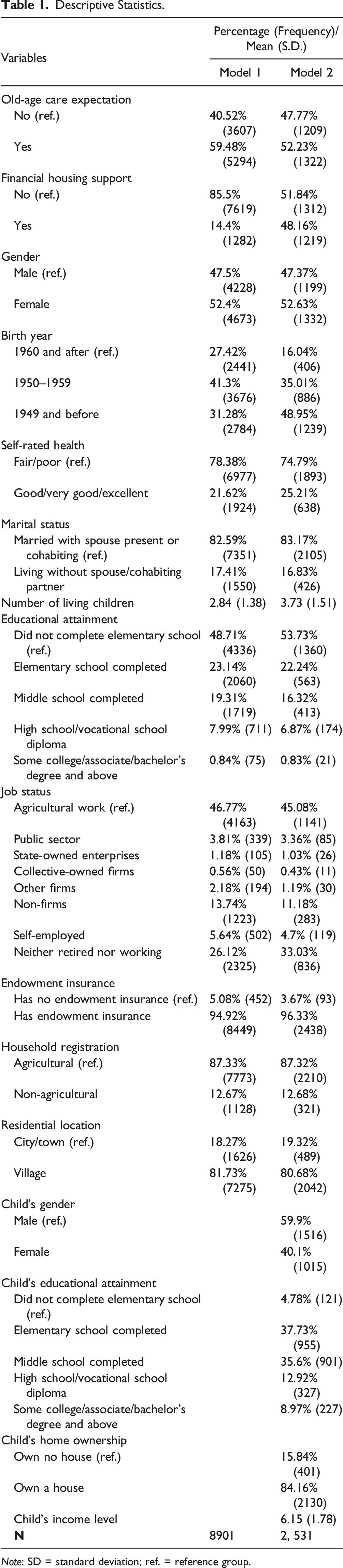
Descriptive Statistics.
Note: SD = standard deviation; ref. = reference group.
To examine a one-on-one reciprocal effect, Model 2 only includes respondents who have multiple children and financially supported at least one child for housing. A parent may contribute more than one observation, whereas each child is unique in the sample; hence we interpret the data on the basis of children numbers. The distributions of most variables are similar in the samples for Models 1 and 2, except for the following. The percentage of children whose parents supported their housing purchase is 48.16%. The percentage of children who are mentioned as expected caregivers by their parents is 52.23%. The average number of children is 3.73 (SD = 1.51). Nearly 49% of children have parents born before 1950, 35% have parents born in 1950–1959, and 16% have parents born after 1959. Almost 60% of children are male. Nearly 22% of children obtained a high school diploma (12.92%) and above (8.97%). Homeowners constitute 84.16% of the sampled children, and their mean income level in the past year is 6.15 (SD = 1.78), namely, a little more than the 20,000−30,000 yuan range.
The Effects of Intergenerational Housing Support
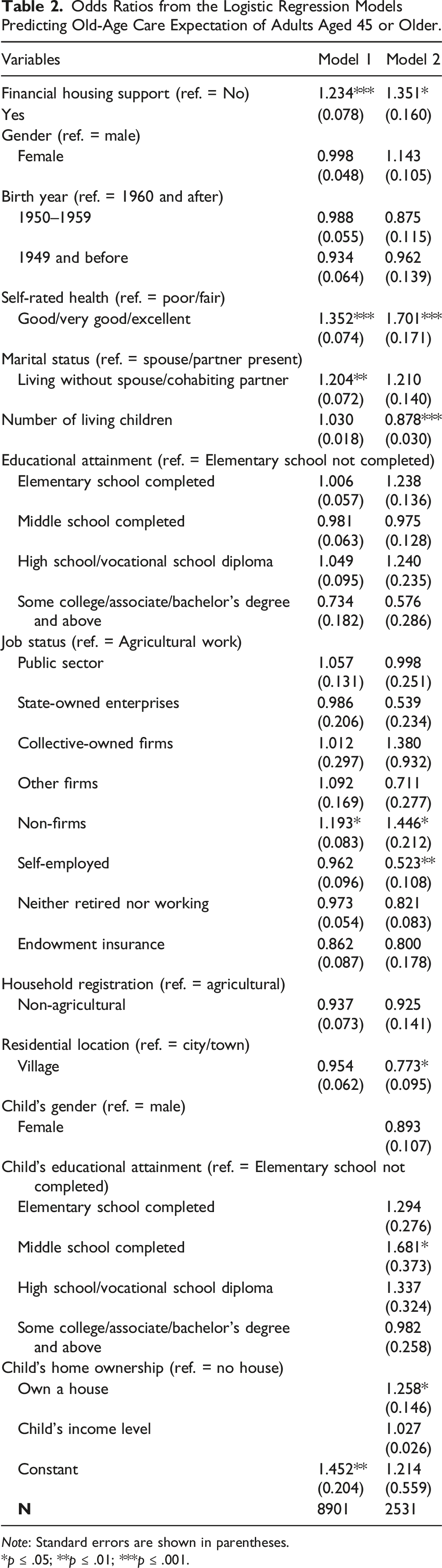
Odds Ratios from the Logistic Regression Models Predicting Old-Age Care Expectation of Adults Aged 45 or Older.
Note: Standard errors are shown in parentheses.
*p ≤ .05; **p ≤ .01; ***p ≤ .001.
Model 2 in Table 2 estimates the effect of providing a child with housing support on the expectation that the particular child will be the old-age caregiver. Results show that, in multi-children families, adult children who received financial housing support from their parents are 35.1% more likely to be named future caregivers than those who had no support. Children whose parents reported better health have 70.1% higher odds of being expected caregivers. An adult child is 12% less likely to be mentioned for old-age care provision when parents have an additional child. Compared with adult children whose parents work in agriculture, those who have parents employed in non-firms and self-employed have 44.6% higher odds and 47.7% lower odds of being an expected caregiver, respectively. Children whose parents reside in a village relative to a city or town are 23% less likely to be expected to provide care. Furthermore, children’s middle school completion and homeownership significantly raise their odds of being named by parents as caregivers by 68.1% and 25.8%, respectively.
Figure 1 shows predicted probabilities estimated from the logistic regression models in Table 2 by the status of intergenerational housing support, adjusted for the other covariates by setting each of them to its mean value. In Model 1, the predicted probability of expecting old-age care by children at the mean is approximately 5% higher for middle-aged/older adults who reported having helped their children buy a house. Among multi-children families where the parents financially helped any child with housing acquisition, the predicted probability of being expected to provide old-age care to their parents is approximately 7.4% higher for support-receiving adult children than for their counterparts without support. Old-age care expectation by housing support. Error bars indicate 95% confidence intervals.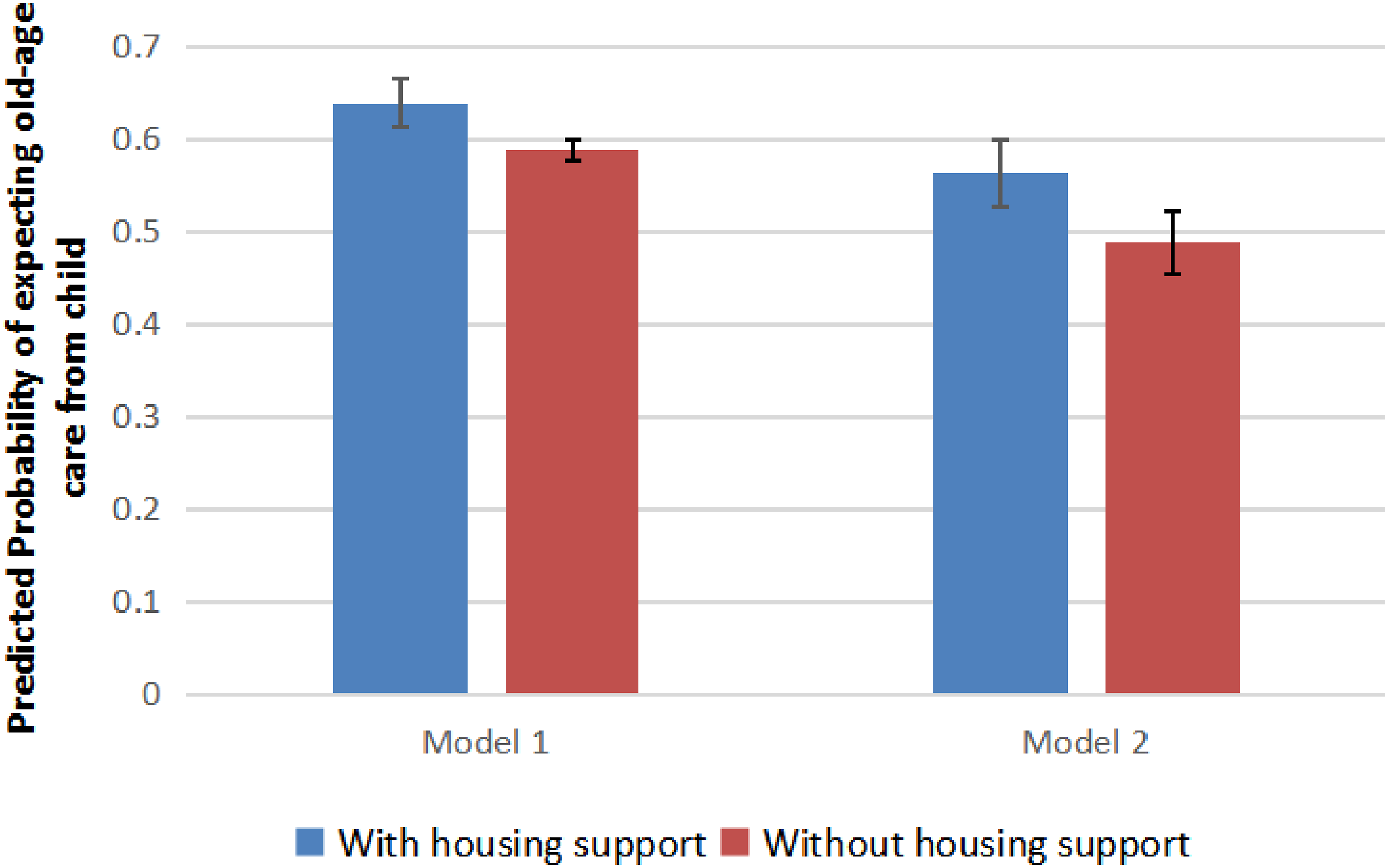
Odds Ratios from the Logistic Regression Models Predicting Old-Age Care Expectation of Adults Aged 45 or Older, by Birth Cohort.

Note: Standard errors are shown in parentheses.
*p ≤ .05; **p ≤ .01; ***p ≤ .001.
aEmployment in collective-owned firms predicts outcome of zero perfectly for the post-1950s group, so this variable was dropped and 2 observations were not used. Employment in state-owned firms predicts outcome of zero perfectly for the 1950s group, so this variable was dropped and 1 observation was not used.
bChild’s incomplete elementary school education predicts outcome of zero perfectly for the post-1950s group, so this variable was dropped and 4 observations were not used. Adult children holding bachelor’s degree or above are treated as the reference group and omitted for this cohort.
Discussion
Housing support from parents to adult children becomes an increasingly prominent social phenomenon in Chinese society. As probably the biggest sum of financial transfer to one’s adult children, this social pressure-driven support may affect parents’ care expectations by changing their old-age resources and balance in intergenerational exchange. Despite the large literature on intergenerational housing transmission and old-age care expectations, little research has explored the possible link between them. To our knowledge, this study is one of the first attempts to examine the relationship between downward housing support and parents’ expectations for old-age care from adult children, whether this relationship is precisely reciprocal, and whether this relationship varies by birth cohort.
Our finding supports Hypothesis 1 that middle-aged/older adults who provided adult children housing support are more likely to expect old-age care from them. On one hand, housing investment for children tends to substantially reduce the parents’ resources for future old-age care that could be outsourced to the market, which increases their need for instrumental care from children. On the other hand, the finding broadly supports the argument that traditional cultural norms of family support still remain stable, at least amongst the middle-aged/older parents (Qin et al., 2020). Under the need-based intergenerational transfer model and a long-lasting filial piety culture, when the need for old-age care increases after a downward transfer toward any of the children, parents would have a higher expectation for old-age care from their children overall, relative to anyone else.
As to Hypothesis 2, our finding reveals that in multi-children families where downward housing support exists, the help-receiving child is more likely to be an expected caregiver than the other children. Echoing Zhang and Bian’s (2021) finding, this result suggests the existence of rational calculations underlying familial relations beyond a purely need-based or corporate model. It confirms a reciprocal intergenerational contract based on equity and balance found in previous studies (e.g., Cao, 2018; Yang, 1996), which is defined by the counter obligation although not necessarily the forms or amount of the repayment. This intergenerational exchange over time reflects fairness between parents and children and among children as well (Heath, 2018). Together with Hypothesis 1, it implies the joint effects of fairness-based reciprocal mentality and the need-based transfer tradition on intergenerational exchange. While giving housing support increases parents’ need for care provided by children, they pin their hope especially on the support-receiving child(ren).
We only found partial support for Hypothesis 3 that the reciprocity decreases from the pre-1950s cohort to the post-1950s cohort. A possible explanation is age. As the oldest cohort, many older adults in the group have experienced an advanced aging process or even found themselves in situations where instrumental care is often needed. The actual experiences of reduced child availability may undermine their faith in getting children’s help despite the traditional values of dependence on children and earlier investment in children. Consistent with previous studies (Cheung, 2019; Qin et al., 2020), our finding supports the modernization perspective by showing a stronger reciprocal relationship among the 1950s cohort than the post-1950s cohort. Those born since 1960 were exposed to a modern society characterized by marketization, individualization, mobility, and social security development more than the older cohorts.
This study has important implications for the design of old-age support policy. Older adults’ care arrangements and the concordance with their expectations are important indicators of their self-reported health and subjective well-being (Chen, 2019; Sereny, 2011; Sereny & Gu, 2011). Given that many older parents are inevitably involved in intergenerational housing support, investigating how such transfer influences their care expectations will help policymakers plan to meet their needs. Our study confirms the need-based intergenerational transfer and the reciprocity/exchange model overall. We suggest the need for a measure that could facilitate those adult children support-receivers to return caregiving services when their parents are in need. We also recommend relevant social advocacy at national and community levels and improved supportive policy for working family carers to juggle caregiving and work. Measures such as flexible working hours and paid care leave need to be considered by employers and should be promoted at the legislation level. Our study also found that providing housing support to a child was not significantly related to expecting the child’ care provision among the pre-1950s and post-1950s cohorts. This finding may indicate a cruel reality of low child availability of family care among the current care demanders (i.e., pre-1950s) and the transitional care preferences among the younger cohort. For these cohorts, community-based supports and services as a new way of satisfying their care needs should be further developed (Fu & Chui, 2020), especially for older adults living alone or with spouse only (Zhang et al., 2018). Policymakers should consider designing a comprehensive multi-level care system, enhancing the social care budget, promoting the marketization of social care for older adults from different birth cohorts and age groups with various personal resources and care preferences, and strengthening the regulations and monitoring for the old-age care market.
Some limitations are worthy of notice. First, a birth cohort may capture the cohort effect and age effect, which cannot be separated given the data. Future research may utilize longitudinal data that cover a longer period to examine the cohort effect controlling for age (groups), such as comparing people age 50 across different birth cohorts. Second, given the PPS sampling approach and lower response rates in urban areas, most of the sample are participants living in villages with agricultural Hukou. The proportion of older adults in rural areas can be very high because young laborers migrate to urban areas on a massive scale. Future studies may oversample the urban population or focus on an urban sampling frame to obtain a more representative sample for urban areas. Third, the lack of information on the exact monetary amount of housing support does not allow us to distinguish between different situations of downward transfer. Given data, future research should further explore this variation and its potential impacts on old-age care expectations.
In an era of decreasing housing affordability for young adults and their greater, prolonged dependence on parents (Zhang & Bian, 2021), this study has significant scientific value. It is among the first attempts to examine the relationship between downward intergenerational housing support and old-age care expectations and generally contributes to the debate of intergenerational transfers in China. From parents’ angle, we found that a transfer pattern driven by traditional norm and reciprocity persists, but the underlying motives have started to change under modernization. Specifically, this research confirms the joint effects of the need-based transfer tradition (LaFave, 2017; Lee and Xiao, 1998) and fairness-based reciprocal mentality (Deng et al., 2020; Zhang and Bian, 2021) on intergenerational exchange among Chinese mid-aged/older adults. Moreover, we explicitly tested the theoretical perspective of equity-based exchange by examining a corresponding one-on-one relationship between the support-receiver and the expected caregiver, drawing on specific children ID. Finally, this study demonstrates distinct patterns of reciprocity across different birth cohorts, pointing to the necessity of diverse policy designs for older adults from different cohorts.
Footnotes
Acknowledgments
The authors acknowledge the CHARLS research and field team and every respondent in the study for their contributions.
Declaration of Conflicting Interests
The authors declared no potential conflicts of interest with respect to the research, authorship, and/or publication of this article.
Funding
The authors disclosed receipt of the following financial support for the research, authorship, and/or publication of this article: This work was supported by Chinese Social Science Foundation Youth Project [20CSH014] and Shanghai Pujiang Program [2020PJC023].
