




Abstract
Using data from 2015 to 2018 waves of the Longitudinal Study of Older Adults in Anhui Province, China, this study investigated associations between different forms of social disconnectedness (social isolation, loneliness, living alone) and psychological well-being of older adults longitudinally. The results showed that social isolation and loneliness were independently associated with psychological well-being, whereas living alone was not. Different forms of social disconnectedness had additive and interactive effects on psychological well-being of older adults. Those who were exposed to all three forms of social disconnectedness suffered from the lowest level of psychological well-being. Moreover, the adverse effects of social disconnectedness on psychological well-being were found to be stronger for older women than for older men. The results underscore the necessity to consider multiple forms of social disconnectedness as well as their different combinations in explaining psychological well-being in later life.
A comprehensive measure of social disconnectedness in later life is constructed by combining two objective indicators (living alone, social isolation) and one subjective indicator (feeling lonely). Experiences of more forms of social disconnectedness take a heavier toll on the psychological well-being of older adults in rural China. Older women are more likely to be adversely affected in the absence of social connection than older men.
Gerontological researchers need to consider multiple forms of social disconnectedness simultaneously to determine which aspects of disconnectedness are most detrimental for the well-being of older adults. Policymakers and practitioners should provide more opportunities for older adults to engage in various formal and informal social activities to help them increase their social networks and reduce perceived loneliness. Policy interventions to improve older adults’ psychological well-being should be gender-specific and pay particular attention to socially disconnected women.What this paper adds
Applications of study findings
Introduction
Social relationships are widely considered crucial to health and well-being across the life course (Umberson & Montez, 2010). Lack of social ties or perceived isolation, often referred to as social disconnectedness, is linked with various negative health outcomes, including heightened depressive symptoms, reduced cognitive function, and increased chronic diseases and mortality risk (Beller & Wagner, 2018; Cornwell & Waite, 2009; Hawkley & Cacioppo, 2010; Steptoe et al., 2013). Despite the established importance of studying social (dis) connectedness, more questions remain underexplored, particularly regarding the mechanisms and how different forms of social disconnectedness may jointly influence older adults’ health.
First, indicators of social disconnectedness vary widely by studies, and the relationships among the indicators are mixed. While it is well recognized that different forms of social disconnectedness are distinct yet overlap (Klinenberg, 2016; Smith & Victor, 2019), empirical research differs on the relative importance of living arrangements, size and composition of social networks, and perceived loneliness (Beller & Wagner, 2018; Coyle & Dugan, 2012; Steptoe et al., 2013). Second, although many studies have explored whether perceived isolation mediated the association between social isolation and mental health, they often suggest a weak or “decoupled” association between the two and only suggest partial mediation (Cornwell & Waite, 2009; Shankar et al., 2011). Surprisingly little attention has been paid to potential moderating or cumulative effects. For example, how could deficits in more than one dimension of social disconnectedness exacerbate the harmful effects? Likewise, how could social integration in one form possibly mitigate the negative impact of another? Finally, there is an ongoing debate on whether social disconnectedness matter more for women or men.
We suggest that China provides a unique, evolving context for studying the association between social disconnectedness and later life well-being. Family structure and living arrangements among rural older Chinese have changed dramatically during the last several decades, largely due to population aging and rural-to-urban migration (Chen & Short, 2008). The average household size has decreased from 3.96 in 1990 to 2.62 in 2020 (National Bureau of Statistics of China, 2021). Empirical studies indicated a declining trend of intergenerational coresidence (Song & Chen, 2020) and an increasing proportion of rural older Chinese living alone or with spouses only (Silverstein et al., 2006). Further, rural older adults lag substantially behind their urban counterparts in various social resources, leading to their higher risks of depression (Tang et al., 2020). As such, rural older Chinese are likely to face the double-jeopardy: a higher probability of social disconnectedness and mental health disadvantages, which deserve urgent attention.
This study uses a longitudinal sample of older adults in rural China to answer three research questions: (a) How do different forms of social disconnectedness independently affect older adults’ psychological well-being? (b) How do the experiences of solitary living, loneliness, and social isolation jointly and interactively shape psychological well-being in later life? (c) Do the perceived associations between different forms of social disconnectedness and psychological well-being differ by gender? Our findings will help policymakers and practitioners design effective interventions to help older adults who are the most vulnerable to social disconnectedness.
Three Distinct Forms of Social Disconnectedness
Social disconnectedness is an umbrella term for several subconstructs. Following previous research (Klinenberg, 2016; Smith & Victor, 2019), this study conceptualizes social disconnectedness as living alone, social isolation, and loneliness (or perceived isolation). Living alone reflects an individual’s living arrangement or household structure. Social isolation is defined as “an objective and quantifiable reflection of reduced social network size and paucity of social contact” (Steptoe et al., 2013). Loneliness refers to the perceived deficit between actual and desired quantity and quality of social interaction (Perlman & Peplau, 1981). Despite overlaps, these three forms of social disconnectedness are distinct constructs, and experiencing one does not necessarily mean experiencing the others (Klinenberg, 2016). Studies have shown that living alone, social isolation, and loneliness are only weakly correlated with each other (Beller & Wagner, 2018; Coyle & Dugan, 2012), and their correlations have further weakened at later life stages (Shankar et al., 2011).
Social Disconnectedness and Health in Later Life: Theoretical Considerations
Social convoy model and stress-related theories provide useful theoretical frameworks to understand the social (dis) connectedness-health association in later life. Social convoy model (Antonucci et al., 2014) posits that individuals go through the life course surrounded by multi-dimensional social relationships. Drawing on this theoretical perspective, an emerging body of literature has shown that social (dis) connectedness is clearly fundamental to health and well-being of Chinese older adults (Tang et al., 2020; Zhang et al., 2022). Meanwhile, the objective or/and perceived lack of social connectedness could be regarded as stress which is likely to be detrimental to health. According to the stress process perspective (Pearlin & Bierman, 2013), socially disconnected people may experience elevated exposure to stress, which can influence health directly, as well as indirectly through biophysiological, behavioral, and social pathways (Cacioppo et al., 2015; Hawkley & Cacioppo, 2010). Those who are socially isolated or living alone may be more prone to smoking and excessive alcohol consumption (Cacioppo et al., 2015; Shankar et al., 2011; Thoits, 2011), and have lower probabilities of receiving informal support (Chen & Short, 2008; Cornwell & Waite, 2009). Feelings of loneliness may affect individuals’ neuroendocrine systems by increasing the activation of the hypothalamic-pituitary-adrenocortical (HPA) axis (Cacioppo et al., 2015) and cognitive biases (Hawkley & Cacioppo, 2010), which in turn lead to poor health.
Moreover, the three forms of social disconnectedness may jointly affect older adults’ health. On the one hand, the effects of cumulative stress on health are stronger than the certain form of stress alone (Thoits, 2010). In this study, cumulative stress refers to the situation where older adults may suffer from more than one form of social disconnectedness simultaneously. Therefore, the more forms of social disconnectedness rural older Chinese experience, the greater the likelihood they will suffer from poor health. On the other hand, the stress buffer perspective posits that resources from family and beyond may buffer the harmful impacts of stress from other social domains (Pearlin & Bierman, 2013). As such, stress from a certain form of social disconnectedness (e.g., solo-living) may not necessarily have a severe influence on health as long as individuals have sufficient external resources, such as support from friends, neighbors, and public services (Carr, 2019).
Social Disconnectedness and Health in Later Life: Empirical Findings
To date, empirical studies focus primarily on the independent effect of each form of social disconnectedness when controlling for other forms. Studies consistently show that social isolation and loneliness have detrimental effects on various health outcomes among older adults in both Western countries and China (Beller & Wagner, 2018; Holt-Lunstad et al., 2015; Luo & Waite, 2014). The link between living alone and health, however, is inconclusive. Some earlier literature reported that living alone was adversely associated with subjective well-being (Chen & Short, 2008), while recent research suggested that those living alone may have high levels of life satisfaction if they enjoy high-quality intergenerational relationships (Chen et al., 2021; Djundeva et al., 2019).
Aside from the independent effects, another strand of research has considered the health consequences of social isolation, living alone, and loneliness simultaneously. These studies, however, concentrate overwhelmingly on whether loneliness mediates the associations between social isolation/living alone and health (e.g., self-rated health, depression, cognitive function, and mortality), which yielded mixed results. Some research found that loneliness is a significant mediator (Cornwell & Waite, 2009), whereas others did not support such a claim (Coyle & Dugan, 2012; Shankar et al., 2011; Steptoe et al., 2013). One potential cause of the inconsistency is that these studies overlook the critical fact that some people may feel lonely even though they are not living alone and/or socially isolated (Newall & Menec, 2019).
The Role of Gender
The association between social disconnectedness and well-being may differ by gender. According to gender-specific socialization experiences and traditional gender-role expectations, men tend to socialize to focus on autonomy and self-efficacy (Pinquart & Sörensen, 2000), while women are inclined to be kin keepers of the family and put more value on interpersonal relationships than men (Cheng & Chan, 2006). Moreover, older women are more likely to live alone (Djundeva et al., 2019), have higher loneliness, and are more sensitive to the lack of social support than their male counterparts (Steptoe et al., 2013; Yang & Victor, 2008). Therefore, social disconnectedness may have a greater impact on the well-being of older women than older men. Yet, the empirical evidence has been mixed. For example, one study in Finland indicated that loneliness was more strongly related to women’s depressive symptoms than men’s (Heikkinen & Kauppinen, 2004). Conversely, another study of older Americans showed that loneliness has stronger effects on men’s depressive symptoms than women’s (Cacioppo et al., 2006). Still, some other studies found no such gender differences (Holt-Lunstad et al., 2015; Steptoe et al., 2013). So far, how the consequences vary by gender in the context of China is unclear, which warrants further exploration.
Research Hypotheses
Based on the above discussions, we first hypothesize that three indicators of social disconnectedness (living alone, social isolation, and loneliness) will be independently associated with older adults’ psychological well-being. Then, we argue that having one form of social disconnectedness may not be detrimental as long as other buffering mechanisms exist. So, we further hypothesize that experiences of more forms of social disconnectedness will take a heavier toll on the mental health of older adults. Finally, given women’s lower socioeconomic status and potentially heavier reliance on social support networks than men in rural China (Li et al., 2009), we expect older women will be more strongly affected by social disconnectedness than older men.
Methods
Sample
We used data from the Longitudinal Study of Older Adults in Anhui Province, China. The sampling frame consisted of the population aged 60 and older living in 72 villages within six rural townships of the Chaohu region, Anhui province. The sample was selected using a stratified multistage method, and the eligible respondents were randomly selected from village rosters. The baseline survey was conducted in 2001, and follow-up surveys were conducted in 2003, 2006, 2009, 2012, 2015, and 2018. We focus on the 2015 and 2018 data because social isolation was first measured in 2015 and followed in 2018. The 2015 survey consisted of 1243 respondents, and 82.1% were re-interviewed in 2018, yielding a panel of 1020 respondents. After deleting 39 respondents with no living child, the final analytic sample included 981 respondents, contributing 1962 person-periods. Missing data (around 6% of the total sample) were handled using the Multiple Imputation via Chained Equations with 10 generated multiple imputed data sets (White et al., 2011).
Measures
Psychological Well-Being
Psychological well-being was operationalized as life satisfaction and depressive symptoms. Life satisfaction was measured by an 8-item Life Satisfaction Scale (Diener et al., 1985). The respondents were asked whether they agreed or disagreed with statements indicating contentment and discontentment with their current lives (1 = yes, 0 = no; range: 0–8). Higher scores denote higher life satisfaction. Prior research (Silverstein et al., 2006) has demonstrated good reliability and validity of this scale among rural Chinese older adults (Cronbach’s alpha = .79). In this study, Cronbach’s alpha scores were .76 and .81 in 2015 and 2018, respectively.
Depressive symptoms were assessed using the Center for Epidemiological Studies Depression Scale (CES-D; Radloff, 1977). Following previous studies (Cacioppo et al., 2006; Cornwell & Waite, 2009), feeling lonely item was removed to decrease overlap. The remaining 8-item were summed (range: 0–16), with higher scores indicating more depressive symptoms (Cronbach’s alpha = .74 and .76 in 2015 and 2018, respectively). Previous studies have used the same scale to measure rural Chinese older adults’ depressive symptoms (Silverstein et al., 2006; Tang et al., 2020), and these studies have confirmed the reliability and validity of the scale (Cronbach’s alpha ranged from .76 to .78).
Social Disconnectedness
Social disconnectedness was measured by living alone, social isolation, and loneliness. Living alone was measured by the respondents’ living arrangements (1 = living alone, 0 = not living alone). Social isolation was measured using the 6-item Lubben Social Networks Scale (LSNS-6; Lubben et al., 2006). The summed scores ranged from 0 to 30 (Cronbach’s alpha = .86 and .87 in 2015 and 2018, respectively). The LSNS-6 scale also has satisfactory validity and reliability among Chinese older adults (e.g., Tang et al., 2020, Cronbach’s alpha = .74 and .85 for the subscale of relative and friends, respectively). A score below 12 was defined as social isolation (Lubben et al., 2006). Loneliness was assessed with “How often do you feel lonely?” (1 = seldom/never, 2 = sometimes, and 3 = often/always). In line with previous research (Luo & Waite, 2014), a dummy variable was created by grouping “sometimes” and “often/always” indicating lonely as opposed to “seldom/never” indicating not lonely. This self-reported measure of loneliness has been widely used in studies of Chinese older adults (Luo & Waite, 2014; Yang & Victor, 2008). It is also highly correlated with two widely used loneliness assessment tools, the De Jong Gierveld Loneliness Scale (De Jong Gierveld & Van Tilburg, 1999) and the UCLA Loneliness Scale (Russell, 1982).
We further identified how older adults were simultaneously exposed to different forms of social disconnectedness. First, we constructed a cumulative measure of social disconnectedness ranging from 1 to 4 (not socially disconnected to disconnected in three forms). Next, we constructed eight mutually exclusive dummy variables to reflect the possible combinations of living alone, social isolation, and loneliness (see Figure 1 for all the categories). Prevalence of different forms of social disconnectedness among older women and men in rural China.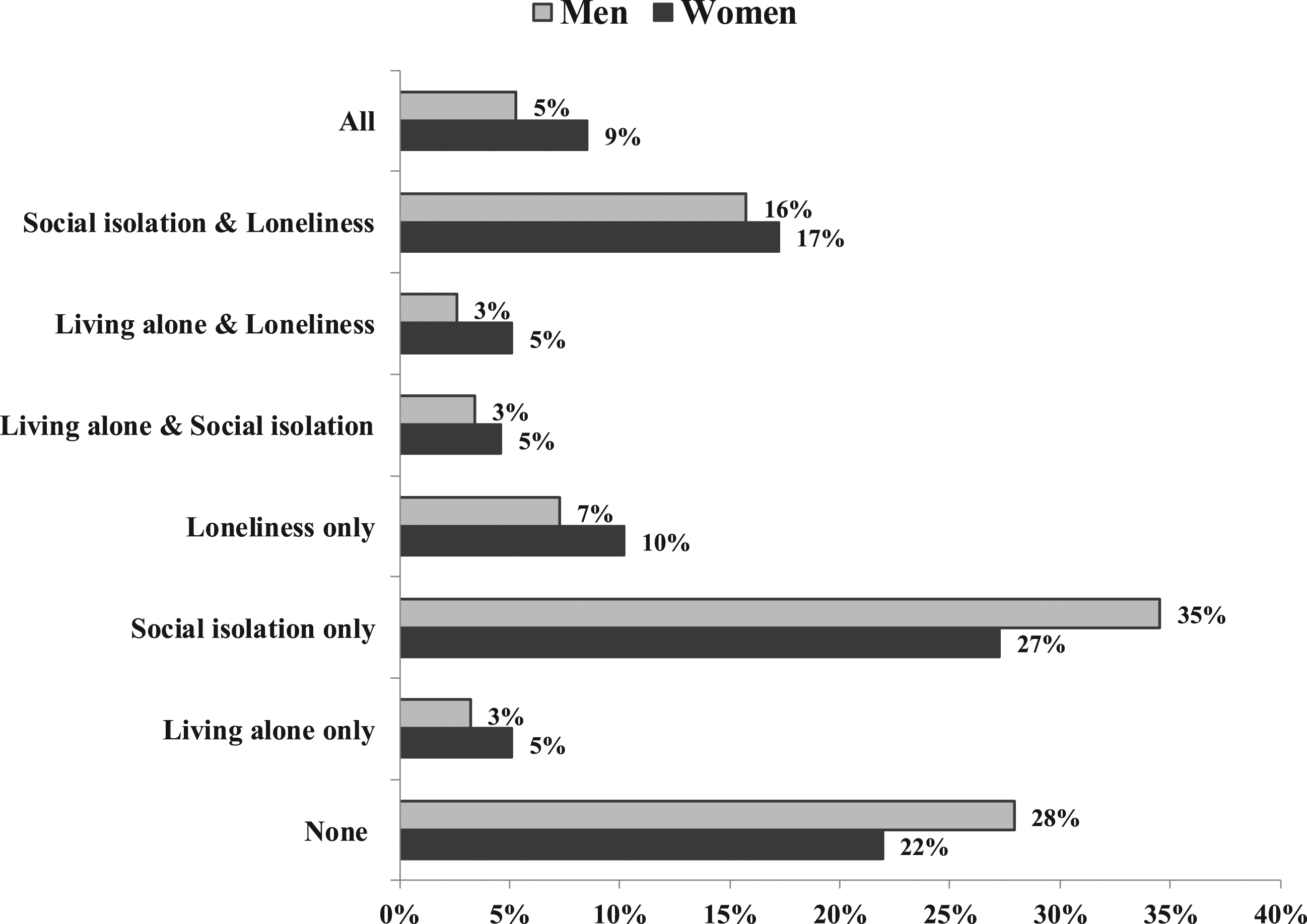
Control Variables
We controlled various time-varying variables, including age, marital status, employment status, annual household income, functional limitations, and intergenerational support (financial, instrumental, and emotional support).
Analytic Strategies
We used fixed-effects linear regression models to investigate longitudinal within-person associations between different forms of social disconnectedness and psychological well-being. The fixed-effects approach has the advantage of controlling for all unobserved and time-invariant factors that are fixed within an older adult, such as genetic factors and personality characteristics (Vaisey & Miles, 2017), which may confound the relationship between social disconnectedness and psychological well-being. We also tried random-effects models, but the result did not pass the Hausman test, suggesting the assumption that the unobserved characteristics not included in the model is uncorrelated with observed predictors does not hold (Allison, 2005). Thus, the current study prefers the fixed effects approach to random-effects models.
Our fixed-effects models estimate the change in psychological well-being as a function of change in social disconnectedness. The model can be specified as follows

We estimated a sequence of models. First, we examined the independent effects of living alone, social isolation, and loneliness on older adults’ psychological well-being, controlling for all covariates. Next, we used the cumulative measure of social disconnectedness as well as their potential combinations to predict older people’s psychological well-being. Finally, we stratified our analysis by gender and compared predicted psychological well-being between older women and older men.
Results
Descriptive Statistics of Analytical Variables by Survey Year and Gender.
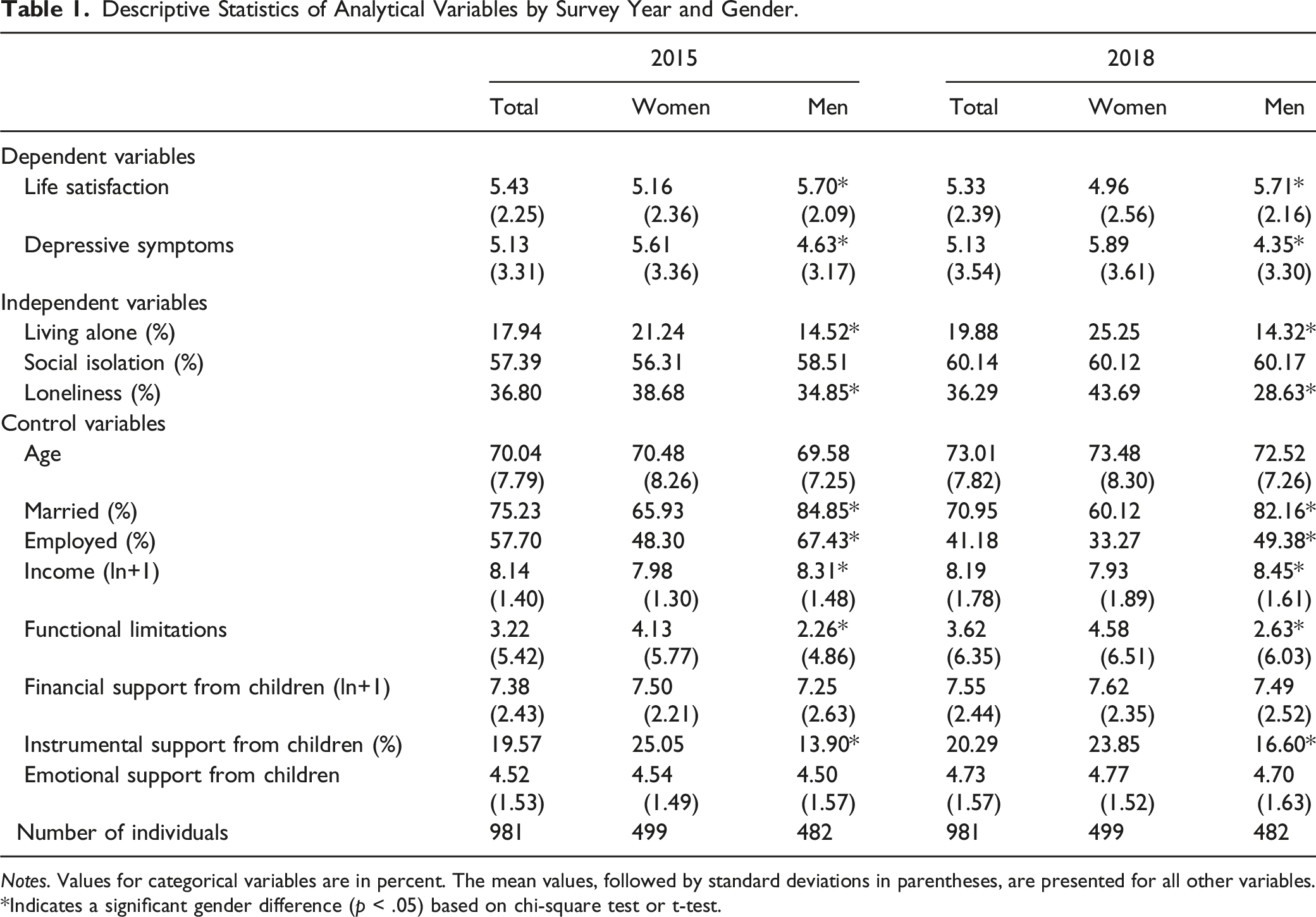
Notes. Values for categorical variables are in percent. The mean values, followed by standard deviations in parentheses, are presented for all other variables. *Indicates a significant gender difference (p < .05) based on chi-square test or t-test.
Figure 1 illustrates the prevalence of different social disconnectedness combinations among older women and men in rural China. The respondents who did not report any social disconnectedness were 22% and 28% among women and men, respectively. Among those who experienced disconnectedness, older women tended to have higher levels of social disconnectedness than older men. The proportion of those who faced all three forms of social disconnectedness was not trivial, ranging from 5% of older men to 9% of older women.
Fixed-effects Linear Regression Models Predicting Psychological Well-being of Older Adults in Rural China, 2015–2018.
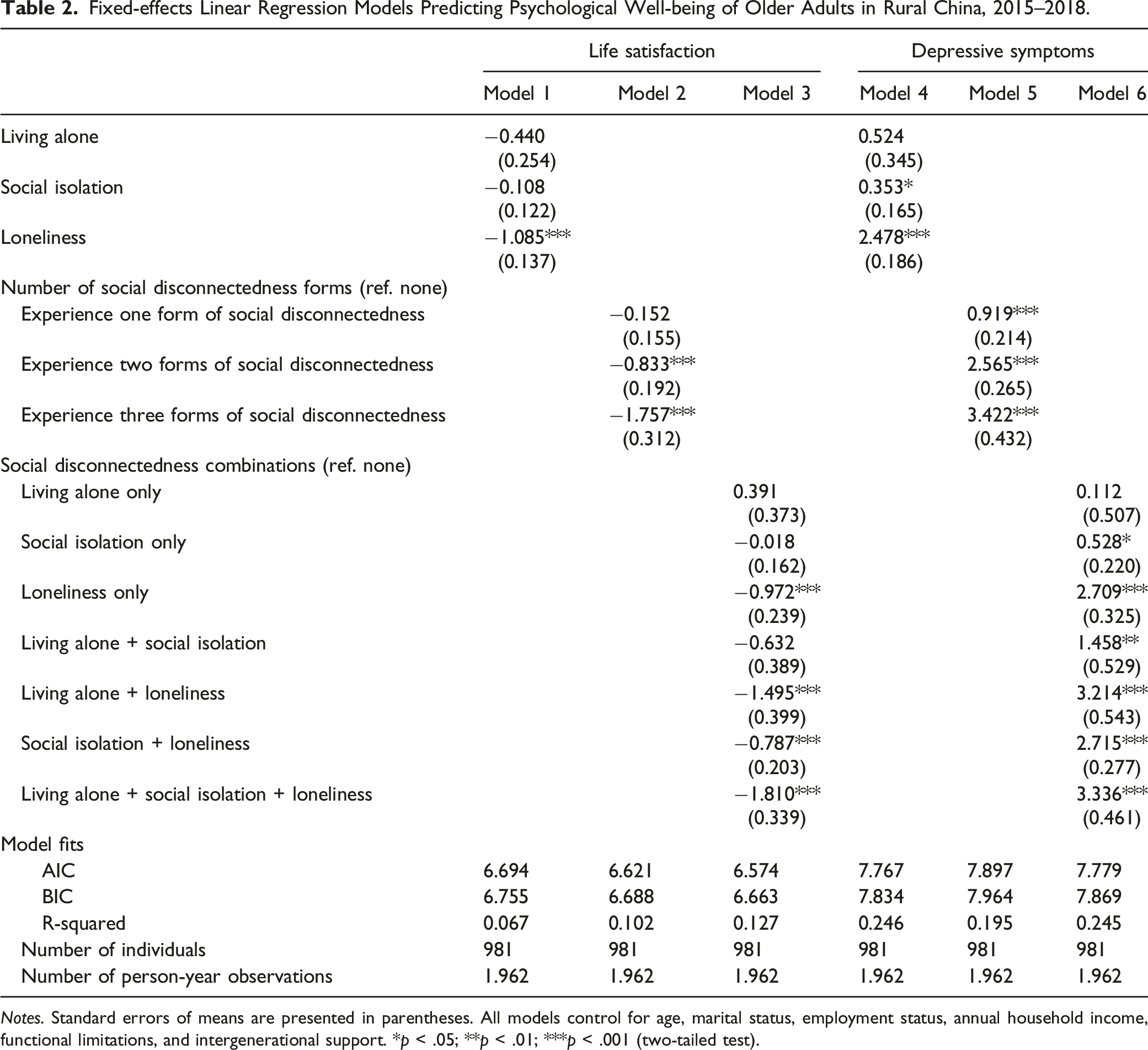
Notes. Standard errors of means are presented in parentheses. All models control for age, marital status, employment status, annual household income, functional limitations, and intergenerational support. *p < .05; **p < .01; ***p < .001 (two-tailed test).
Next, we examined the additive effects of social disconnectedness on psychological well-being (Model 2 and Model 5). Older adults who experienced one form of social disconnectedness reported higher depressive symptoms (b = .919, p < .001) than those who did not report any, while no such association was detected when predicting life satisfaction. Those who experienced two forms of social disconnectedness simultaneously reported significantly lower life satisfaction (b = −.833, p < .001) and higher depressive symptoms (b = 2.565, p < .001) compared with those who were not socially disconnected. Likewise, those experienced all three forms of social disconnectedness suffered from the lowest life satisfaction (b = −1.757, p < .001) and highest depressive symptoms (b = 3.422, p < .001).
We further explored social disconnectedness in more detail. Model 3 and Model 6 showed that when older adults lived alone but neither were socially isolated nor felt lonely, their life satisfaction and depressive symptoms were not significantly different from those who were not socially disconnected. Social isolation only was associated with higher depressive symptoms (b = .528, p < .05), and older adults who suffered from loneliness only reported substantially lower life satisfaction (b = −.972, p < .001) and higher depressive symptoms (b = 2.709, p < .001). Results for older adults experiencing two forms of social disconnectedness were a little complicated. Those who lived alone and were socially isolated reported greater depressive symptoms than their socially connected counterparts, but no such association was found in life satisfaction. In contrast, those who felt lonely (either lived alone or were socially isolated) reported significantly lower life satisfaction and higher depressive symptoms. Again, those who experienced all three forms of social disconnectedness were most disadvantaged in their psychological well-being.
Fixed-effects Linear Regression Models Predicting Psychological Well-being of Older Women and Men in Rural China, 2015–2018
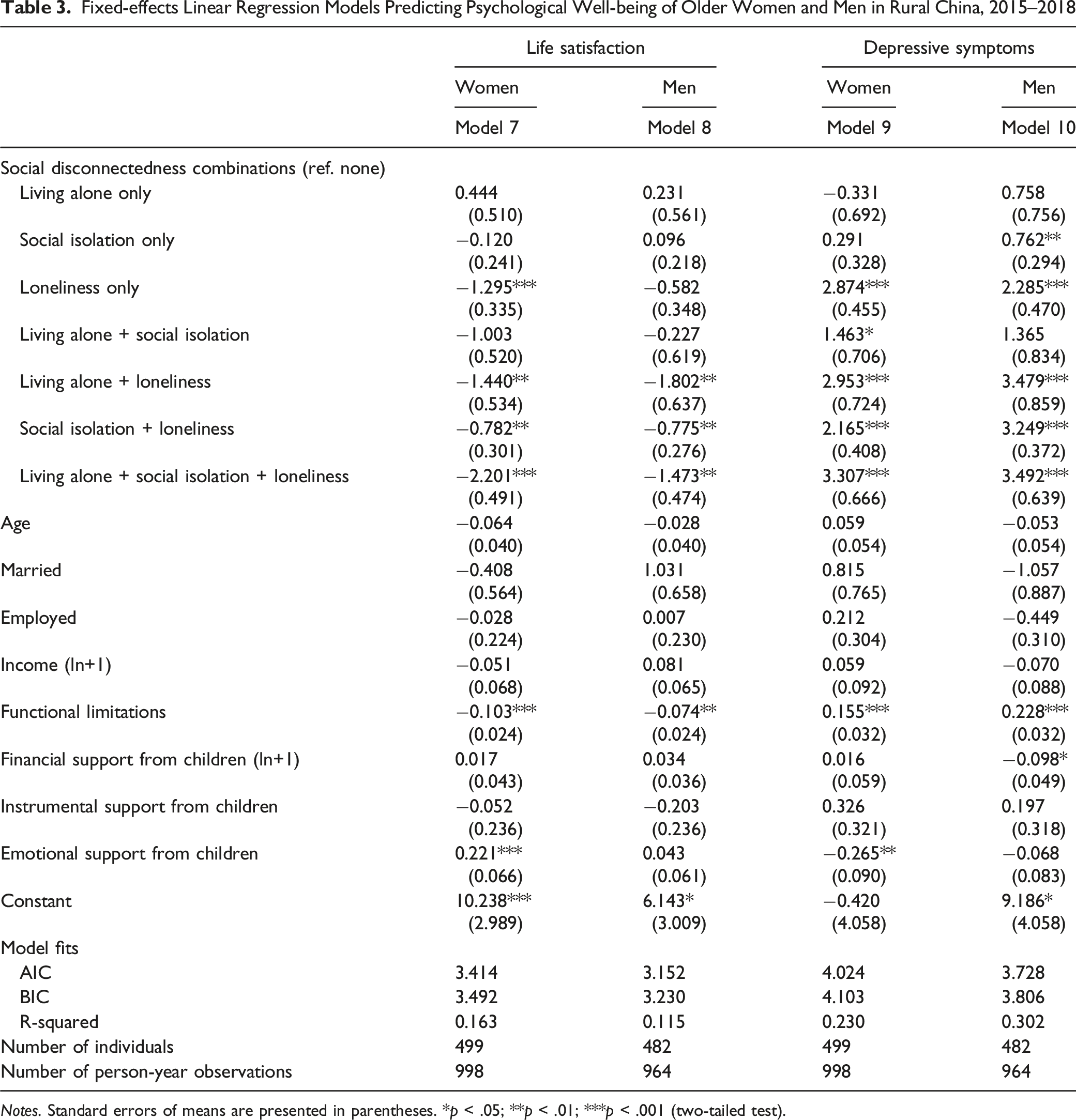
Notes. Standard errors of means are presented in parentheses. *p < .05; **p < .01; ***p < .001 (two-tailed test).
To aid interpretation, we displayed the predicted values of life satisfaction by gender and different forms of social disconnectedness in Figure 2, using results from Models 7–8 in Table 3. Figure 2 shows a lower life satisfaction for women in most scenarios combining different forms of social disconnectedness. This gender gap was especially prominent when they suffered from all three forms of social disconnectedness. Predicted life satisfaction (0–8) by different forms of social disconnectedness among older women and men in rural China.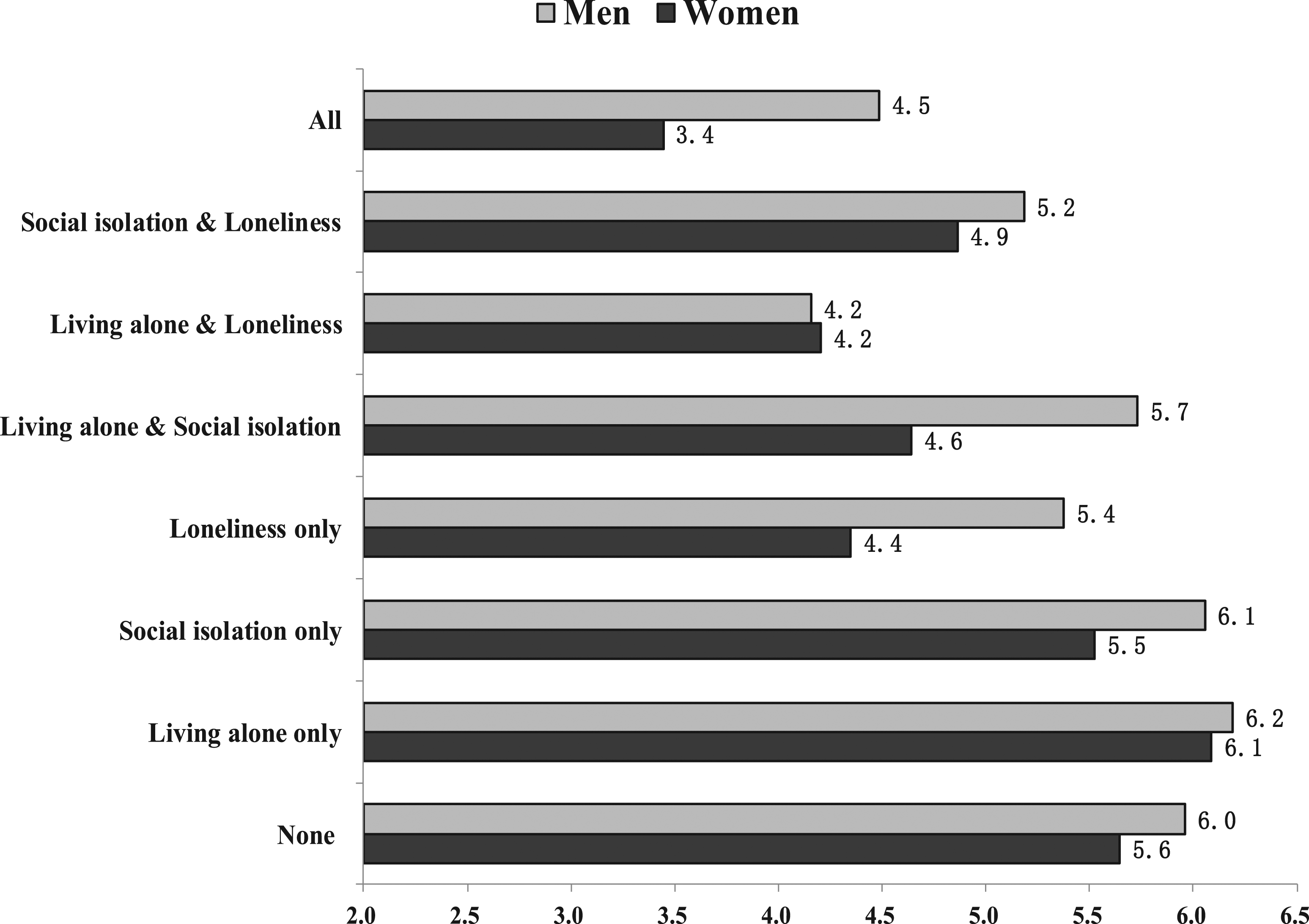
Discussion
In response to global concerns about “aging alone,” Journal of Gerontology: Social Sciences recently published a special issue on international perspectives on social integration and isolation (Carr, 2019). Compared with other countries, China’s statistics are less worrisome, in terms of its low prevalence of kinlessness and solitary living among Chinese older adults (Gu et al., 2019). Nonetheless, our findings present a picture that is perhaps not so rosy in rural China. Yes, most of Chinese rural older adults do not live alone. Yet, the global loneliness epidemic is quietly affecting this population, as our analyses show that one in three persons report feeling lonely. In addition, more than half of our study sample are socially isolated. Considering all three dimensions of social disconnectedness (living alone, socially isolated, and feeling lonely), three-quarters of older adults experience at least one form and more than one-third experience two or more forms.
Our subsequent analyses have clearly established that social disconnectedness strongly affects older adults’ psychological well-being. First, we found that social isolation and loneliness are independently associated with both life satisfaction and depressive symptoms of older adults in rural China. The effect of loneliness is particularly strong, compared with the other two indicators. This is understandably so, as our outcome measures tap into the psychological dimension of well-being.
Another important finding is that different forms of social disconnectedness have additive and interactive effects on psychological well-being. Having one form of social disconnectedness may not be necessarily detrimental, particularly if it takes the form of living alone. One possible explanation is the role of living proximity. Indeed, older Chinese increasingly choose to live close to their adult children rather than living together (Lei et al., 2015). Moreover, strong social networks and high-quality intergenerational relationships can protect those living alone (Chen et al., 2021; Tang et al., 2020). Nonetheless, two or more forms of social disconnectedness elevate depressive symptoms and decrease life satisfaction. As expected, those who experienced three forms of social disconnectedness had the lowest psychological well-being.
Our study has further highlighted that the impact of social disconnectedness on older adults’ psychological well-being is contingent on the different combinations of social disconnectedness. For instance, older adults who were socially isolated and living alone but did not feel lonely showed no deficits in life satisfaction. However, a combination of objective (living alone or socially isolated) and perceived isolation (loneliness) lead to significantly lower life satisfaction and higher depressive symptoms. Interestingly, while living alone is not a significant risk factor in and of itself, when coupled with feeling lonely, older adults suffer from a sharp increase in depressive symptoms and diminished life satisfaction. Indeed, the combination of living alone and loneliness is the most harmful, compared with the other two forms of disconnectedness combinations.
Our study has also made an important contribution to the gendered understanding of social disconnectedness-life satisfaction linkage; that is, the magnitude of the association is stronger for women than for men. Just like women in other settings around the world, Chinese women are the kin keepers of the family, and tend to pay more attention to social connections and interpersonal relationships than men (Cheng & Chan, 2006; Umberson et al., 2022). Previous research has also suggested that older rural Chinese women heavily rely on external social connections to get financial, instrumental, and emotional support (Li et al., 2009). Our findings thus support the argument that rural Chinese women are more likely to be adversely affected by the lack of social connection.
This study has several limitations. First, the analytic sample was restricted to one rural region of China, so the generalizability of our findings was constrained. Second, although our use of fixed-effects models can effectively account for individual-specific unobserved heterogeneities, it does not directly establish causal ordering. Moreover, due to data limitations, our analysis was based on two waves of data collection. Future studies using data from additional follow-up surveys would improve our understanding of causality. Additionally, compared to those who were excluded, our analytic sample comprised respondents showed to be younger, more likely to be married, healthier, and financially better off. In this sense, a more vulnerable subset of the sample was excluded from the study, and our results may be conservative. Third, we did not directly test the possible pathways through which social disconnectedness contributes to poor psychological well-being. For instance, bereavement experience could be related to both the changing of older adults’ social disconnectedness and psychological well-being, future research needs to explore the role of bereavement (e.g., death of a child) in the social disconnectedness and psychological well-being linkage. Finally, our measure of loneliness was limited to one item.
Despite the limitations, this study advances our understanding of the association between social disconnectedness and well-being and has important policy implications. On the research front, it is time to refocus our research lens beyond living arrangements and study the interaction between objective and perceived social isolation. Likewise, policy intervention should target the broader social network of older adults, including family and friendship ties, and formal social relations. The local communities should organize more social activities to encourage rural older adults to participate, which can be a promising way to help them socially connect with others and decrease the risk of social disconnectedness. Given the COVID-19 pandemic where social quarantine is highlighted, we suggest that digital communication technologies could be promising strategies to enhance older people’s social connectedness (Barbosa Neves et al., 2019). Interventions that help rural older adults access the Internet and literacy to digital technology are warranted. For example, programs focused on teaching rural older adults how to use digital technology, especially for social interaction purposes (e.g., WeChat, a multi-purpose messaging platform in China), would help rural older people to have ability to stay connected to family members and friends through digital contact. Finally, interventions should pay special attention to those who suffer from all three forms of social disconnectedness, as well as rural older women.
Footnotes
Declaration of Conflicting Interests
The authors declared no potential conflicts of interest with respect to the research, authorship, and/or publication of this article.
Funding
The author(s) disclosed receipt of the following financial support for the research, authorship, and/or publication of this article: This work was supported by the National Natural Science Foundation of China (Grant 72074177), China Scholarship Council (CSC, 202006280098), the National Institute on Aging (Grant P30AG066614), and the U.S. Eunice Kennedy Shriver National Institute of Child Health and Human Development (Grant P2CHD042849).
