



Abstract
To address the gap of lacking research on the association between coping self-efficacy and loneliness, this study examined this relationship to inform future research and intervention on loneliness. Using data from 151 community-dwelling older adults ages 65 and older, we estimated multivariate logistic regression models with age, race/ethnicity, sex, body mass index, chronic disease composite score, social support, coping self-efficacy, and depression symptoms. Loneliness was reported in 32.1% of participants and negatively associated with coping self-efficacy (OR = 0.68, 95% CI: 0.50–0.93) while controlling for age, race, sex, chronic disease composite score, and body mass index. Our findings suggest that coping self-efficacy may be a target for intervention involving loneliness in future research; however, the causal relationship between coping self-efficacy and loneliness should be explored further.
• This study found that coping self-efficacy and loneliness are negatively associated. • Consistent with previous literature, lower social support and higher depression symptoms were associated with loneliness. • Problem-solving, emotional regulation, and coping through social support were negatively associated with loneliness.
• Further research may explore the causal relationship between coping self-efficacy and loneliness. • Coping self-efficacy may be considered as a target for intervention for addressing loneliness in future studies. • Interventions that address the dimensions of coping self-efficacy such as problem-solving, emotional regulation, and coping through social support may be considered for practitioners and future research.What this paper adds
Applications of study findings
Background
In the midst of the COVID-19 pandemic, increased awareness about the ongoing “loneliness pandemic” has garnered global attention (J. T. Cacioppo & Cacioppo, 2018; Cudjoe & Kotwal, 2020). Approximately 29.5% of adults 55 and older in the United States reported feelings of severe loneliness during the COVID-19 pandemic (O’Shea et al., 2021). Loneliness is an uncomfortable emotional state arising from subjective discrepancy between an individual’s actual versus desired experiences with the quality and quantity of social relationships (Cudjoe & Kotwal, 2020; Perissinotto et al., 2012). Types of loneliness may be pathological, psychosocial, or existential (Bekhet et al., 2008). Pathological loneliness arises from dysfunctional emotional or cognitive states usually from those affected by psychological disorders (Austin, 1989). Psychosocial loneliness is global and general and may occur from any changes or separation (Carr & Schellenbach, 1993). Existential loneliness is referred to as primary loneliness related to being human (Austin, 1989). Despite any individual’s susceptibility to loneliness and its pervasive effects, stigmatization limits its disclosure, which may adversely affect health (J. T. Cacioppo & Cacioppo, 2018). Health consequences of loneliness can include increased functional decline (Nersesian et al., 2018; Perissinotto et al., 2012), deterioration of physical (Holt-Lunstad & Smith, 2016) and psychological health (Gray et al., 2020), suicide (Stickley & Koyanagi, 2016), and death (Holt-Lunstad et al., 2015; Perissinotto et al., 2012). The risk of premature mortality was increased by 26% with loneliness (J. T. Cacioppo & Cacioppo, 2018).
Loneliness increases health service utilization (Gerst-Emerson & Jayawardhana, 2015) and healthcare costs (Mihalopoulos et al., 2020), and is recognized as a public health problem (J. T. Cacioppo & Cacioppo, 2018). The Decade of Healthy Ageing report highlighted loneliness and social isolation as one of United Nation’s initiative (Decade of healthy ageing, 2021). Still, there is a gap in reliable evidence regarding self-efficacy from intervention studies targeting loneliness. Developing effective interventions with appropriate theoretical and programmatic design is a global priority given the high prevalence of loneliness, especially among older adults.
Targeting self-efficacy, especially coping self-efficacy, may present a strategy for allaying loneliness in individuals. Self-efficacy is the subjective belief in one’s ability to achieve particular outcomes by following through with respective thoughts or actions (Bandura, 1977). It encompasses individuals’ perceived abilities and agencies for successfully engaging challenging or novel tasks or circumstances (Luszczynska et al., 2005). Coping self-efficacy, within the realm of general self-efficacy, is a measure of self-confidence in one’s ability to effectively manage challenges using skills in problem-solving, emotional regulation, and coping through social support. It may be important to understand its relation to loneliness since problem-solving, emotional regulation, and coping through social support all represent potential intervention targets for loneliness (S. Cacioppo et al., 2015; Gray et al., 2020; Ong et al., 2016). Improvements in task-focused self-efficacy are associated with better chronic illness management and improved health outcomes (Bohanny et al., 2013; Hays et al., 2014). From a healthcare utilization perspective, higher self-efficacy is associated with significant reductions in hospital length of stay, emergency room visits, and provider visits (Marks et al., 2005). Studies examining the relationship between loneliness and self-efficacy show a strong inverse relationship (Alma et al., 2011; Nguyen et al., 2020; Nieboer et al., 2020). However, prior studies with loneliness have been limited by classifying self-efficacy too broadly for targeted application (i.e., general self-efficacy) (Alma et al., 2011; Nguyen et al., 2020; Nieboer et al., 2020). Additionally, independent of other psychological constructs such as social support and depression, both self-efficacy and loneliness are highly associated with one another (J. T. Cacioppo et al., 2006; Jaremka et al., 2014). However, to our knowledge, coping self-efficacy has not been examined in relation to loneliness (M. D. Hladek et al., 2019).
The purpose of this study was to examine the association between coping self-efficacy and loneliness in older adults. We hypothesized that coping self-efficacy and each of its subscales that focus on problem-solving, emotional regulation, and coping through social support will be inversely associated with loneliness. Additionally, we also investigated changes in the relationship between coping self-efficacy and loneliness with or without social support and depressive symptoms. Study findings may inform future self-efficacy-based interventions targeting loneliness in older adults.
Methods
Participants
Recruitment took place mostly in an active older adult living community in a suburb of Washington DC, not far from Baltimore city, from May 18, 2017 to August 12, 2017. These communities attract higher income, less diverse residents. Recruitment flyers were posted in common areas of community centers or mailed to potential community-dwelling older adult participants. The inclusion criteria for this study were: (1) age 65 years and older, (2) presence of at least one chronic condition through self-report, and (3) ability to speak, read, and understand English. The exclusion criteria were: (1) scoring 2 or less on the Mini-Cog assessment (a cognitive assessment for dementia) (Borson et al., 2003), (2) presence of either active cancer treatment or life-limiting illness, (3) presence of a degenerative neurological condition, and (4) use of specific anti-inflammatory rheumatological drugs. Those with life-limiting illnesses or progressive neurological disease were excluded because of the change in the focus of psychological processes at the end of life (Ruiz-Fernandez et al., 2021). Those with cognitive impairment were excluded since this may have compromised their ability to complete the survey. Since an aspect of the original study involved physiologic stress indices such as inflammatory markers, those who may present with an abnormal increase in inflammatory markers because of chemotherapy or specific immunologic drugs were excluded.
After screening and eligibility criteria were met, written informed consent was obtained before data collection. A total of 159 participants met inclusion criteria. Data was collected via paper survey and stored securely according to university policy. The study was approved by the Institutional Review Board (IRB00095668). Participants were provided with $25 gift cards for study participation.
Sociodemographic Characteristics
Sociodemographic data included age (years), sex (male/female), and race/ethnicity (White, Black, Asian/Filipino/Pacific Islander, American Indian/Alaskan Native, multi-racial/multi-ethnic, and other). These were self-reported by participants.
Primary Measures
Loneliness was the primary dependent variable in this study. It was measured using the three-item Loneliness Scale (Hughes et al., 2004), which was adapted from the Revised UCLA Loneliness scale (Russell et al., 1980). The three items gather self-reported subjective perceptions regarding lacking companionship, feeling left out, and feeling isolated from others in the past 2 weeks. Ordinal response categories were: 1 hardly ever, 2 some of the time, and 3 often. Total scores ranged from 3 to 9, with higher scores indicating a higher level of loneliness.
Coping self-efficacy was the primary independent variable in this study. It was measured using the 13-item Coping Self-Efficacy Scale (Chesney et al., 2006). Responses to items were recorded on a 10-point Likert scale that measured one’s perceived coping ability to overcome life’s challenges with 1 representing not at all confident, 5 as moderately confident, and 10 as totally confident (Chesney et al., 2006). The mean scores ranged from 0 to 10 with higher scores indicating a higher level of coping self-efficacy. The scale consisted of three validated subscales developed from factor analysis for the following: (1) problem-focused coping (questions related to finding solutions to problems and promoting positive thoughts), (2) cessation of unpleasant emotions and thoughts (questions related to resisting negative emotions), and (3) ability to obtain support (questions related to obtaining emotional support from friends or family). In our sample, the reliability of each subscale was higher than the reference group scores with Cronbach’s alpha values of 0.94, 0.95, and 0.86, respectively.
Covariates
Depression was measured using the Patient Health Questionnaire (PHQ-8) (Kroenke et al., 2009), which is an eight-item scale that measures depressive symptoms during the past 2 weeks. The instrument asks questions about mood and symptoms such as sleep and was previously validated in older adults with co-morbidities (Klapow et al., 2002; Kroenke et al., 2010). This instrument is used clinically to screen for depression. The scores ranged from 0 to 24 with higher scores indicating higher depressive symptoms.
Social support was measured using the ENRICHD Social Support Instrument (Vaglio et al., 2004), which uses seven items to assess feeling valued and loved on a 5-point Likert scale. The scores ranged from 6 to 30 with higher scores indicating a higher degree of social support.
Height and weight were self-reported, and the data were used to calculate the body mass index (BMI). A chronic disease composite score included self-reported disease count, number of treatments, and number of functional limitations. This composite score has been demonstrated as a valid measure of chronic disease, with a higher score indicating higher chronic illness burden (De Groot et al., 2003).
Statistical Analysis
The distribution of the loneliness scale scores displayed a right skew in our sample. Therefore, the variable was dichotomized at the median to account for the skewed distribution. Participants with scores below the median (less than 5) were characterized as not lonely and those above the median were characterized as lonely.
Statistical analyses included descriptive statistics and multivariate logistic regressions. Descriptive statistics were calculated for patient demographics and psychosocial variables with continuous variables displayed as means and standard deviations, and categorical variables displayed as counts and proportions. Demographic characteristics of participants were examined by loneliness status using two-sample, two-sided t-tests for continuous variables and chi-square test for categorical variables. We used hierarchical logistic regression models to evaluate our bivariate loneliness outcome measure. Model 1 evaluated unadjusted relationships with each covariate including age, race, sex, coping self-efficacy, depressive symptoms, social support, BMI, and chronic disease composite score. We fit three nested models to adjust for confounding (Models 2, 3, and 4). Model 2 examined the independent variable of coping self-efficacy on loneliness adjusting for age, race, sex, chronic disease composite score, and BMI. Model 3 included all the covariates in Model 2 and added social support. Model 4 included all the covariates from Model 3 and added depressive symptoms.
We hypothesized that both depressive symptoms and social support may act as mediators in the relationship between coping self-efficacy and loneliness. Mediation of the variables for depressive symptoms and social support were tested through mediation analysis using ANOVA (Baron & Kenny, 1986). Given this hypothesis, and to account for both the direct and indirect effects of coping self-efficacy on loneliness, Model 2 was considered as our primary model for this study. Additionally, we explored associations between loneliness and each of the three coping self-efficacy subscales (problem-solving, emotional regulation, and coping through social support) using Model 2 to better understand the potential drivers of these associations. Given the significant association between depression and loneliness (OR = 1.28; 95% CI: 1.14–1.43) (J. T. Cacioppo et al., 2006; Jaremka et al., 2014), a sensitivity analysis was performed with Model 4, which excluded those screened with moderate depressive symptoms as defined by a PHQ-8 score of 10 or above.
Statistical analyses were performed using STATA version 16 (StataCorp, 2019). Post-hoc power analysis involving bivariate analysis of the main outcome, loneliness and coping self-efficacy, showed that with an alpha of 0.05, sample size of 159, and assuming an odds ratio of loneliness as 1.72 in our current study, there was 85% power. This calculation was performed using G*Power (Faul et al., 2007).
Results
Totals and Comparison of Lonely Versus Not Lonely Participants.
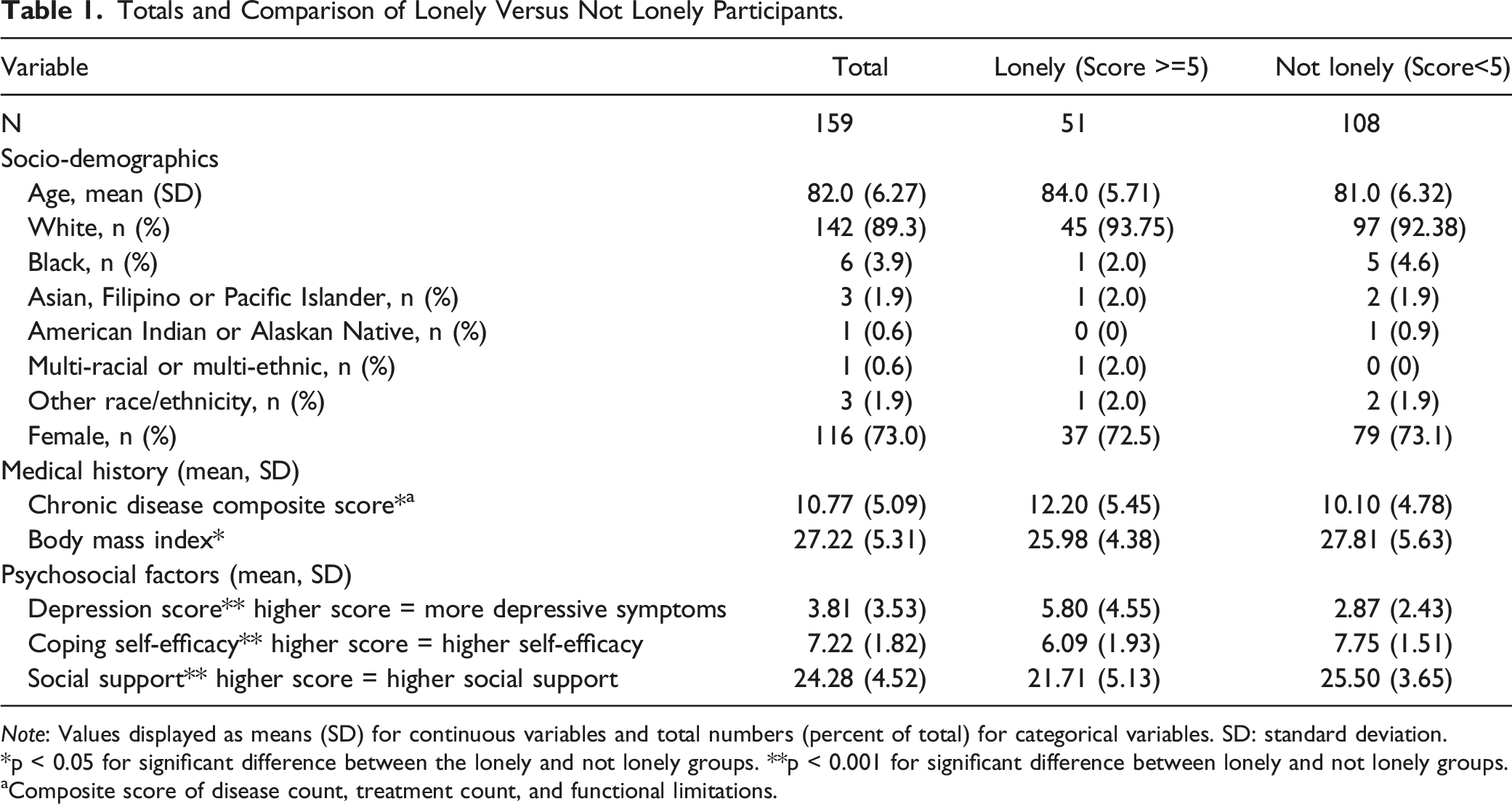
Note: Values displayed as means (SD) for continuous variables and total numbers (percent of total) for categorical variables. SD: standard deviation.
*p < 0.05 for significant difference between the lonely and not lonely groups. **p < 0.001 for significant difference between lonely and not lonely groups.
aComposite score of disease count, treatment count, and functional limitations.
The chronic disease composite score was higher in the lonely group compared to the not lonely group (12.20 ± 5.45 and 10.10 ± 4.78, respectively; p < .05). BMI was lower in the lonely group compared to the not lonely group (25.98 ± 4.38 and 27.81 ± 5.63, respectively; p < .05). There were lower scores for the lonely group compared to the not lonely group for coping self-efficacy (6.09 ± 1.93 and 7.75 ± 1.51, respectively; p < .001) and social support (21.71 ± 5.13 and 25.50 ± 3.65, respectively; p < .001). Depressive symptoms were higher in the lonely group compared to the not lonely group (5.80 ± 4.55 and 2.87 ± 2.43, respectively; p < .001), but neither were suggestive of clinical depression.
Odds Ratios of Loneliness in Unadjusted and Adjusted Models.
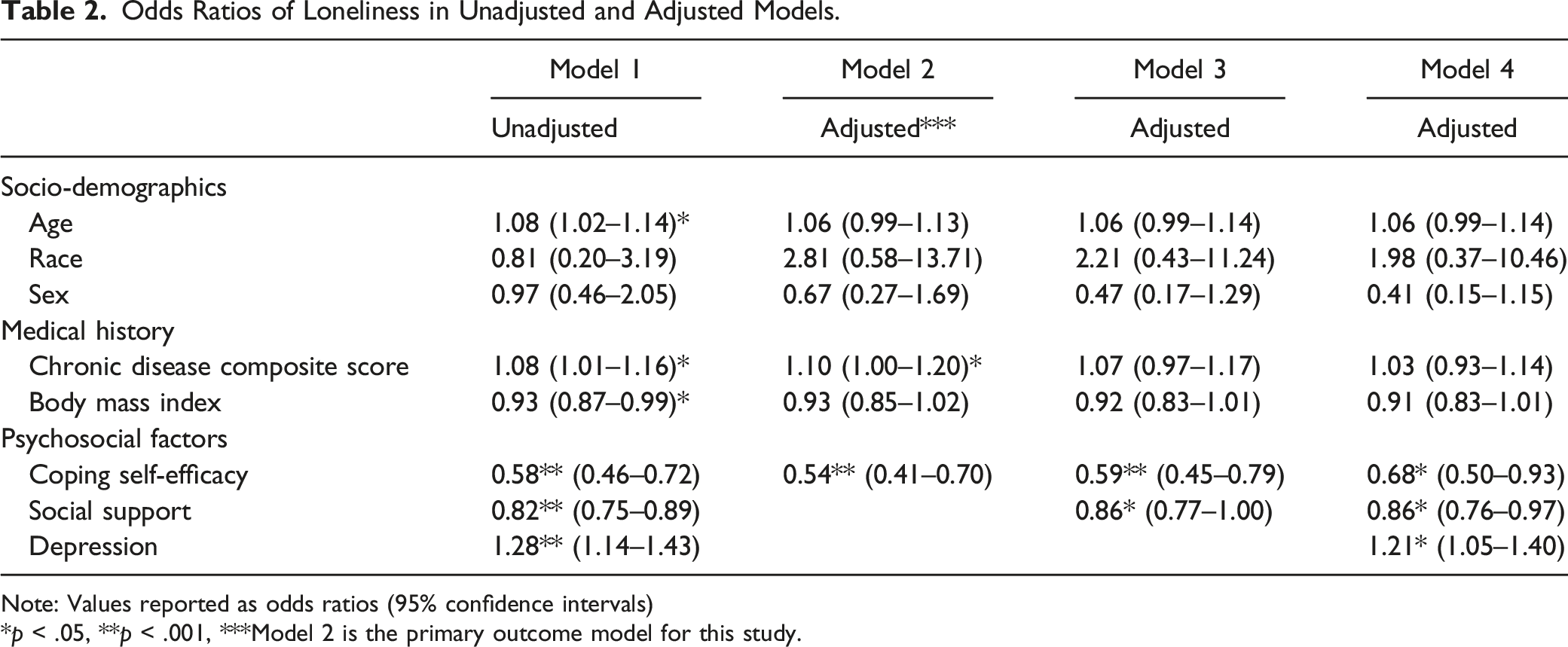
Note: Values reported as odds ratios (95% confidence intervals)
*p < .05, **p < .001, ***Model 2 is the primary outcome model for this study.
Our four models examined the odds of feeling lonely both with and without adjustment for each covariate (age, race, sex, coping self-efficacy, depressive symptoms, social support, BMI, and chronic disease composite score) (Table 2). In our main outcome model (Model 2), there was a 46% decreased odds of loneliness for every one-point increase in coping self-efficacy after adjustment of covariates (age, race, sex, BMI, and chronic disease composite score). Higher coping self-efficacy was negatively associated with feeling lonely (OR = 0.54, 95% CI: 0.41–0.70). This relationship remained significant in Model 3 with the addition of social support (OR = 0.59, 95% CI: 0.45–0.79) and in Model 4 with the addition of depressive symptoms (OR = 0.68, 95% CI: 0.50–0.93). For social support, in Model 3, a higher score was negatively associated with feeling lonely after adjustment of covariates (age, race, sex, coping self-efficacy, BMI, and chronic disease composite score) (OR = 0.86, 95% CI: 0.77–1.00). The relationship persisted in Model 4 with the addition of depressive symptoms (OR = 0.86, 95% CI: 0.76–0.97). Also, in Model 4 after adjustment of covariates (age, race, sex, coping self-efficacy, BMI, and chronic disease composite score), there was a significant positive association between depressive symptom and feeling lonely for participants with PHQ-8 score of 10 or more (scores high enough for clinical depression) (OR = 1.21, 95% CI: 1.05–1.40). Both depressive symptoms and social support did not have any mediating effects in the relationship between coping self-efficacy and loneliness.
Odds Ratios of Loneliness With Subscales of Coping Self-Efficacy Scale in Adjusted Model 2.
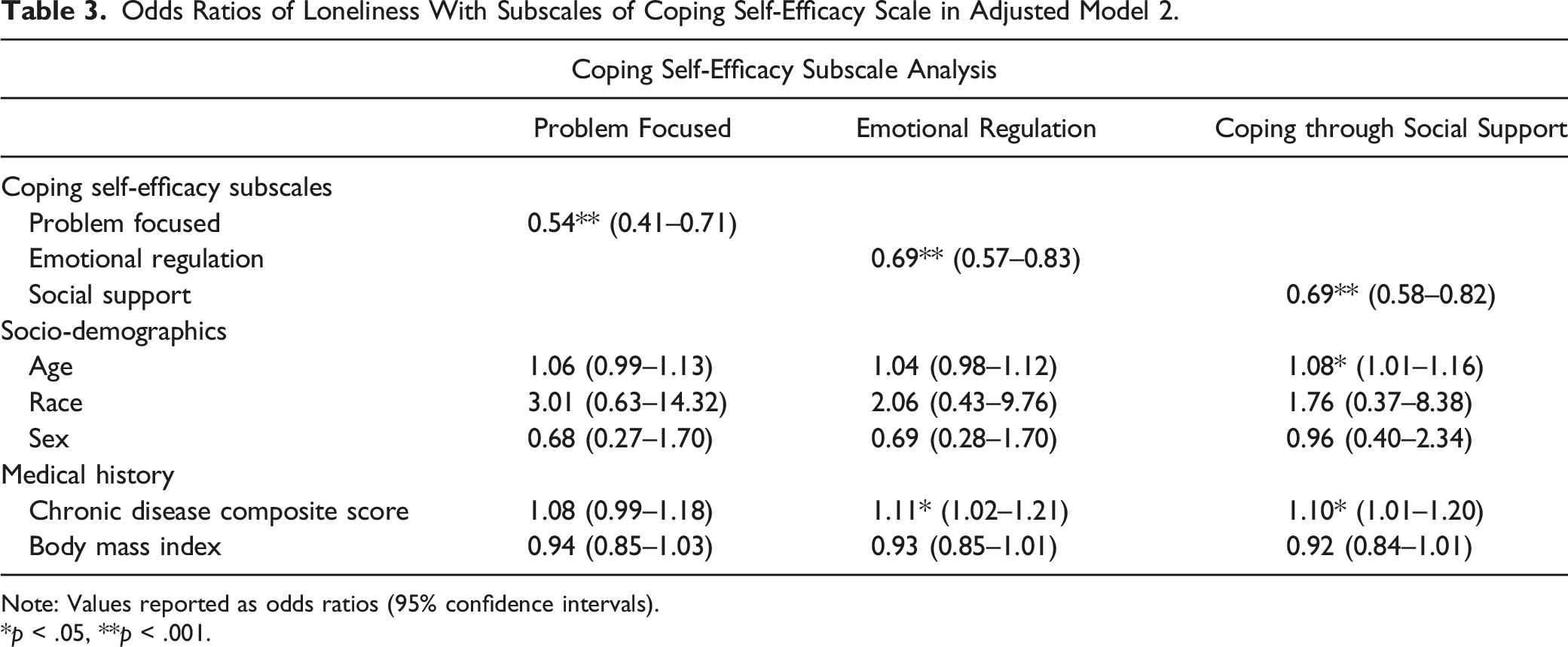
Note: Values reported as odds ratios (95% confidence intervals).
*p < .05, **p < .001.
Odds Ratio of Loneliness With and Without Participants With PHQ-8 Score Below 10.
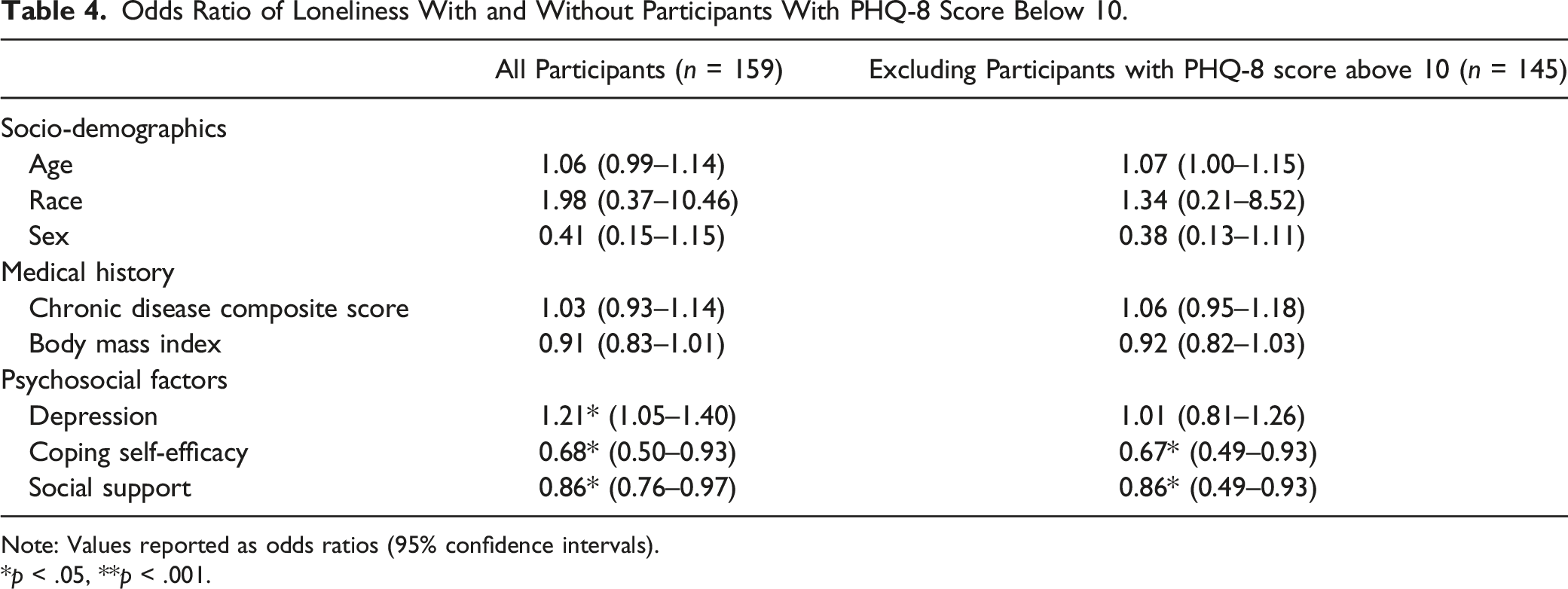
Note: Values reported as odds ratios (95% confidence intervals).
*p < .05, **p < .001.
Discussion
These study findings showed that older adults who had higher coping self-efficacy have significantly decreased odds of loneliness, though this association was not dramatically altered by adjusting for social support or depressive symptoms. This finding is particularly salient since research into loneliness has traditionally focused on deficits to explain symptoms of loneliness (Nersesian et al., 2018). A systematic concept analysis of loneliness identified three critical attributes to consider: (1) a subjective perception of psychological discomfort, (2) dissatisfaction with the quantity and quality of existing relationships, and (3) an interpretation of one’s inability to reconcile this sense of dissatisfaction through corrective actions (ElSadr et al., 2009). The last attribute focuses on the ability or agency to bring about change points to a theoretical basis for hypothesizing the connection between coping self-efficacy and loneliness. Additionally, our empirical findings add nuance for exploring a more agentic model of loneliness through a strengths-based approach (Moore, 2018). Though interventions in previous studies have addressed self-efficacy (Wainwright et al., 2019; Williamson et al., 2015), studies directly addressing coping self-efficacy are lacking. Future research may develop and test interventions that target coping self-efficacy to decrease loneliness. Furthermore, a strength-based approach may be used for coping self-efficacy by incorporating patients and caregivers as partners in addressing loneliness (Swartz, 2017). A strength-based approach promotes collaboration, builds on existing resources, and is solution-driven; it considers the broader context of the patients’ environment (Swartz, 2017). In practice, providers may attempt to understand their patients’ context and existing resources and integrate their opinions and wishes to promote a strength-based approach to increase coping self-efficacy. Additionally, policy initiatives that provide routine screening for loneliness and expand community and mental health services that promote coping self-efficacy may help address loneliness in this population. Existing evidenced based self-management programs that specifically address self-efficacy of chronic disease management (Lorig et al., 2001) could be augmented with more coping-related content.
Coping self-efficacy is a psychosocial construct that has not been fully explored in relation to loneliness. Studies examining the relationship between general self-efficacy and loneliness show a strong inverse relationship between the two where greater self-efficacy is associated with decreased loneliness (Alma et al., 2011; Nguyen et al., 2020; Nieboer et al., 2020). Our study demonstrated an association between coping self-efficacy and loneliness, which has not been shown in previous literature (M. Hladek et al., 2020; Rokach, 1996). However, the directionality of this relationship is unclear. Coping self-efficacy may alleviate loneliness by facilitating an individual to activate coping responses within the following three domains: problem-solving, emotional regulation, and coping through social support. Thus, targeting coping self-efficacy in older adults may help to mitigate the burden of feeling lonely by supporting them to actively engage in the aforementioned domains for support. Future studies exploring a potential causal relationship between coping self-efficacy and loneliness are needed for conceptual clarity and for translation of evidence in intervention studies targeting loneliness.
We used Model 2 to analyze the subscales with domains of problem-solving, emotional regulation, and coping through social support from the Coping Self-Efficacy Scale. The results demonstrated that each subscale was negatively associated with loneliness indicating that each of these coping self-efficacy domains are important to explore as potential ways to intervene among those with loneliness.
Our findings are compelling given the modifiable nature of self-efficacy possible with appropriate intervention design. This study identifies the need for further research exploring coping self-efficacy as a possible intervention pathway to better support global populations whose loneliness has been exacerbated by the COVID-19 pandemic. Self-efficacy is a cognitive behavioral skill that is built on one’s lived experiences. It fosters self-confidence in accomplishing particular tasks and is important to address in older adults since it can promote behaviors that lead to healthier outcomes (Grembowski et al., 2010). Studies have highlighted the influential role of self-efficacy in chronic illness self-management in older adults (Motl & McAuley, 2010; Trief et al., 2009). Moreover, self-efficacy showed an inverse relationship with frailty in a cross-sectional study and may also predict incident frailty within a nationally representative sample (Doba et al., 2016; M. D. Hladek et al., 2021).
The significance of an association between coping self-efficacy and loneliness was not affected in our analysis by the presence of social support. The sensitivity analysis including social support in Model 3 gives us greater insight into the complex association between loneliness and coping self-efficacy because one’s own social support did not change the associations between the former two variables. In other words, the amount of social support did not change the relationship between coping self-efficacy and loneliness. We hypothesize that this is because loneliness is a perception of being alone as opposed to an actual state of it (Cudjoe & Kotwal, 2020), which is an important distinction.
Our study findings corroborated the association between loneliness and depression reported in the literature (Jaremka et al., 2014; Warner et al., 2019). Studies have shown a strong association between loneliness and depression, although the directionality of the relationship is difficult to establish. An observational, longitudinal study of cancer survivors and older adults who are and are not caregivers demonstrated that loneliness is a long-term risk factor for depression (Jaremka et al., 2014). In another study of cross-sectional and longitudinal analyses, higher levels of reported loneliness were associated with more severe depressive symptoms (J. T. Cacioppo et al., 2006). Previous studies targeting loneliness by reducing depressive or maladaptive thoughts and enhancing social interactions have shown promising results (Masi et al., 2011; O’Rouke et al., 2018). An intervention trial on loneliness demonstrated a decrease in loneliness and reduced systolic blood pressure in the intervention group of lonely older adults with co-morbidities (Theeke et al., 2017). In a review by Cacioppo and colleagues (2015), interventions that combined cognitive behavioral therapy and short-term pharmacological treatment together were able to decrease loneliness (S. Cacioppo et al., 2015). Similarly, cognitive and psychological reframing (Ong et al., 2016), resilience training, individual or group therapy, befriending, volunteering, and technology-based interventions have shown evidence in reducing feelings of loneliness (Gray et al., 2020).
There are several limitations to this study. First, the study’s cross-sectional design limits establishing the direction of the relationship between coping self-efficacy and loneliness. Second, the sample population was predominantly white and female. This finding was consistent with those who are 65 and older in Washington DC (70.5% White (Statistical Atlas, 2022), but not in Baltimore (63% Black) (United States Census Bureau, 2021). The recruitment area or methods may have impacted the sample composition and hence limited generalizability of findings to the broader U.S. population. Also, the fact that the prevalence of loneliness in our study population closely aligns with the numbers during the COVID-19 pandemic may reflect the possibility of this sample’s limited generalizability since the pandemic has worsened the prevalence of loneliness among older adults (Hwang et al., 2020). This may have skewed the results in either direction. Furthermore, the sampling method may have skewed the sample toward people with higher self-efficacy who are able to participate in the study and complete the surveys. To reduce this selection bias, the study team supported participants in person as they completed the surveys. Third, excluding populations with life-limiting illnesses, immunological compromise, progressive neurological disease, and cognitive impairment may have led to selection bias and decreased generalizability. Last, the interpretation of the analysis regarding coping self-efficacy may be limited due to the lack of established validity of each subscale of coping self-efficacy (problem-solving, emotional regulation, and coping through social support) in older adults. However, given the high Cronbach’s alpha subscale scores in this sample, we felt confident in our decision to use this scale in this sample.
Despite limitations, the study also presents strengths. This study used standard and validated measures in older adults. The study evaluates the relationship between coping self-efficacy and loneliness, which has not been explored in previous studies (M. D. Hladek et al., 2019). This study was sufficiently powered to detect significant associations between coping self-efficacy and loneliness. Therefore, the current study lays an important foundation for guiding further inquiry and potential future intervention investigations.
Conclusion
Our study findings demonstrated that coping self-efficacy is associated with decreased loneliness. This is an important finding given the recognition of loneliness as an important public health issue. Loneliness is also linked to long-term adverse health outcomes, and our study provides a potential basis for incorporating coping self-efficacy skill development into interventions designed to mitigate loneliness in older adults. Additional research is needed to examine the causal mechanisms underlying loneliness to gain further understanding of the connection between loneliness and coping self-efficacy. Furthermore, the findings from this study present evidence for future investigations to explore a strengths-based agentic coping to intervene upon older adults experiencing loneliness.
Footnotes
Declaration of Conflicting Interests
The author(s) declared no potential conflicts of interest with respect to the research, authorship, and/or publication of this article.
Funding
The author(s) disclosed receipt of the following financial support for the research, authorship, and/or publication of this article: MDH is supported by the NINR/NIH (3P30NR018093). JJS is supported in-part by the NIA/NIH (F31AG071353) and the Cochlear Center for Hearing and Public Health at the Johns Hopkins Bloomberg School of Public Health.
IRB Approval
This cross-sectional study was approved by the Johns Hopkins Medicine Institutional Review Board (IRB00095668).
Data Availability
The data will be available upon request.
