




Abstract
This study aimed to understand the association between the online experience of older adults, their socio-demographic background, and their perceptions regarding the influence of the new technologies on their interpersonal communication. Technology familiarity and grey digital divide approaches served as the study’s theoretical framework. The data were obtained from the 2020 Israel Social Survey and analyzed using multinomial logistic regression models. The sample included adults aged 60 years and older (N = 1,607). The findings show that online group participation and general Internet use, though to a varying extent, corresponded to more positive perceptions of influence of the new technologies on both family and peer communication. Female gender, tertiary education, and belonging to ethnic majority group were associated with more positive perceptions in the studied context. The results imply that online experience of older adults is more dominant than their background with respect to perceptions regarding the influence of new technologies on interpersonal communication. The findings imply that older adults should engage in various activities on the Internet, especially in the online group participation, in order to have better perceptions regarding the new technology influence on interpersonal communication.
Keywords
• Quantitative investigation of factors shaping the older adults' perceptions regarding the role of the new technologies in interpersonal communication. • Examination of the role the online experience may play in shaping of these perceptions, while differentiating between the types of such an experience. • Examination of the perceived technology influence attitudes with respect to communication with different types of actors in personal social networks—family members and friends.
• Development of plans aimed at making the older adults' attitudes toward the technology use for/during the interpersonal communication more positive. • Development of plans aimed at increasing the share of the older Internet users, and the share of the older Internet users who use the Internet for a number of purposes, including online communication or participation in virtual groups. • A basis for the future research attempting to understand attitudes toward technology and the ways these attitudes may be improved.What this paper adds
Applications of study findings
Introduction
Social life of people around the world tends to undergo major transformations as they enter late adulthood. The number of social ties in this lifespan period tends to decrease (Cotten et al., 2013). The literature in the field suggests numerous possible reasons for such a decrease: retirement from the labor market (Kauppi et al., 2021), death of life partners and/or friends, mobility problems (Czaja et al., 2018), relocation from the community to care facilities (Francis et al., 2019), and more. Consequently, people in their later life tend to switch their communication focus toward maintenance of the existing meaningful relationships rather than expanding their social networks (Sims et al., 2017).
In general, maintaining interpersonal communication may protect older adults from cognitive decline and early mortality (Czaja et al., 2018). New technologies (for instance, Internet, mobile devices, or social media) are increasingly used by older adults (Anderson & Perrin, 2017). These technologies help to socialize, often in a real time and with people from outside the older adults' countries of residence (Genoe et al., 2018), gain social support (Francis et al., 2019), and more. For example, Khvorostianov (2016) found that older immigrants attributed the maintenance of family communication to the use of the new technologies. In a similar vein, Karaoglu et al. (2021) found that older adults attributed fast and convenient communication with family and friends to the use of the new technologies.
The use of the new technologies for interpersonal communication was found by the previous research beneficial for the older adults' well-being. Rosenberg and Taipale (2022) found that a larger number of social uses of mobile phones was associated with greater life satisfaction. Gazit et al. (2022) found that membership in family WhatsApp groups was associated with greater well-being and better self-perceptions of aging.
The switch of the interpersonal communication from the completely face-to-face to (at least partially) mediated interaction also poses numerous challenges on older adults (Ball et al., 2019). First, they tend to be seen as digital immigrants (Ball, 2019) possessing lower overall digital skills and experience greater difficulties in using the new technologies than younger people (Francis et al., 2018). Therefore, many older adults have limited ability to cooperate with younger populations with respect to the use of the new technologies, for example, when performing grandparental mediation in a form of a co-use (see Elias et al., 2021). Second, the younger people’s patterns of communication via new technologies (i.e., use of international terminology, relatively high speed of communicating, use of shortcuts and acronyms, and more) are something that is still difficult to catch up with for many older adults (Ivan & Nimrod, 2021). Third, many older adults experience difficulties with an adaptation to a modern communication culture, where the new technologies play an integral role. In this regard, participants in numerous studies (Ball et al., 2019; Ivan & Nimrod, 2021; Karaoglu et al., 2021) expressed a great deal of dissatisfaction with the fact that young people tend to use the new technologies when spending time with their older relatives.
The Current Study
As a result of the interpersonal communication involving new technologies, older adults may hold varying perceptions regarding the influence of these technologies on the process, quality, and/or other parameters of communication. These perceptions may range from viewing the new technologies as assisting in maintaining communication with social ties to perceiving them as disrupting and bringing harm to such a communication (Karaoglu et al., 2021). The current study will address this issue by analyzing the multivariable models estimating the likelihood of having any perception regarding the new technologies' influence on interpersonal communication.
The importance of studying this phenomenon can be understood through the prism of the relevant theoretical frameworks. For example, the Technology Acceptance Model (TAM) (Davis, 1989) postulates that attitudes toward technology have a direct and a positive association with the intention to adopt it. If older people express positive views regarding the particular technology, they will likely adopt it and/or sustain its use. On the contrary, negative views of a particular technology and/or its influence on various life domains may hinder its adoption or lead to discontinuation of its use. Given that previous research generally found that the technology use is associated with a greater subjective well-being in later life (Cotten et al., 2014; Gazit et al., 2022; Rosenberg & Taipale, 2022) and that a notable share of older adults reported that they would experience social exclusion once being detached from the new technologies (Seifert et al., 2018), it is important to understand which factors shape the attitudes toward the new technologies for interpersonal communication in later life. The goal of this study is to understand this issue.
To investigate this phenomenon, the study employed two sets of factors. The role of each one of them is explained by a separate theoretical background. In accordance with the grey digital divide theory (Friemel, 2016), the study used socio-demographic background as one set of factors. In general terms, digital divide approach maintains that inequality exists between groups of people, including older adults, with respect to the use of the new technologies, the skills in their use, and the benefits from their use (Ball et al., 2019). In accordance with this theory, people coming from a more socially advantaged background (i.e., younger, better educated, and having higher income) are more likely to adopt new technologies than people coming from the less advantaged background (Friemel, 2016). Socio-demographic parameters were found explaining not only the technology adoption/use by older adults (Berner et al., 2019; Chopik et al., 2017; Friemel, 2016) but also their attitudes toward technology (Chopik et al., 2017). The latter suggests that people of various backgrounds (for instance, being of different age, holding different education levels, and more) are also divided in terms of their views of technology. The first research question posed here is:
What is the role of the older adults' socio-demographic background in their perceptions of the new technology influence on interpersonal communication? In accordance with the technology familiarity approach, the study used the variables reflecting the Internet use purposes as another set of factors. Familiarity is defined as awareness based on experience, where one has an understanding of the behavior, function, or action of the system or interface being used (Gefen, 2000). People who familiarize themselves with the technology tend to hold more positive views of it, mostly because familiarity allows better understanding of various applications of a technology (Welch & Hinnant, 2003) and reaping benefits from its utilization (Francis et al., 2018) including that performed for social purposes. Previous research conducted in the general population found that familiarity with e-government was positively associated with perception of information reliability on government websites (Welch & Hinnant, 2003). Previous research in older adults found that the frequency of going online was positively associated with perceptions of benefits the Internet may bring when using it for communicating with other people (Cotten et al., 2013). The second research question is therefore formulated as follows:
Does the online experience correspond to a more positive perceived influence of the new technologies on interpersonal communication? This study can be seen as a novelty in the field for the following two reasons. First, most of research investigating perceived influence of new technologies on the interpersonal communication was qualitative (Ball et al., 2019; Ivan & Nimrod, 2021; Karaoglu et al., 2021; Khvorostianov, 2016). This disallows understanding of the particular factors which can explain these attitudes. The only quantitative study predicting technology-related attitudes in older population (Chopik et al., 2017) did not refer to the influence of the new technologies on interpersonal communication. Second, the association between the online experience and these attitudes in later life was not assessed by the research in the domain. The study’s theoretical contribution is in the explanation of the studied phenomenon using frameworks that are usually employed to explain adoption of technologies rather than the attitudes toward them. The study’s empirical contribution is in the use of multivariate categorical analysis in order to reveal factors related to the studied phenomenon. The study will serve public decision makers, as well as communities, in their attempts to make the new technologies more accessible for older adults who are ultimately expected to benefit from their usage.
Methods
Instrument
The current study is based on the data obtained from the Social Survey of Israel (Central Bureau of Statistics, 2020). This survey is conducted every year by the country’s Central Bureau of Statistics since 2002 (CBS, 2022), whereas only non-institutional population is surveyed (Lissitsa & Madar, 2018). Each year, the survey includes core questionnaire (mainly referring to socio-demographic background, labor market participation, and health background) and a rotating module (Lissitsa & Chachashvili-Bolotin, 2014). In 2020, the official title of the survey was “Digital age.” The rotating module consisted of items related to the use of computers and the Internet for various purposes as well as items assessing digital skills and technology-related perceptions (Central Bureau of Statistics, 2020).
Measures
Dependent Variables
Perceived Influence of the New Technologies on Family Communication
The original item asked “In your family, have the new technological means improved or worsened communication between family members?”. The response options were “Improved,” “Worsened,” and “No effect on it” (reference).
Perceived Influence of the New Technologies on Peer Communication
The original item asked “Have the new technological means improved or worsened communication between you and friends?”. The response options were “Improved,” “Worsened,” and “No effect on it” (reference).
Independent Variables
Socio-Demographic Background
Gender (0 = Female; 1 = Male), age category (0 = Aged 60–64 years (reference), 1 = Aged 65–74 years, 2 = Aged 75 years and older), education level (0 = Non-tertiary level [post-secondary or lower], including no studies and no diploma, 1 = Tertiary level [BA, MA, and PHD]), marital status (0 = Not married, 1 = Married), locality size (0 = Small, up to 49,999 residents, 1 = Large, 50,000 residents and more), and population group (0 = Arabs, 1 = Jews and others).
Online Experience
The original item asked: “Do you participate in a special interest group on the Internet, such as virtual social groups, local area groups, or neighbourhood groups?”. Since this question was asked from all the survey participants, three categories were included in it: “yes,” “no,” and “does not use Internet at all.” Based on this item, two dummy variables were created: online communication experience (for those who checked “yes” on this item) and general Internet use (for those who checked “no” on this item). Therefore, respondents who did not use the Internet at all represented the reference category.
Sample
In accordance with the definition of older people by the United Nations (UN, 2023), the study population included adults aged 60 years and older, who provided valid responses on at least one of the two items assessing the influence of technology on the communication between members of family, with friends, and reported about their online experience.
The initial sample of 7,249 survey participants was further limited by age, so that responses of people aged 59 and younger (n = 5,503) were eliminated. The subsequent filtering of the data was performed in accordance with the dependent variables. Of the 1,746 entries remained, 75 were excluded due to having missing values on both variables. Of the remaining, 13 respondents had missing values on one of the variables and mentioned that they have no family/friends on the second variable, or mentioned having no family and no friends. Their responses were discarder either. 1 Hence, in the end of this stage, 1,658 entries remained in the database.
The last stage of the data filtering was performed in accordance with the online experience item. Crosstabulation was performed between the Internet use and online communication experience variables. This examination revealed a minor matching inconsistency. Specifically, 37 of those who reported using the Internet in the Internet use variable were also classified in the “did not use the Internet at all” category of the online experience item. Their responses were therefore discarded. Finally, four participants had missing values on this item, so their responses were also eliminated.
Sample Statistics.
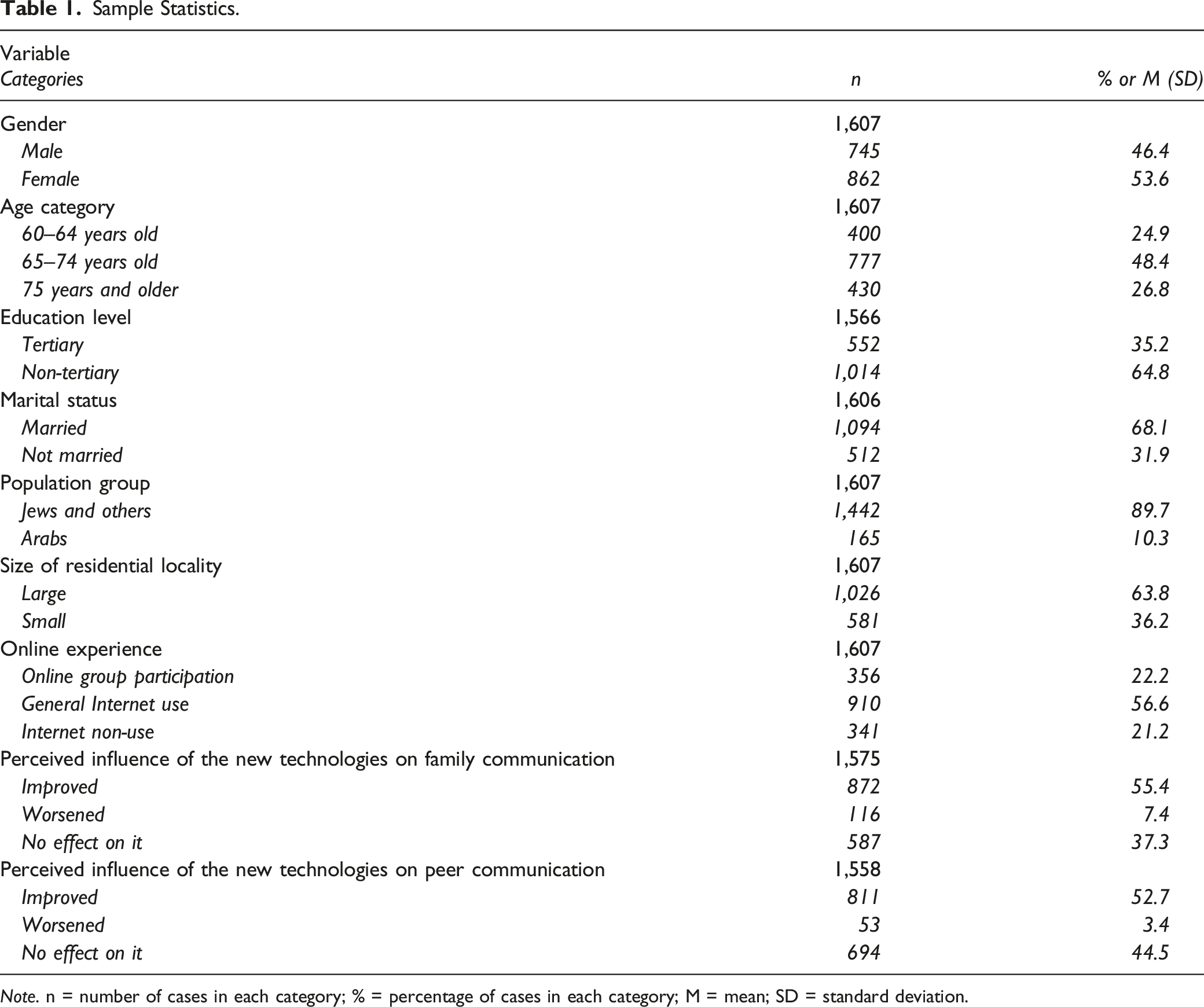
Note. n = number of cases in each category; % = percentage of cases in each category; M = mean; SD = standard deviation.
Analysis
The data were analyzed using multinomial logistic regression models due to the fact that each dependent variable consisted of three categories. In total, two models were examined, one for each dependent variable. Missing values were handled listwise. Each model was significant and fitted the data well.
Results
New Technologies and Family Communication
Coefficients (Standard Errors) of the Logistic Regression Analysis Predicting the Likelihood of Reporting Perceived Influence of the New Technologies on Family Communication.

Significant associations are marked with bold. Reference categories for the independent variables: 1Female, 2Aged 60–64 years, 3Non-tertiary education, 4Not married, 5Small residential locality, 6Arabs, and 7Internet non-use.
Reference category for the dependent variable: a No effect on it.
The findings show that online group participation was associated with both perception of improvement (OR = 6.62, p < .001) and perception of worsening (OR = 3.07, p = .001) in family communication because of the new technologies. In other words, older people who participated in online groups were 6.6 times more likely than those who did not use Internet at all to perceive an improvement in family communication, thanks to the new technologies. However, the former were also 3.1 times more likely than the latter to perceive worsening in family communication because of the new technologies. General Internet use exhibited similar associations (improvement: OR = 4.85, p < .001; worsening: OR = 1.77, p = .044). In other words, older people who used the Internet but did not participate in online groups were 4.9 times more likely than those who did not use Internet at all to perceive improvement in a family communication, thanks to the new technologies. However, the former were also 1.8 times more likely than the latter to perceive worsening in family communication because of the new technologies.
Of the socio-demographic variables, only belonging to Jewish group was associated with lower likelihood of perceiving worsening in family communication because of new technologies (OR = .27, p < .001). In other words, Jewish older adults were 73% less likely than their Arab counterparts to perceive worsening in family communication because of the new technologies.
New Technologies and Peer Communication
Coefficients (Standard Errors) of the Logistic Regression Analysis Predicting the Likelihood of Reporting Perceived Influence of the New Technologies on Peer Communication.
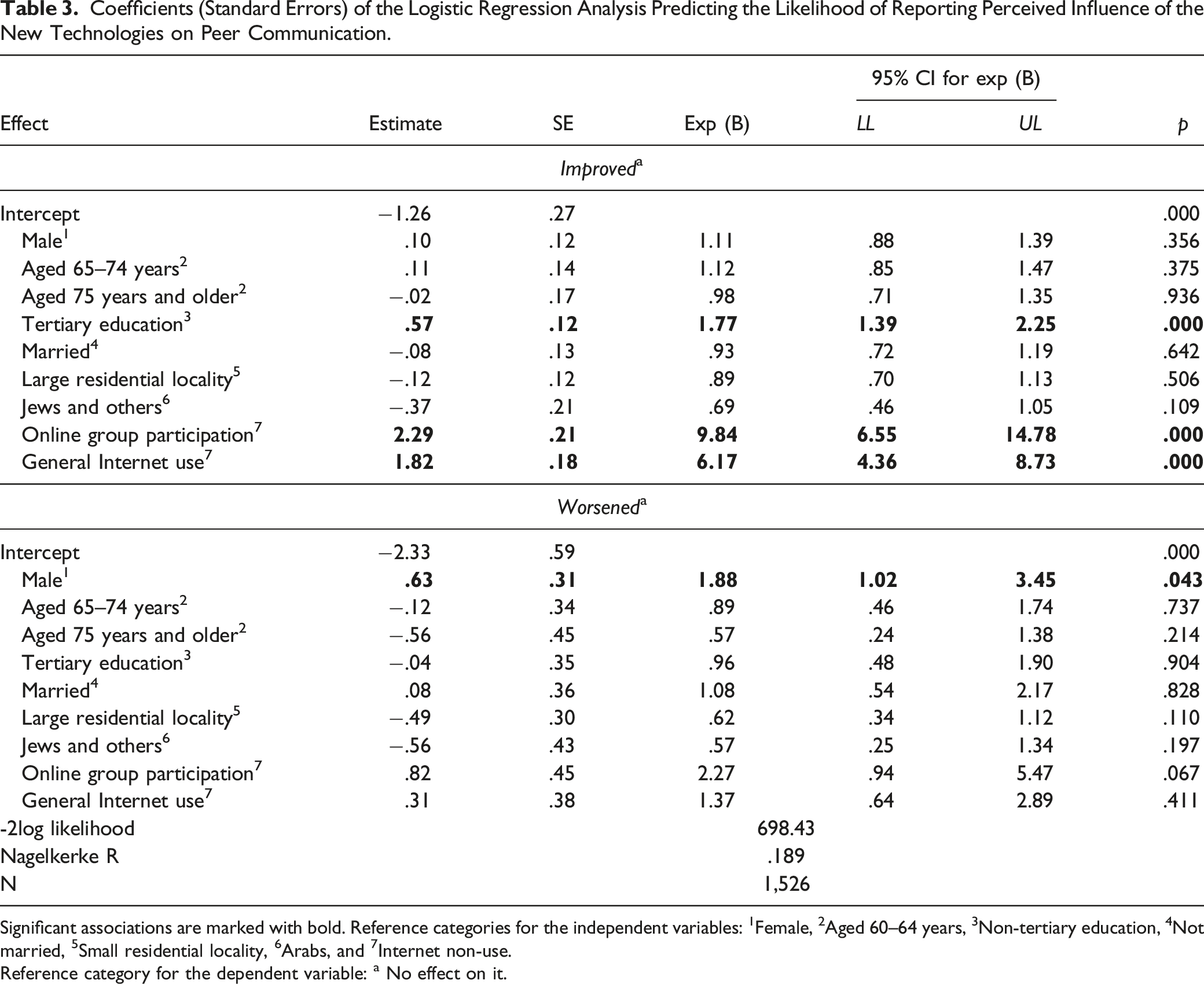
Significant associations are marked with bold. Reference categories for the independent variables: 1Female, 2Aged 60–64 years, 3Non-tertiary education, 4Not married, 5Small residential locality, 6Arabs, and 7Internet non-use.
Reference category for the dependent variable: a No effect on it.
The findings show that having tertiary education positively related to perceiving improvement in peer communication (OR = 1.77, p < .001). In other words, older people with any tertiary level of education were 1.8 times more likely than people with post-secondary or lower education level to perceive improvement in peer communication, thanks to the new technologies. Male gender was positively associated with perceiving worsening in peer communication (OR = 1.88, p = .043). Older men were 1.9 times more likely than older women to perceive worsening in peer communication because of the new technologies.
In contrast to the previous analysis, online experience variables were associated only with the perception of improvement in peer communication (online group participation: OR = 9.84, p < .001; general Internet use: OR = 6.17, p < .001). In other words, older people who participated in online groups were 9.8 times more likely than those who did not use Internet at all to perceive improvement in peer communication, thanks to the new technologies. In a similar vein, older people who used the Internet but did not participate in online groups were 6.2 times more likely than those who did not use Internet at all to perceive improvement in peer communication, thanks to the new technologies.
Discussion
The goal of this study was to understand the association between online experience, socio-demographic background, and perceptions regarding the influence of the new technologies on interpersonal communication among older adults. This examination was performed in light of scarcity of quantitative studies attempting to understand technology-related perceptions in later life. The study acknowledges the role the attitudes toward technology have with respect to an adoption or a sustained use of technology, and the subsequent positive contribution to subjective well-being in this lifespan period (Cotten et al., 2014; Rosenberg & Taipale, 2022).
The findings of the study provided support for both theoretical perspectives employed—the familiarity approach and the grey digital divide theory. As a response to RQ1, socio-demographic background, though in a very partial way, was associated with the views of the new technology influence. The related associations found are discussed below.
The finding on gender, according to which older men were more likely than older women to report worsening in peer communication because of new technologies, can be discussed in terms of gender differences in communication patterns and practices. Since women tend to be more motivated than men to maintain existing social ties (Igarashi et al., 2005), they may reap greater benefits from the tie maintenance using the new technologies than men, for instance, better speed of communication, greater frequency of contact, and more. Consequently, they are less likely to have negative views regarding the influence of the new technologies on an interpersonal communication.
Having tertiary level of education was associated with the perceived positive influence of the new technologies on peer communication. Higher level of education was found by previous research corresponding to greater perceived benefits of using technology (Chopik et al., 2017). Higher level of education tends to reflect more developed cognitive skills (Feinberg et al., 2016). Therefore, older adults with tertiary education can relatively easily adopt or adjust themselves to particular styles of interaction in the virtual space. This is especially pronounced in peer communication where ties and, consequently, communication styles are typically more diverse and possibly less predictable than within families. Higher levels of education also correspond to more active manners of problem solving (Agbaria & Abu-Mokh, 2022). Therefore, older adults with higher education are more likely to seek solutions to overcome problems which may arise when using the new technologies for/during interpersonal communication and, consequently, have more positive views of their influence on this communication.
Finally, Arab older adults seem to have somewhat more negative view of the new technology influence on family communication than their Jewish counterparts. Two main explanations can be provided with respect to this finding. First, Arab older adults, due to years of working mainly in blue collar positions in the past, could have had a lower exposure to the new technologies than their Jewish counterparts, and could have even developed some antagonism toward them, let alone their adoption for the purposes of communicating with family members. Second, Arab community in Israel undergoes major transformations in last two decades including a widespread adoption of the new technologies and of Western values, mainly by younger generations (Abbas & Mesch, 2015), a dissolution of the extended family, and residence with nuclear families only (Manor, 2018). Although Arab older adults still highly value family relations (Manor, 2020), these transformations could project on their view of the new technology influence on these relations. Indeed, participants in the study by Manor (2020) perceived the relationship between younger and older people in Israel’s Arab society being negatively impacted by the increased use of the new technologies by younger generations.
Now I switch to the discussion of the role the online experience variables played in explanation of the studied phenomenon. As the response to RQ2, these variables corresponded to a mostly positive view of new technology influence in the studied context. This corroborates the findings of the previous research which found an association between the frequency of the Internet use and perceived communication benefits being positive (Cotten et al., 2013). The association found in the current study signals familiarity with technology (Welch & Hinnant, 2003). Engaging in online space allows older adults to get familiarized with its features. This particularly applies to online communication experience. When obtaining such an experience, older adults may learn and adopt various techniques of verbal or non-verbal, as well as asynchronous or synchronous communication. In addition, they can get familiarized with a culture of interaction with others in the online space. Hence, the older adults' participation in online groups seems assisting in the upgrading of their mediated communication skills and improving their view of technology to maintain relationships with their social ties. This can also explain the larger odds ratios found for the online group participation rather than for the general internet use variable in each one of the examined models.
The findings on the positive association between the online experience variables and the perception of worsening in family communication corroborate the findings of the qualitative studies (Ball et al., 2019; Karaoglu et al., 2021). These findings suggest that older people, in addition to benefits, also acknowledge negative aspects of incorporating new technologies into family communication. The findings also suggest that people with different online experiences reveal varying levels of such an awareness.
Finally, the results suggest that the examined factors seem performing better in explanation of the studied phenomenon with respect to peer rather than family communication. Online experience variables contributed to a larger increase in explained variance in the perception of the new technology influence on the former rather than the latter type of communication. In addition, the number of the significantly related factors was larger in the former rather than in the latter model, and the associated socio-demographic variables differed between the models. From the empirical point of view, this strengthens the idea that the studied phenomenon should not be seen as a single entity but rather examined with respect to various actors with which older adults may communicate. From the theoretical point of view, the findings can be attributed to a difference in the network diversity. Having online experience, especially participation in groups, may benefit older adults more with respect to peer than family relationship, as it is able to prepare them for the communication with diverse actors which characterizes the peer part of the social network to a greater extent than the family one.
Implications
Two main practical implications can be solicited from the findings. First, older adults of male gender, with lower education levels, and belonging to Arab society should be targeted more by technology-related campaigns provided by the government or local authorities. These campaigns should explain to older adults belonging to these categories about the affordances of the new technologies and the ways these technologies can be successfully incorporated in family and peer communication. In addition, governmental and/or local authorities should allocate resources and organize courses where older adults, especially those belonging to either one of the abovementioned categories (or to more than one of them), would improve their skills in use of the new technologies and learn communication styles using them. Second, communities should encourage older adults to adopt new technologies to use the Internet, especially for participation in virtual groups. These groups, except for mere familiarization with technology and developing digital communication skills, can provide useful information which may contribute to better health and well-being outcomes for the older adults.
Limitations
The results of the study should be interpreted with several limitations in mind. First, the study is cross-sectional, so no causality can be concluded from the associations found. Second, the study was conducted in one social setting. Hence, generalization of its findings on older populations residing in other countries, especially those of low communication context (Hall, 1976), should be done with care. Third, the items serving for definition of the outcome variables did not specify the technologies used. The impact of various technological solutions on the interpersonal communication can be perceived differently. In addition, these items had only three options for response, therefore restricting the number of possible statistical methods.
Conclusions
Three main conclusions can be derived from the findings. First, various online activities seem to contribute differently to the explanation of the perceived new technology influence on an interpersonal communication. Second, socio-demographic background only partially contributes to explanation of these views. Third, the examined attitudes are differently explained (in terms of the set of the significantly associated variables and the explained variance) when discussing interpersonal communication with different types of social ties. Future qualitative studies may shed a greater light on the reasons for having these attitudes. In order to gain better insights into the perceived influence of the new technologies on the interpersonal communication, it is recommended to conduct the future studies among older adults belonging to those socio-demographic categories that were found significantly related to the studied phenomena. In addition, future quantitative studies should provide a more nuanced view of the studied phenomena by differentiating between various new technologies as well as between various use practices.
Footnotes
Acknowledgments
The author would like to thank Prof. Galit Nimrod (Department of Communication Studies, Ben-Gurion University of the Negev, Israel) for her fruitful comments and suggestions on this article.
Declaration of conflicting interests
The author(s) declared no potential conflicts of interest with respect to the research, authorship, and/or publication of this article.
Funding
The author(s) received no financial support for the research, authorship, and/or publication of this article.
Ethical Statement

Data Availability Statement
The current research used the data from the dataset available by request from the Central Bureau of Statistics, State of Israel. The link for downloading this dataset was received upon online request to the email on February 16, 2022.