




Abstract
Gottfredson and Hirschi acknowledge that there are sex differences in levels of self-control, with males exhibiting lower levels of self-control compared to females. There remains a gap in the empirical literature, however, as to whether differential parental treatment can explain differences in levels of self-control across the sexes. Using siblings of opposite sex from the Add Health study (N = 356, brother–sister pairs) and following a within-family research design, the current study examines whether differences in parenting behaviors within the home are associated with sex differences in self-control between siblings and whether these differences in self-control explained sex differences in delinquency. The results revealed that differential maternal attachment and differential maternal rejection were significantly related to sex differences in self-control. Sex differences in self-control, in turn, were significantly associated with sex differences in delinquency. The findings also showed that sex differences in self-control mediated the association between differential maternal rejection and delinquency, but that differential maternal attachment was indirectly associated with higher levels of delinquency for boys via lower levels of self-control. The impact of nonshared environmental factors on behavioral differences in opposite-sex siblings within the home is discussed.
Introduction
Prior research has shown that males tend to exhibit lower levels of self-control than females (Burton, Cullen, Evans, Alarid, & Dunaway, 1998; Hagan, Simpson, & Gillis, 1987). It remains unclear, however, as to why males display lower levels of self-control than females. Some scholars suggest that it is because males receive less supervision and less discipline for their deviant behaviors compared to females (Tittle, Ward, & Grasmick, 2003). That is, parental management techniques mediate the relationship between sex and self-control. There is some evidence that supports the notion that females are more closely supervised than males and that females are less likely to engage in behaviors that reflect low self-control (i.e., substance use) because they are more closely monitored than males (LaGrange & Silverman, 1999; Svensson, 2003). However, few studies have explicitly examined whether parental management practices mediate the relationship between sex and self-control (Chapple, Vaske, & Hope, 2010).
Further, studies that have investigated the links between sex, parental management techniques, self-control, and delinquent behaviors have used between-family research designs. That is, these studies compare a male’s level of parental management, self-control, and delinquent involvement in one household to a female’s level of parental management, self-control, and delinquent involvement in a different household. While between-family studies may include some theoretically important control variables, they may not account for various factors that differ between the households. Thus, between-family studies may be comparing supervision levels for males and females that are applied in completely different contexts. A stronger test of this hypothesis would be to use a within-family research design. As such, the current study examines whether sex differences in parenting practices within the home help explain sex differences in self-control between siblings and whether these differences in self-control help explain sex differences in delinquent behaviors during adolescence.
Literature Review
Gottfredson and Hirschi’s (1990) general theory of crime has received a substantial amount of attention from the criminological community (Cohn & Farrington, 1999). According to Gottfredson and Hirschi, variation in criminal behaviors is explained by an individual’s level of self-control. The authors assert that individuals with low self-control tend to be “impulsive, insensitive, physical (as opposed to mental), risk-taking, short-sighted, and nonverbal” (p. 90). These different elements are said to form a unitary concept of self-control that ultimately reflects an individual’s failure to acknowledge the negative consequences of their behavior. Without the capability and desire to exercise self-control, individuals are “free” to engage in various antisocial behaviors (Tittle, Ward, & Grasmick, 2004).
The general theory states that males are more likely to have lower levels of self-control than females and consequently males will engage in more criminal behavior than females. Indeed, research has consistently revealed that males report lower levels of self-control than females (Burton et al., 1998; Chapple & Johnson, 2007; Moffitt, Caspi, Rutter, & Silva, 2001). Studies have also shown significant sex differences in constructs related to self-control, such as impulsivity, effortful control, risk seeking, and attention deficit hyperactivity disorder (ADHD; Chapple & Johnson, 2007; Else-Quest, Shibley Hyde, Goldsmith, & Van Hulle, 2006; Hagan et al., 1987; Offord et al., 1987). For example, LaGrange and Silverman (1999) found that males scored higher on measures of impulsivity, present orientation, and risk seeking than females. Other studies have shown that males (relative to females) are more likely to engage in behaviors that are indicative of low self-control, such as consuming large quantities of alcohol, smoking cigarettes, having unstable relationships, having large amount of debts, and driving without a seat belt (Keane, Maxim, & Teevan, 1993; Tittle et al., 2003). Thus, males may be more likely to espouse attitudes that reflect lower levels of self-control and they may also be more likely to engage in behaviors that reflect lower levels of self-control.
Despite the substantial amount of research showing a sex difference in levels of self-control and delinquency, it remains unclear as to why males, on average, have lower levels of self-control than females. Gottfredson and Hirschi (1990) suggest that males and females acquire self-control via the same social processes: strong parent–child attachment, effective supervision, recognition of deviant behavior, and punishment for deviant behavior. Females, however, may develop higher levels of self-control because (a) they have stronger attachments to others, (b) they are supervised more closely than males, and (c) they are more likely to be punished for deviant behavior than males (Costello & Mederer, 2003; Tittle et al., 2003). Further, females may care about others' judgments of them more than males; thus, females may develop greater self-control because they are more sensitive to the effects of punishment than males (Heimer, 1996).
Hagan’s power-control theory is another potential explanation for the sex differences in self-control (Hagan et al., 1987). Power-control theory hypothesizes that males have higher levels of risk taking or lower levels of self-control because (a) they are supervised less than females and (b) they are socialized to be risk taking more so than females, especially in patriarchal households (Hagan, Gillis, & Simpson, 1985). Similar to Gottfredson and Hirschi’s (1990) theory, Hagan et al. (1987) argue that females are monitored more closely than males and females are more likely to be punished for deviant behavior than males. However, unlike Gottfredson and Hirschi’s theory, which does not emphasize power structures within the home, power-control theory suggests that households differ based on the degree of patriarchy (i.e., differential power structure between parents) and that males and females are socialized quite differently in patriarchal households. Males, in patriarchal households, are encouraged to be risk taking because risk taking is a characteristic of masculinity. Females, on the other hand, are taught to avoid risky behaviors because females in patriarchal households are encouraged to be passive individuals who attend to others' needs.
Research has provided some support for Gottfredson and Hirschi’s (1990) and Hagan et al.’s (1987) explanations for the sex difference in self-control (Blackwell & Piquero, 2005). For example, studies have revealed that males, on average, are supervised less than females, have weaker attachment to parents than females, and receive harsh discipline more frequently than females (Chapple & Johnson, 2007; Hagan et al., 1987; LaGrange & Silverman, 1999; Moffitt et al., 2001). Empirical evidence also suggests that parental supervision may mediate the relationship between sex and behaviors that are characteristic of low self-control (Richards, Miller, O’Donnell, Wasserman, & Colder, 2004). Webb, Bray, Getz, and Adams' (2002) analysis of data from 1,672 middle and high school youths revealed that maternal monitoring mediated the relationship between sex and adolescent drinking. A study of youths in Sweden also revealed that sex indirectly influenced drug use via lower levels of parental monitoring (Svensson, 2003). Thus, there is some evidence that suggests that males may have lower levels of self-control (relative to females) because they receive less supervision from parents, they have weaker attachments to parents, they are punished less for deviant behaviors, and they are encouraged to take risks.
The above studies highlight the importance of differential parenting between males and females and how differential parenting may contribute to sex differences in self-control. However, a key limitation of the above studies is that they use a between-family research design and follow standard social science methodology by including information on only one sibling and one parent within the household. That is, a male’s level of supervision and self-control in one household is compared to a female’s level of supervision and self-control in a different household. This approach fails to take into account important genetic and environmental factors that differ between the households; thus, research may be comparing apples to oranges when examining sex differences in parenting and in self-control. It would be much more telling whether differences in parenting behaviors within the same household were associated with sex differences in self-control between siblings. As Crouter, Manke, and McHale (1995, p. 328) state, “a within-family design permits comparisons of family socialization experiences of … opposite sex siblings … to test hypotheses about whether sons and daughters in the same family experience increasingly divergent, sex-typed patterns of family socialization.”
Differential parenting practices occurring within the home are best described as nonshared environmental influences. Nonshared environmental influences refer to experiences/events occurring both within and outside the home that are unique to each child (e.g., differential peer networks, differential extracurricular activities). In order to examine the effects of nonshared environmental influences on behaviors, a within-family research design is needed, which includes more than one child per household. Blackwell and Reed (2003) further argue that any examination of power-control theory should use a within-family research design as the theory focuses primarily on differential relationships that occur within the home, which cannot be captured using traditional between-family research designs. In their analysis of 232 opposite-sex sibling pairs, Blackwell and Reed found that gender differences in perceptions of risk mediated the effects of differential maternal attachment on delinquency. Their analyses, along with others, suggest that within-family designs may be appropriate for investigating the interrelationships of gender, parenting, self-control, and delinquency.
On the other hand, between-family research designs are often used when examining the effects of shared environmental influences on behaviors. Shared environmental influences refer to experiences/conditions that are similar among siblings within the home (e.g., socioeconomic status, neighborhood conditions), which in turn have similar effects on children. As such, only one child per home is needed based on the assumption that the effects of the shared environment are the same on all other children residing within the home. Studies, following this approach, have shown little to no systematic difference in socialization practices between boys and girls (Lytton & Romney, 1991). As mentioned, however, these studies compare parenting practices for males in one household to parenting practices for females in a different household, thereby ignoring important genetic and nonshared environmental factors that differ between the households.
Behavioral genetic research has shown that of these two types of environments, nonshared environmental factors are most important in explaining variance in behaviors. Specifically, studies have shown that approximately half of the variance in self-control and in antisocial behaviors is attributed to nonshared environmental factors with the remaining half being due to genetic influences 1 (Beaver, DeLisi, Vaughn, Wright, & Boutwell, 2008; Beaver, Wright, DeLisi, & Vaughn, 2008; Moffitt, 2005; Rhee & Waldman, 2002; Wright, Beaver, DeLisi, & Vaughn, 2008). While these studies are able to highlight the importance of nonshared environmental factors on self-control and delinquency, specifying (a) which nonshared environmental factors (i.e., differential parenting, different peer networks, different interests) are important influences on self-control and delinquency or (b) whether these nonshared environmental factors can explain sex differences in self-control and delinquent behaviors. As such, the current within-family research study uses a difference scores approach to examine the effects of nonshared environmental factors, namely, differential parenting, on sibling differences in self-control and delinquency among brother–sister pairs.
Present Study
In light of the gaps in the literature, the current study examines whether sex differences in maternal monitoring, maternal attachment, and maternal rejection are associated with sex differences in self-control and whether these differences in self-control explain sex differences in delinquent behaviors. First, it is hypothesized that male siblings will have lower levels of self-control because they receive less monitoring, have lower levels of maternal attachment, and feel more rejected by their mothers compared to their sisters. Second, it is expected that differences in self-control will in turn explain sex differences in delinquent involvement, with males exhibiting higher levels of delinquent involvement than females. These hypotheses are examined using data from opposite-sex siblings who reside in the same household. Therefore, the current study is better able to control for (but not entirely eliminate) confounding family and home environmental factors that may not be accounted for in traditional between-family studies that use data from only one youth and one parent in a home. A within-family research design may better control for extraneous influences because males and females from the same household may “look” more similar to one another in terms of parenting and household factors than males and females from different households. Thus, the current study examines whether differences in parenting behaviors within the same household are associated with sex differences in self-control between siblings and whether these differences in self-control explain differences in delinquent behaviors between brothers and sisters during adolescence.
Method
Data
Data for the current study come from the National Longitudinal Study of Adolescent Health (Add Health). Add Health is a longitudinal study of a nationally representative cohort of youth who, during the 1994–1995 school year, were in Grades 7–12. One of the main goals of the Add Health study is to examine how social, family, and school environments during adolescence affect certain behaviors, health, and achievement outcomes in adulthood (Harris et al., 2009). To date, four waves of data have been collected.
During Wave 1 of data collection, a stratified sampling design was utilized to select 132 schools for participation. A self-administered in-school questionnaire was then distributed to all students who were present in the selected institutions and had permission to participate. In total, 90,000 students completed the questionnaire between September 1994 and April 1995. A subsample of over 20,700 adolescents was then selected for in-home interviews. These interviews occurred between April and December 1995 and were meant to gather more sensitive data from the youth. Participants were asked personal questions related to family dynamics, peer relationships, and delinquent behaviors (Harris et al., 2009). For each adolescent who participated in the interview, a caregiver (typically a mother) was also asked to complete a supplemental questionnaire. A total of approximately 17,700 caregiver reports were completed during Wave 1 (Harris et al., 2009).
In 1996, the second wave of data was collected through follow-up in-home interviews. Over 14,700 adolescent participants from Wave 1 were reinterviewed at Wave 2. The questions asked were generally the same as those asked at the first wave since only 1 year had elapsed and the questions were still considered to be age-appropriate (Harris et al., 2009). Between 2001 and 2002, 15,197 Wave 1 respondents participated in the third wave of data collection. Since the participants in the cohort were now young adults, between the ages of 18 and 26, the questionnaire was modified to ask about more age-appropriate events, such as their marriage/cohabitation histories, sexual experiences, childbearing, substance use, and involvement in the criminal justice system.
It is important to note that within the core sample, a genetic subsample was also selected at Wave 1. Specifically, participants at Wave 1 were asked whether they had a sibling in Grades 7–12. If they did, the participant’s siblings was automatically included in the Wave 1 in-home interview. This process created the genetic subsample, which consists of pairs of siblings of different genetic relatedness living within the same household (e.g., identical twins, fraternal twins, full siblings, half siblings, step-siblings, foster children, and adopted [nonrelated] siblings; Harris et al., 2009). The genetic subsample allows researchers to analyze both genetic and social influences on adolescents and assess the degree in which environmental factors shape the behavior of their siblings (Harris et al., 2009).
In the current study, only participants identified as siblings in Wave 1 (N = 2,658) were considered for inclusion. Of these siblings, 712 were identified as part of a brother–sister pair living in the same home and were included in the analyses. 2 Only data collected at Waves 1 and 2 were used in the current study since these two waves include participants during adolescence. Adolescence was the period of development of interest for this study for two reasons. First, adolescence is a time where people are more likely to engage in delinquent behaviors, particularly nonviolent behaviors (Moffitt, 1993). Second, siblings are more likely to be residing within the same home during adolescence, particularly their parent’s home. As such, for this study, parenting measures at Wave 1 were used to examine whether sex differences in maternal monitoring, maternal attachment, and maternal rejection were associated with sex differences in self-control at Wave 1. In turn, sex differences in self-control at Wave 1 were used to explain sex differences in delinquent behaviors at Wave 2 (see Appendix A for a complete list of items included in each measure).
Measures
Maternal monitoring
According to Gottfredson and Hirschi (1990), parents who fail to monitor their children are more likely to raise offspring that are troublesome and delinquent. The Add Health data contain 3 items at Wave 1 that capture maternal monitoring. Specifically, mothers were asked to report whether they knew which school their child’s best friend went to, whether they ever met their child’s best friend in person, and whether they ever met their child’s best friend’s parents. Some scholars have argued that these types of questions are actually tapping into the degree to which the child provides this information to his or her parents as opposed to measuring actual levels of parental monitoring (Stattin & Kerr, 2000). For example, some children are more inclined to inform their parents about their whereabouts, about their friends, and about their activities. These parents are then more knowledgeable about their child’s life and will report higher levels of “monitoring” compared to parents whose children are more reserved with these types of personal information. Nevertheless, the current study replicated Miller’s (2002) measure of maternal monitoring by summing three dichotomous questions related to monitoring (0 = no; 1 = yes). Higher scores on this measure are indicative of greater maternal monitoring (α = .72).
Maternal attachment
Gottfredson and Hirschi (1990) also state that children who are more emotionally attached to their parents will be less likely to engage in antisocial behaviors. The Add Health data contain two self-reported items regarding adolescent’s levels of emotional closeness to their mothers, which has been used in previous studies (Haynie, 2001; Schreck, Fisher, & Miller, 2004; Wright et al., 2008). Specifically, using a scale from 1 (not at all) to 5 (extremely), adolescents indicated how close they felt to their mother and how much they thought their mother cared about them. Together, responses to these two questions reflect the degree to which an adolescent is emotionally attached to his or her mother, with higher scores indicating greater levels of perceived attachment (α = .66).
Maternal rejection
Maternal rejection has also been associated with adolescent antisocial behaviors (Gottfredson & Hirschi, 1990). In order to capture maternal rejection at Wave 1, adolescents were asked to self-report their level of agreement (1 = strongly agree to 5 = strongly disagree) with five statements pertaining to their perceptions of rejection by their mother. Specifically, they were asked how warm and loving their mother is, whether their mother encourages them to be independent, whether their mother talks to them when they do something wrong to explain why it is wrong, whether they are satisfied with the way in which they and their mother communicate, and whether they are satisfied with their relationship with their mother. These 5 items have been used in previous studies (Beaver, Wright, & DeLisi, 2008; Wright et al., 2008) to reflect levels of maternal rejection/disengagement. Summed together, higher scores indicate greater levels of perceived maternal rejection (α = .83).
Self-control
Gottfredson and Hirschi (1990) state that individuals with low self-control are characterized as being “impulsive, insensitive, physical (as opposed to mental), risk-taking, short-sighted, and nonverbal” (p. 90). Since the Add Health data do not contain a direct measure of self-control, many studies have relied on a 5-item measure created by Perrone, Sullivan, Pratt, and Margaryan in 2004 (Beaver, 2008; Beaver, DeLisi, et al., 2008; Beaver et al., 2009; Beaver, Wright, & DeLisi, 2008; Boutwell & Beaver, 2008; DeLisi, Beaver, Wright, & Vaughn, 2008; Perrone et al., 2004; Wright et al., 2008). Specifically, during Wave 1, participants were asked to self-report whether they had trouble (a) getting along with their teachers, (b) keeping their mind focused, (c) getting their homework done, and (d) paying attention in school. 3 These four questions assessed the respondent’s level of impulsivity and their preference for physical and simple activities. An additional question inquiring about the respondent’s self-centeredness was also included (e.g., do you feel that you do everything just about right). 4 Responses to each of the items were summed together to create the self-control scale with higher values reflecting lower levels of self-control (α = .67).
Delinquency
In order to assess adolescent delinquent involvement at Wave 2, participants were asked 14 questions related to various forms of delinquent behaviors. These behaviors ranged from mostly nonviolent types of behaviors (e.g., graffiti, selling marijuana, stealing, property damage) to more violent forms of delinquency (e.g., physical fighting, shot/stab someone). Similar to other studies using the Add Health data (Haynie, 2001, 2002; Haynie, Giordano, Manning, & Longmore, 2005; Haynie & Osgood, 2005; Pearce & Haynie, 2003), the nonviolent and violent items were summed together to create an overall delinquency measure. Higher scores on this measure indicate a greater level of involvement in delinquent activities (α = .84).
Control variable
Since difference scores are used in this study and the sample is selected for only brother–sister sibling pairs residing within the same home, only age (i.e., difference in age) is included as a control variable. Age was measured as a continuous variable in years.
Analytic Plan
One way to quantify sex differences in experiences and behaviors between siblings residing in the same home is to use a difference scores approach. For the current study, difference scores were created in order to capture differences (a) in parental treatment experienced by brothers and sisters within the home, (b) in the level of self-control reported by brothers and sisters, and (c) in the amount of delinquent involvement reported by brothers and sisters. Difference scores are often used when examining the effects of nonshared environmental influences on behavioral differences in siblings (Boisvert & Wright, 2008; Crosnoe & Elder, 2002; Deater-Deckard, 1996; Liang & Eley, 2005). Although the reliability of difference scores has been questioned by some (Bereiter, 1963; Cohen & Cohen, 1983), this approach has been found to be appropriate when using a within-family research design and testing hypotheses that predict sibling differences (Dunn, Stocker, & Plomin, 1990; Rovine, 1994). For the current study, difference scores were calculated by subtracting the value of the female sibling’s score from the value of the male sibling’s score on the same measure. Relative differences (as opposed to absolute differences) were obtained because the sign of the difference (either positive or negative) indicates which sibling scored higher/lower on a given measure. Therefore, a positive score indicates that the male sibling scored higher than his sister on a given measure, whereas a negative score indicates that the female sibling score higher than her brother. A score of zero indicates no difference between the siblings on that given measure.
The analyses were divided into two stages. First, t tests were conducted in order to examine whether there were significant differences in parental treatment, self-control, and delinquent involvement across the sexes. Next, the study used MPLUS 5.21 to produce path models to investigate whether (a) sex differences in maternal attachment, maternal monitoring, and maternal rejection are associated with sex differences in self-control; (b) whether sex differences in self-control are associated with sex differences in delinquency, and (c) whether sex differences in parenting have an indirect effect on sex differences in delinquency via sex differences in self-control. 5 As such, the first step was to regress differences in delinquency onto the differential parenting measures. This process allows for the examination of direct effects of differential parenting on sex differences in delinquency. Next, we regressed sex differences in self-control onto differential parenting measures as well as sex differences in delinquency on both differences in self-control and differences in parenting. This process allowed for the examination of indirect effects in the pathway between differential parenting, self-control, and delinquency. If differential parenting is associated with sex differences in self-control and differences in self-control are associated with differences in delinquency, then a general indirect effect is believed to be operating. A general indirect effect does not require a zero-order association between differential parenting and sex differences in delinquency, prior to entering differences in self-control into the model (Holmbeck, 1997; Preacher & Hayes, 2004). On the other hand, a mediating effect is believed to occur when (a) differential parenting has a zero-order association with sex differences in delinquency (i.e., significant total effect of parenting on delinquency), (b) differential parenting is significantly associated with sex differences in self-control, (c) sex differences in self-control is significantly related to sex differences in delinquency, and (d) the effect of differential parenting on sex differences in delinquency is nonsignificant when sex differences in self-control is entered into the model (Baron & Kenny, 1986).
The models are assumed to be recursive. Model fit is assessed through the chi-square test, Tucker–Lewis Index (TLI), comparative fix index (CFI), and root mean squared error of approximation (RMSEA). A model is said to provide an adequate fit to the data if the χ 2 value is nonsignificant (p ≤ .05), the TLI is ≥ .95, the CFI is ≥ .95, and the RMSEA is ≤ .06 (Hu & Bentler, 1999). Maximum likelihood estimation with robust standard errors (MLR) is used to estimate the path model. MLR is chosen as the estimation technique due to the nesting of siblings within pairs and the slight nonnormality in the data.
Results
Table 1 presents the descriptive statistics for all measures along with their difference scores. For the parenting measures, males self-reported being significantly more attached to their mothers compared to females (t = 3.17, p < .01) and females self-reported feeling significantly more rejected by their mothers compared to males (t = −3.69, p < .001). Furthermore, males reported significantly lower levels of self-control (t = 3.82, p < .001) and significantly higher levels of delinquency (t = 5.10, p < .001) compared to females.
Descriptive Statistics
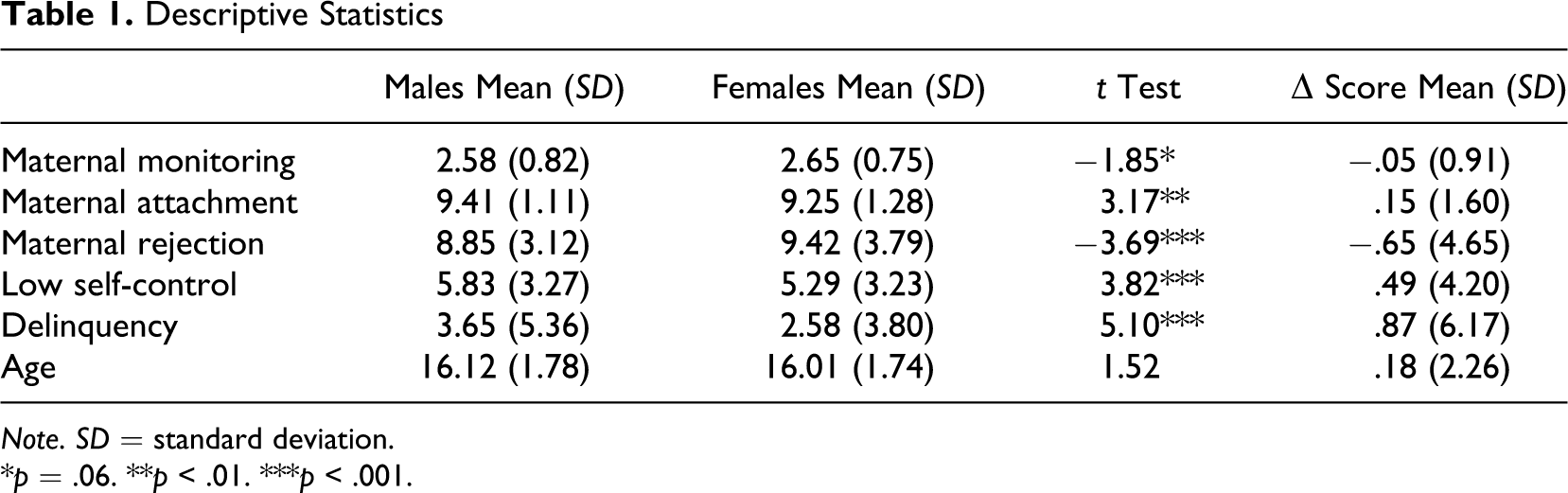
Note. SD = standard deviation.
*p = .06. **p < .01. ***p < .001.
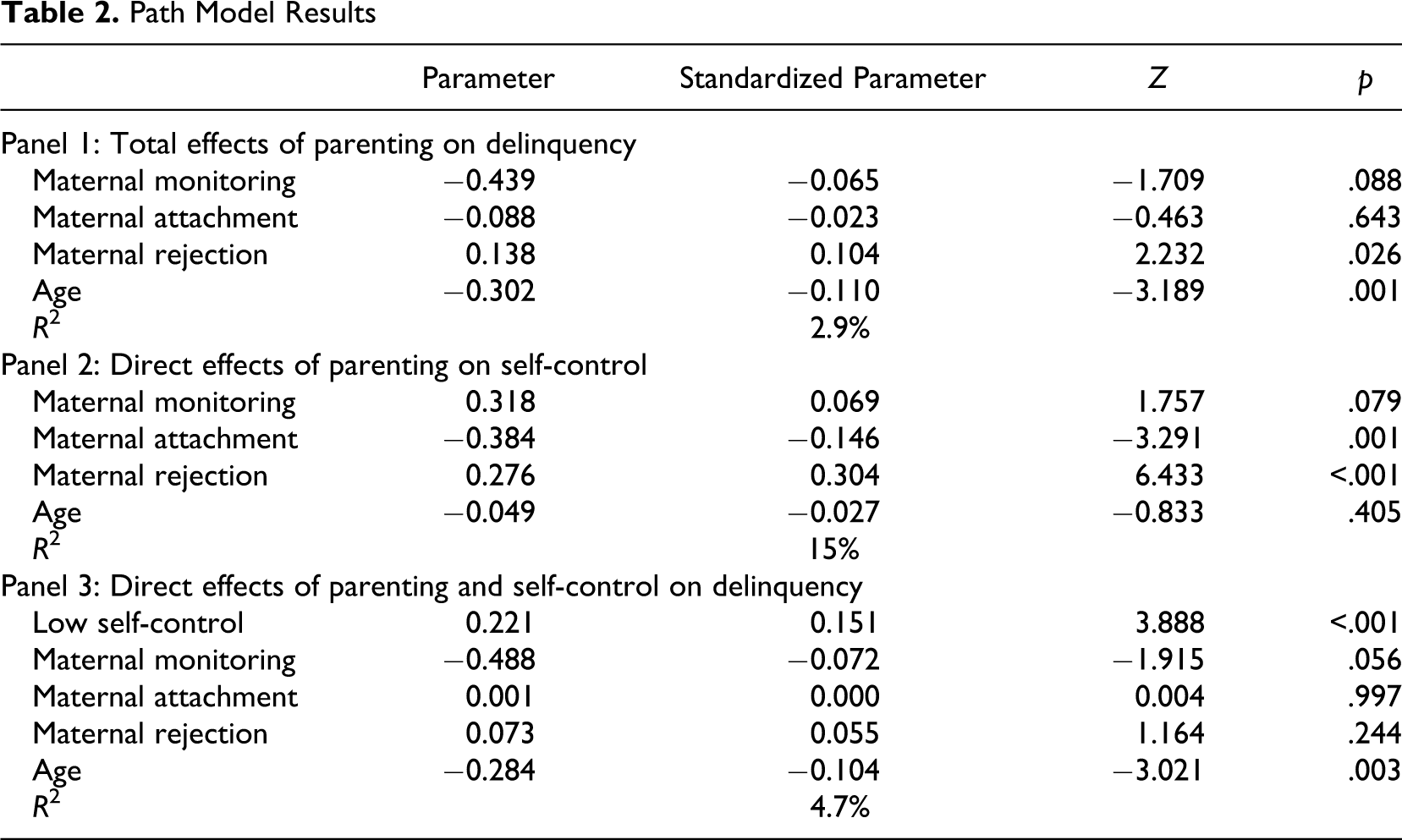
The results of the path model are presented in Table 2 and illustrated in Figure 1 .6 First, Panel 2 of Table 2 shows that of the three parenting measures, differential maternal attachment and differential maternal rejection are significant predictors of sex differences in levels of self-control. More specifically, brothers who report lower levels of maternal attachment and higher levels of maternal rejection (relative to their sisters) have lower levels of self-control than their sisters. The standardized parameters presented in Figure 1 suggest that a standard deviation increase in maternal attachment corresponds to a .15 standard deviation increase in self-control and that a standard deviation increase in maternal rejection is associated with a .30 standard deviation decrease in self-control. Differential maternal monitoring, however, was not significantly related to differences in self-control among brother–sister pairs.
Path Model Results
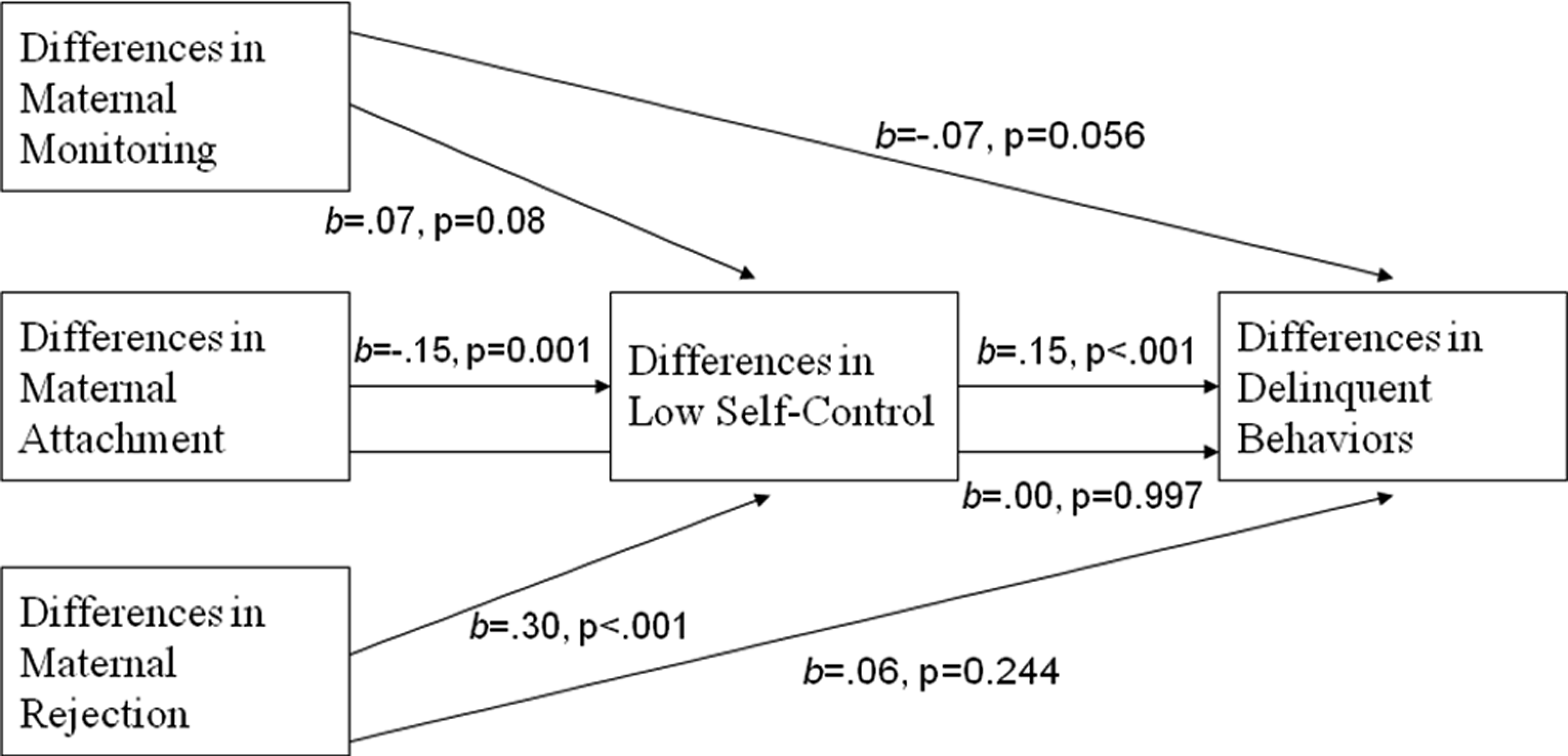
Path model.
Table 2 also reveals that brothers who have lower levels of self-control are more likely to engage in delinquency compared to their sisters (Panel 3). Specifically, a standard deviation increase in self-control corresponds to a .15 standard deviation decrease in delinquency. Overall, brothers who experience less maternal attachment and more maternal rejection are more likely to lack self-control and subsequently these males are more likely to engage in delinquency.
Further investigation of these relationships suggests that sex differences in self-control mediate the effect of maternal rejection on delinquency, but that maternal attachment has an indirect effect on delinquency via lower levels of self-control. Following Baron and Kenny’s (1986) procedures for establishing a mediated relationship, the results show that maternal rejection has a significant total effect on delinquency (b = .138, p = .026), prior to considering the effects of self-control (Panel 1). However, the effect of maternal rejection on delinquency becomes nonsignificant once self-control is entered into the model (Panel 3, b = .073, p = .244). Maternal rejection is associated with lower self-control (b = .276, p < .001) and the indirect effect of maternal rejection on delinquency (via self-control) is statistically significant (b = .061, p = .001); thus, satisfying the requirements for a mediated relationship (Preacher & Hayes, 2004). Maternal attachment, however, does not have a significant zero-order effect on delinquency (b = −.088, p = .643), but the indirect effect is significant (b = −.085, p = .010); thus, the requirements for a general indirect effect are met with maternal attachment.
Discussion
Gottfredson and Hirschi (1990) acknowledge that males exhibit lower levels of self-control compared to females. While empirical research clearly demonstrates that there are significant differences in levels of self-control across the sexes (Burton et al., 1998; Hayslett-McCall & Bernard, 2002; LaGrange & Silverman, 1999; Tittle et al., 2003; Zager, 1994), questions remain as to why. Gottfredson and Hirschi, and other scholars, argue that differential socialization practices experienced by males and females may account for these differences (Chapple et al., 2010; Costello & Mederer, 2003; Gottfredson & Hirschi, 1990; Hagan et al., 1987). Specifically, they state that females have higher levels of self-control than males because parents tend to recognize and discipline their daughters' misbehaviors more often than their sons' misconducts. Furthermore, power-control theory states that differential relationships occur within the home, which can lead to differential socialization practices and lower levels of risk perception among males (compared to females). As such, one of the goals of this study was to examine whether parents treat their sons and daughters differently within the home. Specifically, using a within-family research design, we assessed the degree to which opposite-sex siblings experienced different parental treatment within the home and whether differential parental treatment was then related to sex differences in self-control and delinquency.
The results revealed that parents do in fact treat their sons and daughters differently within the home. These results are aligned with several others that have shown that children experience differential treatment by their parents within the home (Brody & Stoneman, 1994; Brody, Stoneman, & Burke, 1987; Daniels, Dunn, Furstenberg, & Plomin, 1985; Daniels & Plomin, 1985; McHale & Pawletko, 1992; Stocker, 1993, 1995; Stocker, Dunn, & Plomin, 1989). First, consistent with Gottfredson and Hirschi’s general theory and power-control theory, mothers reported monitoring their daughters more so than their sons. This finding is consistent with previous studies that have also shown that parents tend to supervise the behaviors of girls more than the behaviors of boys (LaGrange & Silverman, 1999; Svensson, 2003). Second, although both theories hypothesize that females would have stronger attachments to their parents than males (Costello & Mederer, 2003; Tittle et al., 2003), the current study showed that females self-reported feeling less attached to their mothers and more rejected by their mothers compared to males. These unexpected findings may be due to the fact that adolescents self-reported their feelings toward their mother. Research has shown that females tend to communicate their emotions more than males and are more sensitive to how others treat them, especially at this stage of development (Brody, 2000; Chaplin, 2006; Polce-Lynch, Myers, Kilmartin, Forssmann-Falck, & Kliewer, 1998; Purdie & Downey, 2000; Schwalbe & Staples, 1991; Van Tilburg, Unterberg, & Vingerhoets, 2002). As a result, daughters may have been more expressive in their responses to questions pertaining to their mother and/or were more sensitive to the perceived treatment that they were receiving from their mothers compared to sons. It is also possible that these results would have been different had the mother and father reported their levels of affection and rejection toward each child.
In addition to differential parental treatment, our results revealed significant sex differences in levels of self-control and delinquency. Specifically, similar to previous studies, our results revealed that males reported significantly lower levels of self-control (Burton et al., 1998; Hayslett-McCall & Bernard, 2002; LaGrange & Silverman, 1999; Tittle et al., 2003; Zager, 1994) and a higher level of delinquent involvement compared to females (Achenbach et al., 1990; Farrington, 1986; Junger-Tas, Terlouw, & Klein, 1994; Kessler et al., 1994; Stattin, Magnusson, & Reichel, 1989). These results reinforce the notion that males tend to exhibit attitudes that reflect lower levels of self-control and are more likely to engage in behaviors that reflect low levels of self-control, such as delinquent acts.
While it is evident that there are sex differences in parenting, self-control, and delinquency, the next step was to assess whether differences in parenting was associated with sex differences in self-control and delinquency. First, although Gottfredson and Hirschi (1990) state that parental monitoring is an important causal factor impacting the development of self-control, our results did not support this hypothesis. Specifically, differential monitoring between brothers and sisters did not explain sex differences in levels of self-control, nor did it explain sex differences in delinquency. These results are aligned with others that have found weak to no support for the effects of parental monitoring/supervision on level of self-control and delinquency (Aseltine, 1995; Borawski, Ievers-Landis, Lovegreen, & Trapl, 2003; Cochran, Wood, Sellers, & Wilkerson, 1998; Stattin & Kerr, 2000; Wright & Beaver, 2005). It is possible that supervision at this stage of development is not as critical as the parent–child relationship itself or that supervision is more relevant in one type of household (patriarchal) than another household type (egalitarian; Blackwell & Piquero, 2005). It may also be that the more “emotional” components of the parent–child relationship have a stronger impact on youths' self-control, than merely monitoring one’s whereabouts (Hayslett-McCall & Bernard, 2002).
Indeed, differential maternal attachment and rejection were significantly related to sex differences in levels of self-control. That is, males with lower attachment and higher rejection (relative to their sisters) had significantly lower levels of self-control compared to their sisters. These results suggest that differential attachment and rejection are important nonshared environmental influences that can help explain differences in self-control across the sexes. Furthermore, males with lower levels of self-control (relative to their sisters) were also more likely to commit delinquent acts compared to their sisters. These results are in-line with those from the between-family designs, which show that gender differences in parenting behaviors are associated with gender differences in self-control and antisocial behavior (Blackwell & Reed, 2003; Svensson, 2003; Webb et al., 2002).
In addition, previous within-family studies have shown that differential parenting is significantly related to sibling differences in a host of variety of behaviors (Conger & Conger, 1994; Dunn et al., 1990; McGuire, Dunn, & Plomin, 1995). The results from the current study, however, found no direct effects of differences in maternal attachment and rejection on sex differences in delinquency, once self-control was entered into the model. However, consistent with Gottfredson and Hirschi’s theory, differential maternal attachment did have a significant indirect effect on delinquency via sex differences in self-control. In addition, sex differences in self-control mediated the effects of differential maternal rejection on differences in delinquency. That is, brothers who experienced less maternal attachment and more maternal rejection compared to their sisters were more likely to lack self-control and were subsequently more likely to engage in delinquency compared to females.
Limitations and Future Research
There are important limitations to the current study that need to be addressed in future research. First, the generalizability of the results is an issue due to the nonprobability sampling of the sibling subsample in the Add Heath study. Specifically, when participants indicated that they had a sibling in Grades 7–12, their sibling was automatically included in the Wave 1 in-home interview. As such, the sibling subsample included a large proportion of individuals who were not part of the original sampling frame. This suggests that the sibling subsample may not be representative of the larger population.
Second, since our analyses included siblings of different genetic relatedness residing within the same home, it is not possible to disentangle the effects of genetics and environment. In other words, parents and children are not only sharing the same environment, but they are also sharing similar DNA. Therefore, the relationship found between parenting and child’s behavior may result from common genetic factors operating in both the parent and the child (Scarr & McCartney, 1983). Therefore, future research should take genetic effects into consideration when examining the effects of parenting on child behavior (e.g., Wright & Beaver, 2005).
Furthermore, a review of the behavioral genetic literature shows that both genetic and nonshared environmental factors influence self-control (Beaver, DeLisi, et al., 2008; Beaver et al., 2009; Beaver, Wright, et al., 2008; Wright et al., 2008) and delinquency (Rhee & Waldman, 2002; Moffitt, 2005). A recent study examined whether sex differences in self-control could be explained by different genetic factors operating in males and females (Boisvert, Wright, Knopik, & Vaske, in press). Their results revealed that the genetic influences on self-control are not sex-specific and that the magnitude of the genetic effects on self-control is the same across the sexes. Other studies, however, have provided evidence to suggest that genetic sex differences are present in concepts related to self-control, such as ADHD and self-regulatory problems (Eaves et al., 2000, Nadder et al., 2001, Rhee et al., 1999; Steffenson et al., 1999; van den Oord et al., 1996). Future studies should continue to explore potential genetic and biological differences operating across the sexes.
Finally, the current study focused on three theoretically important nonshared environmental influences on self-control and delinquency, namely, maternal monitoring, attachment, and rejection. There are, however, many other nonshared environmental factors occurring within and outside the home to consider, such as peer networks, extracurricular activities, intelligence, and the sibling relationship itself. Further exploration of these factors using a within-family research design may help better explain sex differences in self-control and delinquency. In addition, understanding why differences in experiences occur, particularly with regard to parenting practices, is needed in order to better interpret our results. There may be several reasons as to why these gender differences in parenting exist, including expectations, socialization, genetic propensity, and most important to the current study, the youth’s level of self-control. In other words, it is quite possible that youth’s level of self-control is influencing parenting behaviors. For example, youths with low self-control may elicit more rejection and less attachment from their mothers compared to youths with higher levels of self-control. As such, future studies should more thoroughly examine why parents treat their children differently (see Caspi et al., 2004).
In sum, using a within-family study design is a unique way to examine the effects of nonshared environmental factors on sibling differences in behaviors. The findings from the current study suggest that parents treat their sons and daughters differently and that differences in attachment and rejection are related to differences in levels of self-control, which in turn is related to sex differences in delinquency. We believe that future studies should continue to use a within-family research design when exploring sex differences in the interrelationship between parenting, self-control, and delinquency.
Footnotes
Appendix A
Delinquency
In the past 12 months, how often did you: Get into a serious physical fighta
Hurt someone badly enough to need bandages or care from a doctor or nursea
Use or threaten to use a weapon to get something from someonea
Take part in a fight where a group of your friends were against another groupa
Pull a knife or a gun on someoneb
You shot or stabbed someoneb
Paint graffiti or signs on someone else’s property or in a public placea
Deliberately damage property that didn’t belong to youa
Take something from a store without paying for ita
Drive a car without its owner’s permissiona
Steal something worth more than $50a
Go into a house or building to steal somethinga
Sell marijuana or other drugsa
Steal something worth less than $50a
Response categories: a0 = never, 1 = one or two times, 2 = three or four times, 3 = five or more times. b0 = never, 1 = once, 2 = more than once (α = .84).
Maternal Monitoring Do you know what school your child’s best friend goes to? Have you met your child’s best friend in person? Have you met your child’s best friend’s parents?
Response categories: 0 = no, 1 = yes (α = 0.72).
Maternal Attachment How close do you feel to your {mother/adoptive mother/stepmother/ foster mother/etc.}? How much do you think she cares about you?
Response categories: 1 = not at all to 5 = extremely (α = 0.66).
Maternal Rejection Most of the time, your mother is warm and loving toward you. Your mother encourages you to be independent. When you do something wrong that is important, your mother talks about it with you and helps you understand why it is wrong. You are satisfied with the way your mother and you communicate with each other. Overall, you are satisfied with your relationship with your mother.
Response categories: 1 = strongly agree to 5 = strongly disagree (α = .83).
Low Self-Control How often do you have trouble getting along with your teachersa? How often do you have trouble paying attention in schoola? How often do you have trouble getting your homework donea? How often do you have trouble getting along with other studentsa? You feel like you are doing everything just about rightb
Response categories: a0 = never, 1 = just a few times, 2 = about once a week, 3 = almost everyday, 4 = everyday; b0 = strongly agree, 1 = agree, 2 = neither agree nor disagree, 3 = disagree, 4 = strongly disagree (α = .67).
Notes
Acknowledgment
This research uses data from Add Health, a program project directed by Kathleen Mullan Harris and designed by J. Richard Udry, Peter S. Bearman, and Kathleen Mullan Harris at the University of North Carolina at Chapel Hill, and funded by grant P01-HD31921 from the Eunice Kennedy Shriver National Institute of Child Health and Human Development, with cooperative funding from 23 other federal agencies and foundations. Special acknowledgment is due Ronald R. Rindfuss and Barbara Entwisle for assistance in the original design. Information on how to obtain the Add Health data files is available on the Add Health website ( ). No direct support was received from grant P01-HD31921 for this analysis.
The authors declared no potential conflicts of interest with respect to the research, authorship, and/or publication of this article.
The authors received no financial support for the research and/or authorship of this article.