




Abstract
This study examines the interrelationship between gang affiliation and commitment for a gang-related homicide on the postincarceration recidivism of a sample of 1,804 serious and violent delinquents released from a large southern juvenile correctional system. Controlling for a battery of preincarceration youth characteristics, delinquent background, and social history measures, this research revealed that gang murderers—gang-affiliated offenders committed for a gang-related homicide—were more likely to experience any rearrest and any felony rearrest postrelease than those not considered gang murderers. General homicide offenders without gang affiliations were also more likely to experience felony rearrest postrelease. Being considered a gang murderer or a general homicide offender, however, was not related to the frequency of postrelease rearrests. Analyses also revealed consistent support for the effect of gang affiliation on all measures of postrelease recidivism, regardless of incarceration offense. Implications for research and practice are explored.
Introduction
There is a widespread empirical recognition that gang affiliation matters in a number of contexts. 1 Gang affiliation negatively impacts family and community relations (see, generally, Kakar, 1998; Maxson, Hennigan, & Sloane, 2005), academic performance (Dishion, Veronneau, & Myers, 2010), and promotes various forms of conflict and violence, delinquency, and later-life criminality (Bjerregaard, 2002; Blackburn, Mullings, Marquart, & Trulson, 2007; Corcoran, Washington, & Meyers, 2005; Decker, 2000; Kakar, 2005; Rosenfeld, Bray, & Egley, 1999; Thornberry, Krohn, Lizotte, & Chard-Wierschem, 1993). A burgeoning body of empirical research has also revealed that gang affiliation increases one’s risk of being the victim of violent crime (DeLisi, Barnes, Beaver, & Gibson, 2009; Peterson, Taylor, & Esbensen, 2004; Taylor, Freng, Esbensen, & Peterson, 2008; Taylor, Peterson, Esbensen, & Freng, 2007).
Beyond these deleterious effects, research has also examined the impact of gang affiliation on juvenile behavior following entry into the juvenile justice system. With few and isolated exceptions, gang affiliation has been associated with an increased risk of recidivism, particularly for youthful offenders who have been released from state juvenile incarceration (Archwamety & Katsiyannis, 1998; Benda, Corwyn, & Toombs, 2001a, 2001b; Benda & Tollett, 1999; Caudill, 2010; Huebner, Varano, & Bynum, 2007; Lattimore, MacDonald, Piquero, Linster, & Visher, 2004; Tollett & Benda, 1999; Trulson, DeLisi, & Marquart, 2011; Trulson, Marquart, Mullings, & Caeti, 2005). Research has also revealed that gang affiliation is a significant determinant of institutional misconduct during periods of juvenile institutionalization (Blackburn & Trulson, 2010; MacDonald, 1999; Trulson, 2007; Trulson, DeLisi, Caudill, Belshaw, & Marquart, 2010). 2 As a collateral consequence, institutional misconduct behavior among state-committed delinquents has also been identified as a significant risk factor for postrelease recidivism (see, e.g., Lattimore et al., 2004; Trulson et al., 2005, 2011).
Previous research on youthful offender populations has clearly demonstrated the negative and far-reaching consequences of gang affiliation across a number of pre-, during, and post-juvenile justice system contexts. This is particularly true of the consequences of gang affiliation on recidivism. Despite this growing body of evidence, however, few research efforts have specifically investigated the interrelationships between gang affiliation, serious gang-related offending, and postincarceration recidivism.
The current study seeks to fill some of the void in previous research by exploring the postincarceration recidivism outcomes of a large sample of serious and violent delinquent offenders incarcerated in state juvenile correctional facilities by way of a unique blended sentencing scheme. Despite the serious and violent offenses of the sample generally, the primary focus of this study is specific to gang-affiliated delinquents committed to state juvenile incarceration for a gang-related homicide. This focus is justified not only because of the consistent negative effects of gang affiliation uncovered in previous research but also in that these offenders represent perhaps the most serious and violent delinquent offenders handled by the juvenile justice system. In sum, one goal of this research is to examine the potential aggravating effect of gang affiliation on recidivism among a group of already serious and violent offenders.
Uncovering the factors related to recidivism among serious and violent incarcerated delinquents, with a focus on gang-related homicide offenders, has a number of important implications. The implications of this research are particularly relevant for state juvenile justice authorities who are increasingly being charged under state-blended sentencing schemes to make decisions or recommendations on whether to release or retain the most serious and violent delinquent offenders—offenders whom prior to blended sentencing would have likely been removed from juvenile justice jurisdiction altogether. This research, for example, has the potential to provide important practical information related to the factors to consider surrounding release decisions of such serious and violent delinquents. In specific, this research can shed light on whether the interrelationship of gang affiliation and gang-related offending is an offending characteristic that merits increased attention during such evaluation and release processes.
The current research also has the potential to inform about areas of intervention during periods of institutionalization to improve the success chances of such risky delinquents following their release. The last seems particularly relevant since the release of serious and violent offenders from state juvenile facilities is inexorably tied to public safety concerns. More globally, this research can shed some initial perspective on whether retaining serious and violent juvenile homicide offenders in the juvenile justice system is preferable to sending such serious offenders to the adult system—many which are likely to face lengthy adult prison terms, a declining chance of meaningful rehabilitation activities, and continued criminal justice involvement throughout the life course.
Review of Relevant Literature
Although a growing body of empirical research has examined the influence of gang affiliation on the postincarceration recidivism of delinquent offenders (Archwamety & Katsiyannis, 1998; Benda et al., 2001a, 2001b; Benda & Tollett, 1999; Caudill, 2010; Huebner et al., 2007; Tollett & Benda, 1999; Trulson et al., 2005, 2011), few research efforts have specifically examined the recidivism outcomes juvenile homicide offenders postincarceration (see, e.g., Hagan, 1997; Heide, Spencer, Thompson, & Solomon, 2001; Myers, Chan, Vo, & Lazarou, 2010; Vries & Liem, 2011). For example, Heide, Spencer, Thompson, and Solomon (2001) examined the recidivism outcomes of 43 juvenile delinquents released from the Florida Adult Department of Corrections for homicide offenses. Of these offenders, 60% were returned to prison following their release from adult incarceration. In a more recent research effort, Myers, Chan, Vo, and Lazarou (2010) explored the recidivism outcomes of 11 juvenile offenders following conviction of sexual homicide. Following release from incarceration, most offenders recidivated—five of which committed additional homicides.
In the most recent study, Vries and Liem (2011) assessed the recidivism outcomes of 137 juvenile homicide offenders adjudicated and released from “sanctions” in the Netherlands. Overall, 59% of the juvenile homicide offenders were reconvicted of an offense postrelease. On average, the juvenile homicide offender recidivists committed 7.64 offenses following their original homicide offense. With that noted, very few homicide offenders registered repeat homicides (two additional homicides), although roughly 20% committed another violent offense following release from sanctions. Results of multivariate analyses found that substance abuse history, relationships with delinquent friends, and delinquent/criminal history indicators were significant determinants of recidivism.
Despite the importance of the aforementioned studies, unfortunately, information was not provided on gang affiliation status among sample members or whether the precipitating homicide offense was considered gang related. Also unfortunate is that small sample sizes were unavoidable in the research efforts, and with the exception of the Vries and Liem (2011) study, this limitation precluded higher-order analyses to ferret out the determinants of recidivism. Moreover, juvenile homicide offenders in most studies had been convicted in adult court and most were sentenced to adult prison and released only after relatively lengthy adult prison terms. These practical and methodological issues notwithstanding, the small amount of research on the postincarceration recidivism outcomes of juvenile homicide offenders paints a bleak picture.
The fact that no large-scale empirical research exists on the postincarceration outcomes of juvenile delinquents incarcerated for a homicide offense implicates that little is known about the recidivism of gang-affiliated delinquents whose homicidal behavior was also deemed gang motivated. Although some research exists on the difference between gang and nongang motivated homicides (see, e.g., Mares, 2010; Rosenfeld et al., 1999), these research efforts were largely incident level in nature and not focused on the specific characteristics of offenders in relation to future offending behavior, particularly following release from secure juvenile confinement. In short, information on the relationship of gang affiliation and recidivism among juvenile offenders in general is mounting, but there is a paucity of information on juvenile homicide offender recidivism following release from juvenile state incarceration (as opposed to release from adult prison facilities). Moreover, information on the recidivism of gang-affiliated juveniles—committed to state incarceration for gang-related offenses, homicides or not—is virtually nonexistent. 3
Despite the lack of information on the recidivism of juvenile homicide offenders in general, and gang-related juvenile homicide offenders in specific, one study does provide some insight on the nexus between gang affiliation, homicide offending, and continued problematic behavior. Although not focused on postrelease recidivism, Drury and DeLisi (2011) examined the institutional misconduct patterns of gang-affiliated adult homicide prison commitments. Net the effects of a number of demographic, criminal history, and social history controls, the interaction between street gang affiliation and incarceration for a homicide offense was significantly related to an increase in all forms of institutional misconduct examined in the study (e.g., weapon possession, major rule violations, etc.). In as much as institutional misconduct can be considered a form of recidivism on the “inside” (see, e.g., Trulson et al., 2010), this research revealed that being a homicide offender with gang ties impacts offending behavior—well beyond the individual effects of being an incarcerated gang affiliate or a homicide offender alone (Drury & DeLisi, 2011).
Drury and DeLisi’s sample was comprised of adults, examined behavior within the institutional context, and concerned only gang affiliations and not gang-motivated behavior. Yet, this research provides some insight on the potential influence that being both gang affiliated and a homicide offender has on postrelease recidivism. In short, this research suggests that homicide offenders who evince street gang ties prior to incarceration are significantly more likely to be involved in future offending behavior than just simply being a homicide offender or a gang-affiliated offender alone. Drury and DeLisi’s research clearly showed the aggravating combination of gang affiliation and homicide behavior on institutional misconduct among adult prison inmates. Whether this holds true for the most serious and violent juvenile delinquents following their release from state juvenile incarceration remains unknown.
Drury and DeLisi’s study notwithstanding, the lack of information on the potential interrelationships between gang affiliation, gang-related homicide offending, and postincarceration recidivism outcomes is surprising on a number of fronts. At the most basic level, the importance and attention given to gang affiliation and its disproportionate negative impact across a variety of behaviors and contexts beyond recidivism means the current research has the potential to fill a critical gap in knowledge. This gap in knowledge is particularly relevant considering that gang-affiliated delinquents who manifest homicidal behavior laced with gang motivations might arguably represent some of the most extreme, serious, and entrenched delinquent offenders handled by the juvenile justice system. The fact that these youthful offenders are routinely removed from juvenile court jurisdiction altogether (e.g., waived to adult court and incarcerated in adult prisons) is further evidence to the problematic nature of such offenders. Perhaps, more than any other juvenile justice population, such offenders may be on a fast track to become the next generation of adult prisoners due to their extreme offending, serious delinquent history, and the aggravating circumstance of being gang affiliated. At a broad level, it is exactly this population of offenders that is of most concern to practitioners, policy makers, and the general public. Indeed, the prevalence of gang prevention programs and more notably antigang interventions such as Boston’s Operation Ceasefire or the Los Angeles Latino Hills Project is prima facie evidence to the concern tied to these types of youthful offenders (see, e.g., Braga & Pierce, 2005). Yet, despite these types of programs and initiatives focused on youthful offenders with gang ties, unfortunately, we know relatively little about what happens when this subgroup of serious and violent gang-related delinquent offenders exits state juvenile incarceration.
Method
Sample
The sample for the present research was comprised of 1,804 serious and violent male delinquent offenders incarcerated and released from a large southern Juvenile Correctional System (JCS, a pseudonym) between 1987 and 2004. 4 All members of the study sample were adjudicated in juvenile court and sentenced to state juvenile incarceration under a unique blended sentencing statute. 5 Adopted in the late 1980s, the blended sentencing law in the state under study provides juvenile court judges a sentencing vehicle whereby certain serious and violent delinquents, ages 10-16, may be incarcerated in state juvenile facilities well beyond the jurisdictional age boundaries of “regular” juvenile courts in the state.
If prosecuted and adjudicated under the blended sentencing statute, as opposed to regular juvenile justice processing or adult court waiver processes, the law provides juvenile court judges the authority to sentence delinquents up to a 40-year blended incarceration term. Procedurally, the first or juvenile portion of the blended sentence is served in a state juvenile facility. As with many blended sentencing schemes among the states (see, Griffin, 2008), juvenile court judges then have the authority to suspend or invoke the adult portion of the blended sentence. The decision to invoke or suspend the adult blended sentence typically occurs by the offender’s 18th birthday. If the court invokes the adult portion of the blended sentence, the youthful offender is transferred to the state’s adult correctional system to continue the original determinate sentence. If the adult portion of the sentence is suspended, the offender is held in a state juvenile facility up to a maximum age of 20, and then released from juvenile confinement.
This study examines the recidivism outcomes of those serious and violent male delinquents released from juvenile confinement facilities short of serving the remainder of their sentence in the adult prison system (n = 1,804). During the time parameters of this study, the 1,804 members of the study sample represent 71% of all offenders sentenced under the state’s blended sentencing statute. The remaining offenders (n = 716) sentenced under this statute during 1987–2004 had the adult portion of their sentence invoked and were transferred to adult prison to serve the remainder of their blended sentence. 6
Data
Data for the present study were provided by JCS. JCS data detailed youth demographic characteristics, social histories, and delinquent records including relevant information on gang affiliations prior to state commitment. JCS data also included detailed sentencing information such as the specific commitment offense that led to state juvenile confinement and whether or not the commitment offense was gang motivated.
JCS also provided detailed recidivism data for the sample under study. Statewide arrest data, collected and centrally maintained by the state’s Center for Law Enforcement and Public Safety (CLEPS, a pseudonym), was provided to JCS for the specific study sample. Importantly, arrest data are tracked for individual delinquent offenders released from state juvenile confinement even as they make the transition to adulthood. 7
Measures
Dependent variables
Three dependent variables were utilized in the current study. The first dependent variable is a measure of the total frequency of felony and misdemeanor rearrests following release from juvenile confinement (M = 4.55, SD = 6.35, skewness = 2.38). 8 The second dependent variable is a dichotomous variable which measures whether or not members of the study sample were rearrested for any offense postrelease (M = .56, or 56% of the sample was rearrested at least one time for any offense postrelease). The final dependent variable measures rearrest for any felony postrelease (M = .50). 9
Based on the count nature of the first dependent variable, a negative binomial regression model was the appropriate technique for this variable since the count of rearrests was cross sectional, constrained to zero, and demonstrated positive skew as indicated by the skewness statistic. Moreover, rearrest data as measured in this study were overdispersed, meaning that the conditional variance exceeds the conditional mean. Utilizing a linear regression model with the above conditions has a high probability of producing unreliable estimates and misleading indications of statistical significance due to several assumption violations. As a result, negative binomial regression models provide superior estimates on the type of data used in this study (Lattimore, et al., 2004; Long & Freese, 2006). In addition, the negative binomial model was preferred to other count models because it does not retain the strict assumption that future arrests or other events are independent of prior arrests or events (Lattimore et al., 2004). 10
Although negative binomial modeling is best suited to the frequency nature of the first dependent variable, the structure of the recidivism data provided by JCS did not allow a specific count of postrelease rearrests categorized specifically as felonies or misdemeanors. In short, the number of felony and misdemeanor arrests were grouped into one count and unable to be disaggregated. This limited our ability to estimate two separate negative binomial models by felony and misdemeanor recidivism counts. To help remedy this limitation of the data, we utilized the two additional dichotomous dependent variables previously mentioned and estimated two logistic regression models. This analysis allowed us to examine the impact of the independent variables on rearrest for any offense, and more specifically, the factors related specifically to felony rearrest.
Independent variables
The main variables of interest in the present study concerns measures of gang affiliation and gang-related homicide offending. For context in the current study, the determination of whether an individual youthful offender was considered “gang affiliated” or whether or not the commitment offense was considered “gang related” was originally determined through a process of law enforcement reporting, preadjudication hearing investigations conducted by probation officers, and ultimately prosecutorial charging decisions. In this study, the determination of an offense being considered gang related relied on the characteristics surrounding the offense and related prosecutorial charging decisions whereas the measure of gang affiliation was dependent upon self-reports from youthful offenders and investigations conducted by probation officers during the preadjudication hearing investigation. Moreover, the measure of gang affiliation was confirmed upon adjudication and commitment to state juvenile incarceration by state JCS intake staff members who verified this information with previously completed official records and their own intake interviews (i.e., preadjudication social history report).
To capture the dynamics related to gang status and homicide behavior, the first independent variable, gang murder, is a dichotomous interaction term constructed from three separate measures that existed in JCS data: gang affiliation, gang-related commitment offense, and commitment for a homicide. Gang murder measures the proportion of the study sample classified as gang affiliated and committed to state juvenile incarceration for a gang-related homicide offense (n = 126, M = .07; the reference group to gang murder includes those offenders who were not gang affiliated, not committed for a homicide offense, and those not committed for a gang related homicide offense). 11 Three additional dichotomous covariates concerning gang status and homicide behavior were also utilized to account for the separate effects of gang affiliation; gang-related offending, and commitment for a homicide offense on postrelease recidivism. The variable gang affiliation measures the proportion of the sample considered gang affiliated by JCS, minus the overlap for those accounted for in gang murder (n = 506, M = .28). The variable gang related measures the proportion of the sample committed to JCS for a gang-related offense, minus those accounted for in gang murder (n = 165, M = .09; see, Drury & DeLisi, 2011, for comparable operationalizations). 12 Finally, the variable homicide separately measures the proportion of the sample committed for a homicide offense, minus those homicide offenders accounted for in gang murder (n = 338, M = .19).
Next, a number of youth, delinquent history, and social history variables were utilized based on their relevance to the body of research on postrelease recidivism among institutionalized delinquent offenders and juvenile homicide offenders (Archwamety & Katsiyannis, 1998; Benda et al., 2001; Benda & Tollett, 1999; Caudill, 2010; Huebner et al., 2007; Lattimore et al., 2004; Tollett & Benda, 1999; Trulson et al., 2005, 2011; Vries & Liem, 2011). A demographic variable indicating race was included with dummy codes for African American (M = .32, reference category), Hispanic (M = .40), White (M = .26), and Other (M = .02). Metric delinquent history variables utilized in the analyses included the age at JCS commitment (M = 15.35, SD = 1.15), total number of previous delinquent adjudications (M = 1.56, SD = .90), and previous out-of-home placements prior to the most recent commitment (M = .43, SD = 1.10).
A group of social history variables was also utilized to account for risky social backgrounds of the study sample prior to their state commitment, beyond delinquent history. These variables have also found support in the general literature as important controls relative to juvenile recidivism (see, generally, Cottle, Lee, & Heilbrun, 2001). All measures were dichotomous and included whether or not the youth was categorized by JCS as a substance abuser at state commitment (M = .43), was considered mentally ill or challenged (M = .12), or suffered moderate to severe physical (M = .13), sexual (M = .11), and/or emotional abuse (M = .24) prior to state commitment. We also included a social history variable indicating whether or not the offender lived in poverty prior to state commitment (M = .56), whether the youth experienced a “chaotic” home environment as determined by JCS (M = .69), whether the youthful offender lived with a family member/members with gang affiliations prior to state commitment (M = .09), and whether or not the youthful offender was violent towards his family prior to state commitment (M = .25). 13
Findings
Table 1 displays the results of the negative binomial model examining the rate of rearrests for the study sample postrelease. For parsimony in presentation and ease of interpretation, Table 1 displays the regression coefficient (b), the standard error (SE), the factor change in the expected rearrest rate [Exp(b)], and the percentage change in the expected rearrest rate for a unit increase of the independent variable [% Exp(b)]. The latter is interpreted as a one unit increase of the independent variable is associated with a +/− ___% change in the postrelease expected rearrest rate.
Negative Binomial Regression Model of Postrelease Arrests (n = 1,804)

Note. JCS = juvenile correctional system. *p < .01; ***p < .001.
Results of the analysis in Table 1 reveal that with the exception of the singular measure of gang affiliation (i.e., gang affiliates had an expected rearrest rate that was 26.50% greater than nongang affiliates, net the effects of other variables), the composite gang murder measure was not significantly related to the expected rearrest rate. In this same line, separate measures for being a homicide offender or being a gang-related commitment were not related to the expected rearrest rate. In sum, the interrelationship between being gang affiliated and committed to state juvenile incarceration for a gang-related homicide (i.e., gang murder) did not significantly impact the expected rearrest rate postrelease. Being gang affiliated, independent of committing a gang-related homicide, was one of the stronger predictors of rearrest in the model. Thus, gang affiliation matters to the frequency of postrelease rearrest much more so than being gang affiliated and being committed to state juvenile incarceration for a gang-related homicide.
Further examination of Table 1 reveals few other significant determinants of the postrelease rearrest rate. Relative to race, African American youth had a significantly higher expected rearrest rate compared to all other racial groups. Consistent with most research on the determinants of recidivism among state committed delinquents, a more developed record of previous adjudications/juvenile system involvement significantly increased the expected rearrest rate postrelease (18.20%). Concerning the social history records of the study sample, being categorized as a substance abuser was related to postrelease recidivism as measured in the model (29.60%). Indeed, substance abusers had an expected rearrest rate that was nearly 30% greater than nonsubstance abusers, net the effects of other variables in the models.
Because the count data did not allow a disaggregation of the type of rearrests incurred postrelease (i.e., misdemeanors vs. felonies), two separate logistic regression models were estimated. These models improved the overall analysis because the data contained an indicator of rearrest for any offense and rearrest for any felony postrelease. As a result, these measures allowed us to examine whether the independent variables were related to recidivism, beyond the overall frequency of rearrests.
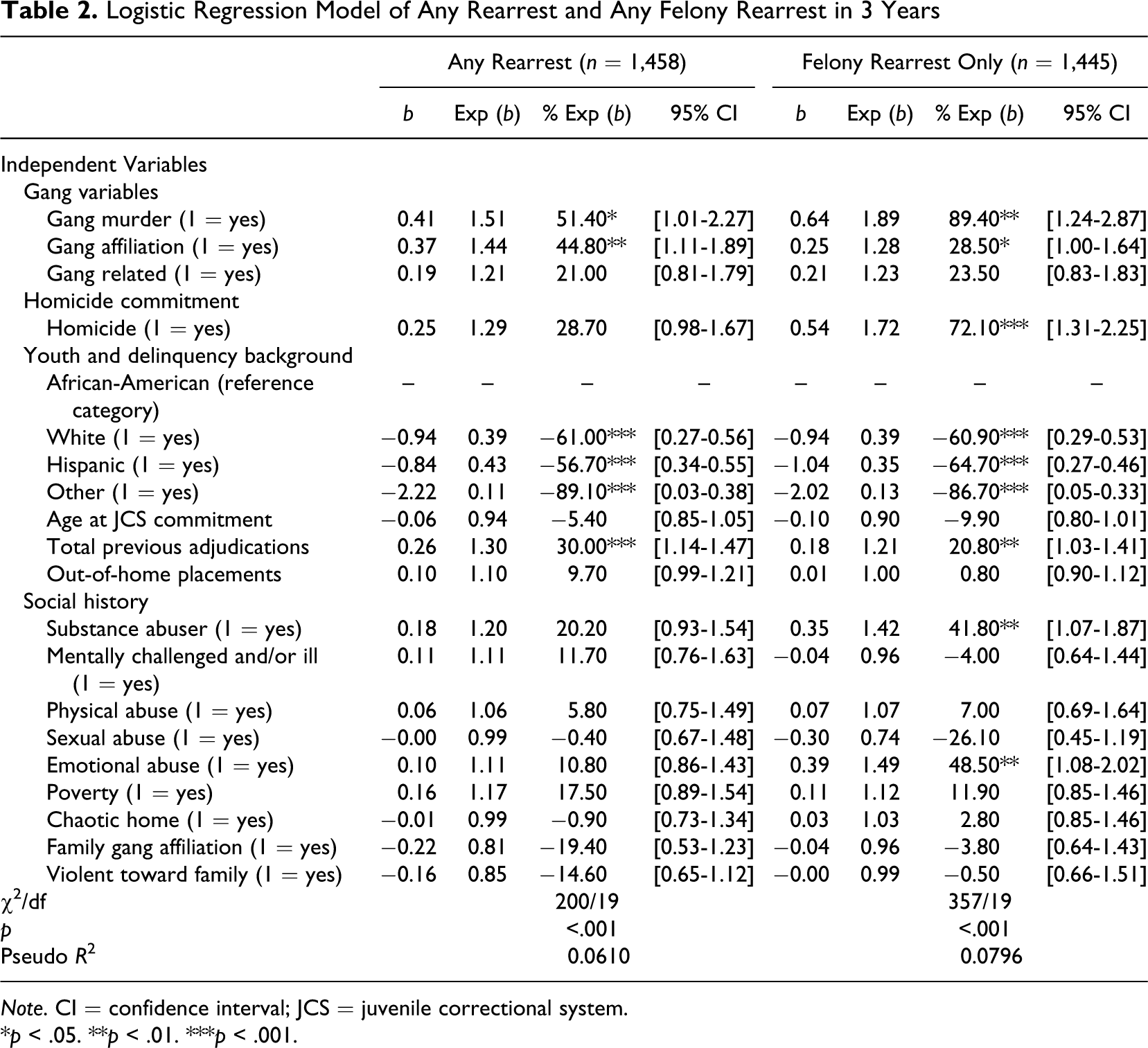
The first model of Table 2 presents a logistic regression model concerning any rearrest postrelease. Results of the data analysis indicate that gang murder was significantly related to any rearrest. Gang murderers were 51.40% more likely to experience a rearrest event postrelease than those not considered gang murderers (i.e., those not gang affiliated, not homicide offenders, and those not involved in a gang-related homicide offense). Moreover, as a separate measure, gang affiliation at state commitment was also a significant predictor of any rearrest postrelease. Gang affiliates had odds of any rearrest that were 44.80% greater than nongang affiliates; net the effects of other variables in the model. Consistent with the count model in Table 1, African Americans were significantly more likely to experience any rearrest postrelease than other racial groups. Also consistent is that those with a greater number of previous adjudications were also more likely to experience rearrest for any offense postrelease (30.00%). No additional social history variables served as significant explanations of postrelease rearrest for any offense in the first model of Table 2.
Logistic Regression Model of Any Rearrest and Any Felony Rearrest in 3 Years
Note. CI = confidence interval; JCS = juvenile correctional system.
*p < .05. **p < .01. ***p < .001.
Table 2 also includes a logistic regression model examining the determinants of felony rearrest postrelease. Gang murder was significant in this model, meaning that being gang affiliated and committed for a gang-related homicide significantly predicted rearrest for a felony postrelease (89.40%), holding other variables constant. Moreover, being a homicide offender alone, absent gang affiliations or gang-related commitment offense, increased the odds of rearrest for a felony postrelease (72.10%). To a lesser extent, the individual effect of being a gang affiliate was also related to felony recidivism (28.50%). In sum, being a gang-related homicide offender, a homicide offender in general, and being a gang affiliate in general, were all relevant as an explanation of felony recidivism net the effects of other variables in the model.
Relative to youth and delinquency background variables, African American offenders had increased odds of felony rearrest compared to other racial groups. Consistent throughout all statistical models, having a greater number of total previous adjudications significantly increased the odds of felony rearrest (20.80%). Being classified as a substance abuser at state commitment also increased the odds of rearrest (41.80%) as did experiencing moderate to severe emotional abuse prior to state juvenile commitment (48.50%). No other social history variables had a significant effect on felony recidivism postrelease.
Discussion and Conclusions
Although research on the impact of gang membership on juvenile recidivism is growing, little scholarship exists on the nexus between gang ties and serious and violent gang-related offending and its impact on postrelease recidivism. This article sought to fill some of that void in the literature by specifically examining the recidivism outcomes among gang-affiliated delinquents committed to state juvenile incarceration for a gang-related homicide offense, compared to other serious and violent offenders. Due to a unique blended sentencing law in the state under study, the serious and violent offenders of focus in this study were spared adult prison time and allowed one more chance to prove their amenability to change. This created a prime opportunity to examine their recidivism outcomes following release from juvenile institutionalization.
Specific to the gang affiliated and gang-motivated homicide offenders in this study, the result of the analyses can be summarized as follows: Being gang affiliated and committed for a gang-related homicide offense (i.e., gang murderer) was not related to the frequency of rearrests postrelease. However, gang murderers were more likely to be rearrested for any offense and for a felony offense postrelease than those not considered gang murderers, net the effects of other controls. Moreover, general homicide offenders without gang affiliations were more likely to be rearrested for a felony, compared to nonhomicide offenders. Thus, the nexus between gang affiliation and gang-related homicide offending did have an impact postrelease recidivism when measured at the dichotomous level, as did being a general homicide offender, at least in the felony rearrest model only. Overall, however, gang murderers did not consistently or clearly stand out as a “special” offending category relative to other offenders, in particular compared to general homicide offenders. 14
Beyond the findings specific to gang murder and homicide offenders generally, it is interesting to note that gang affiliation itself, regardless of offense of commitment, was a significant determinant of the expected rearrest rate and in the models examining any rearrest and felony rearrest. This consistent finding across all statistical models suggests that gang affiliation is a significant red flag for recidivism—regardless of offense of commitment. It is not entirely clear the specific context in which gang affiliation is related to increasing the potential of postrelease recidivism for the youthful offenders in this study. Perhaps youth deemed gang affiliated at state commitment reconnect to the gang lifestyle upon incarceration release and fall into the cycle of lawlessness characterized by such peer groupings (Battin, Hill, Abbott, Catalano, & Hawkins, 1998; Esbensen & Huizinga, 1993; Kakar, 2005; Katz, Webb, & Decker, 2005; Vaughn, Howard, & Harper-Chang, 2007; Winfree, Backstrom, & Mays, 1994). Another explanation may be that gang affiliates evince more problematic social and delinquent backgrounds and the cumulative consequences of such backgrounds impact their postrelease recidivism more negatively relative to nongang affiliates (for a discussion on cumulative risk factors of violence and gang membership, see Esbensen, Peterson, Taylor, & Freng, 2009).
On a broader level, however, the system consequences of being committed to state juvenile incarceration with known gang affiliations may lead to heightened tracking (and labeling) by law enforcement once released and heightened consequences upon reoffending of any sort (Caudill, 2010; Duran, 2009; Friedman, Lurigio, Greenleaf, & Albertson, 2004; Katz, Webb, & Schaefer, 2000). Although ultimately only speculation, the youth of focus in this study committed the most serious and violent offenses in the state and are likely well known by the time they reemerge in their communities—this situation is perhaps enhanced among gang-affiliated youth. The specific system-based context in which individual gang affiliation may influence recidivism following release from confinement is beyond the scope of this study but seems a reasonable explanation to partially explain their generally dismal release outcomes relative to offenders without gang ties.
The bottom line results of this study suggest that involvement with gangs matters relative to recidivism. This finding holds regardless of commitment offense. This finding is consistent with a number of research studies on the impact of gang affiliation on recidivism among general juvenile offenders postincarceration release (Benda et al., 2001a, 2001b; Caudill, 2010; Trulson, Caudill, Belshaw, & DeLisi, 2011; Trulson et al., 2005; Weibush, Wagner, McNulty, Wang, & Le, 2005). The results also suggest that gang affiliates with more developed previous adjudication and incarceration records (see, for support on previous adjudication history and recidivism, Cottle et al., 2001; Lattimore et al., 2004; Ryan, Davis, & Yang, 2001; Trulson et al., 2005; Trulson et al., 2011; Vries & Liem, 2011; Weibush et al., 2005), replete with histories of substance abuse and emotional abuse, may emerge as some of the most problematic offenders following release from state juvenile institutionalization. While being a homicide offender alone was a significant determinant of felony rearrest, measures of gang murder, gang affiliation, previous adjudications, and substance abuse history were also related to postrelease recidivism across models.
Before discussing the implications of the findings, it is important to address some limitations of this study that if improved upon would have provided further specificity into the postrelease recidivism outcomes of the study sample. First, data for this study were limited in the specificity of both independent and dependent variables. Most of the independent variables were dichotomies and prevented a more detailed look into levels of the variables. For example, measures of gang affiliation and gang-related offending originated from official records completed by law enforcement officers and probation officers, prosecutorial charging decisions based partially on those records, and from youth self-reports made to probation officers and state juvenile intake staff at facility commitment. While we have no basis to doubt the veracity of these measures, both gang affiliation and gang-related commitment offense could certainly be improved by more detailed grading based on such factors as length of gang affiliation, measures of intensity or status in the gang, among others. What is and is not a gang member (or a gang related offense) is not a new debate in the literature and greater specificity among these measures would have improved the current study. Related, we were limited in the diversity of covariates in this study and expanded data may have provided additional important controls to account for in addition to the gang-based variables relative to explaining postrelease recidivism. While the variables we included have been utilized and found relevant in previous recidivism research among juveniles, they were also only cross-sectional measures. More up-to-date measures on life circumstances specifically at the point of system release (e.g., housing, job status, social support, gang status, etc.) or information on local life circumstances at various intervals postrelease would certainly have provided more insight and context to the outcomes of individual members of the study sample.
This study was also limited in that it was not possible for us to account for potential periods of postrelease incarceration experienced by offenders upon JCS release. Periods of postrelease incarceration, if they occurred, could reduce exposure time to accumulate rearrests. Although we do not know the effect this limitation had on the results of this study, accounting for exposure gaps because of incarceration time would have provided greater specificity for this study (see, e.g., Piquero et al., 2001 for a perspective on postrelease exposure time and its modest effect on long-term offending trajectories). Still further, our dependent count variable was limited in that felonies and misdemeanors counts could not be disaggregated out due to the nature of the data provided by JCS. Although unavoidable, it is possible that the grouping of all offenses into the rearrest count may have masked some of the effect of the interrelationship between gang affiliation and being committed for a gang-related homicide offense on recidivism. Disaggregating the felony count from the count of other offenses may have improved the count model and provided more specificity as to the relationship of gang murder to recidivism as measured by frequency.
With the above noted, it was not altogether surprising that gang murder or homicide alone failed to be related to the expected rate of rearrests postrelease. Due to the serious and violent record of gang murderers and homicide offenders, and the potential for labeling and tracking upon system release, it is possible that further felony behavior led to increasingly harsh consequences that included detention/imprisonment and dampened the opportunity to accumulate further rearrests. This potential is particularly notable for repeat violent behavior. Being able to disaggregate offense counts into felonies specifically may have provided more insight to this potential. With that said, it was in some sense surprising that the coefficient for the rearrest rate for gang murderers was positive (although not significant), indicating no difference between gang murderers and the reference category of all other offenders concerning the rearrest rate, net the effects of controls. Despite the fact that future felony behavior may lead to increasingly harsh sanctions for these offenders, the positive coefficient direction for gang murder might alternatively be an indication of a disconnect between previous behavior and more current justice system responses. One explanation, for example, is that since the offenders of focus in this study were committed as juveniles but released from state incarceration as adults (i.e., over 17 in the state under study), a disconnect might arise between offending history as a juvenile and postincarceration arrest and processing as an adult. 15
Although our research is limited in the above ways and undoubtedly others, we believe the findings herein help fill an important gap in the literature. This study included the recidivism outcomes of a very large group of homicide offending juveniles, in addition to other extremely serious and violent juvenile offenders. Importantly, this group has been neglected in previous research primarily because most juvenile offenders of this nature are ushered to adult court systems and locked in adult correctional systems to face lengthy adult prison terms. For these offenders, release occurs well into adulthood. For the offenders of focus in this study, however, release occurred at age 20 or before, and after a relatively short term of juvenile incarceration. Broadly, the blended sentencing law in the state under study allowed us a unique opportunity to examine what happens when some of the most serious and violent offenders are released from state juvenile confinement. It also allowed an opportunity to examine the factors that might explain their recidivism outcomes—something that is sorely lacking in the research for the most extreme juvenile offenders (Mulvey, 2011).
On a practical level, the results of this study can provide information to state juvenile justice authorities and judges charged with tough decisions on whether to release serious and violent delinquents early, or rather, push their progression into adult justice including adult imprisonment. This decision making is especially critical in states which are increasingly relying on blended sentencing schemes to provide serious and violent delinquents one more chance to change before adult prison. Indeed, most blended sentencing schemes have a built in discretionary postdisposition stage where authorities must make a crucial determination of juvenile system release or adult system continuation, typically after a period of proving in juvenile correctional facilities (see, e.g., Trulson et al., 2011). Although the current research is not wholly generalizable to the states, previous research suggests that these discretionary decisions will result in most juvenile offenders getting out—sooner than later—despite incredibly serious and violent offenses. Indeed, the offenders of focus in this study were committed to state incarceration at an average age of 15, served roughly 3.5 years of state juvenile incarceration, and were released at an average age of just less than 19.
Overall, the results of this study suggest that state authorities should pay attention to factors such as the interrelationship of gang affiliation and gang-related violent behavior, and homicide behavior generally, with concerns of recidivism specifically and release decisions more broadly. The results also suggest a focus on gang affiliation is warranted, independent of commitment offense. Moreover, a more substantial previous adjudication record and substance abuse history also emerged in this study as factors distinguishing recidivists from nonrecidivists. Attention to these and other factors associated with postrelease recidivism not only provide a basis for critical decisions on whether to suspend or invoke the adult portion of a blended sentence, but perhaps more importantly, provide critical insight into promising areas of intervention well before decisions need to be made relative to suspending or invoking the adult portion of a juvenile offender’s blended sentence. Indeed, such knowledge may also provide authorities more insight on the critical aspects to address during periods of confinement to improve the success chances of such risky delinquents upon system release. Based on the results of this study, gang affiliates in particular, independent of commitment offense, should figure squarely into discussions of not only on how to treat such offenders while incarcerated but also whether to release (or in what context they should be released) such serious and violent offenders directly from state juvenile confinement.
Footnotes
The author(s) declared no potential conflicts of interest with respect to the research, authorship, and/or publication of this article.
The author(s) received no financial support for the research, authorship, and/or publication of this article.