



Abstract
Purpose:
The current study examines whether a police officer’s decision to initiate a discretionary search is impacted by the presence of passengers. It also explores whether groups of minority citizens experience more frequent discretionary searches compared with other groups. These hypotheses are built on the theoretical foundation of officer suspicion, the group hazard hypothesis, the principles of symbolic interactionism, and Black’s theory of law.
Methods:
Traffic stop data from a large, urban city are used to test these hypotheses. Multilevel, Bernoulli models are estimated to reflect the nested nature of the data. Data are analyzed in multiple ways to reflect the complex elements of police–citizen encounters.
Results:
Results indicate that discretionary searches of a citizen are more likely when a passenger is present. While some group effects are also documented, minority groups are not more likely to be searched such that the presence of passengers appears to supersede the impact of race/ethnicity.
Conclusions:
The presence of passengers during a police–citizen encounter has a substantial impact on the likelihood of a discretionary search. Race/ethnicity effects are limited to single-occupant drivers.
Introduction
Scholars’ interest in understanding criminal justice actors’ decision-making processes can be traced to the American Bar Association’s inquiry into the administration of justice during the mid-1950s (Walker, 1993). Contemporary policing research continues this theme by emphasizing the use of discretion and identifying a constellation of citizen, situational, organizational, and community factors related to officer behavior (National Research Council, 2004). Several pioneering policing scholars specifically mention the potential importance of third-party observations on police decision making (see, e.g., Reiss, 1971; Wilson, 1968); however, early quantitative studies largely demonstrate the influence of other variables and did not empirically explore the influence a third party may have on police–citizen interactions (see Riksheim & Chermak, 1993; Sherman, 1980 for comprehensive reviews of this literature). More recent scholarship on use of force and arrest decisions considers the influence of a third party; however, examinations of police searches largely ignore this factor (e.g., Ridgeway, 2006; Rosenfeld, Decker, & Rojek, 2012; Schafer, Carter, Katz-Bannister, & Wells, 2006). Previous research on searches that include a measure of third parties often fail to consider officer discretion, a key element to understanding police behavior (Engel & Calnon, 2004; Lundman, 2004; but see Tillyer, Klahm, & Engel, 2012, for an exception). Thus, the potential influence of a third party on an officer’s discretionary decision to search is an understudied element of police–citizen encounters.
We explore this topic by specifically examining whether a discretionary search is more likely in a traffic stop encounter involving a multiple-occupant vehicle compared to a single-occupant vehicle. We consider passengers a type of third party because an officer generally, although not always, initiates a traffic stop as a result of a driver’s action (i.e., moving or equipment violation). This results in the driver being the primary point of contact and the core of the police–citizen encounter. Passengers, however, are also part of the encounter due to their physical proximity and the potential that an officer may choose to interact with them (i.e., ask questions, etc.). The presence of a passenger is similar, although not substantively identical, to a bystander or another officer’s presence during a street encounter as they observe the interaction between the parties involved. Nevertheless, it is conceivable and theoretically reasonable to suggest the presence of a passenger may exert an influence on an officer’s decision to initiate a discretionary search.
Traffic stops are examined because they represent the most common type of police–citizen encounter (Langton & Durose, 2013), and they offer an opportunity to examine how passengers may influence officer behavior in officer-initiated encounters. The group hazard hypothesis and the principles of symbolic interactionism offer theoretical explanations for the hypothesized processes. We also draw on previous work (Tillyer & Engel, 2013; Tillyer et al., 2012) and Black’s theory of law (1976) to examine how the presence of passengers may influence the relationship between citizen race/ethnicity and discretionary searches. In particular, we investigate whether disparate treatment of minority citizens is heightened when multiple minority citizens are present. Despite recent study of police–minority relations (Alpert, Dunham, & Smith, 2007; Brunson, 2007; Novak, 2004; Tillyer, 2014), exploring an interaction between citizen race/ethnicity and the presence of passengers is an emerging area of research that has the potential to shape our understanding of police–minority encounters. We initially present a theoretically grounded argument for why passengers may influence the likelihood of a discretionary search prior to discussing how this process may differentially occur for groups of minority citizens.
Passengers and Searches
Passengers conceivably exert a nontrivial influence on officer behavior during a traffic stop. Several reasons underlie this claim, not the least of which is officer safety. Officers need to consider a variety of potential scenarios to ensure no harm results from the encounter. While a traffic stop encounter largely involves interactions between the officer and driver, the presence of a passenger is a factor that cannot be disregarded and likely draws some of the officer’s attention due to the close physical proximity of the passenger to the driver and officer. This situation is complicated by the high likelihood that the passenger possesses a personal relationship with the driver. Individuals are more likely to take action in situations involving family, friends, or those with a personal relationship. If an officer pursues a course of action against the driver that is viewed negatively by the passengers, they may respond in a manner that threatens officer safety due, in part, to the preexisting relationship. In a situation involving only a driver, such a concern is not present. While this scenario may be rare, officers concerned with safety must consider all potential situations and act accordingly.
The group hazard hypothesis offers another explanation for why the presence of passengers may influence officer behavior. This perspective reflects the idea that criminal behavior often involves multiple offenders. A long line of research using official data and dating back to the 1920s suggests that delinquency/criminal offending is a group-related phenomenon (e.g., Erickson & Jensen, 1977; Zimring, 1981). Using self-report data, Erickson (1971) revealed that 65% of juvenile violations involved two or more participants. More recently, Schaefer, Rodriguez, and Decker (2014) reported that over one third of all juvenile delinquency cases in one large, urban county involved another juvenile. These empirical findings suggest that criminal activity/delinquency is at least partially characterized by the presence of others.
Assuming that offending in groups is relatively common, it is plausible that officers scrutinize those traveling with others more closely than individual motorists. When engaged in a traffic stop involving multiple occupants, an officer might become more suspicious about their activity, where they have been, and/or where they are going (see M. Smith, Makarios, & Alpert, 2006, for a thorough discussion of how officer suspicion is related to officer action). As Erickson (1973, p. 128) suggests, “violating the law in groups increases the likelihood of official detection and reaction.” In short, officer attention and suspicion may be heightened in situations involving passengers due to the concern that criminal activity may have just occurred or may be about to occur. Thus, an officer’s decision to pursue a search may be influenced by the preconceived idea, implicit or otherwise, that wrongdoing is more prevalent among individuals in a group setting.
Symbolic interactionism offers another explanation for why the presence of passengers may increase the risk of a discretionary search. According to Kenny and DePaulo (1993, pp. 145–146), “people’s self-perceptions are a product of their perceptions of how others view them” and “self-presentational perspectives assume that people often try to convey particular impressions of themselves to others.” Within a police–citizen encounter, officers might feel a pronounced need to act in a more proactive manner (i.e., pursue a search) when others are present to reinforce their authority. Relatedly, Waddington (1999, p. 238) claims that the police’s symbolic representation of authority needs to be consistently “legitimate[d] and re-legitimate[d].” Ultimately, they may be more likely to invoke the law when other citizens are present during an encounter because they want to demonstrate that their authority does not waver (Klinger, 1996; D. A. Smith & Visher, 1981; Tedeschi & Felson, 1994).
Collectively, officer safety, the group hazard hypothesis, and the principles of symbolic interactionism suggest it is conceivable that the presence of a passenger may heighten the likelihood of an officer pursuing a discretionary search. Unfortunately, empirical evidence regarding the accuracy of this claim is limited. Engel and Calnon (2004) reported no relationship between number of people in the vehicle and the likelihood of a search, while Lundman (2004) reported that vehicles involving three or more occupants were more likely to be searched (no effects were reported for a single passenger). Both studies used citizen self-report data, which may not reflect all police–citizen encounters, as survey respondents could have forgotten about incidents or wrongly attributed them to a different time period. Additionally, they analyzed all searches making it impossible to draw clear conclusions about the relationship between passengers and discretionary officer behavior. 1
More recently, Tillyer, Klahm, and Engel (2012) examined the decision to search using data from a mid-western city and reported that young, Black males were more likely to be searched for discretionary reasons and this effect was strengthened when the encounter involved a traffic officer. Number of passengers also exerted a positive effect on the likelihood of a discretionary search. We believe this study’s findings offer a foundation for exploring the relationship between passengers and searches but do not present a definitive conclusion on this issue for a number of reasons. First, the authors focused their theoretical and empirical attention on other effects and presented virtually no discussion of the passenger effect. Second, we are unaware of any other study that examines this relationship, so while we are not surprised by their findings, we believe replication of results is key to building knowledge. Third, we are using data from a different locale, which offer the opportunity to assess the external validity of this relationship. Finally, we extend this area of study by exploring the potential interaction between citizen race/ethnicity and the presence of passengers (discussed in the following section).
Thus, we contend that the likelihood of initiating a discretionary search is influenced by the presence of passengers during traffic stops. This process may be tied to officer safety, an increase in officer suspicion, or based on an officer’s desire to demonstrate their authority. Coupling these explanations with the limited existing research, we hypothesize that:
Race and Policing
The history of policing in the United States has a dark underbelly, which has led to strained relations between police and minorities, in particular, the Black community (K. Williams, 2007). Given this contentious history, there is no shortage of research attempting to identify if the police treat minorities differently with considerable evidence from a number of jurisdictions indicating that Blacks do not enjoy the same treatment as Whites. Specifically, Blacks experience an increased likelihood of being pulled over (Warren, Tomaskovic-Devey, Smith, Zingraff, & Mason, 2006), receiving a citation (Engel & Calnon, 2004), being searched (Rojek, Rosenfeld, & Decker, 2004) or arrested (Engel, Sobol, & Worden, 2000), and having force used against them (Terrill & Mastrofski, 2002). Thus, the preponderance of policing literature suggests that Blacks are treated differently from their White counterparts.
Several theoretical explanations exist for this differential treatment (see Tomaskovic-Devey, Mason, & Zingraff, 2004, for a broader discussion) but two are specifically relevant for the current study and have found support in recent empirical work. M. Smith, Makarios, and Alpert (2006) suggest that officer suspicion strongly influences behavior, in part due to the dangerous environments in which officers frequently operate (also see Crank, 2004). Officer safety (Spano, 2003) also contributes to heightened officer suspicion and such situations are more likely to result in protective action by the officer(s). Unfortunately, suspicion often develops unevenly (Van Maanen, 1978) and may be more likely under certain conditions or in situations involving specific types of citizens (Bittner, 1991; Skolnick, 1966; M. Smith et al., 2006). Officer suspicion is also linked to another body of work suggesting that officer behavior is influenced by preexisting stereotypes regarding certain types of citizens (M. R. Smith & Alpert, 2007; also see Allport, 1954; Lippman, 1922; Luirgio & Carroll, 1985, e.g., from cognitive psychology). Building on Skolnick’s seminal work (1966), this perspective suggests minorities may be viewed or perceived as “symbolic assailants” or individuals more likely to be involved in criminal activity. Thus, it is conceivable that a discretionary search may be more likely when officer suspicion is queued, and heightened when interacting with minority citizens.
Empirical evidence supports this perspective. For example, Alpert, MacDonald, and Dunham (2005) found that citizen race served as a precursor to officers developing nonbehavioral 2 suspicion. Specifically, they reported that officers were 4 times more likely to be suspicious of a Black suspect for nonbehavioral reasons than a White one. Recent work by Brunson and colleagues also suggests that those viewed as symbolic assailants generated greater suspicion (Brunson, 2007; Brunson & Weitzer, 2009).
Donald Black’s (1976) work on the behavior of law also highlights why minorities might receive disparate treatment by police. Black suggests that law operates in a predictable manner, based on characteristics of the individuals involved, particularly as they relate to one’s position within the social hierarchy. Black contends that law is not distributed equally across members of society. Rather, he claims less powerful people and groups have less law available to them but also have more law used against them. Because Blacks are considered to be a less powerful social group, Black’s theory suggests they would receive disproportionate scrutiny by police, in general, and during traffic stops, specifically (Engel, Calnon, & Bernard, 2002). Interestingly, Rosenfeld, Rojek, and Decker’s (2012) test of Black’s theory revealed the relationship might be more complex. Their analysis specifically demonstrated the relationship between one’s status and police search activity was influenced by citizen race, officer race, and demographic characteristics of the encounter location.
Nonpolicing research offers further evidence of racial differences in our society. Holzer, Raphael, and Stoll (2006) reported employers who did not conduct background checks were less likely to hire African Americans than employers who investigated an applicant’s criminal history as a part of their hiring process. This suggests the perceived linkage between race and criminality is quite pervasive and influences decisions within this context. Moreover, it suggests the perception that race is linked to criminality is more powerful than the actual linkage. Rachlinski, Johnson, Wistrich, and Guthrie (2009) applied the implicit association test to a sample of judges and results indicate that even this group exhibits an implicit bias against minority citizens that may impact their judgment. Others suggest that the social construction of race in our society brings different expectations across racial groups (Rawls, 2000), while some more plainly suggest “‘criminal predator’ is used as a euphemism for ‘young Black male’” (Welch, 2007, p. 276).
Given these theoretical explanations and related empirical evidence, we are interested in whether groups of African Americans experience similar treatment from police within the traffic stop context. To our knowledge, no previously published article has examined this issue within the context of policing. We argue that the presence of multiple Black citizens in a vehicle cues greater suspicion in an officer compared to multiple White citizens in a vehicle. In turn, officers are more likely to pursue a discretionary search under the former condition compared to the latter situation due to their underlying perceptions regarding Black citizens and their involvement in crime. Thus, we hypothesize that:
Method
Data to test these hypotheses are drawn from an agency serving a large, urban city of roughly one and a half million residents that has grown approximately 6% during the current decade. It is characterized by a majority Hispanic population, estimated at 63% in 2013, and roughly 7% of the population categorized as African American. The agency employs slightly more than 2,000 sworn officers and provides police services for approximately 40 square miles. Based on the most recent data, the agency responded to slightly more than 1.1 million calls for service, more than 80,000 property crimes, and approximately 7,000 violent crimes. 3
Data to test these hypotheses represent a single year of traffic stops. All encounters were recorded to comply with state law and agency policy that requires collection of information on all traffic-based interactions between the police and citizens. This practice has been in effect since 2001 and a yearly assessment of reporting procedures indicates that officers are complying with these protocols. All encounters captured in the data were officer initiated, that is, all situations in which a citizen requested police assistance, such as a traffic accident or a call for service, were excluded. All pedestrian encounters were removed from consideration to ensure that information was available for all citizens involved in the encounter, as pedestrian encounters likely involve (or may be influenced by) citizens who are unaccounted for within the data. Such situations are best studied separately with data specifically designed to capture information on all relevant citizens/bystanders.
These data are inherently hierarchical and collected at the individual (i.e., citizen) level. There are conceptually three units of analysis in these data depending on the number of occupants in a vehicle—individuals (Level 1), encounters (Level 2), and officers (Level 3). For example, a traffic stop involving a single-occupant vehicle would represent a two-level structure—citizens/encounter 4 nested within officers. A vehicle with multiple occupants would represent a three-level structure—citizens nested within encounters (i.e., stops) nested within officers. Regardless of whether there are passengers present or not, these data are hierarchical because a single officer initiates more than one citizen contact within a year. Thus, the impact of any single officer’s characteristics would influence each of these cases in a similar fashion and this process cannot be accounted for in traditional regression models. Multilevel models are appropriate for this type of nested data because they report appropriate standard errors and use the correct degrees of freedom for each level of analysis (see Johnson, 2010 or Raudenbush & Bryk, 2002, for a more complete discussion of multilevel modeling advantages).
Multilevel models require a minimum number of cases at the lower unit of analysis (i.e., both at the citizen and encounter levels). For example, a minimum number of citizens would need to be present within each encounter, and similarly, a minimum number of encounters would need to be nested within each officer. Application of this criterion eliminated the possibility of estimating a trilevel model, as the large majority of traffic stops involving multiple citizens ranged between two and four occupants. 5 Thus, a two-level model was chosen as the appropriate statistical approach to address the research hypotheses.
Prior to estimating any models, cases with missing information (2.8%) were removed, as Bernoulli, multilevel models require complete information on all variables of interest. The small amount of missing data did not justify the use of imputation. Cases involving officers who initiated less than 20 citizen contacts were also removed. Previous research has applied a rule of 30 to such scenarios (Tillyer et al., 2012), while other commentary suggests a minimum of approximately 12 cases (Johnson, 2010, p. 628; also see Raudenbush & Bryk, 2002). For these analyses, a threshold of 20 was applied to balance the need for stability of estimates with concerns of data loss. 6 Application of this criterion resulted in the loss of 10.2% of the data, that is, roughly 10% of all citizen contacts were initiated by officers who conducted less than 20 contacts within the study period. 7 Thus, data available for analyses included 187,412 police–citizen interactions initiated by 882 officers (Please see Table 1 for descriptive statistics).
Full Model Descriptives.
Note. L1 = Level 1; L2 = Level 2.
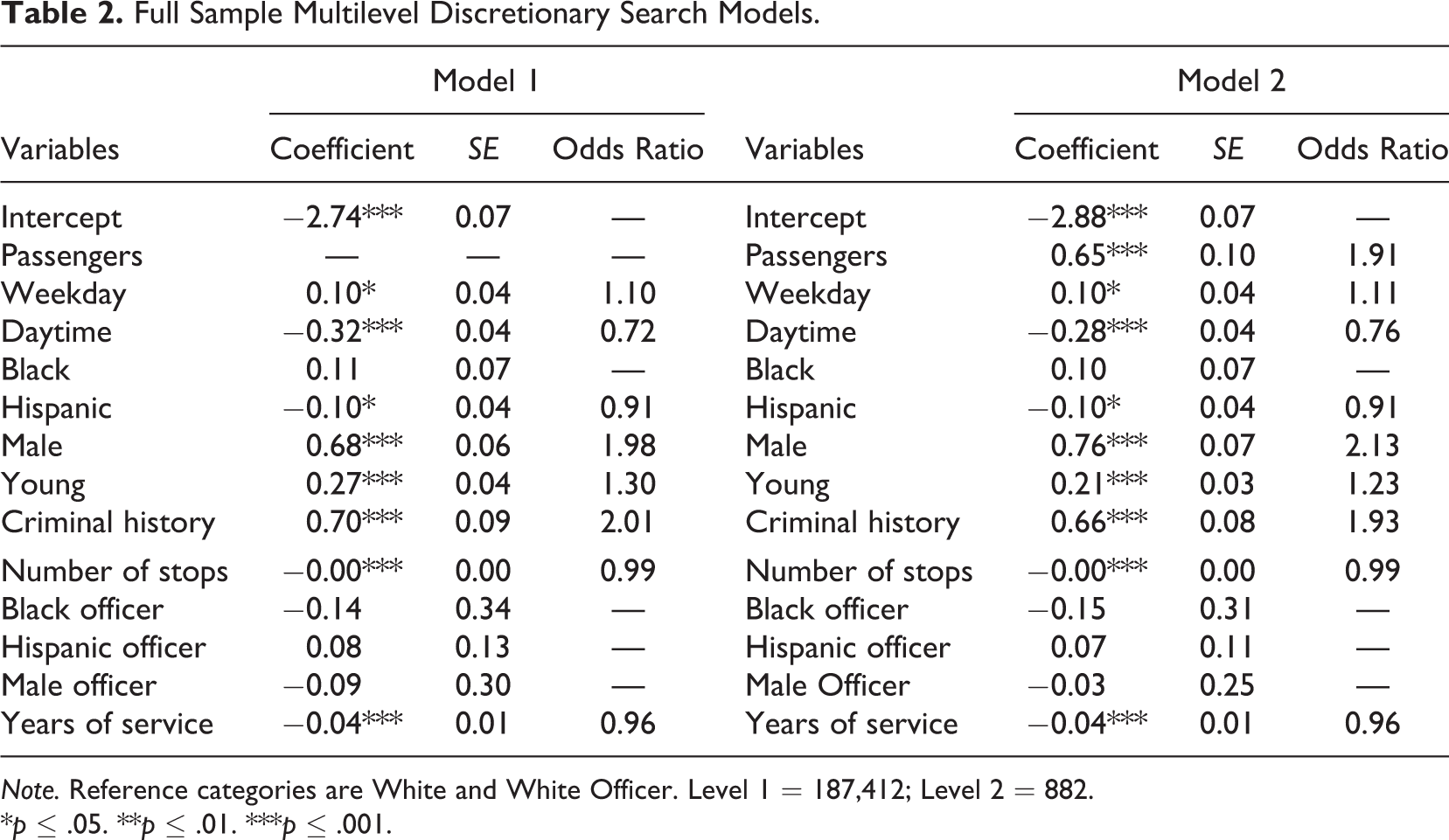
Importantly, the 187,412 cases reflect a single police–citizen contact but not necessarily an encounter. For example, a single-occupant encounter would be counted as one case; however, a multiple-occupant vehicle involving three passengers would be counted as four cases (one case for the driver and one each for the passengers). This data structure required two analytic modeling approaches. First, multilevel models to address the first hypothesis were initially estimated with citizens (i.e., both drivers and passengers) at Level 1 and officers at Level 2. In short, these models examine the likelihood of a citizen being searched for discretionary reasons (i.e., citizens nested within officers), and these findings are reported in Table 2.
Full Sample Multilevel Discretionary Search Models.
Note. Reference categories are White and White Officer. Level 1 = 187,412; Level 2 = 882.
*p ≤ .05. **p ≤ .01. ***p ≤ .001.
To assess the second hypothesis, the data were split into a single-occupant data set representing traffic stops that did not involve any passengers and a multiple-occupant data set that included traffic stops involving at least two citizens. Splitting the data creates interaction terms between all independent variables and the presence of passengers. This approach is useful to assess not only the second hypothesis regarding group effects of citizen race/ethnicity but also other differences between single- and multiple-occupant traffic stop encounters. As reported in Tables 3 –5, the single-occupant data set included 168,057 cases representing traffic stops initiated by officers involving single drivers, and the multiple-occupant data set involving 5,306 cases reflect the number of encounters that officers initiated involving more than one occupant. 8 Models in Table 5 examine the likelihood of an encounter, resulting in a discretionary search of any occupant (i.e., encounters nested within officers). All models were estimated using HLM 6. Data were checked for multicollinearity and all variance inflation factors (VIFs) were within acceptable parameters (VIF < 2.2). Group mean centering was used for all models and population average models with robust standard errors are reported. In sum, Tables 1 and 2 present findings at the citizen level and Tables 3 –5 describe results at the encounter level.
Descriptives for Split Sample.
Note. L1 = Level 1; L2 = Level 2. In the multiple-occupant model, searches are defined as involving at least one passenger. For example, at least one mandatory or discretionary search occurred in 60.4% of all encounters involving at least two passengers.
Searches and Demographics.
Split Sample Multilevel Discretionary Search Models.

Note. L1 = Level 1; L2 = Level 2. Reference categories for the single-occupant model: White citizen and White officer. Reference categories for the multiple-occupant model: two occupants, all White citizens, all female, all old, all no criminal history, and White officer.
*p ≤ .05. **p ≤ .01. ***p ≤ .001.
Measures
The dependent variable for all models was a dichotomous measure of whether a discretionary search (of a citizen or the vehicle) was initiated by the officer. A discretionary search occurred when an officer requested consent to search or proceeded with a search based on probable cause. Nearly all citizens (over 99%) who were asked for consent agreed to allow a search. All other encounters were coded as 0, which include traffic stops involving a search based on policy (i.e., incident to arrest) or situations in which no search was initiated. Encounters resulting in a search due to an outstanding warrant, incident to arrest, or for inventory purposes were considered mandatory searches (1 = yes; 0 = no). In multiple-occupant encounters, three dichotomous search variables were created. All discretionary searches indicate that all searches within the encounter were of a discretionary nature, all mandatory searches reflect an encounter in which all the searches were mandatory, and mixed searches involve situations where at least one discretionary and mandatory search was initiated. 9
The independent variable of primary interest was the number of occupants within the vehicle. An aggregation process was employed to identify the number of occupants within the encounter and that characteristic was applied to each case (i.e., citizen). This information was dichotomized into a variable, indicating whether the citizen was in a vehicle with one or more passengers (coded as 1) or driving by themselves. Additional dichotomous variables were developed for inclusion in the multiple-occupant scenarios that indicated if two passengers, three passengers, or four or five passengers were present.
Examining the effect of passengers on the likelihood of a discretionary search required consideration of additional variables that may be related to the outcome of interest. For example, two dichotomous variables measured whether or not the traffic stop occurred on a weekday and whether the police–citizen encounter occurred between 07:00 and 19:00 (i.e., daytime), respectively. Citizen race/ethnicity, gender, and age were all recorded based on officer perception, while criminal history of the occupant was derived from an official records inquiry. In single-occupant encounters, citizen race/ethnicity was measured using three dichotomous variables coded as 1 for each of the following groups: White, Black, or Hispanic. 10 In multiple-occupant encounters, five citizen race/ethnicity variables were created and coded as 1 when they involved all Whites, all Blacks, all Hispanics, mixed minorities (i.e., a combination of Black and Hispanic occupants), or mixed race/ethnicities (i.e., a combination of White and Black or Hispanic occupants). Citizen gender was dichotomized in single-occupant encounters and coded as 1 for male occupants. In multiple-occupant encounters, citizen gender was dichotomized into all male, all female, and mixed gender encounters that involved at least one male and female citizen. Citizen age was also dichotomized to indicate a citizen under the age of 30 (i.e., young) coded as 1 in single-occupant encounters, and all young, all 30+, and mixed age that represent at least one occupant under the age of 30 and one occupant over the age of 30 in multiple-occupant models. Finally, citizen criminal history was coded as 1 when a citizen possesses an outstanding warrant for an arrest, past convictions for criminal activity, or other violations based on an official record check conducted by the officer during the traffic stop. 11 Citizen criminal history in multiple-occupant encounters was dichotomized into three variables, namely, all criminal history, mixed criminal history, or no criminal history, with each of these variables coded as 1 to represent the characteristic of interest.
At the officer level, a continuous measure of number of stops was included to tap the amount of opportunities an officer possessed to initiate a discretionary search. Officer race/ethnicity was also dichotomized into three variables coded as 1 when the characteristic of interest was present, namely, White officer, Black officer, or Hispanic officer, and officer gender was also dichotomized into a male officer variable. Years of service represents the total amount of years the officer has been employed by the current agency. All descriptive statistics are reported in Tables 1 (full model) and 3 (single- and multiple-occupant models).
Results
Two multilevel models were initially estimated. As displayed in Table 2, Model 1 included all independent variables except for the presence of occupants. Results indicate a citizen’s risk of a discretionary search increased during incidents occurring on a weekday (1.1 times more likely), if they were male (2.0 times more likely), young (1.3 times more likely), or possessed a criminal history (2.0 times more likely) compared to the reference groups. Encounters occurring during the daytime and those involving a Hispanic citizen reduced the chance of a discretionary search compared to nighttime stops and White citizens, respectively. Of note, Black citizens experienced no elevated risk for a discretionary search compared to White citizens. At the officer level, number of stops and years of service were associated with discretionary searches, and no other officer characteristics influenced the likelihood of a discretionary search.
Model 2 in Table 2 adds the variable of interest, presence of one or more passengers. Offering support for the first research hypothesis, a discretionary search is 1.9 times more likely when another citizen is present in the encounter. In other words, the presence of at least one passenger in the vehicle nearly doubles the chance of a discretionary search for any citizen, net of other important variables. The other independent variables were largely unchanged in this model, with only slight deviations in their coefficients.
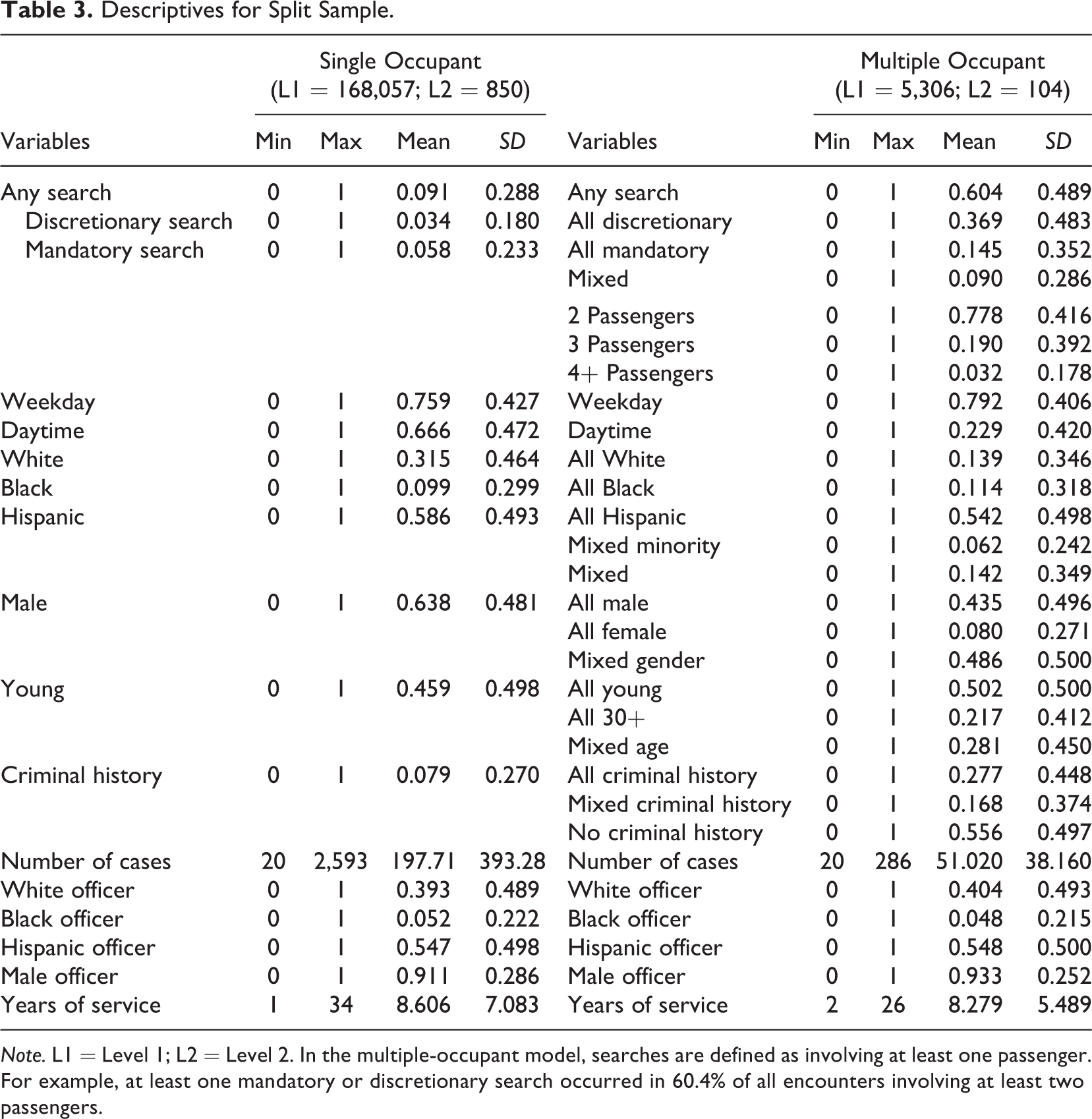
Splitting the data into single- and multiple-occupant data sets revealed that the single-occupant data set involved 168,057 encounters initiated by 850 officers, with 3.4% of all encounters resulting in a discretionary search (see Table 3). The multiple-occupant data set contained 5,306 encounters initiated by 104 officers; 36.9% resulted in discretionary searches only while another 9.0% of the encounters involved both a discretionary and mandatory search. The majority of multiple-occupant encounters involved two citizens (77.8%), and encounters with three occupants and four or five occupants comprised 19.0 and 3.2% of total encounters, respectively. Table 3 offers additional descriptive comparison between single- and multiple-occupant encounters. Various differences appear including time of day, White citizens, citizen gender, and citizens with a criminal history. Conversely, similarities exist for day of the week, Black and Hispanic citizens, and citizen age. Officer characteristics are also largely consistent across the two types of encounters with the exception of traffic stops initiated. These differences are explained by the criteria applied. In the single-occupant data set, officers needed to initiate at least 20 traffic stops of single-occupant vehicles, whereas officers in the other data set needed to initiate at least 20 traffic stops of multiple-occupant vehicles. These differences are reflected in both the range and average number of stops.
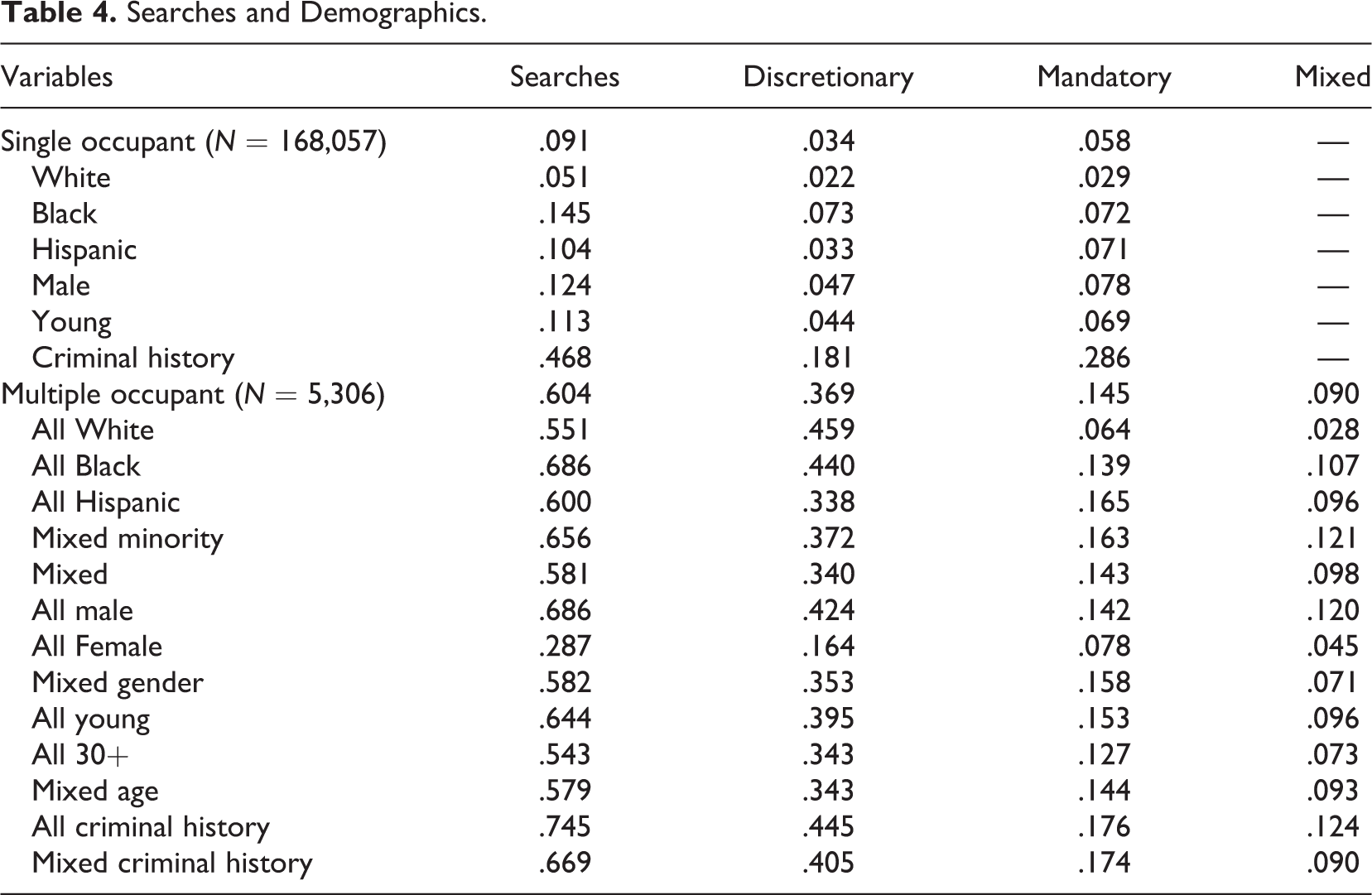
Table 4 reports on a series of bivariate correlations and allows comparisons both within and across the columns. For example, a subgroup can be compared with the overall rate of occurrence for all searches, discretionary searches, mandatory searches, or mixed searches (in the case of multiple-occupant encounters). Considerable differences between the data sets appear. Beyond differences in discretionary search rates between single- and multiple-occupant encounters (3.4 vs. 36.9%), it appears that the initiation of a discretionary search also varied by specific characteristics. For example, discretionary searches occurred overall in 3.4% of all single-occupant encounters but less frequently in White citizen traffic stops (2.2%) compared to Black citizen traffic stops (7.3%; Column 3, Table 4). In the multiple-occupant condition, vehicles containing all White citizens (45.9%) and all Black occupant vehicles (44.0%) were more likely to be searched for discretionary reasons compared to the baseline (36.9%), whereas all Hispanic occupant vehicles were less likely to be searched for discretionary reasons (33.8%). Other notable differences within the multiple-occupant condition include higher rates of search for all male occupant vehicles (42.4%), all young occupant vehicles (39.5%), all criminal history occupant vehicles (44.5%), and at least one citizen with a criminal history vehicles (40.5%).
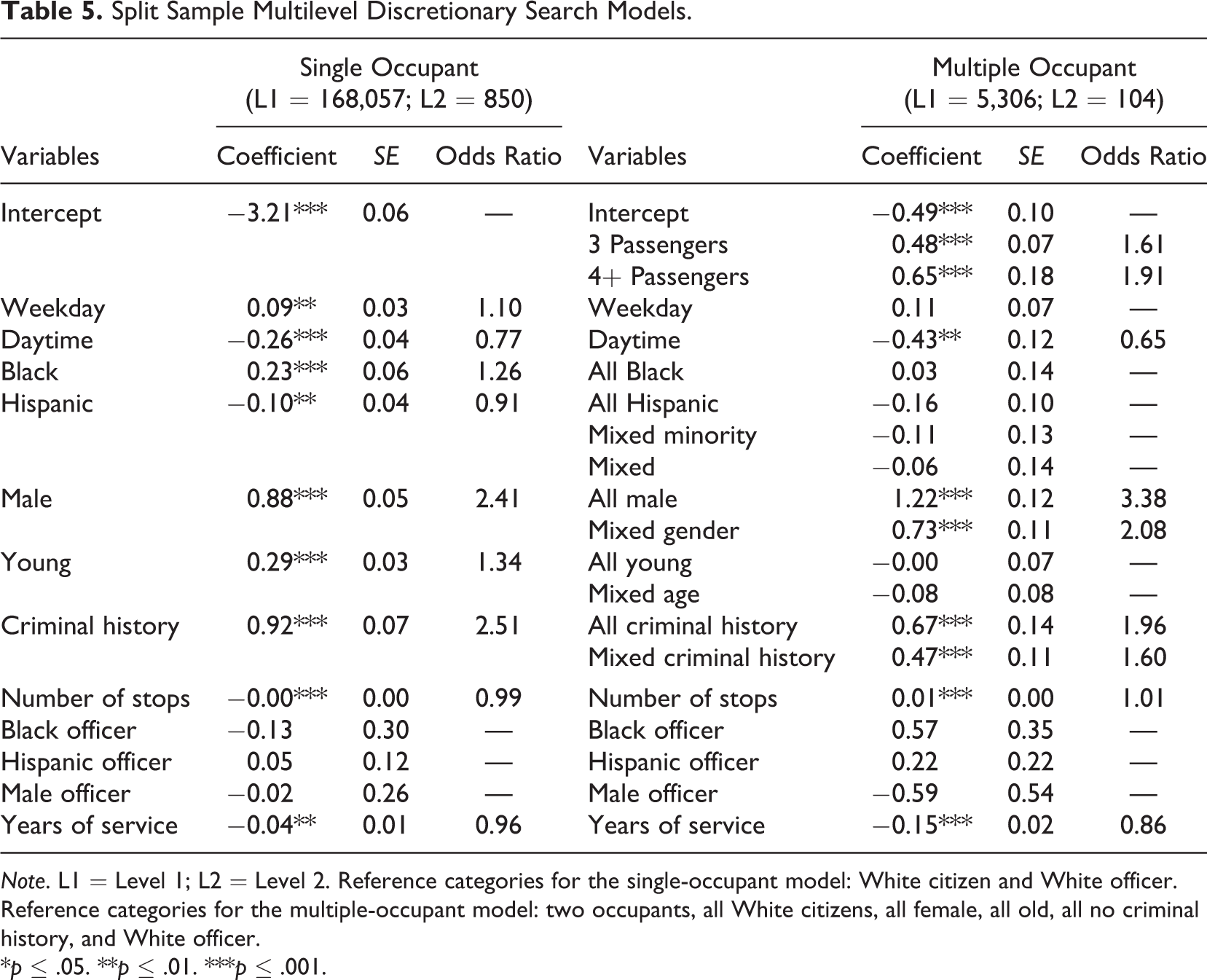
Multilevel models predicting the likelihood of a discretionary search occurring at the encounter level were estimated for the single- and multiple-occupant conditions to further assess these relationships. In the multiple-occupant condition, three occupant encounters were 1.6 times more likely to result in a discretionary search compared to two occupant encounters, and four or more occupant encounters were 1.9 times more likely to culminate in that outcome compared to two occupant encounters (see Table 5, multiple-occupant model). This result is consistent with the findings from the full model (i.e., Model 2, Table 2), suggesting that not only does the presence of a third party impact the likelihood of a discretionary search, but the effect increases as more passengers are present in the vehicle.
The second research hypothesis predicted that the effect of citizen race/ethnicity, in particular, Black citizens, may interact with the presence of passengers to influence the likelihood of a discretionary search. Table 5 summarizes the results from the single-occupant and multiple-occupant condition models. Solo Black drivers were 1.3 times more likely to be searched for discretionary reasons, while solo Hispanic drivers were 0.9 times less likely to receive that outcome relative to solo White drivers. Conversely, in the multiple-occupant model, no citizen race/ethnicity effects are reported. In other words, the increased likelihood of search is restricted to a solo Black driver, whereas the presence of multiple citizens of the same race/ethnicity does not elicit a similar effect. In short, there is no heightened risk of a discretionary search for multiple minority citizens in a vehicle beyond the initial increased likelihood of a discretionary search due to the presence of a third party (see Table 2).
There are other notable differences between the single- and multiple-occupant models. For example, traffic stops initiated on weekdays increased the likelihood of a discretionary search in single-occupant encounters but not multiple-occupant encounters, whereas the nighttime effect on discretionary searches was strengthened in multiple-occupant encounters (although still present in single-occupant situations). Of more interest are the variations across conditions for various citizen demographics. Gender effects were present in both models, with males having a heightened risk for a discretionary search. A comparison between conditions suggests the gender effect intensifies in a group setting, as the all-male occupant condition generates the highest risk for a discretionary search. Interestingly, and somewhat surprisingly, age effects were only present in a single-occupant vehicle (solo drivers under the age of 30 were 1.3 times more likely to be searched for discretionary reasons), and the presence of multiple young citizens in a vehicle was not related to a heightened likelihood of a discretionary search. Finally, citizens with a criminal history were more likely to be searched for discretionary reasons in all conditions, with the strongest effect for solo drivers.
At the officer level, fewer years on the job was a consistent predictor of discretionary searches, with this effect strengthening in multiple-occupant encounters. Also, the number of stops initiated by the officer was statistically significant in both models, although the direction of this effect differed. We view this measure as largely a control for opportunity to search and coupled with its lack of substantive significance do not assign much importance to this result.
Discussion
Understanding a police officer’s use of discretion is a consistent theme in policing research; however, very little attention has been paid to the potential impact of third parties on police behavior. In particular, little is known about this relationship within the most frequent police–citizen encounters, traffic stops. The current study hypothesized the presence of passengers would increase the likelihood of a discretionary search based on concerns of officer safety, the group hazard hypothesis, and symbolic interactionism.
Findings from the multilevel models comport with the limited previous work in this area (Tillyer et al., 2012) and suggest strong support for the first hypothesis. The impact of passengers on officer behavior suggests that self-protection may be a serious consideration when officers are determining a course of action (Brown, 1981; see also Muir, 1977), and officers may feel it is necessary to ensure there is no threat to their safety by initiating a search. This may be particularly true when no other officers are present, when the encounter occurs at night, or when the traffic stop is initiated in a secluded area.
Our findings also reflect the group hazard hypothesis. Drawing from M. Smith and colleagues (2006), it is conceivable that officers exercise their discretion to search (when allowable) more frequently in conditions involving a group due to a heightened level of suspicion. If officers’ suspicion is aroused under these conditions, it would be valuable for future research to explore the degree to which contraband is discovered in single- versus multiple-occupant encounters. Such an approach would test the idea that an officer views a vehicle with multiple occupants as increasing their odds of contraband discovery as a result of more “chances.” The previous literature is mixed on this issue as Lundman (2004) reported an increased likelihood of contraband discovery within encounters involving two occupants (but not for situations involving three or more occupants), while Tillyer and Klahm (2011) found an effect for mandatory searches but not for discretionary searches. Failure to discover contraband, as measured by lower hit rates, would raise questions about the legitimacy of relying on the presence of passengers as an accurate indicator of criminal activity.
Alternatively, the increased likelihood of a discretionary search could simply suggest the police are attempting to express their authority when interacting with multiple citizens simultaneously. Consistent with the symbolic interaction perspective, officers may use their legal discretion to demonstrate their power and legitimacy in society (Klinger, 1996; D. A. Smith & Visher, 1981; Tedeschi & Felson, 1994). The current study’s results also suggest that Waddington’s (1999) claims about legitimacy may have some veracity, as deciding to search a citizen or vehicle within the constraints of the law suggests that the officer is acting in a justifiable manner. Thus, execution of a discretionary search communicates the authority of the police to the citizen.
Our second hypothesis predicted that encounters involving more than one Black citizen would result in a heightened likelihood of a discretionary search compared to other citizen groups. This prediction was predicated on officer suspicion (Alpert, MacDonald, & Dunham, 2005), the perceived link between minority citizens and criminal activity (Welch, 2007), and Black’s theory of law (1976). No support was found for this claim. It is possible this unexpected result might be related to the hierarchy of suspicion cues such that officers place more importance on the presence of associates rather than the racial composition of those associates. That is to say, group involvement may supersede racial classification in terms of the perceived linkage with criminal behavior. This interpretation makes sense in light of what is known about offending patterns, whereas multiple offenders often characterize criminal activity. Thus, group involvement may serve as a primary cue of suspicion thereby increasing the likelihood of a police search independent of race/ethnicity. Future research should strive to understand the underlying mechanism that explains why race is seemingly less important in the group context compared to traffic stops that involve only the driver.
It is also possible that our failure to find support for this hypothesis is unrelated to the development of suspicion, but rather relates to officer safety. When dealing with multiple citizens during an encounter, officers might possess a heightened sense of self-preservation independent of the racial composition of the group, which also suggests that group involvement supersedes the importance of racial composition.
Somewhat related, disentangling encounters involving solo drivers from those with occupants revealed that Black drivers face a heightened risk of discretionary search when driving alone. This effect was not present in the initial models examining a citizen’s risk of search; however, it became apparent when multiple-occupant encounters were removed and single-occupant encounters were analyzed separately.
This finding raises interesting questions about the role of citizen race/ethnicity and passengers in traffic stops. Solo Black citizens experienced an increased likelihood of a search whereas solo Hispanic citizens were less likely to be searched compared to solo White citizens. This finding is somewhat surprising given that minorities, in general, garner more attention from police. It might be contextualized, however, from a “race out of place” frame. As Meehan and Ponder (2002) contend, an officer’s conception of place influences their perception “of what should typically occur in the area and who belongs, as well as where they belong” (p. 402; emphasis in original). Because the study site is mostly comprised of Hispanics, it is conceivable that they would garner less attention than other racial/ethnic groups. There is some empirical evidence suggesting this possibility, as Novak and Chamlin (2012) found that White motorists experienced elevated search rates when the traffic stop occurred in predominately Black areas. Rojek et al. (2012) also reported the demographic makeup of the stop location influenced risk of a search, but this finding was also influenced by the race of the officer initiating the search.
The presence of passengers also appears to interact with other citizen demographics. For example, criminal history’s effect is less pronounced in the multiple-occupant model compared to the single-occupant model. This seemingly suggests that officers give less weight to past criminal history when confronted with a group of motorists. This might be a function of placing more importance on the perception of likely criminal involvement within a group context rather than relying on the actual criminal histories of one’s peers. Conversely, with respect to gender, it appears that officers pay particularly close attention to groups of males traveling together. While male solo motorists experienced an increased risk of being searched relative to females, males traveling together were at an even greater risk of a discretionary search. This suggests that officers are more fearful of or view groups of males as more likely to be involved in wrongdoing compared to a male solo motorist, a group of females, or mixed gendered occupants. Thus, this finding might speak to the magnitude of the perceived linkage between males and criminal involvement or the level of fear induced when dealing with a group of males. Finally, results for citizen age suggest that the effect of the group overshadows the age of the individuals that comprise the group.
More broadly, it is possible that the effect of passengers varies by officer. Beyond the significance of years of service (demonstrated in both models in Table 5), it may be that some officers’ decision making is inhibited in the presence of multiple minorities. This process may develop as a result of the officer being concerned that multiple minorities within the situation may act as “witnesses” to the incident. Given that some searches are discretionary, officers may not pursue them in situations for fear of later reprisals (i.e., community complaints) and/or the development of poor community relations. While the current data do not allow a thorough assessment of such a process, it cannot be eliminated as a possibility given the limited research to date in this area.
In short, results from the current study suggest three conclusions regarding the relationship between the presence of passengers and the likelihood of a discretionary search. First, citizens’ risk of a discretionary search was heightened in the presence of another citizen during a traffic stop. Second, the presence of passengers appeared to supersede any impact of citizen race/ethnicity. Third, examination of solo drivers separately indicates that Black citizens were more likely to be searched for discretionary reasons. Thus, it appears that while solo drivers are at a lower risk for a discretionary search in general, solo Black drivers are more likely than other solo drivers to be subject to this outcome. These findings suggest that future research interested in minority experiences needs, at minimum, to include a measure of passengers.
While we believe this study offers valuable information regarding the impact of passengers on discretionary searches, limitations exist that need to be acknowledged. First, data only allowed an examination of passengers; thus, despite the conceptual importance of other types of third parties (i.e., officers or bystanders), no definitive statements can be made regarding their impact on discretionary searches. Importantly, however, traffic stops are predominately undertaken by a solo officer 12 and rarely include a bystander, which suggests that the current study’s conclusions would not be substantively impacted by inclusion of these additional measures.
Second, we were unable to execute an analytic strategy that allowed a simultaneous assessment of the risk level under a variety of conditions. For example, comparing the risk of a discretionary search for a solo White driver, a solo Black driver, a group of all White citizens, a group of all Black citizens, and so on, at the same time was not possible because of the data structure. 13 Despite the failure to directly answer this question, it is possible to examine the coefficients in Table 5 (results of the single- and multiple-occupant models) and compare their effects across conditions. For example, while male citizens face a higher likelihood of discretionary search, this risk is more pronounced in a group setting. Difference of coefficient tests, such as Clogg’s test, are often used to address this type of question, but they were not appropriate for the current study due to the fact that the dependent variable is a dichotomy (see Allison, 1999; R. Williams, 2009, for a more developed discussion of the concerns surrounding this approach). Moreover, some of the independent variables, including citizen race/ethnicity, did not have matching categories across the two conditions. Thus, employing this strategy to assess relative risk was not possible.
These data represent a single jurisdiction, a single year of data, and a study locale that is predominately Hispanic; thus, concerns of external validity are relevant. We believe, however, the limitation of observing behavior in a single jurisdiction is minimized by the consistency of our findings with other studies (e.g., Tillyer et al., 2012). Moreover, we have no reason to believe that the actions of these police officers were unique, as the agency has regularly been collecting these data for over 10 years. Finally, while the demographic composition of the environment is somewhat unique, Black citizens still comprise a noticeable component of the population similar to other metropolitan areas. Thus, while external validity cannot be disregarded as a threat to the findings, it does not appear to present a significant challenge to the patterns of behavior observed in the data.
Finally, concerns of model misspecification cannot be eliminated. For example, these data did not contain measures of reason for the stop, citizen demeanor, or the context of the encounter, such as the crime rate of the area. More broadly, we recognize that qualitative approaches are underutilized in officer decision-making research. Directly asking officers to explain how suspicion impacts their actions, how the behavior of the citizen may affect their thought processes, and how the presence of a passenger ultimately impacts their actions would offer valuable information to understand an officer’s use of discretion under a variety of conditions. Future research should consider a focus group (or officer survey) methodology to confirm the results presented here.
Despite these limitations, we believe that valuable information has been uncovered regarding differences in police behavior depending on the presence and number of passengers. Further, the experience of minority citizens with the police appears to differ depending on whether they are alone or in a group. We encourage future researchers to extend this research trajectory to consider how police action may be impacted by the presence of other third-party observers. These preliminary results suggest that this is an important factor to consider when studying officers’ use of discretion.
Footnotes
Declaration of Conflicting Interests
The author declared no potential conflicts of interest with respect to the research, authorship, and/or publication of this article.
Funding
The author received no financial support for the research, authorship, and/or publication of this article.