




Abstract
Contemporary research on adolescent involvement in religion and delinquency is generally traced to Hirschi and Stark’s 1969 study, titled “Hellfire and Delinquency.” Their study surprised many by reporting no significant relationship between religious involvement and delinquency. Subsequent replications provided mixed results, but multiple reviews, both traditional and systematic, found religious involvement to be inversely related to delinquency. However, meta-analysis of the relationship remains scant with only three studies published to date. To address this research need, we conducted a meta-analysis of 62 relevant studies over four decades, which provided 145 effect sizes from 193,656 adolescents. We examined six bivariate correlations between two, attitudinal and behavioral, measures of religious involvement (religiosity and church attendance) and three indicators of delinquent behavior (alcohol use, illicit drug use, and nondrug delinquency). Our meta-analysis results indicated an inverse relationship among all correlations (range: −.16 to −.22). Stated differently, the results of this meta-analysis confirmed that religious involvement is negatively related to delinquent behaviors, regardless of measurement characteristics. The implications of this finding for future research on religion and delinquency are discussed.
Although the relationship between religion and delinquency has been studied since the early 1900s (Knudten & Knudten, 1971), Hirschi and Stark’s (1969) landmark study changed the trajectory of criminological research on religion. The results of the study indicated that religiosity and delinquency had little relationship, which surprised researchers who were convinced of the prosocial impact of religion on human behaviors (Stark, 1984). Subsequent research on the relationship between religion and delinquency has generally found support for an inverse relationship between measures of religion and measures of crime and delinquency (Dew et al., 2008; Jang, 2013; Johnson, 2001; Koenig, King, & Carson, 2012; Regnerus, 2006; Stark, 1996).
Systematic reviews of research on religiosity and delinquency have been conducted in the past decade (e.g., Chitwood, Weiss, & Leukefeld, 2008; Johnson & Jang, 2010; Johnson, Li, Larson, & McCullough, 2000b; Johnson, Thompkins, & Webb, 2002). These systematic reviews generally confirmed the conclusion drawn by traditional reviews of literatures: Individuals who are more religious are less likely to engage in crime, delinquency, and use of drugs, licit and illicit. On the other hand, only a handful of quantitative syntheses (i.e., meta-analysis) have been conducted (Baier & Wright, 2001; Yeung, Chan, & Lee, 2009; Yonker, Schnabelrauch, & DeHaan, 2012).
An additional meta-analysis is needed for two reasons. First, this review will bolster the emerging subfield of criminology of religion (Cullen, 2010) beyond simple anecdotal or local research studies toward a more comprehensive representation. Second, well over a decade has passed since Baier and Wright’s (2001) meta-analysis of criminological research published through 1998, and recent meta-analyses by Yeung, Chan, and Lee (2009) and Yonker, Schnabelrauch, and DeHaan (2012) are limited to studies of the last 10–20 years. Thus, there is a need for meta-analysis of both “old” and “new” studies spanning a longer period of time than what the previous meta-analyses covered. In doing so, we confine our analysis to studies that use adolescent samples and examine different types of adolescent deviance: alcohol use, illicit drug use, and delinquency other than drug use, called here “nondrug delinquency.”
Before explaining our methodology, however, a brief history and summary of key research on religion and crime and drug use is in order, which is followed by an overview of studies based on the methods of systematic review and meta-analysis. After presenting results from our meta-analysis, we discuss their limitations and implications for future research on religion and adolescent involvement in delinquency and drug use.
Prior Research
Contemporary research on the relationship between religion and delinquency is generally traced to an important study titled “Hellfire and Delinquency” (Hirschi & Stark, 1969). Hirschi and Stark’s primary conclusion suggested that religious commitment among youth was not related to measures of delinquency. A number of scholars replicated the study, and the replications both supported (Burkett & White, 1974) and refuted (Albrecht, Chadwick, & Alcorn, 1977; Higgins & Albrecht, 1977; Jensen & Erikson, 1979) the original finding. Rather than clarifying the situation, the contradictory findings of initial replications complicated the research landscape. After a series of studies over a decade, it was still debated whether or not religion helped reduce delinquency. Indeed, any number of studies concluded that the religion–delinquency relationship lacked explanatory consensus (Evans et al., 1996; Johnson, Marcos, & Bahr, 1987; Tittle & Welch, 1982).
Stark, Kent, and Doyle (1982) returned to the issue and suggested that these contradictory findings were likely the result of the moral (i.e., religious) makeup of the community being studied. The authors predicted religion would deter delinquency in moral communities, but there would be little or no effect of religiosity on individuals residing in secularized communities. The “moral communities” hypothesis provided an important theoretical framework for understanding why religion reduced delinquency in some studies, whereas other studies found religion had no significant impact on delinquency (Stark, 1996; Stark, Kent, & Doyle, 1982). For example, studies of delinquency in religious communities such as Mormon Wards in Utah and Idaho yielded an inverse relationship between religious commitment measures and delinquency (Albrecht et al., 1977). Conversely, communities reporting lower church membership rates such as Richmond, California, failed to generate the inverse relationship (Hirschi & Stark, 1969).
Other studies continued to provide empirical evidence that an adolescent’s religiosity, measured in terms of religious involvement (e.g., religious service attendance and participation in religious activities) and religious salience (i.e., perceived importance of religion), tended to be negatively associated with delinquency, especially licit and illicit drug use (Burkett & Warren, 1987; Freeman, 1986; Hawkins, Jenson, Catalano, & Lishner, 1988; Jang, Bader, & Johnson, 2008; Johnson, Larson, Li, & Jang, 2000a; Johnson & Siegel, 2008; Stark, 1996). Furthermore, these findings remain significant after holding social learning, social control, and strain variables constant (Cochran & Akers, 1989; Evans, Cullen, Dunaway, & Burton, 1995; Jang & Johnson, 2001, 2003; Johnson, Jang, Larson, & Li, 2001; Koenig, McCullough, & Larson, 2001; Regnerus, 2003; Smith, 2003).
In sum, although some researchers have argued that religious effects are spurious (e.g., Cochran, Wood, & Arneklev, 1994; Ellis, 1987), mounting evidence points to the nonspurious effects of religiosity on crime and drug use, which are partly attributable to religiosity’s prosocial outcomes (Evans et al., 1995; Johnson et al., 2000a). In other words, religiously involved adolescents are less likely to commit delinquency or use illicit drugs partly because they are more attached to their parents, more committed to educational goals, more conventional in moral beliefs, and less likely to have delinquent or drug-using friends than their nonreligious peers (Jang & Johnson, 2001; Johnson et al., 2001; Johnson et al., 2000a; Regnerus, 2003). Moreover, more advanced methods of research synthesis—systematic review and meta-analysis—help make a case for this conclusion.
Previous Systematic Reviews and Meta-Analysis
A number of systematic reviews have been conducted recently on the topic of religion and delinquency. In a systematic review of 40 articles included in journals between 1985 and 1997, Johnson, Li, Larson, and McCullough (2000b) found that most of these studies reported an inverse relationship between measures of religiosity and delinquency. Several studies found no relationship or mixed patterns, and only one reported a positive link between religiosity and delinquency. Interestingly, the authors found that, among those studies with the most sophisticated research designs, the inverse relationship between religiosity and delinquency was stronger.
In another systematic review, Johnson, Thompkins, and Webb (2002) reviewed studies examining religion and multiple outcome areas including delinquency. Among 97 alcohol studies reviewed, only 2 studies found religiosity to be associated with deleterious outcomes, another 10 studies reported inconclusive findings, while 85 studies found an inverse relationship, indicating increasing religiosity was associated with a lowered likelihood of alcohol abuse. They also found 50 of 54 studies on drug use or abuse to show inverse relationships with only 1 reporting a positive relationship. Finally, 37 of another 46 studies within the criminological literature indicated that religiosity is negatively associated with crime and delinquency, while religiosity is positively related to delinquency in only one study. Chitwood, Weiss, and Leukefeld (2008) applied the same method that Johnson et al. (2000b) used to conduct a systematic review of 105 peer-reviewed journal articles published between 1997 and 2006, focusing exclusively on drug use among adults as well as adolescents. They concluded that higher levels of religiosity, however measured, tended to be associated with decreased risk of substance use especially alcohol use among adolescents.
More recently, Johnson and Jang (2010) published perhaps the most comprehensive systematic review of research on religion and crime by locating 270 studies published between 1944 and 2010. Examined in this review were the type of study (e.g., cross-sectional, prospective cohort, retrospective, experimental, case–control, or descriptive), the sampling method (e.g., random, probability, systematic sampling, or convenience/purposive sample), the number of subjects in the sample, population (e.g., children, adolescents, high school students, college students, or adults), location, religious variables included in the analysis (e.g., religious attendance, scripture study, subjective religiosity, religious commitment, intrinsic religiosity, and extrinsic religiosity), controls, and findings (e.g., no association, mixed evidence, beneficial association with outcome, or harmful association with outcome). Consistent with previous systematic reviews, Johnson and Jang (2010) found about 90%of the studies (244 of 270) to report an inverse or beneficial relationship between religion and some measure of crime or delinquency. Only 9% of the studies (24 of 270) found no association or reported mixed findings, whereas only two studies reported that religion was positively associated with a harmful outcome.
The first meta-analysis of this literature was conducted by Baier and Wright (2001), in which they synthesized 60 studies published between 1962 and 1998 and essentially confirmed the results of the previous systematic reviews just summarized. Specifically, the quantitative analysis of 79 correlations led the authors to conclude: “… that religion does indeed have some deterrent effect” (p. 16). Additionally, they found that studies using larger and more representative data sets are more likely to find significant inverse relationship between religiosity and crime or delinquency than studies that utilize smaller, regional, or convenience samples. The authors also found the relationship to be more likely significant when looking at “nonvictim crimes,” measured by drug and alcohol use (by a minor) than “general index crimes” that included violent crimes. This remains the only meta-analysis of studies on religion and crime (and drug use) published in criminological journal.
More recently, two meta-analytic studies were published, one on substance use and the other on “risk behaviors” among adolescents and emerging adults. First, Yeung et al. (2009) reviewed 22 studies published in peer-reviewed journals between 1995 and 2007 and found protective effects of religiosity (i.e., “daily spiritual experiences” as well as religious service attendance, affiliation, private practices, coping, commitment, and salience) on a combined measure of substance use (Zr = −.16). Significant effects were also observed when substance use was examined separately for alcohol (Zr = −.16), cigarette (Zr = −.18), marijuana (Zr = −.14), and other illicit drugs (Zr = −.18).
Second, Yonker et al. (2012) meta-analyzed 75 studies on drug use but also nondrug deviance, published between 1990 and 2010 “in order to capture the most recent research.” Specifically, they found “spiritual/religious” beliefs and behaviors to be negatively correlated with risk behaviors collectively (Zr = −.17) and separately for alcohol use (Zr = −.17), cigarette smoking (Zr = −.13), marijuana use (Zr = −.12), and nondrug deviant behavior, such as vandalism, stealing, and assault (Zr = −.21). Furthermore, they conducted moderator analysis to see whether the relationships between spirituality/religiosity and outcome variables interacted with demographic characteristics of respondents (age and race) and the measures of spirituality/religiosity. Results from the analysis revealed that respondent’s age, but not race, and the spiritual/religious measures did interact. Specifically, the negative correlation between spirituality/religiosity and risk behavior was stronger in emerging adults than adolescents. Among the measures of spirituality/religiosity, service attendance was most strongly correlated with risk behaviors (Zr = −.31), followed by others including salience (Zr = −.22) and private practices and nonservice activities (Zr = −.10).
The Present Study
The current study’s meta-analysis advances the field by improving the number of methodological shortcomings in previous systematic reviews and meta-analyses. First, we focused exclusively on research on adolescent involvement in religion, delinquency, and drug use, whereas Baier and Wright’s (2001) and Yonker et al.’s (2012, p. 304) analyses included research on adults as well, while a majority—two thirds and “56%,” respectively—of their studies had been drawn from adolescent samples (Yeung et al., 2009, p. 258, only reported the range of age included in their meta-analysis, “young people between 11 and 22 years old”).
Second, since Baier and Wright (2001) reported no significant difference between behavioral and attitudinal measures of religious involvement in their effects on crime and delinquency, we conducted meta-analysis separately for the two different types of religious measures to see whether we can replicate their findings. In addition, we extended Baier and Wright’s distinction between crime types—“general index crimes” (theft, robbery, assault, and murder) and drug use, called “nonvictim crimes” (alcohol use by minors and marijuana use)—by examining drug use separately for licit and illicit drugs that are likely to have differential associations with religious involvement as Yeung et al. (2009) and Yonker et al. (2012) did. Prior research shows that religious involvement is more likely to be negatively associated with ascetic (e.g., underage drinking or premarital sex) than with nonascetic and legally serious deviance (e.g., assault) because the latter tend to be condemned similarly by religious and nonreligious people. To the extent that the distinction between ascetic and nonascetic deviance applies to licit and illicit drug use in terms of seriousness, the negative relationship between religion and drug use is expected to be larger for licit than for illicit drugs.
Third, while Baier and Wright (2001, p. 7; emphasis in original) acknowledged a potential problem of meta-analysis, called “the file drawer problem,” which reflects reviewers’ difficulty in retrieving studies reporting nonsignificant results (p > .05), they mainly speculated about why their study might have been less affected by the problem. Similarly, Yeung et al. (2009) and Yonker et al. (2012) both confined their meta-analysis to published research. In this study, however, we included nonpublished studies in the form of dissertations and also checked for the presence of publication bias using Duval and Tweedie’s trim and fill procedure (2000).
Finally, this study updates the current extant knowledge of the relationship between religion and adolescent delinquency and drug use without neglecting “old” studies. We included early research rather than limiting our analysis to relatively recent studies, unlike Yeung et al. (2009) and Yonker et al. (2012). At the same time, a number of studies have been published since the Baier and Wright’s (2001) first meta-analysis and were also included. Taken together, we believe our literature search and screen procedures produced a comprehensive database of literature, not limited by arbitrary time periods or publication status.
Methods
We utilized a meta-analysis framework to synthesize extant investigations into the influence of individual religiosity or religious involvement on delinquency and drug use among adolescents for two reasons. Meta-analysis is an established standard practice that yields objective answers to questions with multiple or conflicting answers (Pigott, 2012). This is important since it is highly probable that researchers across independent studies will find divergent result. Meta-analysis, in contrast, provides a framework to find a more precise estimate of the relationships. In addition, meta-analysis allows for the testing of methodological and substantive study comparison. From this broad view, a meta-analyst is able to determine whether differences between studies are due to reasons other than sampling error. What follows is a description of the methodology for this review.
Selection Criteria
Research design
Primary studies must have employed a design that measured the relationship between religious involvement and a delinquent behavior. We focused on the two most often used measures of religious involvement, one attitudinal, called here “religiosity,” and the other behavioral, church attendance. Religiosity taps perceived importance of religion to an individual in his or her life, whereas church attendance was measured based on a question asking students to describe how often they attended church per month or year. On the other hand, three types of delinquent behaviors were included in our analysis: alcohol use, drug use, and nondrug delinquency. The use of alcohol was considered delinquent behavior because the included studies’ average age must have been below 18 years. Next, drug use is the use of illegal substances, including marijuana, and delinquency refers to nondrug delinquent acts.
Further design characteristics guided the selection process. We included studies that sampled adolescent participants (18.5 years of age) or younger. Studies that failed to provide the age of the subjects, or that simply listed the sample as college-aged or above, were removed. We focused on the cross-sectional relationship between the two constructs because few studies provided longitudinal correlations. These two distinct research designs are not appropriate to synthesize, and therefore, studies that only provided a longitudinal relationship were removed. Studies that provided both relationships were included, but only the cross-sectional relationship was used. We did not exclude studies based on the type of sampling technique (i.e., probability or nonprobability) or the type of sample (i.e., religious vs. general population).
Geographic location
No restrictions were placed on the location of data collection. Studies that occurred outside of the United States were included. We conducted searches in English, however, which may have precluded foreign languages studies from inclusion.
Statistical data
The primary studies must have provided a measure of the relationship between religious involvement and a delinquent behavior. The relevant effect size, therefore, was a correlation coefficient. Although Pearson’s correlation coefficient was the most common form of the effect size, some studies provided information relevant for effect size calculation in various formats. For instance, a 2 × 2 table that provided frequencies or percentages would have produced a relevant effect size. On the other hand, a portion of studies reported only the conditional relationships (i.e., regression coefficients). These coefficients, at this time, could not be included in the analysis due to the nature of the statistic (Pigott, Williams, Polanin, & Wu-Bohannon, 2012).
Time frame
No restrictions were placed on the time frame of publication. This was important because we wanted the database to represent the extant literature universe in order to observe how the relationships changed over time. Preventing research studies from inclusion based on the date of publication would have essentially limited the analytical testing capabilities. The search procedure concluded, however, on February 1, 2015.
Publication status
We did not limit our inclusion criteria to published studies only (i.e., both published and nonpublished studies were included). Rothstein, Sutton, and Borenstein (2006) suggest that limiting empirical research to peer-reviewed studies has the potential to bias the results.
Search Strategy
Our search strategy endeavored to find all relevant citations available in the extant research databases. Although it was possible that a handful of studies remained unidentified, we believe that the search strategy pursued all possible primary studies. The search procedure started by using objective and repeatable search terms across multiple research databases, including Criminal Justice Abstracts, Criminal Justice Periodical Index, Dissertation Abstracts International, ProQuest Research Library, PsycInfo, Sociological Abstracts, Social Science Citation Index, and Social Services Abstracts. The search terms included the following: religion, religiosity, church, church attendance, delinquency, delinquent behavior, alcohol, alcohol use, drug use, marijuana, cigarettes, and some combination thereof. We also contacted researchers who studied religion and delinquent behavior to inquire about potential missing studies, and reference lists from each included study were also searched for potential studies.
Coding
We developed a coding protocol to document relevant study information, using a Microsoft EXCEL database to collect codes efficiently and reliably. We coded the study’s demographic information, such as publication type, year of publication, and funding, as well as sample characteristics, such as the sample’s average age, percentage of males, and percentage of varying racial components. We attempted to code for methodological characteristics, but the only consistently reported indicator of methodological quality was whether the study utilized a probability-based sampling technique. We attempted to contact primary authors if a particular code was not available in the document. Two independent researchers coded the articles, and disagreements were handled via consensus.
Statistical Analysis
Effect size calculation
Based on our research questions, we were also interested in collecting effect size information about a number of variables: religiosity, church attendance, alcohol use, drug use, and delinquent activities. The three “outcome” measures (i.e., alcohol use, drug use, and delinquency) were generally measured as a response to a frequency item. Most often, researchers asked participants how many times in the previous month a participant drank alcohol or used illicit drugs. If the researchers asked about the quantity of alcohol use as well as frequency and reported both measures, we averaged those correlations within the study prior to the analysis. For delinquency measures, the most common approach was to ask participants whether they had committed various violent or nonviolent acts, often across multiple types of delinquency. Instead of attempting to synthesize these separately, we averaged all delinquency correlations within a study prior to conducting the meta-analysis across studies.
The effect size calculated across the studies was the correlation coefficient (Hunter & Schmidt, 2004). As mentioned previously, correlations may also be calculated from noncontinuous data such as Likert-type scales or 2 × 2 tables. Regardless of the type of correlation, all coefficients were converted to Fisher’s Z due to the skewed distribution of the standard errors of the correlation coefficient (Lipsey & Wilson, 2001). Fisher’s Z transformation included a standard error calculation that was based solely on sample size and not on the size of the statistic (Hunter & Schmidt, 2004, p. 83). After synthesis calculations, Fisher’s Z statistic is transformed back into the original correlation coefficient metric for interpretation.
Effect sizes were calculated for each bivariate relationship between the two measures of religious involvement (church attendance and religiosity) and the three delinquent behaviors (alcohol use, drug use, and delinquency). As such, a maximum of six bivariate correlations were calculated per study. If the study provided multiple correlations, for instance, a correlation between church attendance and alcohol use for males and females, we combined the correlations within the study prior to synthesis. This procedure ensured effect size independence, which is an assumption of meta-analysis (Hedges & Olkin, 1985).
Synthesis
The quantitative technique of meta-analysis was used to combine each study’s effect size (Cooper, 2009; Pigott, 2012). We used the inverse-variance, random-effects model such that studies with larger samples provided finer precision and thus were given greater weight in the calculation of the average effect size. This can be written as follows:

where
As important as the average effect size, the next step was to test whether the effect sizes vary significantly. The Q statistic, which follows a χ2 distribution, was calculated and followed by a hypothesis test. We also provided an additional measure of the between-study heterogeneity I 2 (Higgins, Thompson, Deeks, & Altman, 2003). Due to the large number of bivariate correlation pairs (six), we chose not to include forest plots (available upon request). All meta-analytic procedures were conducted using the R package metafor (Viechtbauer, 2010).
Moderator analysis
Given significant effect size heterogeneity, an important aspect of meta-analysis is to understand the reasons effect sizes vary across studies. We conducted a series of moderator analyses using both categorical and continuous variables. We hypothesized that the effect sizes would vary as a function of the publication source, funding, sampling type, sampling location, and the individuals who made up the sample (i.e., general population vs. religious population). In addition, we utilized continuous variables (e.g., average age, percentage of males, African Americans, White students, and the date of publication) to conduct meta-regression analyses. To avoid biased results, moderator analyses that included less than five studies per level were excluded. For example, only three dissertations provided a bivariate correlation between alcohol use and religiosity; therefore, we eliminated the moderator analysis for this variable. We used a random-effects model to evaluate moderators, and all analyses were again conducted in the R package metafor (Viechtbauer, 2010).
Publication bias
As mentioned earlier, we included both published and nonpublished literature in the review. It was possible, however, that nonpublished studies went undetected because of the file drawer issue (Rosenthal, 1991). To test for the presence of publication bias, we conducted Duval and Tweedie’s trim and fill procedure (2000), which used a rank-based augmentation to impute potentially missing values. The results of the procedure provide an indication of the magnitude missing studies might have on the overall results.
Results
The search procedures yielded more than 1,350 citations, including duplicates. Of the 1,350 citations, independent researchers identified 154 citations for further review. The full text of these citations was ordered and screened for potential inclusion. Of these citations, we identified 69 documents that met inclusion criteria. This list was further dwindled, by seven articles, after coding revealed that the average age of the sample was too old.
The search and screen procedure yielded 62 applicable studies. From these, 145 correlations were computed (see Table 1). The average study was published in 1993 and included 3,123 students. Of the 62 studies, 7 were dissertations, 12 included participants outside the United States, and the 30 received partial or total funding. Studies included in the review included 52.80% males, 68.77% White students, and 19.90% African American students, with an average age of 15.53 years.
Study Data Used in Meta-Analysis.
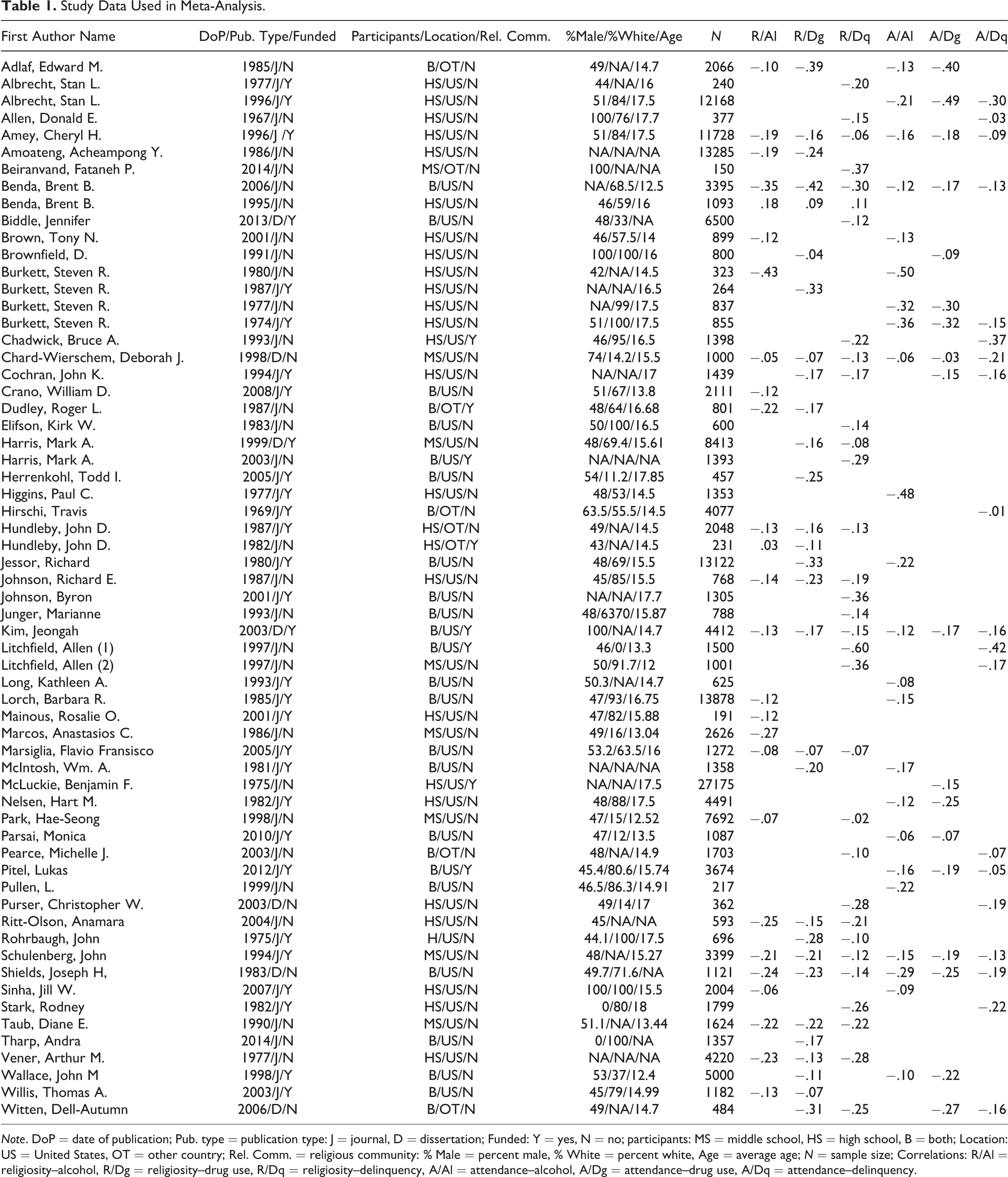
Note. DoP = date of publication; Pub. type = publication type: J = journal, D = dissertation; Funded: Y = yes, N = no; participants: MS = middle school, HS = high school, B = both; Location: US = United States, OT = other country; Rel. Comm. = religious community: % Male = percent male, % White = percent white, Age = average age; N = sample size; Correlations: R/Al = religiosity–alcohol, R/Dg = religiosity–drug use, R/Dq = religiosity–delinquency, A/Al = attendance–alcohol, A/Dg = attendance–drug use, A/Dq = attendance–delinquency.
Alcohol Use
Religiosity
We identified 26 reports that included a bivariate correlation of alcohol use and religiosity (see Table 2). The meta-analytic results revealed a small, negative correlation (
Overall Average Correlation.
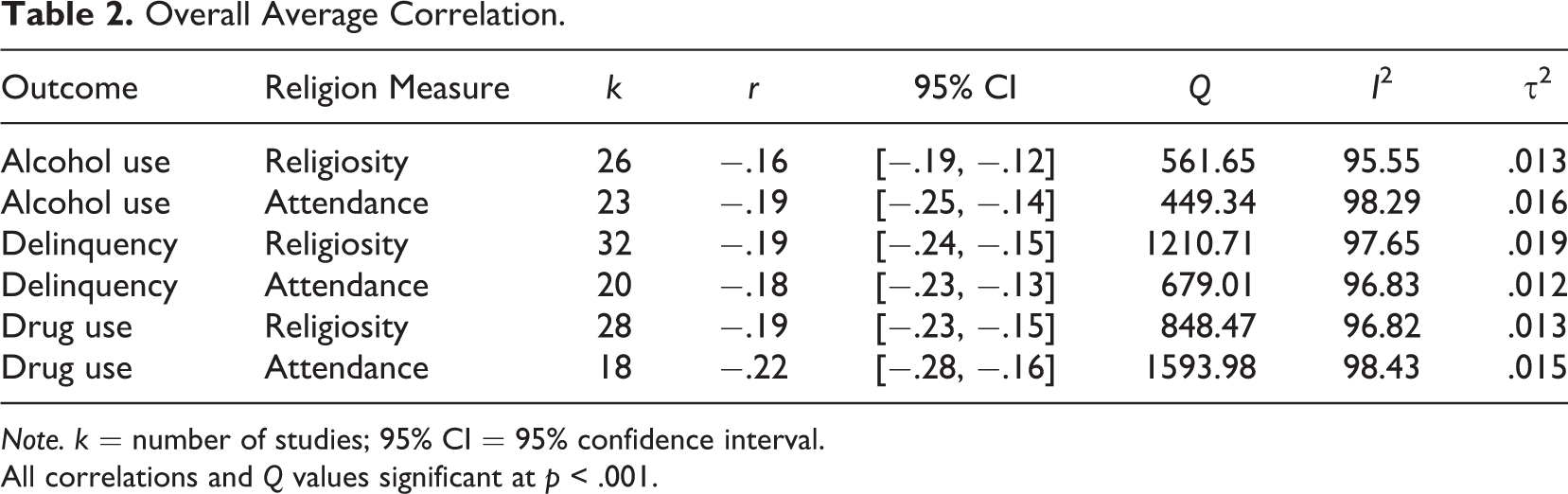
Note. k = number of studies; 95% CI = 95% confidence interval.
All correlations and Q values significant at p < .001.
Inherent in the average effect size was a high degree of heterogeneity (Q = 561.65, p < .001, I
2 = 95.55). As such, we conducted moderator analyses to understand the causes of heterogeneity. Panel A in Table 3 shows that three categorical moderators had sufficient studies per level (i.e., k > 5). Studies that were not funded (Q = 23.91, p < .001) were revealed to have a slightly larger correlation (
Moderator and Meta-Regression Analysis for Alcohol Use and Religiosity (Panel A) and Church Attendance (Panel B).
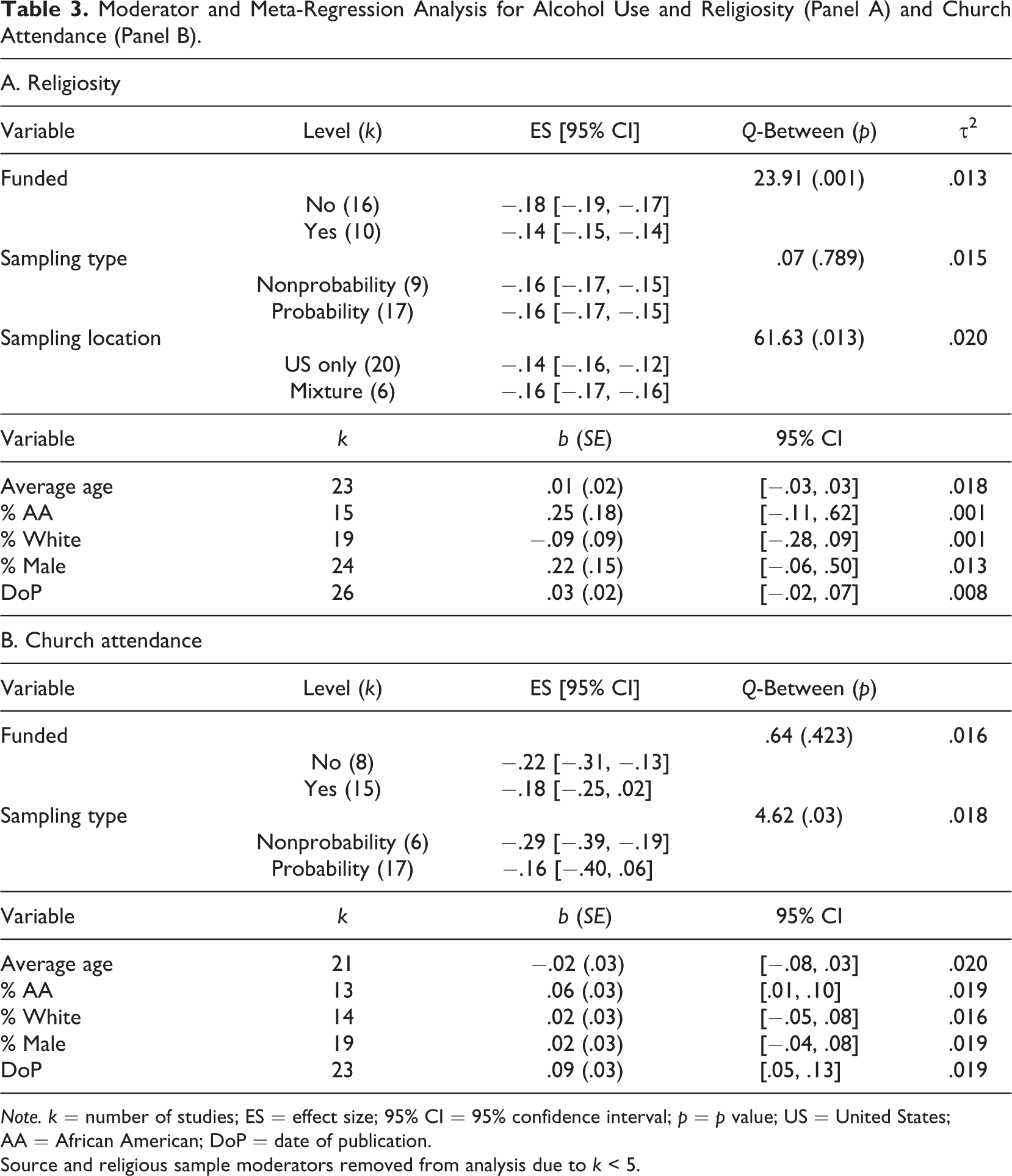
Note. k = number of studies; ES = effect size; 95% CI = 95% confidence interval; p = p value; US = United States; AA = African American; DoP = date of publication.
Source and religious sample moderators removed from analysis due to k < 5.
Church attendance
The search and screen procedures found 23 studies that reported a bivariate correlation between alcohol use and church attendance (see Table 2). The results revealed a small-to-moderate, negative correlation (
Given significant heterogeneity among the effect sizes, we conducted a series of moderator analyses with the results being summarized in Panel B of Table 3. The top part shows only two of the categorical moderators, funding and sampling type, had enough studies per level, although neither was revealed as significant moderators of the average effect sizes. Of significant note, however, two of the five continuous moderators were revealed as significant predictors of the effect sizes. The date of publication predicted the average effect size (b = .09, SE = .03, p < .001). A study conducted early in the database (i.e., 1960s) generally had a larger effect size (i.e., more negative) relative to a study conducted later in the database (i.e., 2000s). In addition, the percentage of African Americans in the study was positively and significantly related to the average effect size (b = .06, SE = .03, p = .04). In other words, as the percentage of African American students increased throughout studies, the less of a relationship was found between alcohol use and church attendance. This is inconsistent with the previous finding that religious influence is more likely among racial minorities, especially Blacks.
Delinquency
Religiosity
Our procedures revealed 32 studies where a bivariate correlation was extracted for the relationship between delinquency and religiosity. The results, presented in Table 2, again revealed a small-to-moderate average effect size (
Moderator and Meta-Regression Analysis for Delinquency and Religiosity (Panel A) and Church Attendance (Panel B).
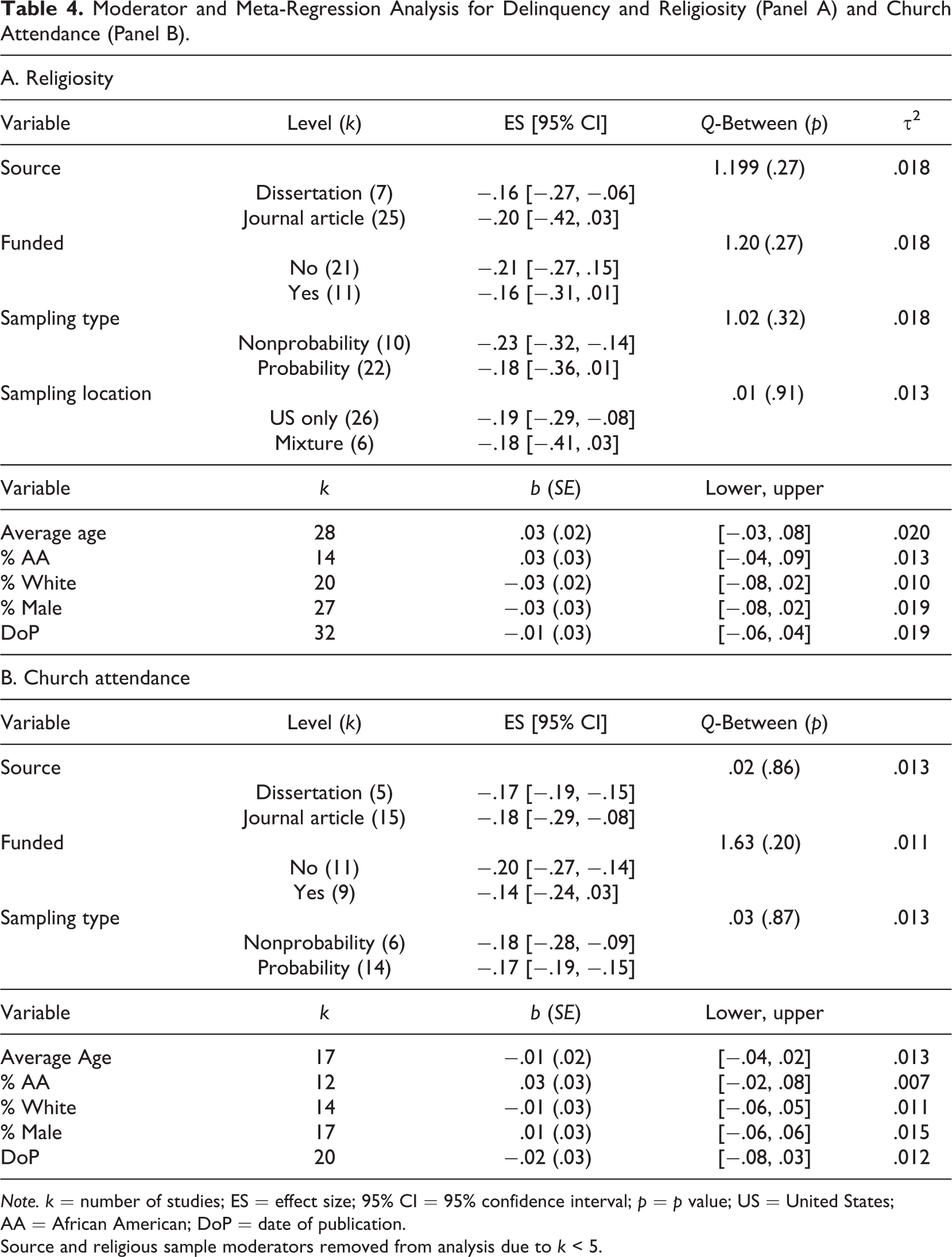
Note. k = number of studies; ES = effect size; 95% CI = 95% confidence interval; p = p value; US = United States; AA = African American; DoP = date of publication.
Source and religious sample moderators removed from analysis due to k < 5.
Church attendance
We found 20 studies that measured delinquency and church attendance, and the results indicated a similar average effect size (
Drug Use
Religiosity
Twenty-eight studies were found that reported a bivariate correlation between drug use and religiosity (see Table 2). The average correlation remained similar in size to the previous analyses (
Given significant heterogeneity among the effect sizes, we conducted a series of moderator analyses and found four categorical moderators to have sufficient studies per level for analysis. The results shown in Table 5 (see Panel A) indicate that a study’s source was a significant moderator (Q = 37.75, p < .001), and studies that derived from a dissertation had a smaller average effect size (
Moderator and Meta-Regression Analysis for Drug Use and Religiosity (Panel A) and Church Attendance (Panel B).
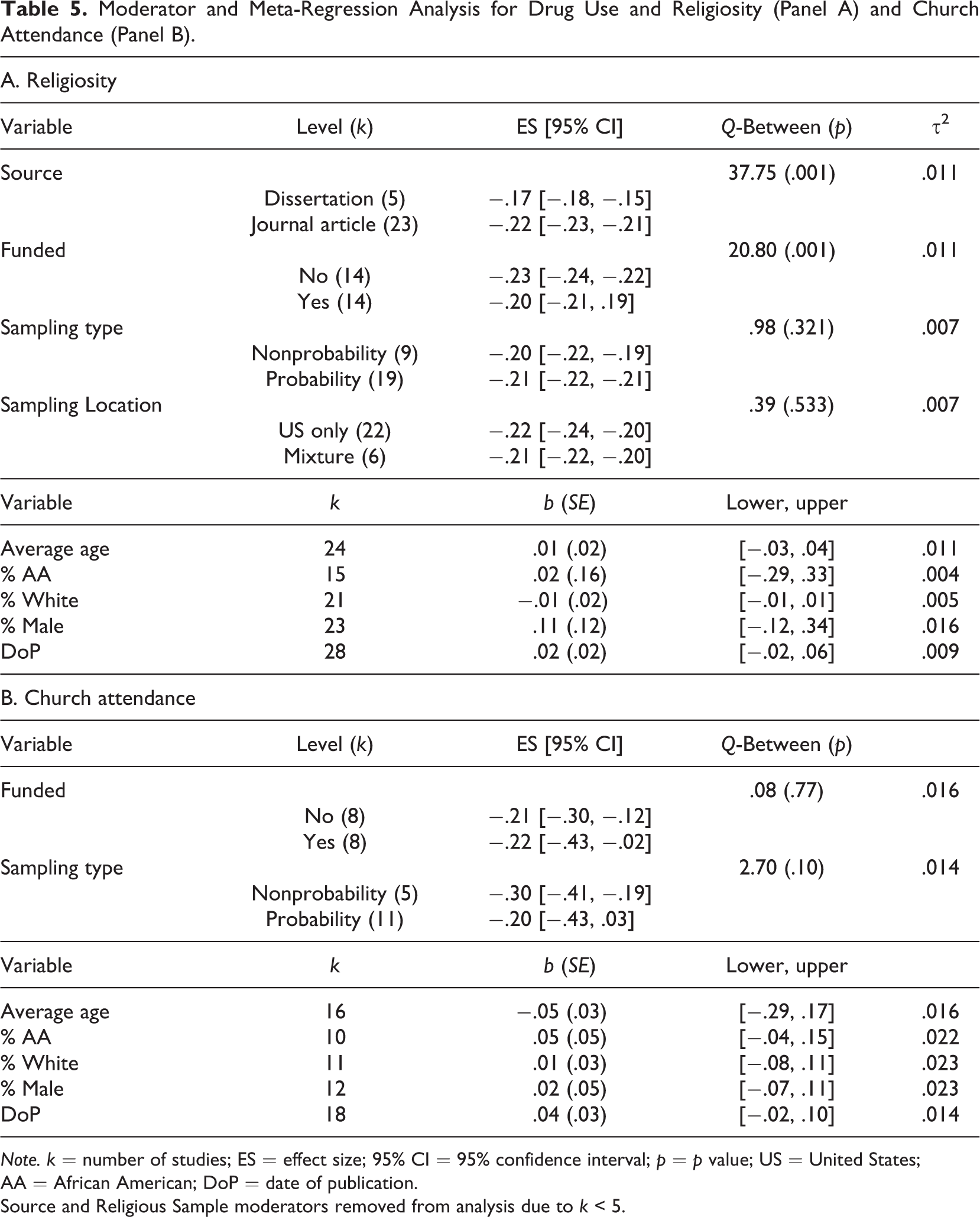
Note. k = number of studies; ES = effect size; 95% CI = 95% confidence interval; p = p value; US = United States; AA = African American; DoP = date of publication.
Source and Religious Sample moderators removed from analysis due to k < 5.
Church attendance
The final set of bivariate correlations between drug use and church attendance yielded 18 studies (see Table 2). The meta-analytic results showed a moderate average effect size (
Once again, moderator analyses were utilized in an attempt to explain the heterogeneity. Two of the categorical moderators had enough studies per level. The results indicated that neither of the categorical moderators yielded significantly different results. The test of the continuous moderators revealed similarly nonstatistically significant results.
Publication Bias
In addition to seeking unpublished dissertations, we conducted publication bias analyses to ensure valid results as indicated above. Results from conducting Duval and Tweedie’s trim and fill procedure (2000) showed little difference between the observed and imputed average effect size, indicating that none of the six bivariate correlations suffered from publication bias in the form of missing studies. We therefore concluded that our search and screening procedure, in addition to the meta-analytic calculations, were valid representations of the universe of studies.
Discussion
While it has been found that religious involvement and delinquent behavior are inversely related (Jang, 2013; Johnson & Jang, 2010), the present study adds to our knowledge because it provides additional evidence of the breadth of this relationship. Our meta-analysis of 62 peer-reviewed journal articles and unpublished dissertations tends to confirm that juvenile behavior has an inverse relationship with religiosity and church attendance: All six bivariate correlations between religious involvement—whether it was measured as attitude (religiosity) or behavior (church attendance)—and delinquent behavior—whether we employed alcohol use, drug use, or nondrug delinquency—resulted in an inverse relationships. Among the six, the relationship between church attendance and drug use (r = −.22) was found to be large relative to the other bivariate associations, which ranged from r = −.16 to r = −.19. This finding is consistent with prior research that tends to find larger influence of religious involvement (1) when measured by a behavioral (church attendance) than attitudinal indicator (perceived importance of religion) and (2) on ascetic (drug use) than nonascetic deviance (nondrug delinquency).
On the other hand, we found religious involvement, whether a behavioral or attitudinal dimension was examined, to have somewhat larger effect on illicit than on licit drug use, although the opposite was expected based on the anticipated differential effects of religious involvement on different types of deviance in terms of seriousness. Specifically, associations between illicit drug use and the two measures of religious involvement, religiosity (r = −.19) and church attendance (r = −.22), were found to be large relative to those between licit drug use (i.e., alcohol use) and the two religious measures, religiosity (r = −.16) and church attendance (r = −.19). However, the bivariate relationship involving a behavioral measure of religious involvement (r = −.22 and −.19) remained larger than that involving an attitudinal measure (r = −.19 and −.16).
In addition, moderator analyses revealed findings of interest. First, studies that did not receive funding had larger inverse correlations with one exception (i.e., studies on church attendance and drug use). Second, journal articles and nonprobability samples were shown to have larger correlations than dissertations and probability samples, respectively, as well. Finally, the date of publication was a significant moderator that revealed a larger correlation for studies conducted before 2000. While these findings are all intriguing, what do they mean? To answer this question, it is necessary to conduct an analysis of a sufficient number of studies that vary in potential explanatory factors of each moderator.
For example, we found studies using probability samples to be likely to report smaller correlations than those using nonprobability samples, while Baier and Wright (2001) found no difference between these two in their meta-analysis. Was it because of their differences in sample size, composition, or some other characteristics? Also, why do older studies, published before 2000, tend to find larger correlation than those published after? Does it have to do with the year of data analyzed (Baier & Wright, 2001), types of analytic methods, or changes in editorial policy? Addressing these questions is beyond the scope of our study, but is one avenue of further research.
Overall results from our meta-analysis tend to be consistent with conclusions of previous literature reviews, whether traditional or systematic, and meta-analyses; that is, religiousness, both attitudinal and behavioral, is inversely related to delinquency and drug use among adolescents. While meta-analysis is to be regularly conducted for update as more studies are published, we argue, the debate over whether the religion–delinquency relationship is nothing but spurious has been settled. The relationship is now empirically well documented. Thus, putting the debate behind, we should move beyond the almost half-century-old “hellfire” hypothesis that has been studied for decades, to pursue a new research agenda on criminology of religion.
For example, numerous researchers have examined whether “secular” or nonreligious predictors of crime explain the religion–delinquency relationship and found the predictors—drawn from major theories of deterrence, social bonding, self-control, social learning, and general strain theories—to mediate the relationship (Johnson & Jang, 2010). That is, religious involvement tends to decrease delinquency in part because it is likely to increase the levels of fear of punishment, social bonds, and self-control, while decreasing delinquent learning and strain-related negative emotions. The religious effect, however, is often found to remain significant after controlling for those variables.
To explain the remaining religious influence, Johnson and Jang (2010) suggest criminologists should explore uniquely religious factors, whose influence on delinquency may not be fully mediated by nonreligious variables. For instance, other things being equal, religious adolescents are less likely to react to strain (e.g., being bullied or criminal victimization) in a delinquent manner than their nonreligious or less religious peers. This may be partly because they are more likely to engage in religious coping, looking for a strength from or connection with God; in this case, the influence of religion is uniquely religious in that their nonreligious or less religious peers are not or less likely to employ religious coping.
While we believe this meta-analysis (which has rarely been done in research on religion and crime) contributes to the criminological literature, we need to acknowledge key limitations of this study. First, as with any meta-analysis, this study is entirely observational, and thus, its conclusions should not be interpreted as causation. This is especially relevant for moderator analyses, which are prone to chance findings (Polanin & Pigott, 2014). Second, although all efforts were made to locate published studies and dissertations, our search failed to include additional publication outlets, such as research reports and papers presented at conferences. Future research should take pains to locate these studies. Third, in order to produce unbiased and independent effect sizes, we averaged correlations within a study when necessary. This is not ideal yet one that is standard practice for meta-analysis (Shadish & Haddock, 2009). Fourth, we did not consider the influence of measurement error. This occurred, however, because most studies failed to provide an estimate of reliability, and we therefore choose to limit our analysis to observed correlations rather than adjust for this error. Finally, we had to exclude longitudinal studies from our meta-analysis because few of them reported longitudinal correlations, which need to be analyzed separately from their cross-sectional counterparts. This limitation needs to be kept in mind when results are interpreted.
Despite these limitations and our restricted coverage of materials, all six bivariate correlations indicated both statistical and clinical significance of a relationship between religious and delinquent behavior. Over the last several decades, there has been an increase in the number of studies within the field of criminology that include religious variables. Moreover, faith-based approaches to crime, delinquency, drug treatment, offender rehabilitation, and various prison programs are becoming more common. If this pattern continues, there will be a need for meta-analyses of this emerging and increasing policy relevant body of research. Finally, providing meta-analytic evidence of the relationship between religious involvement and delinquent behavior, we have built a firm foundation on which future research may further our knowledge about the religion–delinquency relationship.
Footnotes

Declaration of Conflicting Interests
The authors declared no potential conflicts of interest with respect to the research, authorship, and/or publication of this article.
Funding
The authors disclosed receipt of the following financial support for the research, authorship, and/or publication of this article: Joshua R. Polanin was partially supported by an Institute of Education Sciences Postdoctoral Fellowship grant (R305B100016).