



Abstract
The purpose of this study was to determine whether measures of criminal thought content and criminal thought process are capable of mediating the peer influence effect. Participants were all 1,725 (918 boys and 807 girls) members of the National Youth Survey. The average age of the participants was 13.87 years at initial contact. In this study, attitudes toward deviance served as a measure of criminal thought content, proactive criminal thinking served as a measure of criminal thought process, and the lagged delinquent peers–offending relationship marked the peer influence effect. Path analysis was conducted with structured equation modeling and demonstrated that criminal thought content and criminal thought process, both individually and conjointly, mediated the peer influence effect. There was no evidence that these effects were moderated by gender. A principal implication of these results is that criminal thought content and criminal thought process are both instrumental in mediating the effect of peer deviance on participant delinquency. In addition, criminal thought content and criminal thought process appear to be learned through association with deviant peers while providing nonredundant and largely additive variance to predictions of subsequent offending via their ability to link prior delinquent peer associations to future offending behavior.
Keywords
Although antisocial cognition is one of the “Big Four” predictors of recidivism and a potentially important dynamic risk factor (Andrews & Bonta, 2010), its role in criminological theory and research remains unclear. In clarifying this role, it is important that we understand what is meant by the term antisocial cognition. Walters (1990) originally defined antisocial cognition as cognitive patterns designed to advance, protect, and maintain a criminal lifestyle. Kroner and Morgan (2014) refined this definition by distinguishing between criminal thought content (what an offender thinks) and criminal thought process (how an offender thinks). The criminal thought process component of antisocial cognition can be further divided into a proactive dimension and a reactive dimension (Walters, 2012a). While proactive criminal thinking is cold, calculating, predatory, and unemotional, reactive criminal thinking is hot, spontaneous, impulsive, and hyperemotional. The Psychological Inventory of Criminal Thinking Styles (PICTS; Walters, 1995) appears to do an adequate job of assessing criminal thought process and its two primary dimensions, proactive and reactive criminal thinking, but there is no generally accepted measure of criminal thought content. Such a measure is required, however, if we hope to achieve a consummate understanding of antisocial cognition.
Criminal Thought Content Versus Process
In an effort to determine whether the Criminal Sentiments Scale (CSS; Gendreau, Grant, Leipciger, & Collins, 1979; Simourd, 1997) could serve as a possible measure of criminal thought content, Walters (2016) performed a meta-analysis of the CSS as a predictor of recidivism and correlate of criminal thought process. Prior to conducting this meta-analysis, Walters identified three dimensions he believed should be covered by a content valid measure of criminal thought content: negative attitudes toward authority, positive attitudes toward deviance, and criminal identity. He reasoned that one of the three CSS subscales assessed negative attitudes toward authority (Attitudes Toward the Law, Court, and Police: LCP) and another assessed features of a criminal identity (Identification With Criminal Others: ICO). The third subscale, however, was a measure of neutralization (Sykes & Matza, 1957), which is a core feature of criminal thought process. The meta-analysis itself revealed that the CSS total score and one of its subscales (i.e., LCP) performed equivalently to what had been observed previously in a meta-analysis of the PICTS general criminal thinking, proactive, and reactive scales (Walters, 2012b). In the only published study to include participants administered both the PICTS and the CSS, Morgan, Fisher, Duan, Mandracchia, and Murray (2010) discovered that the CSS correlated significantly better with the PICTS proactive scale than with the PICTS reactive scale.
Criminal thought content should be assessed with a measure that covers at least one of the three content areas identified by Walters (2016). A measure of criminal thought process, on the other hand, should assess the rationalizations, excuses, and moral disengagements that characterize proactive criminal thinking or the impulsivity, inconsistency, and emotionality that characterize reactive criminal thinking. Given that proactive criminal thinking was found to correlate better with CSS measures of criminal thought content than reactive criminal thinking (Morgan et al., 2010) and was the only dimension of criminal thought process available in the National Youth Survey (NYS; Elliott, 1976–1980), as assessed by techniques of neutralization, it became the focus of the current investigation. Neutralization overlaps with two of the four thinking styles covered by the PICTS proactive scale (mollification and entitlement), and the NYS neutralization scale encompasses these plus a third proactive thinking style (power orientation). Hence, it was possible to construct a measure of criminal thought content reflecting one of the three dimensions of criminal thought content (attitudes toward deviance) and a measure of criminal thought process reflecting three of the four thinking styles associated with the PICTS proactive criminal thinking scale (mollification, entitlement, and power orientation).
Differential Association and the Peer Influence Effect
An issue in the field of criminology that could perhaps be resolved by research on criminal thought content and criminal thought process is the confusion and lack of consensus over how differential association achieves its criminogenic effect. The relationship between peer associations and subsequent delinquency is well documented (Akers, 1998; Pratt et al., 2010); the mechanism behind the effect, however, has long been a matter of debate. Sutherland (1947) initially held that the primary mechanism through which peer deviance was transmitted was a transfer of attitudes from peers to affected youth. An alternate view is that the primary impetus for differential association or peer influence is the modeling of actual criminal behavior (Costello & Vowell, 1999; Matsueda & Anderson, 1998; Warr & Stafford, 1991). Although the relationship between antisocial thought content and delinquent peer associations has been studied before (Menard & Elliott, 1994; Thornberry, Lizotte, Krohn, Farnworth, & Jang, 1994), there has been only a modicum of research on the relationship between antisocial thought process and delinquent peer associations and no research, to the author’s knowledge, examining the conjoint effect of antisocial thought content and process on delinquent peer associations.
In prior research on proactive criminal thought process and delinquent peer associations, neutralization has been found to correlate with delinquent peer associations in both cross-sectional (Mitchell & Dodder, 1990) and longitudinal (Ariza, Cebulla, Aldridge, Shute, & Ross, 2014) studies. Using measures of both neutralization (Sykes & Matza, 1957) and moral disengagement (Bandura, Barbaranelli, Caprara, & Pastorelli, 1996) to represent proactive criminal thinking, Walters (2015, in press) determined that attitude transfer mediated the peer influence effect, the latter of which was operationally defined as delinquent peer associations leading to participant delinquency. In one of these studies (Walters, in press), proactive but not reactive criminal thinking mediated the peer influence effect (delinquent peers leading to participant delinquency) and reactive but not proactive criminal thinking mediated the peer selection effect (participant delinquency leading to delinquent peers). In neither study, however, was criminal thought content tested as a possible explanation for the peer influence or selection effects. There is consequently a need to evaluate whether criminal thought content also mediates the peer influence effect beyond the contributions of proactive criminal thinking. Hence, the research question asked within the context of the present study was whether proactive criminal thought process and criminal thought content are incrementally valid relative to one another in mediating the peer influence effect.
Potential Moderator Variables
In conducting research on the peer–delinquency relationship, it is imperative that factors potentially capable of moderating the peer influence effect be studied and controlled. Two such factors are gender and parenting. Gender, for instance, has been found to moderate the effect of peers on moral evaluations (Mears, Ploeger, & Warr, 1998) and the effect of peer selection (Walters, 2016) using data from the NYS. Evidence gathered from studies done on other samples indicate that peer associations are more important determinants of delinquency in boys than in girls (Augustyn & McGloin, 2013; Fagan, Van Horn, Hawkins, & Arthur, 2007; Walters, 2014) and that parenting may exert a stronger effect on delinquency in girls than in boys (Silverman & Caldwell, 2005; Walters, 2013), although the research in both areas is far from conclusive (see Hoeve et al., 2009; Negriff, Ji, & Trickett, 2011). Parenting factors have also been found to moderate the effects of peer delinquency on participant delinquency (Henneberger, Durkee, Truong, Atkins, & Tolan, 2013). It is quite possible, then, that the peer influence effect differs as a function of both gender and parenting and so both factors should be taken into account when designing studies on the peer influence effect. Accordingly, the moderating effect of gender on peer influence, particularly in a study where parenting factors are controlled, should probably be tested and the results thoroughly investigated before assuming that the peer delinquency–participant delinquency relationship is not moderated by participant sex.
The Current Study
The purpose of this study was to determine whether criminal thought content (attitudes toward deviance) and criminal thought process (proactive criminal thinking) mediate the peer influence effect (peer delinquency leading to participant offending) using a model Hayes (2013) refers to as parallel multiple mediation (see Figure 1). In a previous study, Hochstetler, Copes, and DeLisi (2002) determined that an accepting attitude toward deviance correlated with future delinquency in the NYS sample. The current investigation extends Hochstetler et al.’s preliminary findings by testing whether a measure of criminal thought content anchors a genuine indirect effect extending from delinquent peer associations to subsequent offending behavior and whether this effect is incrementally valid when coupled with the criminal thought process mediating effect that also runs from delinquent peer associations to subsequent offending previously observed in Walters (2015, in press). The hypothesis tested in this study held that criminal thought content and criminal thought process would mediate the peer influence effect both individually and conjointly. Along with demographic and parental control variables, interaction terms (e.g., Peer Delinquency × Sex) were added to the path analysis in an effort to evaluate for the possibility of moderation by gender and parenting.
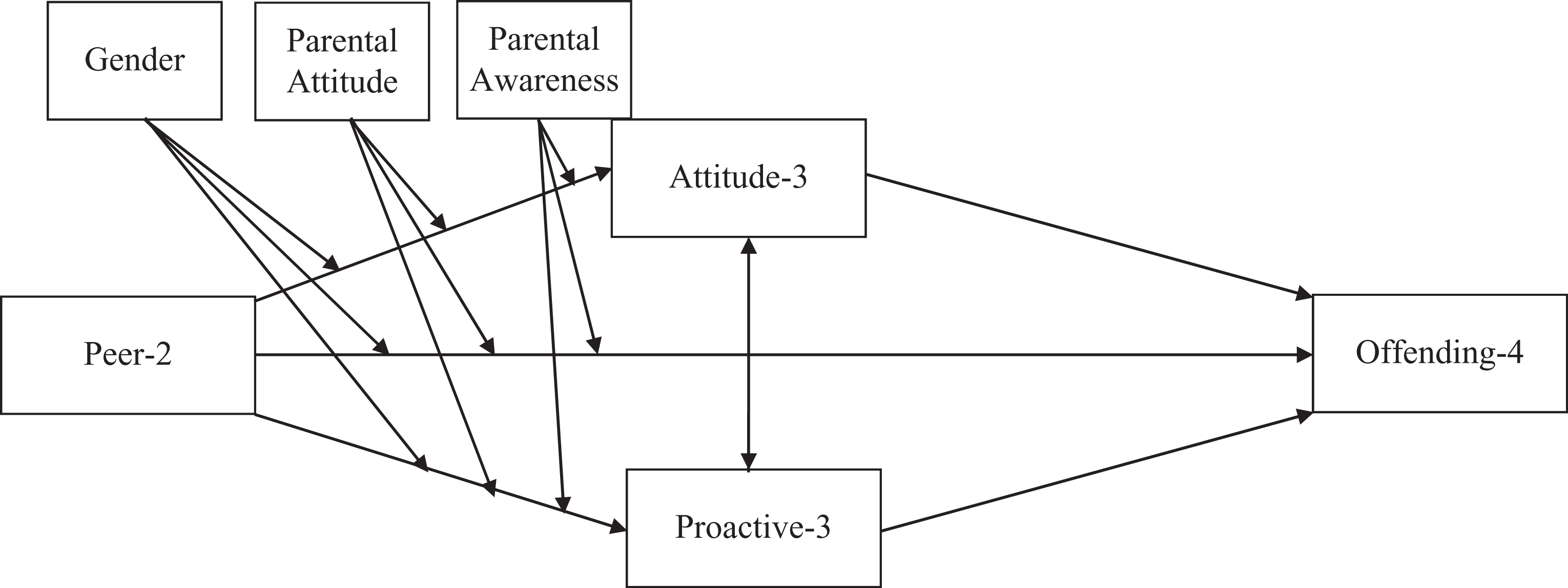
Schematic diagram of the model being proposed in this study with Wave 2 peer delinquency serving as the independent variable, Wave 4 offending behavior serving as the dependent variable, Wave 3 attitudes toward deviance and proactive criminal thinking serving as parallel mediators, and gender, parental attitude, and parental awareness serving as moderators of the peer → mediator and peer → offending pathways.
Method
Participants
The sample for the current study was comprised of youth from the 1,725-member NYS (Elliott, 1976–1980). The NYS is a nationally representative sample of U.S. children first interviewed in 1976 (Wave 1). The sample included 918 boys and 807 girls, and the racial/ethnic breakdown was 78.9% White, 15.1% Black, 4.4% Hispanic, 1.0% Asian, 0.5% Native American, and 0.2% other. The average age of the participants at the start of the study (Wave 1) was 13.87 years (SD = 1.94, range = 11–17), and the median grade level for students participating in the NYS was eighth grade (range = 4–13).
Measures
Wave 2 peer delinquency (Peer) served as the independent variable in this study. This variable was measured with 13 questions about the proportion of close friends the respondent believed participated in the following behaviors over the past year: (1) cheated on school tests; (2) purposely damaged or destroyed property that did not belong to them; (3) used marijuana or hashish; (4) stole something worth less than US$5; (5) hit or threatened to hit someone without any reason; (6) used alcohol; (7) broke into a vehicle or building to steal something; (8) sold hard drugs such as heroin, cocaine, or LSD; (9) stole something worth more than US$50; (10) suggested you do something that was against the law; (11) got drunk once in a while; (12) used prescription drugs such as amphetamines or barbiturates when there was no medical need for them; and (13) sold or gave alcohol to kids under 18. These behaviors were each rated on a 5-point scale (1 = none of them, 2 = few of them, 3 = some of them, 4 = most of them, 5 = all of them), and the results summed to produce a scale that ranged from 13 to 65. These 13 items possessed good internal consistency in the NYS (α = .87).
Wave 4 offending behavior (Offend 4) served as the dependent variable in this study. This was measured with self-reported involvement in 17 different criminal acts over the past year: purposely damaged school property; stealing or trying to steal a motor vehicle; stealing something worth more than US$50; knowingly buying or selling stolen property; carrying a hidden weapon other than a plain pocket knife; stealing something worth less than US$5; attacking someone with the idea of seriously hurting or killing them; being involved in a gang fight; selling marijuana or hashish; selling hard drugs such as heroin, cocaine, and LSD; taking a vehicle for a ride without the owner’s permission; having sexual relations with someone against their will; using force (strong-arm methods) to get money or things from other students; using force (strong-arm methods) to get money or things from a teacher or other adult at school; using force (strong-arm methods) to get money or things from people other than students or teachers; stealing something worth between US$5 and US$50; and breaking into a building or vehicle (or trying to break in) to steal something or just look around. A 9-point scale was used to rate each item (1 = never, 2 = once or twice, 3 = once every 2–3 months, 4 = once a month, 5 = once every 2–3 weeks, 6 = once a week, 7 = 2–3 times a week, 8 = once a day, 9 = 2–3 times a day), and the results were then summed to create a score that ranged from 17 to 153. Test–retest reliability ranged from .60 to .71 for this 17-item index in 2-year intervals between Wave 2 and Wave 4.
Two mediator variables were included in this study: attitudes toward deviance and proactive criminal thinking. Attitudes toward deviance (Attitude) were assessed with a series of self-report questions. One section of the NYS interview protocol presented participants with a series of questions preceded by the following sentence stem (How wrong is it for someone your age to …). The nine forms of deviance evaluated on this scale were cheat on a school test, destroy property, use marijuana, steal less than US$5, hit someone, use alcohol, steal a motor vehicle, sell hard drugs, and steal more than US$50. Each item was evaluated on a 5-point scale (1 = strongly disapprove, 2 = disapprove, 3 = neither approve nor disapprove, 4 = approve, 5 = strongly approve) to produce a score that ranged from 9 to 45. Moderately high levels of internal consistency were obtained in the Waves 2 and 3 administrations of the Attitude scale for the NYS (α = .84–.85).
Proactive criminal thinking (Proactive) was assessed with 10 items from the interpersonal violence and normlessness sections of the NYS. These items were originally designed to measure neutralization, a core component of proactive criminal thinking. The 10 items and the proactive criminal thinking styles they seemed to represent are listed as follows: (1) It is alright to physically beat up another person if he or she called you a dirty name (mollification); (2) Hitting another person is an acceptable way to get him or her to do what you want (power orientation); (3) It is alright to beat up another person if he or she started the fight (mollification); (4) If you don’t physically fight back, people will walk all over you (power orientation); (5) To stay out of trouble, it is sometimes necessary to lie to teachers (entitlement); (6) At school, it is sometimes necessary to play dirty in order to win (entitlement); (7) It is okay to lie if it keeps your friends out of trouble (mollification); (8) In order to gain the respect of your friends, it’s sometime necessary to beat up on other kids (power orientation); (9) Sometimes it’s necessary to lie to your parents in order to keep their trust (entitlement); and (10) It may be necessary to break some of your parents’ rules in order to keep some of your friends (entitlement). Each item was rated on a 5-point Likert-type scale (1 = strongly disagree, 2 = disagree, 3 = neither agree nor disagree, 4 = agree, 5 = strongly agree). Scores on these items were then summed to create a scale that ranged from 10 to 50. A neutralization scale very similar to the one employed in the NYS correlated .45 with the PICTS Proactive score and loaded .90 onto a latent proactive criminal thinking factor in a recent study by Walters and Yurvati (2015). This scale displayed good internal consistency during Waves 2 and 3 of the NYS: α = .82–.85.
Five control variables from Wave 1 of the NYS were included in this study. These variables consisted of three demographic measures (age [in years], sex [1 = male, 2 = female], race [1 = White, 2 = non-White]) and two parent-rated background variables (parental attitudes toward deviance and parental awareness). Parental attitudes toward deviance were based on reports from one parent, usually the mother (92.5% of the time), using the same 9 items as the Attitudes measure and a 4-point rating scale (1 = very wrong, 2 = wrong, 3 = a little bit wrong, 4 = not wrong). Scores on this scale ranged from 9 to 36, and the scale displayed good internal consistency (α = .85). Parental awareness of their child’s friends was assessed with three questions (How many of your child’s close friends do you know? How many of your child’s close friends have you invited to your home or included in family activities outside the home such as picnics or movies? and How many parents of your child’s close friends do you know personally?). Each question was rated on a 5-point scale (1 = all of them, 2 = most of them, 3 = some of them, 4 = few of them, 5 = none of them) and then summed to form a scale that ranged from 3 to 15. This 3-item scale possessed excellent internal consistency (mean interitem r = .55).
Procedure
A nonexperimental longitudinal panel study of the first four waves of the NYS was conducted. Because there was no overlap between waves, the current study qualifies as prospective in nature. Control variables were measured at Wave 1 of the NYS, the independent variable (peer delinquency) was measured at Wave 2, the two mediator variables (Attitudes, Proactive) were measured at Wave 3, and the dependent variable (offending) was measured at Wave 4. Moderation of the peer delinquency–mediator and peer delinquency–outcome relationships by gender, parental attitudes, and parental awareness was tested by including interaction terms between the independent variable (Wave 2 peer delinquency) and each of the three control variables (sex, parental attitudes, parental awareness), after each variable had been centered, in the regression equations of the path analysis predicting the mediating and dependent variables.
Cole and Maxwell (2003) maintain that when performing mediation analysis, it is vital that prior levels of the predicted variables be controlled in order to rule out the possibility that the results were due to preexisting difference on these variables. Consequently, Wave 2 precursor measures for both mediator variables and a precursor measure of the dependent variable were included in regression equations predicting the mediating and dependent variables, respectively. For the purposes of this study and consistent with previous research, the peer influence effect was operationally defined as peer delinquency leading to subsequent offending behavior. Control variables were measured at Wave 1 to conform to the sequential ignorability assumption of causal mediation analysis which holds that control variables should precede the independent variable in time.
Data were analyzed with a path analysis and maximum likelihood (ML) estimator performed using MPlus 5.2 (Muthén & Muthén, 1998–2007). A four-equation path analysis was conducted on the two-mediator model, and 2 three-equation path analyses were conducted on the single-mediator models. Significance was evaluated with bias-corrected bootstrapped 95% confidence intervals (b = 5,000), and a significant effect was recorded when the confidence interval did not include zero. Bootstrapping is currently the preferred method for testing mediation because it does a better job of modeling the nonnormality of indirect effects and handling nonnormality in the dependent variable than the standard z-test and normal theory approach (Hayes, 2013; MacKinnon, Kisbu-Sakarya, & Gottschall, 2013; Rucker, Preacher, Tormala, & Petty, 2011). Kenny’s (2013) “failsafe ef” procedure—
Over 6 of every 10 participants had complete data on all 12 variables (62.7%) and another 24.2% had data missing on just one variable. Of the remaining participants, 8.3% were missing data on two or three variables, 1.8% were missing data on four or five variables, and 3.0% were missing data on six to nine variables. Five variables had more than 5% missing data: parental awareness (23.6%), Wave 2 peer delinquency (13.2%), Wave 4 offending (10.6%), Wave 3 Attitude (5.7%), and Wave 3 Proactive (5.7%). Missing data were handled with full information ML (FIML). FIML estimates model parameters and standard errors for the entire sample from known relationships between nonmissing data. Research indicates that FIML generates model parameters and standard errors that are significantly less biased than those produced by traditional missing data approaches like simple imputation and listwise deletion (Allison, 2012; Peyre, Leplége, & Coste, 2011).
Results
Descriptive statistics and correlations for the 12 variables included in this study are listed in Table 1. Regressing the dependent variable (Wave 4 Offending) onto the 11 independent, mediating, and control variables revealed no evidence of multicollinearity (tolerance = .364–.967, variance inflation factor = 1.034–2.747).
Descriptive Statistics and Correlations for the 12 Variables Included in the Current Study.
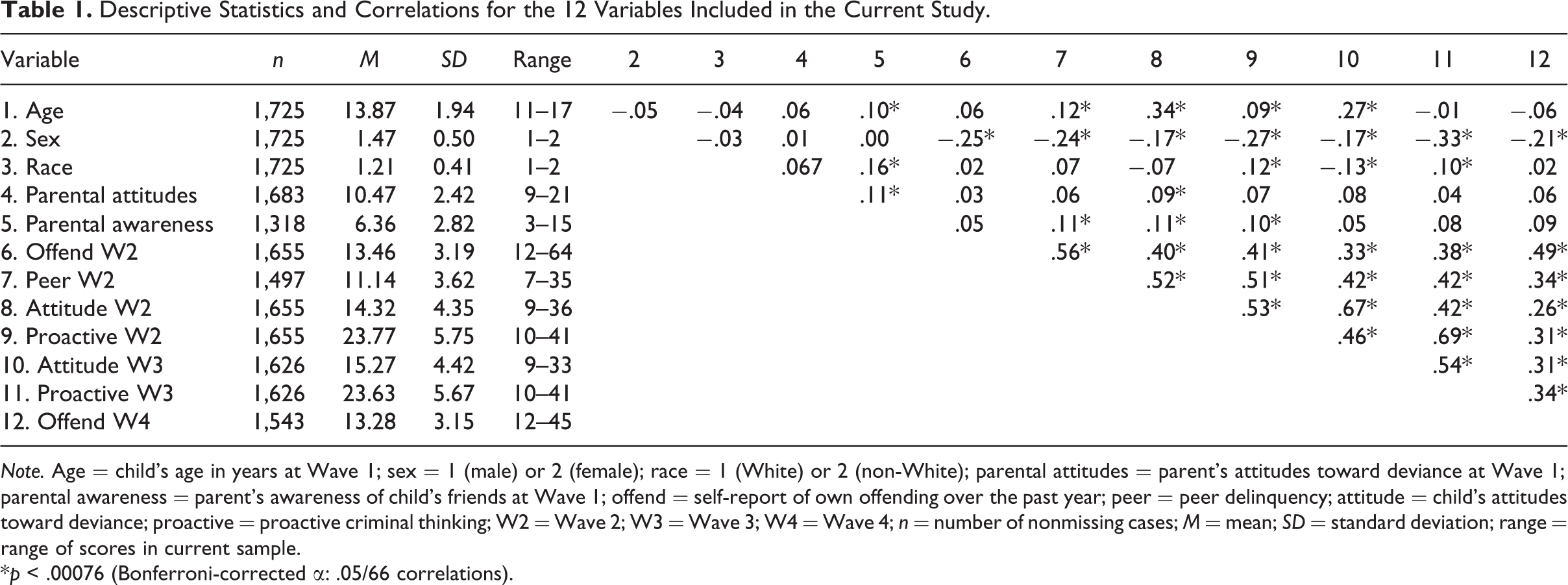
Note. Age = child’s age in years at Wave 1; sex = 1 (male) or 2 (female); race = 1 (White) or 2 (non-White); parental attitudes = parent’s attitudes toward deviance at Wave 1; parental awareness = parent’s awareness of child’s friends at Wave 1; offend = self-report of own offending over the past year; peer = peer delinquency; attitude = child’s attitudes toward deviance; proactive = proactive criminal thinking; W2 = Wave 2; W3 = Wave 3; W4 = Wave 4; n = number of nonmissing cases; M = mean; SD = standard deviation; range = range of scores in current sample.
*p < .00076 (Bonferroni-corrected α: .05/66 correlations).
The results of the four-regression SEM are reproduced in Table 2, and a summary of the total, direct, and indirect effects is provided in Table 3 and Figure 2. Several conclusions can be drawn from these results. First, there was no evidence of moderation by gender or parental attitudes, although parental awareness moderated the Wave 2 Peer–Wave 3 Proactive relationship and approached significance in moderating the Wave 2 Peer–Wave 3 Attitude relationship (see Table 2). The significant and borderline significant inverse correlations that surfaced between the Peer × Parental Awareness interaction in predicting Wave 3 Proactive and Attitude, respectively, indicate that criminal thought content and process were highest when parental awareness was low and peer delinquency was high. Second, both indirect effects (via Wave 3 Attitude and Wave 3 Proactive) were significant (see Table 3 under Specific Indirect Effects). Third, although the Wave 2 Peer → Wave 3 Attitude → Wave 4 Offending effect was larger than the Wave 2 Peer → Wave 3 Proactive → Wave 4 Offending effect, the difference was not significant according to the results of the Preacher–Hayes contrast test (see final row of Table 3). 1
Path Analysis of Attitudes Toward Deviance and Proactive Criminal Thinking as Mediators of the Peer Influence Effect.

Note. Peer 2 (outcome measure) = regression equation with Wave 2 peer delinquency as the predicted variable; Attitude 3 (outcome measure) = regression equation with Wave 3 attitudes toward deviance as the predicted variable; Proactive 3 (outcome measure) = regression equation with Wave 3 proactive criminal thinking as the predicted variable; Offend 4 (outcome measure) = regression equation with Wave 4 participant offending as the predicted variable; age = child’s age in years; sex = 1 (male) or 2 (female); race = 1 (White) or 2 (non-White); parental attitudes = parent’s attitudes toward deviance at Wave 1; parental awareness = parent’s awareness of child’s friends at Wave 1; peer = peer delinquency at Wave 2; attitude = attitudes toward deviance at Waves 2 and 3; proactive = proactive criminal thinking at Waves 2 and 3; offend = own offending at Waves 2 and 4; Peer 2 × Parental Attitude = interaction between Wave 2 peer delinquency and parental attitudes; Peer 2 × Parent Aware = interaction between Wave 2 peer delinquency and parental awareness; Peer 2 × Sex = interaction between Wave 2 peer delinquency and child sex; Attitude 3 with Proactive 3 = correlation between attitudes toward delinquency and proactive criminal thinking at Wave 3; b [95% CI] = unstandardized coefficient and the lower and upper limits of the 95% confidence interval for the unstandardized coefficient (in brackets); β = standardized coefficient; t = asymptotic t-test (standard z-test); p = significance level of the asymptotic t-test. N = 1,725.
Total, Direct, and Indirect Effects for Pathways Running From Peer Delinquency at Wave 2 to Own Delinquency at Wave 4.

Note. Peer 2 = peer delinquency at Wave 2; Attitude 3 = attitudes toward deviance at Wave 3; Proactive 3 = proactive criminal thinking at Wave 3; Offend 4 = participant offending at Wave 4; Preacher–Hayes Contrast Test = comparison between the two indirect effects using a test developed by Preacher and Hayes (2008); BCBCI = bias-corrected bootstrapped 95% confidence interval (b = 5,000); estimate = unstandardized point estimate; lower = lower boundary of the 95% confidence interval; upper = upper boundary of the 95% confidence interval. N = 1,725.
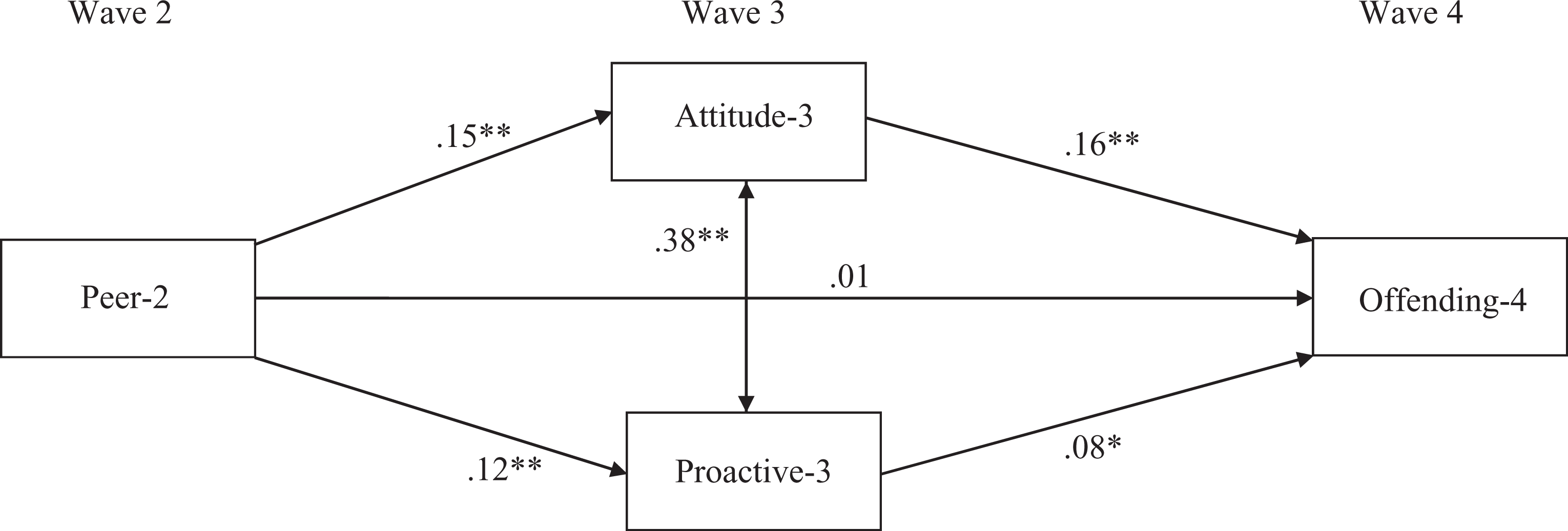
Path analysis of Wave 2 peer delinquency as a predictor of Wave 4 offending via Wave 3 attitudes toward deviance and proactive criminal thinking in adolescent boys and girls. Note. Standardized β coefficients are reported; Peer = peer delinquency; Attitude = attitudes toward deviance; Proactive = proactive criminal thinking; Offending = participant offending; control variables (age, sex, race, parental attitudes toward deviance, parent awareness, and the attitudes toward deviance and proactive criminal thinking precursors) are not shown; n = 1,725. *p < .01. **p < .001.
When examined separately, both indirect effects were significant: Wave 2 Peer → Wave 3 Attitude → Wave 4 Offending (estimate = 0.022, 95% CI [0.012, 0.038]) and Wave 2 Peer → Wave 3 Proactive → Wave 4 Offending (estimate = 0.013, 95% CI [0.006, 0.023]). The Wave 2 Peer → Wave 3 Attitude → Wave 4 Offending indirect effect accounted for 64.7% of the total effect, the Wave 2 Peer → Wave 3 Proactive → Wave 4 Offending indirect effect accounted for 28.9% of the total effect, and the two indirect effects accounted for 87.9% of the total effect when the two-mediator variables were analyzed together. The combined effect (Wave 3 Attitude and Wave 3 Proactive) represents a 35.8% increase in the amount of explained variance over mediation by Wave 3 Attitude alone.
Sensitivity testing conducted on the Wave 2 Peer → Wave 3 Attitude → Wave 4 Offending pathway revealed that a confounding covariate would need to correlate .17 with the mediator (Wave 3 Attitude) and .17 with the outcome (Wave 4 Offending), controlling for the mediator and independent variable (Wave 2 Peer) to reduce the b path (from mediator to dependent variable) of the Wave 2 Peer–Wave 4 Offending mediated relationship with nonsignificance. Sensitivity testing on the Wave 2 Peer → Wave 3 Proactive → Wave 4 Offending pathway revealed that a confounding covariate would need to correlate .20 with both the mediator (Wave 3 Proactive) and the outcome (Wave 4 Offending), again controlling for the mediator and independent variable, to eliminate the mediating effect of Wave 3 Proactive on the Wave 2 Peer–Wave 4 Offending relationship along the b path.
Discussion
The hypothesis tested in this study, that measures of criminal thought content and criminal thought process would mediate the peer influence effect, received support in this study. With attitudes toward deviance representing criminal thought content and proactive criminal thinking representing criminal thought process, criminal thought content and process, both separately and conjointly, mediated the peer delinquency–subsequent offending relationship. Sensitivity testing revealed that the mediating effects of attitudes toward deviance and proactive criminal thinking were modestly to moderately robust to the effects of unobserved covariate confounders. Previous research had shown that criminal attitudes (Thornberry et al., 1994) and neutralizations (Mitchell & Dodder, 1990) were linked to antisocial peer associations and a juvenile’s own delinquent behavior, but this was the first study to demonstrate that both criminal attitudes and neutralizations mediate the peer influence effect of antisocial peer associations on delinquent behavior. Whether we use the criminological terms of antisocial attitudes and neutralization or the criminal lifestyle terms of criminal thought content and criminal thought process, the results are the same—deviant peer associations lead to delinquency via exposure to and learning of antisocial attitudes (criminal thought content) and neutralization techniques (proactive criminal thought process) conducive to crime.
While mediation by criminal thought content exceeded mediation by criminal thought process, the two effects did not differ significantly from one another according to the Preacher and Hayes (2008) contrast test. What is more, the proportion of the total effect accounted for by the indirect effect rose nearly 36% when going from the best single-mediator model (Attitude only) to the combined mediator model (Attitude and Proactive). These results indicate that measures of criminal thought content and criminal thought process successfully mediated the peer influence effect in the current study, achieving significance both individually and collectively and demonstrating incremental validity relative to one another. Such findings also support and extend prior research on the role of criminal thought content and process in the peer delinquency–subsequent offending relationship (Hochstetler, Copes, & DeLisi, 2002; Walters, 2015, in press) and suggest that both criminal thought content and criminal thought process are important mediators of the peer influence effect. Finally, the current results imply that both transfer of attitudes (Sutherland, 1947), as represented in the present study by a measure of criminal thought content (Attitude), and the cognitive mechanisms for modeling of moral behavior (Bandura et al., 1996), as represented in the present study by a measure of criminal thought process (Proactive), were operating in the current investigation.
Nearly nine tenths of the total effect from the two-mediator model was accounted for by the indirect effect of attitudes toward delinquency and proactive criminal thinking on the peer delinquency–subsequent offending relationship. According to Baron and Kenny (1986), a significant indirect effect in the presence of a nonsignificant direct effect (i.e., full mediation) is a more desirable outcome than a significant indirect effect coupled with a significant direct effect (partial mediation). The difference between full and partial mediation, however, is no longer considered meaningful. To the extent that the total and direct effects often have less power to reject the null hypothesis than the indirect effect (Kenny & Judd, 2014) and a total effect can be weakened by suppressor variables or opposite sign (+ and −) multiple mediators (Rucker et al., 2011), most, if not all, mediation is partial, even when the total and direct effects are nonsignificant (Hayes, 2009). In the current study, for instance, the direct and total effects of the two single-mediator models were nonsignificant, despite the fact there was still room for at least one more significant mediator as evidenced by the significance of both mediators in the two-mediator model. This is why it is unwise to compare effect size measures like the proportion of the total effect accounted for by the indirect effect across studies. It is still useful to make such comparisons within a study, however, especially when comparing mediators that have the same independent and dependent variables.
There was no evidence in this study that sex moderated the peer delinquency → criminal thinking → subsequent offending relationship. When the interaction between peer delinquency and sex was included in the two (single-mediator models) and three (two-mediator model) regression equations in which peer delinquency and sex served as predictors, the results were nonsignificant. This occurred in seven of the seven instances. In direct contrast to the results of several recent investigations (Augustyn & McGloin, 2013; Fagan et al., 2007; Silverman & Caldwell, 2005; Walters, 2013, 2014, 2016), the indirect effect of criminal thought content and process on the peer delinquency–subsequent offending relationship did not differ as a function of participant sex. Although this finding is inconsistent with prior research, it is not, in and of itself, inconsistent with the gendered pathways theory of crime. This is because the gendered pathways theory of crime asserts that there are points of both similarity and difference between male and female offending (Chesney-Lind & Palko, 2004). Consequently, while peer relations may be more central to delinquency development in boys than girls, criminal thought content and criminal thought process appear to mediate the peer delinquency–subsequent offending relationship irrespective of whether the sample is comprised of boys, girls, or a mixture of the two.
Implications
The results of the current study denote that a comprehensive theory of criminal thinking should address criminal thought content as well as criminal thought process. In the current study, proxy measures of criminal thought content and criminal thought process were incrementally valid mediators of the peer delinquency–subsequent offending relationship after the alternate mediator (Proactive in the case of Attitude and Attitude in the case of Proactive) had been controlled. Lifestyle theory—a model in which criminal thinking is prominently featured (Walters, 2012a)—considers criminal thought process but not criminal thought content and takes a rational choice perspective on offending behavior. Differential association and social learning theories of crime (Akers, 1998; Menard & Elliott, 1994; Sutherland, 1947), by comparison, emphasize criminal thought content and are less oriented toward rational choice. Even with these differences in assumptions about rational choice and offender decision-making, these two lines of inquiry can be meaningfully reconciled, in part, by integrating criminal thought content with criminal thought process. In the only study to administer the PICTS (measure of criminal thought process) and CSS (measure of criminal thought content) to the same group of individuals, Morgan et al. (2010) discovered that the CSS correlated significantly better with the PICTS proactive scale than it did with the PICTS reactive scale. Additional research is required to determine how criminal thought content complements, contradicts, or confounds criminal thought process. In the current study, the evidence leaned in the direction of showing that criminal thought content complemented rather than competed with criminal thought process in mediating the peer influence effect.
Besides the previously mentioned theoretical implications, there are also several practical implications to the current results that need to be discussed. From a clinical evaluation standpoint, it may be advisable to include measures of both criminal thought content and criminal thought process in risk assessment. If criminal thought content and criminal thought process continue to demonstrate incremental validity relative to each other, as they did in the current study, then it would make sense for clinicians to administer both measures to criminal justice clients instead of just one. These practical implications also extend to treatment interventions for offenders. Rather than focusing exclusively on proactive and reactive criminal thinking styles, the intervention protocol should be expanded to include interventions designed to alter negative attitudes toward authority, positive attitudes toward deviance, and criminal identity. Berman (2004), for instance, determined that attitudes toward authority improved and identification with criminal others declined in a large group of Swedish prisoners exposed to a cognitive–behavioral group intervention. The problem with this study as well as with much of the literature on the treatment of criminal thought content and process is that while criminal thought content and process are known to predict recidivism and cognitive–behavioral programs are known to reduce criminal thought content and process, there are no studies showing that treatment-linked reductions in criminal thinking predict lower levels of subsequent recidivism (Banse, Kppehele-Gossel, Kistemaker, Werner, & Schmidt, 2013). This would appear to be another topic worthy of future investigation.
Limitations
As with any research study, the current investigation suffered from several limitations. First, the data used in this study were at least 35 years old. The first four waves of NYS interviews, the data source for the current study, were conducted between 1976 and 1979. Variables and variable relationships may no longer be the same 35 years later. For instance, the stratified random sample used to create the NYS was 78.9% White, 15.1% Black, 4.4% Hispanic, 1.0% Asian, 0.5% Native American, and 0.2% other. The most recent U.S. census indicates that the racial composition of the U.S. population is now 63.7% White, 12.2% Black, 16.3% Hispanic, 4.8% Asian, 0.9% Native American, and 2.1% other (U.S. Census Bureau, 2011). This raises possible concerns about the generalizability of the current results to present-day relationships. Second, the independent, dependent, and mediator variables were all based on self-report. Relying exclusively on self-report can interject mono-operational bias into a study and inflate variable relationships by way of shared method variance (Shadish, Cook, & Campbell, 2002). In future studies, it will be important to verify these results using nonself-report measures of the independent (peer delinquency) and dependent (subsequent offending) variables. Third, although peer delinquency measures from the NYS were stable over time (r = .54–.59, over 2 years: Walters, 2016), adolescent friendships are often short-lived and so there may be a strong perceptual component to measures of peer delinquency (Rebellon & Modecki, 2014).
The content validity of the measures used to assess the two-mediator variables can be considered a further limitation of this study. The content validity of the criminal thought content measure (i.e., Attitude) was limited by the fact that it covered just one of the three dimensions of criminal thought content identified by Walters (2016), and the content validity of the criminal thought process measure (i.e., Proactive) was limited by the fact it included only three of the four thinking style associated with proactive criminal thinking. It could even be argued that the current study was nothing more than a repackaging of two well-known criminological constructs, definitions favorable to offending behavior (Attitude), and techniques of neutralization (Proactive). There are two factors that need to be considered in response to this critique, however. First, the current study was designed to test a broader set of constructs than just definitions favorable to offending and neutralization (criminal thought content and criminal thought process, respectively) using an integrated theoretical format. Second, there have been no studies utilizing the narrower constructs of definitions and neutralization or the broader constructs of criminal thought content and process that assessed the mediating role of both constructs simultaneously.
The moderator variable analyses could be considered another limitation of this study in the sense that not all relevant moderators were included in the various analyses. Of the three moderator variables included in the present study—gender, parental attitudes, and parental awareness—only one, parental awareness, achieved a significant moderating effect; having moderated the first leg or a path of the indirect effects of criminal thought content and process on the peer delinquency-participant delinquency relationship. In other words, criminal thought content and criminal thought process had their greatest impact on peer influence when peer delinquency was high and parental awareness low. This does not mean, however, that other variables may not also moderate these same pathways or additional ones, such as the b pathway running from the criminal thought content/process to delinquency. Two variables that have been found to moderate the peer influence effect and which could potentially moderate cognitive mediation of this effect—low self-control and friendship quality (Meter, Casper, & Card, 2015; Thomas & McGloin, 2013)—were unavailable in the NYS database but should be considered in future research on criminal thought content and criminal thought process mediation of the peer influence effect.
Conclusion
Future research on criminal thought content and process could benefit from a criminal thought content measure that encompasses all three of Walters’ (2016) dimensions: namely, negative attitudes toward authority, positive attitudes toward deviance, and criminal identity. This, in turn, could serve as the foundation for future research, theoretical speculation, and innovative practical and policy applications. The peer selection effect is an area of theoretical and practical significance to researchers, practitioners, and policy makers. Research indicates that the peer selection effect (participant offending leading to peer delinquency) is mediated by reactive criminal thinking (Walters, in press). It would be interesting to see if criminal thought content or certain dimensions of criminal thought content also mediate the peer selection effect in partnership with the reactive dimension of criminal thought process. It would be particularly helpful to know if criminal thought content possesses incremental validity relative to the PICTS proactive and reactive criminal thinking scales in predicting future recidivism in adults. There is still a great deal more that needs to be learned about the link between criminal thinking and criminal behavior, and research on criminal thought content is a major element of that which needs to be learned before research in this area can move forward.
Footnotes
Declaration of Conflicting Interests
The author declared no potential conflicts of interest with respect to the research, authorship, and/or publication of this article.
Funding
The author received no financial support for the research, authorship, and/or publication of this article.