




Abstract
Due to calls for reform of legislation that accounts for the difficulties complainants of repeated child sexual abuse (CSA) face when asked to particularize individual acts, jurisdictions in the United States and Australia have adopted continuous CSA statutes. Continuous CSA statutes allow for reduced particularity of individual instances when abuse is repeated. In this article, we discuss particularization requirements and how they are adapted in current jurisdictions in the United States and Australia with continuous CSA statutes. We then discuss the relevant research on children’s memory for repeated events and frequency to discuss how current and future research can inform the criteria for the charge. Our goal in this article is to inspire thoughtful discussion of continuous CSA legislation, and how current and future psychological research can advance the criteria for the charge. As more jurisdictions consider adopting these statutes, it would be helpful for psychologists and legal professionals to work toward developing a consensus on the criteria for the charge that balances both the victim’s capabilities to particularize repeated CSA and various rights of the accused.
Child sexual abuse (CSA) is often a repeated offense and prosecution in CSA cases usually depends largely or entirely on the complainant’s episodic memory. Research on judicial decisions in Canada indicated that approximately half of CSA allegations included repeated CSA (D. A. Connolly, Chong, Coburn, & Lutgens, 2015). Regardless of whether abuse is experienced one time or repeatedly, complainants in most jurisdictions are expected to particularize an offense and give unique details about one or more discrete instances of the alleged abuse for the allegation to meet the threshold for prosecution (e.g., Guadagno, Powell, & Wright, 2006). To help a complainant particularize an allegation, forensic interviewers direct the complainant to tell him or her everything about a discrete number of incidents (e.g., Lamb, Orbach, Hershkowitz, Esplin, & Horowitz, 2007). It is challenging for complainants of repeated abuse to recall a complete instance of abuse because memory for instances of a repeated event tend to become integrated into a general event memory representation for what usually occurs rather than what specifically occurred one time (e.g., Danby, Brubacher, Sharman, Powell, & Roberts, 2017; Hudson & Mayhew, 2009).
Courts have recognized that particularization of CSA is an exceptionally difficult task for complainants when CSA is repeated (e.g., People v. Jones, 1990; Podirsky v. The Queen, 1990). Legal professionals have speculated that stringent particularization requirements of discrete acts in cases of repeated CSA may account for a lack of prosecutorial success in CSA cases relative to other criminal cases. 1 A child who experienced frequent repeated abuse may be unable to recall incidents of abuse with the requisite level of particularity for charging each instance of abuse discretely (Sturgess, 1985, para. 7.6). Due to concerns over the undue burden particularization requirements may place on complainants of repeated CSA, some jurisdictions have adopted continuous CSA statutes 2 —an offense specific to repeated CSA that allows for reduced particularity of individual acts (Sturgess, 1985, para. 7.9).
All jurisdictions in Australia have continuous CSA statutes, and there has been an increase in the adoption of continuous CSA statutes in the United States over the past few decades (see Table 1). Some legal scholars in the United States have raised concerns over possible violations of defendant’s rights resulting from relaxed standards of particularization (Bah, 2013). In the limited discussion of continuous CSA statutes in the relevant psycholegal literature to date, psychologists have noted that some continuous CSA statutes fail to alleviate the burden on complainants because complainants must still provide some particulars of a number of individual acts (e.g., Powell, Roberts, & Guadagno, 2007). Additionally, Shead (2014) speculated that the continuous CSA statutes in Australia may not achieve their aim because they are complex and underutilized. 3
Current Continuous CSA Legislation in the United States and Australia.
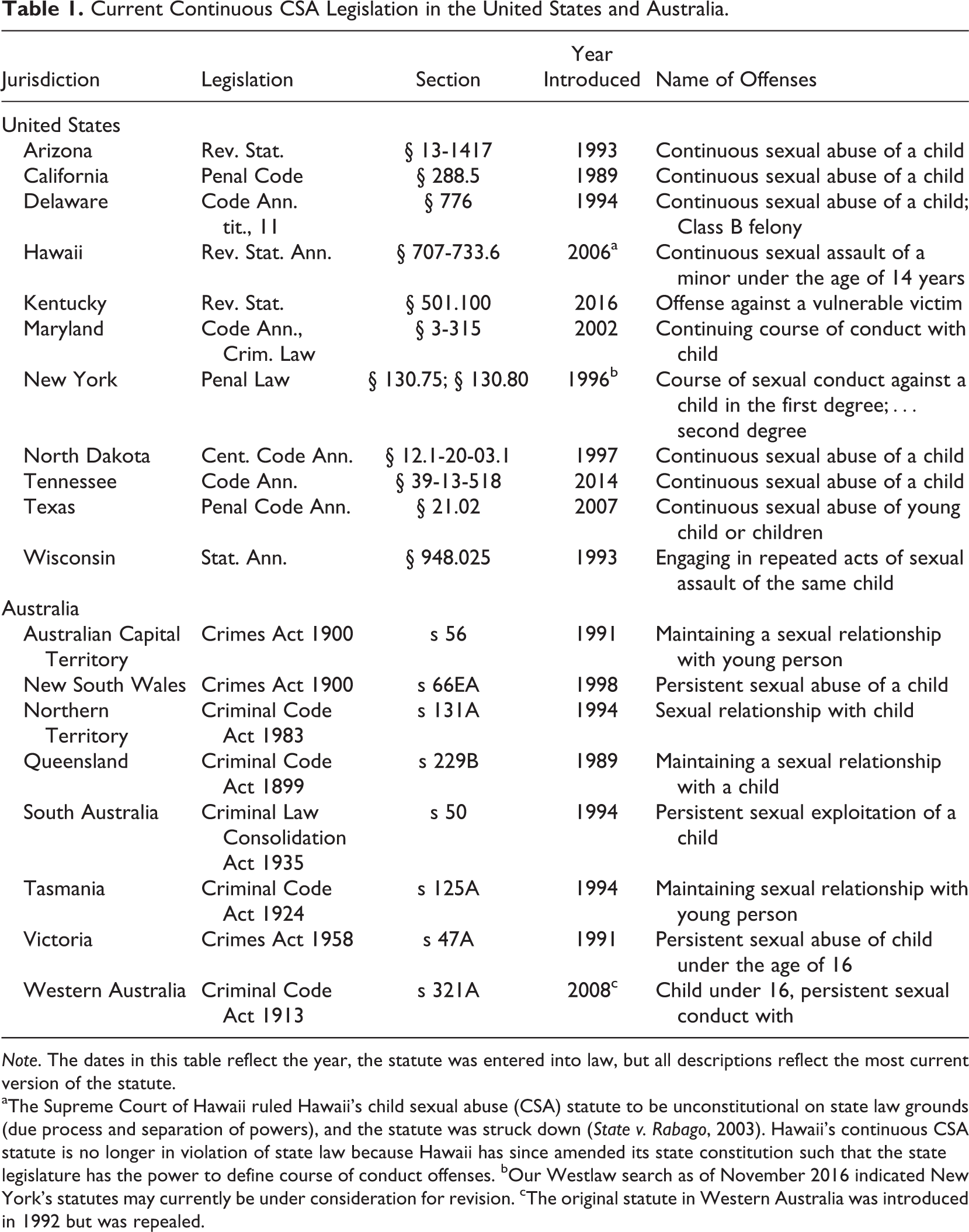
Note. The dates in this table reflect the year, the statute was entered into law, but all descriptions reflect the most current version of the statute.
aThe Supreme Court of Hawaii ruled Hawaii’s child sexual abuse (CSA) statute to be unconstitutional on state law grounds (due process and separation of powers), and the statute was struck down (State v. Rabago, 2003). Hawaii’s continuous CSA statute is no longer in violation of state law because Hawaii has since amended its state constitution such that the state legislature has the power to define course of conduct offenses. bOur Westlaw search as of November 2016 indicated New York’s statutes may currently be under consideration for revision. cThe original statute in Western Australia was introduced in 1992 but was repealed.
Our goal in this article is to discuss the relevant research and inspire further discussion between psychologists and policy makers about continuous CSA legislation. As more jurisdictions around the globe begin to adopt continuous CSA statutes, it is timely and important for psychologists to enter into a discussion with legal professionals about the criteria for the charge that is informed by psychological research on memory for repeated events and the relevant CSA literature.
This article is divided into four major sections. In the first section, we review particularization requirements generally and discuss how they have been interpreted in CSA cases when discrete acts of repeated CSA are charged rather than continuous abuse. Particularization requirements exist to protect the constitutional rights of the accused, and we discuss how particularization requirements meet that objective. In the second section, we introduce continuous abuse statutes and discuss how particularization rules are adapted when continuous abuse is charged. The purpose of the first two sections is not to present a thorough legal analysis of particularization requirements. Rather, our aim is to identify the seminal principles and provide examples of how those principles have been applied in different jurisdictions depending on whether acts of repeated abuse are charged discretely or as a continuous offense. In the third section, we discuss relevant research on children’s frequency memory and memory for repeated events to inform continued development of the charge as more jurisdictions consider adopting continuous CSA statutes. In the final section on policy and future research, we apply the research to continuous abuse criteria and make recommendations on how to construct these charges in a way that considers the capabilities of victims of repeated CSA to particularize individual acts and the rights of the defendant to receive proper notice of what he 4 must defend.
The Particularization Requirement
Particulars are the material facts of an alleged crime that make a complaint or indictment specific rather than general. The sufficiency of the particulars of charging information is determined on a case-by-case basis, but the charging information must comply with state law and “minimal constitutional standards” ( Parks v. Hargett, 1999; United States v. Dashney, 1997). The general requirement for sufficient particularity is similar in many common law jurisdictions. For instance, the U.S. Supreme Court stated, “it is not sufficient that the indictment shall charge the offense in the same generic terms as in the definition; but it must state the species, it must descend to particulars” (United States v. Cruikshank, 1875, p. 558). In Canada, the Supreme Court of Canada affirmed that an indictment is sufficiently particular if it describes the offense in such a way to “lift it from the general to the particular” ( Brodie v. The King, 1936, p. 198, affirmed in R. v. B. [G.], 1990). As discussed by the High Court in Australia in S v. The Queen (1989), Section 582 of The Criminal Code of Western Australia 5 states that an indictment must include “such particulars as to the alleged time and place of committing the offence…as may be necessary to inform the accused person of the nature of the charge.”
A typical indictment will name the offense, indicate the date or time period an alleged offense was committed, state where the alleged offense was committed, and include specific details to support it (e.g., Criminal Procedure Act [CP Act], 2004). When considering particularization of these elements of an indictment, an important distinction is specification versus precision—an indictment must be specific but need not always be precise. There must be reasonable particularization of time, place, and/or some other detail that identifies each separate act charged (see J. J. Connolly, 1990, for discussion; Podirsky v. The Queen, 1990; S v. The Queen, 1989).
Precise time is immaterial unless, in the circumstances of the case, it is a necessary element of the offense (
R. v. Dossi, 1918). In CSA cases, is time of the essence? Courts have consistently ruled, “…while time must be specified, the
Similar to the time specified in an indictment, the place of an alleged offense must be specified with reasonable particularity. In R. v. B. [G.] (1990), the Supreme Court of Canada stated the philosophy behind particularization of place in CSA cases, “While children may not be able to recount precise details and communicate the when and where of an event with exactitude, this does not mean that they have misconceived what happened to them and who did it” (p. 26). The Court affirmed s 529(4.1) (now s 601(4.1) (b)) of the Criminal Code of Canada that states the location of an offense must be proven to have occurred within the jurisdiction of the court, but the precise location is not always essential. Similarly, the Illinois Appellate Court wrote that it is sufficient if there is evidence that proves the crime occurred in the county for which the charges were filed (e.g., People v. Guerrero, 2005).
When a child alleges repeated abuse, the child must differentiate between instances of abuse by reasonably particularizing each act charged. Rinfret J. wrote, “it will be sufficient if the substance of the offence is stated; but every count must contain such statement in substance” ( Brodie v. The King, 1936, p. 193). Therefore, a child who alleges repeated abuse in the home might sufficiently differentiate offenses by describing how an act occurred in a different room in the family home or providing other details unique to each act. Similar to the factors noted in State v. Baldonado’s (1998) test for the reasonableness of an alleged time frame, reasonable particularity of an offense will differ depending on the age of the child, the duration of the abuse, how many times the abuse occurred, the familiarity of the place(s) where the alleged abuse occurred, and so forth.
We turn to a case to illustrate the principle of particularization and possible consequences to an accused person of failing to adequately particularize. In 1996, Valentine was convicted by an Ohio jury of 20 counts of child rape and 20 counts of felonious sexual penetration of his 8-year-old stepdaughter, all counts were reported to have occurred between March 1, 1995, and January 16, 1996, in the family home ( Valentine v. Konteh, 2005, p. 629). None of the counts were differentiated, and they were identically worded.
The majority of the U.S. Court of Appeals (Sixth Circuit) found that the lack of differentiation among the charges violated Valentine’s constitutional right to notice and may subject him to double jeopardy and an unreasonable sentence. Because the counts were undifferentiated, there was concern of double jeopardy within the initial trial because Valentine might have been convicted twice for the same act. If Valentine was charged in the future with a sexual offense against the same complainant during the same time frame, he was at risk of double jeopardy because the court determined it will be unclear if he had already been tried for the criminal act. The court found there was only sufficient evidence to convict on Count 1 of child rape and Count 21 of felonious sexual penetration of a minor. He was originally sentenced to 40 life sentences. Valentine’s sentence was reduced to two life sentences because only two counts were reasonably particularized. The majority of the court ruled “Just as courts should not permit abuse prosecutions to be defeated due to the limited ability of child victims to remember precise temporal details, they should for similar reasons not permit multiple convictions to stand based solely on a child’s numerical estimate” (p. 633). “Instead, if prosecutors seek multiple charges against a defendant, they must link those multiple charges to multiple identifiable offenses. Due process requires this minimal step” (p. 636).
The dissent in
Valentine v. Konteh (2005) held that it is the jury’s decision to determine the number of acts when the number of acts is estimated: …creating a per se rule that unduly narrows the number of identical charges that may be filed, as the majority has done, takes away the jury’s power to determine whether multiple crimes have occurred. The effect of failing to recall time and place details is a matter appropriately assessed by the jury, not by a per se rule. (p. 641)
In summary, a charge must be reasonably particular to protect the rights of the accused, but generally a charge does not need not to be exact. However, prosecutors must be mindful of the effect of failing to adequately particularize on notice requirements, double jeopardy, and sentencing. Unless the circumstances of the case require precision with respect to time, location, and material facts, it will likely be sufficient for the complainant to describe a time frame that is reasonably narrowed, to describe location that is within the jurisdiction of the court hearing the case, and to describe details that differentiate each act charged. When charges cannot be differentiated with reasonable particularity, charging a defendant with a single count of abuse may be preferable. The majority in
Valentine v. Konteh (2005) held: States have the authority to enact criminal statutes regarding a ‘pattern’ or a ‘continuing course’ of abuse. They do not have the power to prosecute one for a pattern of abuse through simply charging a defendant with the same basic [identically worded] offense many times over. (p. 634)
Continuous CSA Statutes
In Australia, the Sturgess Report (Sturgess, 1985) and the High Court in Australia (
Podirsky v. The Queen, 1990, discussing the decision in
S v. The Queen, 1989) called for reform on charging repeated episodes of CSA as discrete acts. Unless the law is changed, there is a possibility that the more acts of intercourse or other acts of sexual abuse and the greater the length of time over which they occur, the more difficult it may be to establish that any one of a series of multiple offenses has been committed. Some reform would seem desirable to cover cases where there is evidence of such a course of conduct (
Podirsky v. The Queen, 1990, p. 136).
This led to enactment of continuous abuse statutes in most Australian states. Some U.S. states have echoed this concern and at least 11 to date 7 have enacted continuous CSA statutes (see Table 1). In jurisdictions that have continuous CSA statutes, most share some characteristics. A minimum number of abusive acts must be proven, most commonly three, in relation to a period of time. This period of time is commonly 3 months in U.S statutes and more general in Australian statutes. The complainant must be a young person or a child in all but one jurisdiction; Kentucky extends the charge to all vulnerable individuals. Four U.S. statutes also specify the relationship that must exist for a continuous abuse charge; the accused must reside with or have recurring access to the child. In Australia, a relationship is specified in half of the acts and is defined broadly as “maintains a sexual relationship.” The acts are listed in Table 1, and the criteria are presented in Table 2.
The Criteria for the Charge of Continuous CSA in Current Statutes in the United States and Australia.
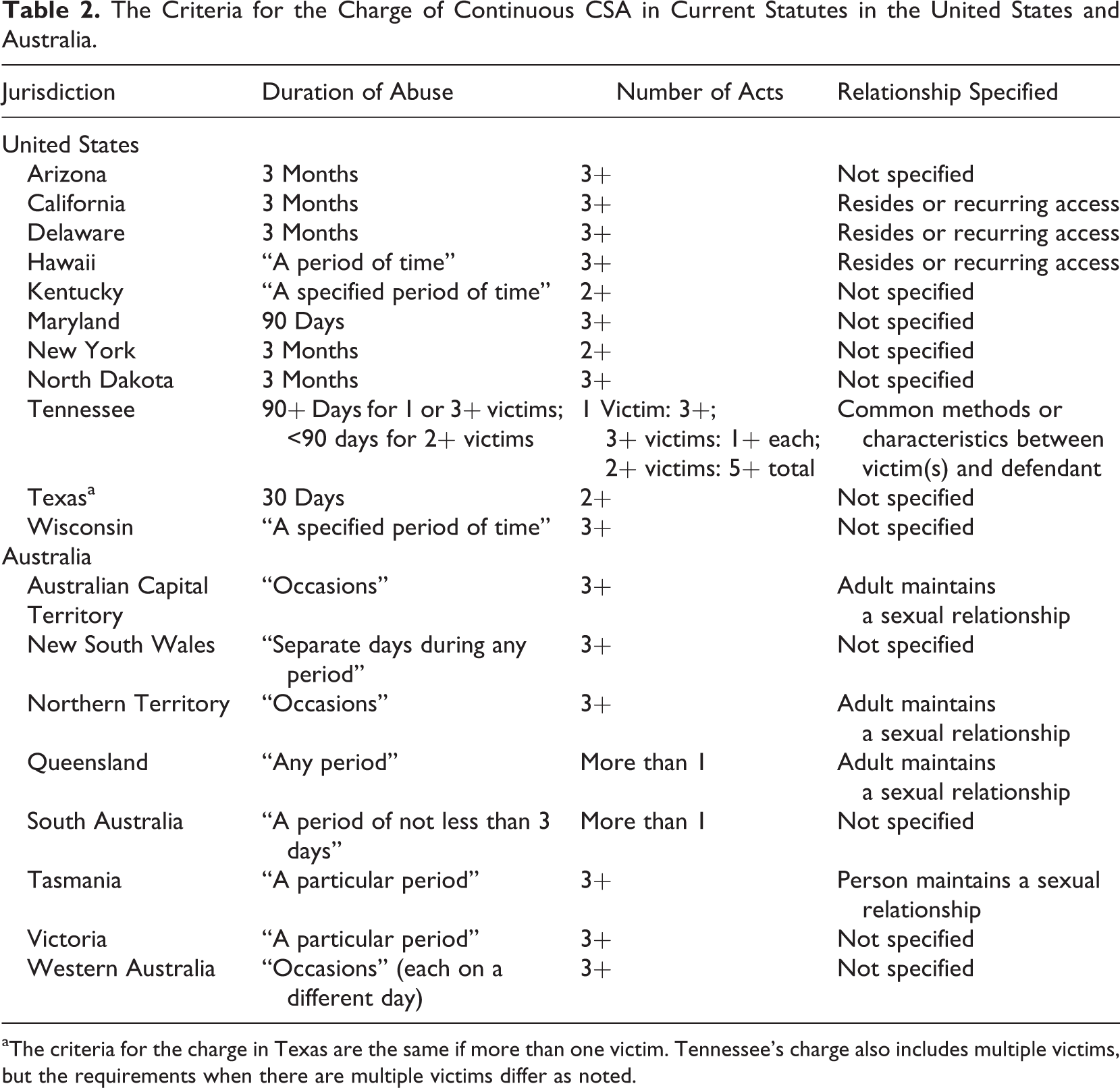
aThe criteria for the charge in Texas are the same if more than one victim. Tennessee’s charge also includes multiple victims, but the requirements when there are multiple victims differ as noted.
Under a continuous CSA charge, reduced particularity of individual acts is expected as the focus of the charge is on the continuous nature of the offense. For example, as noted in Victoria’s statute, the information need not allege the information “with the same degree of specificity as to date, time, place, circumstances…” (Victoria s 47a(3)). Similarly, other states in Australia note that expectations for particularization are relaxed in a continuous CSA charge in comparison to if the act(s) were charged discretely.
When an accused is tried under a continuous abuse statute, the prosecutor must prove the accused had a prescribed relationship with the complainant (in some jurisdictions) and there was a continuous course of abuse. The continuous abuse can be established with generic evidence of what typically happens (Bah, 2013). In addition, a minimum number of acts that occurred over a minimum period of time must be proven. Particularization requirements differ somewhat across jurisdictions; however, if each act contained at least one unique characteristic, that could be sufficient to prove continuous abuse in all jurisdictions. For example, in a Texas case, the defendant was convicted of 1 count of continuous sexual abuse of a child and 12 counts of indecency with a child for touching his daughter’s breasts ( Kuhn v. State, 2013). For the purpose of the continuous sexual abuse charge, the victim testified about one occasion that she had gone swimming in the river with her friends and after a shower, her father “started teaching” her “how to masturbate” (p. 527). He told her to get undressed, and he “started touching [her]” on her “private parts” with his hand…and he “put Vasoline [sic] on” (p. 527). The other acts were less particular in that they were not tied to dates. Rather, the victim testified the defendant touched her breasts and her “private parts” while on his bedroom and on the couch…“pretty much all [her] life” and “as long as [she] can remember” (p. 527). The majority held the particular elements of a continuous abuse charge in Texas had been met, and the defendant had been granted his right to a fair and impartial trial.
Continuous abuse statutes have been criticized primarily due to concerns over possible violations of defendant’s rights (Bah, 2013; see Department of Justice [Hong Kong], 2004). It may be argued that charging CSA as a course of conduct offense hampers a defendant’s right to constitutional notice because the particularity requirements are explicitly relaxed and, in nearly all jurisdictions, jurors must agree a course of conduct has been established rather than each discrete act occurred (Bah, 2013). This effectively reduces the defendant to a general rather than specific defense. It is true that the overall charge is not particularized to the level required for discrete offenses; however, the required number of acts must be proven, and jurors must agree that the required number of acts occurred within the defined time frame. Jurisdictions that require jury agreement on the same acts underlying the charge (New South Wales and Tennessee) arguably have a higher threshold for proof because such a requirement necessitates detail related to each act. 8
A second concern with continuous abuse statutes is that it will be hard to apply double jeopardy laws. If an accused is tried for a continuous abuse offense, can he later be charged with discrete acts that were alleged to have occurred during the same period and against the same complainant? To address this, a clause may be included, such as in New South Wales s 66EA(8): A person who has been convicted or acquitted of an offence against this section may not be convicted of a sexual offence in relation to the same child that is alleged to have been committed in the period during which the accused was alleged to have committed an offence against this section.
On the one hand, it seems morally wrong and legally unjust to require a child victim to particularize multiple acts of persistent, repeated abuse that may have occurred hundreds of times. On the other hand, it has been argued that a continuous CSA charge is not reasonable for a defendant to defend himself against, and “this attempt by states to solve this problem is too broad” (Bah, 2013, p. 1207). Concerns with the fairness of continuous abuse statutes may be tempered when considering the following: A minimum number of acts must be proven, although particularized to a lesser extent than when the charge is for discrete act(s); legislation can be enacted to ensure the accused is not at risk of being tried more than once for the same act; it is possible to set a maximum sentence such that it cannot exceed the sentence that would have been imposed had each offense been charged as a discrete act.
Research Relevant to Charging Repeated CSA
The goal of continuous CSA statutes is to relieve the “intolerable evidentiary burden on the witness” if particularization of each act of repeated CSA must be met (Sturgess, 1985, para. 7.9). There is an important distinction between particularization requirements for offenses charged discretely and as continuous CSA. If charged as discrete acts, a child will be expected to describe each time that is charged in reasonable detail from beginning to end to ensure the standard for particularity of each discrete act is met. If charged as continuous CSA, reduced particularization of instances is expected. The child may need to only describe the general act, particularly in jurisdictions whose statutes do not require the jury to agree on the same acts underlying a charge of continuous CSA. In jurisdictions that require the jury to agree on the same number of discrete acts, the child may be required to provide some details that are unique for a minimum number of acts. In the balance of this section, we discuss the psychological literature on memory for repeated events and conclude that children should be able to provide some unique details that could discriminate a minimum number of acts.
Memory research suggests that after an event is experienced one time, a general memory representation for the event is formed and repeated experience strengthens the general event representation (Fivush, 1984; see Hudson & Mayhew, 2009, for review). This process is consistent with script theory (Schank & Abelson, 1977) and fuzzy-trace theory (Brainerd & Reyna, 2012). Theories diverge on whether individual instances are retained and retrievable as separate memory traces that are distinct from the general event memory trace (fuzzy-trace theory) or if recall of instances is a reconstructive process based on memory for the general event and particular details that may be available (script theory). Despite divergent theories on how memory for repeated events is organized and recalled, theories overlap on the premise that certain event features may increase accurate recall of details from an instance of a repeated event. We will discuss two types of event features: (1) new or deviation details and (2) temporal order. We begin with a discussion of new or deviation details.
In the literature, a typical repeated event contains details that are fixed (i.e., they always occur in the exact same way; for instance, the identity of the perpetrator), details that are variable across instances (i.e., variable details have associated options that change in predictable ways; for instance, abuse always begins or ends with a promise of a reward but the particular reward varies across incidents), and some instances may contain details that are unexpected (i.e., deviation details; for instance, the act was interrupted on one occasion). Fixed details do not enable discrimination between instances, as they are the same across instances. Variable details enable discrimination between instances and are commonly reported, but they are often confused across instances of a repeated event (Gomes, Sheahan, Fitzgerald, Connolly, & Price, 2015). For example, a child may report that one time the perpetrator promised to take the child to the movies when they were done. That may have happened but not during the time the child reports. In fact, there may not have been a movie theater within driving distance of the location of the reported instance of abuse. In cases where a report is differentiated by variable details but details are misattributed to the wrong instance, perceived credibility and case outcomes may suffer (D. A. Connolly, Price, Lavoie, & Gordon, 2008). Deviation details may be most beneficial, as they are often remembered quite accurately and are not confused with other deviations.
Script theorists suggest that instances of a repeated event become integrated into a general event representation and options of variable details are organized like a list of experienced details that are not tightly linked to particular instances (Fivush, 1984); however, deviation details stand out from the script and will be recalled with a high degree of accuracy (i.e., an isolation, or von Restorff effect; D. A. Connolly, Gordon, Woiwod, & Price, 2016; Davidson, 2006; Wallace, 1965). According to fuzzy-trace theory, unique details increase the strength and accessibility of a verbatim memory trace; thus, increasing the likelihood of the trace for the instance that contains the deviation will be retained. If the mechanism described in script theory accurately describes the process, children will be able to recall the deviation details to distinguish one instance from the others but will not be able to accurately describe the instance that contained the deviation. This may not provide information that is particular enough to prove one or more discrete acts but will be sufficient to support a continuous CSA charge in most jurisdictions. If fuzzy-trace theory accurately describes the process, deviation details will help children to recall the complete instance, providing details that are likely to be sufficiently particular for a charge of at least one discrete act, and more than sufficient to prove a continuing abuse charge under the requirements in most jurisdictions. To date, the mechanism that best describes the effect of new or deviation details on children’s memory for an instance of a repeated event is not settled. Regardless of which theory is most representative of the process, continuous CSA statutes accommodate memory for repeated events. However, it is important to keep in mind that in spite of the strength of the general event memory, children are capable of remembering some particular details from a repeated event.
There is evidence that children recall deviation details that were in one instance of a repeated event better than they recall variable details in an instance. Brubacher, Glisic, Roberts, and Powell (2011) asked 4- to 5- and 7- to 8-year-old children to recall the time they remember best of a repeated (4 times) laboratory event. Each instance contained variable details and two deviation details (i.e., two details that had not appeared in any other instance; e.g., children wore a badge and relaxed a part of their body). Children were more likely to correctly attribute deviation details than variable details to the correct instance. This is important because it demonstrates that deviation details can be remembered well and that they can be attributed to the correct instance. However, to study the effect of deviation details on memory for the entire instance, it is necessary to compare memory for an instance that contains deviation details with memory for the same instance that does not contain deviation details.
In D. A. Connolly et al. (2016, Experiment 3), 6- to 8- and 9- to 11-year-olds watched four live magic shows that contained variable details. For some children, at the beginning of the last show, the magician was interrupted for a few minutes, and this caused her to be flustered throughout the rest of the show. Other children did not observe this deviation. A few days after the last magic show, children were asked to describe each magic show and to describe the deviation. Correct recall of deviation details was better than correct recall of variable details. In fact, correct recall of deviation details was quite good; in Experiments 1 and 2 of D. A. Connolly et al. (2016), a single-event condition was included and repeated-event children recalled deviation details as accurately as single-event children.
This finding is consistent with Brubacher et al. (2011) in that children were able to recall details that were different in one instance of a repeated event. Of particular relevance to the current article is whether deviation details presented in one instance of a repeated event help children to recall the entire instance that contained the deviation. In D. A. Connolly et al. (2016, Experiment 3), there were two important manipulations that inform this issue: Some repeated-event children did not experience the deviation, and children were asked to recall all instances of the repeated event. Compared to children who did not see the deviation, younger children (6- to 8-year-olds) recalled more variable details than younger children who did not see the deviation. Importantly, the benefit of the deviation was observed in recall of all instances, not just the instance that contained the deviation. The deviation did not help older children to recall variable details of any of the instances. There is evidence that children recall details that differ across instances of a repeated event. However, there is no clear evidence that deviation details help children to recall the entire instance that contained the deviation.
Certain instances may be recalled well due to temporal order within the series. D. A. Connolly et al. (2016) found that 6- to 11-year-old children recalled the first (primacy) and last (recency) instances of a repeated event better than the two middle instances when tested after a short delay (1–2 days after the last magic show). In Powell, Thomson, and Ceci (2003), 6- to 8-year-olds participated in six similar play sessions and were asked to recall either the first one or the last one following a delay of 5–6 days or 5–6 weeks. Children recalled the first instance better than the last instance at both retention intervals. They further found that accurate recall of the first instance did not decline following the delay but accurate recall of the last instance declined substantially. Hudson (1990) found that 4- to 5-year-old children recalled more about the first than the last instance of a series of four workshops after a 4-week delay to test. Thus, it may be reasonable to expect a complainant to recall accurate details for the first time the abuse occurred and the last time if recall of the last time occurred shortly after the alleged act.
There are a few important limitations to the application of primacy and recency effects to particularization requirements in law. First, in these studies, the core features of the event were identical across experiences, so the first and last instances were easy to classify. In real-world cases of CSA, there may be a grooming process such that the core features of abuse change across time. In this context, it is not clear what would be considered the “first time:” the first time any sexually inappropriate behavior occurred, the first time the child was touched in a sexual way, or the first time penetration occurred. Second, the instance(s) that children can reasonably be expected to recall well after a very long delay is an important consideration because most complainants of CSA delay disclosure for years (D. A. Connolly et al., 2015) and grooming has been cited as a reason for a lengthy delay to disclosure (e.g., Sas & Cunningham, 1995). Third, if details occur in the exact same way each time, a complainant may only be able to differentiate between instances based on temporal features. It may not be sufficient to differentiate instances on the basis of temporal order alone and nontemporal details that distinguish between instances of repeated abuse may be necessary.
Most continuous CSA statutes require a minimum number of acts to be reported (most commonly three). This entails an estimate of frequency and recall of at least some details that prove the minimum number of instances. Whether a child can estimate the frequency of repeated CSA with accuracy and/or confidence does not reliably predict how well details specific to individual times will be recalled (Friedman & Lyon, 2005). In fact, some research suggests memory for content is superior to memory for temporal details (e.g., Friedman, Reese, & Dai, 2011). Until recently, most research on children’s ability to estimate frequency involved estimating the frequency of words from word lists or actions in stories with findings indicating that frequency estimates are fairly accurate around 5–6 years of age, children are particularly accurate at estimating frequency below four, and estimates increase with actual frequency (e.g., D. A. Connolly, Hockley, & Pratt, 1996; Hasher & Zacks, 1979). Recent research has investigated children’s ability to report frequency of experienced events as memory for stories, and word lists may not generalize to memory for repeated events, particularly repeated CSA.
Three studies using different methodologies (lab, field, and archival) converge on the conclusion that children are reasonably good at estimating frequency generally but are quite inaccurate when asked to specify frequency. In a lab-based study, Roberts et al. (2015) examined the frequency reports of children from four previously published studies where children participated in one or four instances of a repeated activity in a school setting. Children ranged in age from 4- to 8-year-old and were interviewed 4–7 days after the last or only activity. Children were asked if they participated one time or more than one time, and the precise number of times was asked if the child said they participated more than once. Roberts et al. found that 85% of children who participated 1 time correctly reported they participated one time whereas only 23% of children who participated 4 times correctly reported that precise number and 28% said they did not know. None of the repeated-event children said they participated one time, demonstrating that children knew the general but not precise frequency. Roberts et al.’s results are limited in their application to repeated CSA because all children were typically developing, they estimated the frequency of benign events that occurred at predictable times (twice per week for 2 weeks), the number of experiences did not exceed four, and the delay to test was short. In the next study, a strikingly similar pattern is reported when these limitations are absent.
Wandrey, Lyon, Quas, and Friedman (2012) asked one hundred and sixty-seven 6- to 10-year-old maltreated children from the Los Angeles Dependency Court to provide temporal information about foster care placements or court visits they had in the past. Children’s actual number of visits ranged from 0 to 12 for placements and 0 to 10 for court visits and delay to recall ranged from months to years. Correlational analyses showed that children’s frequency estimates of visits and placements increased with actual frequency. However, when Wandrey et al. analyzed children’s exact frequency estimates, accuracy was 13.58% for court visits and 23.61% for placements. Children were more accurate when responding to “more than” questions (e.g., Did you live in more than 1, 5, 10 places?) with estimates across ages ranging from 59% to 84% accuracy to these types of questions. Accuracy rates were generally similar across ages, but older children were more accurate than younger children when asked if a court visit occurred “more than 10 times.” In sum, these data suggest maltreated children involved with the legal system are very inaccurate when they provide precise estimates of frequency, but they have a general awareness of frequency, particularly for an event experienced many times.
A similar conclusion comes from archival research. D. A. Connolly and Read (2006) examined 2,064 criminal complaints of historic CSA in Canada from 1986 to 2002 (range = 1–19 years when alleged abuse began; range = 1–28 years when alleged abuse ended). In this study, a case was deemed historic if the delay to prosecution was 2 years or more from when the alleged offense ended (range = 2–48 years from when alleged abuse ended). Judicial decisions indicated that when a complainant provided a precise number of repeated abuse, it was most likely to be reported as having occurred 2 times, and descriptions of frequency were common. Expanding on this data set to include timely and historic CSA cases from 1998 to 2012, Woiwod, Coburn, Chong, and Connolly (2017) conducted a thorough examination of judge’s reports of complainant’s frequency estimates in cases of alleged single and repeated CSA. Complainants in this study ranged in age from 1 to 19 years when the alleged abuse began and 1 to 34 years when the alleged abuse ended and the delay from when the alleged abuse ended to the court date ranged from 3 months to 47 years. Across ages and delays, frequency reports of alleged CSA were increasingly less precise after two instances of abuse were alleged. As indicated across reports from various judges, children often used verbal descriptions to describe the frequency of the abuse (e.g., “more than 1,” “a number of times/week/month/year”). There are several differences between this research and the two studies just discussed. In this archival research, actual frequency could not be known, and the ages of complainants as well as delays were quite different. In spite of these differences, there is quite remarkable consensus that precise frequency is very difficult to provide even after a small number of instances are experienced.
Taken together, the relevant psychological literature suggests (1) children will likely be able to recall at least one instance of repeated abuse with reasonable particularity compared to other similar instances (to the extent the literature applies to repeated abuse, there is evidence the first time will be recalled well across ages and delays and some evidence the last time will be recalled well at a short delay), (2) deviation details that were present in particular instances may enable sufficient discrimination between multiple acts under a continuous CSA charge where such particulars may be necessary but may not be sufficient to particularize acts charged discretely, (3) precise frequency is difficult for children to provide in the context of a repeated event, and (4) frequency reports of a repeated event are likely to be a fairly accurate estimate of actual experiences. It remains unknown if children are able to particularize one instance (e.g., the time they remember the best, the first, a time that was different) and simultaneously recall details that accurately and sufficiently differentiate between several other instances at a level greater than chance (see Danby et al., 2017, where children recalled fewer than half of the episodic details from the time remembered “best” and “another time”). Given that some continuous CSA statutes require jury agreement on the same three acts and thus differentiation between multiple acts may be necessary to support the charge, additional research on children’s ability to recall multiple instances of a repeated-event within one interview is necessary. We now turn to a discussion of how current research applies to continuous CSA statutes and how future research can further inform the criteria for the charge.
Policy Implications and Future Research
Theory, research, and legal cases demonstrate that it is unreasonable to require complainants of repeated CSA to particularize individual acts to the same degree as complainants of single CSA. Repeated CSA should not go unprosecuted due to stringent particularization requirements. However, the requirements of continuous CSA charges must balance what is reasonable for a complainant of repeated CSA to particularize about individual instances with rights of the accused to notice, protection from double jeopardy, and a fair sentence. As more jurisdictions consider continuous abuse statutes, we offer the following recommendations based on psychological research.
When a continuous abuse charge is laid, it may be necessary for a child complainant to provide some details that distinguish each of the minimum number of acts from the others, particularly in jurisdictions that require a jury to agree on the same acts underlying the charge. In most jurisdictions, jurors do not have to agree that the same acts occurred, they need only to agree that the minimum number of acts occurred (Bah, 2013). There is much research that shows that children recall deviation details that occurred during one instance of a repeated event quite well, perhaps as well as children who experience only one event that contains the same deviation details. However, they do not recall typical details as well as deviation details or to a level comparable to single-event children. Accordingly, jurisdictions with the most lenient requirements to prove continuous CSA more than accommodate children’s episodic memory constraints for instances of a repeated event, and jurisdictions with more stringent requirements also accommodate children’s capabilities as long as some instances of repeated CSA have distinct details. An important issue to consider is what details are distinct and what constitutes a deviation may be subjective. Research has only tested details that are operationally defined as deviations rather than investigating subjective interpretations of deviation details. It is likely there are idiosyncratic differences in the types of details children attend to that will enable differentiation between instances and future research could investigate this possibility.
Arguably, the first instance in the literature on memory for repeated events is recalled well because it is distinct. However, the first time may not be clear in the context of repeated abuse. An episode of escalation in the abuse pattern (e.g., a time when a more intrusive offense was committed) may be experienced as a deviation and enable differentiation between instances of abuse to fulfill requirements for a continuous abuse charge in most jurisdictions but may not preserve memory for the entire instance to sufficiently prove a discrete charge. It may also be that an episode of escalation will be experienced as a first time and benefit from the primacy effect that appears to support memory for the entire instance (e.g., it may be the first, the “worst,” “a time that was different,” “the last” as noted in the National Institute of Child Health and Human Development [NICHD] recommendations: Lamb, Hershkowitz, Orbach, & Esplin, 2008). Future research should investigate the effects of changes in some fundamental characteristic of the event that occur part way through the series.
The number of offenses required to establish a pattern of behavior is different across jurisdictions, ranging from more than one to three. Analogue, field, and archival research converge on the conclusion that children’s ability to report the precise number of times an event occurred is quite poor, even when actual frequency is as low as four. Wandrey et al. (2012) noted a continuous CSA statute that requires “multiple acts” occurring over a (specified) “period of time” is in line with developmental research (p. 99). This recommendation is consistent with current guidelines for continuous CSA statutes in some jurisdictions (e.g., Queensland). If the charge and judicial instruction reflect such criteria and indicate that the reported number of offenses need not be precise, jurors may place less emphasis on exact numerosity and children’s confidence when reporting the number of times abuse occurred (Cleveland & Quas, 2016).
Most continuous CSA statutes explicitly require the minimum number of offenses to have occurred on separate days, and in most U.S. states, the abuse must endure for at least 3 months. In the Queensland Law Reform Commission Report (2000), it was argued that separation between acts is necessary because (1) an offense cannot be seen as “persistent” if all acts are committed in 1 or 2 days and (2) it should be easier to particularize acts that occur within a short period of time than a long period of time (p. 102). Point 1 led to the Commission’s recommendation that the charge should be defined by a set number of distinct acts (three) that occurred on “separate days during any period” (p. 113). As previously noted, Queensland has since amended its act to focus on the establishment of an unlawful sexual relationship over “any period” rather than on three discrete acts of CSA that occurred on separate occasions. However, the notion of “persistence” in relation to reduced particularization of instances is one worthy of discussion. Point 2 made by the Commission is probably true if one thinks about particularization in terms of time only (i.e., the acts occurred between these dates). However, psychological research supports an opposite conclusion when one considers particularization of the material facts. Price, Connolly, and Gordon (2006) found that children had more difficulty describing one instance from a series of four similar instances when all were presented in the same day than when they were presented in 4 days or in 2 weeks. Acts of repeated abuse that occur in close temporal proximity may be more likely to result in impoverished memory for individual acts than ones that occur over a longer time. Although a lengthy time between instances may reflect persistence, the research suggests that frequency more than spacing over time accounts for reduced particularization.
Research has shown that frequency leads to reduced particularization of discrete instances of a repeated event, but in some jurisdictions, a continuous CSA charge includes a relationship as an element of the charge. Sturgess (1985) noted that the goal of continuous CSA statutes is to relieve the “intolerable evidentiary burden on the witness” if particularization of repeated CSA must be met to the same degree as that required of discrete offenses (para. 7.9). This implies the purpose of a continuous CSA charge is to account for reduced particularity as a function of frequency of the abuse; this is consistent with research on memory for repeated events. However, Sturgess noted a CSA charge is also meant to account for a situation when an “adult enters into and maintains a relationship with a child of such a nature that he commits a series of sexual offences” (para. 7.9). In CSA cases, the perpetrator is most commonly a parent, followed by a nonparental relative, a family connection, and a community connection (e.g., D. A. Connolly et al., 2015). Although CSA is likely to be perpetrated in the context of a relationship, research indicates frequency leads to reduced particularization of individual instances. Perhaps the context of the relationship is most appropriate for consideration in sentencing rather than a criterion of a continuous CSA charge. Future research could investigate the effects of defining a continuous CSA charge according to the frequency of abuse, the relationship, or both on case outcomes.
A course of conduct offense must reflect a single behavior that is persistent, therefore, such a criterion does not preclude multiple victims when the relationship is not a defining feature of the charge. That is, if multiple victims each allege a single instance of abuse perpetrated by a single accused, taken together, these accusations may amount to a course of conduct. Although most jurisdictions only apply the continuous CSA charge to individual victims, Texas and Tennessee allow for a continuous CSA charge based on single acts from more than one victim. This may be a course of conduct; however, it does not lead to memory processes by which reduced particularization requirements are needed. In other words, if each victim experiences a single act of CSA, it is reasonable for the level of particularity required for each victim to be equivalent to that required of discrete charges and for juries to be required to agree on the same acts rather than having only to agree that the minimum number of acts in the alleged time frame occurred.
Because concerns have been raised over what jurors must agree on under a continuous CSA charge (Bah, 2013), we offer some thoughts when the continuous charge is for a single victim or multiple victims. In most jurisdictions, jury agreement on the same exact acts is unnecessary under a continuous CSA charge; jurors must simply agree that a course of conduct occurred and the minimum number of acts and duration of abuse has been proven. However, Tennessee 9 and New South Wales 10 require jurors to agree on the same three acts underlying a continuous CSA charge for a single victim. Memory research suggests complainants will likely be able to recall one instance accurately regardless of delay (e.g., the first in a repeated event paradigm); thus, in consideration of the capabilities of the victim and the rights of the accused, it may appease some opponents of continuous CSA statutes to require jury agreement on one of the same multiple acts underlying a CSA charge. Although it is a favorable protection for the accused to agree on the same exact multiple acts, this stringent requirement is comparable to the requirement for discrete charges and may not alleviate the burden on a single complainant to particularize instances in a manner consistent with psychological research. Although children often remember details (e.g., variable and deviation details), they have difficulty remembering individual instances of a repeated event. Based on memory research, requiring agreement on each of the same multiple acts seems better applied to cases when there are multiple victims who each report one instance of abuse.
Most of the research that has discussed the application of the particularity requirement to the prosecution of repeated CSA has focused on how forensic interviewing techniques can aide a child in fulfilling the requirements of particularity when instances of repeated CSA are charged as discrete offenses (e.g., Brubacher, Powell, & Roberts, 2014; Powell et al., 2007). Although we do not advocate changes to current practice for forensic interviewers, it is important to note that the standards for particularity differ when repeated CSA is charged as a continuous offense. Perhaps forensic interviewers would benefit from training that outlines how to investigate the general nature of a relationship with a single victim and how to elicit details that help establish a pattern of behavior. Information about the general nature of the relationship or the behavioral patterns could proceed before asking about discrete acts. Such a recommendation is in line with practice recommendations for interviewing individual complainants of repeated CSA to elicit generic information prior to episodic information (Brubacher et al., 2014; D. A. Connolly & Gordon, 2014). However, additional research and discussion on the criteria for a continuous CSA charge are warranted before clear recommendations for forensic interviewers can be made.
This article is about children’s memory for repeated events and continuous abuse statutes. However, we feel it is important to comment briefly on the application of this law and research to adults’ ability to particularize instances of repeated crimes. In all jurisdictions except Kentucky, a charge of continuing abuse can only be laid if the complainant is a child or a young person. There are crimes that are committed against adults that could be repeated, including domestic violence and criminal harassment. A striking finding in the literature on memory for repeated events is that the organization of information is not qualitatively different across most of the life span (Hudson & Mayhew, 2009). Adults also have difficulty particularizing an instance of a repeated event but may be able to identify details that were different during some instances (Leins, Fisher, Pludwinski, Rivard, & Robertson, 2014; Rivard, Fisher, Robertson, & Mueller, 2014; Willén, Granhag, & Strömwall, 2016; Willén, Granhag, Strömwall, & Fisher, 2015). If the point of continuing abuse statutes is to relieve complainants of the impossible evidentiary burden of particularizing each of many instances of continued abuse, and the same burden is present when the complainant is an adult, jurisdictions may consider extending the charge to adults who report repeated abuse.
An important issue that was not addressed because it is beyond the scope of the current article is the effect of different types of testimony on perceived credibility. When the only evidence is the testimony of the complainant, perceived credibility may be as important as actual accuracy (Castelli, Goodman, & Ghetti, 2005). If testimony on the general nature of continuous abuse is less likely to lead to a conviction than specific testimony on discrete acts, charging repeated abuse under continuous CSA statutes may be detrimental to children and case outcomes. An important area for future research is the effect of different levels of testimonial specificity on perceived credibility and ways that a possible negative effect of general testimony can be defeated.
Conclusion
Particularization requirements are in place to protect the rights of accused persons to adequate notice of the charges, to protection from double jeopardy, and to ensure fair sentencing. If the charge is for discrete acts, each act that is charged must be described in terms of time, place, and material facts such that each act is described in reasonable detail. In jurisdictions that have continuous CSA statutes, a minimum number of acts must be proved and a general description alone may be sufficient depending on the requirements in the jurisdiction. Research on memory for repeated events supports the rationale for continuous abuse statutes; when children experience repeated abuse, memory for what typically happens is much stronger than memory for individual instances of abuse, and children may not be able to particularize individual acts to the extent required for discrete charges. However, children are able to recall predictable variable details and unpredictable details, and this may be sufficient to discriminate a subset of instances from the others. Although for reasons described in the article, we believe deviations are a better source of discrimination. Additionally, research shows children reliably recall the first instance well and the last instance at a short delay; to the extent that lab-based research generalizes to memory for repeated CSA, complainants of repeated CSA should be able to provide particulars from one or more instances.
Continuous CSA charges have withstood constitutional scrutiny, but future discussion is necessary on how to best construct the charge to adequately balance defendants’ rights with victim’s capabilities as informed by repeated memory research. This may ensure utilization of the charge in jurisdictions with a continuous CSA charge and inspire other jurisdictions that are considering adopting a continuous CSA charge to do so. We hope involving psychologists in the discussion of continuous CSA statutes will inform legal practice and the adoption of continuous CSA charges in a manner that is fair to both the complainant and the accused.
Footnotes
Declaration of Conflicting Interests
The authors declared no potential conflicts of interest with respect to the research, authorship, and/or publication of this article.
Funding
The authors received no financial support for the research, authorship, and/or publication of this article.