



Abstract
The collective knowledge of offenders is one of the richest ways to advance understandings of crime commission and effective crime prevention. Drawing on self-report data from 53 incarcerated offenders in three Australian states and territories, the current article presents an innovative method which, through a crime script framework, allows for a first-time comparison of completed versus disrupted sexual offenses involving adult female and child victims at each stage of the crime commission process. Findings (a) highlight the critical need to boost the efficacy of situational prevention in the crime setup phase of the sexual offense script and (b) showcase how incorporating a script framework in offender-based research can identify new directions for crime prevention
Keywords
At the core of criminology lies the goal of better understanding crime and criminal behavior. To learn about this social phenomenon, scholars have traditionally drawn on readily available sources of information including administrative records, victimization surveys, and statistics collated by government departments (Jackson, 1990). These data have been instrumental in providing population-level changes in crime trends but are limited in that they only shine light on offenses that have been reported and recorded. They also have clear strengths in their contribution toward descriptive accounts of event and victim characteristics but are not always as helpful in revealing how offenders commit their crimes and the rationale for their decisions. This can result in an incomplete understanding of crime events and how we respond to these events in terms of prevention.
In light of these limitations, ethnographic research offers an alternative approach to data collection. Ethnographic, or offender-based research as a specific example, seeks to elicit offenders’ narrative accounts of crime commission through face-to-face interviews or self-report surveys. This approach facilitates a significantly more comprehensive account of crime and criminal decision-making as it provides the opportunity to learn from those who either currently or previously identified as active offenders (Jacques & Wright, 2010). It is also a relevant data source for crime prevention purposes, specifically situational crime prevention, as it is offenders who are best placed to inform on which measures prevent or facilitate offending (Jacques & Bonomo, 2016). However, there is potential to further boost the benefits of offender-based research through a systematic crime script framework that captures offenders’ behaviors across the entirety of the crime commission process (Cornish, 1994). The main impediment is that currently, there are no instruments which use a script framework for collecting data specifically for situational crime prevention purposes. Addressing this represents a crucial step toward the evaluation of situational crime prevention interventions in real settings. With this information, we can break down crime commission to observe not only which situational crime prevention measures work and which do not, but when in the script they are encountered.
This article presents a novel instrument incorporating a script framework for the purpose of collecting data on situational crime prevention. Developed specifically to capture the perspectives of adult male sexual offenders who have either engaged or had the intention to engage in a contact sexual behavior, our work is an innovative step in identifying how situational measures aimed at preventing sexual violence and abuse function in practice. Analysis focuses on Australian data collected from 53 incarcerated offenders who reported both a disrupted and completed sexual offense against either an adult female or child victim. In providing this first-time comparison of completed versus disrupted sexual crime events, we start to unpack key mechanisms responsible for explaining why some sexual offenses are aborted while others are not. To begin the article, we highlight the contribution that offender-based research has made in determining what can be done from a situational perspective to restrict or prevent criminal opportunities in the first place. We then focus, in particular, on the recent expansion of offender-based research to the study of sexual crimes. Finally, we introduce the crime script framework as an innovative way forward in untangling offender experiences of situational crime prevention, specifically in the context of sexual violence and abuse.
Explaining Offender-Based Research
While not a new development in criminology (see Sutherland, 1937), the possibility of furthering what we know about crime through the perspective of offenders has gained significant momentum in recent years (Jacques & Bonomo, 2016). Facilitating this transition is the recognition that traditional means of exploring crime patterns leave unanswered questions about why and how individuals act in the ways they do. Victim self-reports, for example, do not capture the preparation of offenders before they get access to victims and the subsequent steps that occur postvictimization. These sources are therefore unable to effectively tap into the dynamic nature of interpersonal crime (Luckenbill, 1977). Offender-based methodologies seek to fill these gaps by considering the decisions, and subsequent actions, of individuals throughout the entirety of the crime event. Through the process of interviewing offender populations, offender-based research provides strong evidence to show that “criminals know things about crime that others do not see” (Jacques & Wright, 2010, p. 23).
Offender-based research studies show that many offenders display a rational and systematically driven approach to target selection. This is consistent with early theoretical notions such as rational choice (Cornish & Clarke, 1986). In identifying opportunities to exploit, offenders can be seen to base their decisions on a rational assessment of their surroundings and the subsequent effort involved, perceived risk of apprehension, and anticipated rewards of the behavior (Cornish & Clarke, 1986). Offender-based research allows scholars to understand what it is that either facilitates or hinders criminal decision-making. This puts offender-based research in a unique position to inform not only what motivates the choice to commit crime but what can be done from a situational perspective to restrict or prevent criminal opportunities in the first place.
Offender-Based Research and Situational Prevention
Situational crime prevention is a highly pragmatic approach to crime control which seeks to manipulate those cues within an immediate environment which facilitate opportunities for misconduct (Clarke, 1980). Situated within a rational choice framework and environmental criminology more broadly, situational crime prevention is based on the proposition that crime is as, or more, influenced by setting and context as it is by offender disposition. When people perceive there to be fewer attractive and available opportunities for offending, crime should theoretically decrease (Clarke, 1980). To illustrate how situational crime prevention can be practically implemented to achieve effective crime reduction, Cornish and Clarke (2003) put forward a list of 25 opportunity-reducing techniques. These are classified under the five main strategies of increasing risks of getting caught, increasing effort required to commit crime, reducing rewards of crime, reducing provocations to commit crime, and removing excuses for committing crime. At its core, situational crime prevention aims to unpack how these strategies can be best implemented in real settings, both effectively and efficiently, so that crime opportunities are blocked. For this reason, the perspectives of those at whom these strategies are aimed (i.e., offenders) offer valuable insight for researchers (Jacques & Bonomo, 2016).
In addition to understanding what is effective at disrupting offending, it is important to know what does not work. As Jacques and Reynald (2012, p. 18) explain, “if researchers can determine the kinds of countermeasures used by criminals to reduce the effect of crime prevention techniques, then these countermeasures can themselves be countered by law-abiding persons and governments.” The burgeoning application of offender-based research in the drug market literature is an example of this. Scholars have drawn on qualitative data collected from drug dealers to explore the defensive tactics offenders use to evade sanction (Jacques & Reynald, 2012; Jacques & Wright, 2015). Importantly, these studies show that the types of tactics adopted differ according to offense context (e.g., inner city vs. suburban). This highlights the ability of offender-based research to determine not only what does and does not work, but of importance for focused prevention, under what particular contexts and for which particular groups it works (Jacques & Bonomo, 2016).
Expanding the Scope of Offender-Based Research to Sexual Crimes
While offender-based research has traditionally been applied to inform prevention efforts in property crime (Bennett & Wright, 1984; Wright & Decker, 1994) and most recently drug crime (Jacques & Reynald, 2012; Jacques & Wright, 2015), one novel application of this method is to sexual crimes. In Australia, in 2017, there were 24,957 recorded sexual assaults with 101 victims per 100,000 population (Australian Bureau of Statistics, 2017). When looking at the rate of sexual abuse by age-group, however, the highest rates of victimization were 325 per 100,000 population aged 10–14 and 416 per 100,000 population aged 15–19. This pervasiveness of childhood sexual abuse within the Australian context has also been mirrored in a number of self-report victimization studies (S. E. Moore et al., 2015; Najman, Dunne, Purdie, Boyle, & Coxeter, 2005). Based on a 10-year cohort study of young Australians living in the state of Victoria, for example, E. E. Moore and colleagues (2010) found that the prevalence of unwanted sexual abuse before the age of 16 was approximately 17% for girls and 7% for boys. While this study did include experiences of sexual abuse both with (e.g., touching or fondling) and without contact (e.g., an invitation to do something sexual), it draws attention to the considerable prevalence of child sexual abuse in Australia and the importance of furthering knowledge around innovative methods for preventing sexual offenses.
With regard to how offender-based research can inform sexual crime prevention, if we consider all the actors present during a sexual offense (i.e., offender, victim, potential guardian), it is the offender who is best positioned to reveal details about potential intervention points beyond the actual sexual interaction. There is a sizable body of literature which draws on offender self-report data to examine the modus operandi strategies involved in sexual crimes and the implications these may have for prevention (see, e.g., Beauregard & Leclerc, 2007; Leclerc, Carpentier, & Proulx, 2006; Leclerc, Proulx, & Beauregard, 2009; Leclerc, Wortley, & Smallbone, 2011a). With regard to empirical research on what actually stops sexual abuse from occurring, however, only a handful of studies have taken the step of directly asking offenders their perspectives on prevention. In one of the earliest studies to do this, 72 incarcerated offenders were surveyed on their attitudes toward the efficacy of various child sex abuse prevention strategies (Budin & Johnson, 1989). Most participants agreed that teaching young people the difference between appropriate versus inappropriate touch, the importance of reporting their abuse, and that it is okay to verbally resist their perpetrator would be the most effective recommendations. A limitation of these findings was that a fixed number of measures were tested with no option for further qualitative comment.
Using a semistructured interview process, Elliott, Browne, and Kilcoyne (1995) took a broader approach and asked offenders (n = 91) to suggest anything they believe to be effective in preventing child sexual abuse. Responses were grouped into discrete categories of action relevant to the victim (child) and to actions relevant to potential guardians (parents and teachers/schools). With regard to protective behaviors for children, the most common suggestions were related to the avoidance of isolated locations, going places in groups whenever possible, being aware not everyone is trustworthy, and the importance of disclosure. For parents, recommendations were focused on being vigilant about the interactions of other adults with their child, the importance of emphasizing a “no secrets” attitude in children’s upbringing, and having open discussions within the family about preventing abuse. The comments directed at teachers and schools identified the need for discussions that encourage children to tell, prevention programs that acknowledge contexts beyond stranger abuse, and courses that educate teachers on the signs of sexual victimization. Colton, Roberts, and Vanstone (2012) similarly took the approach of asking offenders how they believe abuse could be prevented but focused specifically on a sample of incarcerated adult males (n = 8) who perpetrated child sexual abuse while in a position of trust. The self-reported responses of participants suggested that time spent working directly with children should always be monitored (i.e., more than one adult present).
The most recent study of these studies focused specifically on youth-orientated organizations (Leclerc, Feakes, & Cale, 2015). Using a sample of 23 Canadian offenders who admitted to sexually offending against a young person they met through work or volunteer activities, information was sought on (a) ways to identify potential offenders during recruitment interviews, (b) the policies organizations should implement to prevent opportunities for abuse, and (c) what parents can do to reduce their children’s risk of victimization. Similar to previous comments, the most common suggestions aligned with controlling access to young people (e.g., carefully screening job applicants), removing opportunities for contact (e.g., extending guardianship by requiring the presence of two staff), and keeping an open dialogue with children which encourages disclosure (Leclerc, Feakes, et al., 2015).
It is evident from the literature presented that empirical research on the effectiveness of situational prevention in sexual crimes is promising, but still in its infancy. The few studies which have explored offender’s perspectives on prevention provide a solid foundation for this understanding, but sample sizes are small, and questions have been directed at what offenders think would work, rather than what actually has or has not worked in practice. To our knowledge, there have also been no studies asking offenders how to prevent sexual offenses committed against adult women—a much needed area of scholarly attention. A further limitation of current self-report studies is the way respondents are asked to consider what may be relevant for prevention. Specifically, these papers position the offender to consider crime as a single event meaning they are not able to disentangle how strategies’ supposed effectiveness might differ across discrete stages of the offense.
Crime Script Analysis and Sexual Offending
One way of systematically breaking down complex offender narratives of sexual offending into discrete, analyzable stages is through the application of crime scripts. First introduced to the study of criminology by Cornish (1994), it is argued that if interventions are to effectively prevent, constrain, or disrupt criminal activity, we need to consider the crime event as part of a bigger crime commission process. This is the objective of crime script analysis. Script analysis allows scholars to capture the step-by-step account of an offender’s decision-making before, during, and after the crime commission process (Cornish, 1994). Applicable situational crime prevention techniques can then be “mapped” onto each stage of the script to disrupt crime before completion (Cornish, 1994).
Recognizing the potential scripts have for refining situational crime prevention, Leclerc, Wortley, and Smallbone (2011a) obtained self-report data from 221 child sex offenders incarcerated in Queensland, Australia. They used these data to propose an eight-stage crime script in child sex offending which sets out the general actions that adult male offenders adopt when engaging in sexual contact with a child (see Appendix A). This article first demonstrated that offenders’ progress through a series of manipulative processes prior to committing any physical acts against the child. This is referred to as the crime setup phase and is comprised of entry to setting (or first meeting/encountering the victim), gaining trust, getting the victim to follow, selecting a suitable location for sexual contact, and creating a situation which permits the offender and victim to be alone. It is only once the child has been effectively isolated that the offender progresses to the crime achievement phase. This is comprised of gaining victim cooperation (e.g., through compliments, physical force, or verbal threats), engaging in sexual activity, and preventing victim disclosure (Leclerc et al., 2011a). After identifying this script, suggestions of situational crime prevention techniques that might disrupt the offense were mapped onto each stage of the crime commission process (Leclerc et al., 2011a). To interrupt an offenders’ ability to gain victim trust, for example, it was suggested that caregivers be provided with training on modus operandi and the context of abuse. By contrast, suggestions aimed at obstructing the later script stage of isolating the victim (referred to in the script as instrumental actualization) included changes to the immediate environment to facilitate the supervision of children (e.g., glass panels on doors) and setting rules around the nature of interactions between nonparents (e.g., staff) and children. Except for the work of Clarke and Newman (2006) on terrorism at that time, this study was the first real attempt to systematically map situational crime prevention techniques onto a crime script.
More recently, the crime script approach has been used to identify potential points for intervention in sexual offenses against women by acquaintances (Chiu & Leclerc, 2016). Similar to child sexual offending, the authors acknowledged that while not always a definitive sequence of actions due to individual case circumstances, the general acquaintance rape script is comprised of eight separate stages which fall within either the crime setup or crime completion phase (see Appendix B). Within crime setup, the stages progress through offender and victim prehistory (the type of established relationship), the setting and circumstances of the meeting, isolation of the victim (referred to as instrumental actualization), and the offender’s approach method. The crime completion phase follows with continuation of the crime (e.g., removal of clothing, use of tools to gain compliance), the sexual act which takes place in interaction with offender reaction (e.g., use of force) and victim reaction (e.g., compliance or resistance), postactions such as apologies or threats, and the offender or victim leaving the scene. Reflecting the slight differences between these script stages and those proposed for child sex offending, the types of prevention measures mapped onto these stage also diverged from those recommended in the context of child sex offending. For example, to prevent isolation of an adult female victim, it was suggested that women be encouraged to trust their instincts when presented with an uncomfortable situation or adopt a buddy system with other females. These differences affirm the importance of recognizing crime specificity within script analysis as there are very few “one-size-fits-all” responses in the context of sexual offending (Chiu & Leclerc, 2016).
It is clear crime script analysis offers a unique framework for organizing self-report data on sexual offending for the purpose of situational prevention. However, to determine which proposed techniques could be effective in real settings, it is of critical importance we move beyond speculative ideas about prevention and start building evidence-based knowledge. For these reasons, it makes sense that when taking the next step of asking sexual offenders about their experiences of situational crime prevention, we collect and analyze these data within a script framework. By using this template, it becomes possible to break down the crime commission process of sexual offenders and consequently observe not only which situational crime prevention techniques work and which do not, but at which stage of the script these obstacles are encountered.
The Present Study
In the first part of this article, we present our new data collection instrument which incorporates a script framework for the purpose of collecting data on situational crime prevention. With this instrument, we can (a) identify situational techniques that prevented sexual offenders from completing an offense, (b) identify situational techniques overcome by the offender and how this was achieved, and (c) identify situational techniques that might be promising in order to prevent sexual offenses. We can also determine how sexual offenders perceive and have experienced guardianship. This is an important contribution as guardianship is intended to function as a key disruptive mechanism for offending, but little is known about the real-life conditions under which guardianship is more or less effective against sexual offenses (Leclerc, Smallbone, & Wortley, 2015; Cook & Reynald, 2016).
The second part of this article will analyze self-reported script data collected with the instrument and provide a first-time comparison of completed versus disrupted sexual offenses at each stage of the crime event (n = 53). Data from both incarcerated offenders with child victims and incarcerated offenders with adult female victims will be presented. By identifying the similarities and differences between offender’s disrupted compared to completed crime commission, we start to unpack the key mechanisms responsible for explaining why some sexual offenses are aborted while others are not. Our aim is to showcase how incorporating a crime script framework in offender-based research can identify innovative avenues for preventing crime, in particular, sexual violence and abuse.
Method
Sample
Three hundred and sixty-three adult males convicted of committing a sexual offense against a child or adult female victim and incarcerated in Queensland, Victoria, or Northern Territory, Australia, volunteered to provide self-report data. Offenders who had a previous assault against an adult male victim were excluded from recruitment due to the much lower frequency of these events and the challenge this may present in terms of recruiting a sample size suitable for analysis. To be eligible for recruitment, participants must also have engaged, or had the intention to engage, in a contact sexual behavior. Applying this definition allowed for the inclusion of sexual acts such as fondling, penetration, and oral contact while excluding nonassaultive behaviors such as exhibitionism, voyeurism, or the distribution or possession of child exploitation material. All participants consented to providing self-report data on their offending behavior but to fulfill the second objective of this study, only offenders who reported both a disrupted and completed sexual offense were included in the current analysis (n = 53). No criterion was imposed to stipulate that both offenses involve the same victim as offenders were asked to discuss their most recent offense of each type.
Of the 53 participants with both a disrupted and completed sexual offense, the majority (79.2%) identified as an Australian-born non-Aboriginal and the average age at the time of the most recent offense was 42.1 years (SD = 13.08). Most (69.8%) did not progress past the completion of secondary school, and just over half (50.94%) reported being married and living with their spouse at the most recent offense. In the population sampled, 50 offenders provided data on a disrupted and completed sexual contact against a child victim (person under the age of 16 years), and 3 offenders provided data on a disrupted and completed sexual contact against an adult female victim (person aged 16 years of over). This distribution was expected as previous research within an Australian context indicates that the majority of incarcerated sexual offenders with an offense against a child know the victim, while majority of the incarcerated sexual offenders with an offense against an adult woman do not (McCabe & Wauchope, 2005). In the sense that an offender has a preestablished relationship with their victim, they are likely to have had more opportunities for a completed and disrupted sexual offense.
Including the self-report data of offenders with an adult female victim was justified on the grounds, there have been no studies directly asking offenders how to prevent sexual offenses committed against adult women. Therefore, even with this small sample, our analysis of these offenders’ accounts makes a unique contribution to the scant knowledge in this area. Broader literature on sexual offending also tends to report on offenses against children and offenses against adult females as empirically distinct crime types (Leclerc, Chiu, & Cale, 2015; Leclerc, Chiu, Cale, & Cook, 2016). For this reason, we argue that it is critical to take the age of the victim into account and conduct separate analyses. Griffith University Human Research Ethics Committee, Queensland Corrective Services Research Committee, Justice Human Research Ethics Committee (Victoria), and NT Department of Correctional Services Executive Directors Group provided ethical approval for the study.
Procedure
The first stage of recruitment involved identifying offenders who were eligible to participate. To facilitate, each corrective services department identified the individuals in their facilities who were either currently serving or had previously served a sentence for a sexual contact against a child or adult woman. For potential participants who agreed to learn more about the project, two strategies of recruitment were employed. These were determined according to the current program status of the offender (i.e., participating in a sex offender therapeutic program, not participating in a sex offender therapeutic program). Offenders participating in a therapeutic program were approached during one of their weekly group sessions and provided with a detailed information sheet and participant consent form. This method was possible as offenders in programs already know each other and have generally overcome the fear of disclosure in front of their group. All other eligible offenders (i.e., those not participating in a program) were approached individually to maintain their confidentiality.
Participants who consented to participate completed the self-report questionnaire in the presence of at least one member of the research teams. This gave participants the opportunity to have any questions or concerns answered regarding their completion of the questionnaire. Once the questionnaire was completed, the research assistant checked the responses to make sure nothing has been misinterpreted or omitted. This helped avoid the occurrence of missing fields in the final data set. Lastly, to link each questionnaire with its consent form, all participants were assigned a unique identification number. We did not record any further particulars which could lead to an individual being identified as having participated in the study.
Measures
Incarcerated adult male sexual offenders who consented to participate were asked to complete a self-report questionnaire incorporating a crime script framework. The self-report questionnaires developed in this research are, to the best of our knowledge, the first instruments that incorporate a script framework for collecting data specifically for situational crime prevention purposes. Acknowledging the distinct differences between sexual offenses against children and sexual offenses against women, two self-report questionnaires were developed. To capture sexual offenses committed against children, the child sexual abuse script proposed by Leclerc et al. (2011a) was employed (Appendix A), and to examine sexual offenses against women, the script for sexual offenses against women by acquaintances proposed by Chiu and Leclerc (2016) was used (Appendix B). Each questionnaire involved five sections and questions were developed based on the literature on sexual offenses and the most recent classification of 25 opportunity-reducing techniques designed in criminology (see Cornish & Clarke, 2003). Only the sections relevant to the current study will be discussed in this article.
Self-Report Data on Most Recent Disrupted Offense
This section of the questionnaire asked offenders to report the situational details of their most recent disrupted (i.e., non-completed) offense. When designing the self-report instruments, we chose to acknowledge that disruptions can occur before or during physical contact, but not after (i.e., reporting the offense once it has occurred). For consistency, a disrupted offense was therefore defined as the most recent time the participant was either (a) disrupted while in the process of initiating the sexual contact or (b) disrupted during the sexual contact. To illustrate, if an offender had identified a suitable victim but the victim engaged in an immediate resistance tactic which meant the offender could not secure their cooperation, this would be considered a disruption before the sexual contact. On the other hand, if the disruption occurred while the offender was engaged in sexual contact with their victim (e.g., through witness intervention or the victim fighting back), this would be considered a disruption during sexual contact. Although an interruption at this script stage has not prevented the initiation of abuse, it may still have played a role in reducing its severity. Leclerc, Smallbone, and Wortley (2015), for example, found that in the context of child sexual abuse, the presence of a potential guardian nearby the scene of the offense reduced the severity of sexual contact by 86% (i.e., duration of contact and occurrence of penetration). As such, this is a consideration we view as important in taking this first step toward the accumulation of evidence-based knowledge on the effectiveness of situational crime prevention for sexual abuse (Leclerc et al., 2011a).
In this section, offenders were asked to report the actions they took at each stage of the script up to point of the disruption. This included how they gained the trust of that victim, how they got the victim to follow them to the location of the offense, where the offense occurred, how they got time alone or found themselves alone with the victim to avoid getting caught, how they got the victim to take part in sexual contact, and what they did sexually with that victim if sexual contact occurred. For each script stage in this most recent disrupted offense, the offender either selected a response from a list to indicate how they behaved at that point in crime commission (e.g., gave the victim compliments) or reported “non-applicable” if they were either stopped or disrupted beforehand or the script stage did not apply (e.g., the location where they found that victim was the location where sexual contact occurred). Offenders who secured sexual contact with their victim by either gaining cooperation or using some other strategy (e.g., physical force) were also asked to report on the actions of the victim at this outcomes stage (e.g., victim physically fought back, victim threatened to report the abuse). This was included to reflect that in both the child sexual offending script and the acquaintance rape script, the offender’s reaction and the types of sexual behaviors they perform occur in interaction with the actions or reaction of the victim. For all questions, the option was also given to provide a qualitative response under “other.”
Acknowledging the importance of guardianship as a key disruptive mechanism, the self-report instruments also sought to explore the dimensions of potential guardianship throughout the offense process. Constructed following previous investigations on guardianship completed by Reynald (2010, 2011a), all offenders, regardless of when in the script they were disrupted, were asked to report on guardianship availability (i.e., presence/absence), monitoring (i.e., nearby or physical witness), intervention (i.e., yes/no, direct/indirect), and who the guardian was (i.e., stranger/known person; child/adult). For the purposes of context, questions were also included on victim characteristics (e.g., sex, age), offender–victim relationship, motivation for offending, and the time and day of the offense. This section concluded by asking at what stage of the script the offender was stopped or disrupted (e.g., when trying to gain the trust of that person, when trying to get time alone with that person) and the situational crime prevention measure that interrupted the crime commission process (e.g., a stranger adult was nearby, the person yelled out for help).
Self-Report Data on Most Recent Completed Offense
The questions in this section concentrated on the offender’s most recent completed offense. This was defined as the most recent time the participant was able to complete crime commission without being disrupted. To provide a point of comparison with the disrupted offense, the questions presented here were a replication of those asked in the section regarding the most recent disrupted offense, with the addition of a question asking if, and how, the offender prevented the victim from disclosing the sexual contact (e.g. did not try to prevent disclosure, offered bribes). As this was a completed offense, there were no questions asking what disrupted crime commission.
Demographics
This section was developed to capture a demographic profile of offenders at the time of their most recent offense. It included questions on the offender’s ethnic background, age, education, marital status, occupation, and if they currently or had previously participated in a therapeutic program for sexual offenders.
Results
Situational Characteristics of Disrupted and Completed Sexual Crime Events
It is known from prior research on offender decision-making, that the way a person acts in a situation is context-dependent (Leclerc et al., 2009). For this reason, we first examine the situational conditions of each offender’s disrupted compared to completed crime commission, focusing on a small number of variables which emerge as theoretically relevant in reviews of sexual offender decision-making. In line with what are considered the necessary conditions for crime (see Cohen & Felson, 1979), we were specifically interested in characteristics relative to the victim (were they suitable?), the offender (were they likely?), and capable guardianship (was it absent?). An extract of this analysis is presented in Table 1. A positive symbol (+) indicates the presence of the variable and a negative symbol (−) indicates the absence of the variable. The presence of shading highlights a difference in how the offender responded to that characteristic across their disrupted and completed offenses. Cells containing an X symbol indicate the crime event was disrupted before that variable was relevant to the script. Within the analysis, this only emerged as applicable when considering guardianship because victim/offender characteristics are determined before the initiation of the crime event whereas guardianship is a variable encountered during the crime event.
Situational Characteristics of Completed and Disrupted Sexual Offenses.
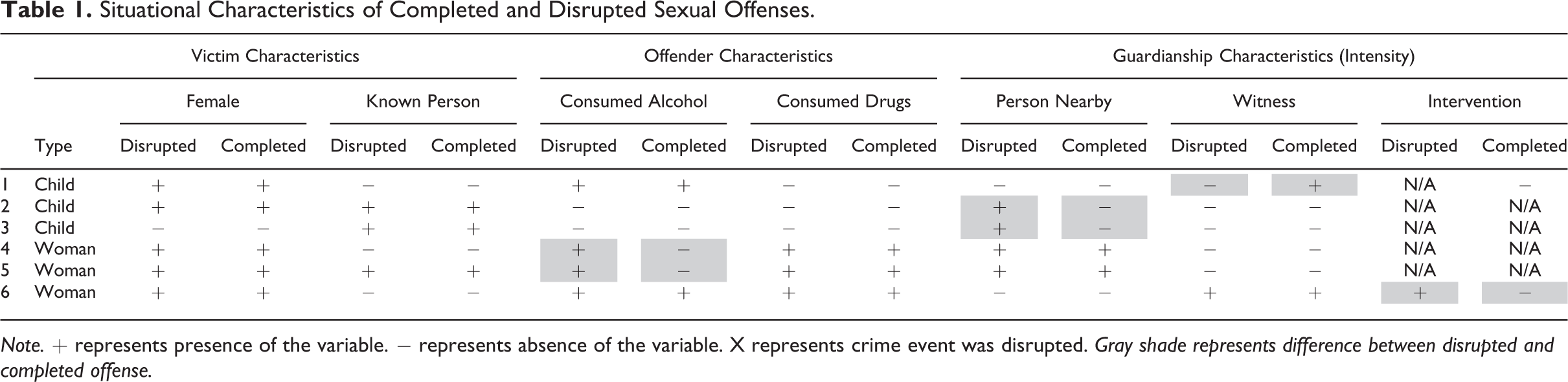
Note. + represents presence of the variable. − represents absence of the variable. X represents crime event was disrupted. Gray shade represents difference between disrupted and completed offense.
Victim characteristics
Participant responses with regard to victim characteristics show that for sexual offenders with child victims, the gender of the victim and relationship with the victim was largely consistent across both the disrupted and completed offense. Eighty-two percent of these offenders reported the victim being female in both offenses, and 88% of victims were, in both reported situations, known to the offender. For offenders with adult female victims, these metrics were slightly different. Two thirds of this sample reported the victim to be a stranger in both the disrupted and completed offense, and while this is not typical of sexual offenses against women, it does reflect the fact that stranger assailants are more likely to be reported and convicted than known assailants. In a paper by Ullman (1998) using rape cases reported to the police, for example, 71.9% of assaults were found to be committed by strangers.
Offender characteristics
Responses informing on offender characteristics showed only 10% of child sex offenders had differing alcohol and/or drug consumption behaviors across both their completed and disrupted offense. In comparison, two of the three offenders who sexually offended against women reported consuming alcohol in their disrupted offense but not their completed offense. Results also show a relatively low prevalence (20%) of alcohol/drug use among child sex offenders prior to both reported offenses. For offenses against adult females, however, all offenders had taken drugs immediately prior to both their disrupted and completed offense.
Guardianship characteristics
Thirty-eight percent of child sex offenders reported a difference in the lowest level of guardianship intensity (i.e., person nearby) between their disrupted and completed sexual offense. However, there were no clear patterns to suggest the proximity of a potential guardian was conducive to a particular offense outcome. At the next highest level of guardianship intensity, 10 offenders with child victims reported a guardian witnessing either their disrupted or completed offense. Specifically, six of these individuals reported a difference in witness availability between their two offenses with five of the six indicating the presence of a witness in their disrupted offense, but the absence of a witness in their completed offense. The occurrence of the highest level of guardianship intensity (i.e., intervention) was reported by 5 of the 10 offenders with child victims who had reported a guardian witnessing either their disrupted or completed offense. The nature of these interventions was primarily direct verbal (e.g., shouting at the offender telling him to stop). All instances of intervention were successful in disrupting the contact and three of the offenders who reported a witness in their disrupted but not completed offense were in this group. For the five offenders who reported a witness that did not engage in subsequent intervention, analysis revealed the witness to be either a co-offender or a child.
None of the men who offended against adult women reported a difference in the presence of nearby/potential guardians between their disrupted and completed sexual offense. Moreover, only one offender with an adult female victim reported any occurrence of a witness and this was present in both their disrupted and completed offense. The main difference emerged at the highest level of guardianship intensity where for this same offender, intervention occurred in their disrupted but not completed offense. Similar to the data reported by the child sex offenders, this intervention was direct verbal. In the completed offense where intervention did not occur, the witness was identified to be a young female who had also been victimized by the offender at an earlier point in the evening.
Script Characteristics of Disrupted and Completed Sexual Crime Events
To build on these dominant situational contexts emerging in self-reported sexual crime events, the next stage involved a step-by-step breakdown of the modus operandi strategies adopted by participants for their most recent disrupted and completed crime commission process. Completing this exercise reveals (a) the stage/s of the crime script in which offending is being disrupted, (b) the stage/s of the crime script in which offending is not being disrupted—suggesting that interventions need to be boosted at this point to maximize capacity for prevention, and (c) the situational conditions under which these patterns emerge. An extract of this analysis is presented in Table 2. A positive symbol (+) indicates the presence of the variable, a negative symbol (−) indicates the absence of the variable, and an X symbol indicates the crime event was disrupted before the offender could progress to that stage of the script. The presence of shading highlights a difference in how the offense unfolded at that stage of the offender’s disrupted compared to completed crime commission process.
Crime Script of Completed and Disrupted Sexual Offenses.
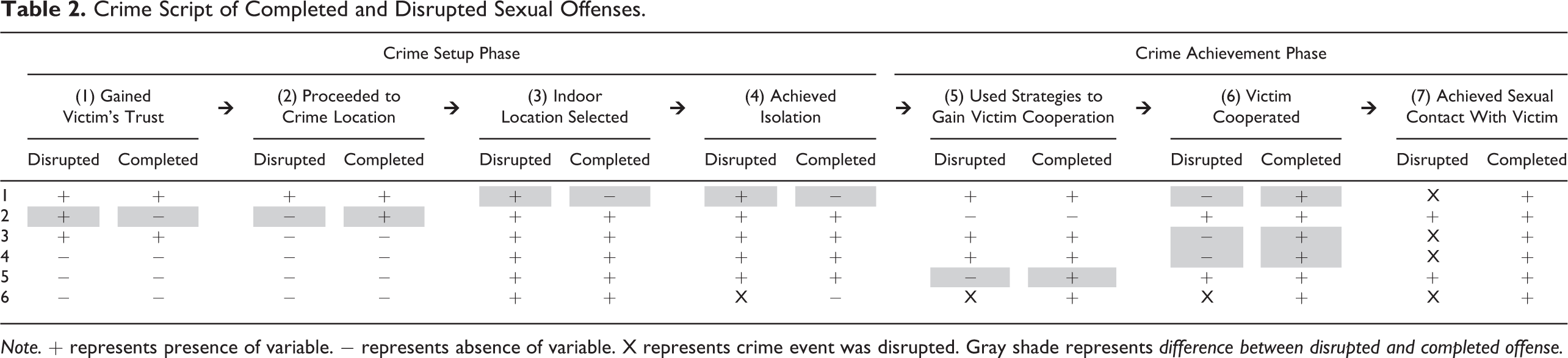
Note. + represents presence of variable. − represents absence of variable. X represents crime event was disrupted. Gray shade represents difference between disrupted and completed offense.
When were sexual offenses disrupted?
Self-reported accounts of respondents’ most recent disrupted sexual contact indicate that regardless of victim type, the majority of offenders encountered no obstacles to their offending in the early stages of the script. Discouragement leading to a disrupted offense outcome during the crime setup phase occurred for only 4% of child sex offenders and 33% of offenders with adult female victims. A disruption while attempting to progress to the crime achievement phase was reported by a further 14% of child sex offenders and none of the offenders with adult female victims. In total, 82% of disrupted offenses involving child sex offenders and 66% of disrupted offenses involving offenders with adult female victims progressed to the crime achievement phase, but most of these were stopped at Stage 6—victim cooperated. Less than one third of offenders with child victims (30%) and 33% of offenders with adult female victims progressed to the point of attaining any sexual contact with their victim before crime commission was stopped or disrupted.
What differentiated disrupted and completed sexual offenses?
Across both victim types, the actions employed by offenders to facilitate their progression through the crime setup phase were relatively consistent for each of their disrupted compared to completed sexual offenses. Most offenders (1) did not attempt to/did not need to gain their victim’s trust, (2) encountered and either attempted or were able to offend against their victim in that same location, (3) carried out the contact in an indoor location, and (4) isolated their victim. These patterns were more pronounced in regard to the selection of an indoor location (reported in 92.4% of all disrupted offenses and 90.5% of all completed offenses) and isolation of the victim (reported in 88% of all disrupted and 82% of all completed offenses).
Analysis of the crime achievement phase of the script indicated that use of strategies to gain victim cooperation across both offenses was also relatively consistent for both offenders with child victims (34%) and offenders with adult female victims (33%). However, the actual attainment of cooperation by the victim emerged as the stage at which differences in disrupted compared to completed crime scripts were most pronounced for both groups. Just over half (54%) of child sex offenders who progressed to this point in both their offenses reported a difference in victim cooperation across the two offenses. Most notably, for 86% of these offenders, the inability to achieve victim cooperation (i.e., negative victim reaction) was reported for their disrupted but not completed offense. A difference in victim cooperation across offenses, influenced by both the victim’s immediate reaction and the offender’s use of threats and violence, was similarly reported by half of the three offenders with adult female victims who progressed to this stage in both their disrupted and completed contacts. This suggests that for both groups of offenders, victim cooperation within the crime achievement phase is operating as the critical script stage at which disruption occurs effectively.
Discussion
To better understand and develop effective crime opportunity reduction, it is becoming increasingly evident that offender insight is critical for building up a picture of offense commission from initiation through to completion. The current article presented an innovative contribution which uses offender self-report data, collected through a crime script framework, to provide a first-time comparison of completed versus disrupted sexual offenses involving adult female and child victims. The instrument refines knowledge of the microsituational contexts of sexual crime events and taps into the distinctive situations and circumstances which should be emphasized to prevent opportunities arising in the first place. Consistent with prior research, results confirmed that while sexual offenders take risks in securing opportunities for sexual contact with a victim, it is critical from the perspective of the offender that these risks can be anticipated and managed (Leclerc et al., 2015).
Preliminary findings demonstrate that guardianship intensity and non-cooperation by the victim are the two dominant mechanisms operating in the disruption of sexual offense opportunities. With respect to guardianship, findings build on previous work by illustrating the importance of considering contextual factors beyond the dichotomous observation of availability (Cook & Reynald, 2016). The emerging position of guardianship research suggests that crime likelihood is most significantly linked with the overtness of guardianship presence and immediacy of guardianship response (Hollis-Peel & Welsh, 2014; Reynald, 2009, 2011a, 2011b). Our findings suggest that the same principle applies in the disruption of sexual offending as every reported intervention led to a disrupted offense outcome. The primarily direct, verbal interventions reported also indicate that while the willingness of third parties to engage in higher levels of intensity is important in determining offense outcome, it is not always necessary that the guardian place themselves in a risky situation to achieve this objective. This is a particularly important finding in light of current research on barriers to bystander intervention, which identify a fear of personal safety as a key reason third parties may avoid helping when witness to a sexual assault (Banyard, 2011).
Analysis of the self-reported offenses where guardianship did not prevent offending (e.g., offense was committed in the presence of a witness) also suggests that the progression from monitoring to intervention is highly context-dependent and driven by more than just the guardian’s belief in their efficacy. In all situations where the monitoring guardian remained passive, they were identified to be a child, co-offender, or another victim. This supports prior work which argues for the importance of exploring the factors that explain both intervention capability and intervention willingness (Cook & Reynald, 2016). It is clear from our findings that the sexual offender’s decision-making process is strongly mediated by how willing they perceive that guardian to be in their capacity to intervene or report (see also Beauregard & Leclerc, 2007). Moreover, this result points to the preparedness of offenders to take risks and the critical need to consider the microsituational context of the offense in building up our understanding of the complex ways guardianship operates as a preventative mechanism in sexual violence and abuse. As explained by Jacobs (2010), situational measures are more likely to thwart a risk-sensitive offender but not a risk-insensitive one. While some offenders will be discouraged by the fear of detection, and subsequent sanction, from what they perceive as a capable guardian, others will be much less responsive. In these latter cases, risk insensitivity will arguably be amplified if that guardian who is nearby is perceived as an easily surmountable threat (e.g., child, co-offender, or another victim).
The second situational measure that played a dominant role in disrupting sexual contact was the offender’s inability to secure victim cooperation. The efficacy of self-protection strategies by the victim is not new in the context of research around sexual offenses against children (see Leclerc, Wortley, & Smallbone, 2011b) or sexual offenses against women (see Guerette & Santana, 2010), but our findings are unique in that this is the first time, to our knowledge, self-protection in sexual offending has been looked at within a script framework. The fact victim cooperation operates as the critical stage of crime commission at which disruption effectively occurs suggests that sexual offenders operate within an opportunity structure in which they are successfully exploiting the facilitating conditions of the early stages in their script (e.g., absence of supervision).
These findings highlight the critical need to boost the efficacy of situational prevention in the crime setup phase of the script. In the context of sexual contacts against adult female victims, the proactive adoption of low-risk self-protection strategies is recommended (e.g., asserting dominance, drawing the attention of people nearby). Offenders with adult female victims had a high prevalence of either alcohol and/or drugs prior to the offense and reported minimal engagement with their victim, who were predominantly strangers, prior to the initiation of contact (Beauregard & Leclerc, 2007; Beauregard, Proulx, Rossmo, Leclerc, & Allaire, 2007). This absence of an established relationship which the offender can manipulate means that at the first victim–offender intersection, there is capacity for the victim to raise an alarm and disrupt the script immediately. If we also factor in the alcohol and/or drug consumption habits of offenders with adult female victims, it is quite possible these offenses are predominantly unplanned and opportunistic. Situational measures which immediately draw offender’s attention to the risks associated with their actions (e.g., calling for help) are therefore also worthy of attention in disrupting sexual offenses against women in the crime setup phase of the script.
For the reported sexual contacts involving child victims, a large majority of contacts in both disrupted and completed events occurring in an indoor setting against a victim with whom the offender had already established trust. For this reason, prevention models for child sexual abuse which emphasize screening potential offenders and regulating child and adult interactions are not likely to be suitable, nor practical in the context of the offending identified in this study. Drawing on the suggestions of Leclerc and colleagues (2011a), prevention capabilities might be better improved by educating primary caregivers on the trust-gaining strategies offenders use to establish relationships with child victims. Better understanding and promoting the trust-building or grooming strategies being adopted should have strong implications for prevention as our findings indicate the techniques offenders employ are clearly facilitating the progression of their offense to the point of intended contact (Leclerc et al., 2011a). The extent to which these trust-building behaviors differ across situational contexts and interact with the actions adopted in subsequent script stages is worthy of future consideration.
The number of disrupted and completed sexual offense scripts committed in the presence of a person nearby, against both types of victims, also indicates that increasing natural surveillance within indoor settings is critical for facilitating prevention. For example, educating victims on safe ways to draw the attention of potential guardians may work to restrict opportunities which arise when potential guardians are not able to directly supervise the victim (Leclerc et al., 2011a). To build on these suggestions, it is critical future research continues to explore the specific circumstances under which guardianship is a factor in sexual offenses. There is currently little understanding of guardianship trends and patterns which emerge from offenders’ accounts of sexual offenses against both adult females and children or under what situational conditions guardianship is effective/ineffective in preventing sexual abuse.
Limitations
To our knowledge, this study represents a first-time comparison of completed versus disrupted sexual offenses involving adult female and child victims. While the findings have important implications for illuminating new avenues in the prevention of sexual offenses, we acknowledge that our conclusions should be considered in light of relevant limitations. Most notably, this study was based on self-report data from incarcerated offenders which may be subject to both memory and social desirability biases. To address this, offenders were asked to report on only their most recent disrupted sexual offense and most recent completed sexual offense. This helped to neutralize the concern of any memory limitations. A research assistant was also present while each participant completed the questionnaire to answer any questions or concerns they had about their responses. In this way, researchers had the opportunity to establish a rapport and help circumvent the problem of inflated or socially desirable responding. As participants still had the freedom to read the survey for themselves and response categories were made exhaustive using the “other” label, it also took into account the sensitivities of the topic and the self-consciousness offenders may experience if asked to disclose verbally.
Second, the offenses reported in our study largely occurred against a female child victim with whom the offender was familiar—characteristics indicative of intrafamilial child abuse patterns (Leclerc et al., 2015). It is therefore likely that at the point of their most recent sexual contact with the victim, respondents had already engaged in an extended period of offending. For this reason, their reporting on how they gained trust or got the victim involved might not have been adequately captured as these were only relevant at the initiation of their relationship with the victim. There is also the possibility that offenders who were disrupted very early in the course of their script (e.g., while gaining the victims trust) may not now recognize that they had initiated a sexual offense script at that time. This may be one explanation for why such a large number of the disrupted offenses reported progressed to the crime achievement phase.
Conclusion and Future Directions
This study makes a useful contribution by demonstrating how a script framework can be incorporated into an offender self-report instrument for the purpose of collecting data on situational crime prevention. By comparing completed versus disrupted sexual offenses involving adult female and child victims within a script framework, this study acts as a first step toward the accumulation of evidence-based knowledge on the effectiveness of situational crime prevention interventions in real settings. Future research using the full database of disrupted and completed sexual crime events will build on this knowledge of what works by examining in-depth associations between situational crime prevention techniques and outcomes of the offenses across different contexts. With this, we can ensure a better understanding of the opportunity structure across the crime commission process for sexual violence and abuse and determine the configuration of situational crime prevention techniques that emerge in situations leading to prevention. Better understanding the critical dimensions of sexual crime events is a key factor in furthering knowledge around innovative methods for preventing sexual offenses involving adult female and child victims. With the support of a crime script framework, the self-reported insights of sexual offenders should be at the center of this growing body of research.
Footnotes
Appendix A
Appendix B
Declaration of Conflicting Interests
The authors declared no potential conflicts of interest with respect to the research, authorship, and/or publication of this article.
Funding
The authors disclosed receipt of the following financial support for the research, authorship, and/or publication of this article: This work was supported by Australian Research Council (DP130100501).