



Abstract
The Resiliency Scale for Young Adults (RSYA) is presented as an upward extension of the Resiliency Scales for Children and Adolescents (RSCA). The RSYA is based on the three-factor model of personal resiliency including mastery, relatedness, and emotional reactivity. Several stages of scale development and studies leading to the current RSYA are described that provide construct validity (i.e., internal consistency, confirmatory factor analyses, and convergent–divergent validity) support for the three-factor structure and 10 subscales of this measure for young adults who are attending college. This work is a step in a longer-term project of translating the constructs of personal resiliency for application across the life span.
Introduction
The transition from adolescence to adulthood brings many challenges ranging from entering postsecondary education and job seeking to changes in relationships and concerns over longer-term goals. Developmentally, early adulthood represents the establishment of oneself in adult roles such as spouse, parent, worker, and community member. For some young adults, attending university and college is a stressful time both due to unique emergent stressors and because of increased vulnerability for exposure to challenging events (Galatzer-Levy, Burton, & Bonanno, 2012; Stelnicki, Nordstokke, & Saklofske, 2015). This transition may be the first time away from their family of origin, and managing their own time, tasks, and responsibilities.
Consistently, research indicates that such transitions are a source of stress, uncertainty, anxiety, and even fear, as individuals go through a process of leaving the familiar behind and entering unfamiliar territory (Latham & Green, 1997). It has been suggested that how well an individual copes with a transition that has, or is, occurring is related to how resilient that individual is (Tusaie & Dyer, 2004). The establishment of first-year university student’s social support systems, especially during the first semester of the academic year, can be a time of social volatility (Brissette, Scheier, & Carver, 2002) and adjustment where they are meeting new people, developing new friendships, evaluating or maintaining old friendships, adjusting to separation from the family and changes in parental support, as well as acquiring knowledge of university resources and the demands of being a postsecondary student (Paul & Brier, 2001; Urani, Miller, Johnson, & Petzel, 2003). The inability to make the transition to young adulthood in college can result in psychological costs such as depression and anxiety, substance abuse, academic failure, and program noncompletion. Considering these and other costs, there is a need to assess, understand, and promote personal resiliency in college students and young adults generally.
Existing assessment tools for resiliency in adults have a variety of foci and/or present with inconsistent factor structures describing resiliency, thus presenting inconsistency in the definition of resiliency across instruments and within the same instrument across samples. Resilience assessment tools for adults include the Ego Resiliency 89-item version (ER89; Block & Kremen, 1996), which focuses on ego resiliency; Connor–Davidson Resilience Scale (CD-RISC; Connor & Davidson, 2003) developed to assess response to medication and also the Brief Resilience Scale (Smith et. al., 2008), which focuses on the ability to recover. Prince-Embury, Saklofske, and Veseley (2015) review these and other scales of resiliency and related constructs. Prince-Embury and Saklofske (2013) present a broader view of theoretical issues in the field.
The development of the Resiliency Scale for Young Adults (RSYA 1 ) reported here applies the three-factor model of personal resiliency developed by Prince-Embury (2006, 2007, 2008a, 2008b, 2009) to the struggles of young adults attending college. This work is considered as a step in the authors’ longer-term project of translating the constructs of personal resiliency for application across the life span and builds on earlier work by the authors (Prince-Embury, 2006, 2007, 2008a, 2008b, 2012, 2013, 2014; Prince-Embury & Courville, 2008a, 2008b; Prince-Embury & Saklofske, 2013, 2014). We will first address general definitions of resilience and then the three-factor model underlying the RSYA.
Defining Resilience/Resiliency
Personal resiliency or the ability to overcome and thrive in the face of obstacles or adversity is relevant throughout all stages of development (A. S. Masten, 2001, 2014; A. S. Masten et al., 2004, Masten & Wright, 2009). The constructs of resilience and resiliency have been defined from multiple perspectives (Luthar, 2006; A. S. Masten, 2007; Prince-Embury, 2013, 2014; Prince-Embury & Saklofske, 2013, 2014; Wald, Taylor, Amundson, Jang, & Stapleton, 2006) but have evolved from examining the circumstances allowing some “extraordinary individuals” to survive in the face of adversity (Werner, 1997; Werner & Smith, 1982, 1992) to A. S. Masten’s (2001, 2014) view of resilience as “ordinary magic.” This perspective suggests that resiliency is based in fundamental systems, already identified as characteristic of human functioning, and that it has great adaptive significance across diverse stressors and threatening situations. In this way, Masten contends that personal resiliency applies potentially to “ordinary” individuals. This shift in emphasis has significant implications by extending the application of resilience theory to a broader range of individuals in varied contexts across the life span.
Extending this view of resiliency as a trait of the individual (J. Block & Kremen, 1996; J. H. Block & Block, 1980), the emphasis has shifted to describing resilience as a dynamic process involving an interaction between the individual and the environment (A. S. Masten, 2007, 2014). Luthar, Cicchetti, and Becker (2000) distinguished between resilience as a dynamic developmental process or phenomenon that involves the interaction of personal attributes with environmental circumstances and personal resiliency (J. H. Block & Block, 1980) as a personality characteristic of the individual.
Several theories have attempted to elucidate the facets of resiliency, their interrelationships, as well as their underlying mechanisms, processes, and outcomes. These theories have drawn from personality, cognitive, and biological orientations, yet none, to date, provide a comprehensive theory of resiliency (Wald et al., 2006). Although many of these theories and models (e.g., Richardson, 2002; Richardson, Neiger, Jensen, & Kumpfer, 1990; Rutter, 1985, 1987, 1990) have been subjected to some empirical investigation, research findings are limited by various methodological shortcomings and in their generalizability (Wald et al., 2006). This has resulted in a continuing lack of clarity and consensus in the definition of resilience and personal resiliency, and in the ways of operationalizing these definitions. It is with this in mind that the three-factor model of personal resiliency and associated Resiliency Scales for Children and Adolescents (RSCA) were developed as a working model operationalized by a brief self-report assessment measure (Prince-Embury, 2006, 2007).
Three-Factor Model of Personal Resiliency
The three-factor model of personal resiliency (Prince-Embury, 2006, 2007) is based on previously identified aspects of personal experience related to three core developmental systems—Sense of Mastery, Sense of Relatedness, and Emotional Reactivity—and the relationship of these factors to one another. It draws from an extensive review of the resilience literature (Prince-Embury, 2006, 2007, 2008a, 2008b, 2012, 2013; Prince-Embury & Saklofske, 2013, 2014) and from A. S. Masten’s (2001, 2007, 2014) suggestion that resilience builds on basic developmental systems. The model operationalized in the RSCA (Prince-Embury, 2006, 2007) has been supported by comparing the fit of one-, two-, and three-factor structures for normative samples of children and adolescents (Prince-Embury & Courville, 2008a), and by an analysis of measurement invariance across gender and age (Prince-Embury & Courville, 2008b). Convergent and divergent validity have been provided for each of the factors represented by the three global RSCA scales (Prince-Embury, 2006, 2007, 2013), including their ability to differentiate children and adolescents with clinical diagnoses from matched control samples (Prince-Embury, 2008a). Core aspects of the three-factor model are described below along with links to other pivotal resilience-related concepts and research.
Sense of mastery
One cluster of constructs consistently identified as important for developmental and resilience research include mastery, competence, and self-efficacy. White (1959) suggested that an individual’s sense of competence or efficacy provides him or her with the opportunity to interact with and enjoy cause and affect relationships in the environment. It is driven by an innate curiosity that is intrinsically rewarding and is the source of problem solving skills. Sense of Mastery, described by Prince-Embury (2006, 2007, 2013, 2014), involves optimism or a positive view about the future and oneself, self-efficacy or the belief that one can master his or her environment, and adaptability reflecting the ability to adjust oneself and one’s behavior when necessary. Sense of Mastery, according to this model, represents a key protective factor of personal resiliency.
Sense of relatedness
Reviewing five decades of resilience research in child development, Luthar (2006) concluded, “Resilience rests, fundamentally, on relationships” (p. 780). The importance of relationships has been noted in every major review of protective factors for resilience (see Masten & Obradovic, 2008). Furthermore, the position of relationships and relational ability as mediators of resilience has been supported in developmental psychopathology research (e.g., Werner & Smith, 1982). Prince-Embury’s (2006, 2007, 2013, 2014) conceptualization of relatedness includes a sense of trust, perceived access to support, and comfort with and tolerance of others. Hence, Sense of Relatedness represents a second protective factor of personal resiliency.
Emotional reactivity
Developmental research has demonstrated that behavioral maladjustment and the development of pathology in the presence of adversity are related to both emotional reactivity and the inability to regulate this reactivity. Emotional Reactivity is the individual’s arousability or the threshold of tolerance that exists prior to the occurrence of adverse events or circumstances. Rothbart and Derryberry (1981) have defined emotional reactivity as the speed and intensity of an individual’s negative emotional response. Prince-Embury (2006, 2007, 2013, 2014) further described three functional aspects of emotional reactivity: sensitivity, length of recovery time from emotional upset, and impairment or degree of disrupted functioning related to emotional upset. Emotional Reactivity represents a vulnerability factor within this three-factor model.
RSCA
The RSCA (Prince-Embury, 2006, 2007) was developed for children and adolescents of ages 9 through 18 years. It is comprised of three global scales based on the three-factor model of personal resiliency: Sense of Mastery, Sense of Relatedness, and Emotional Reactivity (Prince-Embury, 2007, 2008a, 2008b, 2013, 2014). Each of these factors is comprised of subscales: Sense of Mastery includes Optimism, Self-Efficacy, and Adaptability; Sense of Relatedness is comprised of Trust, Comfort With Others, Support, and Tolerance; and Emotional Reactivity is defined by Sensitivity, Recovery, and Impairment. The RSCA was standardized for three age groups (9-11, 12-14, and 15-18 years), and stratified by ethnicity and parent education level within age group and gender. Although the RSCA was developed for children and adolescents, and worded at a third-grade reading level, the intention was to allow for further scale development and longitudinal analysis of aspects of personal resiliency based on the underlying three-factor structure. Thus, the RSCA allows for assessment of the three personal resiliency factors individually and relative to one another, and a more differentiated assessment of personal resilience than assessments that measure it as a single score. Also the RSCA supports a more factorial consistent model of personal resiliency than other assessments (Prince-Embury & Courville, 2008b; Prince-Embury et al., 2015).
The development of the RSYA reported here represents the continuation of the previous research goal of exploring personal resiliency across groups of different ages. More specifically, the work reported here explores how the RSYA, building from the earlier RSCA, may be used to explore personal resiliency in young adults attending college. For example, those who have a higher Sense of Mastery, particularly self-efficacy, may approach the challenges of academic demands, greater autonomy, and independence with more confidence and effective coping skills than those with a lower Sense of Mastery. Bandura (1977, 1993, 1997) contends that an individual’s internalized expectancies of his or her own efficacy affect how he or she interacts with ongoing circumstances. Also, the first experience for students attending college or university involves leaving their preexisting support network and entering a new environment where new friends and support systems need to be created. Youth with a higher Sense of Relatedness, including sense of trust, tolerance, and comfort with others, may make this social transition more easily than those with a lower sense of relatedness. Young adults who embark on this transition with high Emotional Reactivity may find themselves more emotionally challenged in the new environment. Heightened Emotional Reactivity may in turn manifest itself in psychological or physical symptoms, or acting out behaviors.
Resiliency, or lack thereof, in any of these dimensions may have implications for academic success in postsecondary settings. Higher Sense of Mastery may lead to seeking more effective academic skills as well as greater effort to achieve successfully in coursework, leading to higher grades and a greater likelihood of completing their education. An increased Sense of Relatedness underlies the forming and maintaining of friendships and a support system, enhancing quality of life as a student, and, again, may offer a greater likelihood of completing one’s education. Lower Emotional Reactivity in the face of stress may allow youth to weather the occasional disappointments and conflicts that they will inevitably encounter in the course of their education. The work reported here represents the first step in establishing the RSYA as a tool for future research exploring the above hypotheses.
Previous Research in the Development of the RSYA
Phase 1 study
Our initial research explored the applicability of the original RSCA (Prince-Embury, 2006, 2007) and a slightly adapted version with young adult college student populations (Saklofske et al., 2013). As with the original RSCA, the three global factors formed the foundation of these scales and retained the factor labels Sense of Mastery, Sense of Relatedness, and Emotional Reactivity (Prince-Embury, 2007). The first phase of development was the creation of a young adult version RSCA-A, which was essentially the same as the RSCA, with only two items altered to be more appropriate for adults. The word “parents” was replaced by “family” on the Support subscale. This was followed by a revised version titled the RSCA-A-R, which included eight provisional items added to the Adaptability subscale.
Addition of adaptability items
Adaptability was chosen as an area to expand in the young adult version, consistent with the finding that flexible coping was more adaptive for college students (Galatzer-Levy et al., 2012; Saklofske, Austin, Mastoras, Beaton, & Osborne, 2012; Zeidner & Saklofske, 1996). Adaptability is represented in the original RSCA as the degree to which children and adolescents can learn from their mistakes, and the degree to which they can let others help when needed. Also, the original Adaptability subscale had only three items. Added to this subscale were provisional items more appropriate to adults, such as conceptualizing hardships as opportunities for new learning and growth. Findings supported the addition of these new items to the revised Adaptability subscale for inclusion in the next phase of developing a resiliency scale for young adults.
Following from studies of these preliminary adult versions of the scale with two samples of university students (N = 635; 18-25 years), a review of the findings focused on whether the factor structures of the RSCA-A and RSCA-A-R were acceptable and consistent with that of the original RSCA, whether the alpha coefficients for the scales and subscales were satisfactory, and whether the relationship with other theoretically related variables were in the predicted direction. These criteria were all met at the completion of Phase 1 (Saklofske et al., 2013)
Phase 2 study
Phase 2 of the scale development (Saklofske et al., 2013) introduced new trial items with more adult-focused wording but which were consistent with the core underlying constructs of the RSCA-A-R. Further items were generated, and a 105-item version was administered to a third sample of Canadian university students (N = 390), and results were examined to determine internal consistency and the factor structure. The intention was to try out new items that might improve the previous scale and then to shorten the overall number of items per subscale to five. Based on exploratory factor analyses of both the items and the corresponding 10 subscales, all but nine of the newly introduced items were eliminated along with 23 of the original RSCA items, which resulted in a 50-item scale, renamed the RSYA. The current 50-item RSYA included 41 of the original RSCA items, the new Adaptability subscale, and modified versions of the Optimism and Tolerance subscales.
The current version of the RSYA includes five items for each of the 10 subscales comprising the three-factor model. Each item is responded to on a 5-point scale (0 = never to 4 = almost always). The format of the RSYA was modified mixing items reflecting Mastery, Relatedness, and Emotional Reactivity to reduce the possible influence of response set.
Current study
This current study follows from the preceding scale development and is intended to confirm the factor structure of the 50-item RSYA. This study will examine the internal consistency reliability of the three main factors and 10 subscales of the RSYA. Confirmatory factor analysis (CFA) was used to replicate the factor structure found in the previous studies, and followed with an examination of the convergent and discriminant validity of the RSYA. Based on a large literature review (e.g., Prince-Embury & Saklofske, 2013, 2014), we hypothesized that the RSYA protective factors Sense of Mastery and Relatedness would correlate positively with measures of well-being and negatively with measures of negative affect. In addition, we expected Emotional Reactivity to correlate positively with measures of negative affect and negatively with measures of well-being.
Method
Participants
The participants were 290 Canadian undergraduate university students (204 females and 86 males) between 17 and 27 years of age (M = 18.24, SD = 1.51) from the second author’s university. They were recruited through the student subject pool in which students receive credit for participating in approved studies. The majority of the students were in their first year of study (first year = 89%, second year = 6.6%, third year = 1.7%, fourth year or higher = 1.7%). The ethnic backgrounds of the participants in the sample were as follows: 45.2% European, 41.4% Asian, 4.8%, Middle Eastern, 2.1% African, 1.7% Latin American, 0.7% First Nations, and 4.1% Other. Father’s education was distributed as follows: 5.6% less than Grade 12, 15.2% a high school diploma, 30.8% an undergraduate degree, 36.3% a graduate degree, 8.3% a technical diploma, and 3.8% other education. Mother’s education was distributed as follows: 6.2% less than Grade 12, 12.1% a high school diploma, 38.8% an undergraduate degree, 29.1% a graduate degree, 8.7% a technical diploma, and 5.2 other education. In summary, this sample tended to be younger, in their first year of college, predominantly female, European or Asian in ethnic origin, and from families who were relatively well educated.
Instruments
In addition to the RSYA, other measures in the current study were Trait Emotional Intelligence Questionnaire–Short Form (TEIQue-SF; Petrides & Furnham, 2006), Depression Anxiety Stress Scales (DASS-21; Lovibond & Lovibond, 1995), Satisfaction With Life Scale (SWLS; Diener, Emmons, Larsen, & Griffin, 1985), and Flourishing (Diener et al., 2010).
Depression, anxiety, and stress
The 21-item short form of the DASS-21 (Lovibond & Lovibond, 1995) is responded to on a 4-point Likert-type scale ranging from 0 = did not apply to me at all to 3 = applied to me very much, or most of the time. Research supports the reliability and validity of the DASS-21 (Osman et al., 2012). In the current study, the Depression, Anxiety, and Stress subscales of the DASS-21 had coefficient alpha values of .85, .78, and .83, respectively. It was hypothesized that depression, anxiety, and stress would be positively and significantly correlated with scores on the Emotional Reactivity global scale and subscales, representing the vulnerability aspect of the model, and negatively with Mastery and Relatedness.
Flourishing
The Flourishing Scale (Diener et al., 2010) is an eight-item measure responded to on a 7-point rating scale. It assesses “self-perceived success in important areas such as relationships, self-esteem, purpose, and optimism” all of which tap psychological well-being. Validation studies confirm that this scale correlates between .69 and .80 with other psychological well-being scales, thus providing a good assessment of overall self-reported psychological well-being (Diener et al., 2010). In this study, the Flourishing Scale had a coefficient alpha of .90. It was hypothesized that Flourishing would correlate positively with both protective aspects of the personal resiliency model, Sense of Mastery and Sense of Relatedness, and negatively with Emotional Reactivity.
Satisfaction with life
The SWLS (Diener et al., 1985) uses a 7-point rating scale ranging from 1 = strongly disagree to 7 = strongly agree, with responses to five items (e.g., “I am satisfied with my life”). Research supports the reliability and validity of the SWLS (Pavot & Diener, 1993). The SWLS had a coefficient alpha of .89 in the present research. It was hypothesized that satisfaction with life would correlate positively with both protective aspects of personal resiliency, Sense of Mastery and Sense of Relatedness, and negatively with Emotional Reactivity.
The TEIQue-SF
The TEIQue-SF (Petrides & Furnham, 2006) is a 30-item questionnaire assessing global trait emotional intelligence (EI) drawn from the TEIQue that contains 153 items tapping 15 EI facets. Two items from each of the 15 facets are included in the short form and are rated on a 7-point scale (Cooper & Petrides, 2010; Petrides & Furnham, 2006). A coefficient alpha of .89 was found for this sample. It was hypothesized that EI is correlated positively with both Sense of Mastery and Sense of Relatedness, and negatively with Emotional Reactivity
Analysis
First, coefficient alpha values were determined for the RSYA factor and subscale scores. The three-factor model described in the extensive writings of Prince-Embury and which formed the model for the RSCA and the RSYA was tested at the item and subscale level. We conducted CFAs with the 50 items to ensure support for the 10 subscales and three-factor model described by Prince-Embury and adapted for the RSYA. This was followed by a CFA using the 10 subscales to further support the fit of the three-factor model of mastery, relatedness, and reactivity. Pearson correlations were conducted to explore relationships between the RSYA factor and subscale scores with the validity instruments described above.
Results
RSYA Scoring
Each of the 10 subscale scores was derived from the respective five items answered on a 5-point scale (0 = never to 4 = almost always), thus yielding a score range of 0 through 20 for each. The three major factor scores were the totals of subscale scores for that factor: Sense of Mastery (0-60), Sense of Relatedness (0-80), and Emotional Reactivity (0-60). Missing values were treated via multiple imputations using SPSS 22.0. The total amount of missing data comprised less than 5% of the total data, and no patterns of missing data were detected.
Frequency Distribution
The Support subscale was moderately negatively skewed (−.66), and the Recovery subscale was moderately positively skewed (.87). However, these are well within the range of acceptability, and further, the three-factor scale and eight other subscales scores met criteria for the assumption of normality (Tabachnick & Fidell, 2012). The suggestion of a normal distribution of scores for the RSYA three factors and 10 subscales is consistent with the notion of personal resiliency as normally distributed within both normative samples and clinical samples (Prince-Embury, 2010b).
Reliability of RSYA
The internal consistency reliabilities of the RSYA factors and subscales are shown in Table 1. Coefficient alpha values for the RSYA factor scores ranged between .89 and .92. In general, all subscale internal consistencies were adequate to good with coefficient alphas ranging from .75 to .87, with the exception of the Tolerance subscale with a value of .65. Factor and subscale alpha’s remained the same or stronger than those for the earlier and longer RSCA-A and RSCA-A-R versions, again with the exception of the Tolerance subscale.
Coefficient Alpha Values for RSYA Factor and Subscale Scores.

Note. N = 290. RSYA = Resiliency Scale for Young Adults
CFA
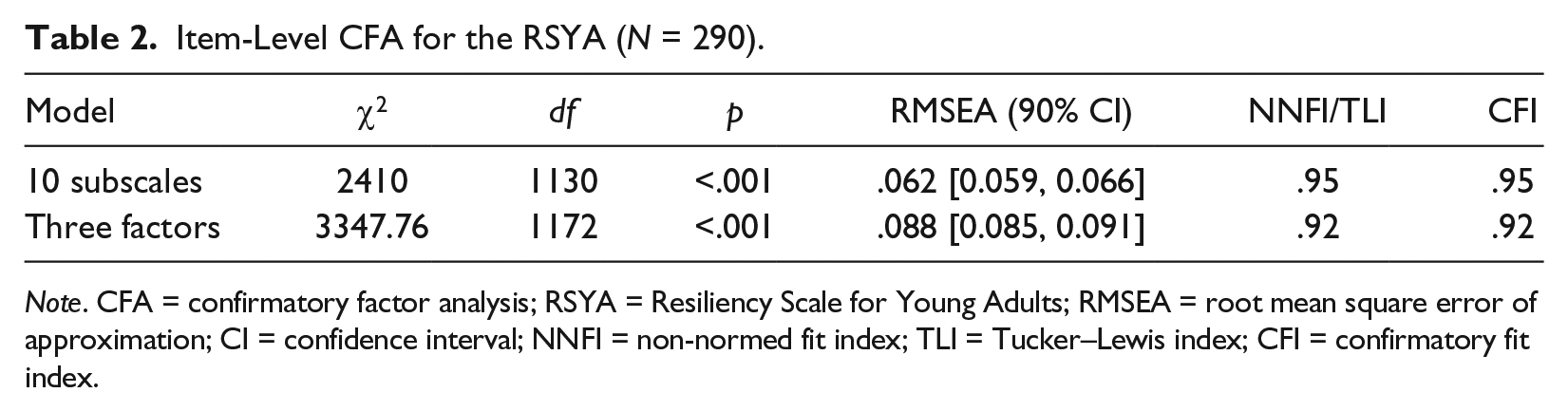
The factor structure of the RSYA was investigated using LISREL 8.80. Maximum likelihood estimation was utilized in all of the models that were evaluated in the current study. The first set of CFAs was conducted at the item level, which were entered as indicators without any parceling of items. Criteria for acceptable fit for the CFAs used in the current study are as follows: root mean square error of approximation (RMSEA) < .08, confirmatory fit index (CFI) > .90, and non-normed fit index (NNFI) > .90 (Brown, 2006; Hu & Bentler, 1999). Results supported both a 10-factor subscale structure and a three-factor structure, and are presented in Table 2. The fit indices of the 10-factor subscale structure reveal a good fitting model with an RMSEA value of .062, an NNFI of .95, and a CFI value of .95. The second analysis using subscale scores indicates that the three-factor structure also demonstrated reasonable fit with an RMSEA value of .088, an NNFI of .92, and a CFI value of .92. Together, these results show the similarity of the RSYA to RSCA factor structure upon which it was modeled. Taken together with the reliability estimates, the RSYA may be examined at the subscale as well as factor level.
Item-Level CFA for the RSYA (N = 290).
Note. CFA = confirmatory factor analysis; RSYA = Resiliency Scale for Young Adults; RMSEA = root mean square error of approximation; CI = confidence interval; NNFI = non-normed fit index; TLI = Tucker–Lewis index; CFI = confirmatory fit index.
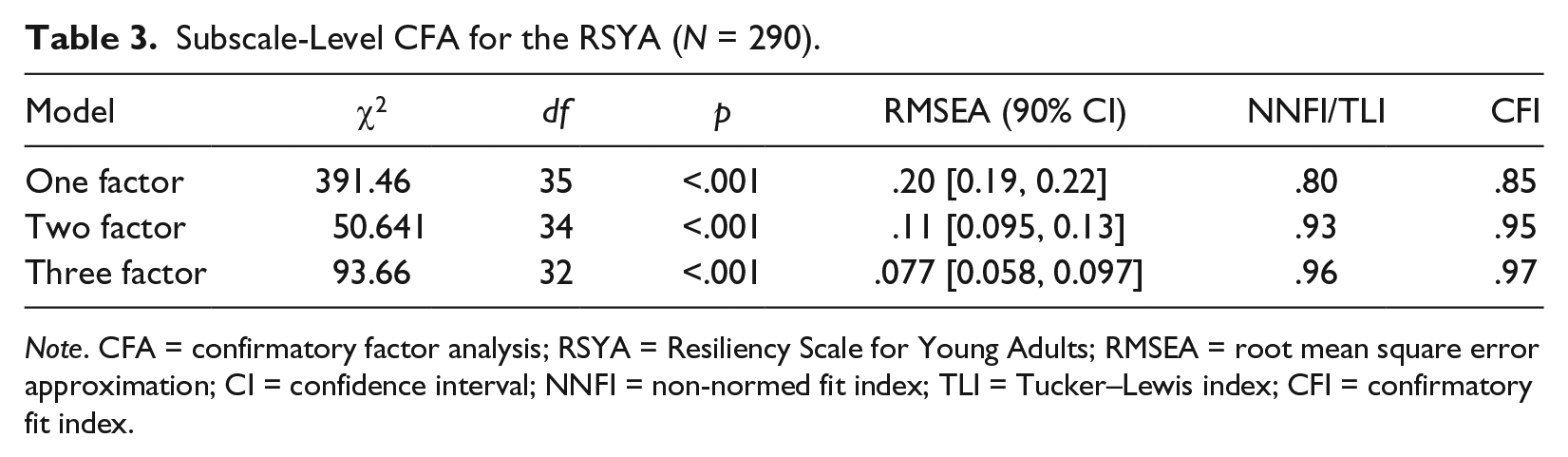
Another series of CFA models were conducted using the subscale values as the indicators for the global model. Three models were tested in this phase of the analysis: one-, two-, and three-factor models. Fit indices are presented in Table 3. The one-factor model was not supported; however, although the two-factor model suggested a reasonably good fit, it was the three-factor model that revealed the best and most acceptable fit. The two-factor solution was examined here because of the high correlation between Mastery and Relatedness, which, taken together, have been viewed as a more strength-based or protective factor description of resiliency (Prince-Embury, 2007, 2010a, 2012, 2013). The RSYA model is further illustrated in Figure 1.
Subscale-Level CFA for the RSYA (N = 290).
Note. CFA = confirmatory factor analysis; RSYA = Resiliency Scale for Young Adults; RMSEA = root mean square error approximation; CI = confidence interval; NNFI = non-normed fit index; TLI = Tucker–Lewis index; CFI = confirmatory fit index.

Model of the RSYA.
Factor loadings for each subscale and the model tested are presented in Figure 1. The square boxes on the left of the figure represent each of the 10 facet scores, and to the left of the facet scores are the error variances. The numbers represented on the arrows that point from the latent variables to the observed facet score are the standardized factor loadings. The arrows between the latent variables indicate the correlation between the latent factors.
Convergent–Divergent Validity
The RSYA factors and subscales correlated in the expected direction with the other scales used in this study. The correlation coefficients are shown in Table 4. The protective factors Sense of Mastery and Sense of Relatedness and their respective subscales correlated moderately and positively with all of the psychological well-being measures, replicating previous results with earlier versions of the RSYA (Saklofske et al., 2013; Vesely, Saklofske, & Nordstokke, 2014). Youth with higher Mastery and Relatedness scores reported a greater satisfaction with life and psychological flourishing and EI. As predicted, the Emotional Reactivity factor and subscales correlated positively and significantly with the DASS measures of stress, anxiety, and depression
Correlations Between RSYA Factors and Subscales, and Criterion Scales (N = 290).

Note. RSYA = Resiliency Scale for Young Adults; Psych Fl = Psychological Flourishing Scale; SWLS = Satisfaction With Life Scale; TEI = Trait Emotional Intelligence; DASS = Depression Anxiety Stress Scales; DASS(S) = Stress Scale; DASS(A) = Anxiety Scale; DASS(D) = Depression Scale.
All correlations significant at p < .01.
Conversely, significant negative correlations were found between the RSYA Sense of Mastery and Relatedness scores and their subscales with the DASS scores of Depression, Anxiety, and Stress. These findings suggest that youth with lower Sense of Mastery and/or Sense of Relatedness may be more likely to report depression, anxiety, and stress. Similarly, there was a significant negative relationship between Emotional Reactivity and its subscales, and psychological flourishing, satisfaction with life, and EI. These results are in line with those reported in studies of the RSCA (Prince-Embury, 2006, 2007) and also earlier versions of the RSYA (e.g., Saklofske et al., 2013)
Discussion
The RSYA is an upward extension of the RSCA. This work was conducted as a step in the authors’ longer-term project of translating the constructs of personal resiliency for application across the life span. The specific goals of modifying the scale reported here were to provide a better fit with the developmental characteristics of young adults together with both shortening the scale and maintaining the original three-factor and 10-subscale structure of the earlier instruments. The resulting 50-item RSYA contains 41 of the original 64 items from the RSCA, whereas 23 items were eliminated. New or modified items were included for four of the 10 subscales of the original RSCA: Adaptability, Optimism, Support and Tolerance. The new Adaptability subscale addresses the youth’s ability to deal with major life changes. The Optimism subscale includes items reflecting the view of oneself as a positive person, the modified Support subscale replaces “parent” with “family,” and the new Tolerance subscale incorporates the capacity to forgive others. Reliability analyses confirms that the three factors and 10 subscales maintained a good to excellent level of internal consistency as found in the previous longer versions of the scale, with the exception of the Tolerance subscale. Although minimally acceptable, the reasons for the lower internal consistency of this subscale require further investigation. However, it is suspected that the low correlations between the item describing “not holding grudges” and other tolerance items will have lowered the reliability of a five-item scale. The extent to which this is unique to this sample or age group or is a weakness in the scale requires additional investigation.
CFA provided supporting evidence for the 10-factor subscale structure at the item level, as well as for the three-factor structure at the item and subscale level. Support for the three-factor structure was comparable with that of the earlier and longer versions of the scale tested in previous samples of young adults. However, a two-factor solution based on the three main factors also supports the view that Mastery and Relatedness together may comprise a protective feature of resiliency. Additional work with the RSYA will allow for combining these factors in the creation of resource and vulnerability indices as available for the RSCA (Prince-Embury, 2007, 2010a) for use in screening.
Convergent and discriminant validity support are provided using various measures of well-being or emotional distress. The Sense of Mastery factor, and particularly the Optimism subscale, is strongly related to students’ self-reported flourishing and subjective well-being. These findings are consistent with research literature associated with the positive psychology movement spearheaded by Martin Seligman (1998, 1995). Furthermore, previous studies of the Sense of Mastery factor have shown it to be correlated with such variables as grade point average and the successful completion of freshman year (Saklofske et al., 2013)
The strong positive correlation of Sense of Relatedness and its subscales with both flourishing and subjective well-being suggests that relatedness may facilitate youths transitioning to the unfamiliar university environment by allowing them to more quickly form new relationships, and connect with and feel comfortable in their new social environment.
Both the Sense of Mastery and Sense of Relatedness factors and their subscales correlate highly with EI, replicating the previous findings of Saklofske et al. (2013). These findings suggest that although not the same, there is significant relationship between EI and these resiliency variables, reflecting the positive nature described by both. Additional research can explore how these variables compare as well as aid in predicting student performance, retention, and well-being.
The Emotional Reactivity factor and subscales were strongly correlated with all three measures of negative affect—stress, depression, and anxiety—which is consistent with previous findings of similar relationships between the Emotional Reactivity factor and subscales in the RSCA (Prince-Embury, 2007, 2010a, 2013, 2014). Thus students who score higher on the Emotional Reactivity Scale and subscales are more likely to experience negative emotions, which may in turn compromise their functioning as students and their personal and social well-being.
Limitations
The RSYA is a self-report measure and does not assess actual resiliency in youth. Additional research will be needed to support predictive validity. Although the concepts addressed by the RSYA are supported by previous theory and research, the RSYA does not purport to assess all aspects of personal resiliency in all situations. Similarly, the three-factor model underlying the RSYA is presented as an understandable and clinically practical model to be used along with other methods for assessing personal resiliency in young adults.
Although a focus of our current research is on postsecondary student success, the current study is also limited by using samples of college students. Additional predictive validity studies should examine the relationship between these constructs of personal resiliency and outcomes for diverse groups of young adults. Having established the goals for the development of the RSYA, the next steps will include acquiring larger and wider samples of young adults to examine whether the structure of the RSYA and its underlying three-factor theory are supported in more diverse samples.
Implications
Finally, the significance of this work builds on the original intentions of the RSCA to operationalize the construct of personal resiliency for practical application (Prince-Embury, 2006, 2007, 2010a, 2011, 2012; Prince-Embury & Saklofske, 2013, 2014). The model graphically displayed above suggests simplification of personal resiliency into three developmentally grounded constructs, which may be broken down further into 10 specific areas for potential intervention as described by Prince-Embury (2010a, 2011, 2012). Support of the three-factor model reflected both in the RSCA and RSYA is consistent with the original intent to provide a potential means for assessing personal resiliency across age groups and longitudinally across the life span. Much additional work needs to be done to achieve the above goal, but we believe that the work reported above represents significant progress toward these ends.
Footnotes
Declaration of Conflicting Interests
The author(s) declared no potential conflicts of interest with respect to the research, authorship, and/or publication of this article.
Funding
The author(s) received no financial support for the research, authorship, and/or publication of this article.