



Abstract
This study explores the relationship between self-reported risk behaviors and personal resiliency in adolescents; specifically whether youth with higher personal resiliency report less frequent risk behaviors than those with lower personal resiliency. Self-reported risk behavior is surveyed by the Adolescent Risk Behavior Inventory(ARBI). Self-reported personal resiliency is reflected in responses to the Resiliency Scales for Children and Adolescents(RSCA). Findings suggest that youth reporting higher personal resiliency report less frequent risk behaviors. The findings suggest the possibility of screening in normative samples of youth in a relatively non-intrusive manner.
Research on risk behavior in adolescence has frequently come under the umbrella of health-related behavior and has been approached from an epidemiological perspective. This perspective considers many types of behaviors that are intentional or unintentionally associated with risk of death or harm (see Centers for Disease Control and Prevention [CDC] Surveillance Summaries, 1994-2013). Risk behaviors include suicide thoughts, intention, plans; substance use and abuse; unsafe sexual behavior; smoking and other risk taking behaviors. According to data gathered at the Center for Disease control, use of alcohol and other drugs is associated with much of the mortality and morbidity among youth (CDC, 2013; Kann, Warrant, Collin, & Kolbe, 1995). Alcohol use is involved in about 50% of all deaths from motor vehicle accident, homicides, and suicides. Careless sexual behavior is a risk variable in multiple ways. Significant morbidity is associated with sexually transmitted diseases. Morbidity and social problems are associated with unplanned pregnancies that occur in adolescence each year. In addition, smoking or use of tobacco, which often begins in adolescence is associated with the three major morbidity-related health conditions, heart disease, cancer, and stroke. Much has been written about circumstances that aggravate the potential for adolescent risk behavior (see CDC Surveillance summaries, 1994-2013).
Some researchers have suggested that current risk prevention policies may not be optimal since their focus is on adolescents in general, rather than those with the highest propensity for adverse outcomes (Ali, Dwyer, Vanner, & Lopez, 2010). Some risk prevention programs have been eliminated by school districts because studies have not demonstrated the program’s effectiveness (Pan & Bai, 2009). Ali et al. suggest replacing existing programs with alternative programs which assess “the levels of risk factors related to problem behaviors such as alcohol, tobacco and other drug use—and identify the levels of protective factors that help guard against those behaviors” (Ali et al., 2010).
Jessor (1991) suggested further that effective policy in reducing this behavior must address an adolescent’s capacity for coping with life as a factor influencing initiation of risky behaviors. Ali et al. (2010) created indices of resilience to identify adolescents at risk of smoking, drinking alcohol, and using illegal drugs. Their analysis suggested that the overall-resilient youth were less likely to engage in risky behaviors.
Resilience in the face of adversity has been studied extensively by developmental psychopathologists for the past 50 years. Personal resiliency has been defined as the ability to weather adversity or to bounce back from negative experience. Much of resilience research has examined the interaction of protective factors and adversity in high-risk populations. As developmental research most of the earlier work focused on children, sometimes in longitudinal studies of factors in the lives of youth that predicted the absence of psychopathology in adulthood in spite of exposure to adversity (see Luthar, 1991, 2003, 2006; Masten, 2001, 2007, 2014; Prince-Embury, 2013, 2014; Prince-Embury & Saklofske, 2013, 2014, for reviews of this literature). Although there have been many definitions of resiliency, there has been consensus that personal resiliency is manifested as the ability to weather adversity or to bounce back from negative experience (Prince-Embury & Saklofske, 2013, 2014).
This study extends exploration of the relationship between self-reported risk behavior and personal resiliency in adolescents; specifically do youth with higher self-reported personal resiliency report less frequent risk behaviors than those with lower personal resiliency? Two brief self-report tools, the Adolescent Risk Behavior Inventory(ARBI) and the Resiliency Scales for Children and Adolescents(RSCA), are employed to examine this relationship. An additional question addressed by this study is whether these tools show promise for screening in general populations of youth. Finally, if significant relationships are found then programming to prevent risk behavior in youth might include interventions to enhance personal resiliency in less resilient youth.
Method
Sample
The sample consisted of 200 cases which were a representative U.S. sample collected as part of the standardization sample for the RSCA(Prince-Embury, 2007b ). The sample consisted of 100 males and 100 females, 15 to 18 years old, and was stratified to be representative of the U.S. 2002 census by ethnicity, parent education level, and region (Prince-Embury, 2007). Ethnicity of the normative sample was as follows: 66% White, 15% Hispanic, 15% African American, 1% Other, and 3% Asian. Parent education level was distributed as follows: 22% had less than 12 years, 36% had 12 years, 28% had 13 to 15 years, and 15% had 16 years or more. The normative sample was identified and tested by paid examiners and took place in school classrooms or the examiner’s office. Responses were anonymous.
Measures
The Adolesent Risk Behavior Inventory (ARBI)
Risk behavior as defined by the ARBI (Prince-Embury, 2007a, 2015) is considered as cumulative frequency of risk behaviors across four areas of potential risk: Self-Harm, Substance Use, Sexual Behavior, and Sensation Seeking. These areas of risk behavior were consistent with risk behavior areas surveyed by the CDC between 1994 and 2014. The ARBI is a 21-item self-report inventory. Risk behavior item clusters include the following: Self-Harm (5), Substance Use (6), Sexual Behavior (3), and Sensation Seeking (4). Sample items for each of the Risk Behavior Clusters are as follows:
Self-Harm: “I do things on purpose to hurt myself.”
Substance Use: “When I use drugs or alcohol I have trouble stopping.”
Sexual Behavior: “I have been sexually active with people I don’t know very well.”
Sensation Seeking: “I like to do dangerous things for excitement.”
Three additional items assess psychological factors that may impact risk behavior. Item responses are rated using 5-point Likert-type response format assessing frequency with which the adolescent engages in the behavior: never (0), rarely (1), sometimes (2), often (3), or almost always (4). Scores obtained include four cluster scores and one total risk behavior score. Alpha coefficients for the ARBI total score and Risk Behavior Cluster scores were good ranging from .81 to .87 in the normative sample (Prince-Embury, in press). ARBI scores have been found to differentiate clinical from non-clinical samples at the total score, cluster score, and individual item level (Prince-Embury, in press).
The Resiliency Scales for Children and Adolescents(RSCA)
Personal resiliency is defined as self-reported response to the RSCA (Prince-Embury, 2007b ). Personal resiliency as defined in the RSCA reflects an underlying three-factor model of personal resiliency including Sense of Mastery, Sense of Relatedness, and Emotional Reactivity. The first two factors are considered positive protective factors and are highly correlated with each other for this sample (r = .78). Sense of Mastery is defined as optimism, self-efficacy, and adaptability. Sense of Relatedness is defined as trust, access to support, comfort, and tolerance of others. The third factor, Emotional Reactivity, is considered a vulnerability factor in that the higher the emotional reactivity, the less resiliency, and the lower the emotional reactivity, the more resiliency. Emotional Reactivity was negatively correlated with both Sense of Mastery (r = −.63) and Sense of Relatedness (r = −.56). Emotional Reactivity is defined as emotional sensitivity, recovery time, and degree of impairment when emotionally upset (Prince-Embury, 2007b, 2008, 2010a, 2013, 2014; Prince-Embury & Courville, 2008a, 2008b; Prince-Embury & Steer, 2010).
The RSCA consists of 64 self-report items organized into three global scores reflecting the three underlying factors of personal resiliency: Sense of Mastery (20), Sense of Relatedness (24), and Emotional Reactivity (20). Sense of Mastery included Optimism, Self-Efficacy, and Adaptability. Sense of Relatedness is comprised of Trust, Support, Comfort, and Tolerance subscales. Emotional Reactivity is comprised of Sensitivity, Recovery Time, and Impairment subscales. Items responses are rated using 5-point Likert-type response format assessing frequency with which the adolescent engages in the behavior: never (0), rarely (1), sometimes (2), often (3), or almost always (4).
Procedure
Youth were identified by paid examiners and were tested in classrooms or the examiner’s office in four regions of the United States. The ARBI and the RSCA were administered in one sitting but order was varied to avoid a systematic sequence effect. Statistical analysis consisted of Pearson correlations and regression analysis as appropriate.
Results
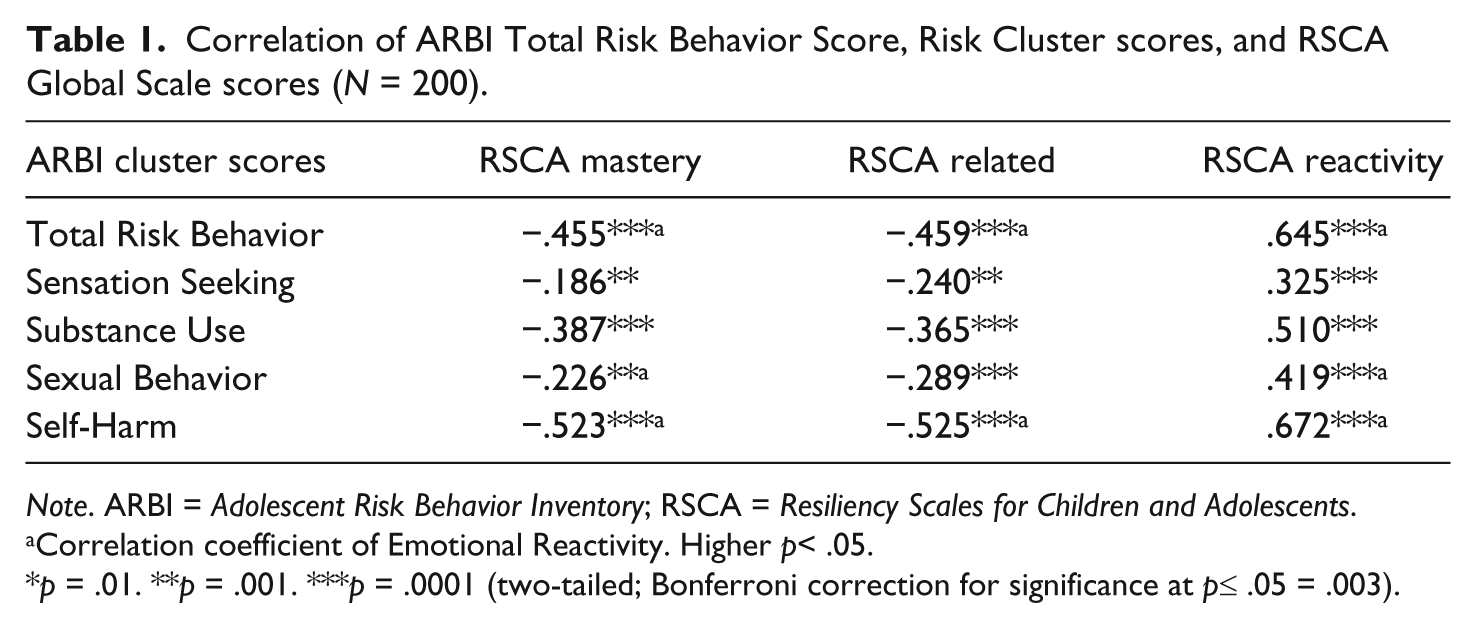
Pearson correlation analysis of ARBI Cluster Scores and three RSCA global scale scores for the normative sample are displayed in Table 1. All correlations were significant in the predicted direction indicating a relationship between adolescent risk behavior and all three aspects of personal resiliency assessed by the RSCA. The ARBI total risk behavior score is positively correlated with the Emotional Reactivity Scale Score suggesting that adolescents who report higher emotional reactivity also report more frequent overall risk behavior. This positive relationship between emotional reactivity and risk behavior in adolescents was consistent across specific areas of risk behavior (see Table 1).
Correlation of ARBI Total Risk Behavior Score, Risk Cluster scores, and RSCA Global Scale scores (N = 200).
Note. ARBI = Adolescent Risk Behavior Inventory; RSCA = Resiliency Scales for Children and Adolescents.
Correlation coefficient of Emotional Reactivity. Higher p< .05.
p = .01. **p = .001. ***p = .0001 (two-tailed; Bonferroni correction for significance at p≤ .05 = .003).
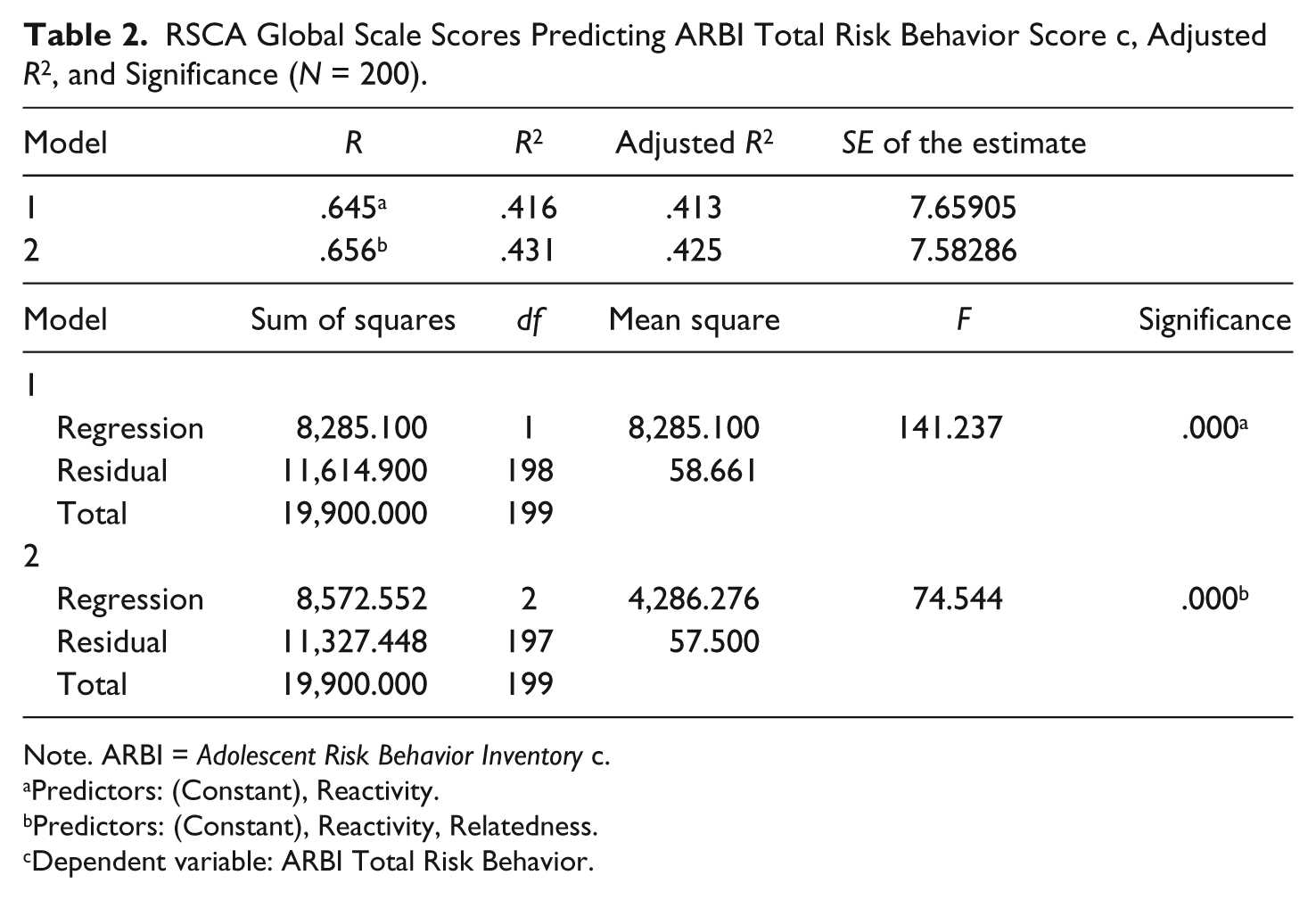
Sense of Relatedness and Sense of Mastery were significantly negatively correlated with adolescent self-reported risk behavior as predicted. The strength of these relationships tended to be less than the relationship between Emotional Reactivity and risk behavior (see Table 1). The correlation coefficient was significantly stronger for Emotional Reactivity and the ARBI total risk behavior score. Relative contribution of three aspects of resiliency was explored using a multiple regression analysis (see Table 2) regressing Emotional Reactivity, Sense of Relatedness, and Sense of Mastery onto the ARBI total risk behavior score.
RSCA Global Scale Scores Predicting ARBI Total Risk Behavior Score c, Adjusted R2, and Significance (N = 200).
Note. ARBI = Adolescent Risk Behavior Inventory c.
Predictors: (Constant), Reactivity.
Predictors: (Constant), Reactivity, Relatedness.
Dependent variable: ARBI Total Risk Behavior.
Regression analysis indicates that 43% of the variance of total risk behavior score was predicted by personal resiliency factors. Of this variance, 41% was predicted by the Emotional Reactivity score and an additional 1.2% of the variance was contributed by the Sense of Relatedness Scale score (see Table 2). Sense of Mastery score did not contribute independent variance to the prediction of total risk behavior score. This is most likely due to the high correlation between Sense of Mastery and Sense of Relatedness. Correlation between Sense of Mastery and Sense of Relatedness for this sample was r = .78. In summary, youth who were more resilient by virtue of lower emotional reactivity reported less frequent participation in risk behaviors. Among the four risk behavior clusters, the relationship with the three personal resiliency scales was strongest for Self-Harm behaviors.
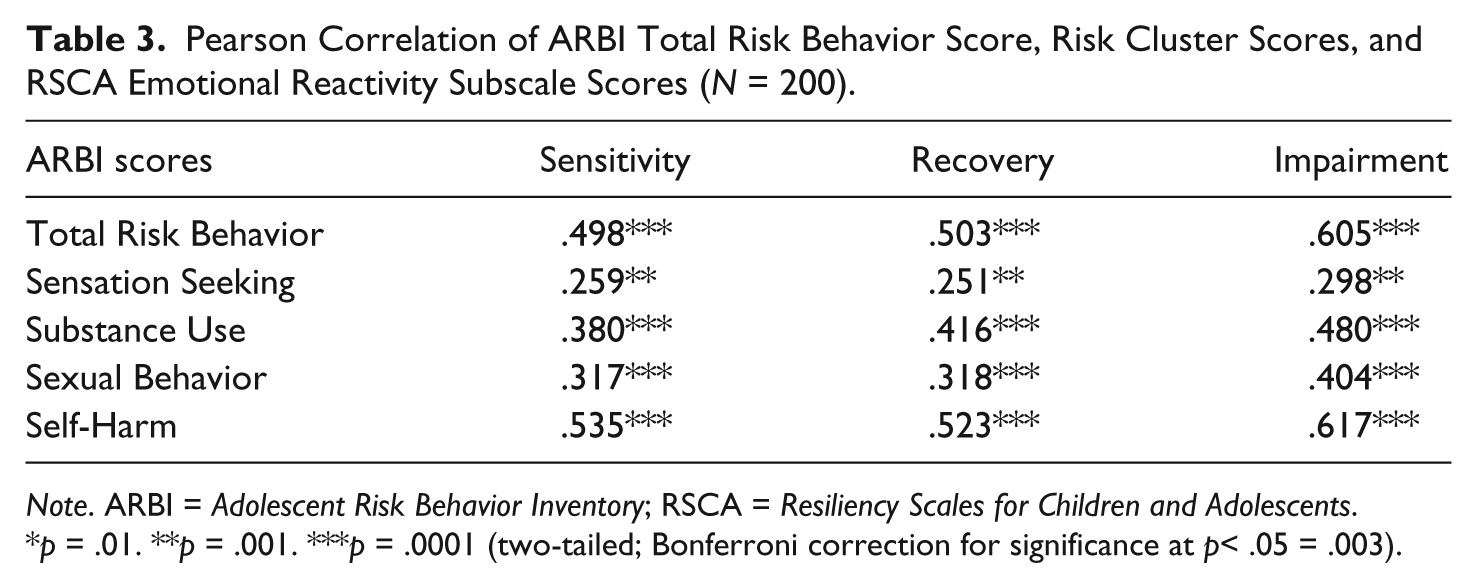
The strength of the relationship between the RSCA Emotional Reactivity Scale score and the ARBI Risk Behavior scores raised the question of whether one aspect of emotional reactivity was more salient than others in relating to adolescent risk behavior. Table 3 shows correlations between the ARBI adolescent risk behavior cluster scores and the three aspects of emotional reactivity assessed by the RSCA Emotional Reactivity subscale scores: Sensitivity, Recovery Time, Impairment. This analysis indicated that all three aspects of emotional reactivity were significantly positively related to frequency of risk behavior. Impairment related to emotional reactivity tended toward a slightly stronger relationship. However, the Emotional Reactivity subscale scores were also highly correlated with each other (.55-.66), so that this tendency was not significant.
Pearson Correlation of ARBI Total Risk Behavior Score, Risk Cluster Scores, and RSCA Emotional Reactivity Subscale Scores (N = 200).
Note. ARBI = Adolescent Risk Behavior Inventory; RSCA = Resiliency Scales for Children and Adolescents.
p = .01. **p = .001. ***p = .0001 (two-tailed; Bonferroni correction for significance at p< .05 = .003).
Analysis at the subscale level for the protective aspects of personal resiliency, Sense of Mastery and Sense of Relatedness, mirrored the relationships between the respective global scales and risk behavior clusters. These results are not all reported.
However, given that the relationship between Self-Harm and these protective factors were higher, the relationship between Self-Harm and these protective factors were explored at the subscale level and were as follows: Self-Harm was negatively correlated with the Sense of Mastery subscales as follows—Optimism (−.492), Self-Efficacy (−.464), and Adaptability (−.417). Self-harm was negatively related to the Sense of Relatedness subscales as follows: Trust (−.538), Support (−.447), Comfort (−.345), and Tolerance (−.449). All of these relationships were significant and in the predicted direction. Among subscales of the protective factors, Sense of Trust appeared to be the most salient variable in mitigating against self-reported self-harm for this sample although this difference was not statistically significant.
Discussion
In summary, these results support the hypothesis that youth risk behavior is related to personal resiliency in multiple ways consistent with a multidimensional definition of personal resiliency. However, the findings suggest also that protective aspects of personal resiliency such as sense of mastery and sense of relatedness are less predictive of overall risk behavior and self-harm than personal resiliency expressed as lower emotional reactivity. Also significant is the finding that these results were consistent across types of risk behavior.
Regarding screening, potential usefulness of the ARBI and the RSCA is supported in that findings are in the predicted direction in a normative sample for which strong variability of risk behavior is not anticipated. In addition, consistency of the relationship between risk behavior and personal resiliency across risk behavior area suggests that these findings are somewhat generalizable across risk behaviors. Furthermore, screening that reflects personal resiliency as a multidimensional construct is more useful in designing preventive interventions. For example, measures of personal resiliency that reflect only protective aspects such as sense of mastery and sense of relatedness would have missed the significance of emotional reactivity in this matter.
Regarding intervention, these findings suggest that interventions designed to help youth lower emotional reactivity through self-soothing, relaxation exercises, and emotion regulation may be particularly useful in helping youth to reduce the frequency with which they engage in risk behavior particularly self-harming behaviors. We might speculate that helping youth reduce their emotional reactivity, particularly the degree to which emotions may interfere with and impair judgment, may be particularly helpful in this matter.
Footnotes
Declaration of Conflicting Interests
The author(s) declared no potential conflicts of interest with respect to the research, authorship, and/or publication of this article.
Funding
The author(s) received no financial support for the research, authorship, and/or publication of this article.