



Abstract
The Flourishing Scale (FS) is a brief eight-item inventory used to measure psychological well-being. This study evaluated the psychometric properties of the FS in a sample of 766 Chinese adolescents. The paper-and-pencil method was adopted. Confirmatory factor analysis was conducted to examine the factor structure of the FS items. Expanded Satisfaction With Life Scale and Hospital Anxiety and Depression Scale were used to examine the criterion-related and incremental validities. Results showed good internal consistency reliability, one-factor structure, strong convergent validity, and incremental validity of the FS in the current sample. We can conclude that the FS is suitable for use in the Chinese adolescent context.
Introduction
The framework of “hedonia” and “eudaimonia” is widely used for studying well-being in various populations. Hedonic well-being, frequently referred to as subjective well-being (SWB), highlights positive feelings (e.g., interested, enthusiastic, and active) and life satisfaction (e.g., I am satisfied with my life) that are currently experienced (Diener & Lucas, 1999). However, eudaimonic well-being, also known as psychological well-being (PWB), emphasizes the individual’s optimal functioning (e.g., I am competent and capable in the activities that are important to me; Ryff & Singer, 2000).
The Satisfaction With Life Scale (SWLS) is the most endorsed instrument for assessing the cognitive component of SWB using five items and has been validated in numerous studies (Diener, Emmons, Larsen, & Griffin, 1985). Nevertheless, previous cross-cultural studies demonstrated that hedonic well-being measured through the SWLS only partly reflects the true profile of well-being among Easterners (Ho, Duan, & Tang, 2014) and concluded that eudaimonic well-being measured by the Flourishing Scale (FS; Diener et al., 2010) might be a better choice for non-Westerners (Tang, Duan, Wang, & Liu, 2016). Specifically, life satisfaction only described intrapersonal well-being in the Western context, which is only one aspect of collective cultures. Various relationships (e.g., kinship and friendship), contributions to society, and self-realization are emphasized in traditional eastern cultures (Ho et al., 2014). Therefore, these components have to be recognized as important means to achieve and evaluate well-being among Chinese. The FS includes a wider range of human positive functioning than the SWLS, including competence, engagement, meaning and purpose, optimism, self-acceptance, supportive relationships, well-being of others, and being respected (Ryff & Keyes, 1995), and has well-established psychometric characteristics in different countries (Tang et al., 2016). To date, no comprehensive examination has been conducted to explore the psychometric properties of the FS in adolescents. Previous studies suggested that the adolescent may face difficulties in understanding the items in the measurements of the adult version (Gadermann, Schonert-Reichl, & Zumbo, 2010). Thus, this study evaluated the psychometric properties of the FS in a sample of Chinese adolescents and further examined the incremental validity of the FS compared with the SWLS.
Method
Participants and Procedures
A total of 766 Chinese adolescents (390 males and 376 females), with ages ranging from 12 to 17 years (M = 15.18, SD = 1.66), voluntarily participated in this study. All of the participants came from middle and high schools in three different cities of China and completed the Chinese version of the FS, which was used in a previous study (Tang et al., 2016). Furthermore, 294 participants among them also completed other measures to assess satisfaction with life and psychological symptoms. Data were collected from March to October 2015. All participants and their teachers signed a written informed consent, which is a common practice in Chinese culture. All the information collected was kept anonymous and confidential. The Ethics Committee of Shanxi Normal University and corresponding schools approved the procedures of the study.
Measures
PWB was assessed using the eight-item FS (Diener et al., 2010). Participants evaluated each item (e.g., “My social relationships are supportive and rewarding”) on a 7-point Likert-type scale, ranging from 1 = strongly disagree to 7 = strongly agree. The validated Chinese version of the FS was adapted in the current study (Tang et al., 2016). SWB was evaluated using the Chinese version of the six-item Expanded Satisfaction With Life Scale (ESWLS; Ho & Cheung, 2007). A 7-point Likert-type scale was used for participants to answer each item (e.g., “So far I have gotten the important things I want in life”), ranging from 1 = strongly disagree to 7 = strongly agree. Good internal consistency reliability, single-factor structure, and criterion-related validities were achieved in previous studies (Duan, Ho, Bai, & Tang, 2013; Ho & Cheung, 2007).
The presence and severity of depression and anxiety symptoms were measured using the widely used 14-item Hospital Anxiety and Depression Scale (HADS; seven items per symptom; Zigmond & Snaith, 1983). The Chinese version of the HADS (Leung, Ho, Kan, & Hung, 1993) was used in the current study. Using a 4-point Likert-type scale, ranging from 0 = absence of symptoms to 3 = severe symptoms, the respondents were required to rate how they felt based on symptoms that had occurred in the preceding week.
Data Analysis
The whole sample was divided into two subsamples. Subsample 1 contained 472 participants who only completed the FS, and their data were used to conduct confirmatory factor analysis (CFA). Hu and Bentler (1999) suggested that the comparative fit index (CFI > .95), Tucker–Lewis index (TLI > .95), and root mean square error of approximation (RMSEA < .05 or .08) can be adapted to evaluate the models. Acceptable indexes were expected to be achieved in all participants, male participants, and female participants, respectively. Then, descriptive statistics of the FS, as well as correlations between the FS and other measures, were calculated using another 294 participants (Subsample 2) who completed FS, SWLS, and HADS. Criterion-related validities, including convergent and discriminant validity, were explored. A completed mental health profile presents a high level of well-being and low level of psychological symptoms (Keyes, 2009). Accordingly, positive correlations between the FS and the SWLS as well as negative correlations between the FS and psychological symptoms were expected. Finally, the incremental validity of the FS was examined by using hierarchical regression analysis, with depression and anxiety symptoms as outcomes. Scores in the SWLS were entered in Step 1 and followed by scores in the FS in Step 2. At least 5.00% additional variance should be identified by a specific variable to demonstrate the incremental validity of the FS. Mplus 7.0 was used for the CFA, whereas SPSS 23.0 was used for the rest of the analyses.
Results
CFA
A total of three models were examined. The goodness-of-fit indexes indicated that the single-factor model of the FS adequately fits the total sample (χ2 = 63.897, p < .001, CFI = .940, TLI = .916, RMSEA = .068, 90% confidence interval [CI] = [.050, .087]), male sample (χ2 = 41.960, p = .001, CFI = .952, TLI = .925, RMSEA = .075, 90% CI = [.045, .105]), and female sample (χ2 = 25.808, p = .172, CFI = .981, TLI = .973, RMSEA = .035, 90% CI = [.000, .070]). The standardized factor loadings are higher than .56.
Descriptive Statistics and Criterion-Related Validities
The descriptive statistics, including means and SD of scores in the FS, the ESWLS, depression, and anxiety are shown in Table 1, which also displayed the Pearson correlations among them. The association between the FS and the ESWLS (r = .36, p < .001) was significantly positive, and the associations between the FS and depression (r = −.41, p < .001), as well as anxiety (r = −.42, p < .001), were significantly negative. In addition, no significant difference of the FS was identified in different genders, FSmale = 5.09 ± 0.80, FSfemale = 5.24 ± 0.74; t(292) = −1.71, p = .09, and age groups, F(5, 288) = .42, p = .83.
Descriptive Statistics and Correlations Among FS, SWLS, Depression, and Anxiety.
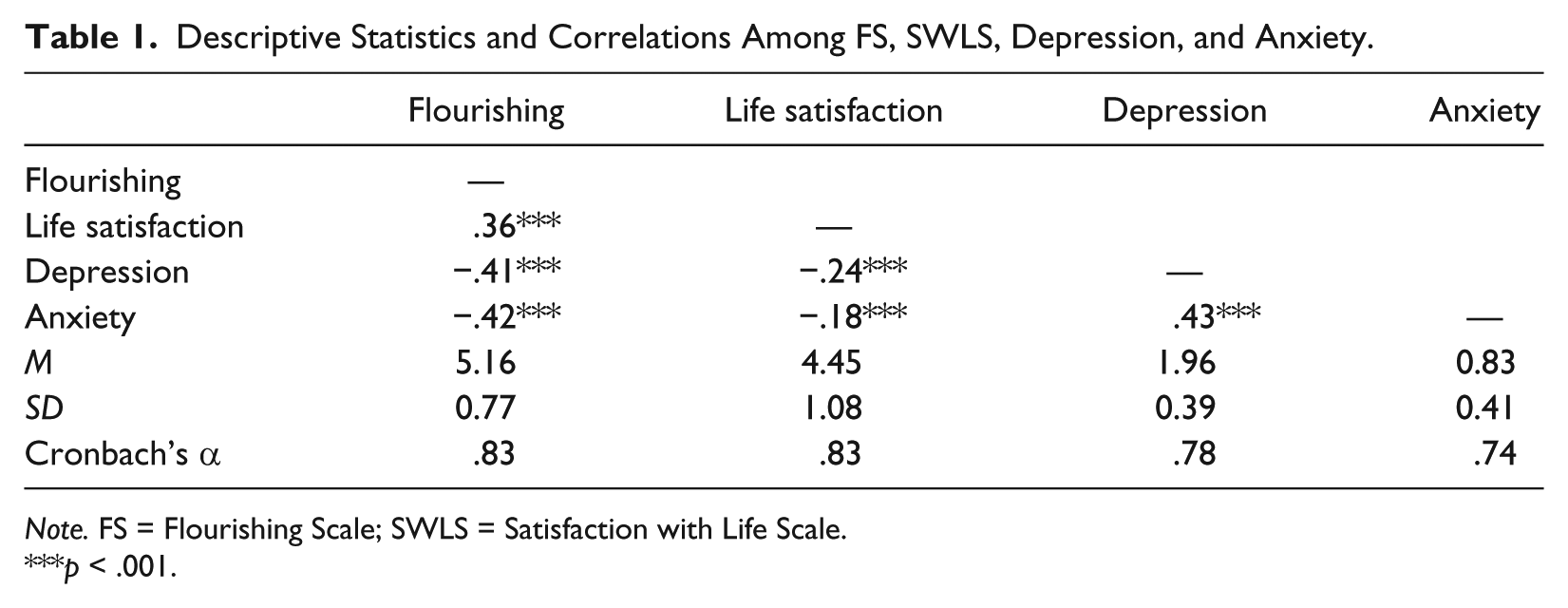
Note. FS = Flourishing Scale; SWLS = Satisfaction with Life Scale.
p < .001.
Incremental Validity
Results of the hierarchical regression analyses are summarized in Table 2. The ESWLS was no longer a significant contributor to depression and anxiety after the addition of the FS into regressions. As reflected by these results, the FS contributed 11% to 14% variances to depression and anxiety.
Regressions of the Flourishing and Satisfaction on Depression and Anxiety.

p < .01.
Discussion
This study showed the single-factor structure of the FS and strong convergent validity of the FS among Chinese adolescents, which were consistent with previous studies conducted in adult samples. Furthermore, the incremental validity indicated that the FS assessed a wider range of well-being than satisfaction with life among Chinese adolescents, which implied that both the FS and the SWLS actually measure different constructs of well-being. Notably, the CFA model of females fit slightly better than that of males. Based on the fit indexes, it is very likely that additional factor (e.g., emotional state and self-esteem) would account for the unexplained association among the items for the male group. More studies should be conducted to explore such gender differences. All these results suggest that the FS is appropriate for measuring PWB among Chinese adolescents. Overall, the current study conducted in adolescents and previous studies administrated in community populations (Tang et al., 2016) demonstrated that the FS is suitable to assess well-being among Chinese individuals, who attribute high value to collectivism, harmony, inter-relationships, and social norms (Duan et al., 2012; Lu & Gilmour, 2004). These results facilitate the theoretical research and practical application of the FS in various fields. At the theoretical level, the aforementioned findings imply that eudaimonic well-being measured by the FS may reflect a more comprehensive profile of individuals in collective cultures. At the application level, the FS can be adapted as an alternative outcome to evaluate intervention programs in campuses, communities, workplaces, and nations.
Footnotes
Declaration of Conflicting Interests
The author(s) declared no potential conflicts of interest with respect to the research, authorship, and/or publication of this article.
Funding
The author(s) disclosed receipt of the following financial support for the research, authorship, and/or publication of this article: Wuhan University Humanities and Social Sciences Academic Development Program for Young Scholars “Sociology of Happiness and Positive Education”.