



Abstract
This study sought to validate the Short Grit Scale (Grit-S), an instrument that measures perseverance and passion for long-term goals, among Chinese high school students. Confirmatory factor analyses revealed that the scale retains the two-factor structure of the original scale. The scale demonstrated satisfactory internal consistency and test–retest reliability. Evidence for construct validity was found in relation to the Big Five personality traits, self-control, and IQ. Evidence for criterion validity was found via the observation that grit explained unique variance in academic performance. Together, the Grit-S is a sound measure of grit among Chinese adolescents.
Grit refers to trait-level perseverance and passion for long-term goals (Duckworth, Peterson, Matthews, & Kelly, 2007). This trait plays a vital role in success, and researchers are now exploring its influential and predictive factors (Eskreis-Winkler, Gross, & Duckworth, 2016). Standardized measurement tools are essential for grit research. Duckworth and her colleagues have successively developed two scales: a 12-item Original Grit Scale (Grit-O; Duckworth et al., 2007) and an eight-item Short Grit Scale (Grit-S; Duckworth & Quinn, 2009).
However, these scales have been mainly used for Western participants, which may limit the generalizability of results. Consequently, it is necessary to validate grit scales across diverse cultures. For instance, the concept of grit might be valued in Chinese culture, as embodied in a national well-known fable, “The Foolish Old Man Removes the Mountains,” which demonstrates that one can realize any aim if one persists enough. Moreover, Chinese parents consider hard work as a key to children’s success and an indispensable characteristic for the ideal child (Shek & Chan, 1999).
Given that no study has validated the grit scales in China, here we sought to validate the Grit-S among Chinese adolescents. First, we evaluated the factor structure and reliability. Second, we assessed construct validity by examining the relationship between grit and other variables. We hypothesized that grit would be correlated with conceptually related constructs (i.e., conscientiousness and self-control) but not with conceptually unrelated constructs (i.e., IQ; Duckworth et al., 2007). Finally, we assessed criterion validity by examining the relationship between grit and academic achievement.
Method
Participants and Procedures
Participants included 607 11th-grade students from one school in Chengdu, China (354 girls; Mage = 17.1, SD = .5). First, they completed four questionnaires: Grit-S, NEO Five-Factor Inventory (NEO-FFI; Costa & McCrae, 1992), Brief Self-Control Scale (SCS; Tangney, Baumeister, & Boone, 2004), and Marlowe–Crowne Social Desirability Scale (MCSDS; Crowne & Marlowe, 1960). One week later, they completed the Raven’s Standard Progressive Matrices (SPM; Raven, 2000). Finally, 1 month after the questionnaire session, all participants took the same unified term examination to monitor learning progress.
Measures
All tests were written in participants’ native language (i.e., Mandarin Chinese).
Grit-S
The Grit-S is a self-report instrument consisting of two subscales, each with four items: Consistency of Interest, referring to the consistency in one’s interests over time; and Perseverance of Effort, which involves sustaining effort in the face of adversity. Response options range from 1 (not at all like me) to 5 (very much like me). The Chinese version of the Grit-S used in the present study was translated by Duckworth’s laboratory. The authors of the current study used a back-translation procedure to ensure the accuracy of the original translation and reached the consensus that any additional changes were unnecessary.
NEO-FFI
The NEO-FFI is a five-factor, 60-item questionnaire measuring Big Five personality. Response options range from 1 (strongly disagree) to 5 (strongly agree). The Chinese version of the NEO-FFI was translated by Yang et al. (1999) using a translation and back-translation process. Here, the Cronbach’s αs were .84, .80, .57, .66, and .78 for Neuroticism, Extraversion, Openness, Agreeableness, and Conscientiousness scores, respectively. The Cronbach’s αs for the Openness and Agreeableness are clearly lower than those of the original NEO-FFI (αs > .75). Another study by Zhang (2003) also found low αs for these two subscales among Chinese participants, and Zhang proposed two possible explanations. First, these facets might have different meanings in Chinese culture. Second, the translation might not be accurate enough to represent the meaning of the original English scale. However, to provide comprehensive investigations across all Big Five domains, we still included these subscales in subsequent analyses.
SCS
The SCS is a unidimensional 13-item questionnaire measuring self-control. Response options range from 1 (not at all like me) to 5 (very much like me). The Chinese version of the SCS was established through a translation and back-translation process by the authors of the current study. Cronbach’s α of the SCS scores for this study was .82.
Raven’s SPM
Raven’s SPM measures non-verbal IQ. To reduce respondent burden, only even-numbered items (i.e., 30 items) were used in the present study (see also Silvia & Sanders, 2010). Because the items in the full version of the Raven’s SPM (60 items) are listed in order of difficulty (i.e., from the easiest to the hardest), the use of even-numbered items may not significantly change the overall test difficulty. Cronbach’s α of the SPM scores for this study was .71.
MCSDS
The MCSDS, the most commonly used questionnaire measuring social desirability, consists of 33 items with a forced-choice format. The Chinese version of the MCSDS was translated by Wang, Wang, and Ma (1999). Cronbach’s α of the MCSDS scores for this study was .72.
Academic performance
Academic performance was indexed by the average standardized score of curriculum subjects in Chinese, English, mathematics, physics, chemistry, biology, politics, history, and geography.
Results and Discussion
Confirmatory Factor Analysis (CFA)
We conducted a CFA to examine the factor structure of the Grit-S using AMOS 22.0 with maximum likelihood estimation method. We adopted multiple indices to evaluate the goodness of fit of the models (Hu & Bentler, 1999): comparative fit index (CFI; > .95), root mean square error approximation (RMSEA; < .06), and standardized root mean square residual (SRMR; > .08). Specifically, two models were tested. Following the original Grit-S, the dimensions of Model 1 were grouped such that the Consistency of Interest and Perseverance of Effort were first-order latent factors, both of which loaded on the second-order latent factor, Grit. Moreover, we tested a more parsimonious model in which all items loaded onto a single latent factor.
The two-factor model, χ2(19, N = 607) = 50.26, p < .001, showed a better fit than the single-factor model, χ2(20, N = 607) = 335.70, p < .001, as indicated by the significant difference in the chi-square statistic, Δχ2(1) = 285.44, p < .001. Moreover, the goodness-of-fit indices also revealed an excellent fit for the two-factor model (CFI = .98, RMSEA = .05, SRMR = .03), but not for the single-factor model (CFI = .78, RMSEA = .16, SRMR = .09). In summary, our results supported the two-factor model (Figure 1).

Standardized factor loadings for the second-order model of the Chinese Short Grit Scale (N = 607).
Reliability Assessment
Cronbach’s αs for scores of the total Grit-S and two subscales (Consistency of Interest and Perseverance of Effort) were .80, .78, and .72, respectively. To examine test–retest stability, we recruited another auxiliary sample of 10th-grade Chinese students (N = 138; 94 girls; Mage = 15.5, SD = .4) to complete the Grit-S twice during a 4-week interval. Their total Grit-S and subscales scores remained stable across 4 weeks (ts < 1.0, ps > .20). Moreover, the test–retest reliability scores were adequate (total score, r = .78; Consistency of Interest, r = .63; Perseverance of Effort, r = .70; ps < .001). Finally, the reliability scores for this study were comparable with those with the original scale (Cronbach’s αs: .60-.83; test–retest correlation: .68; Duckworth & Quinn, 2009).
Construct Validity
Table 1 presents the correlations between the scores of the Grit-S and other variables. First, the scores of the Grit-S was more strongly associated with the NEO-FFI conscientiousness (r = .61) than the other four facets scores (|rs| < .47) (Steiger’s Z test: Zs > 6.75, ps < .001). Second, the Grit-S was strongly correlated with self-control (r = .68, p < .001). Third, the Grit-S was not correlated with IQ (r = .02, p = .60). In summary, consistent with Duckworth et al. (2007), grit is highly correlated with conceptually related constructs, but not with conceptually unrelated constructs.
Pearson Correlations between the Scores of Grit and Other Measures.
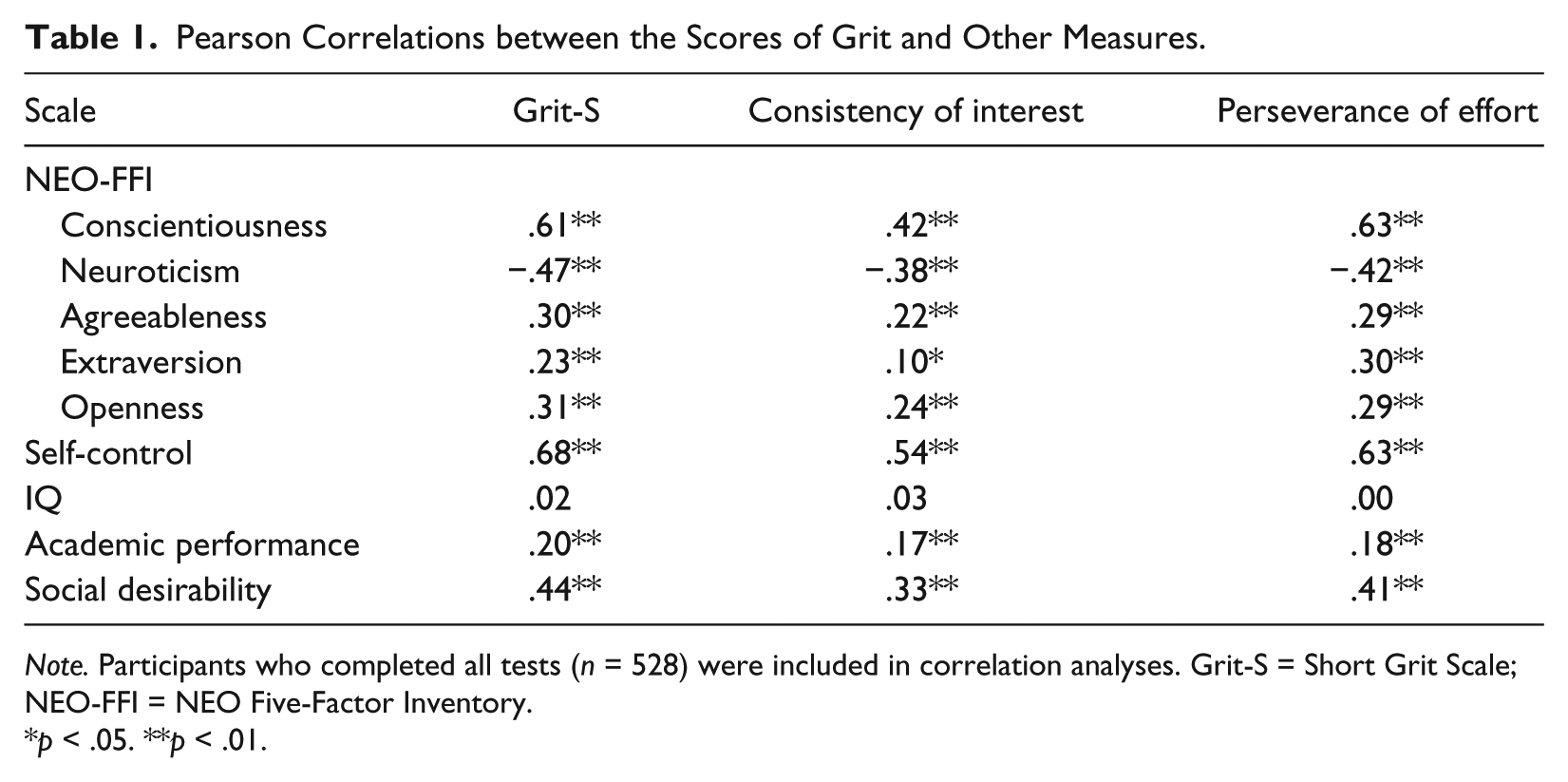
Note. Participants who completed all tests (n = 528) were included in correlation analyses. Grit-S = Short Grit Scale; NEO-FFI = NEO Five-Factor Inventory.
p < .05. **p < .01.
Criterion Validity
The Grit-S scores predicted academic performance measured 1 month later (r = .20, p < .001). Even after controlling for age, gender, and social desirability, we still observed significant partial correlations between the scores of the Grit-S and academic performance (r = .21, p < .001). In summary, the Grit-S scores had adequate predictive validity for academic performance.
Next, by testing four hierarchical regression models, we examined the incremental validity of grit beyond other well-established predictors of achievement, that is, IQ, self-control, and the Big Five personality (Duckworth et al., 2007). Models 1, 2, and 3 included IQ, self-control, and Big Five personality traits in Step 1, respectively; and then included Grit-S in Step 2. In these models, grit consistently explained significant additional variance (β ranging from .15 to .23, ΔR2 ranging from .012 to .04, ps < 0.01). Moreover, in Model 4 that simultaneously included IQ, self-control, and the Big Five personality traits in Step 1 and Grit-S in Step 2, grit still explained significant additional variance (β = .13, ΔR2 = .007, p < .01). Altogether, the Grit-S has incremental validity for predicting academic performance beyond well-known predictors.
Limitations, Implication, and Conclusion
Two methodological limitations should be considered. First, the reliability scores for the Big Five Openness and Agreeableness were low. Second, only half of the items from the Raven’s SPM were used, which may also reduce the reliability and validity of the test. To overcome these limitations, future studies may use other measures of Big Five Personality and the full version of the Raven’s SPM.
Our finding of the association between grit and academic achievement is consistent with similar observations among Western participants (e.g., Duckworth et al., 2007; Duckworth & Quinn, 2009). Altogether, these findings suggest that the influence of grit on academic success might be general across diverse cultures.
In conclusion, our study demonstrated that the Grit-S is a sound measure of grit among Chinese adolescents, and future research should be able to examine its influential and predictive factors among this population.
Footnotes
Declaration of Conflicting Interests
The author(s) declared no potential conflicts of interest with respect to the research, authorship, and/or publication of this article.
Funding
The author(s) disclosed receipt of the following financial support for the research, authorship, and/or publication of this article: National Natural Science Foundation of China (31500884), Projects of Philosophy and Social Sciences Research of Yunnan Province (QN2014012), and Key Projects of Yunnan Provincial Department of Education (2015Z148).