



Abstract
This study validated the Homework Expectancy Value Scale (HEVS) based on 918 middle school students from China. The factor analytic results showed that the HEVS consisted of two distinct yet related subscales: Expectancy and Value. Results further revealed that latent factor means for the HEVS were invariant across gender. Finally, consistent with theoretical expectations, Expectancy and Value were negatively correlated with homework distraction, and positively correlated with homework effort, emotion regulation, completion, and academic achievement.
Expectancy-value theory (Eccles, 1983, 2009) provides a broad framework for understanding motivation in achievement-related activities. It posits that motivation includes two major constructs that influence task choice, persistence, and performance: expectancy and value. Expectancy refers to the degree to which individuals think they can successfully execute goal-oriented behavior. Value refers to the degree to which individuals think an activity is worthwhile.
Expectancy-value theory bears direct relevance to homework and homework research. Whereas it is typically a challenge to keep students motivated in any achievement-related activities, it becomes more of a challenge to keep them motivated in the homework process: (a) homework takes place in the midst of multiple afterschool activities (Xu & Corno, 1998), and (b) students need to do homework with less monitoring and structure than other achievement-related activities (e.g., classwork; Corno & Xu, 2004). Thus, it is not surprising that expectancy and value have been recently viewed as two important constructs in research on homework, as students are more likely to keep themselves motivated in the homework process when (a) they think they can successfully complete homework assignments, and (b) they think that homework assignments are worthwhile (Trautwein, Ludtke, Schnyder, & Niggli, 2006; Yang, Xu, Tan, & Liang, 2016).
However, although relevant items in previous studies (e.g., Trautwein et al., 2006; Yang et al., 2016) concerning homework expectancy and value were informed by expectancy-value theory and with adequate reliability, its validity was not investigated. Thus, there is a need to address this gap in the present study.
Previous research on expectancy-value theory emphasizes the role of domain-specific motivation and measurement (e.g., individuals are more motivated to do well in some areas than in others; Jacobs, Lanza, Osgood, Eccles, & Wigfield, 2002). Consequently, there is a need to investigate homework expectancy and value in the math domain, as (a) math is an achievement domain with heavy homework demand (Yang et al., 2016), and as (b) following through math assignments in particular is a challenge for many students (Landers, 2013).
As expectancy-value theory was originally developed to inform research on gender differences in achievement-related motivation in various fields of study (Eccles, 2009; Wigfield et al., 2015), and as males often hold more favorable achievement-related beliefs in the math domain (Meece, Glienke, & Burg, 2006), there is a need to investigate gender differences in homework expectancy and value.
The goal of the present study is to validate the Homework Expectancy Value Scale (HEVS) concerning middle school math homework. Particularly, the purposes include (a) examining the factor structure of the HEVS, (b) assessing measurement invariance and latent mean differences across gender, and (c) assessing its validity evidence by examining the relationships among the HEVS and several theoretically relevant measures (e.g., effort, completion, and math achievement). As expectancy and value play an important role in task engagement, persistence, and performance (Eccles & Wigfield, 2002), we hypothesized that the HEVS would be negatively correlated with homework distraction, and positively correlated with homework effort, homework emotion regulation, homework completion, and math achievement.
Method
Participants
Participants were 918 students (14.03 ± .81 years; 41.7% females) from three public middle schools in southeastern China, including Grade 7 (29.6%), Grade 8 (40.2%), and Grade 9 (30.2%). Their parents’ education level was 10.6 ± 2.7 years. Concerning math assignments, 78.2% of participants received math homework 5 days or more per week. On average, they spent 35 ± 24 min on math homework daily.
Instrument
The HEVS consists of eight items (see Table 1), based on 4-point ratings: strongly disagree (1), disagree (2), agree (3), or strongly agree (4). It includes two subscales: Expectancy and Value.
Standardized Coefficients for the Final Two-Factor CFA Model.
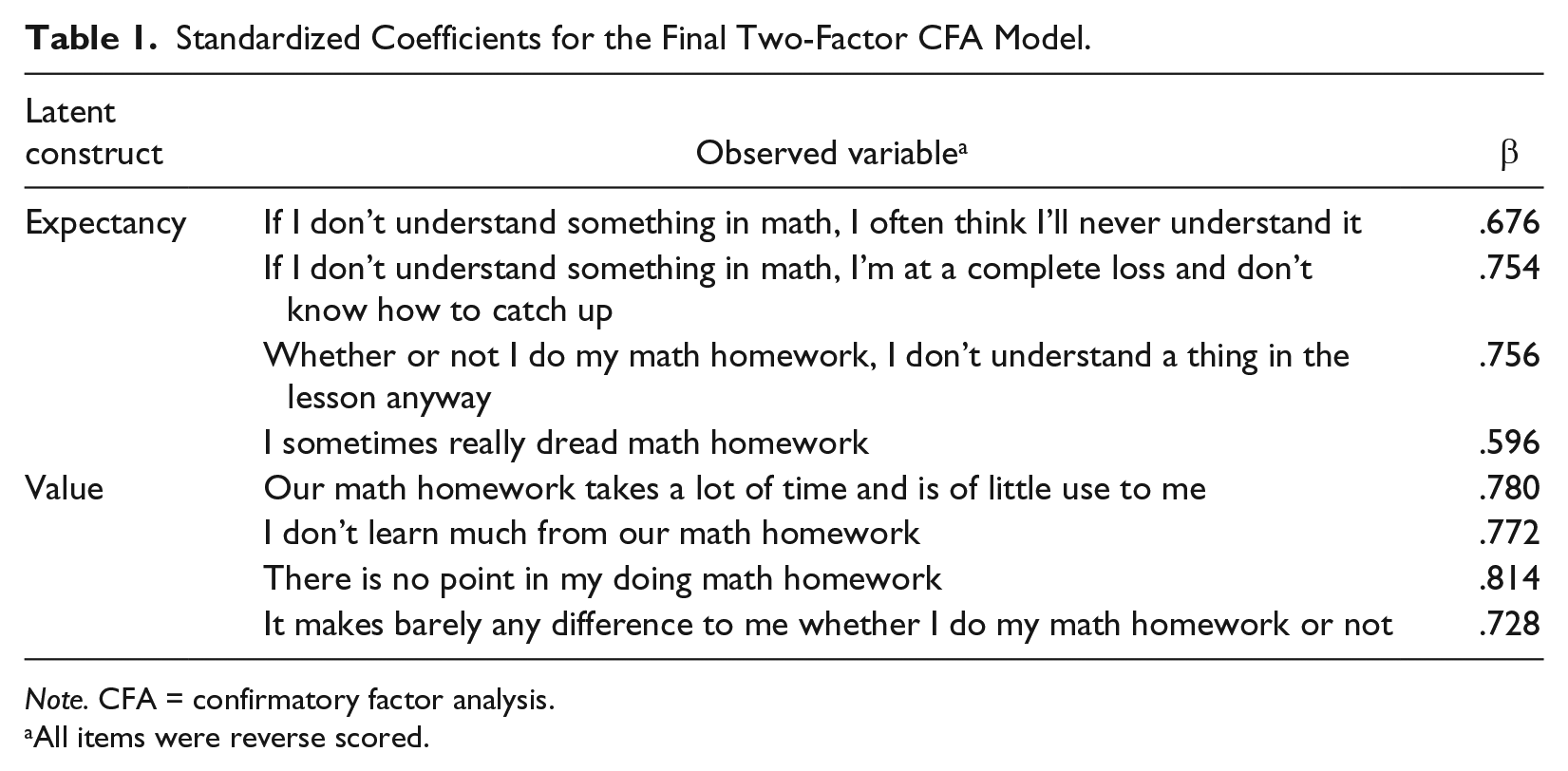
Note. CFA = confirmatory factor analysis.
All items were reverse scored.
Expectancy
Adapted from related previous research (Trautwein et al., 2006; Yang et al., 2016), this subscale includes four items to measure participants’ expectancy beliefs concerning math assignments (e.g., self-confidence to understand math and follow through math homework assignments; α = .79).
Value
This subscale incorporates four items to assess participants’ perceived value of math assignments, informed by related homework studies (Trautwein et al., 2006; Yang et al., 2016). It taps into the importance and utility of math assignments (e.g., learning math materials covered in class; α = .86).
Concurrent and predictive validity
The following theoretically relevant measures were examined: (a) homework behavior, including homework effort (four items; α = .73) and homework completion (one item); (b) homework emotion regulation (Xu, Fan, & Du, 2016b), including emotion management (three items; α = .83) and cognitive reappraisal (three items; α = .84); (c) homework distraction (Xu, Fan, & Du, 2016a), including conventional distraction (three items; α = .70) and tech-related distraction (three items; α = .82); and (d) standardized math test.
Data Analysis
Analyses were carried out in three stages. Due to the space limitation, each stage is combined with the results section.
Results
Stage 1
As expectancy and value are conceptualized as two key constructs in expectancy-value theory (Eccles, 1983), we used EQS 6.2 to examine whether expectancy and value could be empirically distinct. As Mardia’s normalized estimate (40.27) was larger than 5.0, we used robust maximum likelihood estimation procedure and associated Satorra–Bentler (S-B) adjusted fit indices and the chi-square difference tests.
Confirmatory factor analysis (CFA) findings revealed that the two-factor solution (S-Bχ2 = 34.379; df = 19; comparative fit index [CFI] = .993; standardized root mean square residual [SRMR] = .028; root mean square error of approximation [RMSEA] = .030; 90% confidence interval [CI] [.013, .045]) fit the data significantly better than the one-factor solution (S-Bχ2 = 618.700; df = 20; CFI = .709; SRMR =.156; RMSEA = .181; 90% CI [.168, .193]). Furthermore, the chi-square difference between these solutions was significant, ΔS-Bχ2(Δdf = 1) = 249.999, p < .001. Thus, Expectancy and Value can be empirically distinguishable for these participants. The estimated correlation between the two factors was .375, p < .05.
Stage 2
Concerning the two-factor model, invariance was conducted across gender. As the χ2 value tends to be overpowered due to sample size, we used the criterion of .01 for the ΔCFI to determine multigroup invariance (Cheung & Rensvold, 2002). As displayed in Table 2, the results of configural invariance yielded an excellent fit (S-Bχ2 = 56.563; df = 38; CFI = .991; SRMR = .035; RMSEA = .033; 90% CI [.011, .050]). We then examined factor loading invariance (S-Bχ2 = 64.329; df = 44; CFI = .991; SRMR = .043; RMSEA = .032; 90% CI [.012, .048]). Thus, the factor loading was invariant across gender (ΔCFI < .001).
Tests for Gender Invariance of the HEVS: Summary of Goodness-of-Fit Statistics.

Note. HEVS = Homework Expectancy Value Scale; CFI = comparative fit index; RMSEA = root mean square error approximation; CI = confidence interval; SRMR = standardized root mean square residual.
p < .01.
We further tested intercept invariance (S-Bχ2 = 85.345; df = 50; CFI = .990; SRMR = .044; RMSEA = .034; 90% CI [.016, .050]). Therefore, intercepts were invariant across gender (ΔCFI = .001). Finally, we tested latent factor mean invariance (S-Bχ2 = 103.761; df = 52; CFI = .989; SRMR = .044; RMSEA = .034; 90% CI [.016, .050]). Taken together, these findings revealed that the latent factor means were invariant across gender (ΔCFI = .001).
Stage 3
Concerning concurrent and predictive validity, we assessed Pearson correlations between the HEVS composite scores and four external measures. Consistent with our hypotheses, Expectancy and Value were negatively correlated with homework distraction, and positively correlated with homework effort, completion, emotion regulation, and math achievement (see Table 3).
Pearson Correlations Between the HEVS, Homework Behavior, Emotion Regulation, Distraction, and Math Achievement (N = 918).

Note. HEVS = Homework Expectancy Value Scale.
p < .01.
Discussion
Our CFA results revealed that the HEVS consisted of two separate yet related subscales—Expectancy and Value—in the context of math homework. Furthermore, our results regarding latent factor mean invariance suggest that the HEVS is applicable to both females and males. In addition, results revealed that Expectancy and Value, consistent with theoretical expectations, were positively related to homework effort, homework completion, homework emotion regulation, and math achievement, and were negatively associated with homework distraction.
Taken together, the HEVS represents a factorially valid measurement of middle school students’ motivational beliefs concerning their math homework. Thus, our present study extends previous literature on expectancy-value theory, by suggesting that Expectancy and Value as two theoretically distinct constructs can be empirically distinguishable concerning middle school math homework.
Concerning future investigation, there is a need to validate the HEVS in different countries, as student attitudes and affect (e.g., self-confidence and utility) maybe influenced by cultural differences (Else-Quest, Hyde, & Linn, 2010). There is also a need to examine the validity of the HEVS in other domains (e.g., English) and in other learning environments (e.g., online assignments). Finally, there is a need to validate the HEVS with high school students, as competence beliefs and task values may change when students move to high school (Jacobs et al., 2002).
Footnotes
Declaration of Conflicting Interests
The author(s) declared no potential conflicts of interest with respect to the research, authorship, and/or publication of this article.
Funding
The author(s) disclosed receipt of the following financial support for the research, authorship, and/or publication of this article: This research was supported by a grant from Shanghai Peak Discipline Construction Project of Education at East China Normal University, China. The perespectives expressed here represent the authors’ views.