



Abstract
The goal of the present investigation is to evaluate the psychometric properties of the Homework Emotion Regulation Scale (HERS) using 796 middle school students in China. Confirmatory factor analyses (CFAs) supported the existence of two distinct yet related subscales for the HERS: Emotion Management and Cognitive Reappraisal. Concerning the concurrent and predictive validity evidence of the HERS, the results indicated that, consistent with theoretical expectations, Emotion Management and Cognitive Reappraisal were positively associated with mastery and performance orientation, desirable homework behaviors (e.g., completion), learning strategies (e.g., organization), and math homework grade reported by teachers at the end of school semester.
Keywords
As a well-known instructional activity across countries (Cooper, Robinson, & Patall, 2006; Dettmers et al., 2011), homework tends to elicit generally unpleasant emotional responses among many school-age children (Knollmann & Wild, 2007; Pekrun, Goetz, Titz, & Perry, 2002; Xu & Corno, 1998). Indeed, it is frequently viewed as one of the most disappointing parts of schooling (Cooper, 2007; Verma, Sharma, & Larson, 2002).
Because students’ emotions are a vital part of learning, and because “repeated negative experiences can turn children off, or even prematurely burn them out” (Corno & Xu, 2004, p. 232), there is a critical need to study students’ regulation of homework emotion. Yet, despite research showing that students’ unpleasant emotional states are more apparent for homework, as compared with classwork (Leone & Richards, 1989; Verma et al., 2002), the issue of regulating homework emotion is remarkably lacking in homework research.
Therefore, it would be important to bridge this gap in the field. This line of research is especially valuable, as hardly any studies have been conducted regarding the measurement of homework emotion regulation. However, without a valid instrument relating to homework emotion regulation, it is difficult to initiate a new line of empirical inquiry that (a) examines a range of variables that influence homework emotion regulation and (b) conceptualizes homework emotion regulation as a mediating variable that affects homework behaviors (e.g., effort and completion) and academic achievement.
One theoretical framework pertaining to homework emotion regulation is Gross’s (1998, p. 275; 2002) model of emotion regulation, in which emotion regulation is viewed as “the process by which individuals influence emotion they have, when they have them, and how they experience and express these emotions.” In his model of emotion regulation (including situation selection, situation modification, attentional deployment, cognitive change, and response modulation), Gross (2002) has paid particular attention to the role of cognitive change in regulating and monitoring one’s emotional states: “The personal meaning that is assigned to the situation is crucial because it powerfully influences which experiential, behavioral, and physiological response tendencies will be generated in that particular situation” (p. 283).
With respect to cognitive change, it is interesting to note that the emotion regulation literature has been largely limited to cognitive reappraisal as one form of cognitive change (Gullone, Hughes, King, & Tonge, 2010), which “involves changing a situation’s meaning in a way that alters its emotional impact” (Gross & Thompson, 2007, p. 14). What this line of literature has shown is that cognitive reappraisal has positive influence on reducing the experience of negative emotion (Canli, Ferri, & Duman, 2009; Gross & Thompson, 2007). For instance, cognitive reappraisal of negative images (compared with uninstructed watch conditions) resulted in decreased negative affect and to a lesser extent increases in blood pressure (Richards & Gross, 2000).
Surprisingly, little attention has been paid, however, to another important form of cognitive change (i.e., emotion management), particularly as cognitive change is more broadly referred to as “changing how we appraise the situation we are in to alter its emotional significance, either by changing how we think about the situation or about our capacity to manage the demands it poses” (Gross & Thompson, 2007, p. 14). Thus, there is a critical need to examine another form of cognitive change that involves changing how individuals think about their capacity to manage emotion impact (i.e., emotion management), in addition to the current emphasis on how individuals reframe about a situation’s meaning (i.e., cognitive reappraisal). Logically, it would be important to examine whether emotion management can be empirically distinguished from cognitive reappraisal.
Across countries, secondary school students continue to report unpleasant emotional experiences while doing homework (Dettmers et al., 2011; Verma et al., 2002; Xu & Yuan, 2003). Leone and Richards (1989) reported that U.S. students’ emotions during homework were largely negative (regardless of gender, age, and academic achievement), and that their levels of motivation and positive affect were lower (compared with their experiences with activities such as doing chores and eating meals). Likewise, Verma et al. (2002) found that homework was considered as the least favorable school activity for Indian students, who “felt significantly more unhappy, angry, irritable, weak, tired, stressed, and bored while doing homework as compared to classwork” (p. 505).
Recently, Xu (2011b) investigated multilevel models of homework emotion management, utilizing a sample of 1,895 U.S. secondary school students from 111 classes. Although the findings (regarding a broad spectrum of variables that were related to homework emotion management) were interesting and extended the existing homework research, Xu’s (2011b) study was limited to one form of homework emotion regulation (i.e., homework emotion management, which involves down-regulating homework unpleasant emotions and up-regulating positive homework emotions). Consequently, Xu (2011b) called for incorporating “additional items relating to other strategies that students may use to regulate their emotions—such as cognitive reappraisal” in future research on homework emotion regulation (p. 552).
The goal of the current investigation is to evaluate the psychometric properties of the Homework Emotion Regulation Scale (HERS) for Chinese students regarding math assignments. Particularly, the purposes of the current investigation are threefold: (a) to test the factor structure of the HERS for Chinese middle school students, (b) to evaluate internal consistency for the HERS, and (c) to assess the concurrent and predictive validity for the HERS by measuring the relationships between the HERS and several theoretically relevant measures (goal orientations, homework behaviors, learning strategies, and homework performance).
Our investigation seeks to address the following gaps in homework research. First, emotion regulation is noticeably lacking from much current research on homework. Although Xu’s (2011b) study extended the research on homework, it was limited to emotion management (i.e., it did not tap into cognitive reappraisal). However, cognitive reappraisal has not been explicitly conceptualized as one form of homework emotion regulation, although it was alluded to in qualitative research on homework (e.g., a girl learned to look on “the bright side” by herself when she was frustrated with “hard” homework; Xu & Corno, 1998).
Furthermore, Xu’s (2011b) study focused on domain-general homework emotion management (emotion management across homework assignments). As research recently begins to examine domain-specific homework emotion (Goetz et al., 2012), it would be beneficial to examine students’ emotion regulation in math homework. A study such as this is particularly beneficial, as (a) math is a major school subject with high homework demands (e.g., spending about 20%-40% of homework time on math assignments; Pezdek, Berry, & Renno, 2002) and (b) it is no small challenge to stay positive while doing math assignments (e.g., math anxiety and frustration; Else-Quest, Hyde, & Hejmadi, 2008; Landers, 2013).
Finally, this line of study is particularly desirable for middle school students, because students’ homework attitudes become increasingly negative through the school years (Cooper, Lindsay, Nye, & Greathouse, 1998; Xu, 2004). Therefore, it would be critical to study the issue of regulating homework emotion at this developmental stage, both in terms of homework research and intervention.
Method
Participants and Procedure
Participants included 796 students in Grade 8 from three schools in southeastern and southwestern China. Among them, slightly over half were male (55.2%). The average years of education for their parents or guardians was 12.6 (SD = 3.3).
Regarding math homework assignments, about four fifth of participants (78.5%) indicated that they did math assignments 4 days a week or more, and about one fifth of participants (21.5%) indicated that they did math assignments 3 days a week or less. Overall, they spent, on average, 34 min on math assignments daily (SD = 22).
To capture a diversity of responses, we used a stratified sampling approach. First, the teachers were asked to divide students into three equal-sized groups based on math grades in the previous school year (high, middle, and low). The teachers were then asked to randomly select half of their students from each of these three groups. The teachers administered the homework instrument in their classrooms in spring 2013, in which participants were informed the following: “The purpose of this survey is to learn more about how you approach math homework so that teachers and your family can better help you.” To ensure confidentiality, participants were assigned an identification number in the survey, which was then used to link their math homework grade and final math grade at the end of school semester. The survey response rate was 90.5%.
Instrument
The HERS includes six items, in which participants responded using a 5-point format: never (1), rarely (2), sometimes (3), often (4), or routinely (5). It consists of two subscales: Emotion Management and Cognitive Reappraisal.
Emotion Management
This subscale assessed students’ efforts to down-regulate unpleasant emotions and up-regulate positive emotions (Xu, 2011b). Its development was informed by the literature regarding the role of volitional control in academic learning (Corno, 2004; Kuhl, 1987) and related homework literature (Corno & Xu, 2004; Xu & Corno, 1998). It included three items: tell myself not to be bothered with previous mistakes (Item 1), tell myself to calm down (Item 2), and cheer myself up by telling myself that I can do it (Item 3). They were the same three items in the prior study with U.S. students (Xu, 2011b). For the present study, the correlations among three items in this subscale ranged from .59 to .67.
Cognitive Reappraisal
This subscale assessed students’ efforts to reframe or recontextualize an unpleasant stimulus in less emotional terms. Its development was informed by relevant studies on cognitive reappraisal (e.g., controlling emotions by reframing how an individual views or approaches about the specific situation; Gross, 2002; McRae, Ochsner, Mauss, Gabrieli, & Gross, 2008) and relevant homework studies (e.g., looking on “the bright side” by herself when students were frustrated or upset with homework assignments; Xu & Corno, 1998). Initially, this subscale consisted of four items: I think that there are good sides for it as well (Item 4), I think that I can learn something from the situation (Item 5), I think that it’s not all bad (Item 6), and I think I can become a stronger person as a result of what has happened (Item 7). We removed the last item from this subscale in our final analysis, as this item was found to be too general and vague for middle school students (i.e., not focused on the way a student thinks about the homework situation directly as the other three items). This observation is supported by the preliminary findings from our confirmatory factor analysis (CFA) that this item had large correlated errors not only with another item in this subscale (i.e., “I think that it’s not all bad”) but also with another item in the other subscale (i.e., “Cheering myself up by telling myself that I can do it”). It is further substantiated by the finding that the removal of this item did not cause any changes in this subscale’s alpha reliability coefficient. For the present study, the correlations among the remaining three items in this subscale ranged from .66 to .73.
Data Analysis
Several analytical approaches were used to accumulate multiple sources of validity evidence for the HERS, which was illustrated below.
CFA
CFA was performed on the scores of six items with respect to cognitive reappraisal and emotion management. The objective is to test whether emotion management and cognitive reappraisal are empirically distinct through the comparison of the difference in model fit between the competing models: (a) a one-factor model (emotion management and cognitive reappraisal are factorially indistinct) and (b) a two-factor model (emotion management and cognitive reappraisal are factorially distinct).
Several goodness-of-fit measures were applied in the present investigation. These consist of (a) a comparative fit index (CFI) value close to 0.95 (Hu & Bentler, 1999); (b) a root mean square error of approximation (RMSEA) value of less than 0.05 showing good fit, with values as high as 0.08 representing reasonable errors of approximation in the population (Browne & Cudeck, 1993); and (c) a standardized root mean square residual (SRMR) value of less than 0.08 (Hu & Bentler, 1999).
Considerations for concurrent and predictive validity evidence
Relating to concurrent and predictive validity for the HERS, four kinds of external measures were examined, including goal orientations, homework behaviors, learning strategies, and homework performance.
Goal orientations
Participants were asked about their goal orientations (Harackiewicz, Barron, Tauer, Carter, & Elliot, 2000; Pintrich, Smith, Garcia, & McKeachie, 1993). Based on the work by Pintrich et al. (1993), three scales assessed mastery goal orientation (six items, for example, “I want to learn as much as possible in math homework”), performance goal orientation (six items, for example, “My goal in doing math homework is to get a better grade than most of the other students”), and work avoidance goal orientation (five items, for example, “I want to do as little as possible with math homework”). The only modification we made was to reword “in this course” to “math homework,” consistent with our focus on math homework. Reliability coefficients (Cronbach’s α) for the three scales (Mastery, Performance, and Work Avoidance Goal Orientation) in the current investigation were .89, .84, and .86, respectively.
Homework behaviors
Participants were asked to report their math homework behaviors (e.g., effort and completion). Built upon relevant items in the work by Trautwein, Ludtke, Schnyder, and Niggli (2006), participants were asked about math homework effort (four items, for example, “I do my best on my math homework). Reliability coefficient for homework effort in the current investigation was .73.
Moreover, participants responded to two additional items regarding homework completion, adapted from the National Education Longitudinal Study of 1988 (NELS: 88). These two items include (a) “Some students often complete math homework on time; others rarely do. How much of your assigned math homework do you usually complete?” Ratings consisted of none (scored 1), some (scored 2), about half (scored 3), most (scored 4), and all (scored 5); and (b) “How often do you come to class without your math homework?” Ratings consisted of never (scored 1), rarely (scored 2), sometimes (scored 3), often (scored 4), and routinely (scored 5).
Learning strategies
Participants responded about learning strategies. Based on the study by Pintrich et al. (1993), three scales assessed (a) elaboration (six items, for example, “When reading for this class, I try to relate the material to what I already know”), (b) organization (four items, for example, “When I study for this course, I go through the readings and my class notes and try to find the most important ideas”), and (c) critical thinking (five items, for example, “Whenever I read or hear an assertion or conclusion in this class, I think about possible alternatives”). We did not make specific changes to any items, other than we explicitly asked students about their learning strategies in the context of “your math class” (when “this class,” “this course,” or “this subject” was referenced in specific items). For participants in our current investigation, reliability coefficients for elaboration, organization, and critical thinking were .91, .89, and .90, respectively.
Homework performance
At the end of school semester (i.e., 2 months following the administration of the homework instrument), the math teachers provided participants’ math homework grade as well as their final math grade. Participants were given 12 major math assignments, each of which was rated by their teachers on a scale from 0 to 100. The students’ math homework grade was the mean score of these assignments (M = 79; SD = 14). The final math grade (M = 77; SD = 16) consisted of the following three components: (a) math homework grade (15%), (b) math quizzes during the semester (25%), and (c) a standardized math test across the school districts (60%).
To assess the concurrent validity evidence, we computed zero-order correlation coefficients between the HERS, goal orientation, homework behaviors, and learning strategies. To assess the predictive validity evidence, we computed zero-order correlation coefficients between the HERS and participants’ homework performance measured 2 months later. Missing values for the HERS ranged from 0.00% to 0.38% (M = 0.19, SD = 0.13), and they were imputed through the use of the expectation–maximization.
Results
CFA
CFA was performed to examine the validity of the one-factor model versus the two-factor model as discussed above with 796 students. The univariate sample statistics showed all of the items with skewness or kurtosis values less than the absolute value 1. Yet, the multivariate sample statistics were suggestive of nonnormality in our present study in that Mardia’s normalized estimate (i.e., 29.43) was larger than the cutoff point (i.e., 5.00) proposed by Bentler (2006). Consequently, robust maximum-likelihood estimation method with Satorra–Bentler correction was applied to alleviate some nonnormality in this sample.
Compared with the one-factor model (*CFI = 0.906; SRMR = 0.076; *RMSEA = 0.161; 90% confidence interval [CI] = [0.142, 0.181]; asterisk indicating robust statistics), the two-factor model yielded a much better fitting model for the data (*CFI = 0.985; SRMR = 0.025; *RMSEA = 0.069; 90% CI = [0.048, 0.091]). Furthermore, the chi-square difference test between the one-factor model and the two-factor model was highly significant, ΔS-Bχ2(Δdf = 1) = 93.262, p < .001. From the perspective of descriptive fit indices (*CFI, *RMSEA, SRMR) of the two competing models, the differences of these descriptive fit indices are very obvious (*CFI = 0.906 vs. 0.985; *RMSEA = 0.161 vs. 0.069; SRMR = 0.076 vs. 0.025), clearly indicating the superiority of the two-factor model. Thus, these results suggest that emotion management and cognitive reappraisal as two theoretical distinct constructs (i.e., two forms of cognitive change) are empirically distinguishable.
In the two-factor model, as each indicator (i.e., observed variable) was specified to load on only one factor (i.e., latent construct), the standardized estimates became structure coefficients that estimate indicator–construct correlations (Kline, 2010). As indicated in Table 1, for these indicators, the standardized estimates were relatively large (.724-.868), thereby providing further empirical support for convergent validity (Maruyama, 1998).
Standardized Coefficients for the Final Two-Factor CFA Model.
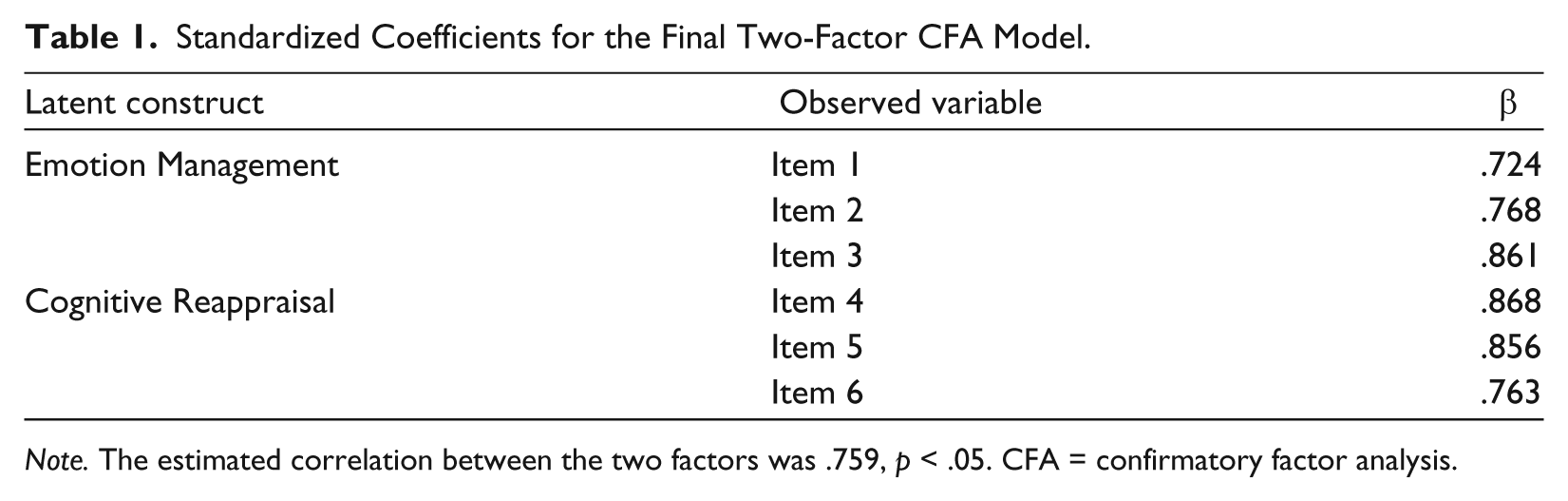
Note. The estimated correlation between the two factors was .759, p < .05. CFA = confirmatory factor analysis.
Reliability
Alpha coefficient for the scores on the six-item HERS was .88 (.87-.89). Alpha coefficients for the scores on the two subscales of HERS were .83 (.81-.85) for Emotion Management and .87 (.85-.88) for Cognitive Reappraisal. These reliability estimates are generally considered as very good in measurement practice (e.g., DeVellis, 1991; Henson, 2001).
Concurrent and Predictive Validity Evidence
To assess the concurrent and predictive validity of the HERS, we investigated the relationships between the HERS and four external measures, including (a) goal orientations, (b) homework behaviors, (c) learning strategies, and (b) homework performance.
HERS and goal orientations
Research consistently emphasizes the important role of goals in emotion regulation (e.g., Eisenberg & Spinrad, 2004; Op ’t Eynde & Turner, 2006). Specifically, as mastery orientation is based on favorable motivational beliefs (e.g., effort leads to success; Boekaerts, 2010) and is positively related to self-regulation and cognitive resource allocation (Radosevich, Vaidyanathan, Yeo, & Radosevich, 2004), we hypothesized that the HERS would be positively correlated with mastery orientation. In addition, as performance orientation attributes success to ability (Creed, King, Hood, & McKenzie, 2009), we hypothesized that the HERS would be positively correlated with performance orientation, but to a lesser degree than the relationship between the HERS and mastery orientation. Meanwhile, as those with avoidance orientation focus on the possibility of failure and engage in self-protective withdrawal strategies (Elliot & Harackiewicz, 1996), we hypothesized that the HERS would be negatively related to avoidance orientation. Results from Table 2 showed that correlation coefficients among the HERS (i.e., emotion management and cognitive reappraisal) and goal orientations (i.e., mastery, performance, and avoidance) were largely in line with our hypotheses.
Pearson Correlations Between HERS, Goal Orientations, Homework Behaviors, and Homework Performance (N = 796).
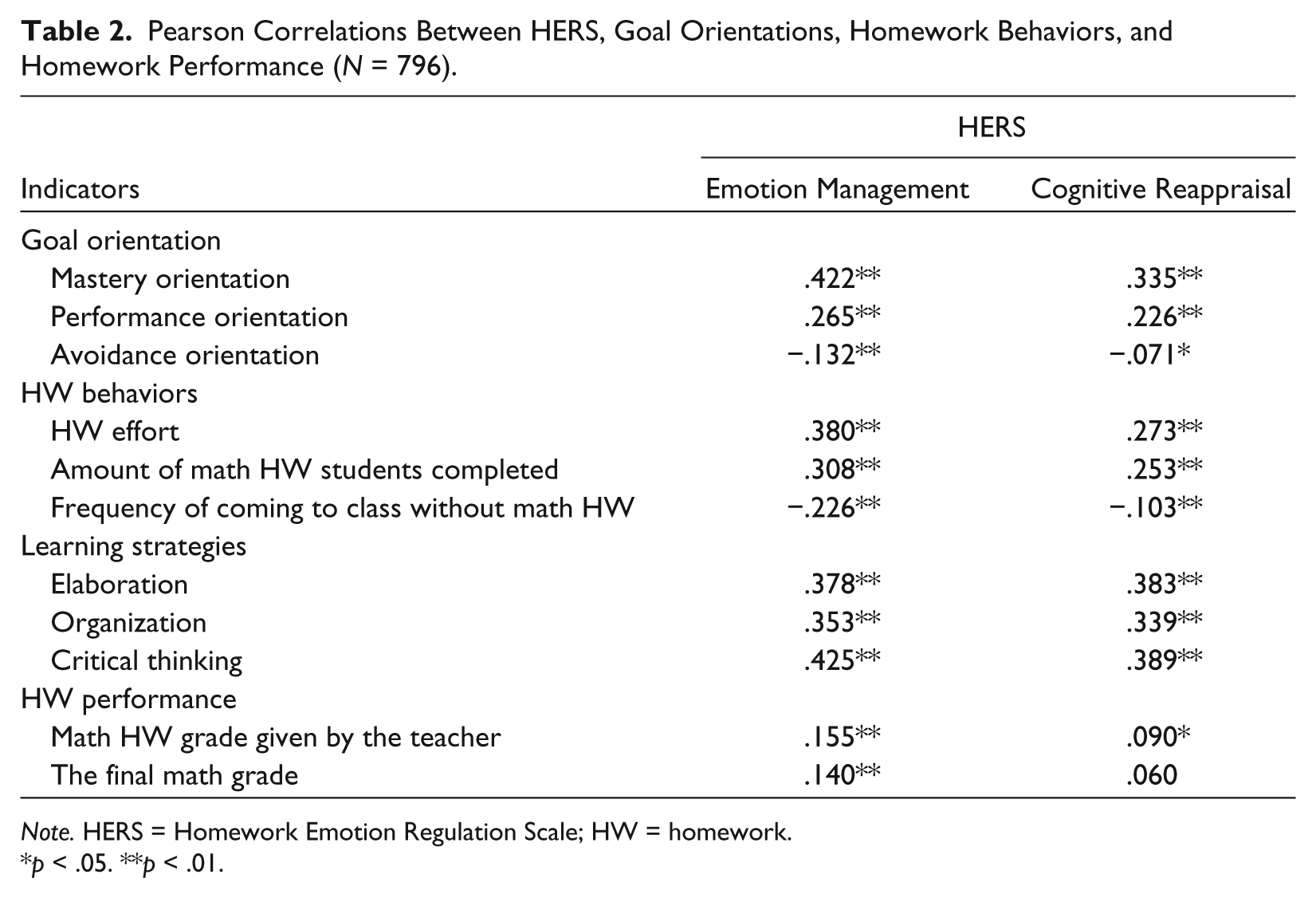
Note. HERS = Homework Emotion Regulation Scale; HW = homework.
p < .05. **p < .01.
HERS and homework behaviors
We assessed the relationship between the HERS and homework behaviors (effort, completion, and the frequency of coming to class without math assignments). Consistent with theoretical expectation regarding the importance of emotion regulation in task completion (e.g., Gross & Thompson, 2007; Pekrun, 2006; Xu, 2011b), emotion management and cognitive reappraisal were positively related to homework effort and homework completion, and negatively associated with the frequency of coming to class without math assignments. These results indicate that emotion management and cognitive reappraisal are related to homework completion behaviors. Logically, such relationships could suggest that emotion management and cognitive reappraisal could influence homework completion behaviors, particularly as a recent meta-analysis of the effectiveness of emotion regulation revealed that the effect of cognitive change on self-report and behavioral measures did not differ (Webb, Miles, & Sheeran, 2012).
HERS and learning strategies
We assessed the relationship between the HERS and participants’ learning strategies in math class. Because there were low to moderate positive relationships between self-regulation (e.g., meta-cognitive self-regulation and study aid) and learning strategies in prior research (Muis, Winne, & Jamieson-Noel, 2007), it was hypothesized that the relationships between the HERS and learning strategies would be low to moderate positive. The results from Table 2 showed that correlation coefficients between the HERS, elaboration, organization, and critical thinking were of direction and magnitude in line with our theoretical expectations.
HERS and homework performance
As research shows that emotion regulation has a positive influence on academic performance (e.g., Gross & Thompson, 2007; Pekrun, 2006), we hypothesized that the HERS would be positively correlated with math homework grades given by the teachers and the final math grade at the end of the semester. Findings revealed that math homework grades were positively related to emotion management (r = .16, p < .01) and cognitive reappraisal (r = .09, p < .05). Furthermore, emotion management was positively associated with math achievement (r = .14, p < .01), whereas the positive effect of cognitive reappraisal on math achievement did not reach significance (r = .06, p > .05). One likely explanation for no linear relationship between cognitive reappraisal and math achievement is that it may take longer for the positive influence of cognitive reappraisal (i.e., being more optimistic about unpleasant homework emotions) to take effect (Leroy & Grégoire, 2007), given that the standardized math test was administered approximately 2 months later.
Discussion
The goal of our current investigation is to evaluate the psychometric properties of the HERS for Chinese middle school students. Our findings indicated that the HERS showed adequate psychometric quality regarding measurement validity and reliability. In particular, our results revealed a significant better fit for the two-factor model (emotion management and cognitive reappraisal are factorially distinct) compared with the one-factor model (emotion management and cognitive reappraisal are factorially indistinct). Thus, our present investigation bridges a gap in previous research on emotion regulation, by supporting the construct validity of the distinction between cognitive reappraisal and emotion management.
Concerning the concurrent and predictive validity evidence of the HERS, our findings indicated that, as theoretically expected, two subscales (Emotion Management and Cognitive Reappraisal) were positively associated with mastery and performance orientation, desirable homework behaviors (effort and completion), learning strategies (elaboration, organization, and critical thinking), and homework performance (homework grade and math achievement), with the exception of 1 out of 18 possible correlations. In addition, two subscales were negatively associated with avoidance orientation and the frequency of coming to class without math assignments. Moreover, these correlations (except for 1 out of 22) were of magnitude consistent with theoretical expectations (e.g., Webb et al., 2012). Overall, the empirical results indicated that these subscales showed good psychometric characteristics (e.g., CFA analysis results, interfactor correlations, and reliability estimates). These empirical findings suggest that the subscales performed well for the intended purpose, despite the fact that the number of items under each subscale is relatively small. Thus, the HERS represents reliable, valid means, and practical instrument for measuring middle school students’ emotion regulation in math homework.
The results relating to the HERS ought to be informative to academic researchers, school counselors, and teachers who are concerned with homework emotion regulation. The HERS ought to be useful to researchers who want to investigate the relationships between homework emotion regulation and other pertinent variables, including homework motivation, homework behaviors (e.g., effort and completion), and academic performance (Cooper et al., 1998; Xu, 2011a). In addition, the HERS may have potential to be used as a general measure of emotion regulation of math homework for secondary school students because its items are not middle school specific.
Concerning future investigation, it would be desirable to replicate our results using a representative sample of middle school students in other settings. There is also a need to examine whether two forms of cognitive change (i.e., emotion management and cognitive reappraisal) are empirically distinct constructs for school-age children in different countries, as the literature on emotion regulation is largely based on studying young children (preschool age) or adults (college age and above) in Western countries (e.g., Jacobs & Gross, 2014). Another line of investigation regarding the validity of the HERS would focus on those students with lower scores on cognitive reappraisal and emotion management to improve homework emotion regulation strategies, then assessing these influences on important external measures (e.g., homework completion as reported by teachers) and subsequent academic achievement. Finally, our study revealed that math achievement measured approximately 2 months later was positively related to emotion management, but not cognitive reappraisal (i.e., the positive influence of cognitive reappraisal on math achievement failed to reach a significant level). Consequently, it would be informative to link these two subscales to academic achievement over a long period of time.
Footnotes
Declaration of Conflicting Interests
The author(s) declared no potential conflicts of interest with respect to the research, authorship, and/or publication of this article.
Funding
The author(s) received no financial support for the research, authorship, and/or publication of this article.