



Abstract
Children’s block building has long been a focus of psychological research, in part because block building skills are thought to be useful indicators of other abilities such as representational thinking. Block building skills are assumed to progress through developmental stages and a number of measures have been developed to assess these skills. In this article, we critically review the literature on two topics related to children’s block building. First, we examine the literature on developmental changes in block play with a focus on the approximate age trends for various block construction abilities. Second, we provide an overview of the scales used to assess block construction complexity such as the Block Building Measure, Building Performance Coding, and Block Structure Complexity Scoring Instrument and propose a conceptual model of the skills involved in block building. Based on this review, we recommend ways to refine existing research methods, improve scale validity, and combine different indices to establish a more comprehensive measure of children’s block construction.
Block play begins in the preoperational stage when children are typically given blocks with predetermined shapes and sizes to build something realistic or imaginary (Richardson, Hunt, & Richardson, 2014), providing a means to learn about spatial relationships and symbolism (Sluss & Stremmel, 2004). With blocks, children often create models representing something familiar to them, and by the age of 3 or 4 years this is one of the most frequently observed forms of play (Stannard, Wolfgang, Jones, & Phelps, 2001).
Blocks are a very prominent play material in early childhood education, with the most widely known unit blocks being those developed by Caroline Pratt in the early 20th century (Hewitt, 2001). These blocks are made from hardwood and cut into mathematically proportionate dimensions of varying shapes and sizes (Otsuka & Jay, 2016). Block building, as a central play activity and one of the crucial pedagogical approaches in the early childhood, has been investigated for over a century (Froebel, 1895), and the popularity of building blocks in contemporary preschool education settings is well-documented in recent studies (Ramani, Zippert, Schweitzer, & Pan, 2014). Blocks are open-ended materials that contribute in a unique way to children’s various aspects of development (Hanline, Milton, & Phelps, 2010), such as language skills (Murphy, Rowe, Ramani, & Silverman, 2014; Snow, Eslami, & Park, 2016), mathematics, and spatial reasoning (Nath & Szücs, 2014) and may provide a context that allows preschoolers to develop prosocial behavior (e.g., smiling, helping, communicating; Rogers, 1985).
While several review papers have focused on play (e.g., Lester & Maudsley, 2007), symbolic play (e.g., Casby, 1997), and pretend play (e.g., Lillard et al., 2013), not much attention has been given to block play, with the exception of a review focused on how block play may improve parent–child relationship (Lin, 2010).
The purpose of this review is to synthesize the current literature on children’s block building and suggest ways to improve how it is measured and studied. The review is organized into four sections: (a) research on developmental changes in block play, with a focus on the approximate age trends for various block construction abilities; (b) measures of construction complexity such as the Block Building Measure (BBM), Building Performance Coding (BPC), and Block Structure Complexity Scoring Instrument; (c) a proposed conceptual model of the skills involved in block building; and (d) recommendations for further research and scale development.
Developmental Changes in Block Play
Early investigations in the 1930s documented some common uses of blocks as children develop. For example, Johnson (1933) described seven stages in children’s block play activities across age groups. These stages are carrying blocks around, making rows or piles, bridging, enclosures, decorative patterns with symmetry, naming of block constructions, and dramatic play with block constructions. Guanella (1934) described five stages: nonstructural or pre-organized use of blocks in late infancy, stacks or rows of blocks, bidimensional construction (combining stacks or rows, such as wall- or floor-like structures), the tridimensional stage (e.g., enclosures), and representational play with blocks. Guanella’s work has served as a basis for later empirical research and the construction of several scales used to assess block constructions.
Emergence of Specific Skills
Regardless of the conceptual framework, findings across studies have suggested generalities in developmental changes in some specific skills involved in children’s block play. Table 1 shows a list of specific block building skills that have been identified at specific ages, with citations of the research studies documenting these patterns.
Development of Block Play Skills in Early Childhood.
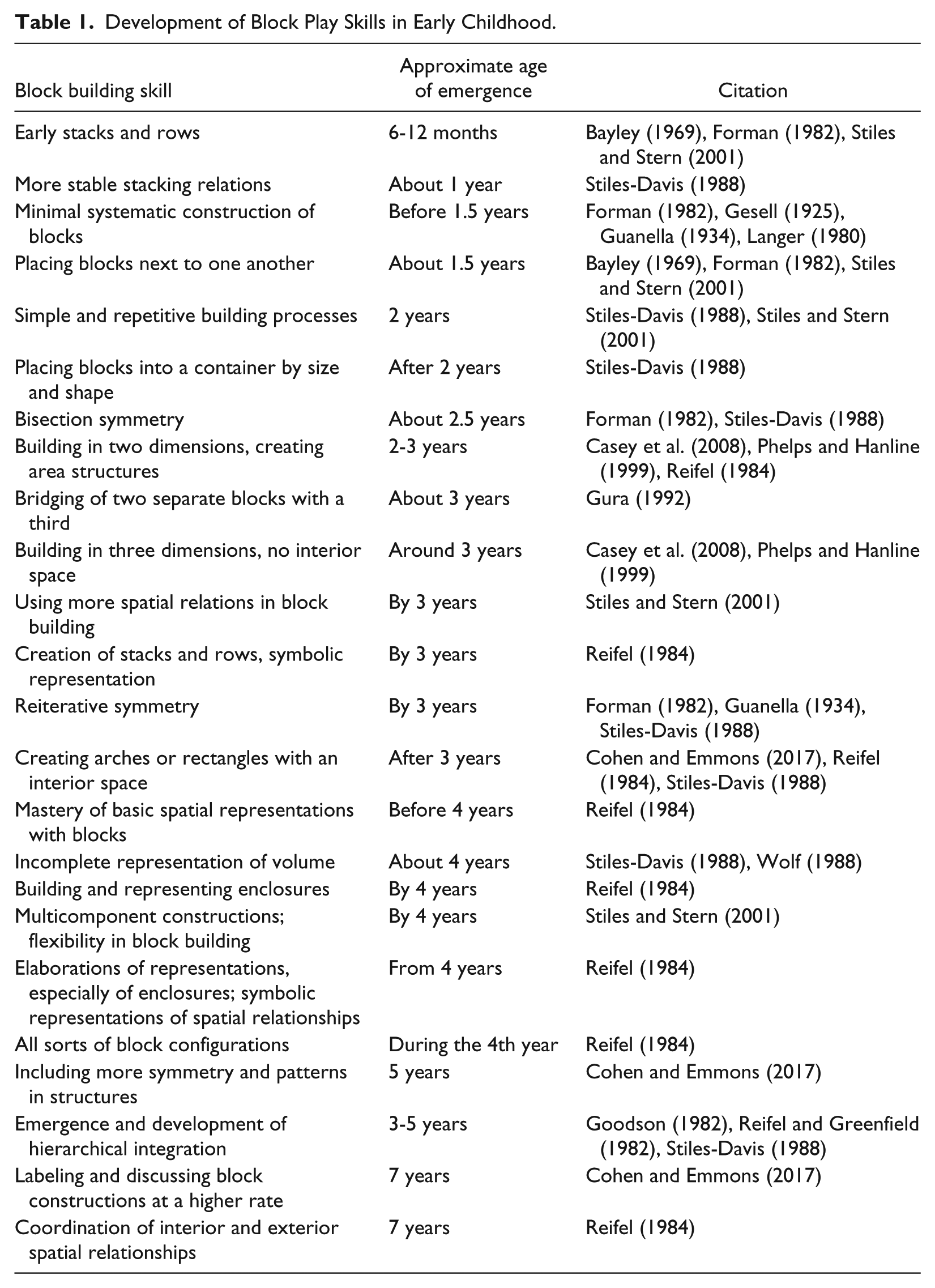
Based on the research summarized in Table 1, we identify five general stages in which increasingly sophisticated block building skills are apparent (Figure 1).
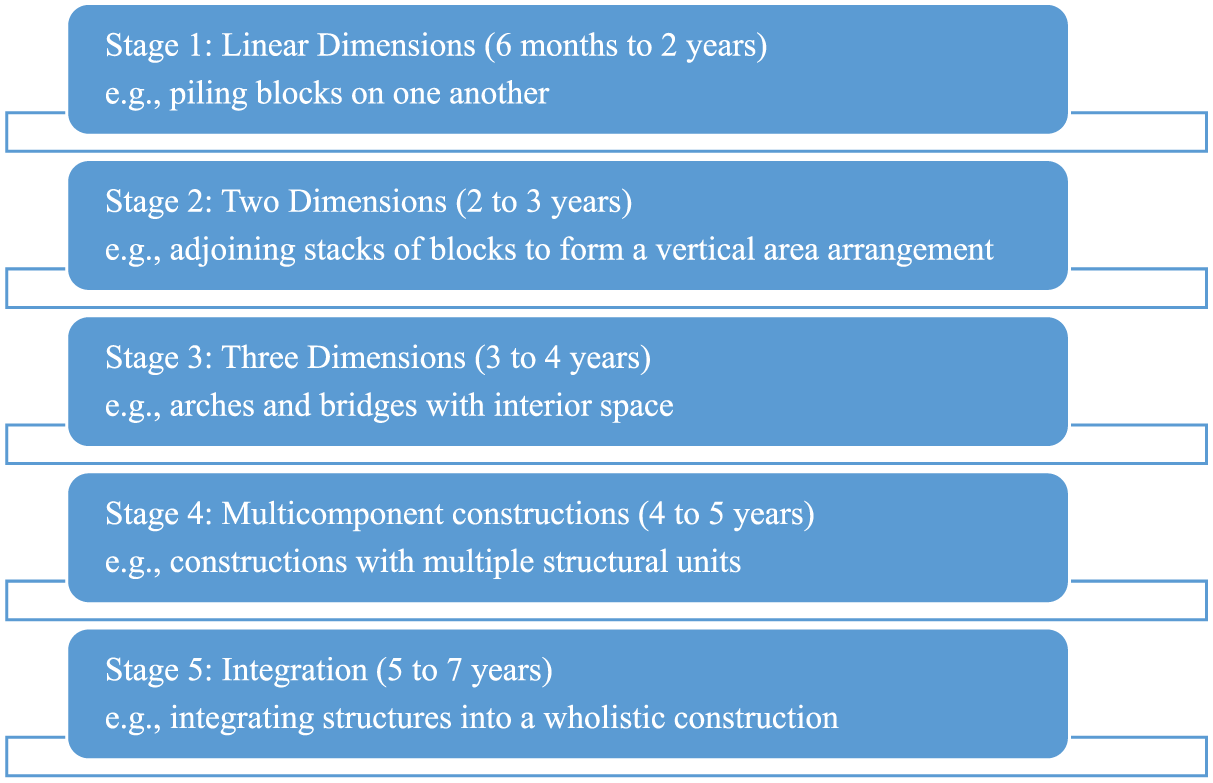
Five stages of block use.
Exploring blocks and building in linear dimensions (6 months-2 years)
Infants at 6 months have a desire to touch, grasp, hold, and feel blocks, exploring their physical properties. Piling blocks on one another often precedes placing blocks next to one another in linear constructions, either stacking them vertically or lining them horizontally. There is little systematic organization of blocks before 2 years of age.
Building in two dimensions and creating area structures (2-3 years)
During this period, children create two-dimensional block constructions with no internal space, creating adjoining stacks of blocks to form a vertical area arrangement such as walls or combining rows of blocks to form a horizontal area arrangement such as floors. At about 31 months, children begin to place a block so that it bisects another block.
Building in three dimensions, creating arches, bridges, and enclosures; adding symbolic representations to structures (3-4 years)
The creation of stacks and rows is common by the age of 3 years. Children gradually move to build in three dimensions, often after first having built piles or rows of blocks with no interior space. Soon they create enclosures, either arches or bridges, with an interior space. They then combine these rows, piles, and enclosures in creative ways. Children also begin to create symbolic representations with blocks, using and representing spatial relations.
Producing multicomponent constructions and elaborations of symbolic representations (4 to 5 years)
By the age of 4 years, most children can build and represent enclosures, and they have usually mastered basic spatial representations with blocks such as on, by, inside, and outside. They also demonstrate differentiation or separation of blocks within a construction. At this stage, children create all sorts of block configurations and build constructions with multiple structural units, such as stacks, rows, area constructions, arches, and enclosures. They show considerable flexibility in generating and integrating different parts of the construction (Stiles & Stern, 2001) and may also include small-scale figures, props, and toy animals in their constructions. Meanwhile, they exhibit more deliberate efforts to achieve symmetry, balance, and patterns in their structures and are able to plan ahead and solve problems to reach their goals.
Emerging integration (5-7 years)
Integration emerges somewhere between ages 3 and 5 years, being widely recognized as a late stage in block building. Advanced integration encompasses complex combinations of arches, enclosures, and other block forms (Casey et al., 2008). By the age of 7 years, most children have developed the spatial skills to design both the interior and exterior of a structure and to integrate them into one wholistic construction. They are also more capable of labeling and discussing the resulting model.
Systematic Growth
Although there are observable individual differences in the pace of acquiring specific skills, the capacity for block building tends to develop in a systematic way. Early constructions are often times products of basic manipulation. As children develop, their constructions become more detailed, complex, coordinated, and balanced. Their block placements increase in precision and symmetry; representational play accompanying block construction also becomes more frequent. However, occasionally children may use blocks in a manner that may not fully demonstrate their abilities. For example, a child who is capable of building an enclosed horizontal space might prefer to construct a vertical linear arrangement at a particular moment. Children may also exhibit lower level skills over an extended period of time and then quickly pass through several stages above that level in a much shorter period of time (Hanline, Milton, & Phelps, 2001).
In sum, as children develop their block construction appears to be more elaborated and representational, showing increasing freedom and flexibility in the building process and ultimately reaching a high level of integration.
Scales Assessing the Complexity of Block Construction
The use of scales to assess block building skills can be traced back to 1916, when Kelley devised the first constructive ability test in an attempt to measure children’s initiative as well as manipulative ability. The record sheet detailed engagement time, dominance of purpose, symmetry, interest in building or playing, merit, structure completion, and other observations. The scale offered a system for objective and standardized grading unaffected by the child’s educational background and English proficiency.
Later, based on Kelley’s (1916) standardized constructive ability test and photographs of individual block constructions that were used as benchmarks for scoring children’s constructions, Bailey (1933) devised the Scale of Block Constructions using the method of equal appearing intervals to evaluate the constructive and manipulative ability of young children. The Scale of Block Constructions could afford objective and quantitative results that would make it possible to study distinct phases of development. It was developed under the assumption that children tended to progress from stacking blocks into vertical lines to constructing enclosures having interior space. Later, children build elaborate constructions including combinations of a variety of stacks and enclosures representing a structure (e.g., a castle). Bailey developed four criteria for judging whether one block construction was superior or inferior to another, namely, availability of evidence for some plan, extent to which the plan was carried out, symmetry of design, and care in placing the blocks.
The Lunzer Five-Point Play Scale (Hulme & Lunzer, 1966; Lunzer, 1955) contains two subscales assessing preschool children’s adaptiveness in the use of play materials and integration of play behavior or play complexity. This scale has been used to analyze preschoolers’ construction play with blocks, Legos, and other carpentry materials (Stannard et al., 2001; Wolfgang, Stannard, & Jones, 2001).
Reifel and Greenfield’s (1982) Coding Categories have been one of the most commonly used measures of spatial relationships in block play. The complexity of structures is described in terms of hierarchical integration and dimensionality. Hierarchical integration reflects increasing complexity in block constructions, which are graded with regard to the presence or absence of the following features: flat or vertical blocks without true integration, at least one block connecting or spanning other blocks, simple integration in the form of enclosures and arches or bridges on the same plane, increased complexity in the form of arches or bridges on nonparallel planes, and a block joining at least two arches or bridges. Dimensionality is rated on the basis of plane geometry with four levels: no dimensions, one dimension, two dimensions, and three dimensions.
Since the early 21st century, researchers have adapted Reifel and Greenfield’s (1982) original Coding Categories scale to assess preschool children’s block building skills (e.g., Casey et al., 2008; Gregory & Whiren, 2003; Phelps & Hanline, 1999). Building on Phelps and Hanline’s (1999) adaptation of the Coding Categories, Hanline et al. (2001, 2010) added three items to create the Block Construction Scoring Scale (BCSS), which is now in common use. The BCSS is comprehensive and specific in its assessment of preschool children’s block use or construction. It scores each construction on 19 levels of complexity organized into five stages: no construction, linear constructions such as vertical linear arrangements, bidimensional/area structures such as horizontal area arrangements, tridimensional constructions such as enclosed vertical space, and representational play in which the resulting structure is meant to be a model of some real-world object or construction. This scale not only measures spatial skills by examining structural complexity but also considers elements of symbolic representation and topological and geometrical knowledge. Another measure, the Block Structure Complexity Scoring Instrument, was later developed from the BCSS, using ratings from 1 to 10 with simple stacks or rows and more complex and representational structures receiving lower and higher ratings, respectively.
Two measures are notable for their focus on specific structural features in block constructions. First, the Measures of Spatial Construction (MOSC; Stiles & Stern, 2001) evaluates the child’s accuracy in copying a model with blocks by assigning a score of 0 (inaccurate), 1 (partially accurate), or 2 (accurate). The MOSC is one of the scales that also collect observational data about the building process, that is, how children produce each construction. In this approach, adapted from Stiles-Davis (1988), each construction is evaluated in terms of three building strategies. A Process I strategy is the use of a single reiterative relation in a single direction. Process I is optimal for making a stack; it can also be used to construct a line if each new block is placed next to the last block placed along the same line. A Process II strategy is the use of more than one type of relations or directions in sequence (e.g., a line and then a stack). A Process III strategy is the use of blocks in more than one way or direction, with the child shifting back and forth between different parts of the construction (p. 164). Second, the BPC scheme (Ramani, 2012) also assesses specified structural features. The experimenter presents a model with specific characteristics for the child to copy and rate the child’s construction on a scale from 0 to 4, depending on the number of characteristics successfully reproduced. The BPC also assesses structural complexity in terms of a wide range of block construction features, such as height and length, intricacy, colors, shapes and sizes of blocks, and number of bridge formations.
The Three Methods of Evaluating the Complexity of Block Structures (Gregory & Whiren, 2003) uses scores from 1 to 4 to rate constructions along the three dimensions of stage, arches, and dimensionality. Adopting this rating system, the BBM (Casey et al., 2008) documents a developmental progression of children’s block building skills as follows: nonconstruction use of blocks, unidimensional constructions, bidimensional constructions, tridimensional constructions, and tridimensional horizontal enclosure constructions. It should be pointed out that in contrast to other measures, the BBM classifies stacks and rows into the same level, vertical and horizontal linear constructions into another level, and arches and enclosures as bidimensional constructions. Another controversial aspect of the measure is that some early childhood educators have reported that the order of some higher level skills on the BBM does not match their actual difficulties (Gura, 1992).
A list of scales together with their reliabilities, the abilities they measure, and the ages of children studied are given in Table 2.
Scales of Block Construction Abilities.

So far, there is not a block construction scale that assesses all aspects of block building. Hierarchical integration and spatial dimensions are two common aspects of construction assessed by scales having a sound developmental framework supported by empirical studies. However, most measures lack theoretical frameworks and evidence of validity.
A Proposed Model of Block Building Skills
In addition to the scales described above, many measures of general intelligence include a block building subtest to assess children’s nonverbal, perceptual-spatial ability. These include the McCarthy Scales of Children’s Abilities (MSCA; McCarthy, 1972), British Ability Scales (revised; BAS-R; Elliott, Murray, & Pearson, 1983; Hill, 2005), Stanford–Binet Intelligence Scale (SBV; Roid, 2003), and Wechsler Preschool and Primary Scale of Intelligence–Fourth Edition (WPPSI-IV; Wechsler, 2012). These tests of intelligence adopt nonverbal block design subtests that are fairly traditional. They typically require reproduction of an actual finished model of block construction aiming to assess children’s abstract visual reasoning (e.g., MSCA, SBV), spatial ability (BAS), visual–spatial and organizational processing, and nonverbal problem solving (WPPSI-IV). Empirical evidence has suggested that reproducing a construction requires multiple skills, including an understanding of structural balance (Casey, Pezaris, & Bassi, 2012) and part-whole relationships (Gura, 1992), representational thinking (Forman, 1982), symbolic representation, topological and geometrical knowledge, early mathematical concepts (Phelps & Hanline, 1999), and spatial cognitive processing (Stiles & Stern, 2001).
For many standardized block design subtests, there are three features that stand out as important. First, for each test item, there is usually a model design presented to the child, who is then required to copy it with the blocks provided (e.g., WPPSI-IV). We think that one clear advantage of this approach is its objectivity, in that the child has a clear standard to follow and the resulting score is based on an objective standard. Scoring is thus straightforward. But there may be an over-emphasis on the child’s ability to mentally rotate the design, because the child always has to do such rotation to match the resulting construction with the model provided. Hence, an inaccurate rotation would always lead to a wrong answer, regardless of how well the child applies the other essential skills such as representational thinking and numeracy. Second, presentations of the model structure can be two- (e.g., WPPSI-IV) or three-dimensional (e.g., UNIT). Compared to a three-dimensional presentation, a two-dimensional one would require at least two extra steps of computation in the block building process, namely, translating the given presentation into a three-dimensional mental model and holding this mental model in working memory for comparison and matching. These two computational steps imaginably demand extra cognitive resources and thus may compromise performance. Third, the widely used diagonal or half-block design with red and white triangles, when used in combination with a model-copying approach, may place a very heavy demand on mental rotation ability to the extent that the test’s sensitivity to the other important skills is compromised (e.g., WPPSI-IV). In sum, we think that many standardized block design subtests adopting a model-copying approach have the advantage of being objective and straightforward in their performance requirement and scoring, but also tend to have the disadvantage of placing too much emphasis on mental rotation and working memory so that the other essential skills could be overlooked.
Having examined a number of block construction scales and the block design subtests from several prominent intelligence tests, we propose that children’s block play provides valuable information on eight major behavioral–cognitive capacities, namely, spatial ability, abstract reasoning, representational thinking, numeracy, constructive and manipulative ability, initiation and execution, adaptiveness in material use, and integration of play behavior. These capacities are organized into the broad areas of cognition and performance (see Figure 2).
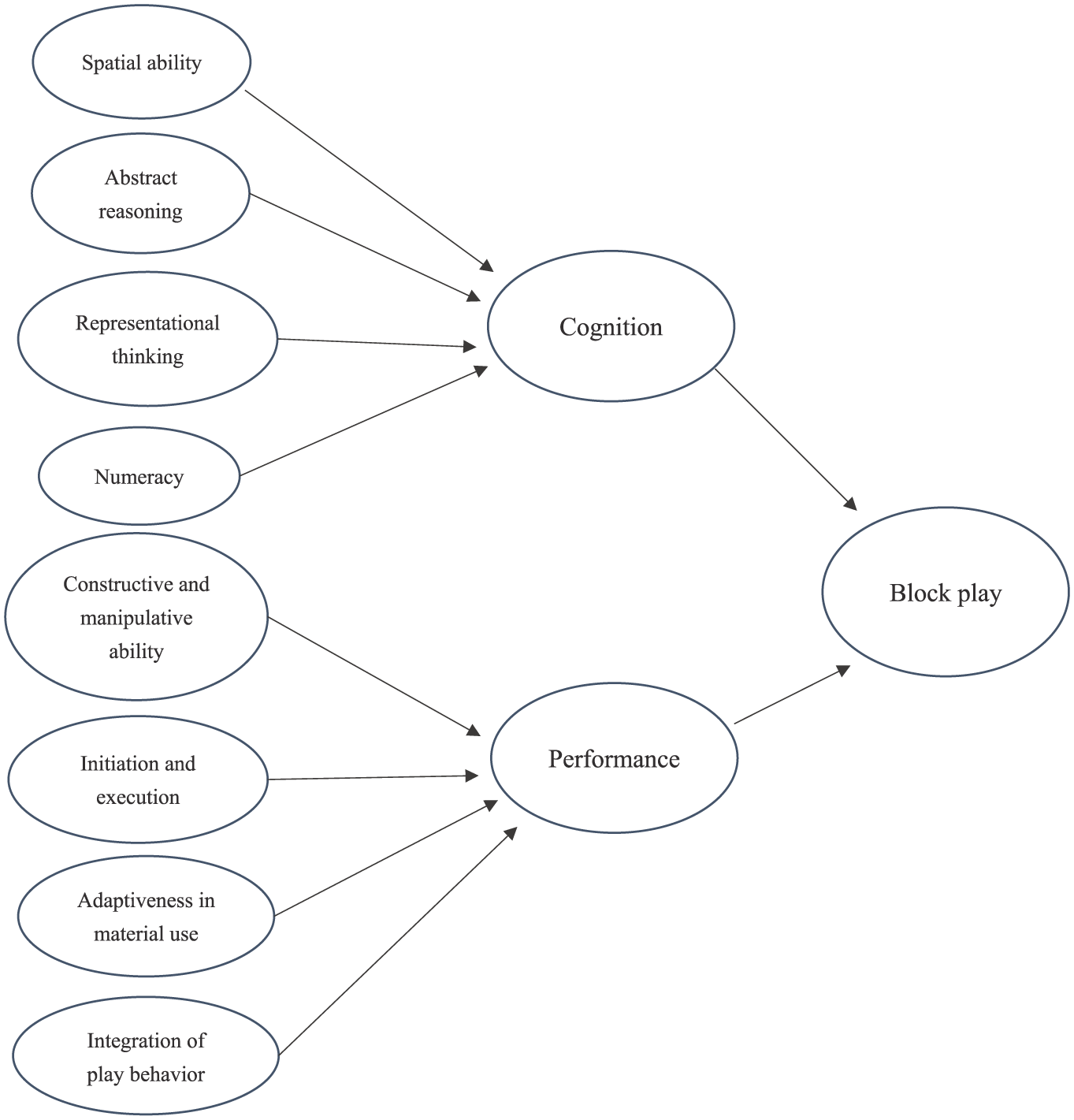
A conceptual model of the behavioral–cognitive capacities underlying block play.
In Figure 2, an arrow means “contributing to” or “promoting.” The model assumes two levels of capacities underlying block play. At the more general level, the “cognition” of block play includes factors having to do with the computation and manipulation of abstract information for goal achievement and problem solving in block play. The most crucial foundation for block play involves the effective processing of perceptual–spatial information, that is, “spatial ability,” as examined by Casey et al. (2008) and Reifel and Greenfield (1982) with the BBM and Coding Categories, respectively. The focus is on the various dimensionalities in space and how they are hierarchically integrated (Stiles & Stern, 2001). Such a spatial focus is also highlighted in the BAS-R (Elliott et al., 1983) and WPPSI-IV (Wechsler, 2012). Next, “abstract reasoning” is highlighted in the MSCA (McCarthy, 1972) and SBV (Roid, 2003), which we think contributes to the overall structural complexity of the construction as assessed in the Three Methods of Evaluating the Complexity of Block Structures (Gregory & Whiren, 2003), BCSS (Phelps & Hanline, 1999; Hanline et al., 2001, 2010), BPC (Ramani, 2012), and Block Structure Complexity Scoring Instrument (Trawick-Smith et al., 2017). “Representational thinking” points to the cognitive processes conducive to the building of mental models to represent some specific aspects of reality. This ability is especially important in the child’s using of blocks to copy preassembled models, as required in the MSCA, SBV, and WPPSI-IV and studied by Forman (1982). “Numeracy” has to do with the perception and computation of quantities in terms of numbers and the numbering system; the significant involvement of this capacity in block play is readily seen in the Block Structure Complexity Scoring Instrument (Trawick-Smith, Swaminathan, Baton, Danieluk, Marsh, & Szarwacki, 2017) and also highlighted by Phelps and Hanline (1999).
In contrast, the “performance” of block play depends on four capacities that are directly involved in the actual execution of behavior leading to the final construction, together with the motivation behind such behavior. “Constructive and manipulative ability” is the ability to plan and to carry out the plan, investigated in the context of block play in an early paper by Bailey (1933). “Initiation and execution” has been viewed by Kelley (1916) as essential in constructive activities in general, which refers to an overall capacity to start, carry out, and continue with a goal-directed activity that is independent of language ability and specific training. “Adaptiveness in material use” is the child’s ability to use the provided material in an appropriate manner after taking into consideration its unique properties and potentialities and the degree to which she is not bound by the suggested usage and how much she is able to adapt it to more creative uses (Hulme & Lunzer, 1966; Lunzer, 1955). Finally, “integration of play behavior” refers to the overall complexity of the play behavior itself and the degree to which the various behavioral elements are connected and integrated into an elaborated whole (Hulme & Lunzer, 1966; Lunzer, 1955).
The proposed conceptual model represents the result of a comprehensive survey on and summarization of the current literature and, more importantly, a detailed and systematic analysis of all the available material that leads to the derivation of eight essential dimensions underlying block play in children. The model provides a new perspective on the development and measurement of children’s block building. Apart from its theoretical importance, the model is also potentially useful in applied settings, especially for the design of intervention programs using block play as a means to promote cognitive development.
Implications for Practice
For education practitioners and psychologists with an applied concern, the main question is how block play could be better incorporated into the formal curriculum and utilized to promote children’s cognitive development and learning in general. Given the eight capacities highlighted in the proposed model with evidences from previously developed block play scales and research on block play documented in the literature, practitioners could always design their own unique play programs to fit into their curricula for the maximization of learning outcome, given their unique educational situations. For instance, to help children who generally do not show a strong motivation to learn, a block play program with an emphasis on “initiation and execution” could be designed and implemented. In this program, the child is more encouraged to come up with her own block designs for her own specific purposes, rather than just copying preassembled structures. She is also encouraged to commit her play ideas into action. By doing this, her general motivation to initiate thoughts and commitment of such thoughts to action could be enhanced. For children who are weak in mathematical thinking and numeracy, balance and geometry in block construction could be emphasized. The child’s attention may then be directed toward structural symmetry and balance and more importantly how such symmetry and balance can be achieved by placing different quantities of blocks of particular shapes into different locations. To enhance symbolic or representational thinking, however, one can ask the child to copy detailed finished models with a set of blocks of much simpler and a restricted range of shapes and sizes, so as to encourage the use of a less detailed and elaborated means (i.e., blocks as symbols) to represent a more information-rich and detailed reality (i.e., the finished model). The main idea behind all these examples for practice is to make use of the eight proposed dimensions in a flexibly way to design block play programs that fit into the unique educational situation faced by the practitioner.
Another question has to do with assessment: Can block play be used as a “fun” way to assess children on the eight dimensions? We think that this is entirely possible. Again, with these eight dimensions in mind, practitioners are encouraged to design their own unique assessment schemes using block play to serve their particular educational purposes. The advantage of this approach to assessment is that block play provides an efficient, integrated, and ecologically valid way to assess the eight capacities. By “integrated” we mean that the different abilities are all nested into one another within one single goal-directed activity and “ecologically valid” simply points to the fact that the eight abilities are assessed during real-life operations. Hence, in addition to its potential use in the promotion of the eight proposed behavioral–cognitive capacities, block play also provides an excellent way to assess them.
Implications for Theory
For psychologists and educationists with a theoretical concern, one important implication of the present review and the proposed model is that it is both possible and fruitful to look at block play in a very different theoretical light. Many existing block design subtests are used to assess “nonverbal ability,” in contrast to “verbal ability,” as a necessary component of general intelligence. The theoretical motivation has to do with a simple need to recognize that intelligence should comprise a verbal and a nonverbal capacity. Looking at block play and block design from this angle, the specific capacities that contribute to block play do not appear to be important: The purpose is served as long as block design does not require language. For researchers interested in block play itself, the main focus has been on scale development, or the use of blocks to measure some specific abilities with a specially designed coding scheme. Our view is different. We “work backward” by first consulting the literature and identifying what all these possibilities are, that is, what block play can tell us about cognitive development, and then coming up with a working model that guides future uses of block play to promote and to assess various behavioral–cognitive capacities. By doing so, we approach a theory of block play that explains the very nature of the activity itself and guides future theoretical work. Therefore, although this review has obvious implications for future scale development, our main purpose is not to propose a better way to measure block play, but rather to argue that given the information available in the literature, it is very likely that block play is supported by the eight proposed behavioral–cognitive capacities. A theory of block play needs to include them.
Recommendations for Future Scale Development
Further research is needed to improve current measures of children’s block building and to develop new, more comprehensive measurement methods to assess these skills. Based on this review, there are still several areas of research that would be useful to pursue in future scale development. The following section focuses on five potential research topics: (a) reliability, (b) validity, (c) evaluation of gender differences, (d) comprehensive measurement, and (e) expansion to older age groups.
First, as shown in Table 2, scales of block building development have demonstrated satisfactory inter-rater reliability, with coefficients ranging from .83 to 1.00. However, test–retest reliability and internal consistency would also be important psychometric characteristics to document. Reliability is the consistency or repeatability of tests or measures (Weir, 2005). The split-half (odd–even) reliability coefficient and short-term (2 weeks) or long-term (6 months) test–retest reliability could estimate the extent to which the items on block construction ability scales homogeneously assess the same underlying construct and provide information on self-correlations of a measurement (Henson, 2001).
Second, evidence of validity would be important to maximize the measures’ utility for research and clinical work. Validity refers to the degree to which a scale measures what it is claimed to measure (Barrett, 1992). Evidence of the validity of block building scales has not been reported. One exception comes from Hanline et al. (2001, 2010). The researchers used a growth curve analysis and concluded that children’s scores on the BCSS increased as their chronological age increased, providing evidence of the measure’s construct validity. Other forms of validity could be tested in future research. For example, discriminant validity could be documented by demonstrating that typically developing children show significantly higher scores than children with developmental disorders. One study showed that children with disabilities tend to develop block building skills in the same sequence as typically developing children but at a slower rate, and they tend to build less complex block constructions (Hanline et al., 2001).
Evidence of convergent validity would be based on correlations between block building scores and scores on related measures. Given that block construction is thought to reflect a child’s level of cognitive development (Reifel & Greenfield, 1982), and in particular, skills in spatial cognitive processing (Phelps & Hanline, 1999), scores on block building scales should correlate with well-validated spatial skills tests (Radakovic, Harley, Abrahams, & Starr, 2015), for example, copying and pattern analysis subtests from SBV (Roid, 2003), copying and pattern construction subtests from BAS (Elliott et al., 1983), and block design subtest from the WPPSI (Kaufman, 1992). Given that the number of items of subtest regarding spatial skills is not enough, we can create more items by (a) setting more items with different difficulty levels and (b) producing more items based on the original ones.
Third, future research could examine whether there is gender differences in the existing scales. Early studies documented that boys and girls do not differ significantly on the MSCA (Kaufman & Kaufman, 1973) or the WPPSI (Herman, 1968), where both of these tests include some type of traditional block building tasks, although evidence for the latter showed superiority of boys over girls on Block Design (Kaiser & Reynolds, 1985). Regarding the inconsistent empirical findings on gender differences for children’s block building activities (reviewed earlier), which might be due to the measures, differ across studies. We propose that there might be gender differences in existing measurements. Therefore, there is a need to consider whether the content of items and dimensions in the various block construction ability scales was designed to be equally suitable for both genders by analyzing the scores obtained by boys and girls on the scales.
Different age levels (e.g., 3-3.5 and 3.5-4 years) are suggested to examine whether there is a developmental trend on gender differences. Boys and girls at each age level selected for analysis should approximately be equal on several background variables, such as social economic status and geographic region. Analysis should then be done on whether the boys’ mean scores are higher than the girls’ at each age level and whether the differences reach statistical significance. A bar chart could be used to show the comparison clearly. If the results of the comparison between boys’ and girls’ raw test scores at different age levels show no significant differences, we can assume that boys and girls do not differ significantly on items or scales that assess block construction abilities. Equivalence testing could also be applied to test whether there exists gender differences.
Fourth, future research could evaluate combinations of different measures to establish a more comprehensive measure of children’s block construction. For example, most existing measures analyze block constructions in terms of structural complexity and building skills, ignoring other aspects of cognitive dimensions in block building. These cognitive dimensions might be seen in part in the representational and symbolic quality of the product, especially when children are asked to copy a model (Otsuka & Jay, 2016). Blocks can be considered a symbolic medium like writing and painting (Reifel & Greenfield, 1982). According to the structure of intellect (SOI) model (Guilford, 1961, 1988), intellect consists of three dimensions: content (type of information), operation (type of mental activity), and product (formal aspects of information). From this perspective, we could say that a comprehensive scale of block building would assess a child’s intellectual ability in manipulating units with symbolic content.
Another example is that although research suggests a link between block building and spatial skills in the early school period (e.g., Casey et al., 2008), spatial (structural) balance that involves balancing a large edifice of blocks upon a lower base of right blocks has received less attention than other aspects of block building (Tian et al., 2018). Meanwhile, a measure of spatial reasoning could be included in a comprehensive measure, as evidence shows that spatial reasoning can be improved (Uttal et al., 2013) and that guided block building is an effective strategy for developing spatial reasoning (Newcombe & Frick, 2010).
A comprehensive assessment would also include children’s interest in block play, their individual initiative and persistence (Kelley, 1916), their creativity, the level of independence exhibited by the child, the strategies they adopt to solve problems (Ramani et al., 2014), and their ability to plan and carry out the plan (Goodson, 1982). These could be measured through quantitative methods as well as qualitative methods such as participant observation, structured observation, unstructured interviews, and open-ended questions (Bryman, 2006).
Fifth, there is a need for research on block building after preschool. The notion that play behavior changes between birth and school age is not new. However, evidence for age changes in block play beyond the preschool years is limited, and no single study has attempted to observe the developmental changes of block play over the childhood. Block building skills may not be fully developed by the end of preschool, and later block building skills may be relevant for understanding spatial reasoning required by advanced mathematics courses such as geometry. At older ages, children continue to develop block building skills and to construct new knowledge, and children use this knowledge to understand new phenomena as their experience expands (Hussain, Lindh, & Shukur, 2006). Hence, it would be beneficial to quantify the developmental progression in the complexity of children’s block constructions from childhood through to adolescence.
Summary
Psychologists’ interest in children’s block building has spanned almost a century, and much is known about preschool children’s block constructions. Block building activities appear to stimulate multiple areas of growth, including language skills and social and cognitive development. The idea that children’s engagement in play activity, such as block building, can provide an indication of children’s cognitive and nonverbal skills is very intriguing and has promoted a large amount of research. Many scales have been developed to assess block constructions, and although these measures show good inter-rater reliability, more research is needed to test other forms of reliability and validity. The next step is to develop a comprehensive measure of block building that generates standardized scores, assesses the process by which children build constructions, and measures block building beyond early childhood.
Footnotes
Declaration of Conflicting Interests
The author(s) declared no potential conflicts of interest with respect to the research, authorship, and/or publication of this article.
Funding
The author(s) received no financial support for the research, authorship, and/or publication of this article.
