



Abstract
This study examined the cross-cultural validity of the Ego-Resilience Scale (ER89) in the Chinese cultural context. The ER89 was translated and culturally adapted into Chinese by following the psychometric validation procedures, in an adolescent sample (N = 943) of 13- to 18-year-olds. A series of psychometric analyses were conducted, including exploratory factor analysis (EFA), confirmatory factor analysis (CFA), analysis for measurement invariance across gender groups, analysis for criterion-related validity evidence, and internal consistency reliability estimates. The results supported the use of ER89 scale in the Chinese cultural context (ER89-C). The empirical findings suggest a two-factor structure of ER89-C (openness to life experiences [OL] and optimal regulation [OR]). The findings also revealed that ER89-C has the expected correlations with external and theoretically related constructs. Overall, ER89-C is shown to possess favorable psychometric characteristics for its use as an assessment tool for ego-resilience level of Chinese adolescents.
Introduction
Resilience refers to a person’s flexibility to cope with various difficulties and challenges in life and to bounce back from adversities and misfortunes (Dent & Cameron, 2003). Resilience has been identified as an important element in positive psychology, and it is significantly and positively correlated with an individual’s subjective well-being (Fredrickson, 2004), positive cognitions (Mak et al., 2011), self-esteem (Benetti & Kambouropoulos, 2006), and self-confidence (Klohnen, 1996). However, people with low level of resilience have more difficulty in dealing with their stress, depression, and anxiety (Dumont & Provost, 1999).
Measurement of Resilience
A number of scales have been developed to measure resilience, with each having its own limitation in terms of psychometric properties. Based on a review of resilience measurement scales (Windle et al., 2011), three shortcomings have been discussed: (a) limited generalizability, (b) lack of theoretical support, and (c) difficulty in practical application. For the concern of limited generalizability, as an example, Connor and Davidson (2003) developed the 25-item Connor–Davidson Resilience Scale (CD-RISC) with five distinct dimensions. Although this scale has shown high scores in psychometric evaluations, it was developed for clinical practices with its high sensitivity to improvement of patients who suffered from posttraumatic stress disorder (Yu & Zhang, 2007). As an example for the second concern of lack of theoretical support, some scales, such as Adolescent Resilience Scale (Oshio et al., 2003), had very little theoretical rationale for supporting the structure of this resilience scale. Furthermore, some (e.g., Youth Resilience Assessing Developmental Strengths; Donnon et al., 2003) were not in the public domain. For the third concern of practical applicability, some scales have a large number of items requiring too much time to complete, which may result in the increase of nonresponse rate and missing data, such as the 45-item Depositional Resilience Scale (Bartone et al., 1989), the 37-item Resilience Scale for Adult (Friborg et al., 2003), and the 94-item Youth Resilience Assessing Developmental Strengths (Donnon et al., 2003).
Uniqueness of Ego-Resilience Scale (ER89)
Among the available instruments, ER89 has received researchers’ attention because of its unique characteristic (Block & Kremen, 1996). First, the target population of ER is nonclinic young people. Second, ER89 was conceptualized in the domain of personality development; as a result, it has a good theoretical basis. Most importantly, different from other resilience assessment, ER89 assumes that ego-resilience refers to temperament or personality traits associated with adaptability, which does not depend on situational risk, threat, or adversity (Luthar et al., 2000; Masten, 1994), but is more related to daily processes as protective factors. Third, practically, ER89 is a relatively brief scale with 14 items for measuring an individual’s resilience. This scale has been administered to young adult samples in the Western cultural contexts, and the results suggested good content and construct validity and good internal consistency (Block & Kremen, 1996).
The Need of Applicability of ER89 in Chinese Cultural Context
In the unique Chinese social and cultural environment, children and adolescents are facing considerable stress and pressure that require them to bounce back from adversities and challenges. For example, in the Chinese cultural context, both the society and family place great importance on children’s educational success (Feng, 1995). Under the collectivism value system, children have high responsibility to meet the expectations of their family (Fuligni & Zhang, 2004). In addition, living in the highly competitive and exam-driven educational system, Chinese children may experience considerable pressure and anxiety in their social and academic lives. Such pressure may lead to a variety of psychological consequences, or even suicidal behaviors. According to China’s Centers for Disease Control and Prevention, suicide has become one of the leading causes of death among adolescents in China. Thus, resilience could be considered as an important protective factor for Chinese students against their daily pressure and stress.
Despite the need for resilience assessment in the Chinese cultural context, currently, there are no psychometrically viable measures in Chinese for this purpose. ER89 has been used in the Western cultures and societies, and has shown good psychometric characteristics. However, the applicability of ER89 in the Chinese context is unknown. Also, cross-cultural research suggested that the internal structure of ER89 could vary across different cultural contexts, for example, the two-factor model in an Italian sample (Alessandri et al., 2008) and the three-factor model in a Hungarian sample (Farkas & Orosz, 2015). It should be noted that, in adapting ER89 to different cultural and language contexts, researchers made different modifications of the original ER89, to achieve acceptable model fit when used in different cultural and linguistic populations. For example, after removing four items, Alessandri et al. (2008) found that a two-factor model had the best fit in an Italian adult sample. Similarly, Farkas and Orosz (2015) dropped three items from the original ER89 and found a three-factor model with the best fit to a Hungarian adult sample.
Aims of the Study
The aims of the present study were to explore the factorial structure of the Chinese version of the ER89 and to examine its psychometric characteristics (e.g., reliability and validity) when it is used among Chinese adolescents, so as to understand the cross-cultural applicability of ER89 in the Chinese context. Based on previous validation studies across different cultures, we hypothesized that the ER89 adapted for the Chinese cultural context could have a different factor structure from the original ER89. Moreover, we further hypothesized that the ER89 adapted for the Chinese cultural context would show good psychometric characteristics, such as having expected correlations with other theoretically positively and negatively related external variables.
Method
Participants and Procedure
This study was approved by the Research Ethics Review Committee under the Research Development Administration Office of the university. Three secondary schools were selected by using convenience sampling from Guangdong Province in southern China, which is an economically advanced province in China with a population more than 100 million. Both student-informed consent and parent-informed consent were obtained before the research began. A sample of 943 adolescents was recruited. Participants were mostly females (n = 578; 61.3%) and averaged 15.89 years of age (range = 13–18 years, SD = 0.81 years).
Measures
Chinese Version of Ego-Resilience Scale (ER89-C)
The original ER89 scale consists of 14 items, and it showed sound psychometric qualities in studies involving U.S. populations (Block & Kremen, 1996). Respondents to ER89-C were asked to respond on a 4-point Likert-type scale, from 1 (does not apply at all) to 4 (applies very strongly). A higher total score on this scale represents higher level of ego-resilience.
As recommended in the Standards for Educational and Psychological Testing, an iterative process involving translation and back-translation was used to translate the original ER89 items into Chinese. The process of translation and back-translation was conducted by four researchers who were not only fluent in Chinese and English but also had rich professional experience in the field of educational psychology. The researchers worked both independently and collectively to compare their own versions, as well as to compare with the original version, and they collaboratively worked on the discrepancies until a consensus was reached. The resultant ER89-C had Cronbach’s alpha of .85 in the current study. In addition to ER89-C, three other measures used in the study (optimism, curiosity, and positive reframe; see below) also went through this elaborate and time-consuming process until the final Chinese versions were ready.
Optimism
The 10-item Life Orientation Test for Optimism with items on 5-point Likert-type scale of 0 (strongly disagree) to 4 (strongly agree) measures one’s optimism (Scheier et al., 1994). A higher total score for this scale indicates a higher level of optimism. Cronbach’s alpha value was .82 for this scale in the original study. The research team translated this scale from English to Chinese by using the same process as described for ER89-C above. In the current sample, the translated version had Cronbach’s alpha of .63.
Hope
Trait Hope Scale (Snyder et al., 1991) includes 12 items on a Likert-type scale ranging from 1 (definitely false) to 4 (definitely true). There are two components on this scale: Pathway Thinking (four items) and Agency Thinking (four items), with the remaining four items functioning as fillers. Higher scores for the two subscales represent higher levels of hope. Cronbach’s alpha values ranged from .74 to .84 for this scale in the original study. The Chinese version of Trait Hope Scale (Ho et al., 2012) was used in the current study, with Cronbach’s alpha of .72 and.67 for Pathway Thinking and Agency Thinking, respectively.
Curiosity
The seven-item Curiosity Exploration Inventory (with four items for exploration and three items for absorption) measures one’s curiosity level (Kashdan et al., 2004), with response scale from 1 (strongly disagree) to 4 (neither agree nor disagree). Higher scores for the two subscales represent higher levels of curiosity. Cronbach’s alpha values ranged from .63 to .74 for this scale in the original study. Using the same translation and back-translation process as described above, the Chinese version was obtained and used in the current study with Cronbach’s alpha of .70.
Positive reframe
The four-item Positive Reframing Scale has items on a 7-point Likert-type scale ranging from 1 (strongly disagree) to 7 (strongly agree), and this scale was used to measure one’s ability of positive reframing thinking (Lambert et al., 2009). Higher total scores represent higher levels of positive reframing. Cronbach’s alpha values ranged from .78 to .82 for this scale in the original study. Using the same translation and back-translation process as described above, the Chinese version had Cronbach’s alpha of .64 in the current study.
Depression, Anxiety, and Stress
The 21-item Depression–Anxiety–Stress Scale (DASS-21) with items on a Likert-type scale ranging from 0 (did not apply to me at all) to 3 (applied to me very much, or most of the time) measures one’s psychological distress. There are seven items for each of the three subscales of Depression, Anxiety, and Stress (Lovibond & Lovibond, 1995). Higher scores on the three subscales and on the total scale indicate individuals experiencing more psychological distress. Cronbach’s alpha values were .91 for Depression, .84 for Anxiety, and .90 for Stress, respectively, in the original study. The Chinese version of DASS (Wang et al., 2016) was used in this study, with Cronbach’s alpha of .83, .80, and .82 for Depression, Anxiety, and Stress, respectively, and .92 for the total scale.
Data Analysis
To examine the factor structure of the ER89-C, the total sample was half split randomly, and one half (n = 472) was used for exploratory factor analysis (EFA) and the other (n = 471) was for confirmatory factor analysis (CFA). More specifically, EFA with principal component analysis as the extraction method and with Promax rotation was used, and the retention of the number of factors was determined by conducting a parallel analysis (Hayton et al., 2004). After the EFA factor structure was obtained, CFA was then conducted with robust maximum likelihood (MLR) estimator (Satorra & Bentler, 2001) in the other half of the data to confirm the factor structure derived from EFA before. In CFA, the root mean square error of approximation (RMSEA), the comparative fit index (CFI), the Tucker–Lewis index (TLI), and the standardized root mean square residual (SRMR) were used for assessing the model fit (Byrne, 2016; Hooper et al., 2008). Internal consistency of the questionnaires was evaluated by Cronbach’s alpha coefficients (Nunnally & Bernstein, 1994).
Criterion-related validity evidence was obtained by using the Pearson correlations between the ER89-C and a group of other measures described earlier (i.e., optimism, hope, curiosity, positive reframe, and DASS-21). Specifically, based on theoretical considerations and previous empirical research literature, we expected that the ER89-C and its subscales would be positively correlated with optimism, hope, curiosity, and positive reframe, but negatively correlated with DASS-21 (Lambert et al., 2012; Schmidt, 2013; Snyder et al., 1991).
In addition, the findings from previous research about gender difference in resilience are inconsistent. Some suggested that girls had higher level of ego-resilience than boys (Alessandri et al., 2008, 2011), others suggested the opposite (Farkas & Orosz, 2015), whereas still others reported no statistical gender group difference in resilience (Vecchione et al., 2010). To address this issue, in this study, we are interested in understanding (a) whether this resilience scale could have different measurement structure for the gender groups and (b) whether gender groups could have different levels of resilience as measured by this scale. For these two issues, measurement invariance of ER89-C between gender groups was empirically evaluated by conducting a multigroup CFA first, and then by conducting a latent mean difference test across the gender groups. For testing the measurement invariance, two criteria were used as suggested in the research literature (F. F. Chen, 2007; Cheung & Rensvold, 2002): ΔCFI (<0.010) and ΔRMSEA (<0.015). It should be noted that chi-square difference test was not used for assessing measurement invariance, as it is highly dependent on sample size (F. F. Chen, 2007; Cheung & Rensvold, 2002). Furthermore, if a scalar invariance across gender groups could be obtained, tests of latent mean differences across gender groups could be further conducted. For this purpose, the latent mean values were constrained to be zeros in the male group, whereas these values were freely estimated for females. Based on the Z statistic, statistical significance associated with differences between the latent means was assessed (Z greater than 1.96 means statistical significance at p < .05).
In the current study, EFA was performed by using IBM SPSS Version 23.0 (IBM, Armonk, New York), and CFA was conducted by using Mplus Version 7.4 (Muthén & Muthén, 1998–2015). In addition, parallel analysis in EFA was performed by the Psych package (Revelle, 2014) with R Version 3.4.4 (R Core Team, 2018). The statistical significance level was set at p < .05 in the current study.
Results
EFA
Results of the EFA analysis with Promax rotation showed that the Kaiser–Meyer–Olkin value was 0.89 (greater than 0.50) and the Barlett’s test of sphericity (χ2 = 1,769.02, df = 91, p < .01) was significant, indicating that the 14 items of the ER89-C were appropriate for a factor analysis (George, 2011). A two-factor structure (Table 1) appeared, which could explain 44.42% of the total variance. All the 14 items clearly loaded on the intended factors (greater than .30; without cross-loadings; Osborne et al., 2014). In addition, the two-factor solution was supported by the results of parallel analysis (Supplemental Appendix A). Furthermore, based on a previous validation study reporting a two-factor model of the ER89 (Alessandri et al., 2011), the emerged two factors for the ER89-C were labeled as openness to life experiences (OL) as the first factor (eight items) and optimal regulation (OR) as the second factor (six items), respectively. In addition, the two factors showed a correlation of r = .49 (p < .01).
Factor Loadings for Items in PCA for the C-ER89 (n = 472).

Note. Loadings larger than .30 were in bold type. PCA = principal component analysis; ER89-C = Chinese version of ego-resilience Scale.
CFA
By using the remaining half sample of n = 471, CFA was conducted to test the two correlated-factor model of the ER89-C derived from EFA described above, and this model was fitted to the data of independent sample. The results of CFA did not show a clear message of model fit, with RMSEA (RMSEA = 0.06; 90% confidence interval [CI] = [0.05, 0.07]) and CFI (CFI = 0.90) satisfying the general expectation for good model fit, but TLI (TLI = 0.88) being slightly on the low side. Model modification index suggested a correlation between the residuals of Item 7 and Item 8. Because both items loaded on the same factor (i.e., OL) and both indicated curiosity, it is reasonable that the two items may share more in common, as reflected by the correlated residuals. With this slight model modification, the model fit of the modified two-factor model (Figure 1) improved with all fit indices meeting the recommended criteria: RMSEA = 0.06 (90% CI = [0.06, 0.07]), CFI = 0.91, TLI = 0.90, and SRMR = 0.05. In addition, as Block and Kremen (1996) originally proposed a single-factor model, we also tested its model fit, and the results showed unacceptable fit of this single-factor model: RMSEA = 0.08 (90% CI = [0.07, 0.09]), CFI = 0.84, TLI = 0.82, and SRMR = 0.06. Furthermore, the Satorra–Bentler Scaled Chi-Square Test (Satorra & Bentler, 2001) showed that this single-factor model was significantly worse than the two-factor model described above (Δχ2= 52.63, p < .01).

Factor loadings of the modified two-factor model of the C-ER89 (n = 471).
Because the correlation between the two factors was high (r = .79, p < .01), 1 we further tested a second-order model. However, the second-order model did not converge properly due to negative variance issues, indicating that the second-order model might overfactor the data (Rindskopf, 1984). Thus, as recommended by F. F. Chen et al. (2006), a bifactor model may be utilized when the data appear to be overfactored in a second-order model. Thus, we further tested a bifactor model (Figure 2), and the bifactor model showed very good model fit, with RMSEA = 0.05 (90% CI = [0.04, 0.06]), CFI = 0.95, TLI = 0.92, and SRMR = 0.04, indicating the ER89-C could be used as a total scale. Moreover, considering that the bifactor model showed superior model fit compared with the modified two-factor models, and this bifactor model makes it possible for researchers to study the general trait score (i.e., ER) independent of specific factors scores (i.e., OR and OL; DeMars, 2013), we used this bifactor model as the baseline model in the subsequent invariance and latent mean difference tests across gender groups.

Factor loadings of the bifactor model of the C-ER89 (n = 471).
Measurement Invariance for Gender Groups
To test measurement invariance across the gender groups, the total sample (n = 943) was used, and model fit information for male and female groups was evaluated first. As shown in Table 2, the bifactor model showed acceptable fitness in both males and females. Measurement invariance tests were then conducted, and the results showed that the configural model had adequate fit, with RMSEA = 0.05 (90% CI = [0.04, 0.06]), CFI = 0.96, TLI = 0.93, and SRMR = 0.03. With configural invariance confirmed, factor loadings were constrained to be equal across gender groups to test metric invariance, and the results showed that the ΔCFI was 0.008 (less than 0.010) and the ΔRMSEA was 0.008 (less than 0.015) between the metric and configural models. Thus, weak invariance across gender groups for the ER89-C was supported. We then tested for scalar invariance by constraining gender groups’ intercepts to be equal, and results showed that the ΔCFI was 0.017 (greater than 0.010) and the ΔRMSEA was 0.006 (less than 0.015), indicating that some intercepts might not be invariant. By checking the modification indices, the intercepts of Item 11 (“I like to do new and different things”) for males and females were suggested to be freely estimated, indicating noninvariance of Item 11’s intercepts across gender groups. As suggested in previous studies, males and females could be different in their activity preferences (Cherney & London, 2006), in their risk perceptions (Gustafsod, 1998), as well as in their interests (Lippa, 2010); thus, the “new and different things” they like to do could be different, which could result in Item 11 being related to resilience somewhat differently. Thus, we decided to freely estimate the intercepts for males and females for Item 11. After doing this modification, better model fit was obtained, with RMSEA = 0.04 (90% CI = [0.03, 0.05]), CFI = 0.96, TLI = 0.96, and SRMR = 0.04; and the new ΔCFI (the modified scalar invariance model vs. the metric invariance model) was 0.003 (less than 0.010) and the new ΔRMSEA was 0.000 (less than 0.015), indicating partial scalar invariance across gender groups (Byrne et al., 1989).
Fit Indices for Gender Invariance Test (n = 943).
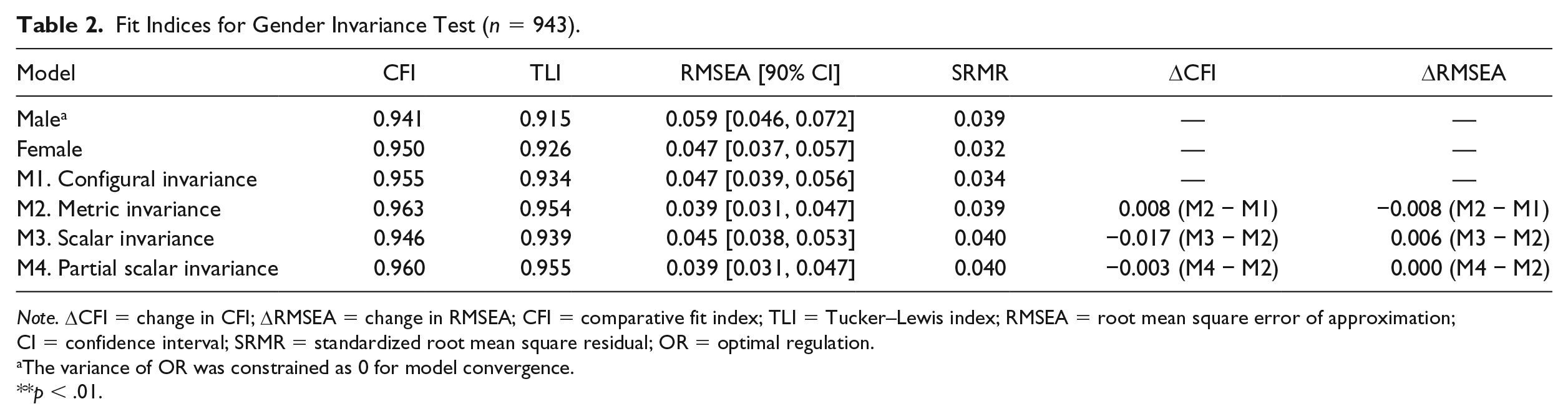
Note. ΔCFI = change in CFI; ΔRMSEA = change in RMSEA; CFI = comparative fit index; TLI = Tucker–Lewis index; RMSEA = root mean square error of approximation; CI = confidence interval; SRMR = standardized root mean square residual; OR = optimal regulation.
The variance of OR was constrained as 0 for model convergence.
p < .01.
Testing for Latent Mean Difference Between Males and Females
Given the support for partial scalar invariance for the bifactor model across gender groups, a comparison of latent factor mean difference in the general ER was conducted. For such purpose, latent mean values were set as zeros for male group, but freely estimated for female group. Results showed that there was a significant latent mean difference on the general factor of ER (Z = 2.037, p < .05, d = 0.205), with females having higher ER than males.
Reliability
To obtain reliability estimates in the form of Cronbach’s alpha coefficients, the total sample (n = 943) was used. Results showed that Cronbach’s alpha values were .72, .82, and .85 for the OR subscale, OL subscale, and the total scale, respectively. Therefore, the reliability estimates for ER89-C and its two subscales were good.
Construct Validity
The correlations between ER89-C and other measures were obtained from the total sample (n = 943). As shown in Table 3, ER89-C had significant original correlations as well as disattenuated correlations (i.e., correlations obtained after correcting for measurement errors of the relevant measures; Fan, 2003) with the theoretically related measures in the expected directions. Specifically, ER89-C had positive and significant correlations with optimism, hope–pathway, hope–agency, curiosity–exploration, and curiosity–absorption (original correlations: r = .25 to .47, all p < .01; disattenuated correlations: r = .34 to .64, all p < .01), and negative and significant correlations with depression, anxiety, and stress (original correlations: r = −.20 to −.17, all p < .01; disattenuated correlations: r = −.24 to −.21, all p < .01).
Correlations Between the C-ER89 and Other Measures (n = 943).
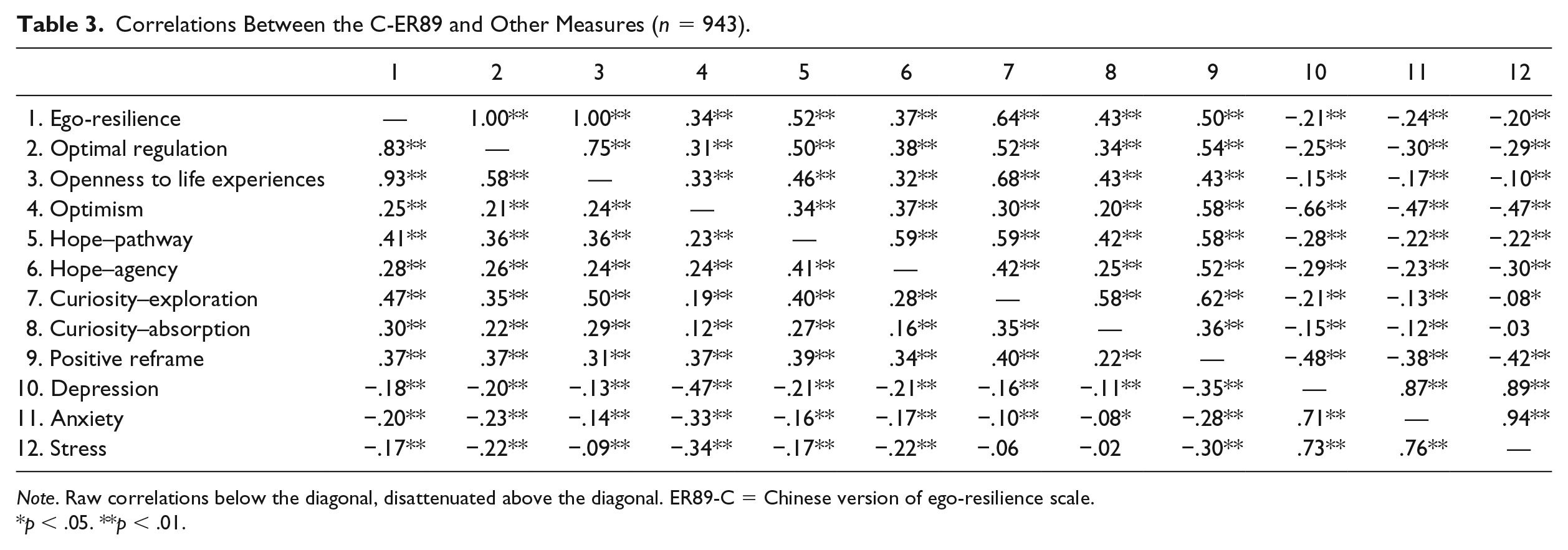
Note. Raw correlations below the diagonal, disattenuated above the diagonal. ER89-C = Chinese version of ego-resilience scale.
p < .05. **p < .01.
Discussion
Chinese adolescents, like their peers in other cultures and societies, encounter various kinds of psychological issues and stressful situations. Ego-resilience could be considered as one important psychological characteristic that helps adolescents to cope with setbacks and stress and to enhance psychological well-being (Klohnen, 1996). An ego-resilient adolescent possesses adaptive skills in response to negative circumstances and has open relationships with other people. However, there was a lack of psychometrically sound measures for ego-resilience in the Chinese context. As a result, there was no viable assessment tool for ego-resilience for adolescents in China.
The study examined the cross-cultural validity of ER89 in the Chinese cultural contexts (ER89-C). The study empirically examined different kinds of evidence relevant to cross-cultural validity. The results from this validation study showed very good estimates of internal consistency reliability of the ER89-C. Findings from the partial measurement invariance also showed that the internal structure of the measure was generally consistent across gender groups. In addition, in line with past research in Western cultural contexts, construct validity was supported by the positive correlations between ER89-C and optimism (Souri & Hasanirad, 2011), curiosity (Hiew et al., 2000), hope (Friborg et al., 2003), and positive reframing (Smith et al., 2008), on one hand, and by the negative associations with depression, stress, and anxiety (Hiew et al., 2000), on the other . In other words, students with higher levels of resilience tend to have higher levels of optimism, hope, and curiosity toward their lives and to have lower levels of depression, anxiety, and stress.
Because of these close associations between resilience and various psychological health outcomes, there have been an increasing number of intervention studies targeting resilience to improve individuals’ psychological health (e.g., Belgrave et al., 2000; Leve et al., 2009; Steinhardt & Dolbier, 2008). For example, Belgrave et al. (2000) ran the resilience-strengthening intervention for African American preadolescent girls, and they found that after a 4-week intervention, the intervention group had higher scores on self-concept, but scored lower on anxiety, when compared with those who did not received such intervention. Similarly, with an intervention designed for enhancing college students’ resilience, Steinhardt and Dolbier (2008) reported that students under intervention had significantly higher scores on coping strategies, positive affect, and self-esteem, whereas lower scores on depression, negative affect, and stress than those in control group. Although ample evidence has shown the benefits of the resilience intervention, to the best of our knowledge, very few interventions have been developed and conducted in the Chinese context, particularly for adolescents (e.g., Stewart & Sun, 2007). As suggested by Baños et al., (2017), it is important to adapt the resilience intervention to specific populations and contexts. The current study thus provided a useful tool to assess Chinese adolescents’ ego-resilience, not only for researchers doing research related to resilience but also for practitioners conducting interventions targeting resilience.
Furthermore, our findings revealed that girls exhibited higher latent means of ego-resilience. Our results are consistent with the previous research, which suggested females exhibited higher resilience than males in an adolescent sample (Caprara et al., 2003) and in an adult sample (Alessandri et al., 2008). It could be possible that girls may have more protective resources associated with resilience; for example, girls tend to have better peer relationships, higher family cohesion, as well as better language communication skills (Hjemdal et al., 2011; Ma & Huebner, 2008). Girls tend to use more emotionally focused strategies, such as help seeking and empathic coping (Sun & Stewart, 2007). All these social and emotional resources may help girls to promote their resilience, to better cope with environmental difficulties, and to be better at conflict avoidance (Flores et al., 2005).
Moreover, the findings from both EFA and CFA, which were based on two independent random samples, have shown that the two-factor structure, OL and OR, fitted the data well. Our results are consistent with the theory of personality, which defined ego-resilience as a high-order system, and was also consistent with the empirical findings in European cultural context (Alessandri et al., 2008). As discussed in Alessandri et al. (2008), OL leads to active engagement with the world, to resources of various problem-solving strategies, and to high positive emotionality. OR leads to the adaptive flexibility and low negative emotionality. These two factors of ego-resilience may be viewed as resources that could contribute to one’s ego-resilient ability.
Comparing the two-factor model in the current ER89-C with that in Alessandri et al. (2008), it is found that the two-factor models found in these two studies are generally similar to each other, although four items had been removed in Alessandri et al. However, there are also some minor differences. For example, in the current ER89-C, Item 9 (“Most of the people I meet are likable”) and Item 12 (“My daily life is full of things that keep me interested”) loaded on the factor of OL, although these two items loaded on OR in Alessandri et al. The reasons for such differences are not entirely clear, but such differences could be due to age and cultural differences. More specifically, the participants in the study by Alessandri et al. were young adults; however, the participants in the current ER89-C were all adolescents. Adolescence is considered as a transitional stage with considerable developmental change in physical, cognitive, social, and psychological aspects (Di Maggio et al., 2016; Morris et al., 2018). Compared with adults, this uncertain and complex stage could affect adolescents’ perception and ability differently when they face challenges and adversity (Di Maggio et al., 2016). Previous research has also supported the age differences of resilience (e.g., Aburn et al., 2016; Chuang et al., 2006).
Moreover, as there is no universal definition of resilience, the specific meanings of resilience could be interpreted differently for people in different cultural contexts (e.g., Letzring et al., 2005; Karairmak, 2010). In other words, it could be that, in China, the two items (Item 9 and Item 12) are more about OL, although these two items are more about OR in other cultural contexts. However, considering that in both studies, a high interfactor correlation (between OL and OR) was revealed, which factors these two items loaded on might not affect the use of the total score of the scale.
Limitations and Future Directions
Despite the positive empirical findings as detailed above, this study has some limitations that could not be ignored. First, the study sample was limited to one geographic location in the southern province of Guangdong in China. It is important to further consider the psychometric characteristics of ER89-C by using samples from other regions in China, so that the generalizability of the findings can be supported. Second, it was a cross-sectional study. Future study may consider a longitudinal design to evaluate the stability of ER89-C over time. Third, self-report is commonly recognized as a data collection method that may lead to data bias; future studies may consider information from other sources (e.g., teachers, parents, and peers report) as complementary information for evaluating one’s ego-resilience level.
Conclusion
In conclusion, the findings of this study provided support for the psychometric quality (e.g., validity and reliability) of the ER89-C. Furthermore, empirical findings have supported the two-factor structure of ER89-C in the Chinese adolescent sample: OL and OR. ER89-C appears to be a psychometrically sound scale that can be applied in future research with Chinese participants. This ER89-C provides an excellent tool for educational practitioners, researchers, and others who seek to measure ego-resilience level and to evaluate the impact of resilience for Chinese adolescents.
Supplemental Material
Supplemental_material – Supplemental material for Applicability of the Ego-Resilience Scale (ER89) in the Chinese Cultural Context: A Validation Study
Supplemental material, Supplemental_material for Applicability of the Ego-Resilience Scale (ER89) in the Chinese Cultural Context: A Validation Study by Xinjie Chen, Jinbo He and Xitao Fan in Journal of Psychoeducational Assessment
Footnotes
Author Contributions
X.C. led the study design and data collection and drafted the manuscript. J.H. participated in the study design, performed the statistical analysis, and drafted the manuscript. X.F. helped to draft the manuscript. All authors read and approved the final manuscript.
Declaration of Conflicting Interests
The author(s) declared no potential conflicts of interest with respect to the research, authorship, and/or publication of this article.
Funding
The author(s) received no financial support for the research, authorship, and/or publication of this article.

Supplemental Material
Supplemental material for this article is available online.
Note
References
Supplementary Material
Please find the following supplemental material available below.
For Open Access articles published under a Creative Commons License, all supplemental material carries the same license as the article it is associated with.
For non-Open Access articles published, all supplemental material carries a non-exclusive license, and permission requests for re-use of supplemental material or any part of supplemental material shall be sent directly to the copyright owner as specified in the copyright notice associated with the article.
