



Abstract
The Triarchic Model of Grit Scale (TMGS), a measure that assesses individuals’ dispositions to show perseverance, passion (or consistency of interests), and adaptability for long-term goals, had acceptable psychometric properties in Filipino student samples. However, there is scant evidence on the validity of this scale in other societies. This research explored the psychometric validity of the Chinese version of TMGS in selected technical–vocational college students in Shenzen, China. Results demonstrated that the scores from the three-factor model of grit were valid and reliable. In addition, whereas perseverance and adaptability were linked to increased life satisfaction and positive emotions, consistency was not related to such criterion variables. Further, perseverance and adaptability were associated with lower negative emotions, while consistency was linked to increased levels of undesirable emotions.
Introduction
In the educational contexts, psychological traits that optimize successful completion of long-term goals are highly valuable. Grit is one of the traits that have gained recent attention due to its association with academic- and work-related accomplishments. Conceptualized initially by Duckworth, Peterson, Matthews, & Kelly (2007), grit comprises two dimensions namely: perseverance of effort and consistency of interest. Perseverance of effort pertains to capacity to persist in challenging tasks, even with the likelihood of facing hurdles and failure. Perseverance differs from resilience, in that the former focused on staying tenacious despite challenges when pursuing long-term goals, while the latter has been conceptualized as dynamic capacity to “bounce back” amid hardships or adversities (Connor & Davidson, 2003). Consistency of interests or passion, on the other hand, refers to espousing similar interest over time in pursuit of long-term ambitions. The authors have demonstrated that the two-factor model of grit predicted optimal performance (e.g., academic achievement and ranking in National Spelling Bee quiz competition) and military retention.
However, theoretical and methodological issues have been raised against the two-factor model of grit. A study which evaluated the structure of grit across seven regions, found that the consistency dimension had lower reliability coefficient estimates in non-Western societies (Disabato, Goodman, & Kashdan, 2019). There is also evidence questioning the generalizability of the two-factor model of grit, as only perseverance of effort dimension has been consistently linked to many performance outcomes (Credé, Tynan, & Harms, 2017). These issues allude to the significance of adopting alternative models to operationalize grit in collectivist societies.
To address the limitations on the existing grit framework, Datu, Yuen, and Chen (2017) developed the Triarchic Model of Grit Scale (TMGS) to assess individuals’ tendencies to espouse determination for long-term goals in a collectivist setting. Aside from highlighting the importance of perseverance and consistency in long-term goal pursuit, this model has underscored the significance of adaptability to situations or calibrating behaviors and plans based on social, situational, and contextual factors. If people belonging to collectivist societies tend to espouse a “context-sensitive self” (Suh, 2007), it is likely that adaptability may be linked to positive outcomes. For those embedded in individualist societies where showing a consistent self-concept is culturally rewarded (Suh, 2007), it is possible that espousing consistency may yield psychological benefits. The authors have shown that TMGS had acceptable psychometric validity among selected undergraduate (Datu et al., 2017) and high school students (Datu, Yuen, & Chen, 2018) in the Philippines. Perseverance and adaptability were also linked to increased academic, career, talent development, self-efficacy (Datu et al., 2017), positive academic outcomes (Datu et al., 2018), and mental health outcomes (Datu, McInerney, Żemojtel-Piotrowska, Hitokoto, & Datu, 2020). However, there is sparse evidence about TMGS’ validity in other collectivist contexts.
It is necessary to validate TMGS in China for two reasons. First, China is home to many cities (e.g., Beijing, Shanghai, Zhejiang province, and Jiangsu province) with excellent performance in mathematics, reading, and science compared to other countries based on the results of PISA 2018 (Schleicher, 2018). If grit is linked to increased achievement in Chinese students (Li, Zhao, Kong, Du, Yang, & Wang, 2018), effective measurement of grit has implications for maintaining competitive academic performance among secondary school students not only in China but also in other competitive societies (e.g., Singapore, Macau, and Taiwan). Second, although there is evidence about the validity and reliability of grit scale in Chinese students (Li, Zhao et al., 2018), this research relied on the two-factor model of grit which could not generate insights into how the generalizability of the three-factor model of grit is used in Chinese and other non-Western societies.
Therefore, this study examined the psychometric validity and reliability of TMGS in technical and vocational education (TVE) students in China. As prior studies (Li, Lin, Zhao, Chen & Wang, 2018, Li, Zhao et al., 2018) focused on providing evidence of grit scale’s validity in mainstream high school students, findings have limited implications for other Chinese student samples (e.g., TVE students). Given the growing number of TVE graduates which accounted for approximately 49% of China’s total number of higher education graduates in 2018, it is equally important to assess the psychometric and criterion-related validity of grit in TVE students.
Grit dimensions and well-being outcomes
Previous studies have demonstrated that grit is positively associated with life satisfaction (Datu et al., 2018; Jin & Kim, 2017; Li, Lin et al., 2018), school satisfaction (Lan & Moscardino, 2019), positive affect (Datu et al., 2016, 2018), psychological well-being (Vainio & Daukantaite, 2016), and interdependent happiness (Datu et al., 2018). In contrast, grit is negatively related to depression (Jin & Kim, 2017) and negative affect (Lan & Zhang, 2019). Whereas perseverance is linked to increased well-being, consistency was not linked to the said outcome (Datu et al., 2016, 2018).
Hence, the overarching aim of this study was to assess the psychometric validity of the Chinese version of TMGS in technical–vocational college students in Mainland China. In examining the validity of the scale, we adopted the construct network validation approach (Martin, 2007) which involved exploring its within-network validity (i.e., through exploring the factor structure and reliability of the scale) and between-network construct validity (i.e., examining the association of TMGS’ dimensions with criterion-related measures). We anticipated that the three-factor model of grit underpinned by perseverance, consistency, and adaptability, which has been found to be valid in the Philippines (Datu et al., 2017, 2018), will be applicable to the Chinese context, given that both are considered collectivist societies. It is also likely that meaning of grit will be similar in both contexts, as prior research indicates that TMGS was valid and reliable in Hong Kong Chinese primary school students (Datu & Fong, 2018). Given the positive association of grit with well-being in China (Li, Lin et al., 2018) and the Philippines (Datu et al., 2018), we did not expect any differences on how grit may relate to well-being dimensions.
Subjective well-being (Diener, 1984) dimensions (i.e., life satisfaction, positive emotions, and negative emotions) were chosen as criterion variables in this study, given that previous studies involving Chinese students demonstrated a positive correlation between grit and such well-being domains (Lan & Moscardino, 2019; Li, Lin et al., 2018).
Methods
Participants
There were 277 technical–vocational college students from skilled-workers’ college in Shenzhen, China, who participated in this investigation. Most of the participants were men (n = 168), while the remaining ones were women (n = 108), except for one student who failed to indicate gender. The participants’ ages ranged from 19 to 25 years (M = 21.65; SD = 1.51). Prior to survey administration, the first author secured an ethical application approval from the Human Research Ethics of his former university (i.e., The University of Hong Kong).
Measures
Triarchic model of grit
The original English version of 10-item TMGS (Datu et al., 2017) was translated to Chinese and used to assess the participants’ passion, perseverance, and adaptability for temporally distant goals. Items were marked on a 5-point Likert scale (1 = not like me at all; 5 = very much like me).
Well-being: To measure life satisfaction, positive emotions, and negative emotions, we translated the English version of 9-item Concise Measure of Subjective Well-being Scale (Suh & Koo, 2011) to Chinese. Items were marked on a 7-point Likert scale (i.e., 1 = strongly disagree and 7 = strongly agree for “life satisfaction”; and 1 = never and 7 = always for “positive emotions” and “negative emotions”). Note that the scales were back translated by an English native speaker which indicated absence of discrepancies on the meanings of translated items.
Results and Discussion
Within-Network Construct Validation
As 0.4% of the responses were missing, we performed Little’s missing completely at random test (Little, 1998). The results showed that these missing values were not missing completely at random. Hence, we adopted expectation–maximization imputation algorithm to supply the missing values and relied on the imputed dataset in the subsequent analyses.
The items’ skewness (−.60 to .15) and kurtosis (−.87 to .57) values suggest that the assumption for univariate normality was adequately satisfied since skewness and kurtosis values did not exceed two and 7 (Finney & DiStefano, 2006). Then, we conducted confirmatory factor analysis via maximum likelihood estimation approach using the 25th edition of analysis of moment structures (AMOS) to test the validity of the hypothesized model of grit with perseverance of effort (with 3 observed indicators 3 error terms), consistency of interests (with 3 observed indicators 3 error terms), and adaptability to situations (with 4 observed indicators 4 error terms) as inter-related latent constructs. Based on Lance, Butts, & Michel’s (2006) recommended cutoff values (Comparative Fit Index or CFI and Tucker–Lewis Index or TLI greater than .90 as well as standardized root mean square residual or SRMR and root mean square error of approximation values lower than .08) in evaluating measurement and structural models, results showed that the model had good fit: χ2 = 90.44; df = 32; CFI = .94; TLI = .91; SRMR = .06; and 90% CI RMSEA = .08 (.062, .101) (See Figure 1). An alternative single-factor model of grit was also tested which yielded poor fit: χ2 = 384.23; df = 35; CFI = .63; TLI = .52; SRMR = .15; and 90% CI RMSEA = .19 (.173, .208). Only the perseverance and adaptability latent constructs had positive inter-factorial correlations. Measurement model of the Triarchic Model of Grit Scale. Note: POE: perseverance of effort; COI: consistency of interests; ATS: adaptability to situations.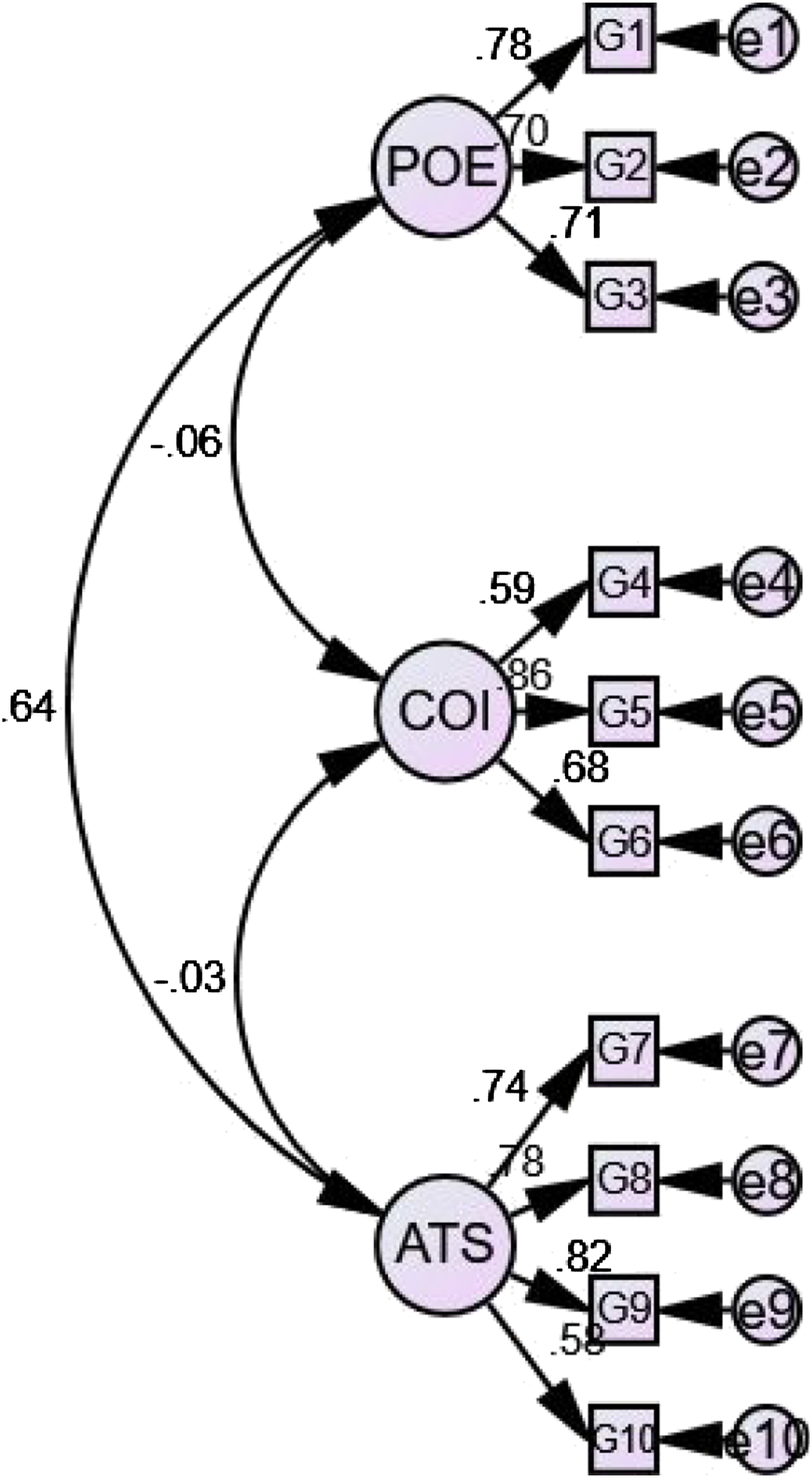
All items significantly loaded onto their hypothesized latent constructs at p <.001. The standardized regression weights between each item and their corresponding latent constructs (e.g., perseverance and adaptability) ranged from .58 to .86. Indeed, these results corroborated existing evidence on the psychometric validity of TMGS in collectivist settings like the Philippines (Datu et al., 2017, 2018).
Descriptive statistics, reliability estimates, and correlational coefficients among triarchic model of grit dimensions and subjective well-being dimensions.

*p <.05, ** p < .01, *** p <.001.
Between-Network Construct Validation
To provide evidence on the between-network construct validity of TMGS, we conducted Pearson’s r-correlational analyses via SPSS. Perseverance and adaptability were positively correlated with life satisfaction as well as positive emotions and negatively correlated with negative emotions, which confirmed previous research findings on the positive associations of these grit dimensions with well-being and positive psychological outcomes (Datu et al., 2017, 2018, 2020). However, consistency was negatively correlated with positive effect and positively correlated with negative emotions. It is likely that consistency may be linked to maladaptive emotional states, as individuals who belong to collectivist societies tend to adopt a highly “context-sensitive self” (Suh, 2002, 2007) which emphasizes the importance of adjusting behaviors based on social, environmental, and situational factors.
In general, results indicate that the Chinese version of TMGS can serve as an effective assessment tool to evaluate TVE students’ passion, perseverance, and adaptability for long-term ambitions. Although Herold (2015) has touted grit as a “racist” construct favoring people with high socioeconomic status and good educational prospects, this research demonstrated that grit may generalize to TVE students whose prospects for career mobility are more limited than typical higher education students. Results have appealing implications for understanding the role of grit in students from financially disadvantaged backgrounds. School psychologists, counselors, and mental health professionals are encouraged to design school-wide prevention programs that cultivate students’ persistence in facing goal-related obstacles and flexibility in implementing plans or pathways needed for goal achievement. Teachers are also recommended to cater for unique needs of less gritty students as they are prone to experience lower levels of cognitive and emotional well-being.
Nonetheless, this study has a few limitations. As we selected technical–vocational college students, results hold limited generalizability to other student samples. We also relied on self-reported measures of grit and subjective well-being which may be vulnerable to common method effects. Future studies can address these methodological shortcomings through recruiting other student samples (i.e., primary school students) and using more objective measures of grit (e.g., parent-report format) and well-being. Given that other details about participants’ demographic profiles (e.g., socioeconomic status, ethnic backgrounds, and religious orientations) were not assessed in this study, no conclusion can be drawn regarding the role of these contextual variables in students’ grit. Future research is warranted to explore how these demographic factors affect grit in various societies.
Footnotes
Declaration of Conflicting Interests
The author(s) declared no potential conflicts of interest with respect to the research, authorship, and/or publication of this article.
Funding
The author(s) received no financial support for the research, authorship, and/or publication of this article.
