



Abstract
Emotions play an integral role in learning. It is an effective response to a stimulus which can be experienced felt along a positive–negative continuum. Achievement emotions arise from academic activities, and can activate or de-activate educational motivation responses. Based on Control Value Theory, this study examined how negative achievement emotions impact high school students’ decision to pursue tertiary education, and what were the contributing factors of these emotions. One thousand five hundred and forty-seven high school students participated in the survey, and data were solicited via established inventories as well as an open ended question. Quantitatively, Partial Least Squares structural equation modelling found boredom and test anxiety to significantly lower students’ decision to pursue tertiary education. The precursors to negative achievement emotions stem from examinations and assessments, struggle in lessons, learning itself, parental expectations to excel, and mental health issues. Findings demonstrated the potential of emotions in influencing students’ value orientation with respect to tertiary education. As the study is based on a post-pandemic context, implications of findings are discussed in view of the underlying post-pandemic challenges accompanied by recommendation to stakeholders.
Keywords
Introduction
Education beyond high school is an important drive for upward economic and social mobility. While the benefits of tertiary education are clear, transition into tertiary education can be a vulnerable phase to many students when they make this pivotal life decision. There is an increasing concern that high school graduates are not continuing study at the tertiary level. In the US, a survey conducted for the Bill & Melinda Gates Foundation found uncertainty to loom large among high school graduates, 46% planned for tertiary education with a majority of them thought that on-the-job learning can better prepare them in future career (Edge Research & HCM Strategists, 2022). Reasons cited for not continuing studies include the following: being sure that it is not for them, questioning the return on investment of it, and not wishing to change their status quo. The study found that the COVID-19 pandemic had potentially made tertiary education less attractive, as students find high school did not prepare them well for college. Tertiary education preparation will be a challenge, especially in the post-Covid era when schools recover from earlier closures. The disruptions to learning can have long lasting effects on some students. Research has showed that learning losses experienced during the pandemic can inflate to larger tests score deficits even after a few years, when students returned to school and started at a lower level (Kaffenberger, 2021). Those who could not cope during school closures can fall further behind when classes returned to normal. This is echoed in a global report that post-pandemic learning poverty has reached 70% among low and middle income economies (The World Bank, 2022). The surges were more profound in regions with longer school closure such as South Asia, the Caribbean, and in Latin America. Such high rates of learning poverty could signal that education systems are lagging in the provision of quality education, and hamper Goal 4 of Sustainable Development Goal to provide quality education while closing the gap of inequitable education for all.
Besides academic concerns, survey on high school graduates’ priorities for the next few years showed that emotional wellness topped the list, followed by financial stability while enrolling to college was at the bottom of the list (Edge Research & HCM Strategists, 2022). The emotional functioning in academic pursuit needs attention, as research noted adolescents experience higher emotionality, and negative emotions are experienced more frequently from early to late adolescence (Bailen et al., 2019). Such a phenomenon is also reported in a large scale study done across 13 countries to investigate the emotional impact of the pandemic induced education crisis (Raccanello et al., 2022). Among the 17,019 participants, students reported negative achievement emotions more than positive ones, significantly impacted by academic workload, online class organization and efficacy in learning. The study noted the scarcity of investigation on achievement emotion, and called for further investigation in different phases of the pandemic especially at the post-pandemic stage.
Emotional functions affect many facets of a student's life. Pfister and Böhm (2008) proposed that emotions function to inform decision-making by providing information about what is pleasurable and painful to shape preferences. Emotions also drive decision-making, help direct focus on matters relevant to decision problems and promote commitment towards actions (Pfister & Böhm, 2008). Negative experiences arising from learning during the pandemic has made tertiary education less attractive, and this pose as motivational drawbacks that hinder students’ decision to participate in tertiary education (Edge Research & HCM Strategists, 2022). Across the globe, similar trend is observed where 72.1% of 560,000 Malaysian school leavers did not wish to pursue further education, main causes cited were loss of interest in study, questioning the purpose of schooling, financial constraints, and the exam-centric system (Mohammed, 2022). With this, the current study aims to investigate the possible effects of negative emotions on college admission decision. Malaysia would be a good test case as the nation had the one of the longest closures where schools were fully closed for 42 weeks and partially closed for 27 weeks, while the global average of full school closure was 14 weeks (Unesco Institute for Statistics, 2022). Pro-longed school closure may exacerbate learning loss, uncertainties in examinations and lost opportunities which precipitate transition barriers into tertiary education. The following research questions (RQ) underpin the study: 1. To what extent do negative emotions influence tertiary education decisions? 2. What are the causes of these negative emotions?
Theoretical Framework
Control Value Theory (CVT) offers a framework to understand academic motivation, specifically from the perspective of emotions aroused from learning (Pekrun & Stephens, 2010). This can be explained from the concept of achievement emotions, brought about by the assessment of control and values associated with educational attainment. The assessment of control refers to perceived controllability in attaining the desired outcome from learning tasks. Pleasant emotions arise when outcomes are controllable, but unpleasant ones occur when desired outcomes are not controllable. On the other hand, value assessment refers to learners’ valuation of achievement outcome or tasks. Pleasant emotions include hope, enjoyment and pride, while unpleasant ones manifest in the forms of hopelessness, anger, frustration, anxiety, boredom and shame (Pekrun & Stephens, 2010). Unpleasant emotions have been shown to have repercussions on student academic choices such as decision to withdraw from a particular study programme, and also decision to stop studying (Hutton et al., 2019; Respondek et al., 2017). There are various factors that can be antecedents or outcome of these emotions, and CVT provides a theoretical framework to examine these relationships.
Achievement emotion can affect students’ decisions for academic pathways. Evidence from longitudinal research has found that negative emotions, particularly, were more prevalent in students who stopped their academic careers than those who completed their studies (Ruthig et al., 2022). Students’ learning is usually assessed according to certain standards of quality. In the course of meeting these standards, achievement emotions are evoked by cognitive evaluation of situational demands, individual abilities, the likelihood of failure and success, and the value placed on assessment outcome (Pekrun & Stephens, 2010). Achievement emotions affect learners of primary, secondary and tertiary levels, and a recent meta-analysis study found that true-score correlations between achievement emotions and academic outcome were stronger at the secondary level (Camacho-Morles et al., 2021). Compared with primary level, secondary students had earlier attended in-person classes before the pandemic and experienced the pre/post-pandemic cycle. As the school is a definitive environment for adolescent’s development, abrupt shifts between school-home can impede the development of friendships and support systems. Disruptions in class delivery, assessment modes, school operation, and curriculum structure may stir-up negative emotions towards learning, and such emotions may curtail further education decisions when students choose to discontinue academic careers after high school.
Achievement Emotions
Within the academic context, learners can experience a broad spectrum of emotions evoked by different situations, and it is necessary to distinguish these settings for conceptual clarity. The literature offers three settings where achievement emotions are most profound: class-related which pertains to activities in classes, learning-related which refers to mastery of one’s study, and test-related emotions brought about by assessment requirements (Pekrun et al., 2002). These three circumstances are affected by varying factors and contexts. For instance, anxiety in class can be affected by social factors, while anxiety during examinations can be influenced by the lack of preparation on the part of the student. These emotions are also grouped into valence (positive or negative emotions) and activation categories. The activation effects refer to emotions that can either activate or de-activate motivational responses. For example, boredom is a negative-activating emotion that can activate students to react negatively such as playing truant, involving in social ill activities as an escapism from the negative emotion etc.
The current study focused on negative emotions arising from class-, learning-, and test-related activities, which can undermine students’ motivation, impair information processing and limit cognitive resources. The common unpleasant emotions are hopelessness, boredom, shame, anger, frustration and anxiety – capable of diverting one’s attention to other task-irrelevant matters, reducing cognitive resources for task completion, consequently affecting performance (Pekrun & Stephens, 2010). Extant literature noted that frustration is closely related to anger, with conceptual overlap and multi-collinearity issues (Hutton et al., 2019). For this reason, the study has excluded anger. With regards to anxiety, it is focused on the context of test-related activities, as it is the most wide-spread and significant unpleasant emotion (Pekrun & Stephens, 2010). In answering RQ1 about the influence of negative emotions on tertiary education decisions, the following sections propose the underpinning hypotheses.
Boredom
This emotion is characterized by feelings of disinterest, low arousal and lack of stimulation (Pekrun & Stephens, 2010). The perceived value of a learning activity is a pertinent determinant of boredom level towards the activity concerned. It usually occurs when control is low (when study is very difficult), or learners have high control but very low demand (Pekrun, 2006). For example, students may be preparing for an easy test that they expected to do well (high control), hence fail to see the value in preparations (low demand). Boredom occurs when revisions exercises are perceived as having low value as there is no sufficient challenge. The lack of arousal may divert attention from learning, lower motivation, and may even induce learners’ desire to get away from the learning situation (Tze et al., 2016). Empirical evidence has suggested the potential of boredom in influencing motivation among secondary school students, demonstrated by a meta-analysis study that found significant negative correspondence between these two factors (Tze et al., 2016). Boredom can also negatively impact motivation to continue study and intention to sign up for future courses (Artino, 2009). In a more severe extent, boredom is significantly influenced intention to drop out of study when students perceive the course to be boring (Respondek et al., 2017). In this vein, such emotion may affect further study choices, and the following hypothesis is proposed:
Boredom can significantly influence secondary students’ intention for tertiary education.
Shame
Shame is induced if failure is judged to be caused by oneself, due to one’s own actions and attributes as possible causes of failure (Pekrun, 2006). It can arise from the appraisal of one’s ability and competence to achieve the learning goals or to master the course content learning, which makes it pertinent to learning motivation. Turner and Husman (2008) investigated the recovery strategy after shame is experienced due to learning failure. Students recovered by either becoming more conscious of their own mistakes or working harder to overcome failure, but some became disoriented and were unable to relate to their current studies for future paths. In appraising failure, the accompanying shame that arises can interfere with students’ future goals orientation when they choose to give up as to avoid failure, and those who view failure as shameful may abandon their future academic plans (Turner & Husman, 2008). Such scenarios may be more profound during the transition from secondary to tertiary level, when students are at a crossroad to decide on life after leaving school. Motivation for tertiary studies is instrumental linked to secondary educational achievement, and shame arises from failure may give rise to goal abandonment in academic pursuit, affecting further education decisions. As such, the following is proposed:
Shame can significantly influence secondary students’ intention for tertiary education.
Test-anxiety
Anxiety is an outcome-related emotion commonly tied to academic success or failure (Pekrun, 2006). Most students, even the most prepared ones, can experience anxiety and worry over an upcoming test, and it is not surprising that assessment-induced anxiety is one of the most profound achievement emotions (Pekrun & Stephens, 2010). It can be described as students’ endurance and inclination to react with worry and emotionality in evaluative situations such as written tests, oral or listening assessments and quizzes (Dalbert & Stöber, 2004). Tests are known stressors that develop over time during school years, and systematic research demonstrated that senior students at secondary level were more prone to anxiety exacerbated by examination pressure (Wuthrich et al., 2020). Such anxiety can potentially affect academic performance henceforth discouraging study continuation, and this effect is found more pertinent for senior students than freshmen being that seniors are nearer to study completion date (Respondek et al., 2017). Investigation done during the COVID-19 had found increased test anxiety to interfere students’ activities, and students experienced fear of being judged (Lane, et al., 2022). The effect of test anxiety can be severe to the extent that it it linked to dropout rate (Hutton et al., 2019; Respondek et al., 2017). In this vein, the earlier emergency remote learning had presented changes to curriculum and modes of assessment as well as impacted high-stakes examinations, which effects can linger and influence long-term study choices. Hence, the following hypothesis:
Test anxiety can significantly influence secondary students’ intention for tertiary education.
Frustration
In learning-related activities, frustration can be aroused if learning cannot be sufficiently controllable or grasped. Frustration is an outcome-related emotion, occurs as a retrospection of learning failure, where it arises in the absence of expected success (Pekrun, 2006). Students experience frustration when they underperform due to personal failure, and especially if efforts expended did not alleviate their academic woes. Such experience can influence study decisions, as demonstrated by an investigation among undergraduates which found frustrated students were not motivated to register for future online courses (Artino, 2009). Evidence directed at the impact of the COVID-19 pandemic noted that negative emotions of frustration, anxiety and boredom impacted students’ learning satisfaction, which is necessary for realizing the learning outcome (Golding & Jackson, 2021). In contrast, frustration can also promote stimulation to exert more efforts among Massive Open Online Courses students, as they strive to circumvent failure (Liu et al., 2021). A recent review found minimal relation between frustration and academic performance due to the lack of evidence in the literature, and called for more investigation on this particular emotion (Camacho-Morles et al., 2021). Hence, the following is proposed:
Frustration can significantly influence secondary students’ intention for tertiary education.
Hopelessness
Within CVT, hopelessness is an outcome emotion usually felt when there is complete lack of perceived control over achievement, heightened by cumulative failure (Pekrun & Stephens, 2010). Empirical evidence has demonstrated the significant negative influence of hopelessness on academic control (Stephen et al., 2019). In the absence of hope, learners may doubt their efforts can bring about academic successes, and subsequently may withdraw from further attempts for academic pursuit. In this vein, hopelessness is manifested as an undesirable response to obstacles appraised as uncontrollable, where students give up further education in view of perceived futility. Consequently, this may give rise to school leavers’ decision to abandon tertiary education goals.
Hopelessness can significantly influence secondary students’ intention for tertiary education. The above discussion had suggested the potential of connection between negative emotions and education decisions. Most of the connections were established in forms of correlations to academic outcome, well-being, intention to complete studies, or dropout (Lane, et al., 2022; Respondek et al., 2017; Stephen et al., 2019). The current study attempts to bring the connections of emotions further to test its effects on intention for tertiary education. Additionally, an open-ended question is used for RQ2 to examine the reasons that give rise to negative emotions towards learning. The combination of established scales and open-ended question can assist in elucidating quantitative results and contribute to the richness of data obtained.
Research Methods
Participants and Data Collection
Participants’ Profile.
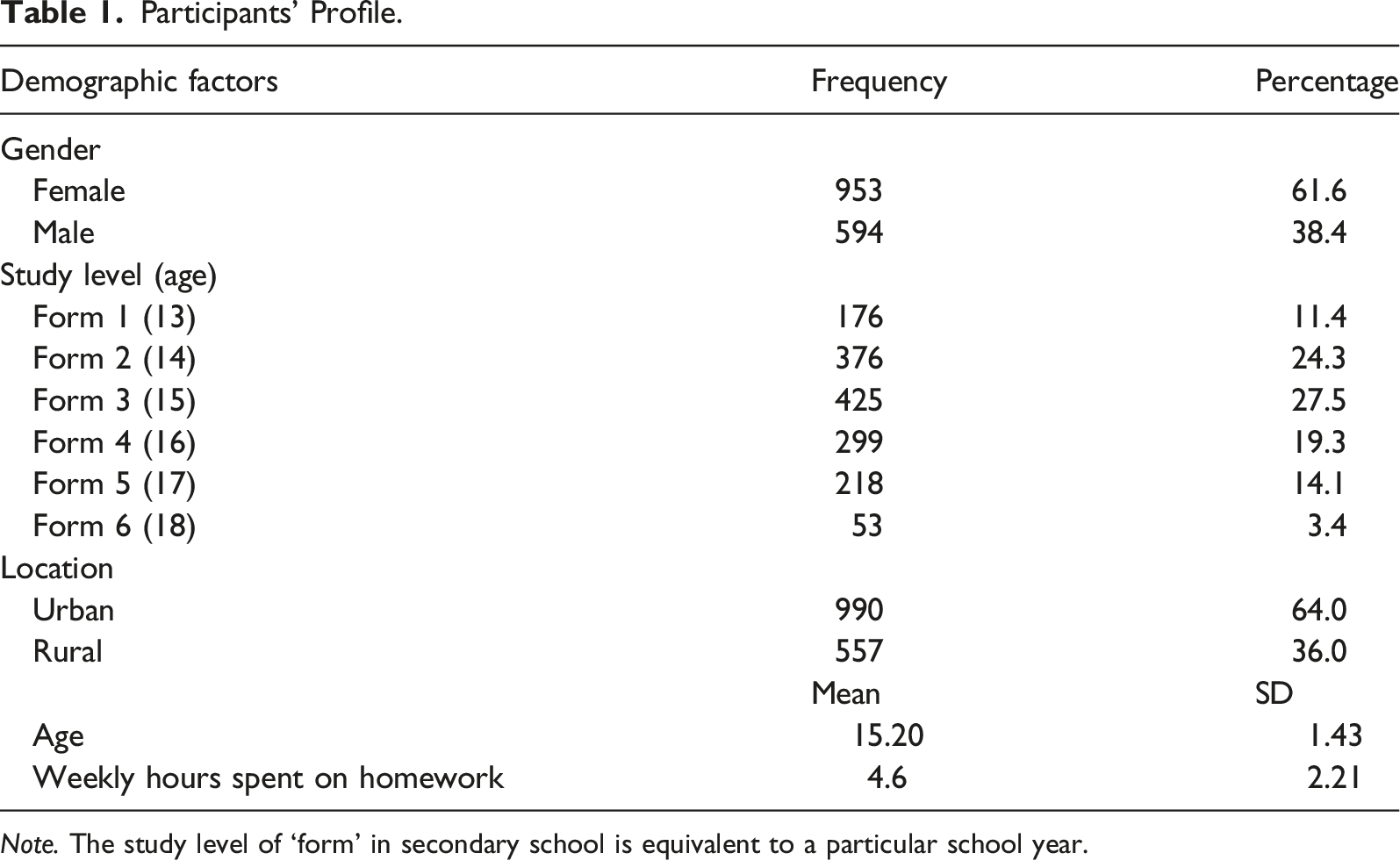
Note. The study level of ‘form’ in secondary school is equivalent to a particular school year.
Measures
With regards to research instrument, the Achievement Emotions Questionnaire (AEQ) is an established instrument used by many studies, with six to 12 items to measure each emotion (Pekrun et al., 2002). To encourage respondents’ engagement in answering the questions, the study adopted a shorten version of AEQ, the AEQ-S which is co-authored by the scale’s original author (Bieleke et al., 2021). The AEQ-S does not measure frustration, and items to measure this emotion were adapted from Artino (2009), intention for tertiary education were adapted from (Stark et al., 2022; Šabić & Jokić, 2019). Some examples of items are ‘I felt as though I was wasting my time studying’ (frustration), ‘While studying I seem to drift off because it’s so boring’ (boredom), ‘My lack of confidence makes me exhausted before I even start’ (hopelessness), ‘I feel ashamed when I realize that I lack ability’ (shame), ‘I get so nervous I wish I could just skip the exam’ (test anxiety), ‘I intend to enroll in tertiary education after finishing secondary school’ (tertiary education intention). All items were gauged with seven Likert options that anchored between 1 = strongly disagree and 7 = strongly agree. The instrument was pre-tested (10 students) and piloted tested (48 students) with acceptable Cronbach’s Alphas between .789 and .882. All items were ensured to score in the same direction before analysis, and hypothesized relationships were tested with SmartPLS 3.3.9 software. Additionally, the questionnaire also included an open-ended question asking what is the biggest challenge participants face that contribute to negative emotions towards their study, and responses were analysed with NVIVO 12.
Quantitative Analysis
Research question one is addressed with five hypotheses, tested with structural equation modelling. Before analysis, data were subjected to quality assessment to evaluate the extent of common method bias with Harman’s single factor analysis employing unrotated principal component analysis. The largest variance explained by all items was 39%, which is less than the threshold of 50%. Hence, common method bias is not a serious concern. Data normality was evaluated with Mardia’s skewness and kurtosis (https://webpower.psych.stat.org), where data violated normality assumptions. However, this would not be a concern as data analysis was carried out using the non-parametric software SmartPLS, where hypotheses were tested with bootstrapping of 5000 resamples (Hair et al., 2017).
Open-Ended Question
Research question two is addressed with an open-ended question. It is not compulsory for participants to answer the open-ended question, and a total of 480 responses (31.2% response rate) were obtained. The researchers went through each response using thematic analysis, which is useful to detect patterns across qualitative data (Braun & Clarke, 2006). An inductive, bottom-up approach is employed without fitting the data into a pre-existing coding frame. As suggested by Braun and Clarke (2006), six stages of approach were employed: familiarization of data, generation of initial codes, identify themes, review themes, define themes and production of reports (Braun & Clarke, 2006). As most of the responses were short, coding was carried out by considering the whole text answer. Each response was independently screened by the second and third author and coded to make sure the code correctly captures the context of the information given. Analysis was supported with NVIVO 12 software.
Results
Assessment of Measurement Model
Internal Consistency and Average Variance Extracted (AVE).

Notes. Quality criteria for measurement model and corresponding threshold in brackets.
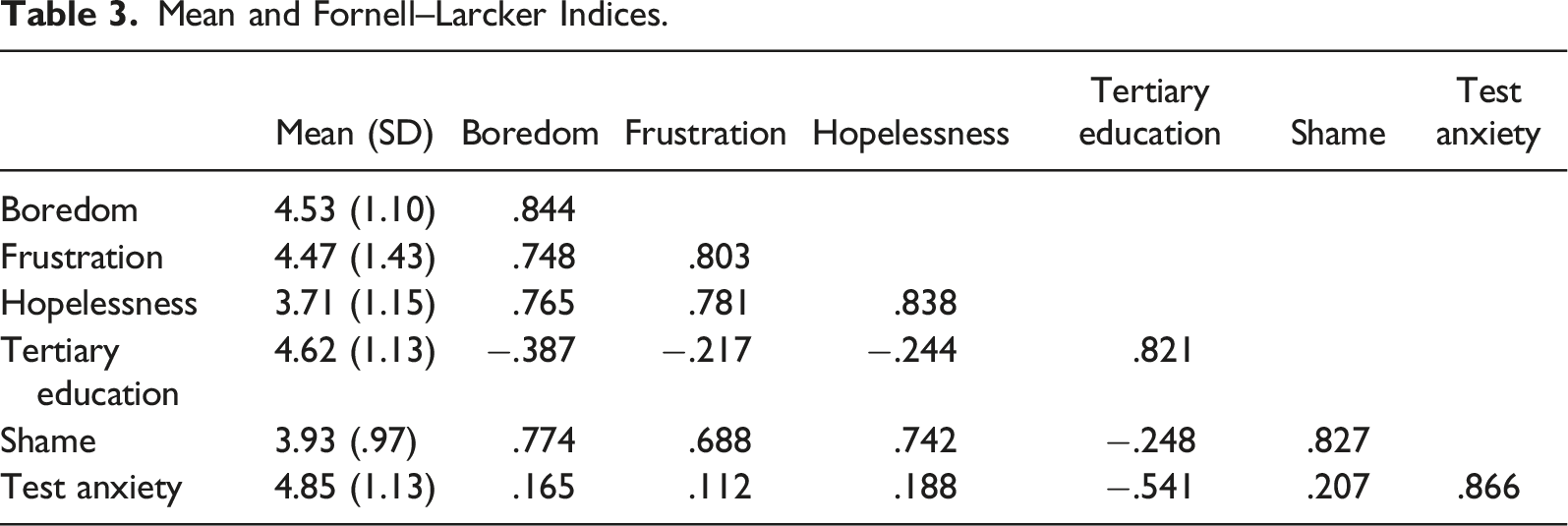
Mean and Fornell–Larcker Indices.
Assessment of Structural Model
Before proceeding to hypotheses testing, variance inflation factor (VIF) was inspected to ascertain the extent of multicollinearity in the model. The highest VIF was 2.933, indicating that collinearity is not a concern because it was lesser than the maximum threshold of 3.3 (Hair et al., 2017). After all quality criteria were satisfied, hypotheses were tested with bootstrapping. Among the five hypotheses, H1 and H3 were supported, where boredom and test anxiety were significant in influencing intention for tertiary education with the latter having a stronger influence. Significance is determined with t-values and p-values, and also 95% confidence intervals without any zero being straddled in between. All relationships were inverse implying that increase in boredom and text anxiety could influence lower intention for tertiary education. Overall, the model accounted for 27.6% of variance in tertiary education intention. Figure 1 shows the structural model that displays the path coefficients between variables. Structural model that shows the adjusted R2 and path co-efficient of hypothesized relationships.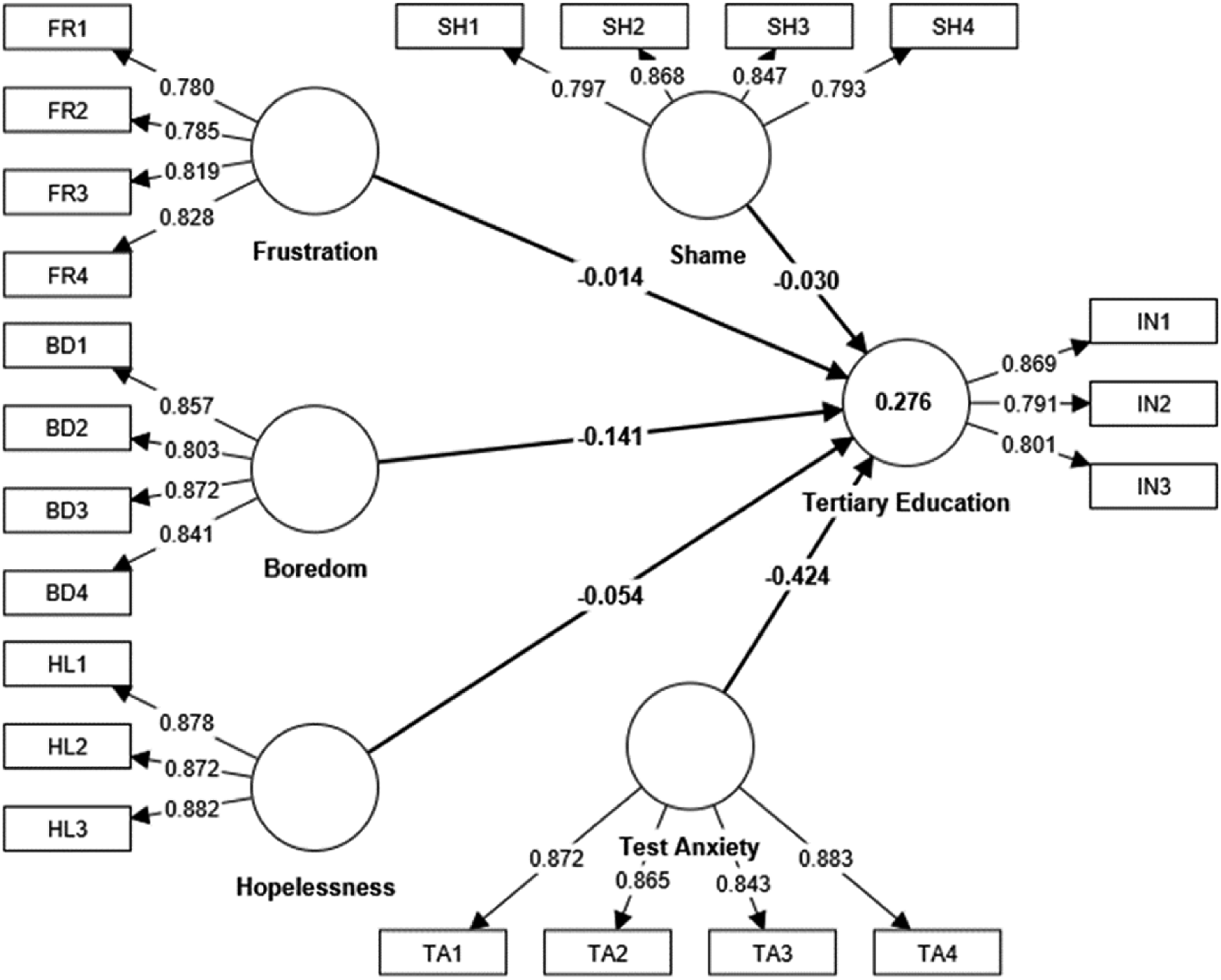
Qualitative Analysis
Most Frequently Appeared Words to Describe Contributing Factors of Negative Emotions.

*Note. SPM Sijil Pelajaran Malaysia (Malaysian Certification of Education – high stakes examination taken at the end of secondary level).
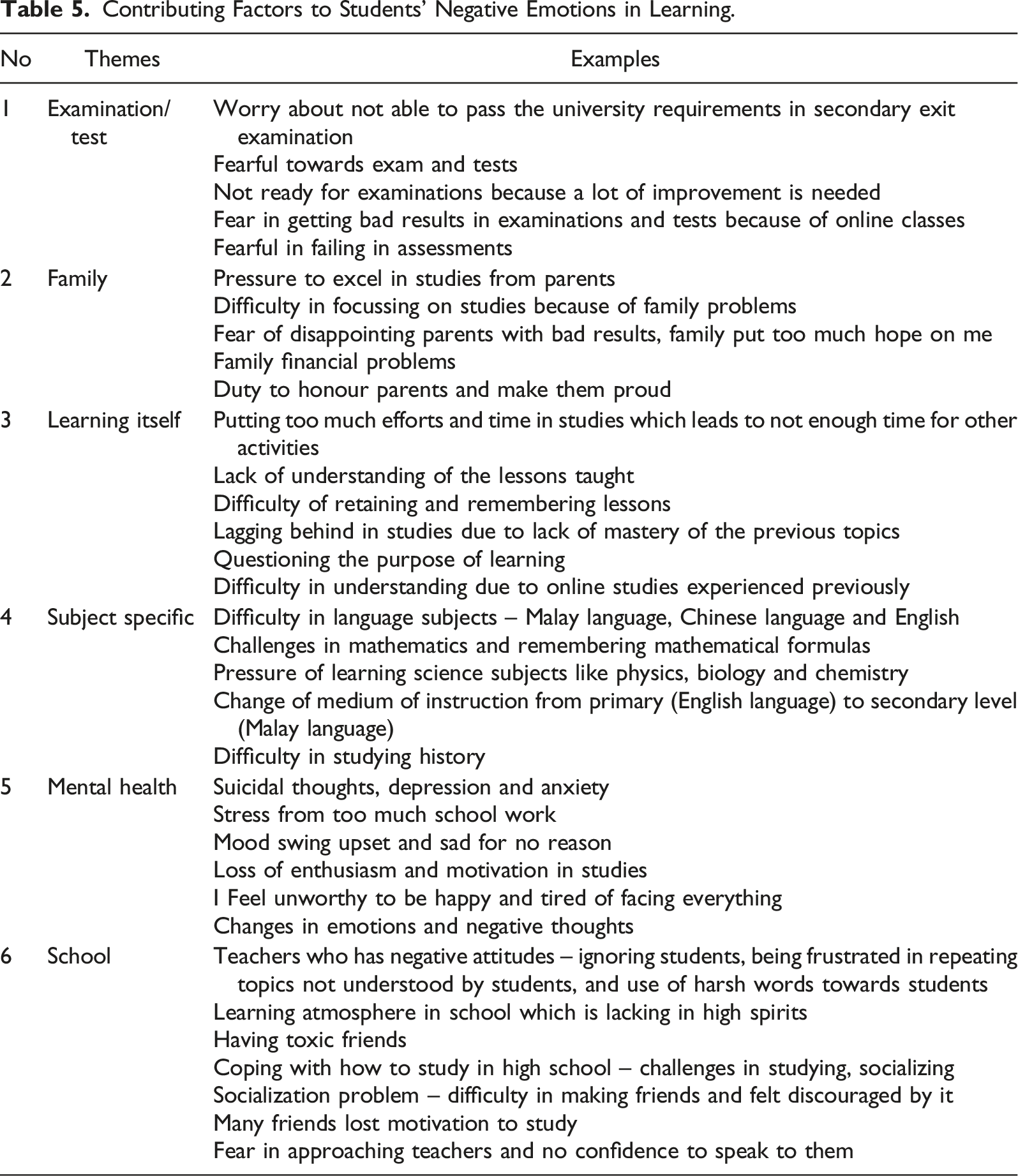
Contributing Factors to Students’ Negative Emotions in Learning.
Discussion
Among the unpleasant emotions, boredom and test anxiety were significant with the latter having a stronger effect in decreasing intention for tertiary education. Anxiety and worry towards assessment failure seem to play a key role, and students who are severely affected have the tendency to avoid such fear-inducing stimuli (evaluative situations). Data were collected when school re-opens after the COVID-19 pandemic, and such changes may cause students to question their own assessment competencies. This is in line with studies that found test anxiety in instigating behavioural outcomes such as low motivation, school absenteeism and school refusal (Wuthrich et., 2020; Kearney, 2008; Finning et al., 2019). The ‘avoidance effect’ of test anxiety is also demonstrated with its potential in being able to fully mediate students’ perception toward their intention to carry-on their studies (Respondek et al., 2017). Present results suggest that emotions felt can affect students’ future orientation and the hesitation to enrol into higher education can manifest as a behavioural outcome of test anxiety. It is possible that school leavers intend to seek alternative trajectories other than academic pathways, as tests are unavoidable and instrumentally linked with higher education. The pandemic situation may have exacerbated the situation, whereby research carried out during the pandemic had reported higher levels of test anxiety among secondary level students (Lane, et al., 2022). In Malaysia, there were changes in curriculum-based assessment for the secondary school exit examinations after school reopened, which can further heighten the anxiety towards examination especially when students are unfamiliar with test formats.
Boredom also had a significant negative influence on intention to further education. Studies have supported the negative effect of boredom on intention to dropout and the feasibility to complete an academic programme (Hutton et al., 2019; Respondek et al., 2017). Boredom towards learning can provoke individuals to leave a learning situation and impede persistence in learning, especially when students find low value in learning activities (Tze et al., 2016). Findings suggest that these effects not only impair students’ present study progress but also affect their consideration for future studies. Among the items used to measure boredom in this study, the one with the highest mean was ‘I would rather put off this boring work till tomorrow’, suggesting procrastination and avoidance due to disinterest. The significant inverse relationship implied that higher boredom experienced will influence students to avoid thinking about learning tasks. This is consistent with prior research that demonstrated the negative effect of boredom on metacognition in learning regulation, which can be detrimental when students shy away and put lesser thoughts in learning because of disinterest (Artino & Jones, 2012). The earlier compulsory online learning had compelled students to depend on online learning materials, whereby contents were reported to be uninteresting (Azahar, 2022). A recent Malaysian study that included participants from primary, secondary and tertiary institutions had reported 77% of respondents to be bored with lessons during the COVID-19 movement restrictions (Kirin, et al., 2021). With such prevalence, it is possible that apathy and boredom experienced undermine students’ decision for further education, as they seek a way out from academic pursuits.
Present findings did not detect any significant effect of hopelessness, shame, frustration on intention for tertiary education. However, this does not mean that students did not experience these emotions. Scholars have posited that negative achievement emotions may present ambivalent influence on academic outcomes, depending on individual coping mechanisms (Hutton et al., 2019; Pekrun, 2006). It is possible when students have set their mind to continue studies after high school, emotions experienced along the way may not affect their decisions, as they will manage and deal with it. For example, students striving to meet the goals of attaining a minimum entry requirement for university entrance assessment would focus on the outcome of learning activities and would not leave any rooms for hopelessness to impede their goals. Future studies may want to incorporate various coping styles to examine how coping strategies can intervene between emotions and adaptive behaviours.
With regards to text responses indicating the biggest challenge that might have caused negative emotions towards learning, the most common themes include learning itself, examinations-related, parents/family issues and mental health issues. It is possible that school closures had caused repercussions on students which evoked negative emotions towards post-lockdown learning. The theme on examinations-related challenges echoes the quantitative findings that implied students who will be sitting for high-stakes examinations worried about their results. Findings are consistent with literature that suggests students are afraid of being judged by their poor results when their self-worth is tied to test outcome (Lane, et al., 2022). Further comments under this theme showed that students are unsure about some examination procedures after they returned to school. There were permanent changes in Malaysian high stakes exams that took place, for instance, the replacement of Form 3 (Grade 9) public written examinations with school-based assessment in the year 2022. It is important for schools to disseminate prompt information and decisions about assessment requirements. Mock assessments would be a good practice to accustom students with new changes in assessment. However, it should not bear assessment weightage lest it causes unnecessary anxiety.
Parental expectations to perform in examinations were also one of the main causes of negative emotions. Extant research has demonstrated the impact of parental expectation on academic stress to perform on test anxiety (Zheng et al., 2023). In the vein of CVT, it is possible that parents with high expectations may exert control over their children’s studies, shaping a learning environment that inhibits autonomy and hamper the sense of competence. It was noted that parents had influenced the stream of classes that students take in higher secondary level, and this can lower students’ control over their studies. Participants also reported they felt obliged and had a sense of duty to honour their parents with good results, which increased anxiety and shame of failure. This could be typical of Asian culture, where family will intensify support for high stake tests and students may perceive the support as pressure to succeed, experiencing increased pressure in fear of failing to meet expectation (Aoki, 2019). Theoretically, students may wish to meet parental expectations which is attached to high value and high consequences assessment like the secondary school exit examinations that potentially determines one’s future. Anxiety may be reinforced with inability to attain the desired results, and eventually hinder intention for tertiary education when they decide for life after school.
Mental health was also a prominent theme, with mentions of depression, anxiety, suicidal thoughts and being stressed. This is congruent with research that found re-opening of school had brought about poor sleep quality, exacerbated mental health-related issues among secondary school students (Puteikis et al., 2022). Globally, mental well-being is a pressing issue among adolescents after school re-opened, as they adjust to the changes that shook up how school was done. Academic routines can be a form of coping mechanism, where a sense of familiarity can help students to deal with daily stressors (Cao et al., 2020). Disruption to these routines means students can lose their bearings in dealing with stressors, hamper mental well-being and may aggravate the difficulties faced in learning. In this vein, another prominent contributor of negative emotion directs at learning itself, implying that students are facing difficulty in learning. Undeniably, students will suffer learning loss to a particular degree which may have repercussions on their comprehension ability and learning skills. Many commented they had difficulties staying focused and expressed worry in subjects such as Mathematics, Science, History and Languages. Malaysia is a multi-racial country with diverse native languages, and the medium of instruction is mainly the Malay Language or English Language. It is possible that students had most probably spoken in their mother tongues at home during school closure, deprived of opportunities to mix with others and practice these languages. The government has introduced intervention programmes for students to catch-up on curriculum, re-learn prior topics, and increase school days by shortening the year-end holidays from the usual 40 days to around 22 days in 2021 and 2022. Despite these measures to curb learning losses, the present study indicated learning is still a challenge. Such a scenario echoed the suggestion of scholars that losses incurred during school closure can have long term consequences, where students continue to fall behind even after school re-opens (Kaffenberger, 2021). Data simulations had found losses caused by a three months’ school closure can ripple seven years later, resulting in a full year’s worth of learning loss (Kaffenberger, 2021). Hence, this study accentuates a sense of urgency as Malaysia’s learning losses is among the highest reported in its region (Asian Development Bank, 2022). This situation may be aggravated by the fact that the nation also has a longer full school closure (42 weeks) compared to the global average of 14 weeks (Unesco Institute for Statistics, 2022).
Theoretical and Practical Implications
The present study demonstrated the potential of negative achievement emotions in intercepting students’ decision to enrol into tertiary education. Higher negative emotions can be a barrier to intention to further study as demonstrated by the inverse relationships found between them. This support CVT theoretical proposition – when students lack control over learning and cannot see the value of it, they may not intend to enrol in tertiary education after finishing secondary school. This implies the potential of achievement emotions on students’ long-term goal orientation. Despite only boredom and test anxiety being significant in affecting further study, the non-significant emotions of shame, frustration, or hopelessness can still be experienced over one’s study career. It is necessary to continue investigation on negative emotions in future studies, as adolescents experience higher intensity of negative emotions and higher emotional instability compared to adults (Bailen et al., 2019).
Practically, the school plays an important role in advocating the value proposition of higher education, helping students to establish a long-term orientation of its economic and social values like potential lifetime earnings, quicker upward social mobility, and better credit position. On the other hand, higher education institutions can collaborate with schools to help build momentum towards higher education qualifications. For instance, micro-credential programmes (MCP) usually offered to the working participants can be offered to secondary students. Lower level MCP can allow students to be familiarised with a particular subject area before they graduate from high school. Such measures can lower uncertainty, and promote a good fit of college programmes to boost students’ control over the direction of life after high school. Some MCP that can be credit transferred to relevant undergraduate programmes could also motivate school leavers to pursue the corresponding degree.
Notably, examinations anxiety and academic boredom had profound influence, and should be addressed in schools. Boredom is often perceived as trivial because it is ‘naturally’ experienced. Efforts in stimulating interest need to be stepped-up in classrooms, to compete with the myriad of activities available out-of-classrooms. Teachers play a key role in delivering contents to be experienced as meaningful, to renew enthusiasm with positive reinforcement, or interconnect textbooks lessons to daily life. However, psychological factors associated with boredom such as deficiency in holding attention, inability to articulate engagement or over/non-sensitivity to stimuli would need professional intervention.
The open-ended question also accentuated examination anxiety and the learning itself to be the top challenge that gives rise to negative emotions. Given the nature of both challenges, preoccupation with worry and fear of potential errors coupled with low confidence in grasping learning topics can hinder learners’ chances to perform well in school life as well as personal life. Students also reported challenges in school factors and mental health issues, and intervention programmes should be targeted at these areas. Parents who are primary caretakers need to be aware of their academic expectations imposed on children. Even though it often arises from good intentions, too much of it can bring about harmful emotional consequences, which subsequently may affect decision to pursue tertiary studies. Additionally, teachers who are primary contacts to students have a pivotal role to play as part of any intervention programmes. They are well-positioned to be part of the solution in alleviating students’ challenges in academic, personal, and mental health issues. Trainings can be provided on how to discern students who are at risk, with sessions that discuss various scenarios and the appropriate responses to be given. Online tools can be developed for teachers to help identify, intervene, with assistance provided for training guidance readily available. Professional help can also be included with referrals that need urgent intervention.
Theoretically, this study adds-on to the body of knowledge for CVT that achievement emotions not only influence learners’ motivations in learning, but may also affect their decision to learn at the tertiary level. This implies the potential of emotions on students’ long-term goal orientation. Further research that incorporates longitudinal design will be very helpful in charting the emotional development of students during their secondary level, and how it can affect the outcome of their post high school decision, and also career orientation.
Conclusion
The study demonstrated that learning is not purely a rational process but can be an emotional one to the extent that negative emotions can stifle learning progression. Emotions can be a lever or stopper to tertiary education, especially boredom and test anxiety. Pre-cursor to negative emotions like difficulties in learning, challenges in examinations, family expectations and mental health issues are inherently linked to development of achievement emotions. Emotions are naturally felt, and it is important for educators, schools, teachers and parents to be vigilant in students’ emotional development in learning, and to teach them in recognizing, expressing and regulating emotions. Failing which, may consequently impair learning interests and decision to continue higher studies. When there is an increase in the number of youths not interested to pursue academic, it may give rise to future earning losses, possible unemployment, hamper upward social mobility, and stunts economic growth as well as a country’s competitiveness.
Limitations
The study only focused on negative achievement emotions. The measurement items for the negative emotions are worded with negative inclination, and the study adopted a simplistic conceptualisation that negative emotions are unfavourable. However, negative emotions can sometimes bring about positive outcomes, when individuals develop positive adaptive behaviour in response to negative emotions, and such behaviour is not included in this study.
The qualitative findings from open-ended text responses were not directed at specific negative emotions such as boredom, shame, frustration or hopelessness investigated, hence could not triangulate quantitative findings. This is due to the intention of the questions asked, where the Likert-scale items investigated influence of distinct negative emotions, and the open ended question asked the possible causes of negative emotions. While the text responses had enriched the study findings, it is limited in ability to explain these individual emotions. Hence, future studies could incorporate interviews tailored to delve deeper to each emotion to triangulate quantitative findings. Additionally, only about a third of the total 1547 participants responded to the open-ended question. This could be that open-ended questions are more time consuming to answer compared to close-ended questions.
Footnotes
Acknowledgments
The authors wish to express thanks to the Malaysian Ministry of Education for approval in conducting the research and also to Ms Bernice Jen Yee Wong for her assistance in data collection and data cleaning.
Declaration of Conflicting Interests
The author(s) declared no potential conflicts of interest with respect to the research, authorship, and/or publication of this article.
Funding
The author(s) received no financial support for the research, authorship, and/or publication of this article.
Ethical Approval
Ethics approval was granted by the ethics committee of the university where the work is conducted, and also the Ministry of Education Malaysia.
