



Abstract
The Grit-short scale measures consistency and perseverance for long-term goals. In the present study, we translated and adapted the Grit-short scale into Hindi (Grit-SH) and examined its within-network and between-network construct validity among Indian adolescents. The participants were 534 senior secondary school students aged 14 – 18 years recruited from five schools across two samples. Grit-SH, along with the brief inventory of thriving and student satisfaction scale, was administered in sample 1 (N 1 = 310), whereas in sample 2 (N 2 = 224), the English version of the Grit-short scale was used. Regarding within-network construct validity, the two-dimensional structure of Grit-SH demonstrated an acceptable fit to the data, partially strict invariance against its English version, and good internal consistency reliability. In terms of between-network construct validity, grit demonstrated a significantly positive correlation with student satisfaction and well-being. Overall, findings indicated that the Grit-SH is a valid and reliable measure of grit that researchers and practitioners can use to assess grit among Indian adolescents.
Duckworth et al. (2007) conceptualized grit to describe individuals’ ability to persist in the face of challenges, setbacks, and failures, maintaining efforts and interest over an extended period. Grit consists of two dimensions, that is, perseverance of efforts (PoE), the tendency to maintain commitment and sustain efforts, and consistency of interest (CoI), the ability to stay focused and passionate about a specific interest and goal over a long period. Duckworth et al. (2007) developed a 12-item grit scale (Grit-O) in English to measure the consistency and perseverance dimensions of grit. However, the results from the confirmatory factor analysis (CFA) indicated a poor model fit for Grit-O (Duckworth et al., 2007). To further improve its psychometric properties, a shorter version of the grit scale (Grit-S) was created with eight items, which demonstrated that the Grit-S is a valid and reliable instrument for assessing grit (Duckworth & Quinn, 2009).
Previous studies, conducted largely in Western individualistic societies where individuals prioritize independence and personal achievement (Hofstede, 2001), have demonstrated that grit is linked with various academic and health-related outcomes among adults and adolescents (Disabato et al., 2018; Duckworth et al., 2007; Duckworth & Quinn, 2009). Due to its implication for psychoeducational outcomes, researchers have translated and validated the Grit-S into various languages such as Chinese (Li et al., 2018), Korean (Bae et al., 2024), Arabic (Shaban, 2020), and Hindi (Singh et al., 2018) to test its applicability in the non-Western collectivist contexts where individuals emphasize interdependence and cooperation (Hofstede, 2001). Studies in diverse collectivist societies have shown a positive association of grit with academic performance (Nishikawa et al., 2022), meaning in life (Datu et al., 2019), academic engagement, and subjective well-being (Datu et al., 2016a), which suggest the importance of the construct.
To the best of our knowledge, the study by Singh et al. (2018) is the only one, which translated the Grit-S into Hindi and examined its psychometric validity among Indian participants. However, there are some limitations within this study. First, the two-dimensional structure of Grit-S reported by Singh et al. (2018) demonstrated poor model fit (comparative fit index [CFI] = 0.83; root mean square error of approximation [RMSEA] = 0.13), when compared to the traditionally acceptable benchmark for model fit (Lance et al., 2006). This indicates the scope for improvement and underscores the need for a valid and reliable Hindi measure of grit. Second, the applicability of the two-dimensional structure was mainly tested among adults (Mage = 25.68 years, SD = 8.10), whether the two-dimensional structure of grit is applicable among adolescents was not tested. Third, they did not test whether the Hindi-translated version of the Grit-S is invariant against its English version, which poses a serious gap in the psychometric literature on grit. The present study aims to address these limitations and extend the study by Singh et al. (2018) by developing the Hindi version of Grit-S and examining its validity among adolescents from India, a collectivist society (Hofstede, 2001).
This is important because Indian adolescents face a range of academic and health-related challenges. These challenges include high academic stress, examination-related anxiety, and parental pressure (Deb et al., 2015). Further, the Indian educational landscape is changing rapidly, characterized by cut-throat competition and rigorous academic standards (Singh, 2022); the development of grit is crucial for adolescents to navigate through obstacles and persist in the face of setbacks. Translating the Grit-S into Hindi (Grit-SH) would be a first step in this direction, which will allow researchers and practitioners to assess and measure grit accurately among Indian adolescents. By assessing adolescents’ levels of perseverance and consistency, valuable insights can be gained to design intervention programs to foster grit among them. This would also provide further insight into the generalizability of grit within the Indian collectivist society. Additionally, measurement invariance (MI) testing of Grit-SH with its English version is essential as it would ensure that the scores obtained from the newly developed Grit-SH are comparable to its English version and can be interpreted meaningfully. Therefore, the present study translated the Grit-S into Hindi and investigated its within-network and between-network construct validity using samples of adolescents from India.
Within-Network and Between-Network Construct Validity
Within-network and between-network construct validity are two approaches to construct validation. Within-network construct validity assesses the factor structure, inter-factorial correlation, measurement invariance across groups, and internal consistency reliability of the measure. Whereas in the between-network construct validity, the association between the construct being validated and its theoretically related constructs is assessed (Martin & Marsh, 2008).
The Present Study
In the present study, we tested the two-dimensional structure of Grit-SH, its internal consistency reliability, and measurement invariance against its English version to assess within-network construct validity. Further, we tested the association of grit with student satisfaction and well-being to assess between-network construct validity. Based on prior research findings, we expected a significant positive correlation between grit, student satisfaction, and well-being among Indian adolescents (Datu et al., 2016a; Oriol et al., 2017).
Methods
Participants and Procedures
A total of 534 school-going adolescents studying in 11th grade were recruited from five government schools using a convenience sampling approach across two samples. Sample 1 consisted of 310 adolescents (boys = 163; girls = 147; range = 14 – 18 years; Mage = 16.07 years; SD = 0.78) who completed Grit-SH along with the Hindi versions of the Brief Inventory of Thriving (BIT) and Student Satisfaction Scale, whereas sample 2 involved 224 adolescents (boys = 116; girls = 108; range = 14 – 18 years; Mage = 16.07 years; SD = 0.78) who completed the Grit-S in its English version. Data from sample 2 was included to test the measurement invariance between the English and the Hindi-translated version of Grit-S. There were students from Science (N = 225), Commerce (N = 54), and Humanities (N = 31) disciplines in sample 1, whereas sample 2 had students from Commerce (N = 91) and Science (N = 133). Prior to survey administration, ethical approval from the authors’ affiliated institution and active consent forms from participants were obtained. The participants completed the surveys in their schools during the zero period.
Translation and Adaptation
The Grit-S was translated into Hindi in a five-step process (Sousa & Rojjanasrirat, 2011). In the first step, two independent translators translated the Grit-S into Hindi. The second step involved a comparison and synthesis of the two translated versions by the first author to rule out any ambiguity or discrepancy in words, sentences, or their meaning. The synthesized version was presented to both translators to resolve any remaining discrepancies. In the third step, another independent translator back-translated the synthesized version into English. In the fourth step, two experts, each with over 10 years of experience in teaching Psychology at the post-graduate level, compared the relevance, format, words, similarity in meaning, and grammatical structure of the back-translated version of the Grit-S with the original scale. Any remaining discrepancies were further resolved by the experts at this stage. In the fifth step, the Hindi version of Grit-S was evaluated by 17 adolescents (boys = 7, girls = 10) through an online pilot study. Their ages ranged from 14 to 17 years (Mage = 15.94 years; SD = 0.83). There were 12 students from the science stream and five from the commerce stream. They were asked about the clarity of items using a dichotomous scale (i.e., clear vs. unclear). The items were retained for the target population if 80% of the pilot sample evaluated it as clear. All items except one were evaluated as clear. Based on the participants’ feedback, minor changes were made to that item. Other measures used in the present study were also translated into Hindi using similar procedures.
Measures
Grit
The Grit-S (Duckworth & Quinn, 2009) comprises eight items to measure the CoI and PoE dimensions of grit, each consisting of four items. The scale is anchored on a five-point frequency scale where 1 indicates “Not Like Me at All” and 5 indicates “Very Much Like Me.” The internal consistency reliability of the scale has been reported in the Results section.
Student Satisfaction
Student satisfaction (SS) was measured using a 7-item student satisfaction scale (Lounsbury et al., 2005). Responses were marked on a 7-point Likert scale (1 = Strongly Disagree and 7 = Strongly Agree). For the present study, the scale demonstrated satisfactory internal consistency reliability (McDonald’s omega = 0.785).
Well-Being
The 10-item Brief Inventory of Thriving (BIT) was used to measure adolescents’ well-being (Su et al., 2014). Participants responded on a 5-point Likert scale where 1 indicated Strongly Disagree and 5 indicated Strongly Agree. For the present study, the scale had satisfactory internal consistency with McDonald’s omega coefficient of 0.826.
Data Analyses
Ancillary Data Analyses
In both samples, the missing data was less than two percent. Little’s test revealed that the data was missing completely at random (MCAR) for both samples (sample 1; χ2 (570) = 550.35, p = .715: sample 2; χ2 (66) = 59.02: p = .716). Therefore, we replaced the missing values with their median values. Subsequently, all the analyses were done using the imputed datasets. The items’ skewness (sample 1; = −0.644 to −0.222: sample 2; = −0.128 to 0.499) and kurtosis (sample 1; = −0.783 to −0.167: sample 2; = −1.019 to −0.619) values did not exceed ±2 and ±7, indicating that all the items of grit scales for both samples were univariate normal as per Finney and DiStefano’s (2006) criteria (see S-Table 1).
Data Analyses Strategy
Through within-network construct validity, we assessed the two-dimensional structure of Grit-SH, measurement invariance against its English version, and internal consistency reliability using confirmatory factor analysis (CFA), multi-group confirmatory factor analysis (CFA), and McDonald’s omega, respectively. CFA with the maximum likelihood estimation was used to test the two-dimensional structure of Grit-SH on R studio with lavaan package (Rosseel, 2012). The decision to accept the model was based on the non-significant p-value of χ2 statistic and four fit indices: (a) the comparative fit index (CFI), (b) the Tucker–Lewis index (TLI), (c) the root mean square error approximation (RMSEA), with its 90% confidence interval, and (d) the standardized root mean squared residuals (SRMRs). For CFI and TLI, the values at or greater than .90 and .95 are an acceptable and excellent fit to the data, respectively. For RMSEA and SRMR, the values at or less than .08 and .05 reflect close and reasonable fit, respectively (Lance et al., 2006). Further, multi-group confirmatory factor analysis was conducted to test the measurement invariance between the English and the Hindi-translated version of Grit-S at the four increasingly constrained invariance models, that is, configural, metric, scalar, and strict. Testing the configural invariance is the initial step in establishing MI, which tests whether the same factor structure exists across the tested groups. Configural invariance is an unconstrained model against which other models are compared, and well-fitting of the same suggests that the factor structure is similar across the groups. In the following steps, sequentially increasing constraints are imposed on items’ loadings, intercepts, and residuals to test metric, scalar, and strict measurement invariance, respectively. If the evidence supports metric and scalar invariance, it implies that the measured scale is consistent across the groups. The non-significant value of the χ2 difference test indicates MI. However, the χ2 difference test is a stringent method of testing MI. Therefore, the non-significant χ2 difference test and/or change in ΔCFI, ΔRMSEA, and ΔSRMR below .01, .015, and .015, respectively, served as an indication of MI (Chen, 2007; Cheung & Rensvold, 2002). We tested for partial invariance for specific items that exhibited a lack of invariance by identifying parameters adversely impacting the model fit using ccpsyc package (Fischer & Karl, 2019). Additionally, internal consistency was measured using McDonald’s omega (ω). Omega coefficient value ≥.70 is indicative of satisfactory reliability (Dunn et al., 2014). Finally, between-network construct validity was tested using Pearson’s correlation. We referred to the recommended guidelines by Gignac and Szodorai (2016) to interpret the magnitude of the correlation. According to the guidelines, the Pearson r correlational coefficient values of .10, .20, and .30 indicate small, medium, and large correlations, respectively.
Results
Model Fit Indices for the Grit-SH.

Note. Grit-SH, the Hindi Version of Grit-Short Scale; χ2, chi-square; df, degree of freedom; CFI, comparative fit index; TLI, Tucker–Lewis index; RMSEA, root mean square error of approximation; CI, confidence interval; SRMR, standardized root mean square residual; bolded, best-fitting model.
Measurement Invariance Between the Hindi and English Version of Grit-S.
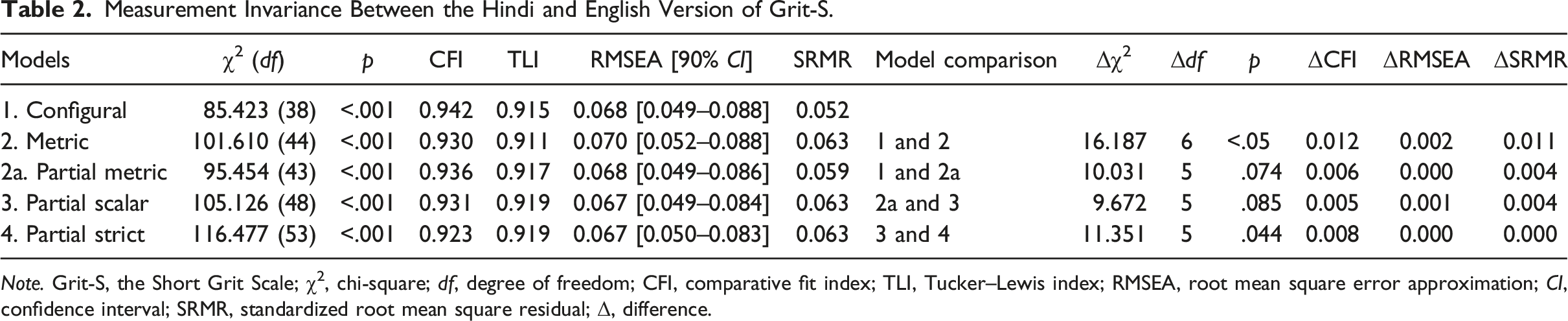
Note. Grit-S, the Short Grit Scale; χ2, chi-square; df, degree of freedom; CFI, comparative fit index; TLI, Tucker–Lewis index; RMSEA, root mean square error approximation; CI, confidence interval; SRMR, standardized root mean square residual; Δ, difference.
Descriptive Statistics and Correlation Coefficients for the Grit-SH Dimensions, SS, and WB.

Note. CoI, consistency of interest; PoE, perseverance of efforts; SS, student satisfaction; WB, well-being.
***p < .001.
Discussion
The present study developed the Hindi version of Grit-S and investigated its within-network and between-network construct validity among Indian adolescents. Results regarding within-network validity indicated that the two-dimensional structure of Grit-SH was applicable among Indian adolescents, partially strict invariant against its English version, and demonstrated good internal consistency reliability. A significantly positive correlation between the dimensions of grit and student satisfaction, as well as well-being, suggested the presence of between-network construct validity.
The CFA results provided valuable insights into the underlying structure of grit as assessed by the Grit-SH scale. The findings indicated that the two-dimensional structure of grit, incorporating PoE and CoI, offered a superior fit to the data compared to the unidimensional structure. This outcome suggests that grit may not be adequately captured by a single overarching dimension but rather manifests as a two-dimensional construct encompassing PoE and CoI. These findings are consistent with prior research conducted in other collectivist contexts (Bae et al., 2024). The identification of PoE and CoI as two dimensions of grit implies that individuals can exhibit varying levels of perseverance and passion for long-term goals independently of each other. This has important implications for both research and practice. By recognizing and addressing these dimensions, interventions aimed at enhancing grit can be tailored to target specific aspects of an individual’s grit profile. Such targeted interventions may yield more effective strategies for facilitating goal achievement.
Further, we tested four levels of measurement invariance between the English and Hindi versions. Configural invariance, pertaining to equivalent factor structure, indicated that the Grit-S has a two-dimensional structure for both English and Hindi versions. Metric invariance, which tests the equivalency of factor loadings, demonstrated that except for one item, participants interpreted the items in the same way. The non-invariant item was less than 20%, so we accepted the metric invariance (Dimitrov, 2010). The result from configural and metric invariance implies that participants conceptualized the grit construct similarly, and the Grit items functioned similarly whether presented in English or Hindi (Putnick & Bornstein, 2016). Since our test supported partial metric invariance, we proceeded to test scalar invariance, which examines the equivalency of item intercepts. Except for one item intercept, results from scalar invariance indicated all items were equivalent. We further tested partial strict measurement invariance, which was achieved after releasing two non-invariant residuals. Previous studies have established that a valid comparison of latent means can be made when scalar invariance is achieved, especially when the proportion of non-invariant items in the scale is minimal (Dimitrov, 2010). Overall, these results suggest that the participants conceptualized the grit construct similarly; the Grit-SH items functioned similarly to their English version and had equivalent levels of the underlying items, suggesting the newly developed Grit-SH is equivalent to its English version (Putnick & Bornstein, 2016). However, full strict MI was not achieved, indicating the unequal measurement error distribution between the two versions (Vandenberg & Lance, 2000). The possible cause for the non-invariant items could have stemmed from the unequal sample size from sample 1 and sample 2 (Chen, 2007).
Moreover, results from the McDonald’s omega indicated that both the PoE and CoI dimensions were internally consistent and reliable. Finally, the PoE and CoI dimensions of Grit were positively correlated with student satisfaction and well-being among adolescents, aligning with previous studies (Bowman et al., 2015; Datu et al., 2016a). This finding not only underscores the importance of grit in promoting positive outcomes but also provides evidence for the presence of between-network construct validity. The significant positive associations between the grit dimensions and indicators of student satisfaction and well-being suggest that individuals who demonstrate higher levels of consistency and perseverance are likely to experience greater satisfaction and well-being in their academic and personal lives.
The present study represents a notable advancement in the validation of the two-dimensional structure of Grit-S within the Indian collectivist context. First, it provides a valid and reliable tool to assess grit in Hindi. Whereas previous research has contributed to its validation among Indian adults (Singh et al., 2018), this study uniquely focuses on adolescents, thus broadening our understanding of the applicability of the Grit-S across different age groups within the Indian population. Additionally, this is the first study that tested the measurement invariance of Grit-S across English and Hindi versions, the two languages used by many Indians. The present findings offer additional evidence to support the validity of Grit-S in the Indian collectivist context, including its application across Hindi and English versions.
Whereas our study offers promising contributions to the Grit literature, it also has some limitations. First, all the measures used in this study were based on self-reporting which may introduce common method bias and limit the application of multitrait-multimethod analyses for assessing the construct validity of the Grit-SH. Future studies can include cross-informant approaches (e.g., parent and teacher reporting) to address these methodological shortcomings. Second, given that participants’ performance in their school subjects was not assessed in the present study, no conclusion regarding the criterion validity of the Grit-SH can be drawn. Future studies can assess the impact of grit on students’ academic performance using the Grit-SH. Similarly, the discriminant validity of the Grit-SH was not established; future studies can use external criteria such as the correlation between school procrastination and grit to establish the discriminant validity of the scale. Third, the study involved cross-sectional data, and changes among participants over time could not be accounted for. Therefore, test–retest reliability and measurement invariance over time could not be tested. Future studies can use a longitudinal design to assess the changes in the levels of grit across time among adolescents. Fourth, adolescents were recruited from a specific cultural context using a convenience sampling approach, which limits the generalizability of the present findings to broader populations across diverse age groups and cultural backgrounds. Future studies may recruit children and adult samples to ensure a more comprehensive representation of the population. Finally, previous research suggested that the factor structure of grit could vary between the Western individualistic and non-Western collectivistic contexts (Datu et al., 2016a). For example, individualist cultures emphasize self-determined goals, whereas collectivist cultures prioritize group harmony and communal objectives over individual aspirations (Hofstede, 2001). Because individuals in collectivist cultures tend to set goals that adapt with significant others, Datu et al. (2016b) introduced a triarchic model of grit, including adaptability to situations as an additional dimension. Although the current study endorsed the two-dimensional model of grit, given the influence of collectivist culture in India (Verma & Triandis, 2000), future research could compare the traditional two-factor model with the newer triarchic model to determine which better applies to the Indian cultural context.
In general, the results indicate that the Grit-SH is a reliable and valid instrument. The findings have implications for the researchers and school psychologists who may use the Grit-SH to evaluate the consistency and perseverance of adolescents for their long-term goals, depending on their needs and the context.
Supplemental Material
Supplemental Material - Evaluating Within-Network and Between-Network Construct Validity of the Hindi Version of the Grit-Short Scale Among Indian Adolescents
Supplemental Material for Evaluating Within-Network and Between-Network Construct Validity of the Hindi Version of the Grit-Short Scale Among Indian Adolescents by Usama Ghayas Syed, and Shikha Dixit in Journal of Psychoeducational Assessment.
Footnotes
Declaration of Conflicting Interests
The author(s) declared no potential conflicts of interest with respect to the research, authorship, and/or publication of this article.
Funding
The author(s) received no financial support for the research, authorship, and/or publication of this article.
Author’s Note
The present study reports partial research work conducted as part of the corresponding author’s ongoing PhD research.

Supplemental Material
Supplemental material for this article is available online.
References
Supplementary Material
Please find the following supplemental material available below.
For Open Access articles published under a Creative Commons License, all supplemental material carries the same license as the article it is associated with.
For non-Open Access articles published, all supplemental material carries a non-exclusive license, and permission requests for re-use of supplemental material or any part of supplemental material shall be sent directly to the copyright owner as specified in the copyright notice associated with the article.
