



Abstract

This edited collection is the latest addition to the growing number of comparative civil service texts. Generally, the contributions in this volume emphasize the political nature of personnel management in government and provide basic descriptions of civil service systems, structure, and recent history. Many chapters are informative and can be used for readings in many types of courses. However, there are shortcomings to this volume. First, the collection lacks an organizing theme. There is no central argument around which the contributors focus their contributions. Second, there is no argument on how this book differentiates from other recent comparative civil service collections. This leaves the reader wondering why this book should be chosen over others, or how it may fill gaps left by other scholars. Overall, this book would be useful to have in a library to use the occasional chapter, but I question its utility as a required course text.
This edited collection is divided into two sections: the first focusing on current theoretical debates in public personnel management, and the second focusing on ten country-specific reports. Among the theory chapters, three stand out. Peter Barberis’s chapter titled The Weberian Legacy is a well-argued and clearly written contribution that creates an arch between the classic tenants of Weber’s ideal type bureaucracy, civil service management, and trends toward performance-focused managerialism. This chapter should be paired with the reading of Weber’s Bureaucracy in master’s and doctoral courses because it provides a good explanation of the ideal type and brings it to its modern application. Next, Sylvia Horton’s chapter contrasting types of civil service systems provides a useful comparison of Anglo-American and Continental European civil service systems. In comparing the different approaches, Horton considers administrative history, law, differences in hiring and promotion practices, and the interface between civil servants and politicians. This chapter would be useful in a basic public personnel course where there is limited space for international comparisons, and in a more general comparative public management course. Third, the chapter by John Halligan, Fiona Buick, and Janine O’Flynn provides a clear and useful description of different approaches to governance structures pursued by Australia, Canada, New Zealand, and the United Kingdom. These governance approaches to improve coordination of policy may be of less interest to American personnel scholars, and the discussion is not exclusively about public personnel management. Despite this, it does establish the complexity of the environment in which civil servants now work. This chapter serves as a good “cheat sheet” for understanding the differences among joined-up, whole-of-government, and horizontal approaches.
The remainder of the book is composed of ten chapters focused on twelve countries (see Table 1). Chapters generally provide useful, interesting information and are well-organized. I learned something new in all of the selections. The description of public personnel management in Japan and China and the impact of single party politics on the relationship between civil servants and politicians were particularly interesting. Furthermore, the description of systems in the United Kingdom, India, Australia, Kenya, Tanzania, and Uganda started with descriptions of their common administrative histories, and then proceeded to describe their very different paths due to different (recent) political trajectories. The chapter on Argentina reminded me of the Nixon administration’s Malek Manual. Multiple chapters discussed the impact of World Bank and International Monetary Fund requirements on the number of civil servants and remuneration policy. Furthermore, a number of chapters described the evolving relationships among civil servants, politicians, and political appointees.
Countries Covered in Comparative Personnel Texts.
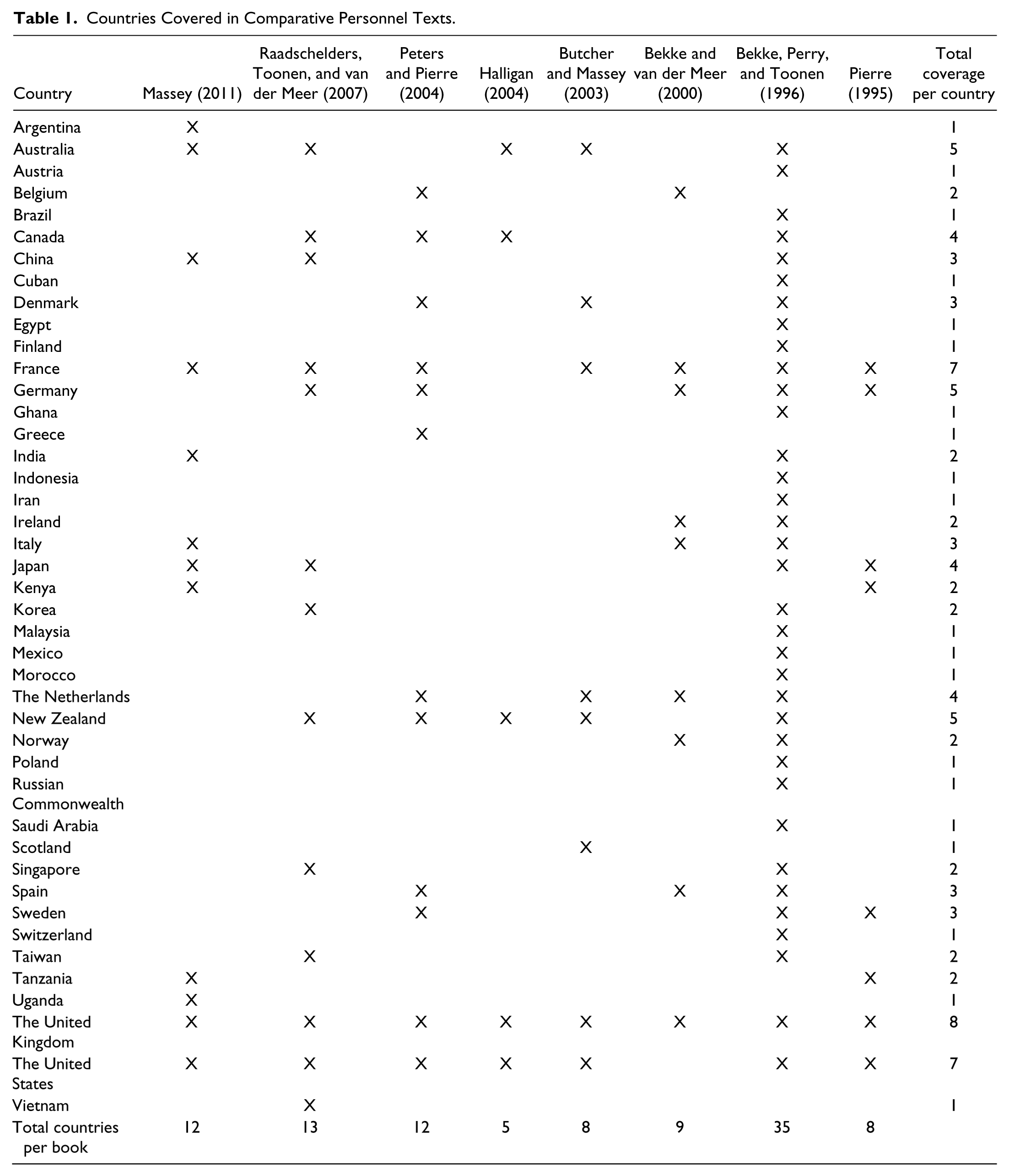
The two weakest chapters of the group centered on Kenya, Tanzania, and Uganda (covered in one chapter), and the United States. In the case of the former, the descriptions of the structures of the three state systems read as though they were taken, with minimal editing, from a web page, legislation, or regulatory handbook, and lacked a robust discussion of politics surrounding personnel management. This left the reader wondering how things actually worked, and lacked the rich narrative of the other chapters. Given the minimal amount of scholarship on civil service systems on the African continent, the weakness of this chapter was particularly disappointing. The chapter on the American civil service was long on history and short on current policy debates. In fact, the discussion of policy debates over the last two decades was weak and inadequate. A reader interested in current debates on civil service policy in the United States would be better served by skimming the last decade of abstracts in the Review of Public Personnel Administration. A more up-to-date chapter would have focused on some of the following: the failure of reforms in the Departments of Homeland Security and Defense, debates over union rights at the federal and state level, changes to the hiring process at the federal level including the repeal of the rule-of-three, and so on.
When examining the collection as a whole, other shortcomings emerge. First, this collection of essays lacks a unifying theme. It is not clear that the editor and contributors are trying to make a particular argument or highlight one topic for comparison across the countries studied. In the first chapter, written by the editor, there is a brief consideration on how the concept of civil servant is defined. Unfortunately, the manner in which this question is raised is not very interesting. Furthermore, the authors of the country-specific chapters covered this question in a minimal, uninteresting, unengaged manner. There was no discussion, for example, on whether we should consider employees of British quangos, non-departmental executive agencies, or New York’s public authorities as civil servants. These organizations are created by government, act on behalf of government, but frequently operate outside of traditional civil service rules. Should we consider government contractors as civil servants? Government funds their pay checks, they act on behalf of government, but different labor law generally applies. “Who is a civil servant” is only an interesting question when we extend it to our new governance environment—a discussion the text failed to raise.
Second, it is not obvious how this edited collection improves what we already know from other comparative personnel texts. All of the countries covered in this text, except for Tanzania, have been included in previous collections (see Table 1). The chapters update reform discussions with recent politics, but these are quickly outdated, and greater trends are covered in other comparative personnel texts more effectively. Furthermore, this collection does not seek to suggest or improve methods for conducting empirical comparative civil service research.
A minor criticism must also be levied. Multiple chapters were in need of significant proof-reading. Many book and journal publishers are reducing their proof-reading capacity to save money and speed time to print. It is unfortunate and frustrating that publishers who invest in manuscripts are not willing to ensure the manuscripts are readable.
Overall, the parts of this edited collection are better than the whole. Scholars will likely find a useful chapter here and there to enhance course reading lists or to inform research. As a result, it is worth having this volume in major university libraries. However, the text as a whole lacks a unifying theme that advances comparative personnel scholarship. It is difficult to foresee circumstances in which the majority of the book would be useful as required reading in a course. This book is only available in hardback; given the excessive price of more than $150, it is not worth purchasing for your individual library.
Footnotes
Acknowledgements
I wish to thank my research assistant Ashley Davis-Alteri for her assistance on this review.